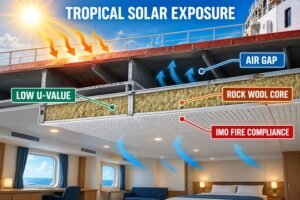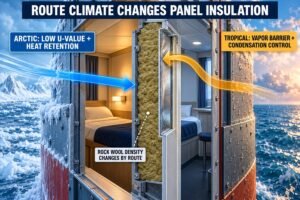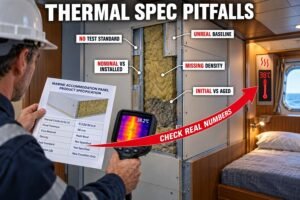
Land panels look cheap, but using them on ships causes quick failures and major safety risks. Need a fix? Let us explore why marine panels are the only safe choice.
Standard building panels cannot be used onboard ships because they fail to meet the mandatory SOLAS regulations for fire resistance, cannot withstand constant vessel vibration, lack the necessary moisture and salt corrosion defenses, and exceed strict maritime weight limits. Marine panels are engineered specifically for these four extreme conditions.
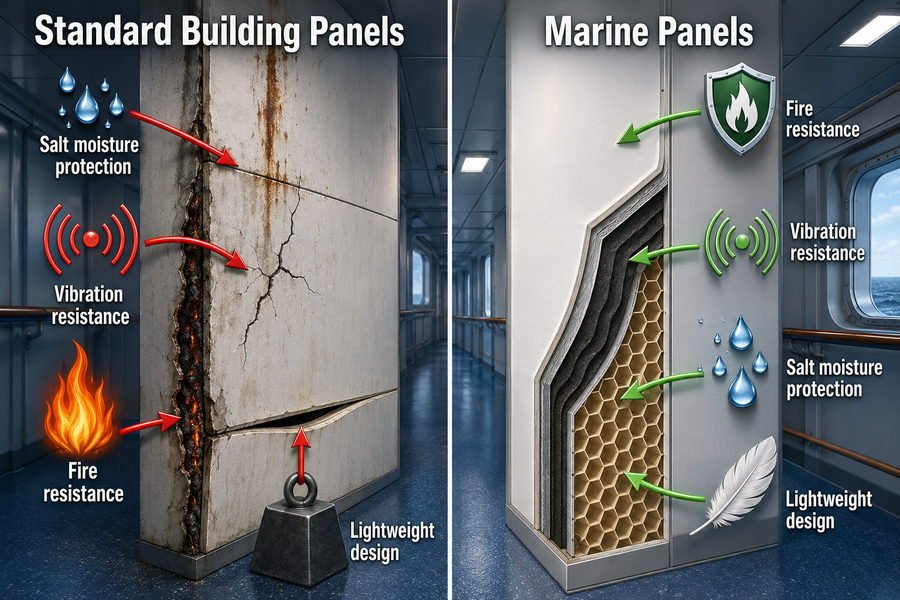
You might think drywall is good enough for a cabin interior. But when you are at sea, the environment changes completely. We must build walls that protect lives, survive storms, and pass tough shipyard inspections.
How Do Marine Accommodation Panels Structurally Differ From Architectural Drywall?
Ordinary drywall crumbles under stress, causing delays and lost money. Want a panel that lasts? Let us see how marine panels are built completely differently.
Marine accommodation panels differ from architectural drywall in three main ways: their core uses high-density rock wool (100-120 kg/m³) instead of gypsum, their surface is galvanized steel (0.6mm thick) instead of paper, and they use male-female joint locks instead of taped seams.
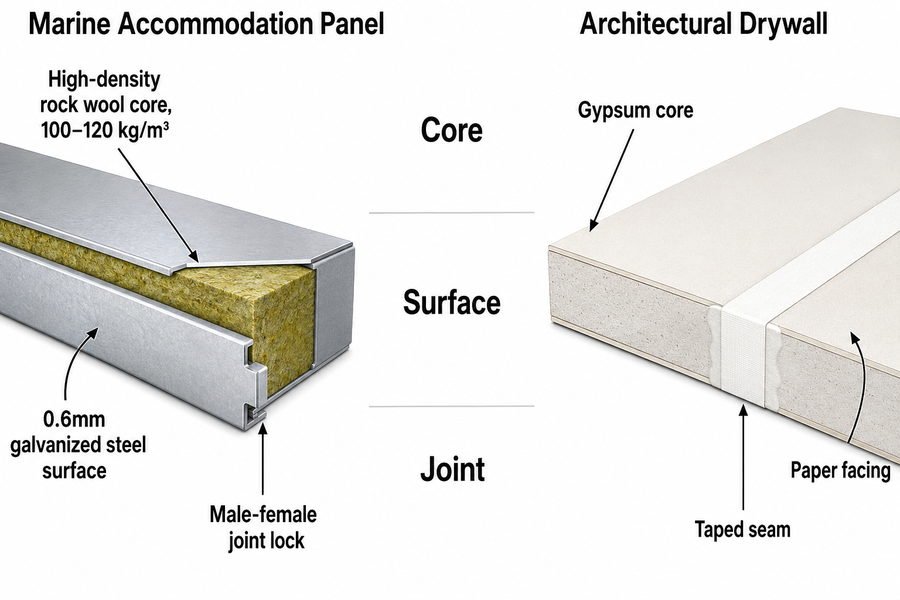
When I first started working as an employee in a marine outfitting factory, I saw buyers try to save money with standard walls. The results were bad. The structural differences between land materials and sea materials are huge. Let us look at the three main differences in detail.
Core Material Differences Between Marine Panels and Drywall
First, we look at the core. Standard architectural drywall uses a gypsum core.1 Gypsum is hard but very brittle. If you hit it, it breaks. In marine accommodation panels, we use high-density rock wool. According to marine factory production standards, we use a density of 120 kg/m³ for B-15 class panels2. This rock wool does not break when you hit it. It absorbs the impact. Standard gypsum boards cost about $3 to $5 per square meter. But a 50mm thick marine rock wool panel costs $18 to $25 per square meter from a good supplier in Asia. You pay more, but you get a core that survives the ocean.
Surface Protection and Joint Connections in Marine Panels
Second, we look at the surface. Drywall has paper on the outside. Paper tears easily and gets soft when wet. Marine panels use a galvanized steel skin. We use a steel sheet that is 0.6mm thick. This steel gives the panel extreme strength. To make it look nice, we press a PVC laminate film onto the steel. This PVC film is usually 150 microns thick. It resists scratches.
Third, we look at the joints. In a house, builders connect drywall with paper tape and joint compound. This is very slow. On a ship, tape will crack in one week because the ship moves3. Marine panels use male-female joint locks. The edge of one panel slides directly into the edge of the next panel. You do not need tape. You do not need glue. You just push them together. This locking design makes the wall solid and cuts installation time by 50%4.
| Feature | Architectural Drywall | Marine Accommodation Panel |
|---|---|---|
| Core Material | Gypsum block | High-density rock wool (120 kg/m³) |
| Surface Skin | Craft paper | 0.6mm Galvanized steel + PVC film |
| Panel Connection | Paper tape and wet compound | Interlocking male-female edges |
| Installation Speed | Slow (needs drying time) | Fast (snap and lock) |
Why Do Marine Accommodation Panels Need Stricter Fire Ratings Than Land-Based Panels?
A fire at sea is a nightmare. Land panels burn fast, trapping crews on the ship. How do marine panels stop this? Here is the truth about marine fire ratings.
Marine accommodation panels require stricter fire ratings because escape is impossible at sea. They must meet SOLAS A-Class (A-60, A-30, A-15, A-0) or B-Class (B-15, B-0) standards, stopping fire spread for 30 to 60 minutes and limiting unexposed side temperature rises to 140°C.
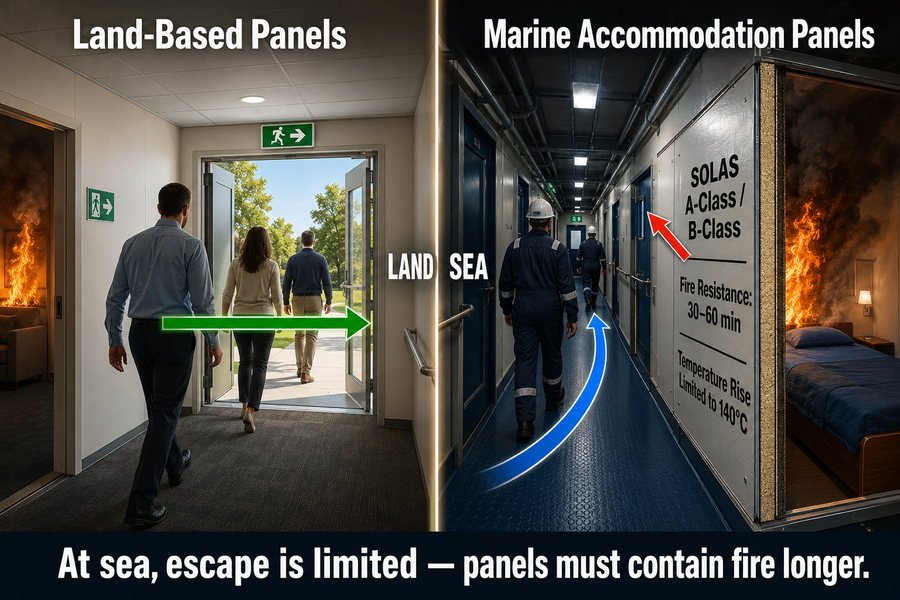
You can run outside if a house catches fire. You cannot run outside in the middle of the ocean. This simple fact is why the International Maritime Organization (IMO) created the Safety of Life at Sea (SOLAS) rules5. I have helped many buyers understand these rules so their ships do not fail port inspections. We must build walls that keep the fire in one room.
Understanding SOLAS A-Class and B-Class Fire Ratings for Ships
SOLAS divides fire ratings into A-Class and B-Class6. A-Class panels go into high-risk areas. These areas include engine rooms and main escape routes. An A-60 panel must stop flames and smoke from passing through for 60 minutes. An A-15 panel must do the same but the temperature limit applies for 15 minutes.
B-Class panels go into standard cabin partitions. A B-15 panel must stop flames for 30 minutes. It must also stop the heat from spreading for 15 minutes.7 You cannot use land panels here. Standard wood or drywall will burn or collapse in less than 10 minutes. When you buy B-15 marine panels from a factory in China, expect to pay around $20 per square meter. A-60 panels are thicker and heavier, costing around $40 to $50 per square meter.
The 140°C Temperature Rise Limit on the Unexposed Side
Stopping flames is not enough. Heat can kill. SOLAS requires that the unexposed side of the panel (the safe side) must not rise more than 140°C above the starting temperature8. If the fire is 900°C on one side, the other side must stay cool enough to touch. If the temperature goes above 140°C, paint on the safe side can catch fire. Marine panels use the 120 kg/m³ rock wool core to trap this heat. Standard building panels do not have this thermal block, so heat travels straight through them.
| SOLAS Rating | Flame Stop Time | Heat Limit Time (Max 140°C rise) | Typical Usage Area |
|---|---|---|---|
| A-60 | 60 Minutes | 60 Minutes | Engine rooms, main bulkheads |
| A-15 | 60 Minutes | 15 Minutes | Hallways near stairs |
| B-15 | 30 Minutes | 15 Minutes | Cabin walls and doors |
| B-0 | 30 Minutes | 0 Minutes | Small storage lockers |
How Does Vessel Vibration Reshape Accommodation Panel Construction?
Ship engines cause non-stop shaking. Normal walls crack, leaving you with angry shipyard bosses. How do we build panels that survive? Let us look at vibration resistance.
Vessel vibration reshapes accommodation panel construction by forcing the use of three key upgrades: steel skins for tensile strength, rigid lock-joint edge profiles that prevent seam separation, and specialized U-channel floor tracks with rubber dampening strips to absorb engine frequencies from 1 Hz to 50 Hz.
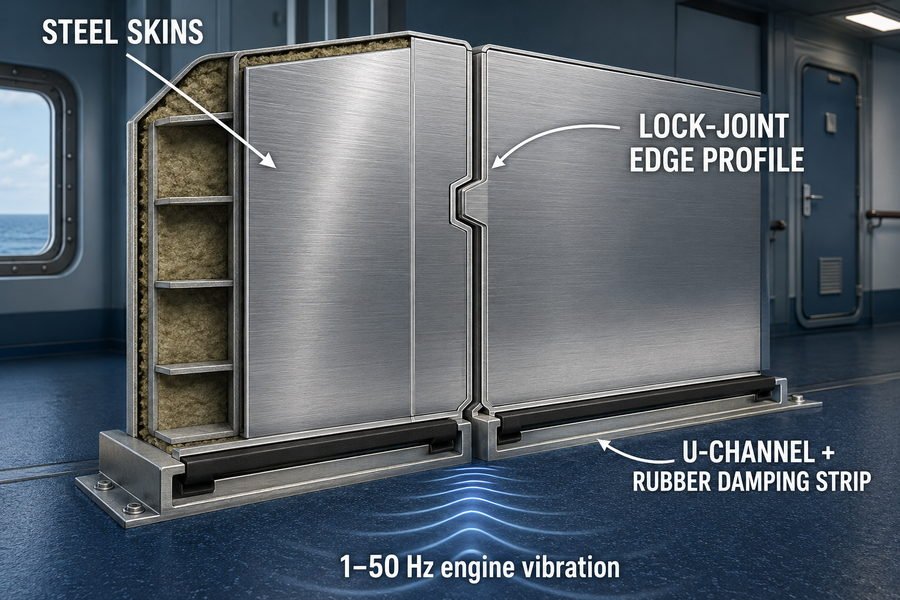
A ship engine produces massive energy. This energy travels through the steel hull and enters the cabin walls.9 Normal land walls are static. They sit on solid earth. Marine walls must be dynamic. If you use standard building panels, the engine vibration will destroy them in one month. I have seen interior decoration companies lose thousands of dollars replacing cracked walls because they ignored vibration. We must use three specific construction upgrades to solve this.
Combating Hull Vibration with Lock-Joint Edge Profiles and Steel Skins
First, we use steel skins. Drywall bends and snaps under constant shaking. The 0.6mm galvanized steel skins on marine panels give the wall high tensile strength. It bends slightly but does not break. Second, the rigid lock-joint edge profiles keep the walls together. When a ship hits a wave, the hull twists.10 If walls are screwed together like land panels, the screws rip out of the material. The male-female lock joints allow the panels to flex together. They shift just a fraction of a millimeter without pulling apart. This prevents seam separation entirely.
Using U-Channel Floor Tracks and Rubber Dampening Strips
The third upgrade happens at the floor. We never put marine panels directly on the bare steel deck. Engine vibrations operate at frequencies between 1 Hz and 50 Hz.11 If the panel touches the deck, it will vibrate, creating a loud humming noise in the cabin. We install specialized steel U-channel floor tracks. Inside these tracks, we place rubber dampening strips. These rubber strips are usually 3mm to 5mm thick. The panel sits on the rubber. The rubber absorbs the 1 Hz to 50 Hz engine frequencies. This stops the vibration from entering the wall and keeps the cabin quiet.
| Vibration Defense Component | Function on the Ship | Standard Land Equivalent |
|---|---|---|
| 0.6mm Galvanized Steel Skin | Provides tensile strength to prevent snapping | Brittle paper or plaster |
| Male-Female Lock Joints | Prevents seam separation when hull twists | Hard screws and wet compound |
| U-Channel Floor Tracks | Holds panel securely in place | Simple wood floor plates |
| 3mm Rubber Dampening Strips | Absorbs 1 Hz to 50 Hz engine vibrations | None (direct floor contact) |
Why Is Weight Control Critical For Marine Accommodation Panels?
Heavy panels sink your fuel efficiency and ruin ship stability. Want to cut operational costs? Here is why strict weight control is mandatory for marine panels.
Weight control is critical for marine accommodation panels to maintain vessel stability, reduce fuel consumption, and increase cargo capacity. Marine panels typically weigh between 14 kg/m² to 20 kg/m², which is 30% to 50% lighter than standard cement boards or heavy drywall systems of the same thickness.
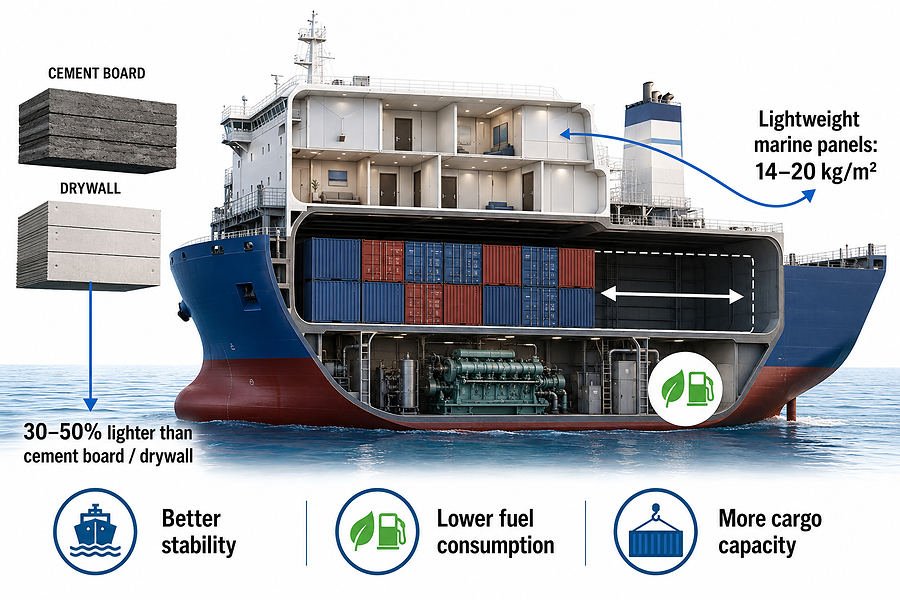
Every extra kilogram on a ship costs money. Shipowners count every ton. When interior decoration companies buy materials, they often forget about the total weight. I always tell my clients to calculate the total square meters before they buy. Weight control changes the entire design of a ship. Let us break down why we must keep panels between 14 kg/m² and 20 kg/m².
The Impact of Panel Weight on Vessel Stability and Cargo Capacity
A large passenger ship or a commercial vessel needs thousands of square meters of interior walls. Let us look at the math. A medium-sized vessel might need 5,000 square meters of partition walls. If you use standard land-based cement boards, they weigh around 30 kg/m². The total wall weight is 150 tons.
If you use high-quality marine rock wool panels weighing 16 kg/m², the total wall weight drops to 80 tons. You save 70 tons. This is a 46% weight reduction. You can use those 70 tons to carry more paying cargo. Also, walls are built high up on the ship above the waterline. If the top of the ship is too heavy, the vessel loses stability12. It rolls too much in the waves. Lightweight marine panels keep the center of gravity low, making the ship safer in a storm.
Fuel Consumption Savings from Lightweight Marine Panels
Weight directly connects to fuel burn13. Heavy ships need more engine power to push through the water. Marine fuel is expensive. The current price of Very Low Sulfur Fuel Oil (VLSFO) is around $600 per ton14. If your ship carries 70 extra tons of useless heavy walls, the engine works harder every single day. Over a year, this burns thousands of extra dollars in fuel. By paying slightly more for lightweight 16 kg/m² marine panels during the outfitting phase, the shipowner saves massive amounts of money on fuel over the 25-year life of the vessel15.
| Material Type (50mm Thick) | Average Weight per Square Meter | Total Weight for 5,000 m² Project |
|---|---|---|
| Standard Cement Board | 30 kg/m² | 150 Tons |
| Heavy Acoustic Drywall | 25 kg/m² | 125 Tons |
| Marine Panel (B-15 Rating) | 16 kg/m² | 80 Tons |
| Marine Panel (A-60 Rating) | 20 kg/m² | 100 Tons |
Do Gypsum Or MDF Panels Meet SOLAS Requirements For Ship Accommodation?
Buyers often ask if cheap MDF can work. The answer is harsh, and making the wrong choice fails inspections. Let us expose the truth about MDF and gypsum.
Gypsum and MDF panels absolutely do not meet SOLAS requirements for ship accommodation. They fail the non-combustibility test (FTP Code Part 1), release toxic smoke (FTP Code Part 2), and completely lose structural integrity within 10 minutes of fire exposure, meaning marine surveyors will reject the vessel immediately.
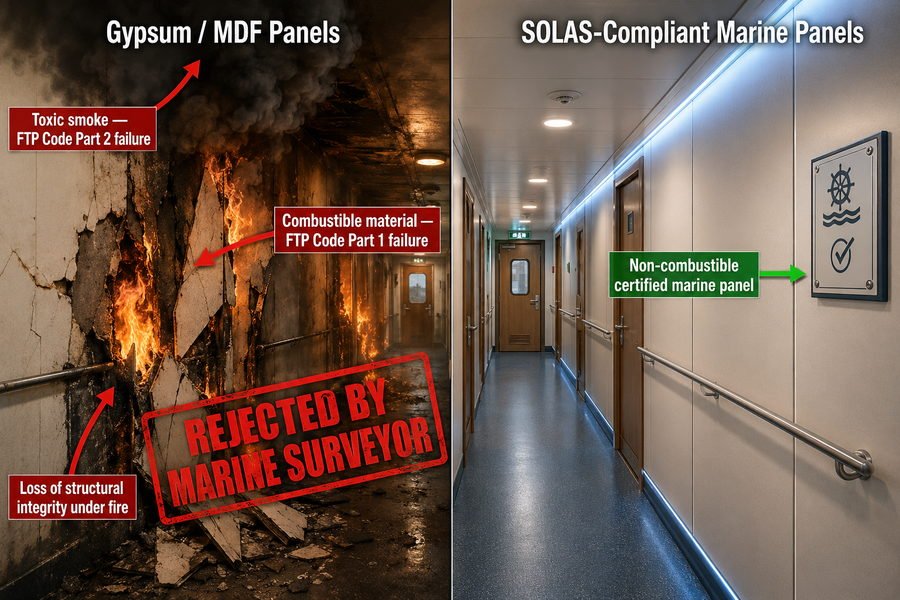
I receive many emails from procurement officers asking if they can just use MDF (Medium Density Fiberboard) to save money. A standard MDF panel costs about $6 per square meter. It is very cheap. But my answer is always no. If you put MDF or regular gypsum on a commercial ship, the marine surveyor will fail the ship16. You will have to tear out all the walls and buy marine panels anyway. Here are the specific tests these cheap boards fail.
Why Gypsum and MDF Fail the SOLAS Non-Combustibility Test
The IMO Fire Test Procedures (FTP) Code governs all ship materials. FTP Code Part 1 tests non-combustibility. They put the material in a 750°C furnace17. To pass, the material must not burn, and it must not add heat to the furnace. MDF is made of wood fibers and glue. It burns violently in this test. Gypsum has paper on the outside. The paper burns instantly. When the core of regular gypsum gets hot, the water inside boils, and the board cracks. Standard marine rock wool passes this test easily because stone fibers do not burn.
The Dangers of Toxic Smoke and Rapid Structural Failure
FTP Code Part 2 tests smoke and toxicity. This is where MDF is the most dangerous. MDF contains urea-formaldehyde resins. When MDF burns, it releases thick, black, toxic smoke containing cyanide gas18. In a ship cabin, this smoke kills the crew before the flames even reach them. Gypsum also drops burning paper and creates thick smoke.
Furthermore, both materials fail the structural test. If a fire starts, an MDF board or a gypsum board will completely lose its shape and collapse within 10 minutes. A B-15 marine panel stands strong for at least 30 minutes19. If the surveyor sees MDF, they know the ship is a death trap, and they will reject the vessel immediately.
| Test Parameter | MDF Panel | Gypsum Board | Approved Marine Panel |
|---|---|---|---|
| FTP Code Part 1 (Combustibility) | Fails (Burns rapidly) | Fails (Paper burns, core cracks) | Passes (Non-combustible) |
| FTP Code Part 2 (Smoke Toxicity) | Fails (Releases cyanide gas) | Fails (Heavy smoke) | Passes (No toxic smoke) |
| Structural Integrity in Fire | Fails in 10 minutes | Fails in 10 minutes | Holds for 30-60 minutes |
| Surveyor Approval | Rejected | Rejected | Approved |
Which Humidity And Salt Risks Disqualify Building Panels From Marine Accommodation Use?
Saltwater rusts metal, and high sea humidity breeds mold quickly. Regular boards rot in weeks. How do we stop this? Let us review the marine climate dangers.
Building panels are disqualified from marine accommodation because they succumb to 80-100% relative humidity and continuous salt spray. These risks cause paper-faced drywall to grow toxic black mold, MDF to swell by 20% in thickness, and untreated steel to rust, making hot-dip galvanized marine panels essential.
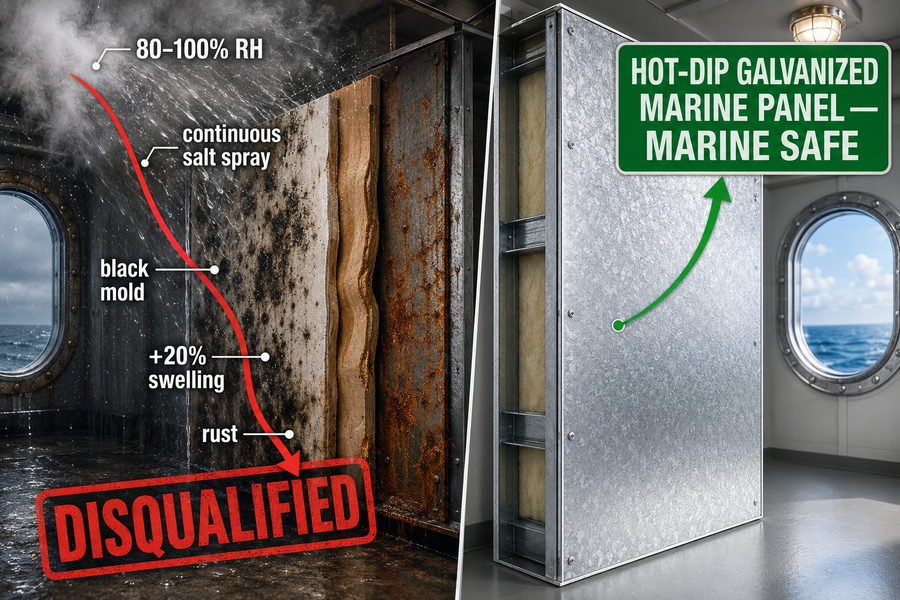
The ocean is a very aggressive environment. The air over the sea is basically a salty, wet fog. I have seen land-based doors and walls installed on ships by mistake. Within three months, they looked like they were fifty years old. The water and salt attack everything. We must build panels that fight back against these specific natural risks.
Black Mold on Drywall and Severe Swelling of MDF Boards
Let us discuss humidity. The air at sea often reaches 80% to 100% relative humidity20. Standard drywall uses craft paper on its face. Paper absorbs water from the air very fast. Once the paper is wet, it becomes food for toxic black mold21. Within a few weeks, black spots cover the walls. This ruins the cabin and makes the crew sick.
MDF is even worse. MDF acts like a dry sponge. When you put MDF in 90% humidity, it sucks the moisture out of the air. The wood fibers expand. A 15mm thick MDF panel will swell by 20%22. It will grow to 18mm thick. This swelling breaks the joints and ruins the paint. Marine panels use steel and rock wool. Neither material absorbs water. Therefore, mold cannot grow, and the panel never changes size.
Preventing Rust with Hot-Dip Galvanized Marine Panels
Next, we face the salt spray. Salt acts as a catalyst for rust. If you use standard cold-rolled steel or untreated iron for your wall tracks or panel skins, the salt air will cause severe rust in a matter of days. To stop this, marine panel skins are made of hot-dip galvanized steel.
The factory coats the steel with a heavy zinc layer. We usually require a zinc coating of at least Z120 (which means 120 grams of zinc per square meter). This zinc sacrifices itself to protect the steel underneath23. On top of the zinc, we add the PVC laminate layer. This creates a double barrier. The salt never touches the raw steel. Standard building panels do not have this zinc and PVC protection, which completely disqualifies them from marine use.
| Material Risk Factor | Effect on Building Panels | Marine Panel Solution |
|---|---|---|
| 80-100% Humidity | Drywall grows black mold; MDF swells 20% | Steel and rock wool do not absorb water |
| Continuous Salt Spray | Untreated steel tracks rust in weeks | Hot-dip galvanized steel (Z120 coating) |
| Condensation Inside Walls | Wood rots and loses strength | Rock wool core allows airflow without rotting |
Conclusion
Standard building panels belong on land. Marine panels solve strict fire, weight, vibration, and salt challenges. Choosing the right marine panels keeps your ship safe, compliant, and cost-effective.
-
"Drywall - Wikipedia", https://en.wikipedia.org/wiki/Drywall. A neutral building-materials reference supports that conventional drywall, or gypsum board, is manufactured with a gypsum-based core faced with paper or similar liners. Evidence role: definition; source type: encyclopedia. Supports: Standard architectural drywall uses a gypsum core.. ↩
-
"What are the essential technical specifications to include in a marine ...", https://magellanmarinetech.com/what-are-essential-technical-specifications-include-in-marine-wall-panel-rfq/. A classification-society or type-approval document for B-15 accommodation panels can support that some certified marine panels use mineral wool cores with specified densities near 120 kg/m³; this would document an approved construction rather than prove that 120 kg/m³ is a universal B-15 requirement. Evidence role: case_reference; source type: institution. Supports: Marine factory production standards use a density of 120 kg/m³ for B-15 class panels.. Scope note: B-15 fire classification is performance-based, so density may vary by approved panel design. ↩
-
"[PDF] guidelines on fatigue module 5 fatigue and ship design 1", https://downloads.regulations.gov/USCG-2016-0782-0005/attachment_9.pdf. Marine vibration and ship-motion research supports the mechanism that shipboard structures and interior fittings are exposed to cyclic movement and vibration; it does not by itself verify the specific claim that taped drywall joints crack within one week. Evidence role: mechanism; source type: paper. Supports: Drywall tape joints are vulnerable on ships because vessel movement can stress interior partitions.. Scope note: The one-week failure timeline would require direct testing or field data for taped drywall joints on vessels. ↩
-
"[PDF] Panelization: A Step Toward Increased Efficiency in Homebuilding", https://www.huduser.gov/portal/periodicals/cityscpe/vol23num3/ch15.pdf. A construction productivity study on prefabricated or interlocking panel systems can support that factory-made panelized assemblies reduce installation labor or duration compared with wet-applied jointing methods; unless the study measures the same marine panel system, the 50% figure remains contextual rather than directly proven. Evidence role: statistic; source type: paper. Supports: Interlocking marine wall panels can substantially reduce installation time compared with taped-and-compounded drywall.. Scope note: The percentage reduction may depend on project type, crew experience, and the exact panel system tested. ↩
-
"International Convention for the Safety of Life at Sea (SOLAS), 1974", https://www.imo.org/en/about/conventions/pages/international-convention-for-the-safety-of-life-at-sea-(solas),-1974.aspx. The IMO’s SOLAS overview explains that the current SOLAS Convention is an IMO-administered international treaty setting minimum safety standards for the construction, equipment, and operation of ships. Evidence role: historical_context; source type: institution. Supports: IMO is the international body responsible for the current SOLAS safety rules for ships.. Scope note: This supports IMO’s present role in SOLAS but the wording should note that the first SOLAS convention predates the IMO. ↩
-
"Summary of SOLAS chapter II-2 - International Maritime Organization", https://www.imo.org/en/ourwork/safety/pages/summaryofsolaschapterii-2-default.aspx. SOLAS Chapter II-2 and the IMO Fire Test Procedures framework define fire-resisting divisions by classes, including A-class and B-class divisions, with specified fire-test and insulation criteria. Evidence role: definition; source type: institution. Supports: SOLAS fire protection rules classify ship divisions using A-class and B-class fire ratings.. Scope note: The source defines regulatory classes; it does not verify any particular manufacturer’s panel. ↩
-
"[PDF] recommendation for fire test procedures for “a” and “b” class ...", https://wwwcdn.imo.org/localresources/en/KnowledgeCentre/IndexofIMOResolutions/AssemblyDocuments/A.163(ES.IV).pdf. SOLAS definitions for B-class divisions require prevention of flame passage for the first half hour of the standard fire test, while the B-15 designation indicates that the insulation-temperature criterion is maintained for 15 minutes. Evidence role: definition; source type: institution. Supports: A B-15 marine panel is defined by a 30-minute flame-passage criterion and a 15-minute insulation criterion.. Scope note: This supports the regulatory rating definition, not the compliance of a specific product unless it has valid type approval or test certification. ↩
-
"[PDF] RESOLUTION MSC.307(88) (adopted on 3 December 2010 ...", https://wwwcdn.imo.org/localresources/en/KnowledgeCentre/IndexofIMOResolutions/MSCResolutions/MSC.307(88).pdf. SOLAS fire-division definitions specify an insulation criterion in which the average temperature rise on the unexposed side must not exceed 140°C above the original temperature during the relevant rated period. Evidence role: mechanism; source type: institution. Supports: SOLAS fire-rated divisions use a 140°C average unexposed-side temperature-rise limit.. Scope note: The criterion is a laboratory test requirement and does not by itself prove the temperature of every installed panel during an actual shipboard fire. ↩
-
"[PDF] MSC.337(91) (adopted on 30 November 2012) CODE ON NOISE ...", https://wwwcdn.imo.org/localresources/en/KnowledgeCentre/IndexofIMOResolutions/MSCResolutions/MSC.337(91).pdf. Studies of shipboard noise and vibration describe machinery-induced vibration as structure-borne energy transmitted through the hull and supporting structures into accommodation areas. Evidence role: mechanism; source type: paper. Supports: Ship engine vibration can travel through a steel hull and affect cabin walls.. Scope note: This supports the transmission mechanism generally, not the vibration level in any specific vessel or cabin wall system. ↩
-
"Torsional Vibration Study of Ship Propulsion Systems 6105MECH ...", https://www.academia.edu/38617630/Torsional_Vibration_Study_of_Ship_Propulsion_Systems_6105MECH_Marine_Design_and_Propulsion_Coursework_1_School_of_Engineering_Technology_and_Maritime_Operations. Naval-architecture references describe wave loading as causing hull-girder bending and torsional deformation, which can create relative movement in structures attached to the hull. Evidence role: mechanism; source type: education. Supports: Wave impacts and sea loads can cause a ship hull to twist or deform.. Scope note: This supports the existence of hull deformation under wave loading, but not the effectiveness of any particular lock-joint profile. ↩
-
"[PDF] MSC.337(91) - International Maritime Organization", https://wwwcdn.imo.org/localresources/en/KnowledgeCentre/IndexofIMOResolutions/Documents/MSC%20-%20Maritime%20Safety/337(91).pdf. Ship-vibration measurements and standards commonly identify low-frequency hull and machinery vibrations within the approximate 1–50 Hz range relevant to crew comfort and structural response. Evidence role: statistic; source type: paper. Supports: Ship engine or machinery vibration commonly occurs in a low-frequency range around 1–50 Hz.. Scope note: The exact frequency range varies by vessel type, machinery speed, mounting, and operating condition. ↩
-
"[PDF] COURSE OBJECTIVES CHAPTER 4 4. STABILITY", https://www.usna.edu/NAOE/_files/documents/Courses/EN400/02.04%20Chapter%204.pdf. Naval architecture references explain that added weight high above the waterline raises a vessel’s vertical center of gravity and can reduce transverse stability, commonly assessed through metacentric height. Evidence role: mechanism; source type: education. Supports: Adding excessive weight high in a ship can reduce vessel stability.. Scope note: This supports the stability mechanism generally; it does not quantify the effect of the specific panel weights in the article. ↩
-
"Improving the energy efficiency of ships", https://www.imo.org/en/ourwork/environment/pages/improving%20the%20energy%20efficiency%20of%20ships.aspx. Marine engineering and transport-energy studies describe vessel displacement and resistance as factors affecting required propulsive power and fuel consumption. Evidence role: mechanism; source type: paper. Supports: Increased vessel weight can increase required power and fuel consumption.. Scope note: This provides general support for the relationship between vessel weight and fuel use; actual savings depend on hull form, speed, route, sea state, and operating profile. ↩
-
"Daily Bunker Fuel Prices | Open Ag Transport Data", https://agtransport.usda.gov/Fuel/Daily-Bunker-Fuel-Prices/4v3x-mj86. Bunker fuel price indexes report VLSFO prices by port and date, providing a contemporaneous benchmark for approximate per-metric-ton fuel costs. Evidence role: statistic; source type: institution. Supports: VLSFO can be priced at approximately $600 per metric ton in current bunker fuel markets.. Scope note: Fuel prices are volatile and location-specific, so the cited figure should be dated and treated as an approximate market snapshot rather than a constant value. ↩
-
"The Life Cycle of a Maritime Ship between " Product " and ...", https://www.academia.edu/25207107/The_Life_Cycle_of_a_Maritime_Ship_between_Product_and_Service_. Shipping-sector analyses commonly use vessel economic lifetimes in the range of about 20–30 years when assessing fleet turnover, efficiency investments, or lifecycle emissions. Evidence role: general_support; source type: institution. Supports: A 25-year operating life is a plausible planning assumption for a commercial vessel.. Scope note: This supports the reasonableness of a 25-year planning horizon, but individual vessel lifetimes vary by ship type, maintenance, regulation, and market conditions. ↩
-
"[PDF] RESOLUTION MSC.307(88) (adopted on 3 December 2010 ...", https://wwwcdn.imo.org/localresources/en/KnowledgeCentre/IndexofIMOResolutions/MSCResolutions/MSC.307(88).pdf. SOLAS chapter II-2 and the IMO FTP Code require specified shipboard construction materials and fire divisions to meet prescribed fire-test and approval methods, and statutory or class surveys verify compliance with those requirements. Evidence role: general_support; source type: institution. Supports: If MDF or regular gypsum is installed on a commercial ship in a regulated fire-safety location, a marine surveyor may reject the installation.. Scope note: The source would support the regulatory basis for rejection, but actual survey findings depend on vessel type, flag administration, class society, location of installation, and whether the specific product has approval. ↩
-
"[PDF] RESOLUTION MSC.307(88) (adopted on 3 December 2010 ...", https://wwwcdn.imo.org/localresources/en/KnowledgeCentre/IndexofIMOResolutions/MSCResolutions/MSC.307(88).pdf. The IMO FTP Code Part 1 non-combustibility test specifies heating specimens in a furnace stabilized at approximately 750°C and assessing criteria such as temperature rise, sustained flaming, mass loss, and calorific value. Evidence role: definition; source type: institution. Supports: FTP Code Part 1 uses a 750°C furnace and defined criteria to assess non-combustibility of marine materials.. ↩
-
"Respiratory Symptoms due to Occupational Exposure to ... - PMC - NIH", https://pmc.ncbi.nlm.nih.gov/articles/PMC5227115/. Fire-effluent studies of wood composites and nitrogen-containing urea-formaldehyde-bonded materials report toxic combustion products including carbon monoxide, formaldehyde, and, under some fire conditions, hydrogen cyanide. Evidence role: mechanism; source type: paper. Supports: Burning MDF can produce toxic smoke components, potentially including hydrogen cyanide under relevant fire conditions.. Scope note: The presence and concentration of hydrogen cyanide depend on MDF formulation, resin chemistry, ventilation, temperature, and combustion conditions; a study may not prove the same emissions for every MDF panel. ↩
-
"What Does Fire Rating Duration Mean for Marine Wall and Ceiling ...", https://magellanmarinetech.com/what-fire-rating-duration-mean-for-marine-wall-ceiling-panels/. SOLAS fire-protection definitions describe B-class divisions as constructed to prevent flame passage for the first half-hour, while a B-15 rating additionally satisfies insulation temperature-rise limits for at least 15 minutes. Evidence role: definition; source type: institution. Supports: A B-15 marine fire division is expected to maintain fire integrity for 30 minutes, with B-15 insulation performance for 15 minutes.. Scope note: This supports the 30-minute fire-integrity aspect of a B-15 division, but it does not by itself prove the mechanical load-bearing strength of every commercial panel marketed as B-15. ↩
-
"What Is Humidity? | NESDIS - NOAA", https://www.nesdis.noaa.gov/about/k-12-education/atmosphere/what-humidity. Meteorological or oceanographic data on marine boundary-layer humidity support the premise that shipboard materials may be exposed to persistently high relative humidity. Evidence role: statistic; source type: government. Supports: The air at sea often reaches 80% to 100% relative humidity.. Scope note: Humidity varies by region, season, ventilation, and whether measurements are taken indoors or outdoors; a source may support typical marine exposure conditions rather than this exact range in all seas. ↩
-
"A Brief Guide to Mold, Moisture and Your Home | US EPA", https://www.epa.gov/mold/brief-guide-mold-moisture-and-your-home. Public-health and building-science sources describe how persistent moisture enables mold growth on cellulose-containing materials such as paper-faced gypsum board and summarize associated respiratory and allergic health concerns. Evidence role: expert_consensus; source type: government. Supports: Wet paper-faced drywall can support black mold growth and may create health risks for occupants.. Scope note: Such sources generally support health risk from dampness and mold exposure, but they may not prove that every black mold species present on drywall is toxigenic or that illness will occur in every crew member. ↩
-
"[PDF] thermal degradation of wood fibers during hot-pressing of mdf ...", https://research.fs.usda.gov/treesearch/download/29254.pdf. Wood-composite materials research documents that MDF is hygroscopic and that elevated relative humidity can increase panel thickness through moisture uptake and fiber swelling. Evidence role: mechanism; source type: paper. Supports: MDF absorbs moisture in high humidity and can undergo substantial thickness swelling.. Scope note: The exact 20% swelling figure depends on MDF grade, density, resin system, exposure time, and test method; a study may support the mechanism and comparable swelling values rather than this precise example. ↩
-
"[PDF] Corrosion and Cathodic Protection - Bureau of Reclamation", https://www.usbr.gov/power/data/fist/fist4_5/FIST%204-5%20Final%20(8-22-2013)%20(2).pdf. Corrosion-engineering references explain that zinc coatings on galvanized steel provide barrier protection and cathodic, sacrificial protection to underlying steel when the coating is damaged. Evidence role: mechanism; source type: institution. Supports: Hot-dip galvanized zinc coatings protect steel by sacrificial corrosion as well as by forming a physical barrier.. Scope note: The protection duration depends on coating mass, chloride exposure, abrasion, temperature, and maintenance; the mechanism does not by itself establish service life in a specific shipboard location. ↩