Are peeling panels and mold ruining your ship's wet areas? Solving these issues early saves money. Let us look at when you must use moisture-resistant and hygienic accommodation panels.
Marine wet areas require accommodation panels with built-in moisture and hygiene functions when exposed to continuous high humidity, frequent washdowns, or strict sanitary rules. This includes galleys, public restrooms, ship hospitals, and laundries, where standard panels fail due to water ingress, bacterial growth, or delamination.
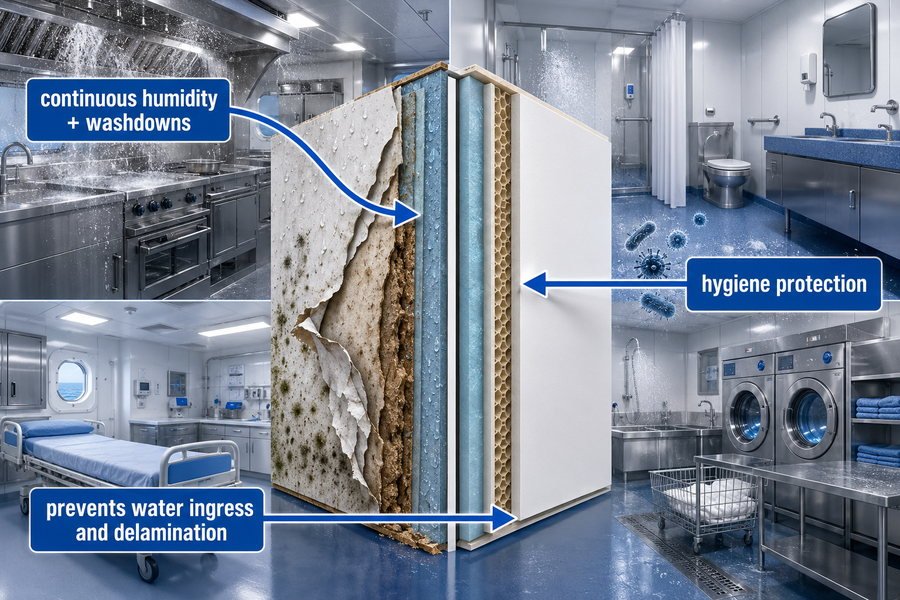
Using the wrong panel type in a wet space will lead to costly repairs and failed inspections. I have seen many projects fail because buyers chose standard panels for wet rooms. To stop this from happening to you, we need to look at specific spaces and their exact requirements.
Which Wet Rooms Need Accommodation Panels With Decorative Finish and Moisture-Resistant Cores?
Do you struggle to choose the right panels for different wet rooms? Picking standard cores for high-moisture areas causes fast rotting. Here are the specific rooms that need protection.
Wet rooms requiring decorative, moisture-resistant core accommodation panels include passenger bathrooms, crew shower blocks, laundries, and indoor swimming pool enclosures. These four areas face daily steam and splashing, requiring non-combustible PVC-coated steel laminated to water-resistant rockwool or aluminum honeycomb cores to prevent structural rotting.
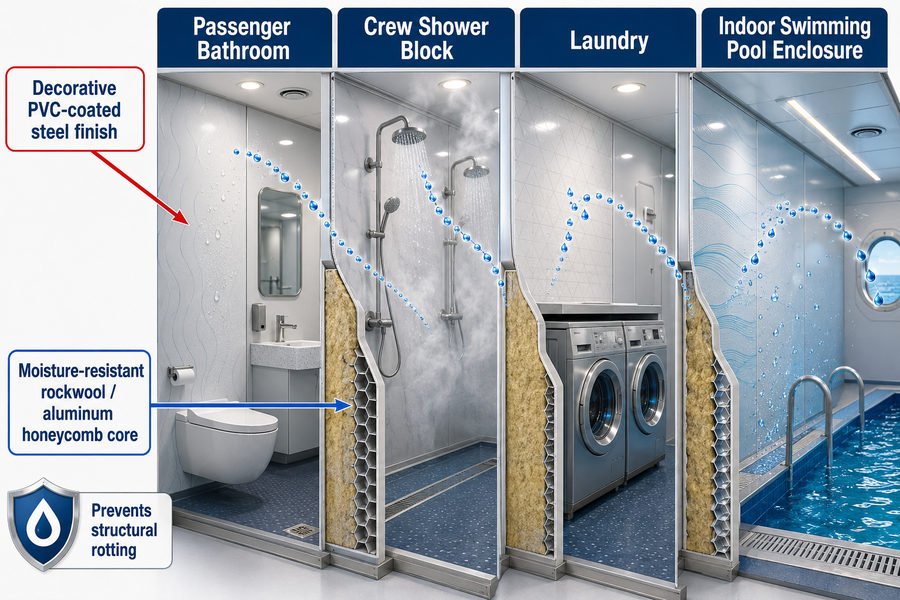
Panel Requirements for Passenger Bathrooms and Crew Shower Blocks
I remember a project where the shipyard used standard panels in crew showers. After six months, the core absorbed water, and the panels bent. According to SOLAS Chapter II-2, bulkhead panels must be non-combustible1. For passenger bathrooms and crew shower blocks, we use rockwool cores with a density of 120 to 150 kg/m³. But standard rockwool absorbs water. You must specify hydrophobic rockwool cores with a water absorption rate of less than 1% by volume, per ASTM C1104 standards. The surface is usually a 0.6mm galvanized steel sheet coated with a 150-micron PVC decorative film. This stops water from entering the core when the crew takes daily showers. If you use standard cores here, you will replace them within a year.
Core Upgrades for Laundries and Indoor Swimming Pool Enclosures
Laundries and pool enclosures face even higher moisture levels. In a ship laundry, the relative humidity often stays above 85%2. For these two areas, rockwool can still be risky if the panel joints fail. I always tell my clients to use aluminum honeycomb cores for these spaces. Aluminum honeycomb cores weigh about 5 to 7 kg/m². This is much lighter than rockwool. More importantly, aluminum does not absorb water at all. According to the United States Public Health Service (USPHS) Vessel Sanitation Program guidelines, materials in splash zones must be smooth and non-absorbent3. Aluminum honeycomb panels cost around $40 to $50 per square meter, but they never rot. They offer complete peace of mind for high-humidity pool areas and hot laundries.
| Space Type | Recommended Core Material | Core Density/Weight | Cost Estimate (USD/sqm) | Water Absorption |
|---|---|---|---|---|
| Passenger Bathrooms | Hydrophobic Rockwool | 120 - 150 kg/m³ | $25 - $35 | < 1% by volume |
| Crew Shower Blocks | Hydrophobic Rockwool | 120 - 150 kg/m³ | $25 - $35 | < 1% by volume |
| Ship Laundries | Aluminum Honeycomb | 5 - 7 kg/m² | $40 - $50 | 0% |
| Pool Enclosures | Aluminum Honeycomb | 5 - 7 kg/m² | $40 - $50 | 0% |
Why Are Decorative-Only Accommodation Panels Unfit for Galley and Pantry Walls?
Are you tempted to use standard decorative panels in galleys to save money? This choice leads to quick damage from grease and heat. Let us look at why they fail.
Decorative-only accommodation panels are unfit for galley and pantry walls due to three critical failures: inability to withstand high-pressure hot water washing, zero resistance to hot oil splashes, and failure to meet USPHS fire and food safety cleaning standards. Standard PVC films melt or peel under these harsh conditions.
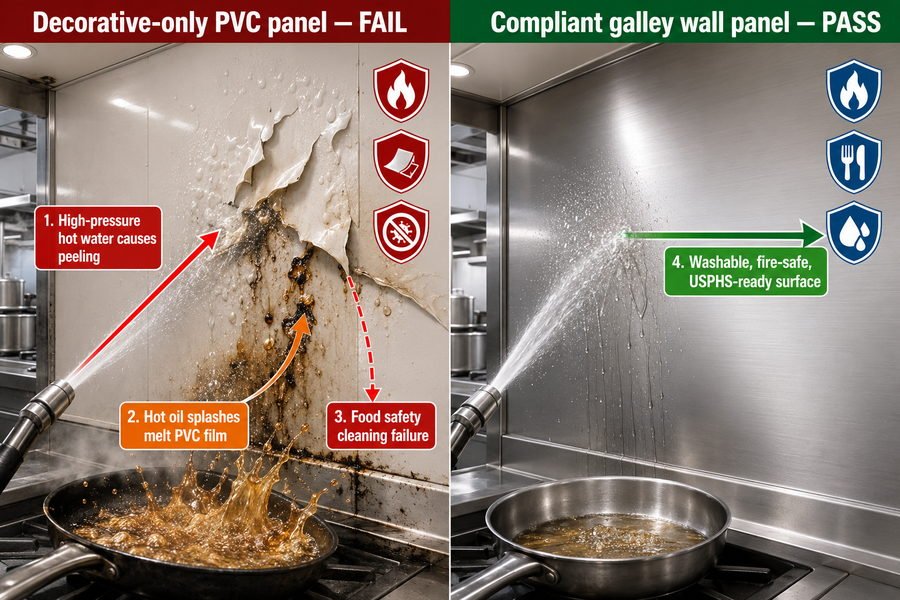
The Impact of High-Pressure Washing and Hot Oil on Galley Panels
In a busy ship galley, the crew cleans the walls daily. They use high-pressure hoses with hot water. Standard decorative panels usually have a PVC film. This film can only handle temperatures up to 60°C before the glue softens.4 When galley cleaning water hits 80°C to 85°C, the PVC film peels off. Also, hot cooking oil splashes regularly hit the walls near fryers. Standard PVC film reacts with hot oil and melts.5 I have seen standard panels fail in less than three months in a busy offshore vessel galley. You must use SUS304 or SUS316L stainless steel finishes instead. A 0.7mm thick stainless steel surface handles temperatures up to 800°C without damage. It ignores hot water and hot oil completely.
Meeting USPHS Fire and Food Safety Cleaning Standards
The rules are very strict for galleys and pantries. According to the 2018 USPHS Vessel Sanitation Program Construction Guidelines (Section 4.1.1.1), galley bulkheads must be "smooth, durable, non-absorbent, and easily cleanable."6 Decorative PVC films have micro-textures. These tiny bumps trap grease and bacteria. Food inspectors will fail your ship if they see grease buildup. Also, galleys are high fire risk areas. SOLAS requires A-60 class fire bulkheads for galleys.7 While standard B-15 panels use 50mm thick rockwool, galley panels often need to cover heavy A-60 steel bulkheads with a cleanable skin. Stainless steel panels cost around $60 to $80 per square meter, but they are the only way to meet all food safety and fire standards in a galley or pantry.
| Failure Point | Standard Decorative Panel (PVC) | Galley-Grade Panel (Stainless Steel) | Regulatory Requirement |
|---|---|---|---|
| Wash Temperature Limit | 60°C | 800°C | Must withstand 80°C+ hot water |
| Hot Oil Resistance | Melts and stains | Zero damage | Must resist hot oil splashes |
| Surface Texture | Micro-textured (traps grease) | Perfectly smooth | USPHS: Smooth, easily cleanable |
| Cost per sqm | $20 - $30 | $60 - $80 | N/A |
Which Marine Sanitary Spaces Require IMO Hygienic Surfaces With Decorative Finishes?
Worried about failing health inspections in your ship's public areas? Some spaces demand strict hygiene but still need to look good. Let us identify these specific sanitary spaces.
Marine sanitary spaces requiring IMO hygienic surfaces with decorative finishes include public restrooms, spa wellness centers, gym locker rooms, and food handling corridors. These four areas must combine USPHS-compliant non-porous, easy-to-clean anti-microbial coatings with high-end aesthetic designs like woodgrain or marble to satisfy both inspectors and paying passengers.
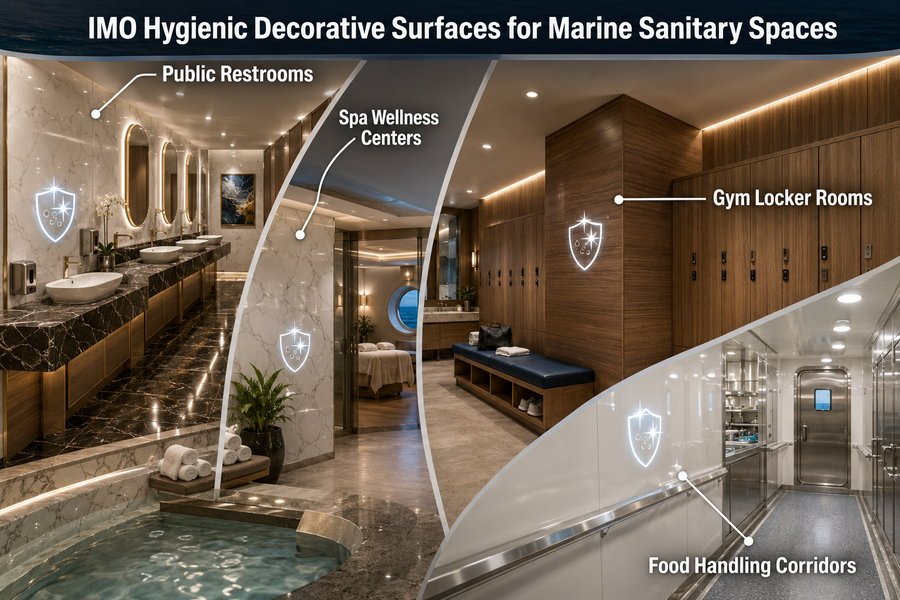
Hygienic Demands for Public Restrooms and Food Handling Corridors
High traffic areas carry high risks of spreading germs. Public restrooms on cruise ships or large ferries see hundreds of users daily. Food handling corridors connect the main galley to the dining rooms. If you use standard painted steel here, it will scratch easily, leaving spaces for bacteria to grow8. The International Maritime Organization (IMO) and USPHS mandate non-porous surfaces9. We solve this by using PET (Polyethylene Terephthalate) coated steel panels. PET films provide a hard, non-porous surface that resists harsh cleaning chemicals10. The cost for PET-coated panels ranges from $35 to $45 per square meter. They offer woodgrain finishes that look great in public restrooms and corridors while meeting health codes perfectly.
Aesthetic and Sanitary Needs in Spa Wellness Centers and Gym Locker Rooms
Passengers expect luxury in spa wellness centers and gym locker rooms. But these spaces have high humidity and lots of sweat. Standard finishes look cheap and trap odors over time. You need panels that kill bacteria on contact while looking expensive. Many top-tier panel makers now add silver-ion antimicrobial technology to the decorative film. According to ISO 22196 testing standards, silver-ion coatings reduce surface bacteria by 99.9% within 24 hours11. This keeps the spa and locker rooms smelling fresh. You can print marble or stone patterns onto these hygienic films. This gives you the high-end look of real stone without the heavy weight. Real stone is too heavy for ships, but a 15 kg/m² B-15 panel with a marble silver-ion film solves the problem beautifully.
| Sanitary Space | Typical Surface Solution | Key Benefit | Aesthetic Option |
|---|---|---|---|
| Public Restrooms | PET Coated Steel | High scratch and chemical resistance | Woodgrain |
| Food Corridors | PET Coated Steel | Non-porous, easy to wipe down | Solid colors / Woodgrain |
| Spa Centers | Silver-Ion PVC Film | 99.9% bacteria reduction, odor control | Marble / Stone patterns |
| Gym Locker Rooms | Silver-Ion PVC Film | 99.9% bacteria reduction, odor control | Metallic / Woodgrain |
How Do Moisture-Resistant Decorative Accommodation Panels Prevent Post-Handover Delamination Claims?
Are expensive warranty claims eating into your project profits? Panel delamination is a massive headache after handing over the ship. Here is how the right panels prevent this disaster.
Moisture-resistant decorative accommodation panels prevent post-handover delamination claims by utilizing three key features: marine-grade polyurethane (PUR) hot-melt adhesives, edge-sealed galvanized steel profiles, and hydrophobic rockwool cores. These elements completely block water vapor from penetrating the panel edges, ensuring the decorative film never separates from the steel substrate.
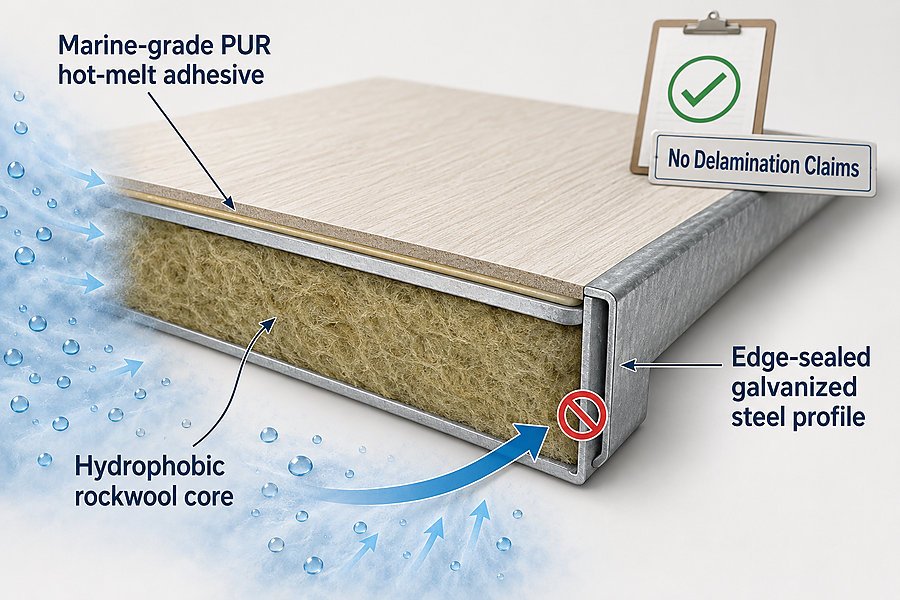
The Role of PUR Hot-Melt Adhesives and Edge-Sealed Profiles
Delamination happens when the glue holding the decorative film to the steel fails. Many cheap factories use EVA (Ethylene Vinyl Acetate) cold glue to save money. EVA glue costs about $1.50 per kilogram. But EVA glue dissolves when exposed to constant moisture12. I always check that the factory uses PUR (Polyurethane) hot-melt adhesive. PUR glue costs around $4.50 to $6.00 per kilogram. PUR cures through a chemical reaction with moisture in the air13. This makes a waterproof bond that never lets go. Also, you must use edge-sealed galvanized steel profiles. A standard B-15 panel has open folded edges. Moisture-resistant panels use a special U-profile with waterproof silicone sealant applied to the edges. This stops water vapor from entering the sides of the panel.
Blocking Internal Condensation with Hydrophobic Rockwool Cores
Even if the surface is sealed, ships experience massive temperature changes. A cold air-conditioned cabin next to a hot humid bathroom creates condensation inside the bulkhead14. If you use standard rockwool, it acts like a sponge. Once wet, standard rockwool loses its fire rating. It also causes the steel face to rust from the inside out. This leads to massive delamination bubbles on the wall. By specifying hydrophobic rockwool cores treated with water-repellent silicone oils, the core stays dry. According to EN 1609 testing, hydrophobic rockwool absorbs less than 0.1 kg/m² of water15. Because the core stays dry, the steel does not rust, and the decorative film stays perfectly flat for the entire life of the ship.
| Delamination Prevention Feature | Standard Panel Specification | Moisture-Resistant Panel Specification | Impact on Panel Lifespan |
|---|---|---|---|
| Adhesive Type | EVA Cold Glue ($1.50/kg) | PUR Hot-Melt Glue ($4.50 - $6.00/kg) | Prevents film peeling from humidity |
| Profile Edges | Open folded steel | Sealed U-profile with silicone | Blocks water vapor entry |
| Core Material | Standard Rockwool | Hydrophobic Rockwool | Stops internal rusting and bubbling |
Which Ship Hospital Areas Require Decorative and Antibacterial Accommodation Panel Performance?
Do you know the exact panel specs for ship medical facilities? Getting this wrong endangers lives and fails certifications. Here are the hospital zones that need antibacterial panels.
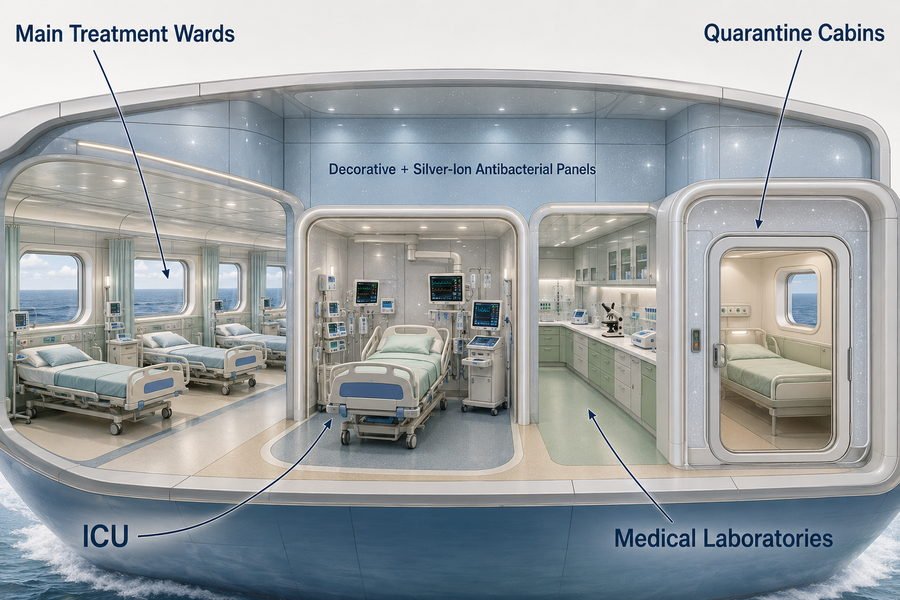
Ship hospital areas requiring decorative and antibacterial accommodation panel performance include the main treatment wards, quarantine cabins, intensive care units (ICU), and medical laboratories. These four high-risk zones demand smooth, silver-ion coated surfaces to kill pathogens, combined with calming decorative colors to reduce patient stress during rough sea journeys.
Pathogen Control in Main Treatment Wards and Quarantine Cabins
A ship hospital is small, so controlling infections is very hard. In the main treatment wards and quarantine cabins, sick people are confined in tight spaces. You cannot use standard panels here. The World Health Organization (WHO) Guide to Ship Sanitation16 outlines strict rules for medical spaces. We must use antibacterial panels. These panels feature a specialized PVC or melamine film embedded with silver nanoparticles. When bacteria touch the surface, the silver ions destroy them17. In a quarantine cabin, the panels must also withstand strong chemical fogging. Cleaners use agents like hydrogen peroxide vapor to kill viruses18. Standard panels fade after a few fogging cycles. High-grade hospital panels keep their calming light blue or soft green decorative colors even after heavy chemical cleaning.
Advanced Hygiene in Intensive Care Units (ICU) and Medical Laboratories
The Intensive Care Units (ICU) and medical laboratories on large ships handle serious emergencies. These spaces handle blood work and severe injuries. The walls must be completely seamless. While the panels themselves have antibacterial coatings, the joints between the panels are weak points. I advise clients to use flush-joint profiles filled with marine-grade antibacterial silicone sealant. In the medical laboratories, panels must also resist chemical spills from testing reagents. We often use HPL (High-Pressure Laminate) finishes on the steel sheets for labs. HPL with a thickness of 0.8mm offers high chemical resistance19. While standard panels cost $20 per square meter, antibacterial hospital-grade panels cost between $55 and $70 per square meter. It is a necessary cost to protect human life at sea.
| Hospital Zone | Key Risk Factor | Required Panel Surface | Estimated Cost (USD/sqm) |
|---|---|---|---|
| Main Treatment Wards | General bacteria spread | Silver-ion coated PVC/Melamine | $55 - $70 |
| Quarantine Cabins | Viral infections, chemical cleaning | Chemical-resistant Silver-ion film | $55 - $70 |
| Intensive Care Units (ICU) | Severe pathogen risk in joints | Flush joints with antibacterial silicone | $60 - $75 |
| Medical Laboratories | Chemical spills, blood handling | High-Pressure Laminate (HPL) 0.8mm | $65 - $80 |
Conclusion
To ensure your ship passes inspections and avoids costly repairs, you must specify the correct moisture-resistant and hygienic panels for every wet room, galley, public space, and hospital area.
-
"Are Marine Fire Divisions the Same as Marine Panel Ratings?", https://magellanmarinetech.com/are-marine-fire-divisions-same-as-marine-panel-ratings/. SOLAS Chapter II-2 sets fire-safety requirements for ship construction materials, including non-combustibility requirements for specified divisions and accommodation-space materials under the Fire Test Procedures Code. Evidence role: expert_consensus; source type: institution. Supports: SOLAS Chapter II-2 requires relevant ship bulkhead or interior panel materials to meet non-combustibility requirements.. Scope note: The exact applicability depends on vessel type, space category, and the classification of the bulkhead or lining assembly. ↩
-
"Laundry Hygiene and Odor Control: State of the Science - PMC", https://pmc.ncbi.nlm.nih.gov/articles/PMC8231443/. Studies and occupational-environment guidance on commercial laundries describe laundries as high-heat, high-moisture spaces where inadequate ventilation can produce elevated relative humidity, supporting the characterization of ship laundries as high-humidity environments. Evidence role: general_support; source type: paper. Supports: Ship laundries can experience very high relative humidity, with levels often exceeding 85% in poorly ventilated or heavily used conditions.. Scope note: Evidence may support high humidity in laundries generally rather than proving that ship laundries routinely remain above 85 percent relative humidity. ↩
-
"[PDF] 2025 Construction Standards | Vessel Sanitation Program - CDC", https://www.cdc.gov/vessel-sanitation/media/pdfs/2025/06/2025_VSP_Construction_Standards-508.pdf. The CDC Vessel Sanitation Program construction guidance requires surfaces in food, cleaning, and wet-use areas to be smooth, durable, and nonabsorbent where exposed to splash or moisture, supporting the use of nonabsorbent materials in splash zones. Evidence role: expert_consensus; source type: government. Supports: USPHS/CDC Vessel Sanitation Program guidance requires splash-zone materials to be smooth and non-absorbent.. Scope note: The VSP guidance applies to cruise ships subject to the program and may not govern every vessel type or every non-food wet area in identical terms. ↩
-
"The Effect of Temperature on Shear Bond Strength of Clearfil SE ...", https://pmc.ncbi.nlm.nih.gov/articles/PMC4345108/. A polymer-materials or adhesive technical source can document typical service-temperature limits for PVC films and pressure-sensitive or laminating adhesives, supporting the claim that heat can soften bonded decorative films. Evidence role: mechanism; source type: paper. Supports: PVC decorative films or their adhesives may soften or lose bond strength at elevated cleaning temperatures around 60°C.. Scope note: The exact failure temperature depends on the PVC formulation, adhesive chemistry, substrate, and exposure duration; a source may support the mechanism and typical range rather than this precise 60°C threshold for all panels. ↩
-
"[PDF] Chemical Resistance and Chemical Applications for CPVC Pipe and ...", https://www.nrc.gov/docs/ML1820/ML18207A604.pdf. A polymer-compatibility or materials-science source can support that PVC has limited resistance to some oils and that elevated temperatures can accelerate softening, swelling, or deformation. Evidence role: mechanism; source type: paper. Supports: PVC film can be degraded, softened, swollen, or thermally deformed by hot oils, depending on temperature and formulation.. Scope note: Such evidence may establish chemical and thermal vulnerability in general, but it may not prove that every decorative PVC film will melt under all galley hot-oil splash conditions. ↩
-
"[PDF] VSP 2018 Construction Guidelines | Vessel Sanitation Program - CDC", https://www.cdc.gov/vessel-sanitation/media/files/vsp_construction_guidelines_2018-508.pdf. The USPHS Vessel Sanitation Program Construction Guidelines state construction and finish requirements for food-area bulkheads, including smoothness, durability, non-absorbency, and cleanability. Evidence role: expert_consensus; source type: government. Supports: USPHS VSP construction guidance requires galley or food-area bulkheads to have smooth, durable, non-absorbent, easily cleanable finishes.. ↩
-
"[PDF] Supplement - International Maritime Organization", https://wwwcdn.imo.org/localresources/en/publications/Documents/Supplements/English/QF110E_122015.pdf. SOLAS fire-safety provisions and related IMO guidance classify galleys as higher fire-risk accommodation/service spaces and prescribe fire-resisting divisions in specified arrangements, providing regulatory context for A-class or A-60 boundary requirements. Evidence role: historical_context; source type: institution. Supports: SOLAS/IMO rules can require fire-rated A-class, including A-60 in specified cases, for boundaries involving galleys or high fire-risk service spaces.. Scope note: The exact A-60 requirement depends on vessel type, gross tonnage, layout, adjacent spaces, and applicable SOLAS chapter/regulation; the source may support the regulatory framework rather than a universal rule for every galley bulkhead. ↩
-
"Influence of Surface Roughness, Nanostructure, and Wetting ... - PMC", https://pmc.ncbi.nlm.nih.gov/articles/PMC10848269/. Research on hygienic surface design and bacterial adhesion indicates that scratches, roughness, and damaged coatings can increase microbial retention and make cleaning less effective on food-contact or wet-area surfaces. Evidence role: mechanism; source type: paper. Supports: Scratched painted steel can create surface defects where bacteria are harder to remove.. Scope note: This supports the general mechanism; it does not prove that every painted-steel installation in ship corridors will scratch or harbor bacteria at the same rate. ↩
-
"[PDF] Circular Letter No.4221/Add.1 2 April 2020 To: All IMO Members ...", https://wwwcdn.imo.org/localresources/en/MediaCentre/HotTopics/Documents/Circular%20Letter%20No.4221-Add.1%20-%20Communication.pdf. Ship sanitation guidance such as the USPHS Vessel Sanitation Program and WHO ship sanitation materials require food-area and sanitary surfaces to be smooth, durable, nonabsorbent, and readily cleanable. Evidence role: expert_consensus; source type: government. Supports: Maritime sanitation rules or guidance require nonporous, cleanable surfaces in relevant ship hygiene areas.. Scope note: This is direct support for nonabsorbent cleanable surfaces in ship sanitation guidance, but the exact scope of IMO requirements should be verified separately because IMO instruments may address sanitation less specifically than USPHS or WHO guidance. ↩
-
"Surface Properties of the Polyethylene Terephthalate (PET ... - PMC", https://pmc.ncbi.nlm.nih.gov/articles/PMC9780983/. Materials references describe polyethylene terephthalate films as having low water absorption and generally good resistance to many dilute chemicals, supporting their use where wipe-clean polymer surfaces are needed. Evidence role: definition; source type: education. Supports: PET film has material properties consistent with a hard, low-porosity, chemically resistant surface.. Scope note: Chemical resistance depends on the exact cleaner concentration, temperature, exposure time, film formulation, and coating system; the source would not prove resistance to all harsh disinfectants. ↩
-
"A Closer Look at Studies Using the ISO 22196:2011 Standard - PMC", https://pmc.ncbi.nlm.nih.gov/articles/PMC10813364/. ISO 22196 specifies a laboratory method for measuring antibacterial activity on plastics and other nonporous surfaces after a defined contact period, and studies of silver-containing polymer coatings often report log-scale bacterial reductions under those test conditions. Evidence role: mechanism; source type: institution. Supports: Silver-ion antimicrobial coatings can be evaluated under ISO 22196 and may achieve 99.9% bacterial reduction in controlled testing.. Scope note: ISO 22196 is a test method rather than a guarantee of performance; a 99.9% reduction must be supported by test results for the specific coating and organisms tested, and it does not directly prove odor control in real spa or locker-room use. ↩
-
"[PDF] Enhanced Adhesion of EVA Laminates to Primed Glass Substrates ...", https://docs.nlr.gov/docs/fy05osti/37391.pdf. A materials or adhesive-science source should support that ethylene-vinyl acetate adhesives generally have poorer resistance to prolonged water or moisture exposure than moisture-curing polyurethane systems; this would substantiate the moisture-sensitivity mechanism but may not prove literal dissolution under all conditions. Evidence role: mechanism; source type: paper. Supports: EVA adhesive bonds can fail or degrade under constant moisture exposure.. Scope note: Support is likely to be comparative or conditional, because EVA formulations vary and some are modified for improved water resistance. ↩
-
"Mechanism and kinetics of moisture-curing process of reactive hot ...", https://ui.adsabs.harvard.edu/abs/2020CEJA....400051S. A polymer-chemistry or adhesive-technology source should document that reactive polyurethane hot-melt adhesives cure by reaction of isocyanate groups with ambient moisture, forming a crosslinked polyurethane/urea network; this supports the stated curing mechanism rather than any specific product performance. Evidence role: mechanism; source type: paper. Supports: PUR hot-melt adhesives cure by a moisture-triggered chemical reaction.. Scope note: The source would explain the general chemistry of PUR hot-melt adhesives, not verify the performance of a particular factory’s adhesive. ↩
-
"[PDF] Moisture Research - Optimizing Wall Assemblies - Publications | NLR", https://docs.nlr.gov/docs/fy13osti/56709.pdf. A building-physics or HVAC source should support that interstitial condensation can occur when warm, humid air contacts or diffuses toward a colder surface below the dew point within an assembly; this provides general physical support for the bulkhead example. Evidence role: mechanism; source type: government. Supports: Large temperature and humidity differences across an enclosure can cause internal condensation when surfaces fall below the dew point.. Scope note: The evidence would establish the condensation mechanism generally and may not specifically test ship cabin-to-bathroom bulkheads. ↩
-
"Properties of Loose-Fill Insulation Made of Leaves - PMC", https://pmc.ncbi.nlm.nih.gov/articles/PMC12842999/. An EN 1609-related insulation standard summary, certification document, or independent product test should show that short-term water absorption of hydrophobic mineral wool is measured under EN 1609 and can be reported at or below 0.1 kg/m²; this supports the testing basis and threshold only for tested materials. Evidence role: statistic; source type: institution. Supports: Hydrophobic rockwool can achieve short-term water absorption below 0.1 kg/m² when tested under EN 1609.. Scope note: EN 1609 defines a test method; the 0.1 kg/m² value is a performance result for particular hydrophobic mineral-wool products, not a universal property of all rockwool. ↩
-
"Introduction - Guide to Ship Sanitation - NCBI Bookshelf - NIH", https://www.ncbi.nlm.nih.gov/books/NBK310821/. The WHO Guide to Ship Sanitation provides international public-health guidance for ships, including sanitation measures intended to reduce communicable-disease risks in confined ship environments. Evidence role: historical_context; source type: institution. Supports: The WHO Guide to Ship Sanitation outlines strict rules for medical spaces on ships.. Scope note: This would support the relevance of WHO ship-sanitation guidance, but it may not directly require antibacterial wall panels or specify particular panel materials. ↩
-
"The Antibacterial Mechanism of Silver Nanoparticles and Its ... - PMC", https://pmc.ncbi.nlm.nih.gov/articles/PMC7174845/. Peer-reviewed reviews of silver nanoparticles and silver ions describe antimicrobial mechanisms including membrane disruption, protein interaction, oxidative stress, and interference with bacterial DNA replication. Evidence role: mechanism; source type: paper. Supports: Silver ions embedded in antibacterial panel films can kill or inhibit bacteria that contact the surface.. Scope note: Such evidence supports the general antimicrobial mechanism of silver-based surfaces, but efficacy depends on ion release rate, coating design, organism type, surface wear, and cleaning conditions. ↩
-
"Updates | Infection Control - CDC", https://www.cdc.gov/infection-control/hcp/disinfection-sterilization/updates.html. Public-health and infection-control literature identifies vaporized hydrogen peroxide as a disinfectant/decontamination method with demonstrated activity against microorganisms, including viruses, under validated concentration, exposure-time, and environmental conditions. Evidence role: expert_consensus; source type: government. Supports: Hydrogen peroxide vapor is used as a chemical disinfection method to inactivate viruses.. Scope note: This supports hydrogen peroxide vapor as a virucidal disinfection method in general; it does not prove effectiveness for every ship cabin layout or for every fogging protocol. ↩
-
"High Pressure Laminates with Antimicrobial Properties - PMC - NIH", https://pmc.ncbi.nlm.nih.gov/articles/PMC5456506/. Technical standards and materials literature for high-pressure decorative laminates describe chemical-resistance testing and classify HPL as a durable surfacing material for environments exposed to common reagents and cleaning agents. Evidence role: general_support; source type: institution. Supports: 0.8 mm high-pressure laminate finishes can provide chemical-resistant wall or panel surfaces for laboratory use.. Scope note: This would support HPL’s general chemical resistance, but a source should be checked for the specific 0.8 mm thickness and for the exact laboratory chemicals expected on board. ↩