You see a beautiful panel and buy it. But when the inspector checks, your ship fails the safety test. Stop looking at just the surface and start checking the specs.
Selecting marine accommodation panels based only on appearance causes specification failures because it ignores three critical structural requirements: fire rating compliance (A-Class or B-Class), acoustic insulation values (Rw 30-45 dB), and moisture resistance ratings. Missing any of these three factors leads to inspection failures and costly project reworks.
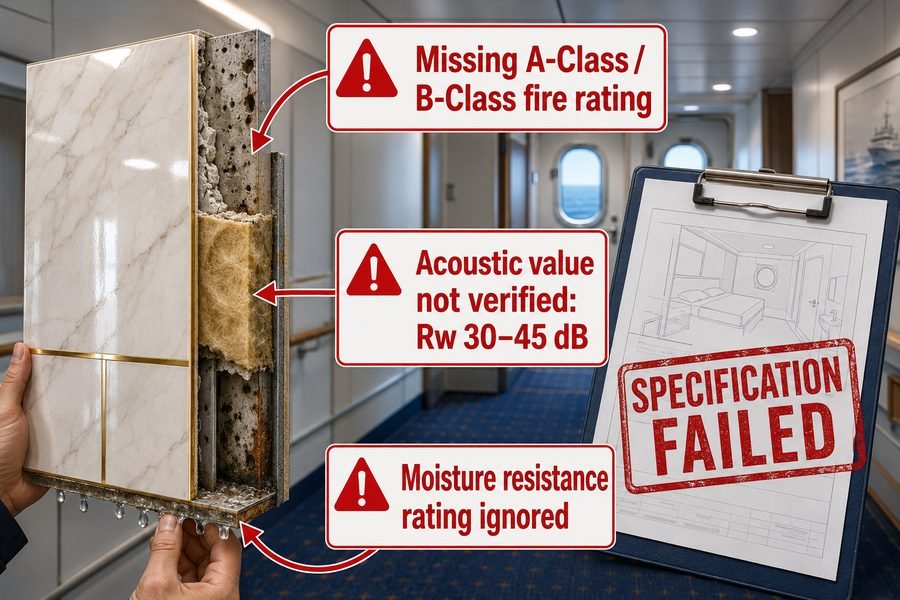
Let's look closely at why relying on looks alone is a costly mistake and how we can avoid these traps in our outfitting projects.
What Are The Compliance Risks Of Using Decorative Marine Accommodation Panels In A-Class Fire Zones?
You install a nice wooden-look panel in a high-risk area. A fire breaks out, the panel burns fast, and you face huge legal fines. Understand the fire rules now.
Using purely decorative marine accommodation panels in A-Class fire zones creates four major compliance risks: failing SOLAS Chapter II-2 inspections, losing marine insurance coverage, facing port state detention, and endangering crew lives. These panels lack the required rockwool core density (100-150 kg/m³) to contain fires for 60 minutes.
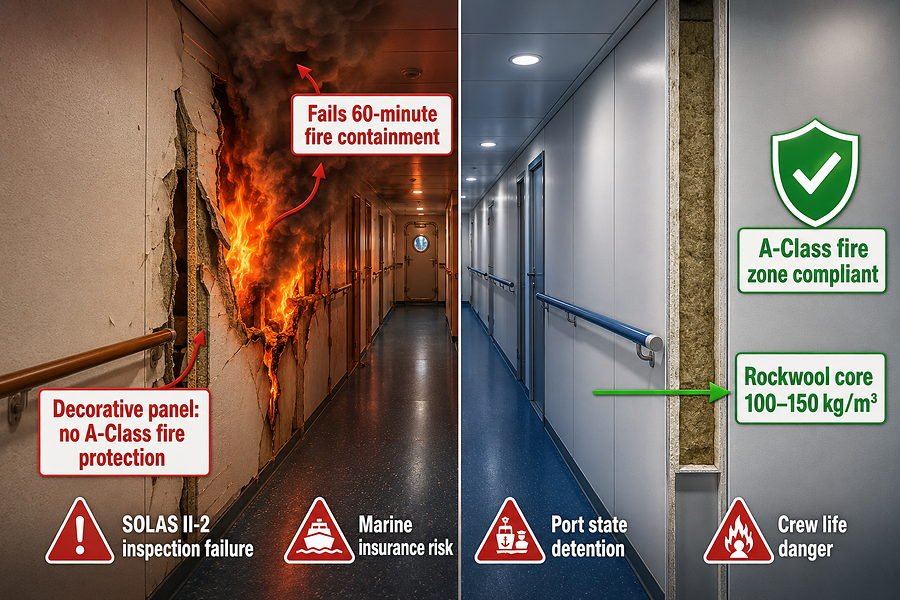
I see this problem often when I talk to buyers from interior decoration companies. They want the ship to look like a luxury hotel. They choose thin panels with beautiful PVC films. But they forget the core function of an A-Class fire zone. The regulations from the International Maritime Organization (IMO) are very strict. We must look at the four major compliance risks we face when we make this mistake.
Failing SOLAS Chapter II-2 Inspections and Port State Detention
The first risk is failing the Safety of Life at Sea (SOLAS) Chapter II-2 inspections. Inspectors test the bulkheads. An A-60 class panel must stop smoke and flames for 60 minutes1. The unexposed side of the panel must not rise more than 140°C above the starting temperature. Standard decorative panels only use honeycomb cores or low-density rockwool (around 60 kg/m³). They fail this test in less than 15 minutes.2
The second risk happens when the ship tries to leave the port. Port State Control (PSC) officers check the ship certificates. If they find non-compliant panels in the engine room boundaries, they issue a port state detention3. The ship cannot sail. A delayed ship costs the owner between $10,000 and $30,000 per day in port fees and lost business.
Losing Marine Insurance Coverage and Endangering Crew Lives
The third risk involves marine insurance coverage. Insurance companies require the ship to meet all classification society rules, like DNV or Lloyd's Register. If you use unapproved decorative panels and a fire happens, the insurance company will refuse to pay the claim4. They will say the ship was not seaworthy. The shipyard or the interior contractor must pay for the damage from their own pockets.
The fourth and most important risk is endangering crew lives. A purely decorative panel will burn quickly. It will also release toxic smoke from the cheap surface glue. High-density rockwool (100 to 150 kg/m³) does not burn and does not create toxic smoke. We must prioritize life safety over a pretty surface.
| Risk Category | Consequence of Decorative Panel Use | Required A-Class Specification | Source/Authority |
|---|---|---|---|
| SOLAS Inspection | Immediate failure and rework | Temp rise < 140°C for 60 mins | IMO FTP Code Part 3 |
| Port State Control | Ship detention at port | Valid Type Approval on board | Port State Authority |
| Marine Insurance | Claim denial after a fire incident | DNV/Lloyd's Register compliance | Insurance Policies |
| Crew Safety | Toxic smoke and rapid fire spread | Rockwool density 100-150 kg/m³ | SOLAS Chapter II-2 |
How To Match Marine Accommodation Panel Type To Zone Function During Early Specification?
You order panels without checking the room type. Later, you realize the cabin panels do not fit the engine room. Match the panel to the room early to save money.
To match marine accommodation panel types to zone functions, you must assess three parameters: fire risk level (A, B, or C Class), noise reduction needs (30 to 45 decibels), and moisture levels (dry cabins vs. wet sanitary spaces). This three-step assessment prevents costly mismatches during early specification.
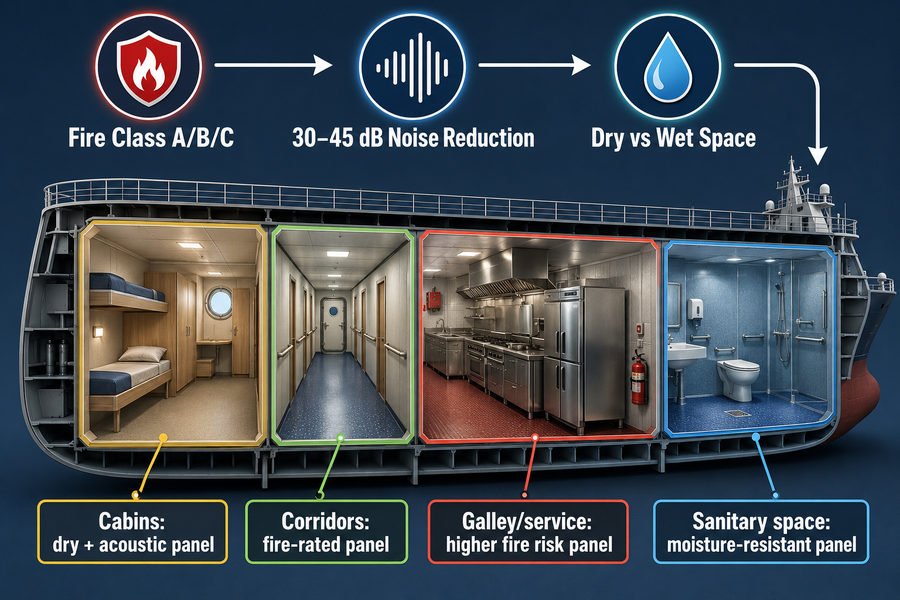
When I worked at the marine outfitting factory, I learned that fixing a mistake on paper costs $10. Fixing a mistake during installation costs $1,000. Procurement officers buy outfitting products from China or Vietnam. They need to get the specifications right before the factory starts cutting the steel. To do this, we must evaluate the three specific parameters for every room on the ship.
Assessing Fire Risk Levels and Noise Reduction Needs
The first parameter is the fire risk level. You must look at the shipyard's general arrangement plan. The plan tells you if the wall is an A-Class, B-Class, or C-Class division5. If the wall separates a cabin from the engine room, it is an A-60 zone6. You must buy a panel with a 50mm thickness and 150 kg/m³ rockwool core. If the wall separates two passenger cabins, it is a B-15 zone. You can use a lighter panel, usually 50mm thick but with a 120 kg/m³ core.
The second parameter is the noise reduction need. The IMO sets noise limits for ships.7 A passenger cabin must be quiet. The panel between cabins needs a sound reduction index (Rw) of at least 35 decibels (dB). For walls near the engine room, the requirement jumps to 45 dB. Standard decorative panels only block about 25 dB of noise. You must specify panels with special sound-damping layers or double-skin steel to meet the 45 dB requirement.
Evaluating Moisture Levels for Wet and Dry Spaces
The third parameter is the moisture level. Ship rooms fall into two categories: dry spaces and wet spaces. Dry spaces include bedrooms and corridors. Standard PVC-laminated galvanized steel panels work perfectly here.
Wet spaces include sanitary rooms, bathrooms, and laundry areas. If you use a standard dry-space panel in a wet space, the moisture will enter the panel joints8. You must specify panels made of PVC-coated galvanized steel or stainless steel for wet areas. The bottom profile must also be stainless steel to stop water from touching the core material.
| Assessment Parameter | Standard Dry Cabin Requirement | High-Risk/Wet Zone Requirement | Specific Material Difference |
|---|---|---|---|
| Fire Risk Level | B-15 Class Fire Rating | A-60 Class Fire Rating | Rockwool density jumps from 120 to 150 kg/m³ |
| Noise Reduction | Rw = 30 to 35 dB | Rw = 40 to 45 dB | Addition of acoustic damping sheets |
| Moisture Level | Standard humidity (Dry) | High humidity (Wet Space) | Stainless steel bottom profiles needed |
Which Onboard Areas Are Most Often Misspecified With Decorative-Only Marine Accommodation Panels?
You want the whole ship to look great. But using standard decorative panels in the wrong rooms causes rot and fire risks. Know the problem areas to avoid failure.
Three onboard areas are most often misspecified with decorative-only marine accommodation panels: galley bulkheads (requiring A-60 fire ratings), sanitary wet rooms (requiring PVC-coated galvanized steel for water resistance), and engine room boundaries (requiring heavy acoustic insulation). Using standard panels in these three areas leads to rapid degradation.
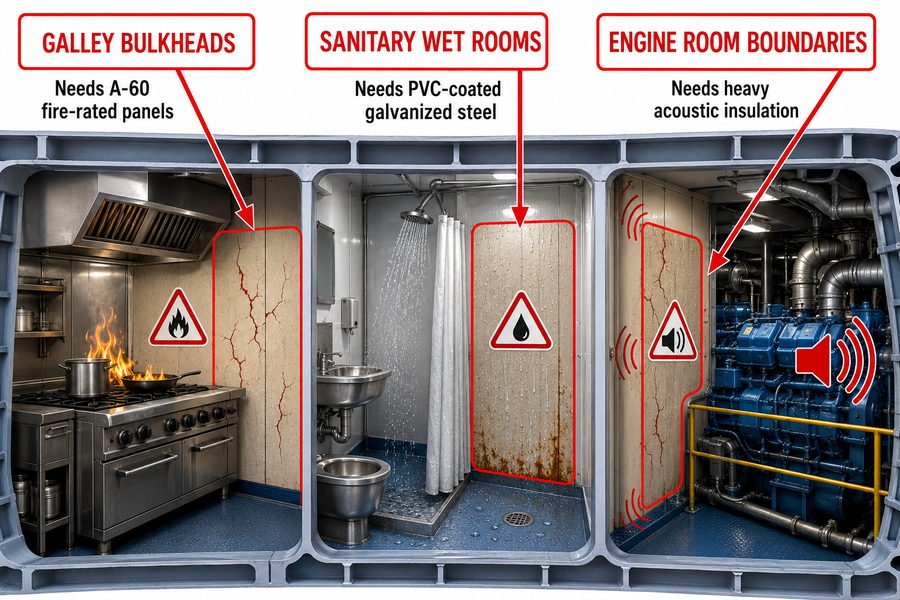
Buyers want low prices. They often order one type of cheap decorative panel for the entire ship to get a bulk discount. This is a massive mistake. A ship is a complex machine. Different rooms have completely different physical environments. Over my years helping clients, I constantly see the same three onboard areas fail because the buyer only cared about the surface color and ignored the engineering reality.
Misspecification Risks in Galley Bulkheads and Engine Room Boundaries
The first heavily misspecified area is the galley bulkhead. The galley is the ship's kitchen. It is a high-heat, high-grease, and high-fire-risk zone.9 Buyers often install standard decorative panels here because they look like clean white tiles. But standard panels have a 0.5mm steel skin covered in PVC film. The cooking heat melts the PVC film. The galley requires an A-60 rated panel10 with a stainless steel surface or a thicker 0.6mm to 0.8mm galvanized steel skin covered in heat-resistant paint.
The second problem area is the engine room boundary. The engine room produces massive vibrations and noise. Buyers sometimes use standard cabin panels on the outside of these walls to make the adjacent corridor look nice. These panels rattle and fail to stop the noise. The engine room boundary needs a heavy-duty acoustic panel, often with a perforated surface on the inside and a solid 0.7mm steel plate on the outside to handle the 100 dB engine noise11.
The Dangers of Using Standard Panels in Sanitary Wet Rooms
The third and most common misspecified area is the sanitary wet room. This includes public toilets and private cabin bathrooms. Buyers love to use wood-grain decorative panels here to match the bedroom. However, a ship's bathroom is a wet, salty environment. The water seeps into the bottom edge of the standard panel. The rockwool acts like a sponge. It absorbs the water and stays wet forever.
Once the core is wet, the steel skin rusts from the inside out12. Within one year, the beautiful wood-grain panel gets covered in brown rust bubbles. To fix this, you must specify panels specifically designed for wet units. These use special water-resistant adhesives and stainless steel base tracks.
| Onboard Area | Common Misspecification | Correct Panel Specification | Consequence of Error |
|---|---|---|---|
| Galley Bulkheads | PVC-coated 0.5mm steel panel | A-60 rated, Stainless Steel skin | PVC film melts, extreme fire hazard |
| Engine Boundaries | Standard B-15 decorative panel | Heavy acoustic panel (Rw > 45 dB) | Extreme noise pollution in corridors |
| Sanitary Wet Rooms | Standard cabin panel with wood PVC | Moisture-resistant steel + SS track | Core rot and internal steel rust |
What Documents Confirm A Marine Accommodation Panel Fits Its Required Zone Role?
You receive the panels but the shipyard rejects them. Why? Because you lack the right paperwork. Get the correct certificates before shipping to ensure seamless acceptance.
Four essential documents confirm a marine accommodation panel fits its required zone role: the Marine Equipment Directive (MED) Wheelmark Certificate, the Type Approval Certificate from a classification society, the IMO FTP Code Fire Test Report, and the manufacturer's Quality Assurance (Module D) certificate. All four are mandatory.
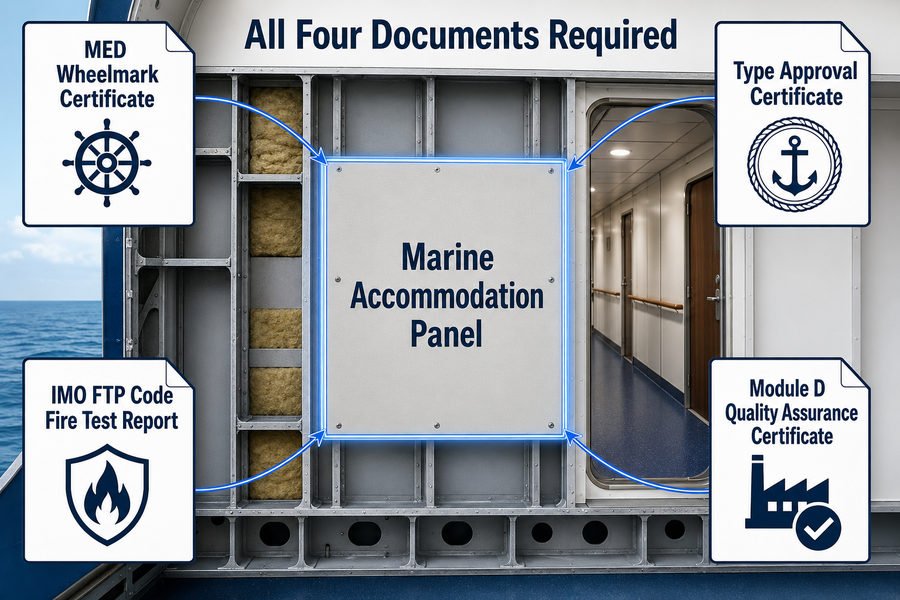
In international shipbuilding, physical quality is only half the battle. The other half is paperwork. I constantly remind procurement teams that a product without certificates is useless scrap metal to a shipyard. European and American shipyards will not let you unload the container if the documentation is wrong. You must demand the four essential documents from your Asian suppliers before you pay the balance.
Understanding MED Wheelmark and Type Approval Certificates
The first document is the Marine Equipment Directive (MED) Wheelmark Certificate. If the ship flies a European flag, this is the law.13 The Wheelmark proves the panel meets European safety standards. The panel itself must have the Wheelmark logo stamped or printed on it.
The second document is the Type Approval Certificate. Classification societies like DNV, ABS (American Bureau of Shipping), or BV (Bureau Veritas) issue this. This certificate proves the specific panel design passed all engineering reviews. It clearly states if the panel is B-15 or A-60. You must check the expiration date. A Type Approval is usually valid for five years. If the supplier gives you an expired certificate, the shipyard will reject the panels immediately.
The Role of IMO FTP Code Fire Test Reports and Module D Certificates
The third document is the IMO FTP Code Fire Test Report. This is the raw data from the laboratory. The Type Approval is just a summary, but the Fire Test Report shows exactly how the panel behaved in the furnace. It proves the panel passed the specific tests in the International Code for Application of Fire Test Procedures14. You need this to prove the core density matches your order.
The fourth document is the manufacturer's Quality Assurance (Module D) certificate. This is critical. The first three documents prove the factory can make a good panel. The Module D certificate proves the factory makes every panel exactly like the test sample. An auditor visits the factory every year to check their production line. Module D certificates are typically valid for three years.
| Required Document | What It Proves | Issuing Authority | Validity Period |
|---|---|---|---|
| MED Wheelmark | Legal compliance for EU-flagged vessels | Notified Body (e.g., DNV, LR) | Tied to Type Approval |
| Type Approval | Panel design meets classification rules | Classification Society (ABS, BV) | Typically 5 years |
| IMO FTP Test Report | Actual laboratory fire test results | Independent Fire Testing Lab | Permanent for that specific design |
| Module D Certificate | Factory maintains consistent quality | Classification Society Auditor | Typically 3 years |
How Does Misusing Decorative Marine Accommodation Panels In Wet Zones Raise Maintenance Costs?
You install cheap decorative panels in a bathroom. Six months later, the panels rust, and you must pay double to replace them. Stop this cycle of wasted money.
Misusing decorative marine accommodation panels in wet zones raises maintenance costs through three distinct failures: core material rot causing a 100% loss of structural integrity, surface film delamination requiring full replacement, and rust spread on thin 0.4mm steel skins. Fixing these three issues costs three times the original price.
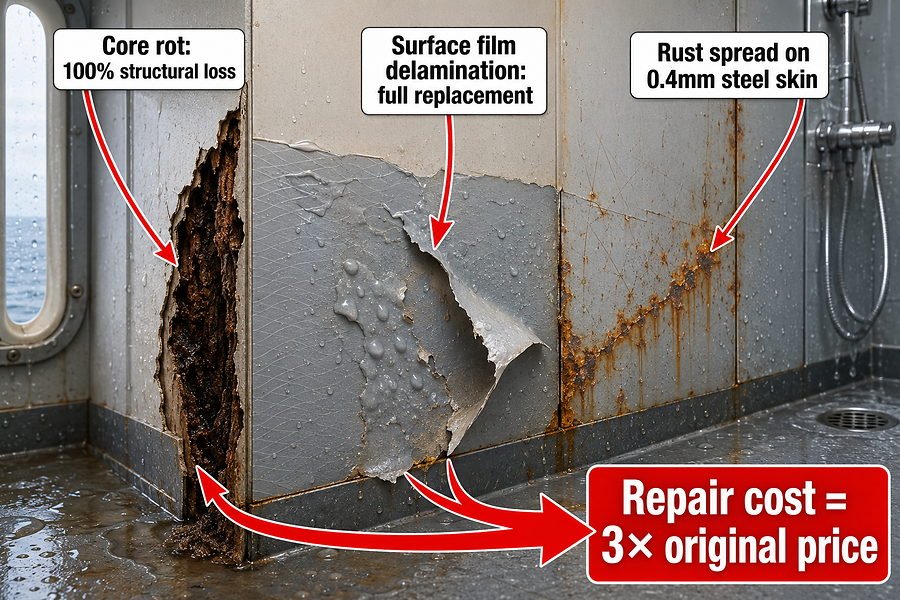
Ship owners hate unexpected maintenance costs. When you use a dry-cabin decorative panel in a wet sanitary zone, you create a financial time bomb. A standard marine panel costs about $45 to $55 per square meter. But replacing a broken panel on a working ship costs over $150 per square meter because the labor is very expensive15. We must analyze the three distinct failures that cause these massive cost overruns.
Core Material Rot and Loss of Structural Integrity
The first failure is core material rot. Standard panels use rockwool glued to the steel skins. When water enters the panel from the shower floor, the rockwool absorbs the water. Wet rockwool loses its strength.16 The glue dissolves. This causes a complete loss of structural integrity. The wall becomes soft and unstable. You cannot repair a rotten core. You must tear down the entire bulkhead. The ship owner must hire contractors to cut out the old wall and weld new floor tracks, destroying the bathroom floor in the process.
The second failure is surface film delamination. Decorative panels use a PVC film glued to the steel plate. In a wet bathroom, the hot steam attacks the glue line at the edges of the panel17. The PVC film starts to peel off, like old sunburned skin. Once it peels, it looks terrible. Passengers complain. The crew cannot just paint over the peeled PVC. They must replace the whole panel to make the cabin look acceptable again.
Surface Film Delamination and Rust Spread on Steel Skins
The third failure is rust spread on thin steel skins. Standard decorative panels often use thin 0.4mm or 0.5mm galvanized steel to save weight and money. When the PVC film delaminates or the core gets wet, the thin steel is exposed to salt air and water. Rust forms rapidly.18
Because the steel is so thin, the rust eats completely through the metal in a few months, creating holes. Water then flows into adjacent dry cabins, ruining the carpets and beds there. What started as a $50 panel mistake in one bathroom suddenly causes $500 of damage in the bedroom next door.
| Failure Type in Wet Zones | Cause of Failure | Physical Result | Cost Impact (Estimated) |
|---|---|---|---|
| Core Material Rot | Water absorption by standard rockwool | Wall becomes soft and structurally weak | $150/m² (Full replacement + labor) |
| Film Delamination | Steam attacks standard PVC adhesives | PVC film peels away from steel skin | Passenger complaints, forced replacement |
| Rust Spread on Steel | Water hits thin 0.4mm standard steel | Rust holes penetrate the panel wall | Damage spreads to adjacent dry cabins |
What Zone Checklist Prevents Marine Accommodation Panel Misspecification In Newbuild Projects?
You forget one detail, and the whole cabin fails inspection. Use a strict checklist every time you order. A simple list saves you from massive project delays.
A successful zone checklist to prevent marine accommodation panel misspecification contains four verification steps: confirming the SOLAS fire class (A/B/C), verifying the acoustic rating requirement (Rw > 35dB), checking the steel plate thickness (0.6mm minimum), and matching the core density (minimum 120kg/m³). Following these four steps ensures total compliance.
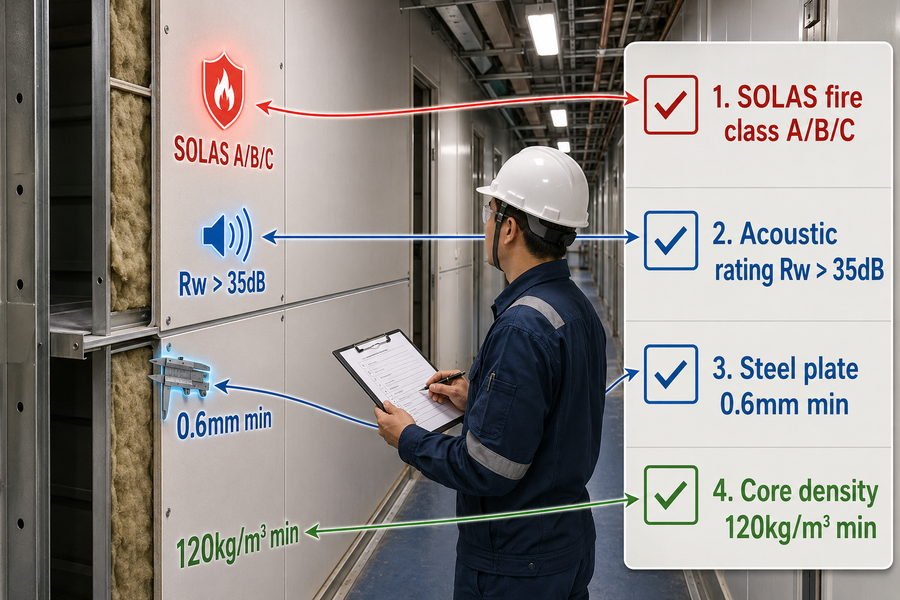
I always tell procurement officers that memory is the enemy of quality. When you order materials for 500 cabins, you will make a mistake if you just guess. You need a hard system. A rigid checklist is the only way to guarantee the factory in China produces exactly what the shipyard in Europe demands. You must run every panel type through these four verification steps before you sign the purchase order.
Confirming SOLAS Fire Class and Verifying Acoustic Ratings
The first step is confirming the SOLAS fire class. You look at the ship's fire plan. Does this specific wall need to be B-0, B-15, A-30, or A-60? You write this exact class on your purchase order. You then demand the supplier provide the Type Approval certificate matching that exact class19.
The second step is verifying the acoustic rating requirement. You check the noise control plan. Does the wall need to stop 35 decibels or 45 decibels? If it needs 45 dB, you cannot buy a standard panel. You must explicitly write "High Acoustic Panel, Rw > 45dB" on the order. You must ask the supplier for the lab test report proving their panel actually stops 45 decibels of noise.
Checking Steel Plate Thickness and Matching Core Density
The third step is checking the steel plate thickness. Do not let the supplier choose the thickness. Standard cheap panels use 0.4mm or 0.5mm steel. For a durable ship, especially in corridors or galleys, you must specify a minimum of 0.6mm galvanized steel plate20. This prevents dents when crew members hit the walls with carts.
The fourth step is matching the core density. The density of the rockwool determines the fire safety21. For B-15 class panels, you must specify a minimum rockwool density of 120 kg/m³. For A-60 class panels, you must specify 150 kg/m³. You must tell the factory that you will cut a sample panel open upon delivery to weigh the rockwool. This stops factories from secretly using cheaper 80 kg/m³ rockwool.
| Checklist Step | Target Value / Action | Purpose | Document to Request from Supplier |
|---|---|---|---|
| 1. Confirm Fire Class | Specify exact class (e.g., B-15, A-60) | Ensure SOLAS compliance | Valid Type Approval Certificate |
| 2. Verify Acoustic Rating | Specify required decibel drop (e.g., Rw > 35dB) | Meet IMO noise limits22 | Acoustic Laboratory Test Report |
| 3. Check Steel Thickness | Demand minimum 0.6mm steel plate | Prevent denting and rust | Mill Test Certificate for Steel |
| 4. Match Core Density | Demand 120kg/m³ (B-15) or 150kg/m³ (A-60) | Guarantee fire resistance | IMO FTP Code Fire Test Report |
Conclusion
Choosing marine accommodation panels by appearance causes massive failures. By matching fire ratings, securing the right documents, and using a strict checklist, you ensure your shipbuilding project succeeds safely.
-
"[PDF] RESOLUTION A.754(18) adopted on 4 November 1993 ...", https://wwwcdn.imo.org/localresources/en/KnowledgeCentre/IndexofIMOResolutions/AssemblyDocuments/A.754(18).pdf. The IMO Fire Test Procedures Code defines A-class divisions as those preventing the passage of smoke and flame for the specified fire-test period, with A-60 divisions meeting the 60-minute insulation criterion. Evidence role: definition; source type: institution. Supports: An A-60 class panel must prevent smoke and flame passage for 60 minutes and meet prescribed temperature-rise limits.. ↩
-
"Which Parameters Determine the Fire Rating of Marine Aluminum ...", https://magellanmarinetech.com/which-parameters-determine-fire-rating-marine-aluminum-honeycomb-panels/. Fire-test research on combustible decorative panels and lightweight core assemblies can document that such constructions may lose integrity or insulation well before the A-60 duration under standard furnace exposure; this would contextualize, but may not universally prove, a 15-minute failure time for all decorative panels. Evidence role: general_support; source type: paper. Supports: Standard decorative panels using honeycomb cores or low-density rockwool can fail A-60 fire-resistance testing far earlier than 60 minutes.. Scope note: The result is likely material- and assembly-specific; a source may support typical failure behavior rather than every honeycomb or low-density rockwool panel failing within exactly 15 minutes. ↩
-
"[PDF] PROCEDURES FOR PORT STATE CONTROL, 2023", https://wwwcdn.imo.org/localresources/en/OurWork/IIIS/Documents/A%2033-Res.1185%20-%20PROCEDURES%20FOR%20PORT%20STATE%20CONTROL,%202023%20(Secretariat)%20(1).pdf. IMO and regional Port State Control procedures identify serious SOLAS fire-safety deficiencies as grounds for detention when they create a clear hazard or show the ship is not fit to proceed to sea. Evidence role: mechanism; source type: institution. Supports: Port State Control may detain a ship when non-compliant fire-safety construction or certification deficiencies make the vessel unfit to sail.. Scope note: Port State Control officers assess deficiencies case by case; the source would support detention authority and criteria, not that every non-compliant panel automatically results in detention. ↩
-
"What Are the Risks of Non-Marine-Grade Accommodation ...", https://magellanmarinetech.com/what-risks-non-marine-grade-accommodation-panels-on-commercial-vessels/. Marine insurance law and standard hull policy conditions commonly treat seaworthiness, class maintenance, and compliance with statutory requirements as material to coverage, so a proven breach involving unapproved fire-safety construction may allow denial or reduction of a claim. Evidence role: general_support; source type: government. Supports: Use of unapproved panels that breaches seaworthiness or classification requirements can jeopardize marine insurance coverage after a fire.. Scope note: Coverage consequences depend on the policy wording, governing law, causation requirements, and facts of the casualty; the support is for legal plausibility rather than an automatic refusal in every case. ↩
-
"[PDF] RESOLUTION MSC.307(88) (adopted on 3 December 2010 ...", https://wwwcdn.imo.org/localresources/en/KnowledgeCentre/IndexofIMOResolutions/MSCResolutions/MSC.307(88).pdf. IMO/SOLAS fire-safety rules and the IMO Fire Test Procedures Code define A-, B-, and C-class divisions and their fire-resistance performance criteria for ship construction. Evidence role: definition; source type: institution. Supports: Ship accommodation and service-space walls are classified as A-, B-, or C-class fire divisions.. Scope note: These sources define the classification framework; they do not verify the classification of any particular wall in a shipyard drawing. ↩
-
"[PDF] RESOLUTION A.122(V) adopted on 25 October 1967 ...", https://wwwcdn.imo.org/localresources/en/KnowledgeCentre/IndexofIMOResolutions/AssemblyDocuments/A.122(5).pdf. SOLAS Chapter II-2 and related IMO guidance require higher fire integrity for boundaries adjacent to machinery spaces, with A-class divisions such as A-60 used where specified by the ship type and space arrangement. Evidence role: expert_consensus; source type: institution. Supports: A boundary separating accommodation from an engine or machinery space may require an A-60 fire-rated division.. Scope note: The source can support the regulatory basis for A-60 boundaries near machinery spaces, but the exact requirement depends on vessel type, flag-state interpretation, and approved fire-control plans. ↩
-
"[PDF] MSC.337(91) - International Maritime Organization", https://wwwcdn.imo.org/localresources/en/KnowledgeCentre/IndexofIMOResolutions/Documents/MSC%20-%20Maritime%20Safety/337(91).pdf. The IMO Code on Noise Levels on Board Ships establishes maximum permissible noise levels for shipboard spaces, including accommodation areas and machinery-space-related limits. Evidence role: definition; source type: institution. Supports: The IMO establishes shipboard noise limits that guide acoustic requirements for accommodation and other spaces.. Scope note: The IMO code sets noise-level limits in spaces; it does not by itself prescribe a specific wall-panel Rw value for every construction detail. ↩
-
"How to choose the right marine wall panels for marine interior ...", https://magellanmarinetech.com/how-choose-right-marine-wall-panels-for-marine-interior-projects/. Marine accommodation and wet-room design guidance commonly treats joints, penetrations, and lower interfaces as vulnerable paths for water ingress, requiring moisture-resistant materials and detailing in wet spaces. Evidence role: mechanism; source type: research. Supports: Using dry-space panel construction in bathrooms, laundries, or sanitary spaces can allow moisture to penetrate joints and affect the panel assembly.. Scope note: Such guidance supports the general moisture-ingress mechanism; it may not directly test the specific panel construction described in the article. ↩
-
"History of SOLAS fire protection requirements", https://www.imo.org/en/OurWork/Safety/Pages/History-of-fire-protection-requirements.aspx. Maritime fire-safety guidance and casualty analyses identify cooking spaces as ignition-prone areas because heat sources, combustible residues, and ventilation paths increase fire likelihood and spread potential. Evidence role: expert_consensus; source type: institution. Supports: Ship galleys are high-heat, high-grease, and high-fire-risk areas.. Scope note: This supports the general risk profile of galleys, not the failure of any specific decorative panel product. ↩
-
"What Is the Purpose and Scope of the IMO FTP Code? - Magellan ...", https://magellanmarinetech.com/what-purpose-scope-of-imo-ftp-code/. SOLAS/IMO fire-test standards define A-class divisions and the A-60 rating as maintaining insulation performance for 60 minutes under specified fire exposure conditions. Evidence role: definition; source type: institution. Supports: An A-60 rated panel is a recognized marine fire-resisting construction category relevant to ship bulkheads.. Scope note: The standard defines fire-resistance performance; it does not by itself prove that every galley bulkhead must use this exact panel specification in all vessel classes. ↩
-
"Physical influences on seafarers are different during their voyage ...", https://pmc.ncbi.nlm.nih.gov/articles/PMC7141673/. Occupational-noise studies and maritime health guidance report that ship engine rooms commonly reach sound-pressure levels around or above 100 dB, supporting the need for acoustic control near engine-room boundaries. Evidence role: statistic; source type: paper. Supports: Ship engine rooms can produce noise levels around 100 dB, making acoustic panel performance relevant for adjacent spaces.. Scope note: Reported noise levels vary by vessel type, engine load, measurement position, and maintenance condition. ↩
-
"Marine Atmospheric Corrosion of Carbon Steel: A Review - PMC", https://pmc.ncbi.nlm.nih.gov/articles/PMC5506973/. Corrosion literature on marine and insulated steel structures shows that trapped moisture and chlorides can accelerate hidden corrosion at metal interfaces, making internal rusting plausible when panel cores remain wet. Evidence role: mechanism; source type: paper. Supports: Moisture trapped inside a panel can promote internal corrosion of steel skins, especially in salty marine environments.. Scope note: This provides a general corrosion mechanism rather than direct test evidence for the specific decorative panel assembly described in the article. ↩
-
"Directive 96/98/EC", https://en.wikipedia.org/wiki/Directive_96/98/EC. Directive 2014/90/EU establishes EU rules for marine equipment placed on board EU ships and requires compliant equipment to bear the wheel mark after conformity assessment. Evidence role: definition; source type: government. Supports: The MED Wheelmark is a legal compliance requirement for applicable marine equipment installed on EU-flagged ships.. ↩
-
"[PDF] RESOLUTION MSC.307(88) (adopted on 3 December 2010 ...", https://wwwcdn.imo.org/localresources/en/KnowledgeCentre/IndexofIMOResolutions/MSCResolutions/MSC.307(88).pdf. The IMO Fire Test Procedures Code sets out standardized fire-test methods used to demonstrate compliance of ship materials and constructions with SOLAS fire-safety requirements. Evidence role: definition; source type: institution. Supports: The IMO FTP Code Fire Test Report documents testing against the International Code for Application of Fire Test Procedures.. Scope note: The source supports the role of the FTP Code in standardizing tests, but individual panel compliance must still be verified from the specific laboratory report and approval certificate. ↩
-
"[PDF] The Economic Importance of the U.S. Private Shipbuilding and ...", https://www.maritime.dot.gov/sites/marad.dot.gov/files/2021-06/Economic%20Contributions%20of%20U.S.%20Shipbuilding%20and%20Repairing%20Industry.pdf. Maritime repair-cost data showing that onboard retrofit work is strongly labor-driven would support the claim that replacement costs can greatly exceed panel purchase prices. Evidence role: statistic; source type: institution. Supports: Replacing a broken panel on an operating ship can cost far more than the original panel price because labor dominates the repair cost.. Scope note: This would contextualize the cost escalation; it may not independently verify the specific $150/m² figure without a project-specific cost schedule. ↩
-
"The Influences of Moisture on the Mechanical, Morphological ... - PMC", https://pmc.ncbi.nlm.nih.gov/articles/PMC7288152/. Materials research on mineral wool shows that moisture exposure can change its physical and mechanical properties, supporting the mechanism that water ingress can weaken a rockwool-core panel. Evidence role: mechanism; source type: paper. Supports: Wet rockwool can lose mechanical performance when water enters the panel core.. Scope note: Such studies usually examine mineral wool as an insulation material, so the evidence is indirect for this exact marine decorative panel construction. ↩
-
"Effect of Temperature and Humidity Coupling on the Ageing Failure ...", https://pmc.ncbi.nlm.nih.gov/articles/PMC11013269/. Adhesion studies report that elevated temperature and moisture can reduce bond strength and promote interfacial failure in polymer-to-metal adhesive systems, supporting the proposed delamination mechanism. Evidence role: mechanism; source type: paper. Supports: Hot, humid bathroom conditions can weaken adhesive bonds at panel edges and contribute to PVC film delamination.. Scope note: The support is mechanistic unless the source specifically tests PVC film bonded to galvanized steel in marine sanitary spaces. ↩
-
"Marine Atmospheric Corrosion of Carbon Steel: A Review - PMC", https://pmc.ncbi.nlm.nih.gov/articles/PMC5506973/. Corrosion references on marine atmospheres show that chloride-containing salt spray and moisture accelerate corrosion of exposed steel, supporting the claim that damaged steel skins can rust quickly in wet marine environments. Evidence role: mechanism; source type: government. Supports: Exposed thin steel in salt air and water is prone to rapid corrosion once protective layers are breached.. Scope note: Actual perforation time depends on coating condition, steel thickness, salinity, wet-dry cycling, and maintenance, so this does not by itself prove failure within a few months. ↩
-
"How Does the IMO FTP Code Connect with Other Marine Fire Safety ...", https://magellanmarinetech.com/how-imo-ftp-code-connect-with-other-marine-fire-safety-frameworks/. The IMO SOLAS framework and the International Code for Application of Fire Test Procedures define fire-test requirements for A- and B-class divisions, supporting the need to verify that a marine panel assembly has approval for the specified class. Evidence role: expert_consensus; source type: institution. Supports: Marine wall panels should be ordered and verified against the exact SOLAS fire class required for the ship location.. Scope note: The IMO rules establish testing and approval requirements, but they do not prescribe the article’s procurement checklist wording. ↩
-
"Analysis Of Dynamic Dent Resistance Of Auto Body Panel", https://ui.adsabs.harvard.edu/abs/2007AIPC..907..252D/abstract. Engineering references on plate and sheet-metal behavior show that flexural stiffness increases strongly with thickness, supporting the general mechanism by which thicker steel facings improve resistance to deformation and denting. Evidence role: mechanism; source type: education. Supports: Specifying a thicker steel plate can improve panel durability and dent resistance in high-traffic ship areas.. Scope note: This supports the physical rationale for greater dent resistance but does not independently establish 0.6 mm as a universal marine-panel minimum. ↩
-
"[PDF] RESOLUTION MSC.307(88) (adopted on 3 December 2010 ...", https://wwwcdn.imo.org/localresources/en/KnowledgeCentre/IndexofIMOResolutions/MSCResolutions/MSC.307(88).pdf. Fire-test standards for marine divisions evaluate complete assemblies, while mineral-wool research shows that density can influence thermal insulation and fire-performance behavior, giving contextual support for checking insulation density as one factor in fire-rated panel performance. Evidence role: mechanism; source type: paper. Supports: Rockwool core density is relevant to the fire performance of marine wall panels.. Scope note: Density alone does not determine SOLAS fire classification; the certified performance depends on the tested complete assembly, including facings, joints, adhesives, and installation details. ↩
-
"[PDF] MSC.337(91) (adopted on 30 November 2012) CODE ON NOISE ...", https://wwwcdn.imo.org/localresources/en/KnowledgeCentre/IndexofIMOResolutions/MSCResolutions/MSC.337(91).pdf. IMO Resolution MSC.337(91), the Code on Noise Levels on Board Ships, sets maximum noise-level criteria for ship spaces and provides the regulatory context for specifying acoustic performance in accommodation partitions. Evidence role: expert_consensus; source type: institution. Supports: Acoustic ratings for wall panels should be checked against ship noise-control requirements because IMO rules regulate onboard noise levels.. Scope note: The Code addresses allowable onboard noise levels; it does not directly require a particular Rw value for every wall panel type. ↩