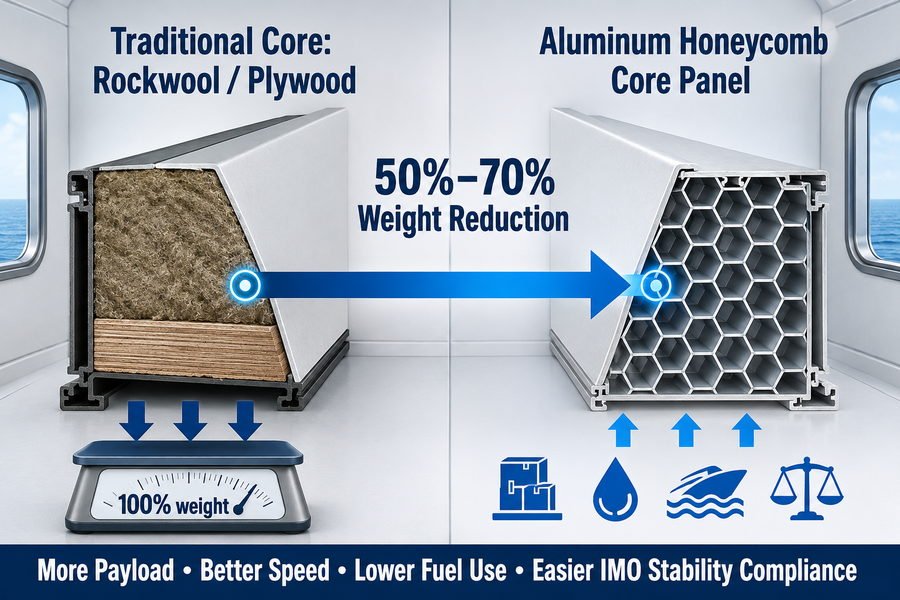
Heavy outfitting limits your ship's payload and slows it down. You need a lighter, strong solution. Aluminum honeycomb core panels solve this by cutting weight without losing strength.
Aluminum honeycomb core marine accommodation panels offer a massive 50% to 70% weight reduction compared to traditional rockwool or plywood cores. This directly increases payload capacity, improves vessel speed, lowers fuel consumption, and makes achieving strict IMO stability requirements much easier for both commercial and high-speed craft.
Let me share why this matters so much. If you build ships, every kilogram counts. A heavy cabin can ruin the entire performance of a good hull.
How Do Aluminum Honeycomb Core Marine Accommodation Panels Lower Vessel Center of Gravity?
High center of gravity makes ships unsafe in rough seas. Standard panels add too much top-weight. Aluminum honeycomb core panels keep the upper decks light and stable.
Aluminum honeycomb panels lower the center of gravity by replacing heavy upper-deck materials. While a standard 50mm rockwool panel weighs 16-18 kg/m², an aluminum honeycomb panel weighs only 5-7 kg/m². This removes tons of weight high above the waterline, directly improving metacentric height (GM) and vessel roll stability.
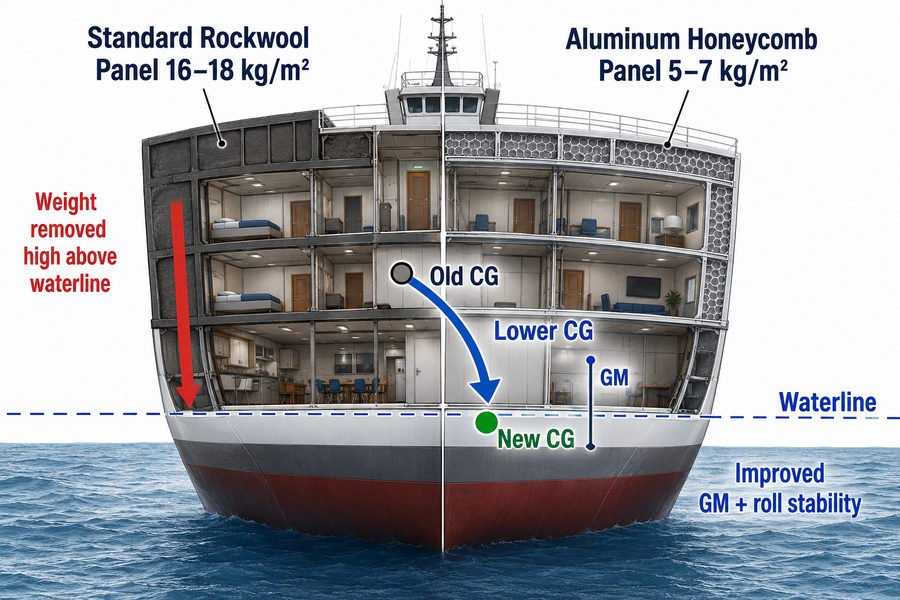
I often see buyers focus only on price and forget about ship stability. But stability is the most basic rule of shipbuilding. When you use heavy panels on the top floors of a ship, the ship becomes top-heavy. This is very dangerous.
Impact of Aluminum Honeycomb Core on Metacentric Height (GM)
The metacentric height, known as GM, measures how stable a ship is. A larger GM means the ship will stay upright. When a ship rolls in the water, a heavy top floor will pull it down further. The International Maritime Organization (IMO) has very strict rules about this in the Intact Stability Code1. By changing to aluminum honeycomb core panels, you take weight off the top. According to basic marine engineering rules, moving weight lower, or removing weight from the top, increases the GM2. A 50mm aluminum honeycomb panel weighs about 6 kg/m². A rockwool panel weighs about 17 kg/m². If you have a deck that uses 2,000 square meters of panels, you save 22 tons of weight high in the air. This change makes a huge difference in safety.
Weight Distribution in Multi-Deck Accommodation Areas
In my job at Magellan Marine, I review many ship plans. Passenger ships have many decks above the main deck. The higher you go, the more the weight matters. The aluminum honeycomb core has a very low density. The core itself often weighs only 20 to 30 kg/m³. Because of this, the total panel weight is very light. When you use these light panels on deck 4, deck 5, and deck 6, the center of gravity drops.
| Deck Level | Traditional Rockwool Weight (2000m²) | Aluminum Honeycomb Weight (2000m²) | Total Weight Saved Per Deck |
|---|---|---|---|
| Deck 4 | 34,000 kg | 12,000 kg | 22,000 kg |
| Deck 5 | 34,000 kg | 12,000 kg | 22,000 kg |
| Deck 6 | 34,000 kg | 12,000 kg | 22,000 kg |
| Total | 102,000 kg | 36,000 kg | 66,000 kg |
This 66,000 kg saved at the very top of the ship changes the entire design. The naval architect can now make the hull narrower, or the ship can carry more weight on the bottom.
What Fuel Savings Come From Aluminum Honeycomb Core Marine Accommodation Panels?
High fuel costs eat into your project's daily budget. Heavy panels make the engines work much harder. Switching to aluminum honeycomb panels reduces drag and cuts fuel burn.
Replacing heavy panels with aluminum honeycomb core marine panels can yield fuel savings of 2% to 5% annually for medium-to-large vessels. By shedding up to 50 tons of deadweight on a typical ferry, resistance drops, allowing engines to run at lower RPMs to maintain identical cruising speeds.
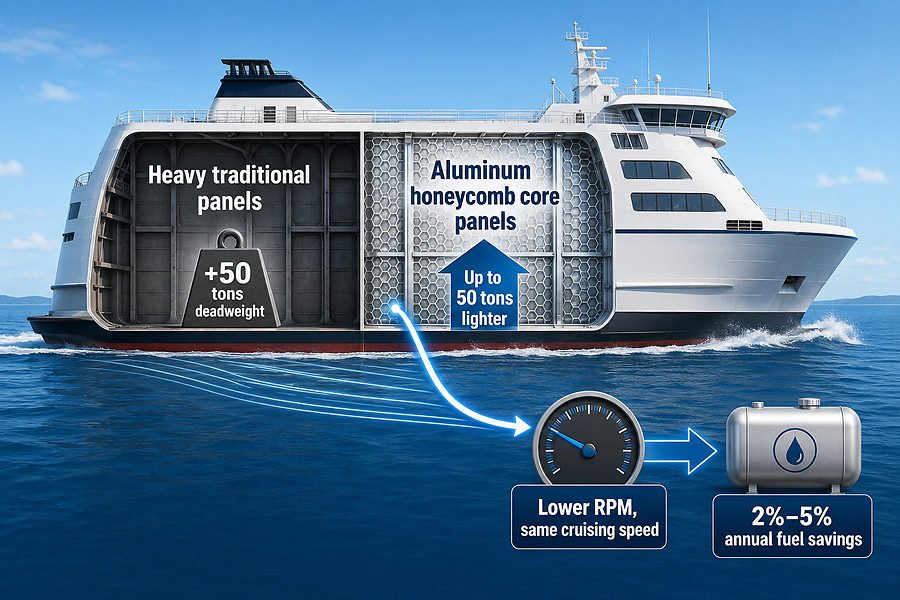
Ship owners complain to me about fuel costs all the time. Fuel is the biggest cost of running a ship. If you buy heavy panels because they are a little cheaper today, the ship owner will pay for that mistake in fuel every single day.
Calculating Fuel Savings from Reduced Panel Deadweight
It takes power to push weight through the water. Marine engineering studies state that for every 10% reduction in a ship's deadweight, you can save about 3% to 5% in fuel3. Let us look at a medium passenger ferry. The ferry uses about 5,000 square meters of wall and ceiling panels. If you use traditional panels, the outfitting weight is about 85 tons. If you use aluminum honeycomb panels, the outfitting weight drops to about 30 tons. You save 55 tons. This 55-ton drop means the ship sits higher in the water. Less water touches the hull. This reduces the wetted surface area. The ship creates less drag. The captain can lower the engine power and still travel at 20 knots.
Long-Term Financial Benefits of Lightweight Aluminum Honeycomb Panels
Let us put this into real money. A typical ferry might burn 20 tons of marine diesel oil (MDO) every day.4 The price of MDO changes, but let us say it is $800 per ton. That is $16,000 a day in fuel. If the lighter aluminum honeycomb panels save just 2% of fuel, you save 0.4 tons of fuel a day. That equals $320 saved every day.
| Metric | Heavy Mineral Wool Panels | Lightweight Aluminum Honeycomb Panels |
|---|---|---|
| Daily Fuel Burn | 20 Tons | 19.6 Tons (Assuming 2% savings) |
| Daily Fuel Cost ($800/ton) | $16,000 | $15,680 |
| Annual Cost (300 operating days) | $4,800,000 | $4,704,000 |
| Annual Money Saved | $0 | $96,000 |
This means the ship owner saves nearly $100,000 every year just because you bought the right interior panels. The panels pay for themselves very quickly.
How Does Aluminum Honeycomb Core Weight Compare to Mineral Wool Core in Marine Accommodation Panels?
You want top fire safety but hate heavy mineral wool. Heavy bulkheads slow down the factory installation. Aluminum honeycomb offers a much lighter, fast alternative.
A standard 50mm mineral wool core marine panel weighs between 16 kg/m² and 18 kg/m². In stark contrast, a 50mm aluminum honeycomb core panel weighs just 5.5 kg/m² to 7.5 kg/m². This means aluminum honeycomb is roughly 60% to 70% lighter than mineral wool.
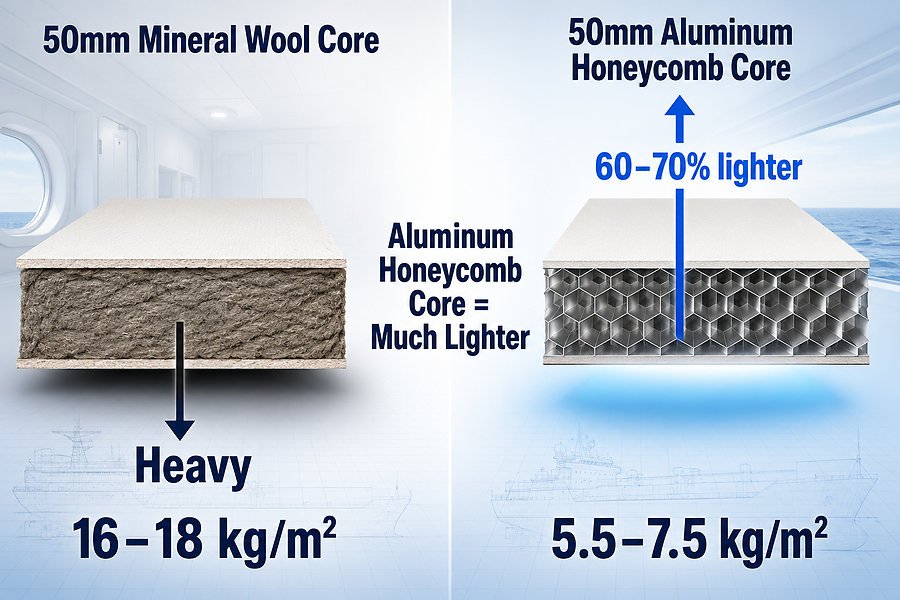
When my clients from Asia and Europe visit our factory, they are always shocked when they pick up an aluminum honeycomb panel. You can lift it with one hand. Try doing that with a rockwool panel, and you will hurt your back.
Detailed Weight Breakdown of Mineral Wool vs. Aluminum Honeycomb Cores
Let us look at why these numbers are so different. A marine panel has two parts: the steel or aluminum skins on the outside, and the core on the inside. Mineral wool, or rockwool, is made by melting rocks and spinning them into fibers. To pass the SOLAS A-class or B-class fire tests, this rockwool must be very dense. A normal marine rockwool core has a density of 120 kg/m³ to 150 kg/m³.
On the other hand, an aluminum honeycomb core is mostly empty air. It is made of very thin aluminum foil glued together in hexagon shapes. The density of a marine aluminum honeycomb core is only 20 kg/m³ to 30 kg/m³. Even with the metal skins on the outside, the final panel weight is extremely low. A normal 50mm aluminum honeycomb panel stops at about 6 kg/m². A normal 50mm rockwool panel starts at 16 kg/m².5
Installation Speed and Labor Cost Advantages of Lighter Panels
Weight is not just about the ship in the water. Weight matters in the shipyard. Heavy panels need more workers to carry them. They need cranes. Workers get tired fast. When I worked on the factory floor, I saw this clearly. Light aluminum honeycomb panels speed up the work.
| Feature | 50mm Mineral Wool Panel | 50mm Aluminum Honeycomb Panel |
|---|---|---|
| Core Density | 120 - 150 kg/m³ | 20 - 30 kg/m³ |
| Total Panel Weight | 16 - 18 kg/m² | 5.5 - 7.5 kg/m² |
| Workers Needed to Carry | 2 Workers | 1 Worker |
| Worker Fatigue Level | High | Low |
| Installation Speed | Slow | Fast |
If you are buying for a large shipyard, saving time means saving huge amounts of money on labor. One worker can carry and install an aluminum honeycomb panel by themselves. This cuts your installation labor costs in half.6
How Much Payload Do Aluminum Honeycomb Core Marine Accommodation Panels Add Back?
Every ton of heavy outfitting means one less ton of paying cargo. This directly hurts the owner's profits. Lighter panels let you carry more goods or people.
On a typical 100-meter Ro-Pax ferry requiring 5,000 square meters of interior paneling, switching to aluminum honeycomb core panels saves roughly 50 to 60 metric tons of weight. This allows the vessel to add back 50 to 60 tons of payload, equaling about 30 to 40 extra cars.
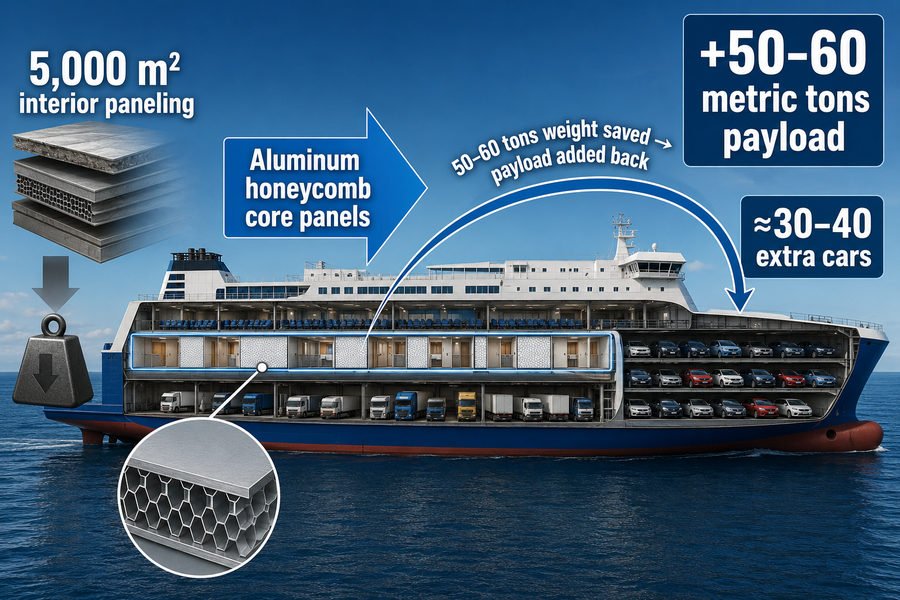
When you build a ship, the total weight the ship can hold is fixed. This is called displacement. If the ship itself is heavy, you cannot put much cargo inside. If the ship is light, you can pack it full of cargo.
Calculating Payload Gains on a 100-Meter Ro-Pax Ferry Using Aluminum Honeycomb Panels
Let us do the math clearly. A Ro-Pax ferry carries both passengers and cars. A 100-meter ferry needs about 5,000 square meters of panels7 for cabins, public spaces, and crew areas.
We know the weight difference. A traditional rockwool panel is 17 kg/m². An aluminum honeycomb panel is 6 kg/m².
The difference is 11 kilograms for every single square meter.
Multiply 5,000 m² by 11 kg/m². The answer is 55,000 kilograms. That is 55 metric tons.
Because the ship is 55 tons lighter, the captain can load exactly 55 tons more cargo before the ship sinks to its maximum waterline limit8.
Revenue Impact of Added Cargo Capacity via Lightweight Panels
This weight means real business. The ship owner makes money by moving cargo. Every extra car or container is pure profit. Let us look at what 55 tons looks like in the real world. A normal car weighs about 1.5 tons. 55 tons divided by 1.5 tons equals about 36 cars.
| Cargo Type | Weight | Payload Added by Using Honeycomb (55 Tons Total) |
|---|---|---|
| Standard Car | 1.5 Tons | ~36 Extra Cars |
| Adult Passenger | 80 kg | ~680 Extra Passengers |
| Standard 20ft Container (Empty) | 2.3 Tons | ~23 Extra Empty Containers |
If a ferry charges $50 per car, 36 extra cars mean $1,800 more profit on every single trip. If the ferry makes two trips a day, that is $3,600 extra per day. You can see why smart buyers always ask me for aluminum honeycomb marine panels.
Do Aluminum Honeycomb Core Marine Accommodation Panels Aid IMO Tonnage and Stability Targets?
Failing IMO stability checks means very expensive redesigns. Heavy cabins make passing these tests hard. Lightweight honeycomb panels ensure you meet safety codes easily.
Yes, aluminum honeycomb core marine panels directly aid in meeting the IMO 2008 Intact Stability Code (IS Code) and EEDI targets. By drastically reducing deadweight and lowering the ship's center of gravity, these panels improve the righting lever (GZ) curve and reduce the overall carbon footprint required for propulsion.
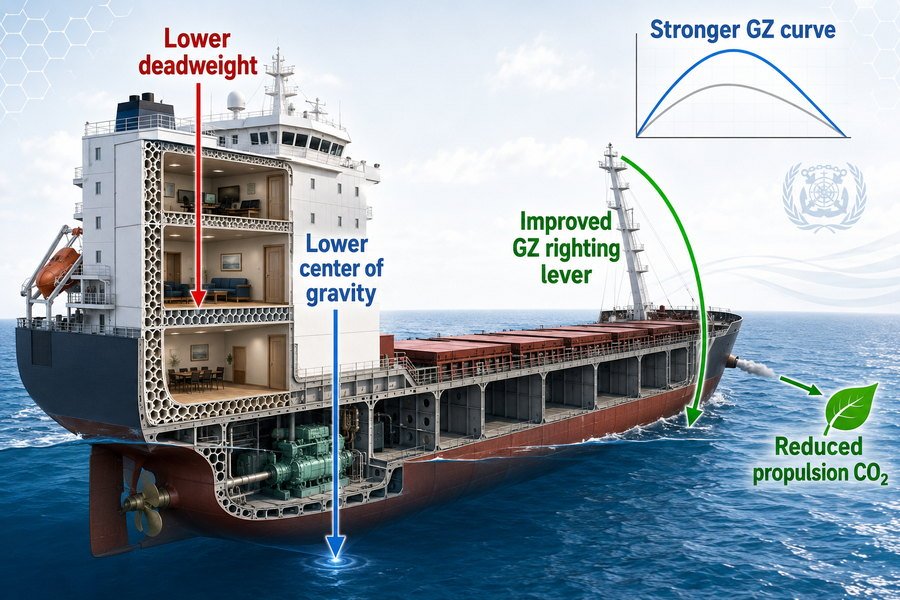
I have seen projects stop completely because the ship failed the IMO stability test on paper. The designers had to go back and find ways to cut weight. It is much easier to just start with lightweight panels.
How Aluminum Honeycomb Panels Improve the IMO Intact Stability (IS) Code GZ Curve
The IMO 2008 IS Code is the bible for ship safety. It requires ships to have a specific righting lever curve, called the GZ curve. This curve shows how well a ship will bounce back when a wave pushes it to the side. To pass this code, the area under the GZ curve must meet strict numbers.
If the top of the ship is heavy, the GZ curve is weak. The ship might tip over. By using aluminum honeycomb panels, we remove 50 to 60 tons from the top decks. This lowers the center of gravity. A lower center of gravity creates a stronger GZ curve.9 The ship passes the IMO code without needing to add extra ballast water at the bottom, which would just make the ship heavier and slower.
Meeting IMO Energy Efficiency Design Index (EEDI) with Aluminum Honeycomb Panels
The IMO also has rules about pollution. This is the EEDI. It forces new ships to be more energy efficient. The EEDI formula looks at how much CO2 the ship creates compared to the cargo it carries.10
| IMO Regulation | Goal | How Aluminum Honeycomb Panels Help |
|---|---|---|
| 2008 IS Code | Keep ship from tipping over | Lowers center of gravity, improves GZ curve |
| EEDI | Reduce CO2 emissions | Lowers ship weight, reduces fuel burned per ton of cargo |
| Deadweight Rules | Maximize safe loading | Decreases lightship weight, increases safe cargo limits |
Because aluminum honeycomb panels cut the total weight of the ship, the engine burns less fuel to move the same amount of cargo. Less fuel burned means less CO2 in the air. This directly lowers the ship's EEDI score, helping the shipyard meet the strict environmental laws of Europe and the United States.
Why Choose Aluminum Honeycomb Core Over Plywood Core for High-Speed Craft Marine Accommodation Panels?
Plywood is cheap but heavy and prone to moisture damage. High-speed crafts need absolute minimum weight. Aluminum honeycomb is lighter, fire-safe, and never rots.
For High-Speed Craft (HSC), aluminum honeycomb core panels are chosen over plywood because they are 50% lighter, completely non-combustible, and impervious to moisture. Plywood weighs about 12-14 kg/m² and burns, whereas 6 kg/m² aluminum honeycomb panels pass the strict IMO HSC Code fire safety rules while maximizing sprint speeds.
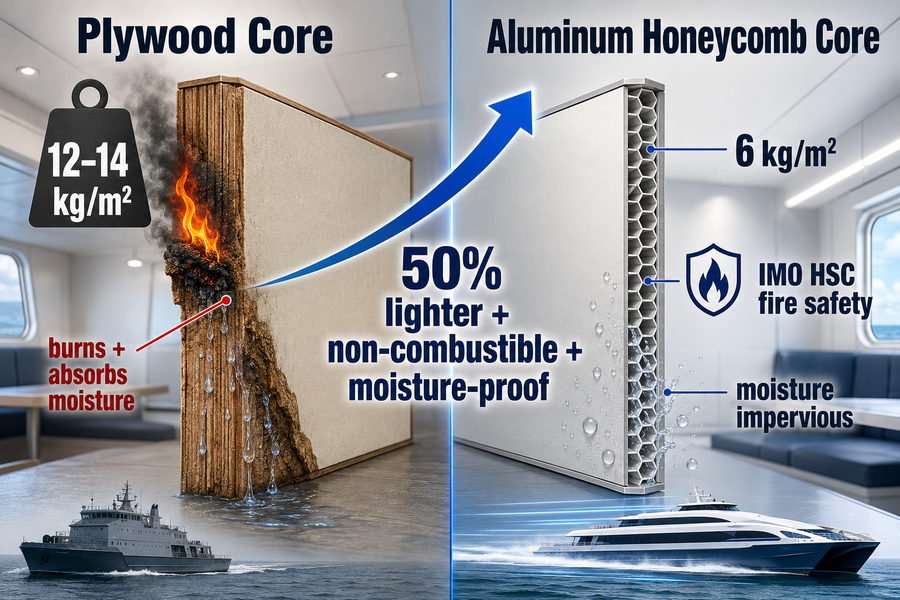
High-speed ferries and patrol boats are totally different from normal ships. They skim on top of the water. Weight is their biggest enemy. I always tell buyers that using plywood on a high-speed boat is a big mistake.
Strict Weight Limits and Performance Metrics for High-Speed Craft
A high-speed craft needs to go fast, usually over 30 knots. To do this, the hull is made of light aluminum. It makes no sense to put heavy wood panels inside a light aluminum hull. A standard marine plywood panel used for walls weighs around 12 kg/m² to 14 kg/m²11. An aluminum honeycomb panel weighs only 6 kg/m². This means the aluminum honeycomb is more than 50% lighter. On a fast ferry, saving 10 tons of weight can add 1 or 2 full knots to the top speed12. This means shorter trip times and happier passengers.
Fire Safety and Moisture Resistance: Aluminum Honeycomb vs. Plywood
There is a bigger problem with plywood: fire and water. The IMO High-Speed Craft (HSC) Code has very strict fire rules. Plywood is wood. It burns. You have to treat it with heavy chemicals to slow the fire down, but it still makes smoke. Aluminum honeycomb is metal. It does not burn at all. It gives you perfect non-combustible safety.
Also, ships are wet. Plywood absorbs water from the ocean air. Over time, it gets heavier, rots, and smells bad. Aluminum never absorbs water.
| Material Type | Weight (per m²) | Fire Safety (IMO HSC Code) | Moisture Resistance |
|---|---|---|---|
| Marine Plywood | 12 - 14 kg | Poor (Requires heavy chemical treatments) | Poor (Absorbs water, rots) |
| Aluminum Honeycomb | 5.5 - 7.5 kg | Excellent (Non-combustible) | Excellent (Waterproof, no rot) |
For any high-speed project, aluminum honeycomb is the only smart choice. It protects the ship from fire, keeps the speed high, and lasts much longer than wood.
Conclusion
Aluminum honeycomb core panels drastically cut weight, boost speed, save fuel, and increase payload. As a marine outfitting specialist, I always recommend them to improve your ship's efficiency and profit.
-
"[PDF] RESOLUTION MSC.267(85) (adopted on 4 December 2008 ...", https://wwwcdn.imo.org/localresources/en/KnowledgeCentre/IndexofIMOResolutions/MSCResolutions/MSC.267(85).pdf. The IMO International Code on Intact Stability sets internationally recognized intact-stability criteria for ships, including criteria related to initial metacentric height and righting-arm characteristics. Evidence role: historical_context; source type: institution. Supports: The International Maritime Organization regulates ship intact stability through the Intact Stability Code.. Scope note: The Code establishes regulatory stability criteria; it does not by itself verify the article’s specific panel-weight calculations or safety outcome. ↩
-
"[PDF] COURSE OBJECTIVES CHAPTER 4 4. STABILITY - USNA", https://www.usna.edu/NAOE/_files/documents/Courses/EN400/02.04%20Chapter%204.pdf. Naval-architecture stability theory defines GM as the distance between the vessel’s center of gravity and metacenter; lowering the center of gravity, with the metacenter otherwise unchanged, increases GM and initial stability. Evidence role: mechanism; source type: education. Supports: Removing weight from high locations or moving weight lower increases metacentric height in the general stability model.. Scope note: This supports the general hydrostatic mechanism; the actual GM change for a specific vessel depends on its loading condition, geometry, free-surface effects, and stability calculations. ↩
-
"Improving the energy efficiency of ships", https://www.imo.org/en/ourwork/environment/pages/improving%20the%20energy%20efficiency%20of%20ships.aspx. A naval architecture or marine energy-efficiency study should be cited to support the modeled relationship between vessel weight/displacement reduction and fuel-consumption reduction, noting that the percentage savings vary with hull form, speed, loading condition, and operating profile. Evidence role: statistic; source type: paper. Supports: A 10% reduction in ship weight/deadweight can yield roughly 3%–5% fuel savings.. Scope note: The article applies a general weight-reduction estimate to interior panel weight; many studies discuss displacement or lightweight changes rather than deadweight in the strict naval-architecture sense. ↩
-
"[PDF] 2020 report of fuel oil consumption data submitted to the IMO Ship ...", https://wwwcdn.imo.org/localresources/en/OurWork/Environment/Documents/Air%20pollution/MEPC%2077-6-1%20-%202020%20report%20of%20fuel%20oil%20consumption%20data%20submitted%20to%20the%20IMO%20Ship%20Fuel%20Oil%20Consumption%20Database%20in%20GISIS.pdf. A ferry operations report, government inventory, or peer-reviewed emissions study can provide contextual fuel-consumption ranges for passenger or RoPax ferries, supporting the plausibility of a 20-ton-per-day assumption while showing that actual use depends on route length, speed, vessel size, and duty cycle. Evidence role: statistic; source type: government. Supports: A ferry can plausibly consume about 20 tons of marine diesel oil per day.. Scope note: This would support the assumption as plausible for some ferries, not as a universal figure for all medium passenger ferries. ↩
-
"Aluminum Honeycomb vs. Rock Wool: How Do Fire Ratings and ...", https://magellanmarinetech.com/aluminum-honeycomb-rock-wool-how-fire-ratings-ship-areas-determine-marine-panel-selection/. Marine classification or type-approval data for 50 mm sandwich panels report substantially lower areal mass for aluminum-honeycomb-core panels than for mineral-wool-core fire panels, supporting the stated weight contrast. Evidence role: statistic; source type: institution. Supports: A normal 50 mm aluminum honeycomb panel weighs about 6 kg/m², while a normal 50 mm rockwool panel starts at about 16 kg/m².. Scope note: The precise kg/m² values are model-specific and depend on skin gauge, core grade, adhesive system, and fire rating. ↩
-
"[PDF] B-118779 Ways To Increase U.S. Shipbuilding Productivity", https://www.gao.gov/assets/b-118779-095788.pdf. A time-and-motion or labor-productivity study of prefabricated panel installation can support whether reducing crew size from two installers to one lowers direct installation labor by about 50%. Evidence role: statistic; source type: research. Supports: Using one worker instead of two to carry and install aluminum honeycomb panels cuts installation labor costs in half.. Scope note: Such evidence would only apply under comparable panel sizes, site logistics, safety rules, and installation tasks; it would not automatically include overhead, supervision, equipment, or rework costs. ↩
-
"(PDF) Design of a Double Ended Ferry - Academia.edu", https://www.academia.edu/101268706/Design_of_a_Double_Ended_Ferry. A naval-architecture or ferry-design source can contextualize typical accommodation and interior-outfitting areas for Ro-Pax vessels of this size; such evidence would support the order of magnitude but would not prove that every 100-meter ferry requires exactly 5,000 m² of panels. Evidence role: general_support; source type: education. Supports: A 100-meter Ro-Pax ferry may require roughly 5,000 square meters of interior panels for cabins, public spaces, and crew areas.. Scope note: Panel area depends on vessel layout, passenger capacity, cabin mix, fire zones, and operator specifications. ↩
-
"International Convention on Load Lines", https://www.imo.org/en/About/Conventions/Pages/International-Convention-on-Load-Lines.aspx. Sources on ship deadweight and load lines explain that reducing lightship weight can increase the available deadweight margin before the assigned load-line draft is reached; this supports the displacement principle but not the operational claim that the saved weight converts exactly into 55 tons of saleable cargo on every voyage. Evidence role: mechanism; source type: institution. Supports: A reduction in ship lightweight can increase the available deadweight capacity up to the vessel’s load-line limit.. Scope note: Actual additional payload may be constrained by stability, deck space, axle loads, passenger-certification limits, fuel and stores, route rules, and cargo mix. ↩
-
"[PDF] COURSE OBJECTIVES CHAPTER 4 4. STABILITY - USNA", https://www.usna.edu/NAOE/_files/documents/Courses/EN400/02.04%20Chapter%204.pdf. Naval-architecture stability references explain that the righting lever GZ is governed by the relative positions of the center of gravity and buoyancy, and that lowering the vertical center of gravity generally increases metacentric height and righting arms, supporting the stated stability mechanism. Evidence role: mechanism; source type: education. Supports: Lowering a ship’s center of gravity improves the GZ/righting-lever curve.. Scope note: This supports the general stability relationship, not the specific magnitude of improvement for any particular ship or panel installation. ↩
-
"[PDF] Ship Energy Efficiency Regulations and Related Guidelines", https://wwwcdn.imo.org/localresources/en/OurWork/Environment/Documents/Air%20pollution/M2%20EE%20regulations%20and%20guidelines%20final.pdf. IMO EEDI materials define the Energy Efficiency Design Index as a measure of a ship’s estimated CO2 emissions relative to transport work or capacity-distance, supporting the description of EEDI as a CO2-per-cargo-efficiency metric. Evidence role: definition; source type: institution. Supports: EEDI evaluates new ships by relating estimated CO2 emissions to the cargo or transport work they can carry.. Scope note: This supports the regulatory concept of EEDI, but does not by itself prove that a specific lightweight material will reduce an individual vessel’s attained EEDI. ↩
-
"[PDF] Wood Handbook, Wood as an Engineering Material", https://research.fs.usda.gov/download/treesearch/37440.pdf. Engineering reference data on plywood density can be used to estimate areal mass for typical marine/interior panel thicknesses, supporting the stated order of magnitude for plywood panel weight. Evidence role: statistic; source type: government. Supports: A standard marine plywood panel used for walls weighs around 12 kg/m² to 14 kg/m².. Scope note: The source is likely to support calculated ranges from density and thickness rather than verify every commercial marine plywood wall panel directly. ↩
-
"[PDF] Chapter 7 Resistance and Powering of Ships - USNA", https://www.usna.edu/NAOE/_files/documents/Courses/EN400/02.07%20Chapter%207.pdf. Naval-architecture studies of high-speed craft resistance show that displacement affects resistance and attainable speed, providing contextual support for the claim that weight reduction can improve top speed. Evidence role: mechanism; source type: paper. Supports: On a fast ferry, saving 10 tons of weight can add 1 or 2 full knots to the top speed.. Scope note: The exact conversion of a 10-ton weight saving into a 1–2 knot speed increase depends on hull form, installed power, loading condition, and sea state, so a general source would not prove this figure for all fast ferries. ↩