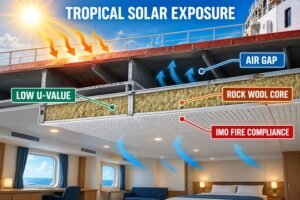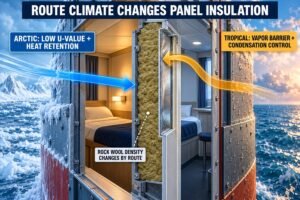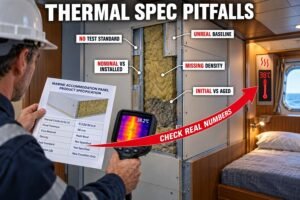
Choosing the wrong panel core puts your ship at risk of failing safety inspections. Rock wool solves this by offering unmatched fire resistance, thermal insulation, and sound reduction.
Rock wool is the standard core for marine panels because it comprehensively delivers A-class fire resistance, high acoustic dampening, excellent thermal insulation, and structural stability. It meets stringent SOLAS and IMO regulations, making it the only reliable choice for building safe, compliant, and comfortable marine accommodations.
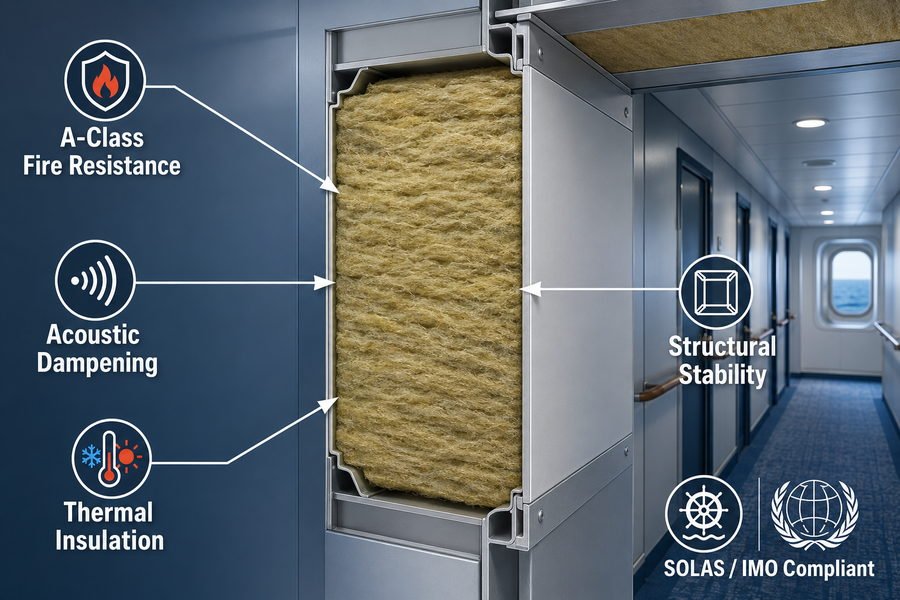
Let us look closer at why this material dominates the marine interior market and how it impacts your next outfitting project.
Why Does Rock Wool Core Reach A-Class Fire Rating in Marine Wall & Ceiling Panels?
Failing fire tests causes massive project delays. Rock wool stops fire spread dead in its tracks, giving your crew vital time to escape during an emergency.
Rock wool achieves A-Class fire ratings through its non-combustible basalt stone fibers, a high melting point exceeding 1000°C, and excellent thermal resistance. It comprehensively prevents flames and toxic smoke from passing through the panel for 60 minutes, fully satisfying the IMO 2010 FTP Code Part 3 requirements.
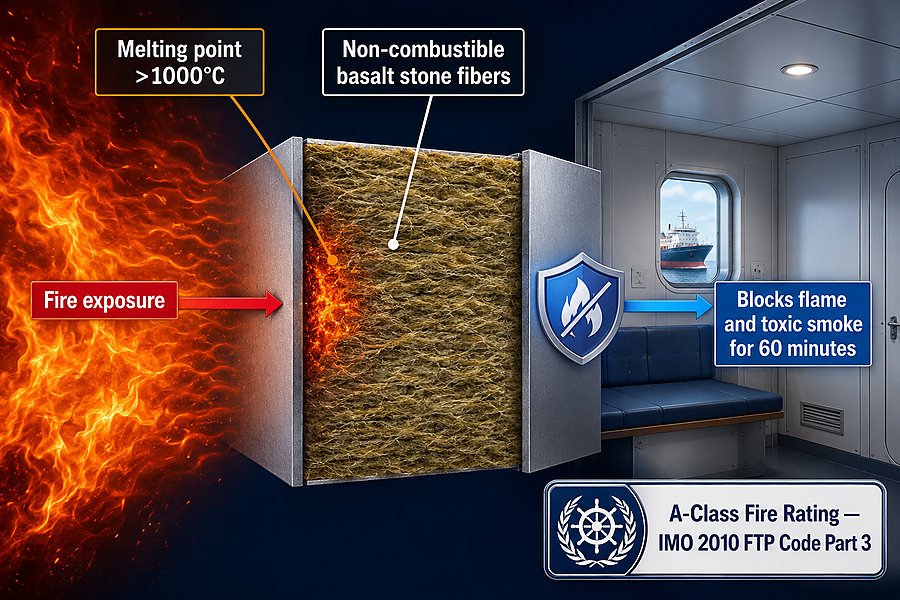
I will explain the exact mechanics of how rock wool survives extreme heat and keeps the unexposed side of the panel safe.
Basalt Stone Fibers and High Melting Point Requirements
When we talk about marine safety, the raw material of the panel core is the most important factor. Rock wool is made from melted basalt stone.1 In the factory, we melt this volcanic rock and spin it into fine fibers. Because the origin of the material is stone, it is completely non-combustible. As I mentioned in the quick answer above, these basalt fibers give the rock wool a melting point that exceeds 1000°C2. This is a very important number. During an A-Class fire test, the temperature inside the testing furnace gets incredibly hot very fast. If the core material melts, the steel skins of the wall panel will buckle, and the fire will break through. Because basalt rock wool stays solid at 1000°C, it holds the panel together and stops the flames from spreading to the next cabin.
Thermal Resistance Standards Under IMO 2010 FTP Code Part 3
Stopping the flames is only the first job. The second job is stopping the heat. The IMO 2010 FTP Code Part 3 sets strict rules for thermal resistance. For an A-60 rating, the panel must block the fire for 60 minutes. During this 60 minutes, the temperature on the safe side (the unexposed side) of the panel cannot rise more than 139°C on average above the starting temperature3. Also, no single point on the safe side can rise more than 180°C. Rock wool has a very low thermal conductivity, usually between 0.034 and 0.040 W/mK4. This means it traps the heat inside its fibers. Even when the fire side is nearly 1000°C, the safe side stays cool enough so people can touch it and escape safely.
| Fire Rating Class | Time Holding Flames (Minutes) | Max Average Temp Rise on Safe Side | Max Single Point Temp Rise | Suitable Core Material |
|---|---|---|---|---|
| A-0 | 60 Minutes | No limit | No limit | Rock Wool |
| A-15 | 60 Minutes | 139°C for first 15 mins | 180°C for first 15 mins | Rock Wool |
| A-30 | 60 Minutes | 139°C for first 30 mins | 180°C for first 30 mins | Rock Wool |
| A-60 | 60 Minutes | 139°C for full 60 mins | 180°C for full 60 mins | Rock Wool |
What Rock Wool Density Is Required for A-60 Marine Wall & Ceiling Panels?
Guessing panel density ruins both budgets and weight limits. Getting the exact rock wool density right ensures you pass A-60 without adding dead weight.
For A-60 marine wall and ceiling panels, the required rock wool density typically ranges from 120 kg/m³ to 150 kg/m³. Wall panels usually use 120-130 kg/m³ to balance weight and fire resistance, while load-bearing or high-acoustic areas may require up to 150 kg/m³ for structural integrity.
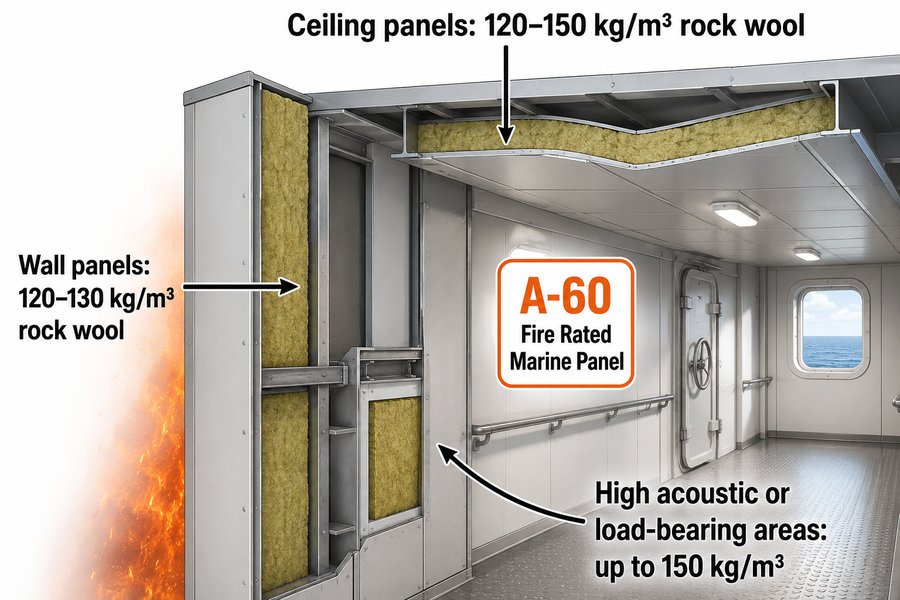
Knowing these specific density ranges helps you control shipping costs and panel handling during installation.
Density Requirements for Standard A-60 Marine Wall Panels
When I worked at the factory, I saw many buyers try to save money by ordering low-density rock wool. This is a big mistake. For standard A-60 marine wall panels, you need a density of 120 kg/m³ to 130 kg/m³5. If you use a density lower than 120 kg/m³, the panel will fail the 60-minute thermal resistance test because there is too much air and not enough stone fiber to block the heat6. Also, lower density makes the panel weak. The steel skin will not stick well to the soft core, causing the panel to bend. A density of 120 kg/m³ to 130 kg/m³ provides the perfect balance. It passes the IMO fire tests without making the panel too heavy for the shipyard workers to lift.
Using Higher 150 kg/m³ Density for Specific Marine Applications
Sometimes, a standard wall panel is not enough. You might need to build a wall near a noisy engine room, or you might need a panel that can hold heavy equipment attached to it. In these cases, we increase the density to 150 kg/m³. This high density gives the panel extra structural integrity. It is much harder and stiffer. The 150 kg/m³ density also provides better acoustic dampening7, blocking engine noise from reaching the crew cabins. However, you must remember that a 150 kg/m³ core is more expensive and much heavier. You should only use it when the project specifically requires high acoustic ratings or extra strength, not for every normal cabin wall.
| Rock Wool Density | Best Application Area | A-Class Fire Rating Capability | Key Benefit |
|---|---|---|---|
| 100 kg/m³ | B-Class Cabin Partitions | Not suitable for A-60 | Lowest weight and cost |
| 120 kg/m³ | Standard A-60 Wall Panels | Yes, passes A-60 | Good balance of weight and fire safety |
| 130 kg/m³ | Standard A-60 Ceiling Panels | Yes, passes A-60 | Slightly stiffer for hanging ceilings |
| 150 kg/m³ | Engine Room Walls / Acoustic Areas | Yes, passes A-60 easily | Best structural strength and noise reduction |
Rock Wool vs Glass Wool Core in Marine Accommodation Panels: Which Is Better?
Choosing the wrong wool wastes money and compromises safety. While both look similar, they perform very differently when a real fire breaks out.
Rock wool is significantly better than glass wool for marine accommodation panels. Rock wool comprehensively offers a higher melting point (>1000°C), superior compressive strength, and better acoustic insulation. Glass wool is lighter and cheaper but melts around 600°C, making it strictly unsuitable for A-Class marine fire boundaries.
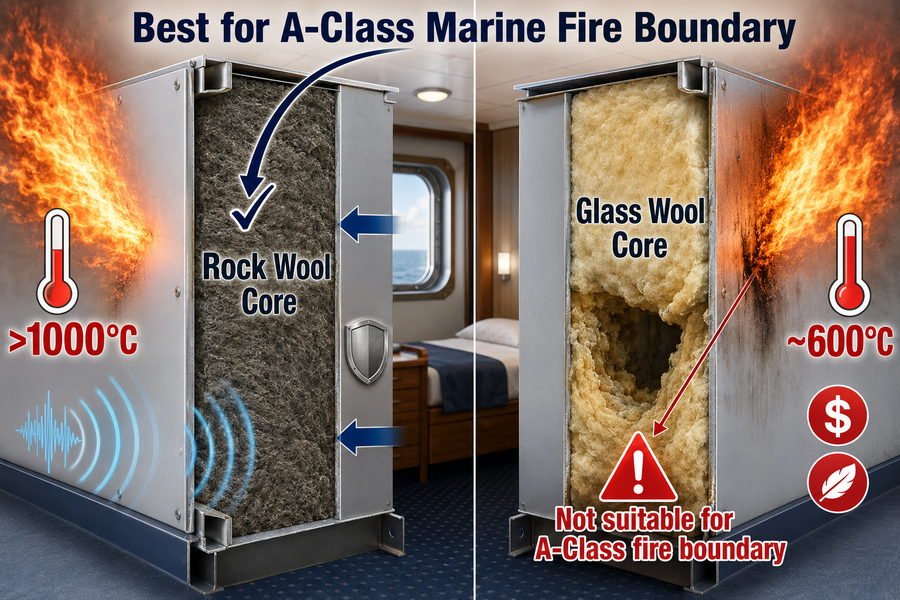
Let us break down the exact performance differences so you can make the safest and most cost-effective purchasing decision.
Comparing Melting Points and Fire Safety Limits
The biggest difference between rock wool and glass wool is how they handle extreme heat. As I noted above, rock wool has a melting point that exceeds 1000°C8. Glass wool, on the other hand, is made from melted glass and sand. It has a much lower melting point of about 600°C9. In a serious ship fire, the temperature reaches 842°C in just 30 minutes10. If you use glass wool inside an A-Class wall panel, the core will melt into liquid glass inside the steel skin within half an hour. The panel will collapse, and the fire will spread rapidly. This is why marine surveyors and classification societies do not allow glass wool as the main structural core for A-Class fire boundaries11. Rock wool stays strong past 1000°C, ensuring the fire is contained.
Compressive Strength and Acoustic Insulation Differences
Beyond fire safety, rock wool is better for daily ship operations. A ship vibrates constantly. Glass wool is very soft and lacks compressive strength. Over time, the vibration of the ship can cause the glass wool inside the panel to sag down, leaving empty spaces at the top of the wall. Rock wool has superior compressive strength. Once it is glued inside the steel skins, it stays rigid and keeps the panel perfectly flat for decades. Also, because rock wool is denser, it provides much better acoustic insulation. A dense rock wool panel will block normal conversation and engine hum much better than a light glass wool panel, keeping the crew cabins quiet and comfortable.
| Feature | Rock Wool Core | Glass Wool Core |
|---|---|---|
| Melting Point | > 1000°C | Approx. 600°C |
| Suitability for A-Class Panels | Highly Recommended (Mandatory for A-60) | Not Suitable |
| Compressive Strength | High (Remains rigid under vibration) | Low (Prone to sagging over time) |
| Acoustic Insulation | Excellent (Blocks low and high frequencies) | Moderate (Blocks high frequencies only) |
| Cost and Weight | Heavier and slightly more expensive | Lighter and cheaper |
What Melting Point Must Rock Wool Core Meet for Marine Fire Compliance?
A low melting point turns wall panels into a hazard. Knowing the exact temperature requirements ensures your ship passes all SOLAS safety inspections.
To meet marine fire compliance, rock wool core must have a melting point exceeding 1000°C (1832°F). This extremely high threshold is mandatory because the standard IMO fire test curve reaches 945°C within the first 60 minutes, and the core must remain structurally intact to prevent fire spread.
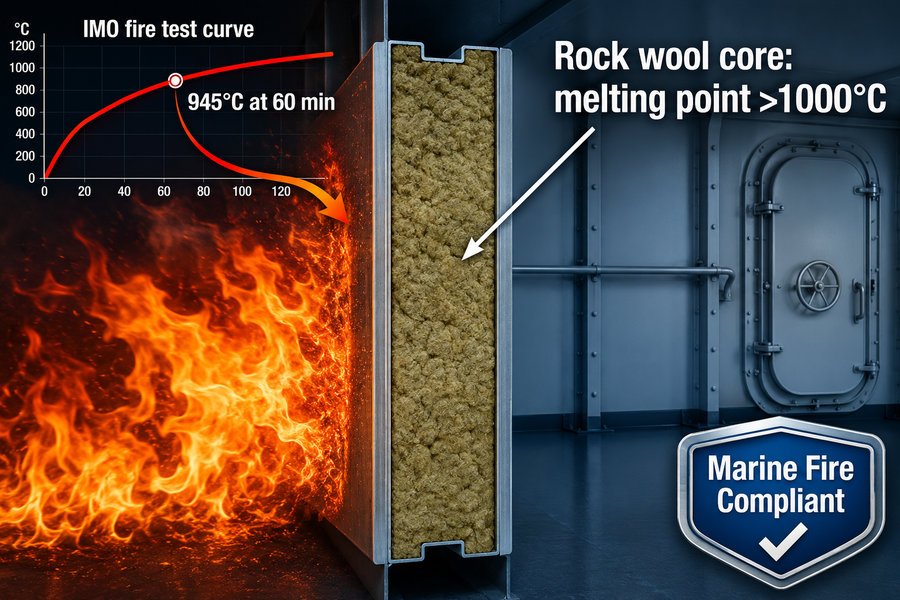
Understanding this temperature curve shows exactly why other standard insulation materials fail on ships.
Analyzing the Standard IMO Fire Test Temperature Curve
To understand why the melting point must exceed 1000°C, you have to look at how ships are tested. The International Maritime Organization (IMO) uses the ISO 834 standard fire test curve12. This curve dictates exactly how hot the testing furnace must get, and how fast. When the test starts, the temperature rises instantly. At 5 minutes, the furnace is already 576°C. At 30 minutes, it hits 842°C. By the end of the 60-minute test for an A-60 panel, the temperature reaches a massive 945°C. I have watched these tests in person, and the heat is terrifying. If the core material cannot survive this exact temperature curve, the panel fails the test and cannot be installed on a ship.
Why Structural Integrity at 1000°C Stops Fire Spread
Because the test reaches 945°C at 60 minutes, the melting point of the core must be higher than that to provide a safety margin. This is why classification societies demand a melting point exceeding 1000°C13. If a core material melts at 900°C, it turns to liquid before the test is over. When the core melts, the panel loses its structural intactness. The thin steel skins of the wall panel have nothing to support them. They will warp, tear, and open holes. Through these holes, flames will shoot into the next room, causing fire spread. Rock wool maintains its structural integrity above 1000°C.14 It stays solid, supports the steel skins, and keeps the wall standing tight, completely trapping the fire in the room where it started.
| Time in Fire Test | ISO 834 Furnace Temperature | Rock Wool Condition (Melting Point >1000°C) | Result on Panel |
|---|---|---|---|
| 5 Minutes | 576°C | Solid and intact | Steel skin heats up, core blocks heat |
| 30 Minutes | 842°C | Solid and intact | Core starts resisting intense heat transfer |
| 60 Minutes | 945°C | Solid and intact | Panel remains standing, stops fire spread |
| 120 Minutes | 1049°C | Edges begin to degrade | End of testing limit for most standard panels |
Why Does SOLAS Mandate Non-Combustible Rock Wool Core in Marine Wall & Ceiling Panels?
Toxic smoke and fast-moving flames sink ships fast. SOLAS enforces strict non-combustibility rules to save lives and protect your multi-million dollar vessel.
SOLAS mandates non-combustible rock wool core in marine panels to comprehensively prevent fire propagation, eliminate toxic smoke generation, and protect escape routes. Under IMO FTP Code Part 1, the core must not burn, sustain flames, or release hazardous gases, ensuring crew safety and vessel integrity during a fire emergency.
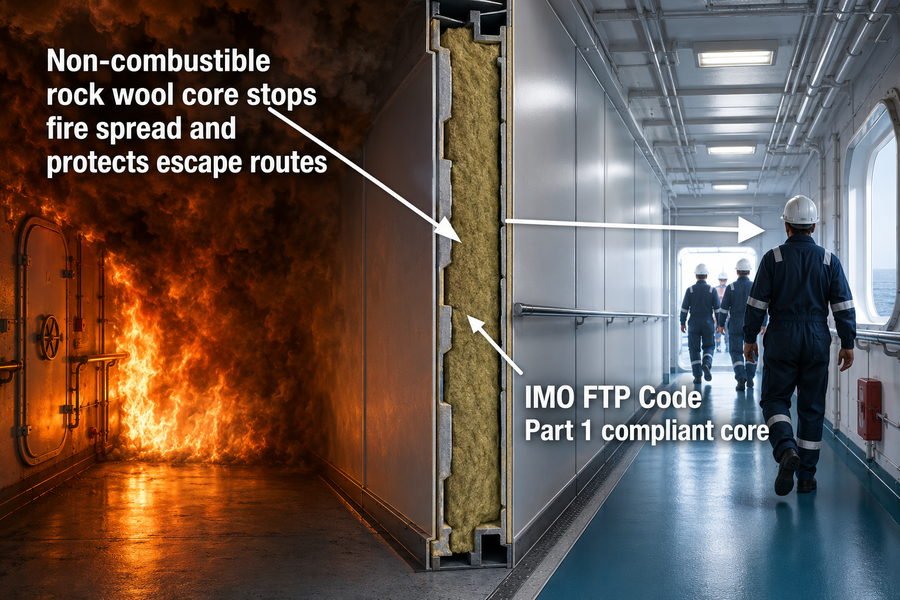
I will detail the specific non-combustibility tests that panel cores must pass to receive their marine certification.
Passing the IMO FTP Code Part 1 Non-Combustibility Test
The Safety of Life at Sea (SOLAS) convention is the supreme law for shipbuilding. SOLAS states that you cannot use materials that add fuel to a fire.15 To prove a material is safe, it must pass the IMO FTP Code Part 1 test for non-combustibility. In this test, a sample of the rock wool is put into a special furnace heated to 750°C16. To pass, the material must meet three strict conditions. First, it must not sustain flames for more than 10 seconds. Second, the temperature inside the furnace cannot rise more than 50°C above the starting 750°C, which proves the material is not burning and releasing heat. Third, the sample cannot lose more than 50% of its mass. Because rock wool is made from stone, it easily passes these tests. It simply does not burn, which is why SOLAS mandates it to prevent fire propagation.
Eliminating Toxic Smoke to Protect Crew Escape Routes
Fire propagation is only half the danger. In a ship fire, toxic smoke kills people much faster than actual flames17. A ship is a closed steel box. If a fire starts, the crew must use narrow corridors to find the lifeboats. If the wall panels burn and create thick, black, poisonous smoke, the crew will choke and lose their way. SOLAS demands non-combustible materials specifically to eliminate toxic smoke generation. When rock wool is exposed to extreme heat, it releases zero hazardous gases and generates no thick smoke18. It protects the escape routes, keeping the air clear enough so the crew can see the exit signs and breathe safely while they evacuate.
| IMO FTP Code Part 1 Test Metric | Allowed Limit for Non-Combustible Material | Rock Wool Performance |
|---|---|---|
| Furnace Temperature | Tested at 750°C | Withstands 750°C easily |
| Sustained Flaming | Maximum 10 seconds | 0 seconds (Does not flame) |
| Temperature Rise | Maximum 50°C rise | Less than 10°C rise |
| Mass Loss | Maximum 50% loss | Less than 5% loss |
| Toxic Smoke Release | Must not release hazardous gases | Zero toxic smoke produced |
How Does Rock Wool Density Affect Marine Wall & Ceiling Panel Weight?
Overweight panels increase fuel consumption and installation labor. Calculating the exact weight based on density keeps your ship design within safe operational limits.
Rock wool density directly determines panel weight. For a standard 50mm thick marine wall panel, a 100 kg/m³ density adds 5 kg per square meter, while a 150 kg/m³ density adds 7.5 kg per square meter. Higher densities provide better fire rating but significantly increase total vessel weight.
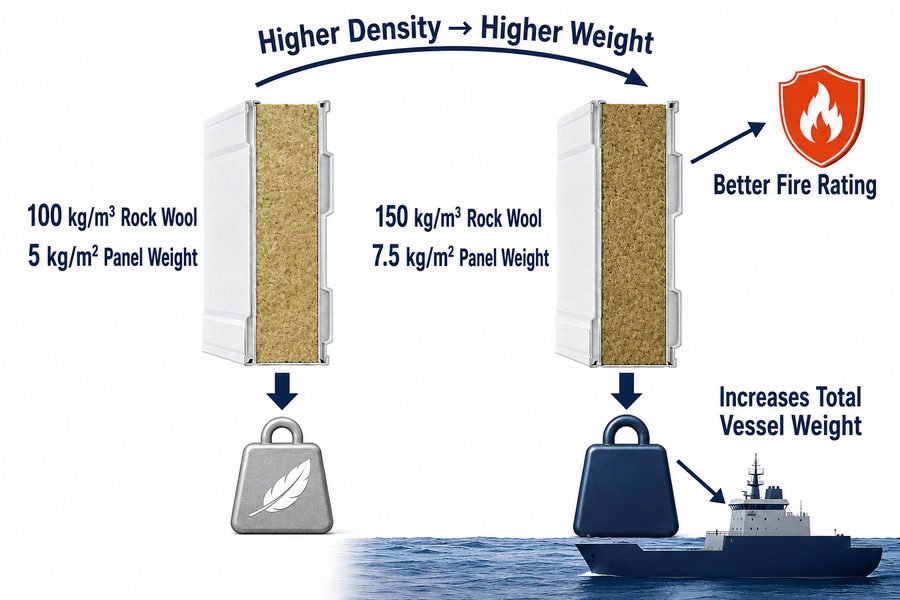
Let us calculate exactly how much weight different panel densities will add to your interior decoration project.
Calculating Rock Wool Weight Per Square Meter
When you buy panels for a large shipyard project, you must calculate the exact weight. You do not want surprises during transport or installation. The math is simple. You take the density and multiply it by the thickness in meters. Most standard marine wall panels are 50mm thick (which is 0.05 meters). If you buy a panel with a rock wool density of 100 kg/m³, the core weight is 100 multiplied by 0.05. That equals 5 kg per square meter. If you buy a heavier density of 150 kg/m³, the core weight is 150 multiplied by 0.05, which equals 7.5 kg per square meter. The steel skins on both sides add about 9 to 10 kg per square meter19 (if you use standard 0.6mm galvanized steel). So, a 50mm panel with 120 kg/m³ density will have a total vessel weight of about 15 to 16 kg per square meter.
Balancing Fire Safety Ratings with Total Vessel Weight Limits
Why does this math matter? Because weight costs money. If you are fitting out a large cruise ship or a huge offshore platform, you will use thousands of square meters of wall panels. If you use 150 kg/m³ density everywhere, you will add tons of unnecessary dead weight to the ship. This heavy weight makes the ship burn more fuel every day20. It also increases your shipping costs from Asia to your project site. A smart buyer knows how to balance weight and fire ratings. You should use the heavier 150 kg/m³ panels only where the rules strictly require it, like A-60 engine room boundaries21. For standard B-15 cabin partitions22, you can use 100 kg/m³ to save weight and money.
| Rock Wool Density | Core Weight (50mm Thick Panel) | Estimated Steel Skin Weight | Total Panel Weight per m² | Impact on Ship |
|---|---|---|---|---|
| 100 kg/m³ | 5.0 kg / m² | 10.0 kg / m² | 15.0 kg / m² | Lightest, good for fuel savings |
| 120 kg/m³ | 6.0 kg / m² | 10.0 kg / m² | 16.0 kg / m² | Standard balance for A-60 |
| 130 kg/m³ | 6.5 kg / m² | 10.0 kg / m² | 16.5 kg / m² | Slightly heavier, better stiffness |
| 150 kg/m³ | 7.5 kg / m² | 10.0 kg / m² | 17.5 kg / m² | Heaviest, increases fuel costs |
Conclusion
Rock wool is the ultimate core for marine panels. Its unmatched fire resistance, density options, and strict compliance with SOLAS ensure your ship remains safe, compliant, and well-insulated.
-
"The Influences of Moisture on the Mechanical, Morphological ... - PMC", https://pmc.ncbi.nlm.nih.gov/articles/PMC7288152/. A neutral materials reference describes rock wool/mineral wool as fibers produced by melting basalt or similar silicate rock and spinning the melt into fibers. Evidence role: definition; source type: encyclopedia. Supports: Rock wool is made from melted basalt stone.. Scope note: Some commercial stone-wool formulations include slag or other mineral additives, so the source would support the general material category rather than every product formulation. ↩
-
"Study of Industrial Grade Thermal Insulation at Elevated Temperatures", https://pmc.ncbi.nlm.nih.gov/articles/PMC7602747/. A materials or fire-safety source reports that stone wool is an inorganic mineral fiber insulation with high-temperature resistance around or above 1000°C, supporting its use where non-combustibility is required. Evidence role: general_support; source type: paper. Supports: Basalt fibers give rock wool a melting point that exceeds 1000°C.. Scope note: The exact melting or service temperature can vary with fiber chemistry, density, binder content, and test method, so the source would support the general temperature-resistance claim rather than a universal value for all products. ↩
-
"Are Marine Fire Divisions the Same as Marine Panel Ratings?", https://magellanmarinetech.com/are-marine-fire-divisions-same-as-marine-panel-ratings/. The IMO fire-test criteria for A-class divisions specify insulation performance by limiting the average temperature rise on the unexposed face during the rated period and also limiting any individual measurement point. Evidence role: expert_consensus; source type: institution. Supports: For an A-60 rating, the unexposed side temperature rise is limited during the 60-minute rating period.. Scope note: Official IMO/SOLAS wording commonly states an average limit of 140°C, so a source may contextualize the article’s 139°C figure rather than exactly reproduce it. ↩
-
"Determination of Thermal Properties of Mineral Wool Required for ...", https://pmc.ncbi.nlm.nih.gov/articles/PMC10488771/. Independent building-physics or insulation references report typical room-temperature thermal conductivity values for mineral wool in the approximate range of 0.034–0.040 W/m·K. Evidence role: statistic; source type: education. Supports: Rock wool has a low thermal conductivity, usually between 0.034 and 0.040 W/mK.. Scope note: Thermal conductivity depends on density, temperature, moisture, and product design, so the cited range should be treated as typical rather than universal. ↩
-
"How to choose the right marine wall panels for marine interior ...", https://magellanmarinetech.com/how-choose-right-marine-wall-panels-for-marine-interior-projects/. Marine type-approval documentation or class-society test reports for A-60 mineral-wool sandwich panels commonly specify core density, thickness, and construction details as part of the tested assembly; such documentation can substantiate whether a 120–130 kg/m³ rock-wool core is typical for a given certified A-60 wall-panel design. Evidence role: case_reference; source type: institution. Supports: A rock-wool density of 120–130 kg/m³ is an appropriate or typical density range for standard A-60 marine wall panels.. Scope note: A-60 approval is assembly-specific, so evidence from one tested panel design would support the density range as an example or industry practice, not as a universal rule for all A-60 panels. ↩
-
"Determination of Thermal Properties of Mineral Wool Required for ...", https://pmc.ncbi.nlm.nih.gov/articles/PMC10488771/. Peer-reviewed studies on mineral-wool insulation describe how density affects heat transfer through fibrous insulation by changing solid conduction, gas conduction, convection, and radiation within the pore structure. Evidence role: mechanism; source type: paper. Supports: Lower-density rock wool can reduce thermal resistance because the fiber-pore structure changes heat-transfer behavior inside the insulation.. Scope note: These studies explain the physical mechanism relating density and thermal performance, but they do not directly prove that every core below 120 kg/m³ will fail an IMO A-60 assembly test. ↩
-
"Providing an optimal porous absorbent pattern to reduce mid to low ...", https://pmc.ncbi.nlm.nih.gov/articles/PMC6277340/. Acoustics research on mineral-wool and porous absorbers reports that density and airflow resistivity influence sound absorption and sound transmission performance, providing context for why denser mineral-wool cores may be selected for noise-control applications. Evidence role: mechanism; source type: paper. Supports: Using a denser mineral-wool core can improve acoustic performance in some marine wall-panel applications.. Scope note: The acoustic benefit depends on the full panel assembly, frequency range, air gaps, facings, and installation; density alone does not guarantee a particular cabin-noise rating. ↩
-
"Mineral wool - Wikipedia", https://en.wikipedia.org/wiki/Mineral_wool. A neutral materials reference or mineral-wool technical source should document that stone/rock wool fibers are commonly reported to withstand temperatures above about 1000°C before melting, supporting the stated high-temperature threshold. Evidence role: definition; source type: research. Supports: Rock wool has a melting point above 1000°C.. Scope note: Reported service-temperature and melting-temperature values vary by formulation and test method, so the source should be used to support the approximate threshold rather than an exact universal value. ↩
-
"Glass wool - Wikipedia", https://en.wikipedia.org/wiki/Glass_wool. A materials-science or glass-fiber reference should support that glass wool softens or loses structural integrity at substantially lower temperatures than stone wool, with values often discussed around the 500–700°C range depending on glass composition. Evidence role: definition; source type: research. Supports: Glass wool has a substantially lower high-temperature limit than rock wool, approximately around 600°C.. Scope note: Glass wool may soften over a range rather than have a single sharp melting point, and the exact value depends on its glass composition. ↩
-
"Are Marine Fire Divisions the Same as Marine Panel Ratings?", https://magellanmarinetech.com/are-marine-fire-divisions-same-as-marine-panel-ratings/. The ISO 834/IMO fire-resistance time–temperature curve gives a furnace temperature of approximately 842°C at 30 minutes, supporting this as a standard fire-test benchmark for marine fire divisions. Evidence role: statistic; source type: institution. Supports: A standard marine fire-resistance test reaches about 842°C after 30 minutes.. Scope note: This value describes a standardized test curve rather than the measured temperature profile of every real ship fire. ↩
-
"What Is the Purpose and Scope of the IMO FTP Code? - Magellan ...", https://magellanmarinetech.com/what-purpose-scope-of-imo-ftp-code/. SOLAS/IMO FTP Code requirements for A-class divisions specify non-combustible materials and successful standard fire testing for approved divisions, providing regulatory context for why low-temperature insulation cores may be unsuitable for A-class fire boundaries. Evidence role: expert_consensus; source type: institution. Supports: A-Class marine fire boundaries must use materials and assemblies that satisfy non-combustibility and fire-resistance requirements, making unsuitable cores unacceptable.. Scope note: The regulation generally defines performance and test requirements rather than naming every prohibited insulation material, so it supports the compliance rationale more directly than a categorical ban on glass wool. ↩
-
"[PDF] RESOLUTION MSC.61(67) (adopted on 5 December 1996 ...", https://wwwcdn.imo.org/localresources/en/KnowledgeCentre/IndexofIMOResolutions/MSCResolutions/MSC.61(67).pdf. A source on the IMO FTP Code or ISO 834 time–temperature exposure would support that marine fire-resistance tests use a standardized furnace heating curve comparable to ISO 834; this establishes the testing framework but does not prove any individual panel’s certification result. Evidence role: definition; source type: institution. Supports: The International Maritime Organization uses the ISO 834 standard fire test curve for ship fire-resistance testing.. Scope note: Supports the standard test framework, not the performance of the specific panel described. ↩
-
"How to choose the right marine wall panels for marine interior ...", https://magellanmarinetech.com/how-choose-right-marine-wall-panels-for-marine-interior-projects/. A classification-society rule, IMO FTP Code provision, or marine type-approval document would support that certain insulation or core materials used in fire-rated ship divisions are required to be non-combustible and to satisfy high-temperature performance criteria; if the cited rule does not state a melting-point threshold directly, it should be treated as contextual support rather than proof of the exact 1000°C requirement. Evidence role: expert_consensus; source type: institution. Supports: Classification societies require relevant ship-panel core or insulation materials to have a melting point exceeding 1000°C.. Scope note: Some rules may specify non-combustibility or fire-test performance rather than an explicit melting point above 1000°C. ↩
-
"Determination of Thermal Properties of Mineral Wool Required for ...", https://pmc.ncbi.nlm.nih.gov/articles/PMC10488771/. A materials-science source on stone wool or mineral wool thermal behavior would support that rock wool has a melting range or high-temperature stability around or above 1000°C; this supports the material-property claim but does not by itself demonstrate full A-60 panel integrity in a certified assembly. Evidence role: mechanism; source type: paper. Supports: Rock wool remains solid or structurally stable at temperatures above 1000°C.. Scope note: Material stability alone does not prove the certified fire performance of a complete wall or panel system. ↩
-
"[PDF] MSC.99(73) - International Maritime Organization", https://wwwcdn.imo.org/localresources/en/KnowledgeCentre/IndexofIMOResolutions/MSCResolutions/MSC.99(73).pdf. An IMO or SOLAS reference should be used to show that SOLAS fire-safety provisions require fire-restricting arrangements and prescribe non-combustible materials in specified shipboard applications; this supports the regulatory basis but does not mean every material anywhere on a vessel must be non-combustible. Evidence role: historical_context; source type: institution. Supports: SOLAS states that shipbuilding materials in relevant fire-safety applications must not contribute fuel to a fire.. Scope note: SOLAS requirements vary by ship type, space, and application; the source may support the general regulatory framework rather than this absolute wording. ↩
-
"What Is the IMO FTP Code for Marine Interior Materials?", https://magellanmarinetech.com/what-imo-ftp-code-for-marine-interior-materials/. The IMO FTP Code Part 1 non-combustibility test specifies a furnace method conducted at approximately 750°C and sets criteria including limited flaming, temperature rise, and mass loss; this supports the described test conditions, subject to the exact wording and tolerances in the official code. Evidence role: definition; source type: institution. Supports: The IMO FTP Code Part 1 non-combustibility test uses a furnace heated to 750°C and evaluates flaming, temperature rise, and mass loss.. Scope note: The official FTP Code should be checked for precise tolerances, sample preparation, and calculation rules. ↩
-
"[PDF] International study of the sublethal effects of fire smoke on ...", https://nvlpubs.nist.gov/nistpubs/Legacy/TN/nbstechnicalnote1439.pdf. Fire-safety research and government fire statistics commonly identify smoke inhalation and toxic combustion products as major causes of injury and death in fires; this supports the importance of smoke toxicity in evacuation scenarios but may not prove the comparative phrase “much faster” for all ship fires. Evidence role: expert_consensus; source type: government. Supports: Toxic smoke is often a primary life-safety hazard in fires and can incapacitate occupants before direct flame contact.. Scope note: Evidence is likely general fire-safety evidence unless a maritime-specific casualty study is used. ↩
-
"Low Formaldehyde Binders for Mineral Wool Insulation: A Review", https://pmc.ncbi.nlm.nih.gov/articles/PMC8995714/. Independent test data or standards-based classifications for un-faced stone wool should be cited to show that mineral wool is non-combustible and typically has very low smoke production under fire exposure; this contextual support should not be read as proving zero emissions for every product formulation. Evidence role: general_support; source type: paper. Supports: Rock wool exposed to high heat produces no hazardous gases and no thick smoke.. Scope note: Binders, facings, adhesives, or product-specific formulations can affect smoke and gas emissions, so product test reports are needed for an absolute “zero hazardous gases” claim. ↩
-
"[PDF] Chapter 9 1. Locate the centroid (x, ӯ) of the area. 2. The steel plate ...", https://info.montgomerycollege.edu/_documents/faculty/chou/enes102/hw5.pdf. A materials-property source reporting steel density at about 7,850 kg/m³ supports estimating two 0.6 mm steel sheets at roughly 9.4 kg/m²; this verifies the mass calculation but not the exact coating or panel-fabrication allowance. Evidence role: mechanism; source type: education. Supports: Two 0.6 mm galvanized steel skins add about 9 to 10 kg per square meter to a panel.. Scope note: The source would support the density-based calculation, not a specific supplier’s finished panel weight. ↩
-
"Improving the energy efficiency of ships", https://www.imo.org/en/ourwork/environment/pages/improving%20the%20energy%20efficiency%20of%20ships.aspx. IMO or academic studies on ship energy efficiency support the general relationship between vessel displacement, resistance, and fuel consumption; this is contextual evidence and does not quantify the fuel penalty for these specific panels. Evidence role: mechanism; source type: institution. Supports: Additional vessel weight can increase fuel consumption during operation.. Scope note: The evidence would establish the general naval-architecture relationship, not a project-specific daily fuel-consumption figure. ↩
-
"Are Marine Fire Divisions the Same as Marine Panel Ratings?", https://magellanmarinetech.com/are-marine-fire-divisions-same-as-marine-panel-ratings/. SOLAS/IMO fire-safety materials define A-class divisions and require A-60 divisions to meet specified integrity and insulation criteria for 60 minutes; this supports the regulatory relevance of A-60 boundaries but not a universal rock-wool density requirement. Evidence role: definition; source type: institution. Supports: A-60-rated boundaries are a recognized higher fire-protection category in marine construction, including for machinery-space separations where required by rules.. Scope note: Fire-class rules specify performance criteria, while the exact insulation density depends on the tested and approved panel assembly. ↩
-
"What Are Marine Fire Doors?", https://magellanmarinetech.com/what-are-marine-fire-doors/. IMO/SOLAS fire-safety definitions describe B-class divisions and B-15 insulation performance as a 15-minute criterion; this supports the distinction between B-15 and A-60 fire classes, but not the claim that 100 kg/m³ rock wool is sufficient in every approved cabin partition. Evidence role: definition; source type: institution. Supports: B-15 cabin partitions are a recognized marine fire-class category with lower insulation-duration requirements than A-60 divisions.. Scope note: The source would support the fire-rating distinction; actual permissible panel density must come from the certified assembly approval. ↩