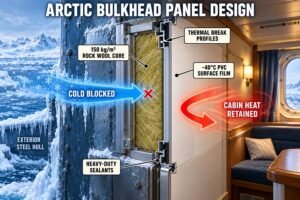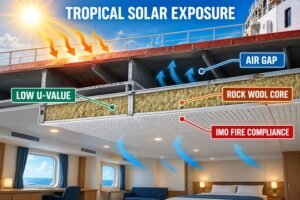
Choosing the wrong core material ruins your ship's interior. When marine accommodation panels fail inspections or lack soundproofing, it hurts your project. So, how does rock wool density change everything?
Rock wool density directly determines a marine accommodation panel's fire rating, acoustic insulation (STC), mechanical strength, and overall weight. Typical densities range from 100 kg/m³ to 150 kg/m³, balancing structural integrity for A-Class fire boundaries with lightweight needs for standard cabin partitions.
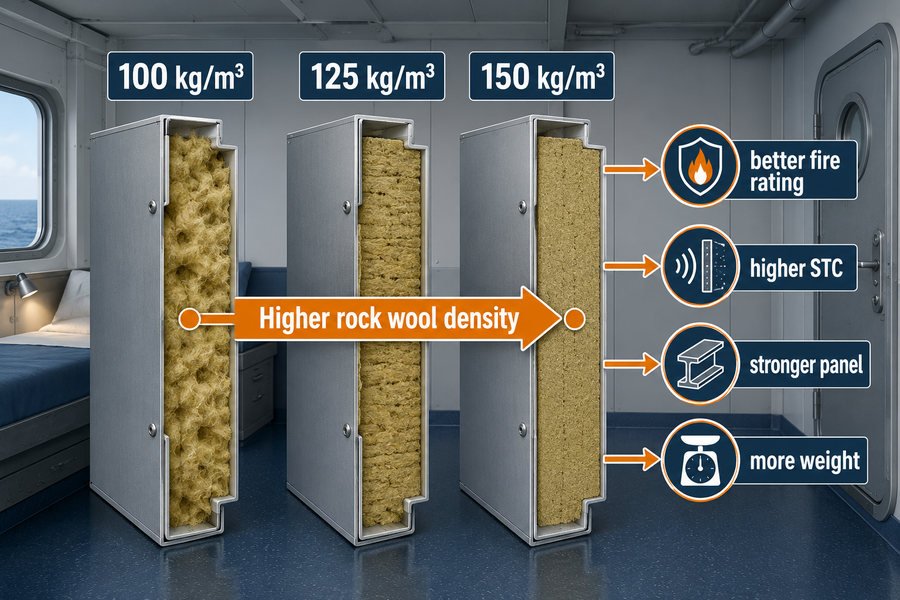
You might think more density is always better, but that is a costly trap. Let us look at the exact numbers you need to buy smart and pass inspections.
What Rock Wool Density Is Optimal for A-60 Marine Wall & Ceiling Panels?
A failed fire test costs you time and money. If you guess the core density for A-60 bulkheads, surveyors will reject them. What is the exact number you need?
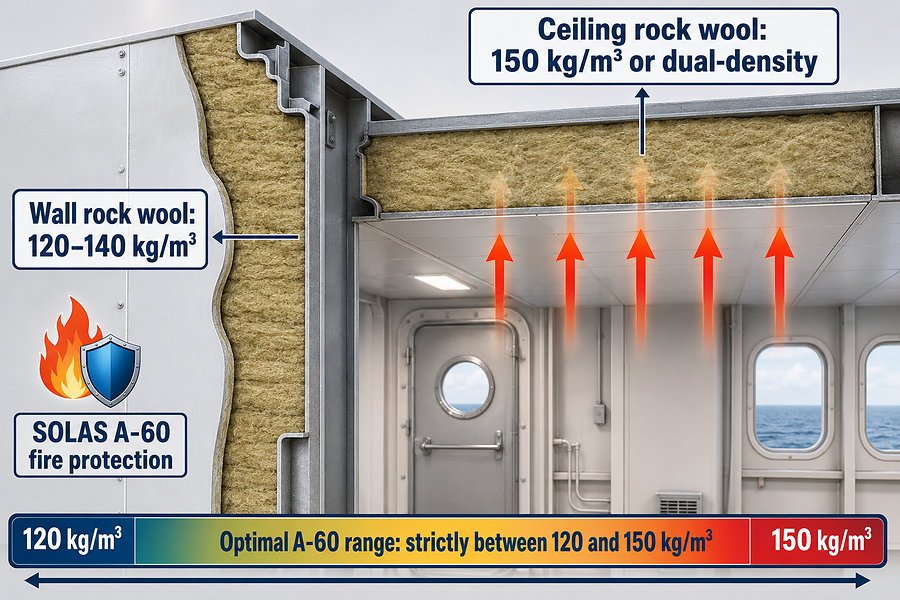
For A-60 marine wall and ceiling panels, the optimal rock wool density is strictly between 120 kg/m³ and 150 kg/m³. Wall panels typically require 120-140 kg/m³ to meet SOLAS fire tests, while A-60 ceilings often use a dual-density approach or a flat 150 kg/m³ to block vertical heat transfer.
Knowing the number is just the start. Let me explain why these specific densities are required and how they affect your buying choices from Asian factories.
SOLAS Requirements for A-60 Wall Panel Core Density
I worked in a marine outfitting factory for years before joining Magellan Marine. I learned quickly that marine wall panels must meet strict rules. The International Convention for the Safety of Life at Sea (SOLAS) sets the standard. For an A-60 rating, the bulkhead must stop fire and heat for 60 minutes.1 To achieve this, the rock wool core density must be between 120 kg/m³ and 140 kg/m³2. If you buy a panel with 100 kg/m³ density from a supplier to save money, it will fail the fire test. The heat will pass through too fast. When I help buyers source from China or Vietnam, I always check the factory's Type Approval certificate (like DNV or ABS). The certificate will state the exact density tested under the IMO 2010 FTP Code. You must ensure the mass production matches this number.
Density Variations for A-60 Marine Ceiling Panels
Ceiling panels face a harder job than wall panels. Heat rises. Therefore, A-60 marine ceiling panels often need higher rock wool density. Many certified A-60 ceiling panels use 150 kg/m³ rock wool. Some modern designs use a dual-density approach to save weight. They might use a thin 150 kg/m³ layer facing the heat, and a thicker 120 kg/m³ layer above it. As a buyer, you need to balance price and safety. A single 150 kg/m³ core is cheaper to make but heavier. Dual-density is lighter but costs more.
| Panel Type | Target Fire Rating | Required Rock Wool Density | SOLAS / IMO FTP Code Standard |
|---|---|---|---|
| Standard Wall Panel | A-60 | 120 - 140 kg/m³ | IMO Res. MSC.307(88) Part 3 |
| Standard Ceiling Panel | A-60 | 150 kg/m³ | IMO Res. MSC.307(88) Part 3 |
| Cabin Partition | B-15 | 100 - 120 kg/m³ | IMO Res. MSC.307(88) Part 3 |
How Does Higher Rock Wool Density Impact STC Rating of Marine Wall & Ceiling Panels?
Noisy cabins lead to unhappy ship owners. If your marine panels block fire but fail to block engine noise, the interior is ruined. How does density change acoustic ratings?
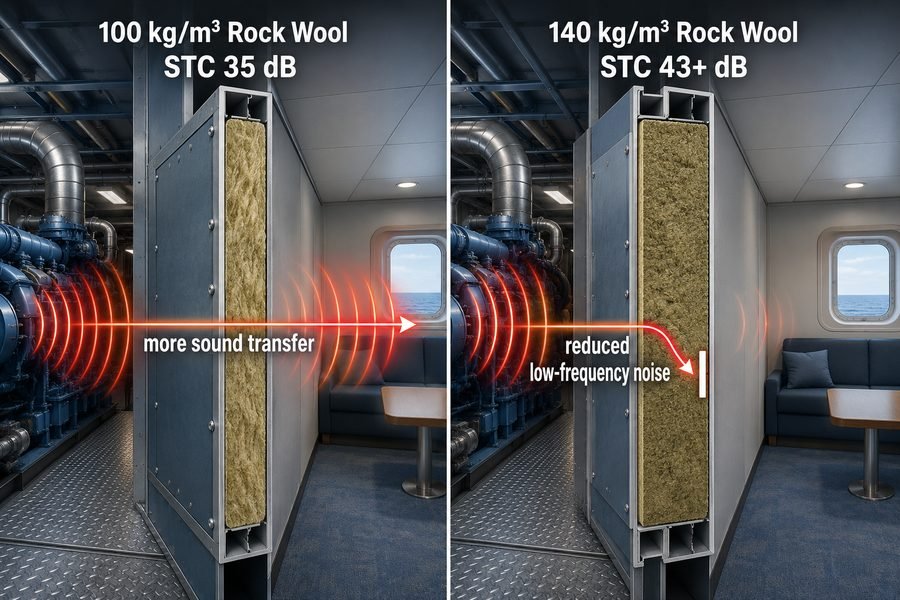
Higher rock wool density significantly improves the Sound Transmission Class (STC) rating of marine panels by adding mass and reducing low-frequency sound transfer. Moving from 100 kg/m³ to 140 kg/m³ can increase the overall STC from 35 dB to over 43 dB, effectively blocking engine and airborne noise.
Soundproofing is a major selling point for high-quality interiors. Let us break down exactly how much sound you can block by choosing the right core density.
Low-Frequency Noise Reduction Through High-Density Rock Wool
On a ship, noise is everywhere. Engines, pumps, and generators create a lot of low-frequency sound. STC measures how well a partition blocks airborne sound. In marine outfitting, mass is your best friend against low-frequency noise. According to ISO 10140 standards for laboratory measurement of sound insulation, increasing the rock wool density from 100 kg/m³ to 140 kg/m³ adds critical mass. A standard 50mm marine wall panel with 100 kg/m³ density usually provides an STC of around 35 dB. This blocks normal talking, but not engine rumble. When you upgrade to a 140 kg/m³ core, the STC rating jumps to roughly 43 dB.3 This is a huge difference. I always tell my clients: if the shipyard complains about noise, check the panel's core mass.
Diminishing Returns on Acoustic Insulation Above 150 kg/m³
However, adding more density does not always keep adding soundproofing. After you reach 150 kg/m³, you hit a limit.4 If you increase the density to 180 kg/m³, the rock wool becomes too stiff. It stops acting like a sponge for sound waves. Instead, it starts to act like a solid bridge, transmitting vibrations right through the marine panel. Therefore, the sweet spot for maximum STC rating without adding useless weight is between 130 kg/m³ and 150 kg/m³.
| Rock Wool Density (kg/m³) | Panel Thickness (mm) | Estimated STC Rating (dB) | Sound Blocking Capability |
|---|---|---|---|
| 100 | 50 | 33 - 35 | Basic speech privacy |
| 120 | 50 | 37 - 39 | Loud speech blocked |
| 140 | 50 | 41 - 43 | Engine noise reduced |
| 160 | 50 | 42 - 44 | Diminishing returns (Too rigid) |
Does Higher Rock Wool Density Always Improve Marine Panel Fire Resistance?
Buying heavier panels seems like a safe bet for fire protection. But paying for extra density can ruin your budget and cause installation failures. Is more density always better?
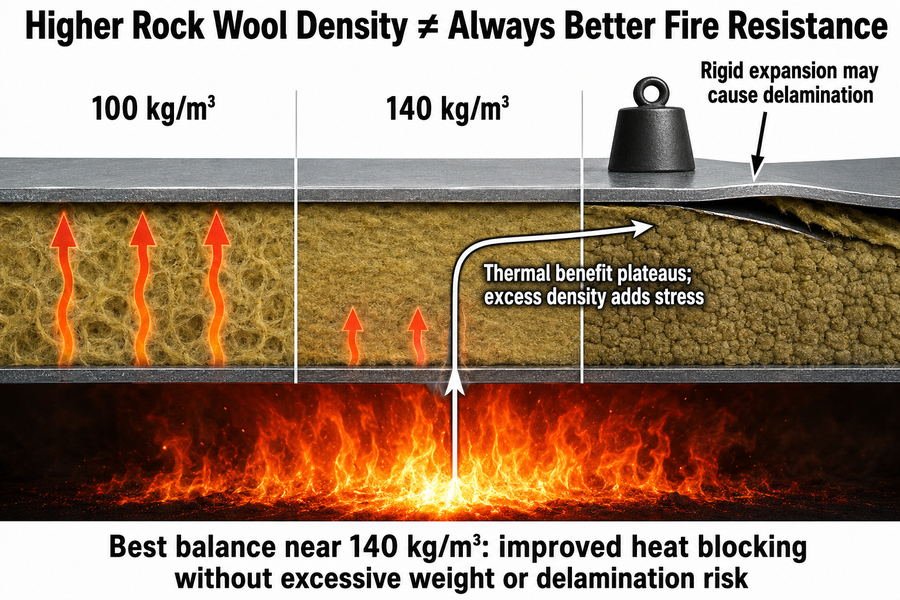
Higher rock wool density does not always improve marine panel fire resistance. While moving from 100 kg/m³ to 140 kg/m³ improves heat blocking, exceeding 150 kg/m³ provides minimal thermal benefit, increases weight drastically, and can cause the panel's steel skins to delaminate under extreme fire stress due to rigid expansion.
This is a common misunderstanding that costs buyers a lot of money in Asia. Let us dive into the science of why too much density is a bad thing.
The Thermal Blocking Limit of Rock Wool Insulation
When I first started in this industry, I thought a 160 kg/m³ marine wall panel would easily beat a 130 kg/m³ panel in a fire test. I was wrong. The IMO 2010 FTP Code measures how long a panel can stop heat transfer. Rock wool stops heat because it traps tiny pockets of air between its fibers. Air is a poor conductor of heat. When you increase the density up to about 140 kg/m³, you pack the fibers tightly, blocking heat radiation. But if you compress the rock wool past 150 kg/m³, you squeeze out too much air. The solid fibers start to touch each other too much. Solid rock conducts heat faster than trapped air. So, pushing the density past 150 kg/m³ actually stops helping5. The fire resistance stops improving, but the cost and weight keep going up.
Delamination Risks in Over-Densified Marine Wall Panels
There is another dangerous problem with using rock wool that is too dense. During an A-Class fire test, the temperature hits 945°C in 60 minutes6. The steel skins of the marine panel expand. If the rock wool core is between 120 and 140 kg/m³, it has enough flex to absorb this expansion. If the core is 160 kg/m³ or higher, it is too stiff. The glue holding the steel to the core will break. We call this delamination. Once the skin falls off, the fire destroys the core in minutes. This is why you must stick to the manufacturer's approved density, usually around 140 kg/m³.
| Core Density | Heat Conduction Risk | Delamination Risk in Fire | Overall Fire Test Performance |
|---|---|---|---|
| 100 kg/m³ | High (Too much air flow) | Low | Fails A-60 |
| 140 kg/m³ | Low (Optimal air pockets) | Low | Passes A-60 |
| 180 kg/m³ | Medium (Fiber conduction) | High (Too rigid) | High risk of failure |
What Density Tolerance Should Be Specified for Rock Wool Marine Accommodation Panels?
Factory mistakes will cost you the whole project. If the rock wool density inside your panels is uneven, the surveyor will fail your ship. What tolerance should you demand?
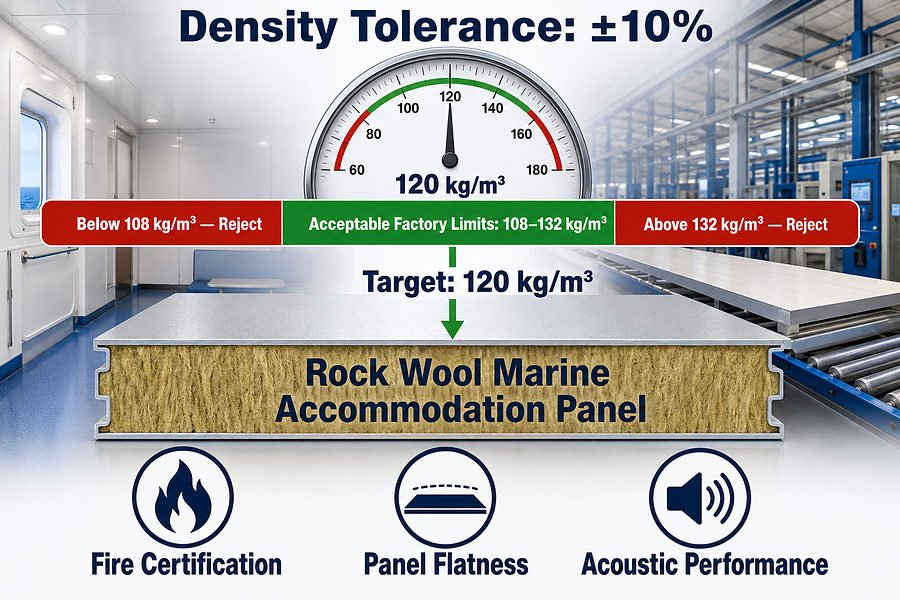
The standard density tolerance for rock wool in marine accommodation panels must be strictly specified at ±10%. For a target density of 120 kg/m³, acceptable factory limits are 108 kg/m³ to 132 kg/m³. Anything outside this range compromises fire certification, panel flatness, and acoustic performance during final installation.
Do not trust a factory that promises zero variance. That is impossible. But controlling the tolerance is how you protect your money. Let me show you how.
Establishing the Plus or Minus Ten Percent Industry Standard
In the factory where I used to work, cutting rock wool was a messy job. Rock wool is a natural mineral product, spun into fibers. Because of this manufacturing process, its density can never be exactly perfect across the whole slab. However, marine classification societies like ABS, Lloyd's Register, and DNV are very strict. Based on standard EN 1602 for thermal insulating products, the acceptable industry tolerance is ±10%7. If you order marine ceiling panels with a 150 kg/m³ core, the actual density must stay between 135 kg/m³ and 165 kg/m³. If you do not write this ±10% limit into your purchase contract, cheap suppliers will give you boards with a 20% or 30% variance. This means part of your panel might be 110 kg/m³ and fail a fire test.
Impact of Uneven Density on Marine Panel Flatness
Density tolerance is not just about fire ratings. It is also about the beauty of the interior. When we use cold press machines to glue the PVC-coated steel skins to the rock wool, the pressure must be even. If a rock wool slab has a density of 140 kg/m³ on the left and 100 kg/m³ on the right, the right side is softer. The press will crush the soft side more.8 When you take the panel out, the steel surface will look wavy. The shipyard will reject these panels. As a buyer looking for high quality at a low price, always demand a ±10% density tolerance certificate before shipping.
| Target Density | Acceptable Minimum (-10%) | Acceptable Maximum (+10%) | Impact of Failing Tolerance |
|---|---|---|---|
| 100 kg/m³ | 90 kg/m³ | 110 kg/m³ | Poor screw holding, wavy surface |
| 120 kg/m³ | 108 kg/m³ | 132 kg/m³ | Potential A-Class fire test failure |
| 150 kg/m³ | 135 kg/m³ | 165 kg/m³ | Overweight, delamination issues |
How Does Rock Wool Density Affect Screw Holding in Marine Wall & Ceiling Panels?
Hanging heavy items on cabin walls is a nightmare if the screws strip out. A weak panel core means falling TVs and broken furniture. How does density fix this?
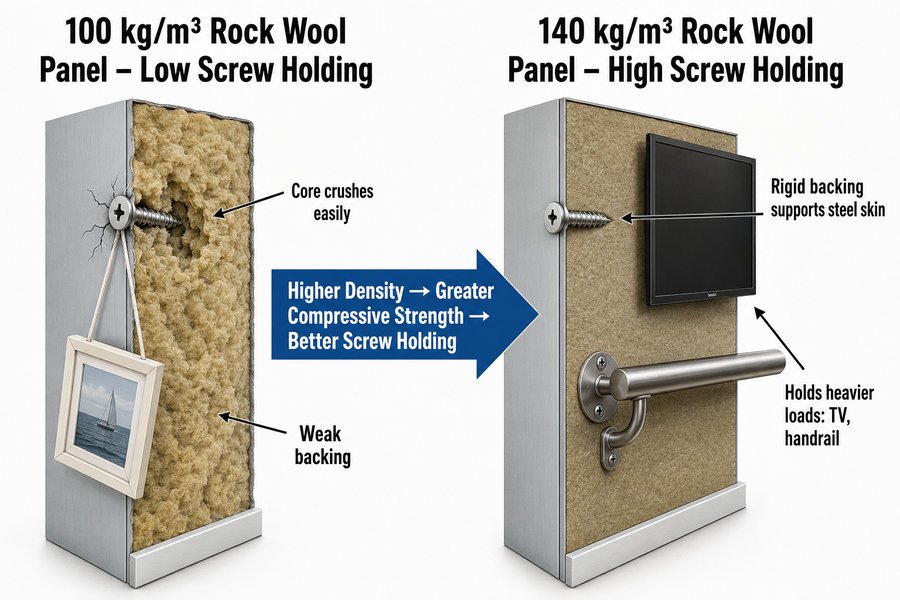
Higher rock wool density directly increases the compressive strength and screw holding capacity of marine wall and ceiling panels. While 100 kg/m³ panels barely support light picture frames, 140 kg/m³ panels offer enough rigid backing for the steel skin to secure heavier fixtures, TVs, and handrails without crushing the core.
You cannot build a safe cabin if the walls cannot hold weight. Let us look at the mechanical reasons why density matters for installation.
Compressive Strength Relationship with Core Density
Screws in a marine wall panel do not grip the rock wool itself. Rock wool is just stone fiber. The screw grips the 0.6mm galvanized steel skin. However, when you tighten a screw, or hang a heavy television on the wall, the bracket pulls on the steel skin and pushes against the panel. This pushing force needs resistance. We call this compressive strength. A low-density core, like 100 kg/m³, is too soft. When you tighten the screw, the steel skin bends inward and crushes the rock wool behind it. The screw becomes loose. Based on EN 826 standards for compressive behavior, a 140 kg/m³ rock wool board has a compressive strength of around 40 kPa (kilopascals). This is rigid enough to stop the steel skin from bending inward, giving you a strong, tight screw connection.
Practical Load Limits for High-Density Marine Accommodation Panels
I always remind my clients to plan their wall loads. If you are just hanging a lightweight mirror or a small coat hook, a standard B-15 panel with 120 kg/m³ density is perfectly fine. The steel skin and core will hold it. But if the shipyard wants you to install heavy pull-down beds, large monitors, or safety handrails, you need a stronger backing. Even with 140 kg/m³ or 150 kg/m³ density, you cannot just use normal self-tapping screws for massive weights. For items over 15 kg, we always recommend inserting a steel backing plate inside the panel during manufacturing9, regardless of the rock wool density.
| Core Density | Compressive Strength | Screw Holding Support | Recommended Wall Fixtures |
|---|---|---|---|
| 100 kg/m³ | ~20 kPa | Poor | Paper towel holders, light frames |
| 120 kg/m³ | ~30 kPa | Medium | Mirrors, standard coat hooks |
| 140 kg/m³ | ~40 kPa | Good | Small TVs, shelving brackets |
| Any Density | N/A (Requires Steel Plate) | Maximum | Handrails, fold-down beds |
Why Do Lightweight Marine Wall & Ceiling Panels Use Lower-Density Rock Wool?
Heavy ships burn more fuel and carry less cargo. If you use thick, high-density panels everywhere, ship owners will lose money. Why is lower density essential for modern ships?
Lightweight marine wall and ceiling panels use lower-density rock wool (100 kg/m³ to 120 kg/m³) primarily to reduce overall vessel weight, save fuel costs, and increase payload capacity, while still meeting the lower B-15 or C-Class fire ratings required for internal cabin partitions.
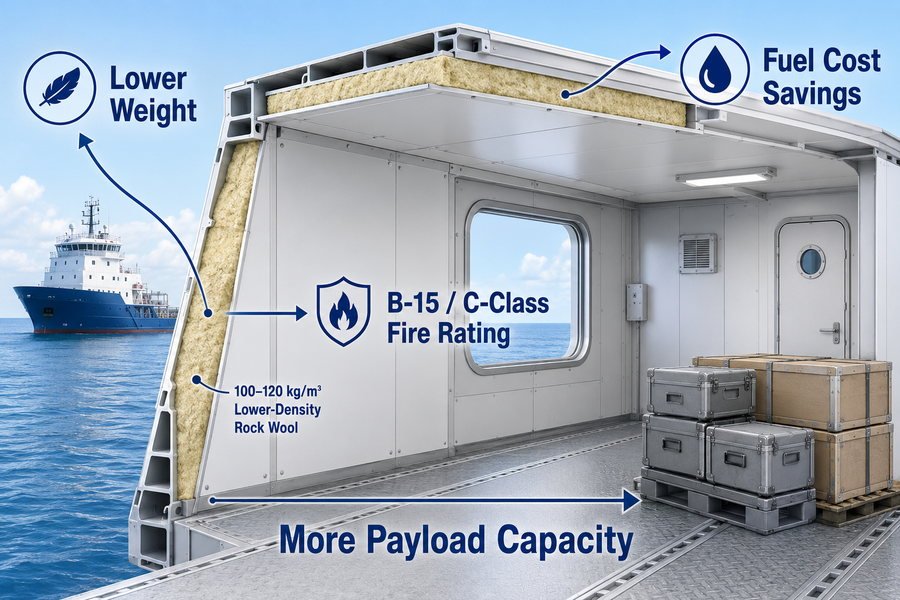
We just talked about why high density is great for fire and sound. But in shipbuilding, every extra kilogram hurts your profits. Let us balance the scales.
Fuel Efficiency and Payload Gains from Weight Reduction
On large commercial vessels or luxury cruise ships, there are thousands of square meters of marine accommodation panels. The weight adds up very fast. A standard 50mm thick marine wall panel with a 140 kg/m³ rock wool core weighs about 18.5 kg per square meter. If we drop the rock wool density to 100 kg/m³, the panel weight drops to about 16.5 kg per square meter. Saving 2 kg per square meter might sound small. But on a passenger ship with 20,000 square meters of paneling, that is a saving of 40 metric tons! According to general naval architecture principles, reducing deadweight directly lowers fuel consumption10. It also allows the ship to carry more cargo or passengers. This is why shipyards constantly ask procurement officers to find lighter materials.
Matching Core Density to B-Class and C-Class Fire Ratings
You cannot use a 100 kg/m³ lightweight panel on the main engine room wall. That requires an A-60 rating. However, most walls inside the living quarters do not face high fire risks. The walls between two passenger beds, or separating a hallway from a bathroom, usually only need a B-15 or C-Class fire rating. The SOLAS B-15 test only requires the panel to stop fire for 30 minutes, and stop heat for 15 minutes11. A lower-density rock wool core, around 100 kg/m³ to 120 kg/m³, easily passes this test. Therefore, using heavier 140 kg/m³ panels for simple cabin partitions is a waste of money and a waste of payload capacity.
| Fire Rating Requirement | Typical Core Density | Panel Weight per m² (50mm thick) | Primary Application Area |
|---|---|---|---|
| C-Class | 100 kg/m³ | 16.5 kg | Internal bathroom partitions |
| B-15 Class | 100 - 120 kg/m³ | 16.5 - 17.5 kg | Cabin to cabin dividing walls |
| A-60 Class | 140 kg/m³ | 18.5 kg | Engine room boundaries, stairwells |
Conclusion
Rock wool density shapes marine panel fire safety, acoustic performance, and weight. By matching the correct density to your specific SOLAS requirements, you balance cost, compliance, and vessel efficiency.
-
"[PDF] RESOLUTION A.754(18) adopted on 4 November 1993 ...", https://wwwcdn.imo.org/localresources/en/KnowledgeCentre/IndexofIMOResolutions/AssemblyDocuments/A.754(18).pdf. The IMO 2010 FTP Code defines A-class divisions by integrity and insulation criteria in the standard fire test, with the A-60 designation corresponding to a 60-minute insulation period under the prescribed temperature-rise limits. Evidence role: definition; source type: institution. Supports: For an A-60 rating, the bulkhead must stop fire and heat for 60 minutes.. Scope note: The standard defines test performance for the complete division assembly; it does not by itself specify a particular core material or density. ↩
-
"[PDF] RESOLUTION MSC.307(88) (adopted on 3 December 2010 ...", https://wwwcdn.imo.org/localresources/en/KnowledgeCentre/IndexofIMOResolutions/MSCResolutions/MSC.307(88).pdf. Published type-approval documentation for A-60 bulkhead assemblies commonly identifies the tested insulation material, thickness, and density, supporting the need to match production panels to the approved tested construction. Evidence role: case_reference; source type: institution. Supports: The rock wool core density for an A-60 wall panel must be between 120 kg/m³ and 140 kg/m³.. Scope note: Such certificates support density requirements for specific approved panel designs, not a universal SOLAS rule that all A-60 wall panels must use 120–140 kg/m³ rock wool. ↩
-
"(PDF) Study on Acoustics in Buildings - Academia.edu", https://www.academia.edu/52394276/Study_on_Acoustics_in_Buildings. Laboratory sound-insulation measurements on comparable mineral-wool-filled sandwich or partition panels document the STC/Rw values achieved by specific panel thicknesses, densities, facings, and mounting conditions, providing empirical context for the stated increase to about 43 dB. Evidence role: statistic; source type: paper. Supports: A 50 mm marine wall panel upgraded from a 100 kg/m³ to a 140 kg/m³ rock wool core can reach an STC rating of roughly 43 dB.. Scope note: The result would only directly support this claim if the tested assembly matches the article’s 50 mm marine panel construction; ISO 10140 defines measurement procedures but does not itself guarantee a specific STC value for a given rock wool density. ↩
-
"Providing an optimal porous absorbent pattern to reduce mid to low ...", https://pmc.ncbi.nlm.nih.gov/articles/PMC6277340/. Acoustics research on porous absorbers and lightweight partitions shows that mineral wool performance is governed by flow resistivity, stiffness, mass-air-mass resonance, and mechanical coupling, supporting the general mechanism of diminishing acoustic gains at higher densities. Evidence role: mechanism; source type: paper. Supports: Increasing rock wool density beyond about 150 kg/m³ may yield diminishing sound-insulation returns because higher density and stiffness can increase mechanical coupling or reduce absorber effectiveness in some panel assemblies.. Scope note: Such sources usually support the mechanism of diminishing returns rather than a universal cutoff at exactly 150 kg/m³, which is likely assembly-specific. ↩
-
"Determination of Thermal Properties of Mineral Wool Required for ...", https://pmc.ncbi.nlm.nih.gov/articles/PMC10488771/. A peer-reviewed study on mineral wool heat transfer reports that thermal conductivity depends nonlinearly on density because gas conduction, solid conduction, and radiative transfer contribute differently as fiber packing changes. Evidence role: mechanism; source type: paper. Supports: Rock wool insulation does not necessarily keep improving thermally at densities above about 150 kg/m³ because reduced air volume and increased solid contact can offset gains from reduced radiative transfer.. Scope note: Such studies support the physical mechanism and the existence of an optimal density range, but they may not prove the article’s exact 150 kg/m³ threshold for every marine wall-panel construction. ↩
-
"How Does the IMO FTP Code Connect with Other Marine Fire Safety ...", https://magellanmarinetech.com/how-imo-ftp-code-connect-with-other-marine-fire-safety-frameworks/. The IMO FTP Code time-temperature curve for fire-resistance testing specifies furnace temperatures that rise to approximately 945°C at 60 minutes for relevant fire test procedures. Evidence role: definition; source type: institution. Supports: An A-Class fire test under the IMO FTP framework reaches about 945°C after 60 minutes.. ↩
-
"Determination of Thermal Properties of Mineral Wool Required for ...", https://pmc.ncbi.nlm.nih.gov/articles/PMC10488771/. A standards or classification source should show whether mineral-wool density acceptance is commonly specified as a ±10% tolerance; EN 1602 can support the method for measuring apparent density of thermal insulation products, but it does not by itself establish a universal procurement tolerance. Evidence role: expert_consensus; source type: institution. Supports: Based on standard EN 1602 for thermal insulating products, the acceptable industry tolerance is ±10%.. Scope note: Support may be contextual unless a product standard, classification rule, or procurement specification explicitly states the ±10% acceptance limit for this marine-panel use case. ↩
-
"[PDF] Mechanical Properties Characterization of Composite Sandwich ...", https://ntrs.nasa.gov/api/citations/19880000739/downloads/19880000739.pdf. Research on mineral-wool or sandwich-panel mechanics can support that lower-density core regions generally have lower compressive stiffness or strength, making them more susceptible to deformation under pressing loads; this supports the physical mechanism but may not prove the exact defect rate in marine ceiling-panel production. Evidence role: mechanism; source type: paper. Supports: If one side of a rock-wool slab has lower density, it is softer and will be compressed more during cold pressing, contributing to surface waviness.. Scope note: The evidence would likely establish the material-mechanics relationship rather than directly document this specific factory pressing process. ↩
-
"How to choose the right marine wall panels for marine interior ...", https://magellanmarinetech.com/how-choose-right-marine-wall-panels-for-marine-interior-projects/. Engineering guidance for lightweight or sandwich wall panels can support the principle that concentrated heavy fixtures require structural backing or reinforcement rather than relying only on thin skins and insulation cores. Evidence role: expert_consensus; source type: institution. Supports: Heavy wall-mounted items on marine accommodation panels should use an internal steel backing plate rather than relying only on self-tapping screws and rock wool density.. Scope note: Such sources may support the need for reinforcement for heavy concentrated loads, but may not independently validate the article’s specific 15 kg threshold for marine accommodation panels. ↩
-
"Improving the energy efficiency of ships", https://www.imo.org/en/ourwork/environment/pages/improving%20the%20energy%20efficiency%20of%20ships.aspx. Naval architecture literature treats vessel displacement as a key determinant of resistance and required propulsive power; reducing onboard weight can therefore lower fuel consumption for a comparable speed and operating profile. Evidence role: mechanism; source type: paper. Supports: Reducing vessel weight can reduce fuel consumption.. Scope note: The relationship is not a fixed proportional rule; actual fuel savings depend on hull form, speed, loading condition, weather, and operating practices. ↩
-
"What Is the Purpose and Scope of the IMO FTP Code? - Magellan ...", https://magellanmarinetech.com/what-purpose-scope-of-imo-ftp-code/. The IMO Fire Test Procedures Code defines B-class divisions as preventing flame passage for 30 minutes and sets insulation criteria for B-15 divisions based on limiting temperature rise on the unexposed side for the first 15 minutes. Evidence role: definition; source type: institution. Supports: A B-15 fire rating involves 30 minutes of flame integrity and 15 minutes of insulation performance under the IMO/SOLAS fire test framework.. Scope note: This supports the regulatory meaning of the B-15 rating, not whether any specific lightweight panel construction will pass the test. ↩