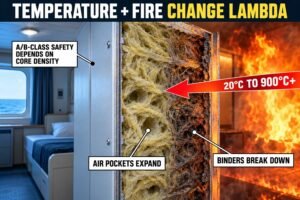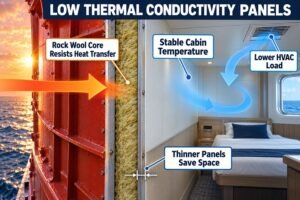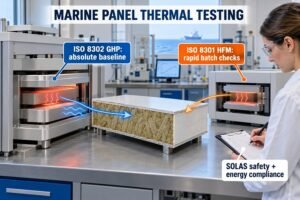
Panel failures cost you time and money. Weak cores cause sagging ceilings and warped walls. I will show you exactly which rock wool properties ensure your panels survive harsh seas.
The most critical mechanical properties for marine rock wool cores are tensile strength, shear strength, compressive strength, and bonding strength. Together with proper fiber orientation, these five factors completely determine load capacity, prevent delamination, stop sagging, and ensure structural integrity under IMO resolution MSC.307(88).
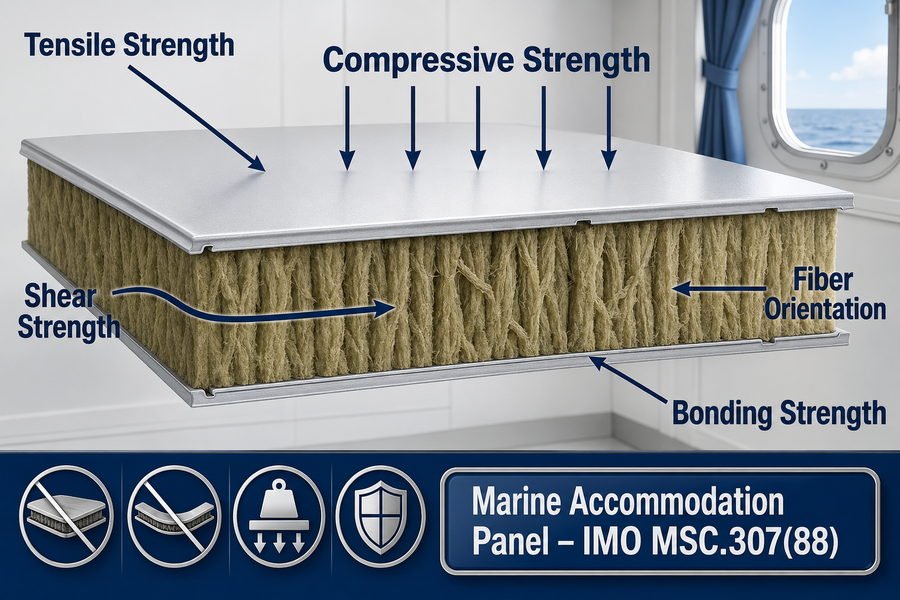
If you ignore these specs, your next shipyard inspection will be a disaster. Let's break down each property so you never buy substandard panels again.
What Tensile Strength Should Rock Wool Core Achieve in Marine Accommodation Panels?
Buying cheap panels risks core tearing. Weak tensile strength means the wool pulls apart under stress. You need specific numbers to check your supplier's test reports.
Marine rock wool cores must achieve a minimum tensile strength perpendicular to faces (TR) of 30 kPa to 100 kPa, depending on panel application. Wall panels typically require 40-60 kPa, while heavy-duty load-bearing panels need 80-100 kPa to prevent tearing under vibration and thermal expansion.
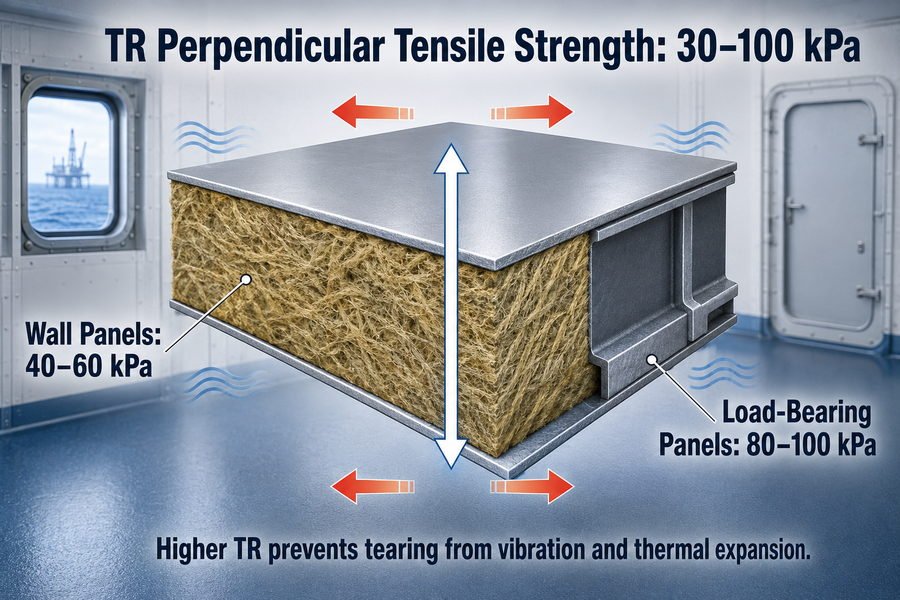
Minimum Tensile Strength Requirements for Standard Wall Panels
Tensile strength measures how well the rock wool holds itself together when you pull it apart. In the marine industry, we test this using the EN 1607 standard. For standard 50mm marine wall panels, the core must reach a tensile strength of 40 to 60 kPa. If the number is lower than 30 kPa, the panel is too weak. I once visited a shipyard where the procurement team bought cheap panels from an unverified factory. The supplier used a low-quality core with only 20 kPa tensile strength to save costs. During the ship's sea trials, the simple movement of the hull caused the core to tear down the middle. The steel skins stayed on the frame, but the inside of the panel broke into pieces. The contractor had to rip out all the walls and replace them. You must demand test reports showing at least 40 kPa for basic cabin walls.
Tensile Strength Standards for Heavy-Duty Applications
Not all panels do the same job. Panels placed near the engine room or public corridors face massive vibrations and pressure changes. For these heavy-duty areas, a tensile strength of 40 kPa is not enough. You need to upgrade the core to reach 80 to 100 kPa. These high-strength cores cost more, but they prevent failures in high-stress zones. High tensile strength directly stops the internal fibers from breaking1 when the ship's steel structure flexes and moves. When you review factory quotes, always check if they specify different tensile strengths for different ship zones.
| Panel Application Type | Minimum Tensile Strength (EN 1607) | Typical Density Required | Failure Risk if Too Low |
|---|---|---|---|
| Standard Cabin Wall | 40 - 60 kPa | 100 - 120 kg/m³ | Internal core tearing |
| Engine Room Proximity | 80 - 100 kPa | 120 - 150 kg/m³ | Complete panel separation |
| Standard Ceiling Panel | 30 - 50 kPa | 100 - 120 kg/m³ | Fiber layer splitting |
How Does Rock Wool Shear Strength Affect Marine Wall & Ceiling Panel Integrity?
Ship vibration destroys weak panels. Without shear strength, the steel skin slides against the core. This leads to buckling and rejected interiors by the shipyard.
Shear strength resists sliding forces between the steel face and the core. Marine panels require a shear strength of 20 kPa to 50 kPa. This range prevents buckling in walls and stops sheer stress failure in ceiling spans during extreme hull flexing and constant engine vibrations.
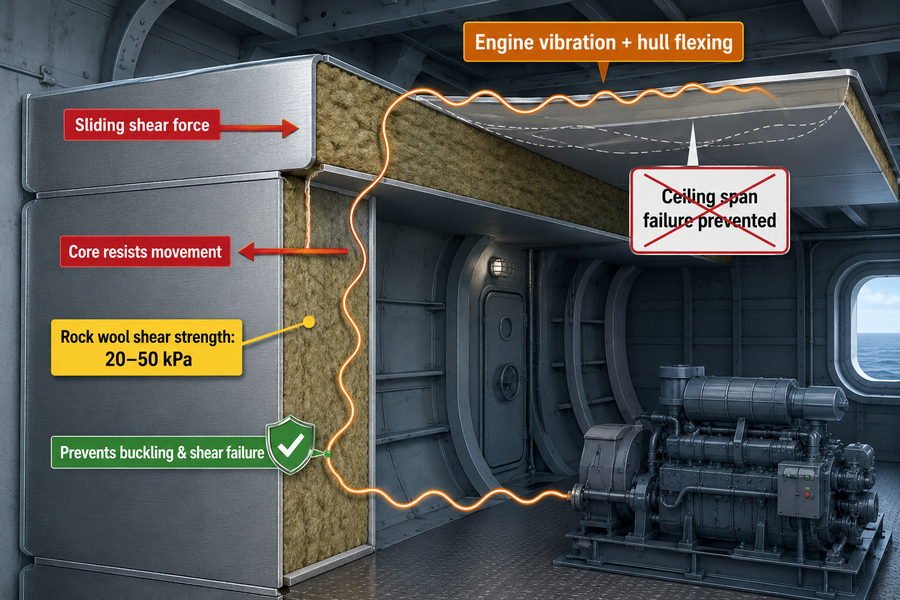
The Role of Shear Strength in Preventing Wall Panel Buckling
Shear strength is the ability of the panel to resist parallel sliding forces. Imagine pushing the front steel skin up and pushing the back steel skin down at the same time. The core must stop them from moving. We measure this under the ISO 12090 standard. A good marine rock wool core will provide 20 to 50 kPa of shear strength. When a ship hits heavy waves, the hull twists. This twisting puts huge diagonal forces on the vertical wall panels. If the shear strength is below 20 kPa, the core cannot hold the skins steady. The steel faces will start to slide and eventually buckle. Buckled walls look wavy and terrible. Ship owners will refuse to accept the project if the walls are not perfectly flat. Buying a core with at least 30 kPa shear strength2 easily prevents this wavy buckling effect.
Shear Stress Failure in Long Span Ceiling Panels
Ceiling panels face a different problem. They lay flat and must stretch across wide spans, sometimes up to 2.4 meters. Gravity pulls the middle of the panel down. This creates high shear stress near the edges where the panel connects to the ceiling frame. If the shear strength is low, the panel will actually snap or bend sharply near the supports. The core inside shears apart under the weight. To safely span a ceiling across a standard cabin room without extra metal supports, the rock wool core needs that higher end of the range, closer to 40 or 50 kPa3. This keeps the ceiling rigid and safe.
| Force Type | Target Shear Strength (ISO 12090) | Physical Result of Good Strength | Physical Result of Poor Strength |
|---|---|---|---|
| Vertical Hull Twisting | 20 - 30 kPa | Wall remains completely flat | Steel skin buckles and looks wavy |
| Horizontal Gravity Load | 40 - 50 kPa | Ceiling spans straight and rigid | Ceiling snaps near the frame joints |
What Delamination Risks Come From Low-Quality Rock Wool in Marine Accommodation Panels?
Peeling panel skins ruin cabins. Low-quality wool causes the steel to detach completely. You must understand why this happens to protect your project profits.
Low-quality rock wool causes three main delamination risks: adhesive failure from surface dust, cohesive failure from weak fiber binding, and chemical failure from moisture absorption. These three issues lead to complete skin detachment, loss of fire ratings, and mandatory replacement under marine class society rules.
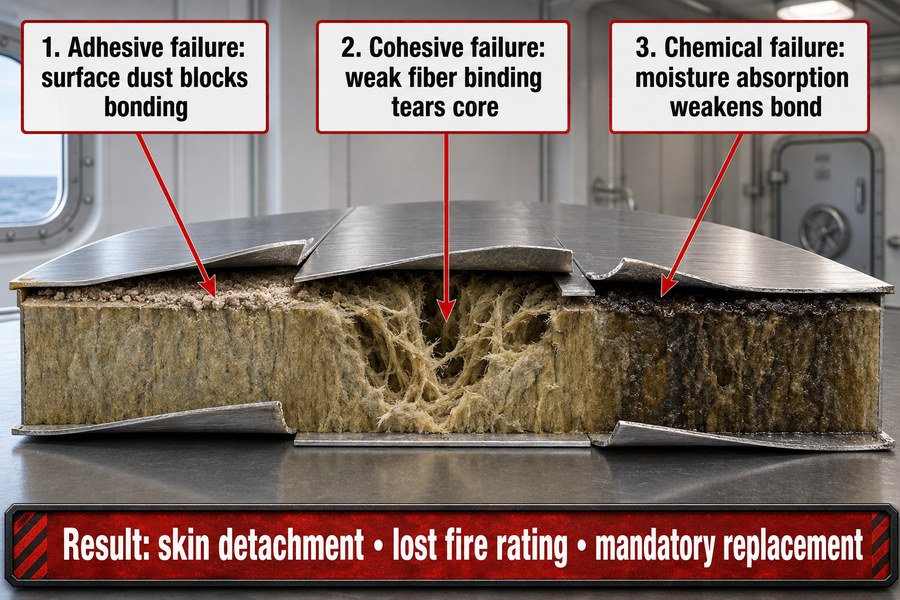
Adhesive and Cohesive Failures in Rock Wool Cores
Delamination means the steel skin peels away from the rock wool. This destroys the panel's fire rating. The first risk is adhesive failure. This happens when the glue fails to stick to the wool. Low-quality rock wool creates a lot of loose dust on its surface. If the factory does not use vacuum blowers to clean the wool before applying the polyurethane (PUR) glue, the glue just sticks to the dust, not the actual fibers.4 The skin easily peels right off. The second risk is cohesive failure. In this case, the glue works perfectly, but the wool fibers are tied together very poorly. The internal binder resin used by the cheap supplier breaks. The skin falls off, taking a thin layer of weak rock wool with it. You avoid cohesive failure by ensuring the factory uses cores with high tensile strength.
Chemical Failures from Moisture Absorption
The third delamination risk is chemical failure. Ships operate in very wet environments. Good marine rock wool must have less than 1% water absorption according to the EN 1609 standard5. Cheap rock wool absorbs moisture from the air. When the wool gets wet, the water chemically reacts with the PUR adhesive. The moisture breaks down the glue line over a few months.6 I had a client who bought panels that looked great in the factory. But after sitting in a humid shipyard warehouse for three months, the steel skins bubbled and detached. The cheap rock wool soaked up the humidity and ruined the chemical bond. Always ask your supplier for moisture absorption test data before you place your order.
| Delamination Risk Type | Root Cause in Low-Quality Core | How to Identify the Failure | Solution & Factory Requirement |
|---|---|---|---|
| Adhesive Failure | Dust on the rock wool surface | Clean steel skin peels off easily | Factory must vacuum core before gluing |
| Cohesive Failure | Weak internal fiber binding | Steel peels off with a thin wool layer | Specify > 40 kPa tensile strength |
| Chemical Failure | High moisture absorption (>1%) | Glue line turns soft or crumbles | Require EN 1609 water absorption <1% |
What Compressive Strength Prevents Sagging in Rock Wool Marine Ceiling Panels?
Sagging ceilings look terrible and fail inspections. If your core crushes too easily, the panel loses shape. You need the right compressive specs to keep ceilings flat.
To prevent sagging, marine ceiling panels require a rock wool compressive strength of at least 30 kPa at 10% deformation, with high-load areas needing up to 70 kPa. This ensures the panel can support its own weight, lighting fixtures, and HVAC vents without crushing or bending over time.
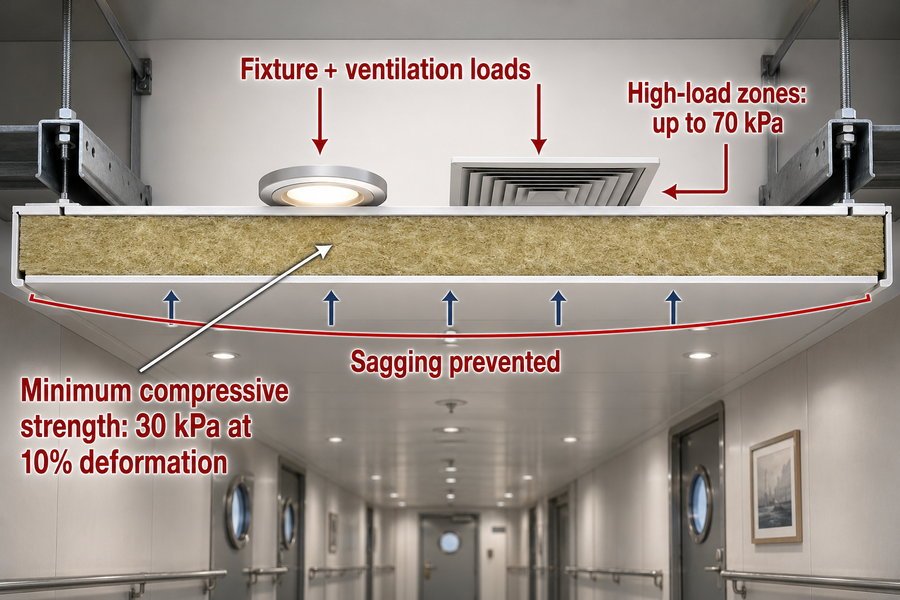
Minimum Compressive Strength (CS) for Standard Ceiling Spans
Compressive strength measures how much weight the panel can handle before it squishes. We test this using the EN 826 standard. The key metric is CS(10), which means the pressure needed to crush the panel by 10% of its thickness7. For a 50mm ceiling panel, 10% is 5mm. If a panel squishes by 5mm, it is visually ruined. To stop this, a standard ceiling panel must have a minimum compressive strength of 30 kPa8. When the panel is installed overhead, it fights gravity every single day. If the compressive strength is only 10 or 15 kPa, the core will slowly compress under the weight of the bottom steel face. After a year, the ceiling will sag in the middle, looking like a hammock. Buying cores with 30 kPa minimum ensures the ceiling stays perfectly straight for the life of the ship.
High Compressive Strength for Loaded Ceiling Panels
Ceilings are rarely empty. Shipyards cut holes in them to install heavy lighting fixtures, smoke detectors, and heavy steel HVAC air vents. These extras add massive point loads onto the panel. The basic 30 kPa core cannot support this extra weight. For these specific ceiling panels, you must order rock wool with a compressive strength of 60 to 70 kPa. To reach 70 kPa, the factory usually has to increase the rock wool density to about 120 or 150 kg/m³.9 If you put a heavy air vent into a weak 30 kPa panel, the edges around the hole will crush immediately. The vent will hang loose and rattle when the engine runs. Always match the compressive strength to the equipment you plan to install.
| Ceiling Installation Type | Target Compressive Strength (CS10) | Required Wool Density | Potential Consequence of Low Strength |
|---|---|---|---|
| Blank standard ceiling span | 30 kPa minimum | 100 kg/m³ | Slow sagging in the center over time |
| Ceiling with light fixtures | 40 - 50 kPa | 120 kg/m³ | Indentations around the light frames |
| Ceiling with heavy HVAC vents | 60 - 70 kPa | 150 kg/m³ | Core crushes and vents hang loose |
How Is Bonding Strength Tested Between Rock Wool and Steel Facing?
You cannot just guess if the glue works. Bad bonding means the panel falls apart during transit. You must ask factories for specific test methods and numbers.
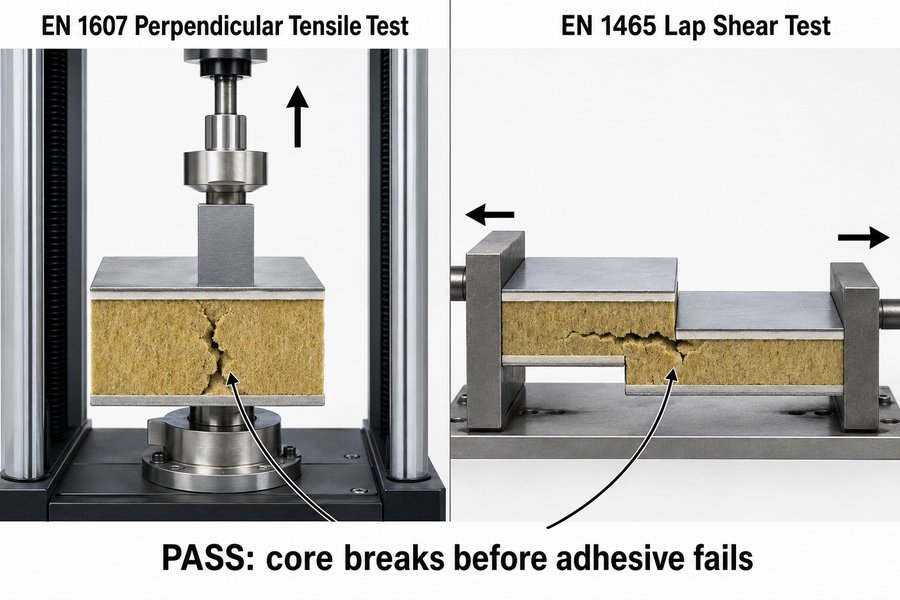
Bonding strength is tested using the perpendicular tensile test (EN 1607) and the lap shear test (EN 1465). The factory pulls or slides the steel face away from the core using a universal testing machine. A passing result requires the core to break before the adhesive layer fails.
Performing the Perpendicular Tensile Test (EN 1607)
The most common way to prove bonding strength is the perpendicular tensile test, following standard EN 1607. The factory cuts a small square sample of the finished panel. They glue metal blocks to the outside of the steel skins. Then, they put the sample into a large universal testing machine. The machine slowly pulls the two steel faces in opposite directions at a steady speed of 10 mm/min. We watch the machine's computer screen to see how much pulling force is applied. A good two-component PUR glue line has a strength of over 100 kPa. Because the rock wool itself usually has a strength of 40 to 60 kPa10, the test must end with the rock wool tearing in half. This proves the glue bond is actually stronger than the core itself. If the glue breaks first, the panel fails the test.
Utilizing the Lap Shear Test (EN 1465) for Marine Panels
The second critical method is the lap shear test, based on EN 1465. Instead of pulling the faces apart, the testing machine pushes one steel face up and the other steel face down. This mimics the sliding friction of a ship rolling in the ocean. Again, we are looking at the glue line. To pass this test, the glue must withstand immense sliding pressure. Factories achieve good results here by applying enough adhesive. A high-quality marine panel needs about 150 to 200 grams of PUR glue per square meter11. If a factory tries to save money and only uses 80 grams, the lap shear test will break the glue line easily. Request both test reports to ensure your investment is safe.
| Bonding Test Method | Standard | Direction of Force Applied | Passing Criteria Condition |
|---|---|---|---|
| Perpendicular Tensile Test | EN 1607 | Pulling outward (vertical away from core) | Rock wool tears before the glue line breaks |
| Lap Shear Test | EN 1465 | Sliding parallel (opposite directions) | Glue holds tight under max sliding pressure |
Why Does Fiber Orientation Affect Marine Wall & Ceiling Panel Load Capacity?
Density alone does not mean strength. If the fibers lie flat, the panel crushes easily. Changing the fiber direction completely alters how much weight the panel can hold.
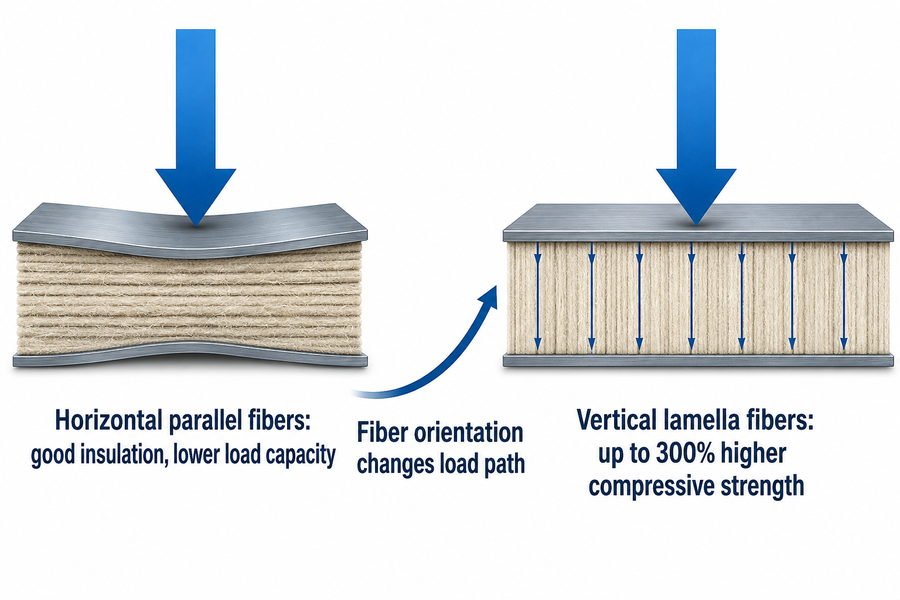
Fiber orientation determines structural integrity. Horizontal parallel fibers offer good insulation but low strength. Vertical lamella fibers stand upright between the steel faces, increasing compressive strength by up to 300% and significantly boosting tensile strength, allowing panels to support heavy loads without adding extra density.
The Weakness of Horizontal Parallel Fibers
When rock wool is manufactured, the fibers naturally fall flat and lay parallel to the ground. This creates standard rock wool slabs. If a factory glues these standard slabs directly between steel skins, the fibers lie horizontally inside the panel. This horizontal orientation is great for trapping air and providing fire insulation, but it is terrible for mechanical strength. Because the fibers are lying down, they easily squish when you push on the steel face. A standard parallel fiber panel might only provide 10 to 15 kPa of compressive strength. You cannot use these for long ceilings or heavy load-bearing walls. They simply bend and dent too easily. Many cheap suppliers use parallel fibers because skipping the extra cutting process saves them a lot of money and time.
The Strength Advantage of Vertical Lamella Fibers
Quality marine panel factories do not use flat slabs. They take the rock wool, cut it into narrow strips, and turn every single strip 90 degrees. This process creates lamella cores. Now, the fibers stand straight up vertically between the two steel faces. The fibers act like thousands of tiny, strong pillars. This simple change is incredible. Without adding any extra weight or density, the compressive strength jumps from 15 kPa to 50 or 70 kPa.12 That is a 300% increase in strength just by turning the fibers around. Tensile strength also goes up massively. Vertical lamella fibers are mandatory if you want rigid, high-quality marine panels that feel solid when you knock on them. Always ask your supplier to confirm they use lamella orientation in writing.
| Fiber Orientation Type | Compressive Strength Range | Manufacturing Process | Best Application |
|---|---|---|---|
| Horizontal Parallel Fibers | 10 - 15 kPa | Standard flat slab gluing | Non-structural bulkheads only |
| Vertical Lamella Fibers | 50 - 70+ kPa | Cut into strips and rotated 90° | Load-bearing walls and all ceilings |
Conclusion
Mastering tensile, shear, compressive, and bonding strengths, along with proper fiber orientation, guarantees you purchase durable marine panels. This saves your projects from costly shipyard rejections and delayed schedules.
-
"[PDF] Mechanical response of metallic honeycomb sandwich panel ...", https://groups.seas.harvard.edu/hutchinson/papers/metallichoneycombs.pdf. Research on sandwich panels identifies core tensile strength and through-thickness failure resistance as factors in preventing core cracking, face-core separation, and related damage under bending or dynamic loading. Evidence role: mechanism; source type: paper. Supports: Higher tensile strength in a panel core helps resist internal fiber rupture and related core failure when the ship structure flexes or vibrates.. Scope note: The support is likely to be based on general sandwich-panel mechanics and may not directly test the same marine rock wool wall panels described in the article. ↩
-
"Shear and Compression Wrinkling Experimental Analysis with a ...", https://pmc.ncbi.nlm.nih.gov/articles/PMC12471650/. A source should substantiate that sandwich-panel core shear properties influence face-sheet stability and buckling resistance; if used for this sentence, the evidence would be contextual unless it directly validates a 30 kPa minimum for marine wall panels under hull-twist loading. Evidence role: mechanism; source type: paper. Supports: Buying a core with at least 30 kPa shear strength prevents wavy buckling of marine wall panels.. Scope note: Likely sources may support the shear-strength-to-buckling mechanism but not the specific 30 kPa threshold or all marine wall-panel configurations. ↩
-
"[PDF] Structural evaluation of steel faced sandwich panels", https://nvlpubs.nist.gov/nistpubs/Legacy/BSS/nbsbuildingscience51.pdf. A structural-design or experimental source should show that ceiling or horizontally spanning sandwich panels require higher core shear strength as span and gravity load increase; support for the exact 40–50 kPa range would require test data or design calculations for comparable panel geometry and loading. Evidence role: general_support; source type: paper. Supports: Rock wool cores for long-span ceiling panels need shear strength near 40–50 kPa to span a standard cabin room without extra supports.. Scope note: General sandwich-panel design literature may support the relationship between span, shear stress, and core failure, but may not directly prove this numerical range for every cabin ceiling system. ↩
-
"Towards Reliable Adhesive Bonding: A Comprehensive Review of ...", https://pmc.ncbi.nlm.nih.gov/articles/PMC12195023/. A surface-preparation or adhesion-science source should be cited to support that dust and weak boundary layers reduce adhesive bonding because the adhesive bonds to loose contaminants rather than to the substrate surface. Evidence role: mechanism; source type: paper. Supports: Dust on the rock-wool surface can cause adhesive failure because PUR adhesive may bond to loose dust rather than to the mineral fibers.. Scope note: The source may establish the general adhesion mechanism rather than testing this exact rock-wool/PUR/steel panel process. ↩
-
"EN ISO 29767:2019 - Water Absorption Test for Thermal Insulation", https://standards.iteh.ai/catalog/standards/cen/fed1d76e-9d24-4e20-9745-f080fc4a98c4/en-iso-29767-2019?srsltid=AfmBOoqDmNpaA0HfarxZJaZtEhMi7w3mBM6MPIPaSc1-GQuL4nv8u72R. A standards or testing source should be cited to establish that EN 1609 is the European test method for determining short-term water absorption of thermal-insulation products by partial immersion, and any separate marine or product specification would be needed to substantiate the stated <1% acceptance limit. Evidence role: definition; source type: institution. Supports: Marine rock wool should meet a water-absorption limit measured under EN 1609, stated in the article as less than 1%.. Scope note: EN 1609 defines a test method; it may not itself impose a universal <1% requirement for all marine rock wool products. ↩
-
"Hydrolysis-resistant and stress-buffering bifunctional polyurethane ...", https://pmc.ncbi.nlm.nih.gov/articles/PMC7428285/. A polymer-chemistry or materials-aging source should be cited to show that polyurethane adhesive systems can be degraded by moisture-related reactions such as hydrolysis or by water interference at the bond line, reducing adhesive strength over time. Evidence role: mechanism; source type: paper. Supports: Moisture absorbed by the rock-wool core can degrade the PUR adhesive bond line and contribute to delamination over time.. Scope note: The aging rate depends on polyurethane formulation, curing conditions, temperature, and exposure; a general source may not verify the specific “few months” timeframe. ↩
-
"Analysis of Active and Passive Deformation of Expanded ...", https://pmc.ncbi.nlm.nih.gov/articles/PMC9654952/. Technical descriptions of insulation testing define compressive stress at 10% deformation as the load per unit area required to reduce an insulation specimen’s thickness by 10%. Evidence role: definition; source type: institution. Supports: CS(10) means the compressive stress needed to deform the panel by 10% of its thickness.. Scope note: This supports the meaning of the CS(10) metric, not the article’s specific design thresholds for marine ceiling panels. ↩
-
"How to choose the right marine wall panels for marine interior ...", https://magellanmarinetech.com/how-choose-right-marine-wall-panels-for-marine-interior-projects/. Guidance on mineral-wool sandwich panels and insulation products commonly reports compressive strength as a design-relevant property in the tens of kilopascals, but a 30 kPa minimum for ship ceilings should be treated as a design specification rather than a universal standard unless verified by a marine rule or project specification. Evidence role: general_support; source type: institution. Supports: A standard ceiling panel should have a minimum compressive strength of 30 kPa.. Scope note: Neutral sources may support the plausibility and use of kPa compressive-strength ratings, but may not directly prescribe 30 kPa as a universal minimum for standard ship ceiling spans. ↩
-
"The Effect of Mineral Wool Fiber Additive on Several Mechanical ...", https://pmc.ncbi.nlm.nih.gov/articles/PMC10820291/. Studies and technical references on mineral wool report that mechanical properties such as compressive strength generally increase with density, providing contextual support for using higher-density rock wool to obtain higher compressive-strength ratings. Evidence role: mechanism; source type: paper. Supports: Higher rock wool density is usually required to reach about 70 kPa compressive strength, with densities around 120–150 kg/m³.. Scope note: The source may establish the density–strength relationship generally, but the exact 120–150 kg/m³ density range for achieving 70 kPa depends on product formulation, fibre orientation, binder content, and manufacturing process. ↩
-
"Mechanical Properties of Polyurethane Adhesive Bonds in a ...", https://pmc.ncbi.nlm.nih.gov/articles/PMC8152272/. Published mineral-wool standards or technical literature report tensile strength perpendicular to the faces in kPa and show that values vary substantially by density, fibre orientation, and product type; a source reporting 40–60 kPa would support this range as product-dependent context rather than a universal material constant. Evidence role: statistic; source type: paper. Supports: Rock wool cores commonly have perpendicular tensile strengths around 40–60 kPa, so cohesive failure in the core can indicate that the adhesive bond is stronger than the core.. Scope note: The stated range may apply only to specific rock-wool board or sandwich-panel core products, not all mineral wool. ↩
-
"A modified method for shear strength measurement of adhesive ...", https://bioresources.cnr.ncsu.edu/resources/a-modified-method-for-shear-strength-measurement-of-adhesive-bonds-in-solid-wood/. Technical literature on polyurethane-bonded sandwich panels identifies adhesive coat weight as a process variable affecting skin–core bond strength and reports application quantities in g/m²; this supports the statement as a contextual manufacturing benchmark, not as a universal requirement for all marine panels. Evidence role: general_support; source type: research. Supports: A high-quality marine panel needs about 150 to 200 grams of PUR glue per square meter.. Scope note: Adhesive quantity depends on adhesive chemistry, substrate roughness, core porosity, pressing conditions, and applicable marine certification requirements. ↩
-
"Experimental Study on Mechanical Properties of the Sandwich ...", https://pmc.ncbi.nlm.nih.gov/articles/PMC7215314/. Research on mineral-wool sandwich-panel cores describes strong anisotropy in mechanical properties and shows that reorienting fibers into lamella cores can substantially increase compressive strength at comparable density. Evidence role: mechanism; source type: paper. Supports: Reorienting rock-wool fibers into vertical lamella cores can increase compressive strength from roughly 15 kPa to 50–70 kPa without increasing density.. Scope note: A neutral source may support the direction and mechanism of the strength increase, while the exact 50–70 kPa figures should be verified against the same density grade and test procedure used in the article. ↩