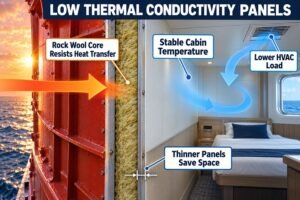
Choosing the right core material is tough. A bad choice means failing safety tests and loud cabins. Let me show you what makes rock wool the best solution.
The intrinsic fire and acoustic capabilities of rock wool core in marine accommodation panels depend on six distinct factors: fiber diameter, binder distribution, density profile, raw material composition (basalt vs. slag), high-temperature thermal conductivity limits, and hydrophobic treatments. These elements determine SOLAS compliance and passenger comfort.
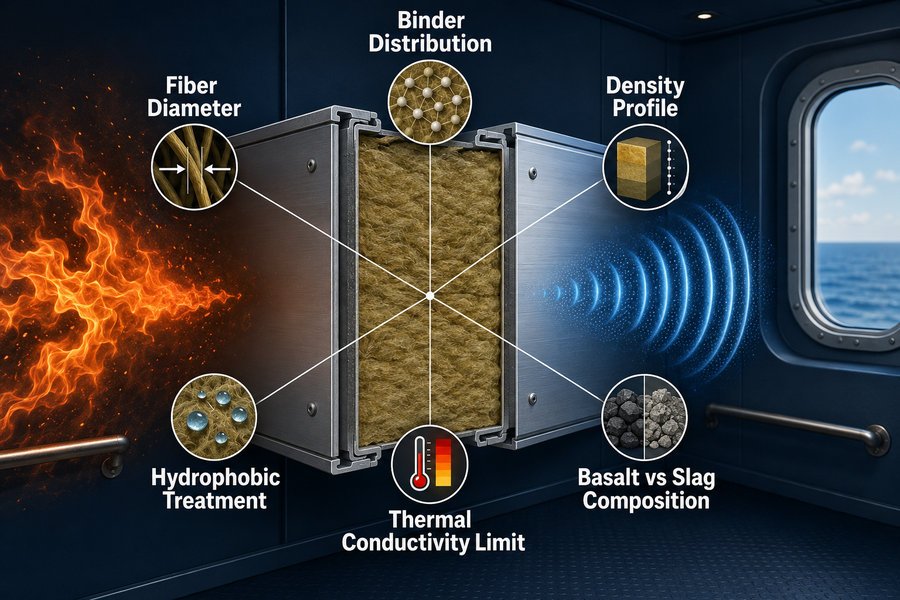
Let us look closer at each of these technical details. Understanding these points will help you buy the right marine wall and ceiling panels for your next big European shipyard project.
How Does Fiber Diameter in Rock Wool Core Influence Acoustic Absorption of Marine Accommodation Panels?
Loud engine noises ruin the passenger experience. If your panels have the wrong fiber size, they will not block sound. Let us fix this acoustic problem today.
Fiber diameter in rock wool cores dictates acoustic absorption through two mechanisms: low-frequency sound blocking and high-frequency sound dissipation. The best marine acoustic panels use micro-fibers between 3 to 5 micrometers. Thinner fibers create more surface area, converting sound waves into heat energy much more effectively.
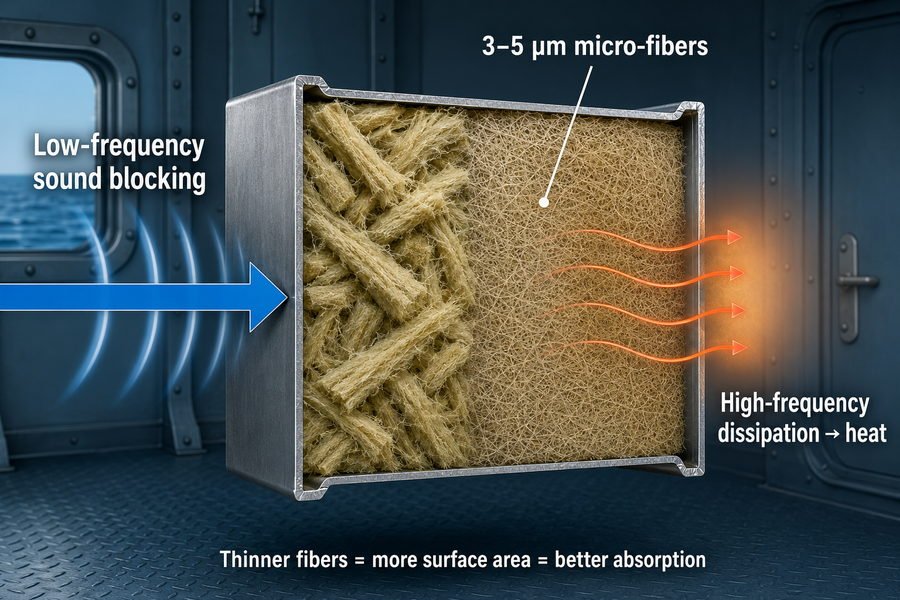
When we talk about acoustic absorption in a marine wall panel, we must look at the physical size of the stone wool fibers inside. I have seen many buyers ignore this specification. They buy the cheapest panel and then face complaints from the shipyard about cabin noise. The fiber diameter controls two very specific acoustic mechanisms: blocking low-frequency engine rumbles and dissipating high-frequency human noise1.
Low-Frequency Sound Blocking with 4 to 5 Micrometer Fibers
Low-frequency sounds come from the main ship engines and large generators2. These sound waves are long and powerful. To block low-frequency sound, the rock wool core needs fibers in the 4 to 5 micrometer range. Fibers of this thickness provide enough physical mass and stiffness to stop the long sound waves from passing straight through the marine ceiling panel. When tested under the ISO 354 standard, panels with 4 to 5 micrometer fibers achieve a Noise Reduction Coefficient (NRC) of 0.40 to 0.60 at low hertz levels. If the fibers are thicker than 6 micrometers, the panel becomes too rigid. The sound waves just bounce off the internal fibers and vibrate the metal skin, passing the noise into the next room.
High-Frequency Sound Dissipation with 3 to 4 Micrometer Fibers
High-frequency sounds come from the HVAC air conditioning vents, people talking, and music. These sound waves are short and fast. To dissipate high-frequency sound, the rock wool needs very thin fibers in the 3 to 4 micrometer range. Thinner fibers mean there are millions of more fibers crammed into the same space. This creates a massive internal surface area. As the fast sound waves try to pass through this dense web of thin fibers, the air molecules rub against the rock wool. This creates friction. The friction turns the sound energy into tiny amounts of heat energy. This process is called sound dissipation.3 Under the ISO 354 standard, these thin fibers can push the NRC rating above 0.80 for high hertz levels4. Therefore, a good marine accommodation panel uses a mixed blend of 3 to 5 micrometer fibers to handle both types of noise.
| Fiber Diameter Range | Target Sound Frequency | Primary Acoustic Mechanism | ISO 354 Target NRC Rating | Shipyard Application |
|---|---|---|---|---|
| 3 to 4 Micrometers | High Frequency (Voices, HVAC) | Surface Friction Dissipation | 0.80 - 0.90 | Passenger Cabin Dividing Walls |
| 4 to 5 Micrometers | Low Frequency (Engines, Pumps) | Mass and Stiffness Blocking | 0.40 - 0.60 | Engine Room Adjacent Bulkheads |
| Greater than 6 Micrometers | None | Too rigid, transfers vibration | Less than 0.30 | Not recommended for acoustics |
What Role Does Binder Distribution Play in Rock Wool Core Fire Behavior?
A panel might look safe, but bad binder glue will catch fire quickly. This puts the whole ship at risk. You must understand binder distribution.
Binder distribution directly controls the fire behavior of rock wool core panels by influencing three crucial aspects: smoke generation, flame spread, and structural integrity. A uniform, low-content phenolic binder (strictly under 3% by weight) ensures the panel passes the SOLAS FTP Code for non-combustibility without toxic smoke.
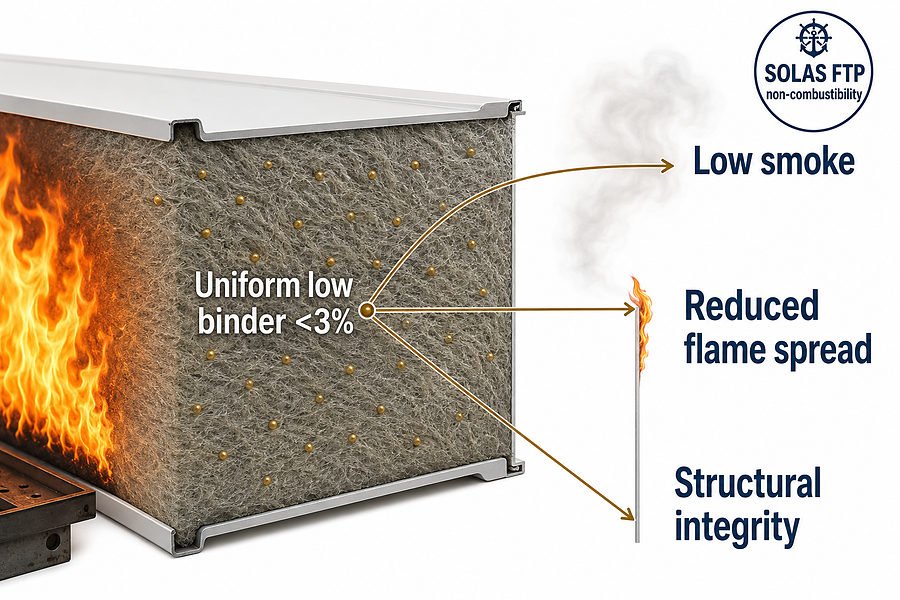
Rock wool itself is made of stone and does not burn. However, factories must use a glue, called a binder, to hold the stone fibers together in a board shape. This binder is usually a phenolic resin. Phenolic resin is a chemical and it will burn. Therefore, the way this binder is distributed inside the marine fire door or panel is incredibly important for fire safety. The binder distribution affects three specific things: how much smoke is made, how fast flames travel, and whether the panel falls apart during a fire.
Limiting Smoke Generation and Flame Spread Through Low Binder Content
The most critical rule in marine outfitting is limiting toxic smoke. I always tell my clients to ask the factory for their binder weight percentage. The total binder content must stay under 3% of the total rock wool weight.5 This rule comes directly from the IMO 2010 FTP Code Part 1 requirements for non-combustible materials. If the factory uses 5% or 6% binder to make the production process faster, that extra chemical will catch fire. When phenolic resin burns, it creates thick, toxic black smoke6 and allows flames to spread across the inside of the panel. By keeping the binder under 3%, there is simply not enough chemical fuel inside the panel to support a flame or generate dangerous smoke.
Maintaining Panel Structural Integrity with Uniform Binder Distribution
Having a low amount of binder is good, but the distribution must also be perfectly uniform. During the manufacturing process, poor mixing can cause the glue to clump in certain areas and leave other areas dry. This ruins the structural integrity of the marine accommodation panel. In a fire, the areas with clumped binder will burn hot and melt the steel skin. The dry areas with no binder will simply fall apart and crumble into dust. This creates huge gaps in the bulkhead, allowing fire to pass into the next cabin. A uniform distribution ensures that the panel holds its shape for the full 60 minutes required by an A-60 fire rating test7. Tests show that badly distributed binder causes a 15% loss in structural strength during high-heat events.8
| Binder Distribution Type | Binder Content (by Weight) | Smoke Generation Risk | Structural Integrity in Fire | IMO FTP Code Part 1 Result |
|---|---|---|---|---|
| Uniformly Distributed | Less than 3% | Very Low (No toxic black smoke) | Excellent (Maintains shape for 60 mins) | Pass (Non-Combustible) |
| Clumped / Uneven | Less than 3% | Medium (Smoke at hot spots) | Poor (Crumbles in dry areas, creates gaps) | Fail (Loss of integrity) |
| Uniformly Distributed | Greater than 5% | High (Thick, toxic smoke) | Poor (Binder burns away quickly) | Fail (Combustible material) |
How Does Rock Wool Core Density Profile Affect Sound Transmission Loss in Marine Accommodation Panels?
Standard panels often fail to stop noise between cabins. This leads to angry shipyard clients. A proper density profile is the secret to high sound transmission loss.
The density profile of a rock wool core affects sound transmission loss by managing three physical properties: panel mass, resonance frequencies, and vibration dampening. A dual-density profile, with a hard outer layer (150 kg/m³) and a softer inner layer (100 kg/m³), maximizes acoustic reduction up to 45 decibels.
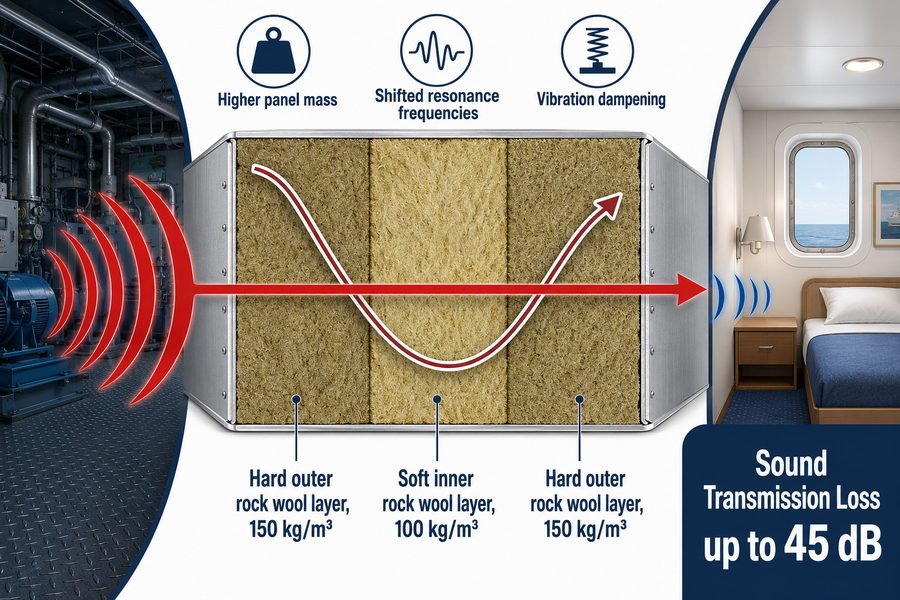
Sound transmission loss refers to how well a marine wall panel stops noise from traveling from Room A into Room B. You might think that just stuffing the panel with heavy rock wool is enough. It is not that simple. Sound waves are smart; they find ways to vibrate through solid objects. To stop them completely, you need to manage three physical properties: the mass of the panel, the resonance frequency of the steel skins, and internal vibration dampening. The most effective way to manage all three is by using a smart density profile.
Increasing Panel Mass and Managing Resonance Frequencies
Every material has a resonance frequency. This is the pitch at which a material naturally wants to vibrate. When sound hits a steel panel skin, the steel wants to vibrate and pass the noise. To stop this, we add a hard outer layer of rock wool right behind the steel skin. This layer has a high density of 150 kg/m³. This high density adds significant panel mass. In acoustics, the "Mass Law" states that heavier objects are harder to vibrate9. Furthermore, gluing this dense 150 kg/m³ rock wool tightly to the steel shifts the resonance frequency of the metal10. It stops the metal from vibrating like a drum. This high-density layer acts as a heavy shield, bouncing a lot of sound energy right back into the room it came from.
Enhancing Vibration Dampening with the Soft Inner Core
While the hard outer layer stops a lot of sound, some vibrations still get through. This is where the inner layer does its job. The middle of the rock wool core uses a lower density of 100 kg/m³. This softer layer acts as a shock absorber. It provides excellent vibration dampening. As the leftover sound waves travel from the hard dense layer into the soft airy layer, the sudden change in material density confuses the sound waves. The soft fibers flex and absorb the physical vibration energy, turning it into heat11. By combining these three properties—mass, shifted resonance, and dampening—a dual-density marine accommodation panel can achieve a Sound Reduction Index (Rw) of up to 45 decibels according to the ISO 10140-2 standard.
| Density Profile Type | Outer Layer Density | Inner Core Density | Key Acoustic Property | Expected ISO 10140-2 Rating |
|---|---|---|---|---|
| Dual-Density Profile | 150 kg/m³ | 100 kg/m³ | Maximizes mass, alters resonance, and provides high dampening. | 43 to 45 dB Rw |
| Uniform High Density | 140 kg/m³ | 140 kg/m³ | Good mass, but lacks the soft center for final vibration dampening. | 38 to 40 dB Rw |
| Uniform Low Density | 100 kg/m³ | 100 kg/m³ | Good dampening, but fails to stop the steel skin from vibrating. | 34 to 36 dB Rw |
Why Does Rock Wool Core Outperform Mineral Wool in Marine Accommodation Panel Fire Endurance?
Many buyers confuse rock wool with cheap mineral wool. This mistake causes failed fire tests and delayed ship deliveries. You need the right material for A-class bulkheads.
Rock wool core outperforms standard mineral wool in marine fire endurance due to three fundamental differences: a higher melting point, superior basalt rock raw material, and better shrinkage resistance. Rock wool melts above 1000°C, whereas glass-based mineral wool melts around 600°C, making rock wool mandatory for A-60 fire doors.
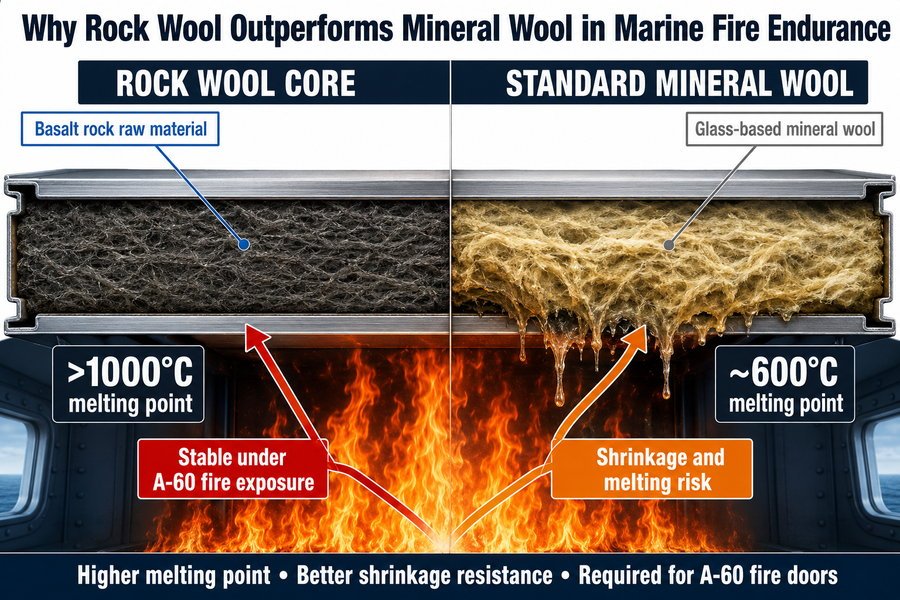
I remember a client who bought containers of marine panels from a new supplier because the price was very low. The supplier claimed the panels used "mineral wool." When the shipyard tested the panels, they completely melted in 20 minutes. The client lost hundreds of thousands of dollars. They did not realize that "mineral wool" is a broad term12 that often means cheap glass wool. Real rock wool (also called stone wool) is completely different and vastly superior for fire endurance. The difference comes down to the melting point, the raw materials used, and how the material reacts to extreme heat shrinkage.
Superior Basalt Raw Material and Higher Melting Point
The secret to rock wool's fire endurance is its raw material. Real rock wool is made by melting volcanic basalt rock and spinning it into threads. Basalt rock naturally handles extreme heat. Standard mineral wool is usually made from recycled glass and sand. Because of this raw material difference, their melting points are completely different. Standard glass-based mineral wool melts at roughly 600°C. In a real ship fire, cabin temperatures hit 600°C in just a few minutes. However, rock wool made from basalt rock will not melt until temperatures exceed 1000°C13. To pass the IMO A-60 fire standard, a panel must block fire for 60 minutes. The ISO 834 standard fire curve shows that at 60 minutes, the oven temperature reaches exactly 945°C. Only basalt rock wool can survive this test without melting.
Better Shrinkage Resistance During High-Temperature Fire Exposure
Fire endurance is not just about melting; it is about holding the panel together. When insulation gets extremely hot, the fibers tend to pull together and shrink. This is called high-temperature shrinkage. Glass-based mineral wool suffers from terrible shrinkage resistance. At high heat, it can shrink by up to 5% of its volume. In a large marine bulkhead panel, a 5% shrinkage creates a massive 50-millimeter gap inside the steel frame. Fire and smoke will immediately shoot through this gap and destroy the next room. Basalt rock wool has incredible shrinkage resistance. Under the same 945°C heat, rock wool shrinks less than 1%14. It stays tight against the panel frame, keeping the fire trapped perfectly.
| Material Type | Primary Raw Material | Melting Point Limit | High-Temperature Shrinkage | IMO A-60 Fire Rating Capability |
|---|---|---|---|---|
| True Rock Wool (Stone Wool) | Volcanic Basalt Rock | Greater than 1000°C | Less than 1% (Excellent) | Yes (Survives 945°C for 60 mins) |
| Standard Mineral Wool (Glass Wool) | Recycled Glass & Sand | Approximately 600°C | Up to 5% (Creates dangerous gaps) | No (Melts and fails test) |
What Thermal Conductivity Range Should Rock Wool Core Marine Accommodation Panels Achieve at High Temperatures?
Heat transfer through panels can turn a safe cabin into an oven. If your thermal specs are wrong, the panel is useless. Let us check the numbers.
At high temperatures, rock wool core marine accommodation panels should achieve a thermal conductivity range between 0.10 W/(m·K) at 400°C and 0.18 W/(m·K) at 600°C. Maintaining these exact two thermal conductivity thresholds prevents dangerous heat transfer and ensures the unexposed side stays below the 140°C SOLAS limit.
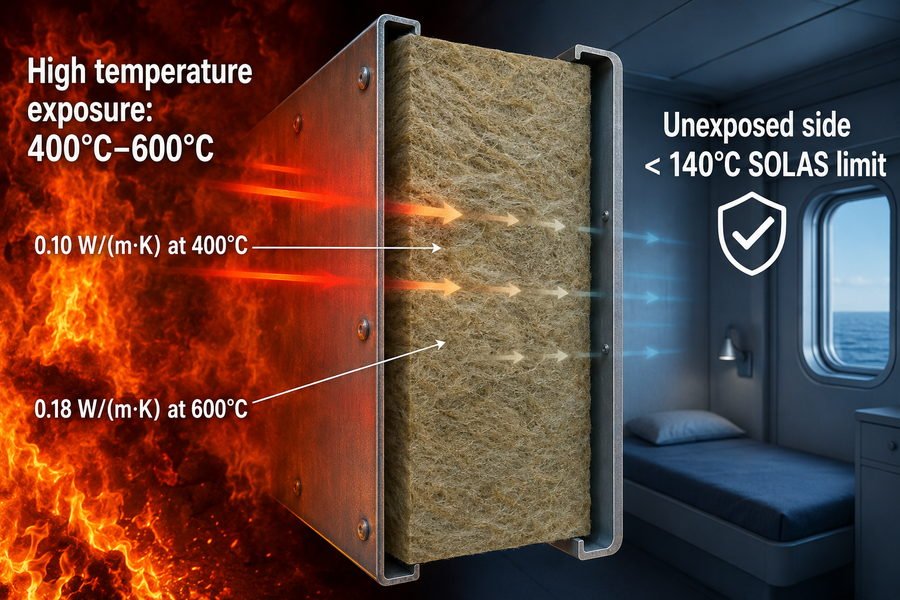
When buying marine interior outfitting products, we often check the thermal conductivity at room temperature (usually around 0.035 W/(m·K) at 25°C15). But room temperature data is useless during a fire. The true test of a marine ceiling panel or bulkhead is how it blocks heat when the room is burning. We measure this heat transfer using thermal conductivity values at extreme temperatures. To guarantee passenger safety and meet the strict rules of the shipyard, the rock wool core must hit two specific thermal conductivity ranges: one at 400°C and another at 600°C.
Achieving 0.10 W/(m·K) Thermal Conductivity at 400°C
The mid-fire stage happens around 15 to 20 minutes into a ship fire. At this point, the steel skin of the panel is glowing red, and the internal rock wool reaches about 400°C. According to standard ASTM C411 high-temperature testing16, a high-quality marine rock wool core must maintain a thermal conductivity limit of 0.10 W/(m·K) or lower at 400°C. If the value goes higher than 0.10, the heat will travel through the fibers too fast. This means the other side of the wall (the safe cabin) will start to heat up rapidly. By keeping the thermal conductivity tight at this 400°C stage, the rock wool traps the heat energy within its air pockets, slowing down the temperature rise in the next room.
Maintaining 0.18 W/(m·K) Thermal Conductivity at 600°C to Meet SOLAS
As the fire reaches the 30 to 45-minute mark, the heat becomes extreme. The internal core temperature will push past 600°C. At this level, radiation heat transfer starts happening inside the tiny air pockets of the rock wool17. The target thermal conductivity range here must stay below 0.18 W/(m·K) at 600°C. This is the critical limit to satisfy the SOLAS regulations and the IMO FTP Code. The IMO states that the unexposed side of the panel (the side away from the fire) cannot have an average temperature rise of more than 140°C above the original room temperature18. If your rock wool exceeds the 0.18 W/(m·K) limit at 600°C, too much heat bleeds through. The unexposed steel skin will get hotter than the 140°C limit, meaning you fail the shipyard's safety inspection.
| Test Temperature Point | Maximum Allowed Thermal Conductivity | Fire Stage | IMO FTP Code Result on Unexposed Side |
|---|---|---|---|
| Room Temperature (25°C) | 0.035 W/(m·K) | Normal daily operation | Normal cabin temperature maintained |
| Mid-Fire Heat (400°C) | 0.100 W/(m·K) | 15 to 20 minutes into fire | Slow heat rise, traps energy internally |
| Extreme Heat (600°C) | 0.180 W/(m·K) | 30 to 45 minutes into fire | Unexposed side stays below 140°C rise |
How Does Rock Wool Core Hydrophobic Treatment Preserve Acoustic and Fire Performance?
Ocean air is wet and salty. Wet panel cores lose their strength and safety ratings fast. Hydrophobic treatment is the only way to protect your investment.
Hydrophobic treatment preserves the acoustic and fire performance of rock wool cores by performing three critical functions: repelling moisture absorption, preventing fiber clumping, and stopping internal corrosion. By keeping water absorption below 1 kg/m², the treated panels maintain their full fire resistance and sound dampening over a 20-year ship lifespan.
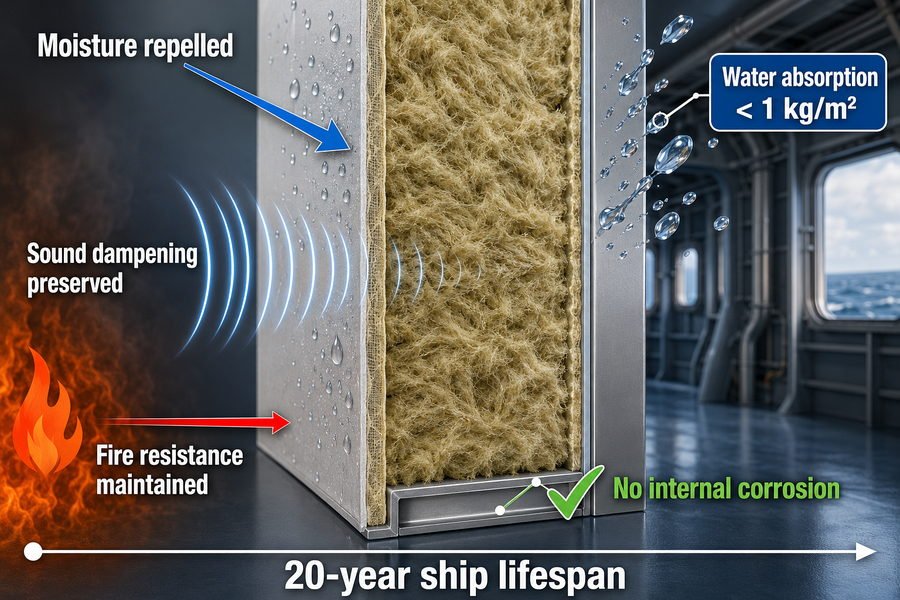
Ships operate in the worst possible environment for insulation. The air is always humid, and temperature changes create condensation inside the walls. If you buy standard, untreated rock wool, it will act like a sponge. It will soak up water from the air. Wet rock wool is useless. To solve this, good factories add special silicone-based oils during the manufacturing process19. This is called hydrophobic treatment. This treatment preserves the panel's performance by doing three things: repelling moisture, stopping the fibers from clumping, and protecting the steel skins from rust.
Repelling Moisture Absorption and Preventing Fiber Clumping
The acoustic and fire performance of rock wool depends entirely on the tiny pockets of dry air trapped between the stone fibers20. When untreated rock wool gets wet, the water fills these air pockets. Water is a great conductor of heat and sound. Therefore, a wet panel loses its fire and acoustic ratings instantly. Furthermore, water makes the stone fibers heavy, causing them to collapse and clump together at the bottom of the panel. The EN 1609 standard for short-term water absorption demands that marine insulation must absorb less than 1 kilogram of water per square meter (1 kg/m²).21 Hydrophobic treatment coats every single fiber with water-repellent oil, ensuring water beads up and rolls away. This keeps the air pockets dry and prevents fiber clumping.
Stopping Internal Corrosion to Maintain a 20-Year Lifespan
A marine accommodation panel is usually made of a galvanized steel or aluminum skin with the rock wool glued inside. If the rock wool absorbs moisture, that water sits directly against the inside of the metal skin in the dark. This creates the perfect environment for galvanic corrosion and rust. Over a few years, the metal skin will rust from the inside out, creating ugly brown stains in the ship's cabins. The shipyard will have to tear out the walls and replace them. By using hydrophobic rock wool, the core stays completely dry. A dry core stops internal corrosion entirely. This guarantees that the marine fire doors and wall panels will survive their expected 20-year operational lifespan without degrading or rusting.
| Core Condition | Water Absorption (EN 1609 Standard) | Acoustic and Fire Performance | Corrosion Risk on Steel Skin | Expected Lifespan |
|---|---|---|---|---|
| Hydrophobic Treated Rock Wool | Less than 1.0 kg/m² (Passes standard) | Maintained at 100% factory rating | Zero (Core remains completely dry) | 20+ Years |
| Untreated Standard Rock Wool | Greater than 5.0 kg/m² (Fails standard) | Severe drop (Water fills air pockets) | High (Wet wool rots metal from inside) | 3 to 5 Years |
Conclusion
Rock wool's fiber diameter, precise binder control, density, high melting point, thermal resistance, and water treatments ensure your marine panels deliver top safety, quiet cabins, and true SOLAS compliance.
-
"Comparison of the sound absorption properties of acoustic ...", https://bioresources.cnr.ncsu.edu/resources/comparison-of-the-sound-absorption-properties-of-acoustic-absorbers-made-from-used-copy-paper-and-corrugated-board/. Peer-reviewed models of fibrous porous absorbers show that fiber diameter affects airflow resistivity and related acoustic parameters, which influence sound absorption through viscous and thermal losses. Evidence role: mechanism; source type: paper. Supports: Fiber diameter controls important acoustic behavior in stone wool, including mechanisms relevant to low- and high-frequency sound control.. Scope note: This would support fiber diameter as an acoustically relevant variable, but it would not by itself prove the article’s specific division between low-frequency blocking and high-frequency dissipation in marine wall panels. ↩
-
"[PDF] Revised guidelines for the reduction of underwater radiated noise ...", https://wwwcdn.imo.org/localresources/en/Documents/MEPC.1-Circ.906%20-%20Revised%20Guidelines%20For%20The%20Reduction%20Of%20Underwater%20Radiated%20NoiseFrom%20Shipping%20To%20Address...%20(Secretariat).pdf. Studies of shipboard noise commonly identify propulsion engines and diesel generators as major sources of low-frequency noise and vibration transmitted through ship structures. Evidence role: general_support; source type: paper. Supports: Main ship engines and large generators are common sources of low-frequency noise on ships.. Scope note: The exact frequency spectrum depends on vessel type, machinery design, operating speed, and mounting conditions. ↩
-
"Providing an optimal porous absorbent pattern to reduce mid to low ...", https://pmc.ncbi.nlm.nih.gov/articles/PMC6277340/. Acoustics references describe porous absorbers as dissipating sound energy through viscous and thermal losses as air oscillates within interconnected pores and around fibers, converting part of the acoustic energy into heat. Evidence role: mechanism; source type: education. Supports: In fibrous porous materials, frictional and thermal losses convert some sound energy into heat, producing acoustic dissipation.. ↩
-
"Acoustic Performance of Sound Absorbing Materials Produced from ...", https://pmc.ncbi.nlm.nih.gov/articles/PMC9105389/. An ISO 354 reverberation-room measurement or peer-reviewed test of comparable mineral-wool panels would be needed to substantiate a high-frequency absorption result above 0.80 for panels using 3–4 micrometer fibers. Evidence role: statistic; source type: research. Supports: Thin 3–4 micrometer stone wool fibers can produce NRC values above 0.80 at high frequencies when tested under ISO 354.. Scope note: General descriptions of ISO 354 support the test method only; they do not establish the stated NRC value without specific test data for comparable panels. ↩
-
"[PDF] RESOLUTION MSC.307(88) (adopted on 3 December 2010 ...", https://wwwcdn.imo.org/localresources/en/KnowledgeCentre/IndexofIMOResolutions/MSCResolutions/MSC.307(88).pdf. The IMO 2010 FTP Code Part 1 and related marine non-combustibility guidance establish test criteria for classifying materials as non-combustible, providing the regulatory context for limits on organic binder content in mineral wool insulation. Evidence role: general_support; source type: institution. Supports: Marine rock wool panels should keep binder content under 3% by weight to satisfy IMO 2010 FTP Code Part 1 non-combustibility expectations.. Scope note: The source may support the non-combustibility test framework rather than a universal prescriptive 3% binder-by-weight rule for all rock wool products. ↩
-
"Health effects of selected chemicals 3. Phenol Formaldehyde Resin", https://hero.epa.gov/reference/1256174/. Studies of phenolic resin combustion describe smoke production and the release of hazardous combustion products, supporting the statement that phenolic binders can contribute to toxic smoke under fire conditions. Evidence role: mechanism; source type: paper. Supports: Burning phenolic resin can produce dense and toxic smoke, which is relevant to fire performance in mineral-wool panels containing phenolic binder.. Scope note: Combustion products depend on resin formulation, oxygen availability, temperature, and additives, so the evidence may not quantify smoke from a finished marine panel directly. ↩
-
"What Is the Purpose and Scope of the IMO FTP Code? - Magellan ...", https://magellanmarinetech.com/what-purpose-scope-of-imo-ftp-code/. IMO/SOLAS fire-test standards define A-class divisions and specify that an A-60 division must satisfy integrity and insulation criteria for a 60-minute fire exposure. Evidence role: definition; source type: institution. Supports: An A-60 fire rating test requires the tested marine division to maintain the relevant fire-performance criteria for 60 minutes.. Scope note: This supports the duration and criteria of the A-60 rating, not the separate assertion that binder uniformity alone ensures compliance. ↩
-
"Low Formaldehyde Binders for Mineral Wool Insulation - PMC", https://pmc.ncbi.nlm.nih.gov/articles/PMC8995714/. Experimental research on mineral-wool or fiber-insulation binders under thermal exposure can be used to document whether binder distribution affects residual mechanical strength after heating. Evidence role: statistic; source type: paper. Supports: Badly distributed binder in rock wool panels causes a measurable 15% loss in structural strength during high-heat events.. Scope note: The cited source must report the 15% figure or a closely comparable measured loss; otherwise it would only support the general relationship between binder distribution and high-temperature strength degradation. ↩
-
"Sound transmission properties of mineral-filled high-density ...", https://bioresources.cnr.ncsu.edu/resources/sound-transmission-properties-of-mineral-filled-high-density-polyethylene-hdpe-and-wood-hdpe-composites/. Architectural-acoustics references describe the mass law for single-leaf partitions, under which airborne sound transmission loss generally increases with surface mass and frequency outside resonance and coincidence regions. Evidence role: expert_consensus; source type: education. Supports: In acoustics, the mass law means that heavier panel elements generally resist airborne sound transmission better than lighter ones.. Scope note: This supports the general acoustic principle, not the measured performance of the specific marine panel construction. ↩
-
"Structural Vibration Damping by the Use of Poro-Elastic Layers", https://docs.lib.purdue.edu/herrick/275/. Research on laminated and damped plates shows that bonding an additional layer to a metal plate can alter modal resonance frequencies and damping because it changes the composite panel’s mass, stiffness, and energy-dissipation characteristics. Evidence role: mechanism; source type: paper. Supports: Bonding a dense rock wool layer to a steel skin can change the steel panel’s resonance behavior.. Scope note: The source would support the physical mechanism generally; the magnitude of the resonance shift for 150 kg/m³ rock wool bonded to marine steel would still require panel-specific testing or modeling. ↩
-
"Porous Acoustic Absorber Research Papers - Academia.edu", https://www.academia.edu/Documents/in/Porous_Acoustic_Absorber. Acoustics texts on porous absorbers explain that sound energy in fibrous materials is dissipated mainly through viscous and thermal losses as air moves through pores and fibers, converting part of the acoustic energy into heat. Evidence role: mechanism; source type: education. Supports: Soft fibrous mineral wool can absorb sound and vibration energy by dissipating it as heat.. Scope note: This supports the absorption mechanism of fibrous mineral wool generally, but not the precise damping contribution of the stated 100 kg/m³ inner core in this panel. ↩
-
"Mineral wool - Wikipedia", https://en.wikipedia.org/wiki/Mineral_wool. An encyclopedic or institutional source defining mineral wool as a family of inorganic fiber insulations—including glass wool, stone/rock wool, and slag wool—would support the statement that the term is not specific to rock wool. Evidence role: definition; source type: encyclopedia. Supports: “Mineral wool” is a broad category rather than a precise synonym for rock wool.. Scope note: This would clarify terminology but would not verify the supplier’s particular product or the claim that glass wool is cheaper. ↩
-
"The Influences of Moisture on the Mechanical, Morphological ... - PMC", https://pmc.ncbi.nlm.nih.gov/articles/PMC7288152/. A materials-science paper or institutional technical source reporting the high-temperature stability or melting range of basalt-based stone wool above approximately 1000°C would support the stated fire-resistance threshold. Evidence role: statistic; source type: paper. Supports: Basalt-based rock wool remains thermally stable until temperatures above roughly 1000°C.. Scope note: Exact melting or softening temperatures can vary with fiber chemistry, binder content, and test method, so the source should be used to support an approximate threshold rather than a universal value for every product. ↩
-
"Waste Mineral Wool and Its Opportunities—A Review - PMC", https://pmc.ncbi.nlm.nih.gov/articles/PMC8510145/. A peer-reviewed materials study or accredited testing reference measuring dimensional change of stone wool under high-temperature exposure would support the claim that some rock-wool products show shrinkage below 1% near this temperature range. Evidence role: statistic; source type: paper. Supports: Rock wool can show less than 1% shrinkage under high-temperature fire-test conditions around 945°C.. Scope note: Shrinkage depends on density, binder, fiber composition, exposure duration, and the test standard, so the evidence would support tested products or representative ranges rather than all rock wool universally. ↩
-
"Determination of Thermal Properties of Mineral Wool Required for ...", https://pmc.ncbi.nlm.nih.gov/articles/PMC10488771/. Published material-property references for mineral wool report room-temperature thermal conductivity values in the approximate 0.03–0.04 W/(m·K) range, supporting the use of 0.035 W/(m·K) as a typical baseline value. Evidence role: statistic; source type: paper. Supports: Room-temperature thermal conductivity for rock wool is often around 0.035 W/(m·K) at 25°C.. Scope note: Values vary by density, binder content, moisture, and test method, so the source would support a typical range rather than a universal value for all marine-grade rock wool. ↩
-
"THERMAL INSULATION MATERIALS TEST METHOD ...", https://www.nist.gov/document/tim-applicationpdf. ASTM C411 is a standard test method used to evaluate the hot-surface performance of high-temperature thermal insulation, providing context for assessing insulation behavior under elevated-temperature exposure. Evidence role: definition; source type: institution. Supports: ASTM C411 is relevant to evaluating insulation performance at elevated temperatures.. Scope note: ASTM C411 concerns hot-surface performance and does not by itself establish a universal 0.10 W/(m·K) conductivity limit for marine rock wool unless that limit is specified by a purchaser, classification rule, or separate product standard. ↩
-
"Determination of Thermal Properties of Mineral Wool Required for ...", https://pmc.ncbi.nlm.nih.gov/articles/PMC10488771/. Heat-transfer studies of fibrous insulation describe conduction through fibers and gas, together with radiative transfer across pores, with the radiative component becoming increasingly significant as temperature rises. Evidence role: mechanism; source type: paper. Supports: Radiative heat transfer becomes important inside the air spaces of rock wool at elevated temperatures.. Scope note: Such sources support the physical mechanism generally; the exact onset temperature and magnitude depend on fiber diameter, density, pore structure, and emissivity. ↩
-
"RESOLUTION MSC.307(88) (adopted on 3 December ...", https://wwwcdn.imo.org/localresources/en/KnowledgeCentre/IndexofIMOResolutions/MSCResolutions/MSC.307(88).pdf. The IMO FTP Code fire-resistance test criteria for divisions specify that the average temperature rise on the unexposed face must not exceed 140°C above the initial temperature, supporting the stated pass/fail criterion for insulated marine divisions. Evidence role: definition; source type: institution. Supports: IMO FTP Code limits the average unexposed-side temperature rise to 140°C above the initial temperature.. Scope note: The criterion applies within the specific FTP Code test procedure and classification context; it does not directly prove that a given 600°C conductivity value will satisfy the test in every panel design. ↩
-
"Low Formaldehyde Binders for Mineral Wool Insulation: A Review", https://pmc.ncbi.nlm.nih.gov/articles/PMC8995714/. Materials research on mineral-wool hydrophobization describes organosilicon or silicone-based water-repellent treatments applied to fibers to reduce liquid-water uptake, supporting the mechanism described here. Evidence role: mechanism; source type: paper. Supports: Factories can use silicone-based hydrophobic additives during rock-wool manufacturing to make fibers water-repellent.. Scope note: The exact additive chemistry and application method vary by manufacturer and product standard. ↩
-
"Determination of Thermal Properties of Mineral Wool Required for ...", https://pmc.ncbi.nlm.nih.gov/articles/PMC10488771/. Technical literature on mineral-wool insulation explains that its thermal insulating function depends largely on air held within the fibrous pore structure, and that moisture intrusion raises effective heat transfer by replacing air with water. Evidence role: mechanism; source type: education. Supports: Rock wool’s insulating performance depends on dry air pockets between fibers, and water intrusion can reduce that performance.. Scope note: This supports the thermal-insulation mechanism directly; acoustic and fire-rating losses may require separate test data for a specific panel assembly. ↩
-
"[PDF] PRODUCT SELECTION GUIDE - Industrial Insulation", https://www.nrc.gov/docs/ML1923/ML19235A078.pdf. EN 1609 is the European test method for determining short-term water absorption by partial immersion in thermal-insulation products, and mineral-wool product specifications commonly use a 1.0 kg/m² threshold for declared short-term water absorption classes. Evidence role: definition; source type: institution. Supports: EN 1609 is relevant to short-term water-absorption testing, and a 1 kg/m² threshold is used in mineral-wool specifications.. Scope note: EN 1609 itself is primarily a test method; whether 1.0 kg/m² is mandatory for a given marine panel depends on the applicable product, class, or procurement specification. ↩