Ship environments ruin the wrong wall panels fast. Replacing water-damaged panels delays shipyard projects and hurts your profits. Let us look at how marine environments dictate the exact core material for your next interior project.
Environmental conditions dictate marine accommodation panel core selection based on six factors: high humidity resistance, salt air corrosion tolerance, condensation cycle endurance, operating temperature limits, fire rating stability after aging, and vessel vibration profiles. Matching core materials to these specific stressors prevents costly premature failures and ensures regulatory compliance.
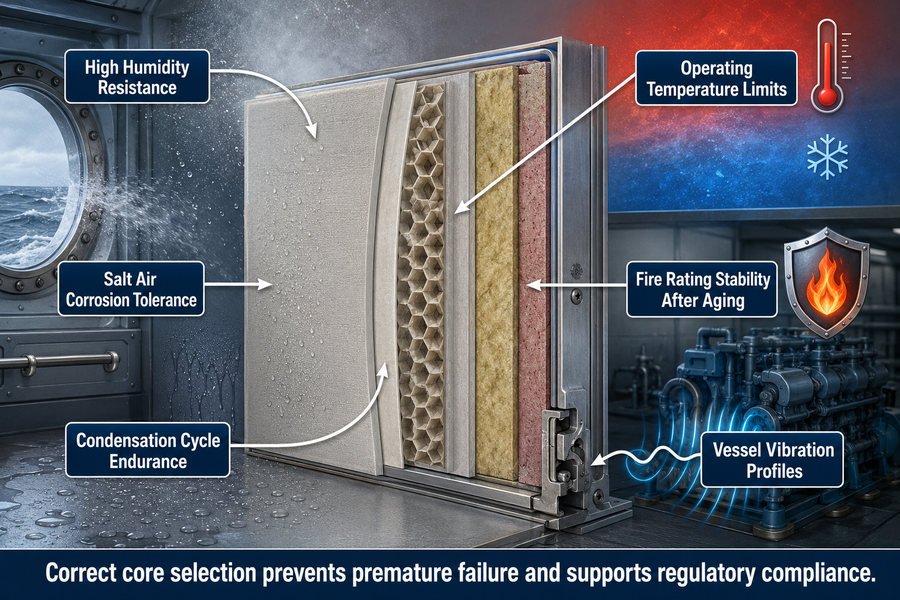
I remember a major ferry project where the builder used standard rock wool in a high-humidity deck area, and the panels failed within six months. Picking the right core from the start saves you time, money, and angry calls from the shipyard.
Which Core Resists High Humidity Without Acoustic Loss in Marine Accommodation Panels?
High humidity destroys ship soundproofing fast. Wet core materials let engine noise flood crew cabins. Choosing moisture-resistant acoustic cores keeps the noise out and keeps the ship crew happy.
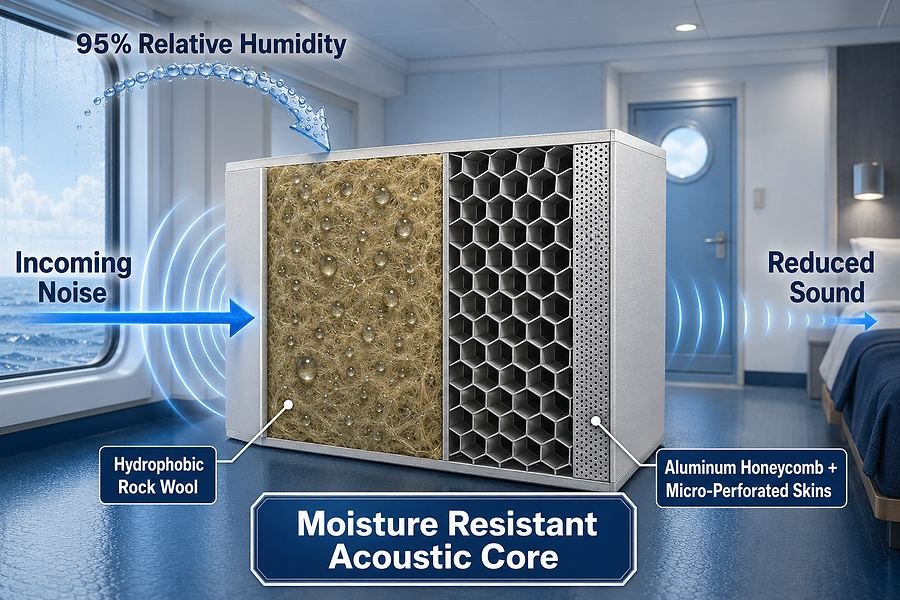
To resist high humidity without acoustic loss, use hydrophobic rock wool or aluminum honeycomb with micro-perforated skins. Hydrophobic rock wool maintains up to 45 dB reduction even at 95% relative humidity, while aluminum honeycomb offers consistent sound dampening because it does not absorb water at all.
Performance of Hydrophobic Rock Wool in High Humidity
When you buy acoustic panels for a ship, standard rock wool seems cheap. But in my years at the Magellan Marine factory, I saw standard rock wool act like a sponge. When standard rock wool absorbs water from humid sea air, the water fills the air gaps inside the wool. Those air gaps are what stop the sound waves. Once water fills them, the noise travels straight through the water and into the cabin. To solve this, you must buy hydrophobic rock wool. Factory engineers treat this material with special water-repellent oils during production. According to ISO 717-1 acoustic tests, a 50mm thick panel with a 150 kg/m³ hydrophobic rock wool core still blocks 45 decibels (dB) of noise even after spending 30 days in a room with 95% relative humidity. The cost is about $5 to $8 more per square meter than standard wool, but it saves the entire acoustic function of the panel.
Acoustic Stability of Aluminum Honeycomb with Micro-Perforated Skins
If you cannot risk any water absorption at all, you must use aluminum honeycomb. By itself, solid aluminum reflects sound, which is bad for cabins. But when we build it with micro-perforated surface skins, the tiny holes trap the sound waves inside the honeycomb cells. Because aluminum is a metal, 95% or even 100% humidity does not change its weight or structure1. The sound reduction remains a constant 35 to 40 dB. I always recommend this for wet areas like public bathrooms or pool decks on cruise ships.
Acoustic Performance Comparison under 95% Humidity
| Core Material Type | Water Absorption Rate (by volume) | Acoustic Reduction at 95% Humidity | Estimated Price per Square Meter |
|---|---|---|---|
| Standard Rock Wool | 15% to 20% | Drops to 20 - 25 dB | $15 - $25 |
| Hydrophobic Rock Wool | Less than 1% | Maintains 42 - 45 dB | $20 - $33 |
| Perforated Alu Honeycomb | 0% | Maintains 35 - 40 dB | $45 - $60 |
How Does Salt Air Affect Aluminum Honeycomb vs Rock Wool Core Longevity?
Salt air eats through cheap materials quickly. Corroded panels mean failed ship inspections and very expensive rework. Knowing how salt impacts different cores protects your interior outfitting investments.
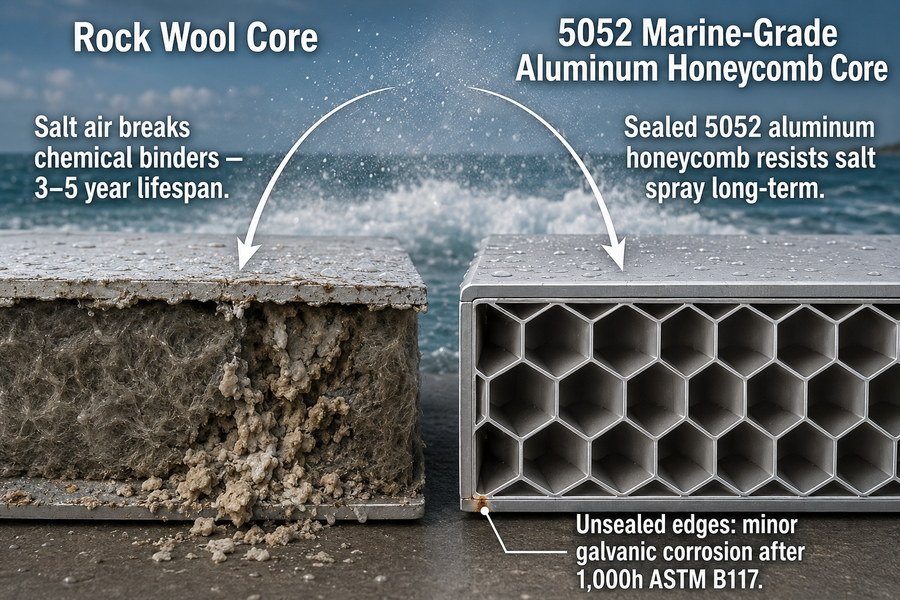
Salt air degrades standard rock wool by breaking down chemical binders, reducing lifespan to 3-5 years. In contrast, 5052 marine-grade aluminum honeycomb withstands salt spray indefinitely if sealed, while unsealed edges may show minor galvanic corrosion after 1,000 hours per ASTM B117 standards.
Salt Air Degradation of Chemical Binders in Standard Rock Wool
Salt air is the biggest enemy of cheap ship panels. When I visit shipyards in coastal areas, I often see older ships with bulging wall panels. This happens because salt air enters the panel joints. Standard rock wool holds its shape using cheap chemical resin binders2. When sodium chloride (salt) from the ocean air mixes with natural moisture, it creates a weak acid. Over 3 to 5 years, this salty moisture breaks down the resin binders inside the standard rock wool. Once the binder dissolves, the rock wool fibers fall apart and sink to the bottom of the panel. The top of the wall becomes empty, and the panel loses its shape. Replacing a failed panel costs around $150 to $200 per square meter when you include labor, which destroys project profit margins.
Lifespan of 5052 Marine-Grade Aluminum Honeycomb in Salt Spray
When you need a panel to last 20 years in salty ocean air, you need to buy 5052 marine-grade aluminum honeycomb. Regular commercial aluminum (like 3003 series) will rust in salt air. But 5052 aluminum contains magnesium3, which naturally fights salt corrosion. In factory tests using the ASTM B117 standard, we spray panels with a heavy salt fog for 1,000 continuous hours. If the panel edges are properly sealed with marine glue, the 5052 aluminum honeycomb shows zero corrosion. Even if a worker cuts the panel and leaves the edge unsealed, the 5052 core only shows a tiny bit of white powdery oxidation, but it does not lose its structural strength.
Salt Air Lifespan and Degradation Costs
| Core Material | Grade / Treatment | Lifespan in Ocean Air | Replacement Risk Cost (per m²) |
|---|---|---|---|
| Standard Rock Wool | Urea-formaldehyde binder | 3 to 5 years | $150 - $200 |
| Aluminum Honeycomb | 3003 Commercial Grade | 7 to 10 years | $100 - $150 |
| Aluminum Honeycomb | 5052 Marine Grade | 20+ years | $0 (Rarely fails) |
Which Core Handles Repeated Condensation Cycles Better in Marine Accommodation Panels?
Temperature swings cause hidden wall sweat inside ships. Trapped water breeds black mold and rots panels from the inside out. Selecting cores that manage condensation cycles stops this hidden decay.
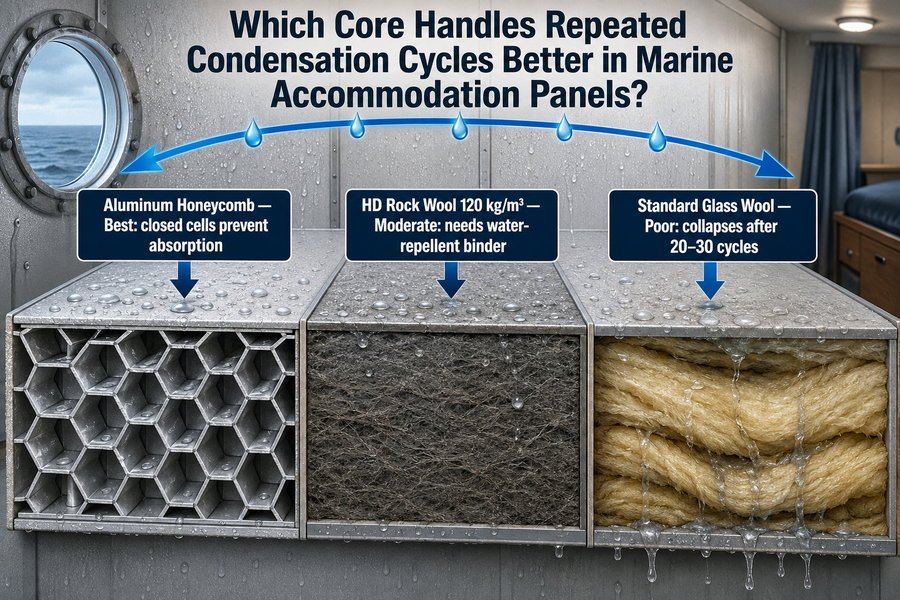
Aluminum honeycomb handles repeated condensation cycles best because its closed-cell structure prevents water absorption completely. High-density rock wool (minimum 120 kg/m³) can survive moderate cycles if treated with water-repellent binders, but standard glass wool collapses and loses structural integrity after just 20 to 30 wet-dry cycles.
Closed-Cell Aluminum Honeycomb Response to Condensation Cycles
Condensation happens because the inside of a ship cabin is warm, but the steel hull touching the ocean is very cold.4 This difference creates "dew" or "sweat" inside the walls every single day. I tell my clients that if they are building ships that travel between cold and hot climates, condensation is a daily threat. Aluminum honeycomb is the best choice for this problem. Because the core is made of solid metal shaped into hexagons, it forms a closed-cell barrier. When water drips down the steel hull and touches the back of the panel, the aluminum simply blocks it. The core absorbs exactly 0% of the water.5 When the sun comes up and heats the ship, the condensation evaporates naturally without ever entering the core.
Treatment Needs for High-Density Rock Wool under Wet-Dry Stress
If your budget does not allow for aluminum, you can use rock wool, but you must be careful. Standard glass wool or cheap rock wool will absorb the daily condensation. After 20 to 30 days of getting wet and drying out (wet-dry cycles), the fibers break, and the wool turns into a heavy, wet lump at the bottom of the wall.6 To prevent this, you must buy high-density rock wool. You need a density of at least 120 kg/m³, and it must have water-repellent binders. Under the ISO 12571 moisture test, this high-density treated wool only absorbs 1% moisture by volume during condensation cycles7, allowing it to survive for years without collapsing.
Structural Collapse of Standard Glass Wool from Moisture
I never recommend standard glass wool for ships that cross different climates. Glass wool is very light, usually around 20 kg/m³ to 40 kg/m³. Because it is so light, it has huge air pockets. When condensation hits it, the glass wool sucks up the water. The water makes the wool five times heavier, and gravity pulls it down. It collapses entirely.
Core Material Survival Rates in Condensation Cycles
| Core Material | Density | Water Retention after 30 Cycles | Structural Result |
|---|---|---|---|
| Standard Glass Wool | 24 kg/m³ | High (soaks up water) | Complete collapse |
| High-Density Rock Wool | 120 kg/m³ | Low (~1%) | Keeps shape |
| Aluminum Honeycomb | N/A | 0% | No change |
How Does Operating Temperature Range Drive Marine Accommodation Panel Core Choice?
Extreme heat or freezing cold ruins weak core materials. Cracked walls lead to major safety risks on the ship. You must exactly match the panel core to the ship's operating temperature limits.
Operating temperatures drive core choice into three ranges: below 0°C requires vapor-sealed polyurethane (PU) foam to stop ice expansion; 0°C to 80°C suits standard aluminum honeycomb; and high-heat zones up to 1000°C demand ceramic fiber or high-density rock wool to meet IMO SOLAS A-60 fire structural requirements.
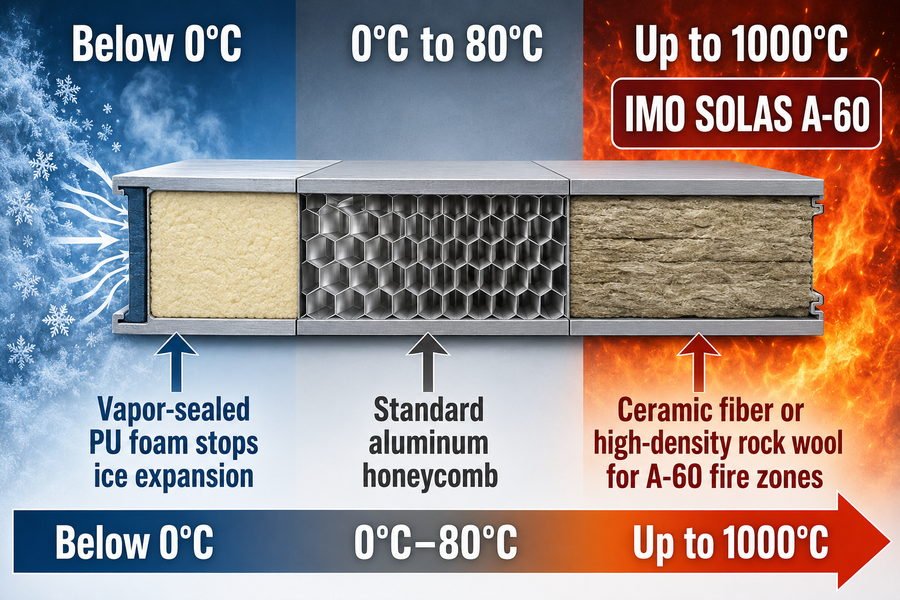
Using Polyurethane (PU) Foam for Below 0°C Freezing Zones
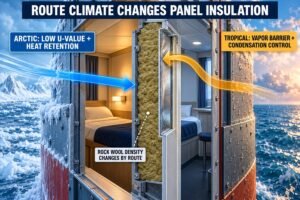
Different rooms on a ship have totally different temperatures. If you are buying panels for a walk-in freezer room or a ship operating in the Arctic, the temperature drops below 0°C. At this temperature, any moisture inside the panel will turn into ice. Ice expands, and it will push the steel surface right off the panel core.8 I learned this the hard way on a fishing vessel project. For freezing zones, you must buy panels with a Polyurethane (PU) foam core. PU foam has a density of about 40 kg/m³ and acts as a total vapor seal.9 It traps the cold inside and stops any water from entering and freezing.
Applying Aluminum Honeycomb for 0°C to 80°C General Areas
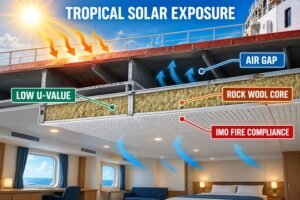
For normal living spaces, hallways, and dining rooms, the temperature usually stays between 20°C and 40°C. In the summer, near windows, it might reach 80°C. Standard aluminum honeycomb is perfect for this middle range. The metal does not warp or change shape until it gets much hotter.10 Aluminum honeycomb panels keep the cabins perfectly flat and looking clean.
Meeting IMO SOLAS Requirements with Ceramic Fiber for 1000°C Heat
If you are buying panels for the walls right next to the ship's main engine, you face extreme heat. In an engine fire, temperatures jump to 1000°C in minutes. International Maritime Organization (IMO) SOLAS rules are very strict here. You must use an A-60 rated panel.11 Aluminum melts at 660°C, so you cannot use it here. You must use ceramic fiber cores or 150 kg/m³ high-density rock wool. These materials do not melt or smoke at 1000°C, blocking the fire for 60 minutes and saving the crew.
Operating Temperature Limits for Panel Cores
| Room Type | Temperature Range | Required Core Material | Core Density Needed |
|---|---|---|---|
| Freezers / Arctic Stores | -30°C to 0°C | Polyurethane (PU) Foam | 40 - 50 kg/m³ |
| Cabins / Hallways | 0°C to 80°C | Aluminum Honeycomb | N/A |
| Engine Rooms / Galleys | Up to 1000°C | Ceramic Fiber / Rock Wool | 120 - 150 kg/m³ |
Which Core Holds Fire Rating After Long-Term Humidity Aging?
Aging panels often lose their original fire resistance. A failed fire test on an old ship causes massive shipyard delays. Using cores that stay fireproof after years of aging ensures long-term compliance.
Ceramic fiber and high-density hydrophobic mineral wool hold their IMO fire ratings after long-term humidity aging. Standard rock wool can absorb moisture, dropping its melting point and failing A-60 tests after 10 years, whereas ceramic fibers maintain a 1200°C melting point regardless of lifetime moisture exposure.
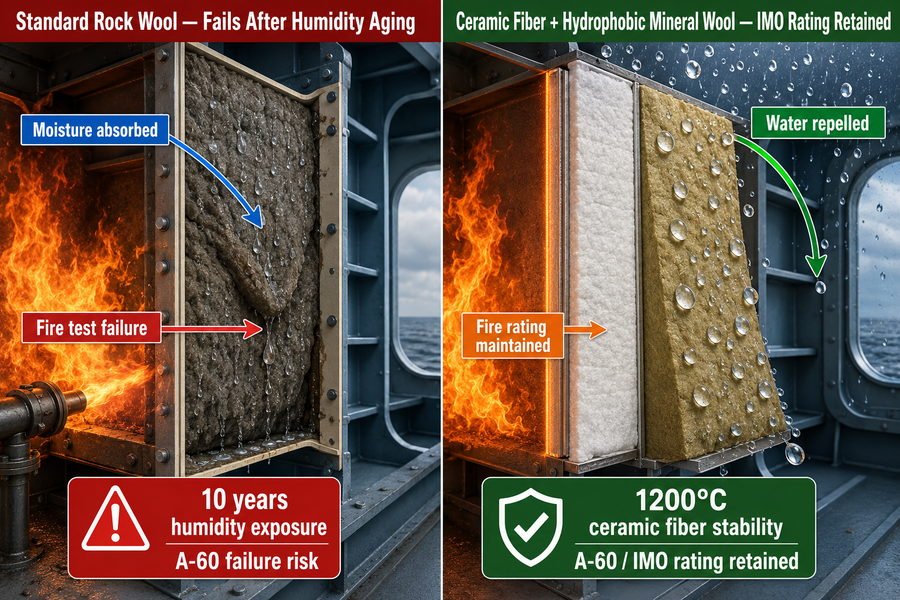
IMO Fire Rating Stability of Ceramic Fiber After Humidity Aging
When a ship is built, the panels pass the fire test easily. But port inspectors check ships again when they are 10 or 15 years old. In my experience helping clients pass the IMO FTP Code Part 3 fire tests12, older panels often fail. This happens because the core material aged badly in the humid ocean air. Ceramic fiber is the safest choice for long-term fire ratings. Ceramic fiber is made from silica and alumina.13 These minerals do not react with water. Even if a ceramic fiber panel sits in a 90% humidity environment for 15 years, its melting point stays at exactly 1200°C.14 When the inspector tests the ship later, the panel still easily passes the A-60 fire rating.
Hydrophobic Mineral Wool Performance in Long-Term Fire Tests
If ceramic fiber is too expensive for your budget, hydrophobic mineral wool is the second best option. As I explained earlier, the factory treats this wool to reject water. Because it keeps the water out over the years, the structure stays tight. When fire hits it 10 years later, the tight fibers still block the heat for the required 60 minutes.
Failure Rates of Standard Rock Wool Due to Moisture Absorption
You must avoid standard, untreated rock wool for fire-rated walls. Over 10 years, standard rock wool absorbs water and salt. The salt attacks the fibers. The moisture makes the panel heavy, and the wool sags.15 In a real fire, the top of the wall is empty because the wool sank to the bottom. The fire burns right through the empty top space in 5 minutes. The shipyard will have to tear out all the walls and replace them to pass inspection, which costs thousands of dollars.
Fire Rating Changes After 10-Year Humidity Aging
| Core Material | Original IMO Rating | Melting Point | Rating After 10 Years Aging |
|---|---|---|---|
| Ceramic Fiber | A-60 | 1200°C | A-60 (Passes) |
| Hydrophobic Rock Wool | A-60 | 1000°C | A-60 (Passes) |
| Standard Rock Wool | A-60 (when new) | 1000°C | Fails (due to sagging/gaps) |
How Does Vibration Spectrum Affect Aluminum Honeycomb vs Rock Wool Core Choice?
Engine vibrations shake panels apart over time. Loose dust from broken cores causes crew health issues and fails acoustic tests. Matching the core to the exact vibration spectrum prevents premature structural failure.
Low-frequency structural vibrations (1-50 Hz) favor aluminum honeycomb due to its high shear strength and rigidity. High-frequency airborne vibrations (above 500 Hz) require rock wool cores to absorb sound energy, though constant shaking causes standard rock wool below 100 kg/m³ to settle and leave uninsulated voids.
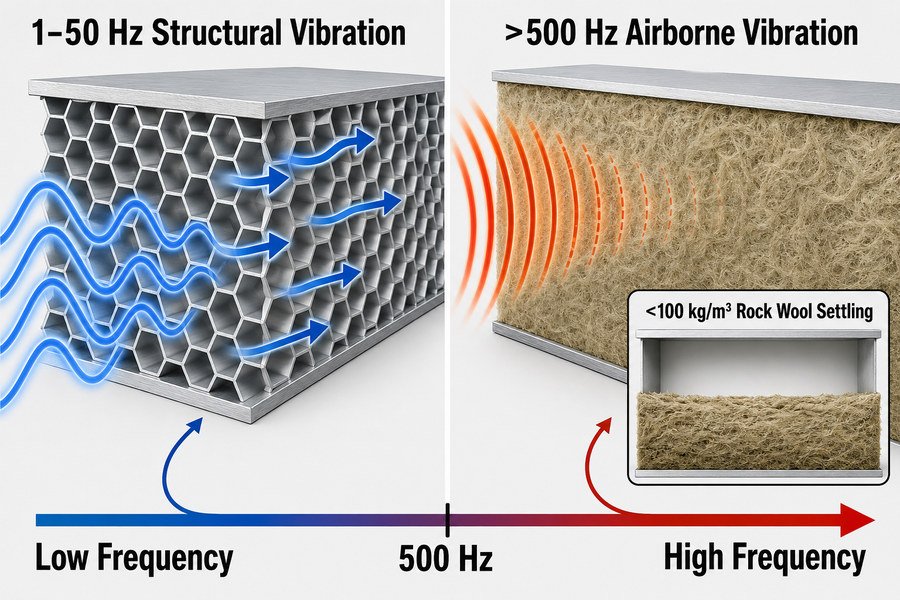
Resisting 1-50 Hz Structural Vibrations with Aluminum Honeycomb
Every ship shakes. The main diesel engines create powerful, slow shaking called low-frequency structural vibration. This vibration travels through the steel floors and into the wall panels. This shaking usually measures between 1 and 50 Hertz (Hz)16. When I check panels near the engine casing, I see that heavy materials often break under this slow shaking. Aluminum honeycomb is the best material for low-frequency vibration. It has a very high shear strength17. Because it is a solid metal web, the hexagons flex just a tiny bit and absorb the shaking without breaking. DNV rules often require strong, rigid panels in these high-vibration zones to stop the walls from rattling loudly.
Absorbing 500+ Hz Airborne Sound Energy with Rock Wool
While the engine shakes the floor, the ship's generators and ventilation fans create a fast, high-pitched noise. We call this high-frequency airborne vibration. It usually measures above 500 Hz. Aluminum honeycomb is rigid and does not stop high-frequency noise very well. To stop the fast sound waves from entering the sleeping cabins, you need a soft material to catch the energy. High-density rock wool is perfect for this. The dense fibers trap the fast vibrations and turn the sound energy into tiny amounts of heat18.
Settling Issues in Standard Rock Wool Below 100 kg/m³
You must be careful when buying rock wool for shaking ships. If you buy cheap rock wool with a density below 100 kg/m³19, the ship's constant shaking will destroy it. The vibration acts like a hammer, slowly shaking the light fibers downwards. Over two years, the wool "settles" to the bottom of the steel panel. The panel gets hollow at the top, and black dust falls out of the bottom joints. I always advise buyers to pay $3 to $5 more per square meter to get 120 kg/m³ or 150 kg/m³ density to stop this settling problem.
Vibration Impact on Different Core Materials
| Vibration Type | Best Core Material | Reason for Selection | Avoid Using |
|---|---|---|---|
| Low Frequency (1 - 50 Hz) | Aluminum Honeycomb | High shear strength, stays rigid | Light glass wool (shakes apart) |
| High Frequency (500+ Hz) | High-Density Rock Wool | Soft fibers trap fast sound energy | Solid Aluminum (reflects noise) |
| Continuous Shaking | Core over 120 kg/m³ | Density stops settling and dust | Core under 100 kg/m³ (sags) |
Conclusion
Choosing the right marine panel core based on environmental factors like humidity, salt, and vibration ensures long-lasting ship safety. Make smart core choices to protect your shipyard projects and profits.
-
"How Does Aluminum Honeycomb Core Compare to Other Cores in ...", https://magellanmarinetech.com/how-aluminum-honeycomb-core-compare-to-other-cores-marine-accommodation-panels/. Materials-science references describe aluminum and aluminum honeycomb cores as non-hygroscopic metallic structures whose mass and cell geometry are not changed by humidity exposure in the way porous fibrous insulations can be; this supports humidity stability but does not by itself prove a specific acoustic rating. Evidence role: mechanism; source type: education. Supports: Aluminum honeycomb is not subject to water absorption-related weight or structural change at very high humidity.. Scope note: Contextual support only; corrosion environment, alloy, coatings, and bonded joints may affect long-term durability in marine service. ↩
-
"Low Formaldehyde Binders for Mineral Wool Insulation: A Review", https://pubmed.ncbi.nlm.nih.gov/35433028/. Technical literature on mineral wool manufacture describes the use of organic resin binders, including phenolic or urea-modified systems, to bond fibers and help maintain product form, supporting the binder-dependence described here. Evidence role: mechanism; source type: paper. Supports: Standard rock wool uses chemical resin binders to hold fibers together and maintain panel shape.. Scope note: This supports the general role of binders in rock/mineral wool, but does not by itself verify the claimed 3–5 year salt-air failure timeline in ship panels. ↩
-
"[PDF] Corrosion of Bare and Coated Al 5052-H3 and Al 6061-T6 in Seawater", https://www.hnei.hawaii.edu/wp-content/uploads/Corrosion-of-Aluminum-Alloys-in-Seawater.pdf. Materials references list magnesium as the principal alloying element in 5052 aluminum and describe aluminum–magnesium 5xxx alloys as having good corrosion resistance in marine or seawater environments, providing contextual support for the alloy-selection rationale. Evidence role: mechanism; source type: education. Supports: 5052 aluminum contains magnesium, and this alloy chemistry is associated with improved resistance to saltwater or marine corrosion.. Scope note: This supports the general corrosion-resistance rationale for 5052 alloy, but it does not prove zero corrosion for a specific honeycomb panel design or sealing process. ↩
-
"condensation: dew, fog and clouds", http://cimss.ssec.wisc.edu/wxwise/class/dewfog.html. A source on psychrometrics or marine condensation should support that condensation forms when humid indoor air contacts a surface whose temperature is below the air’s dew point, which is the physical mechanism relevant to a cold ship hull. Evidence role: mechanism; source type: education. Supports: Warm, humid cabin air can condense on a cold steel hull when the hull surface is below the dew point.. Scope note: This would support the condensation mechanism generally, not prove that it occurs daily in every ship cabin or voyage profile. ↩
-
"Advances in Hygroscopic Polymer Gels toward Efficient Atmospheric ...", https://pmc.ncbi.nlm.nih.gov/articles/PMC12752633/. A materials source should document that aluminum itself is non-hygroscopic/non-porous and does not absorb water into its bulk, which is the basis for treating aluminum honeycomb cores as water non-absorbing materials. Evidence role: general_support; source type: research. Supports: Aluminum honeycomb core material does not absorb water into the metal core.. Scope note: Such evidence would support the behavior of the aluminum material, but it may not prove that a complete honeycomb panel cannot retain water in cells, seams, coatings, adhesives, or damaged areas. ↩
-
"The Influences of Moisture on the Mechanical, Morphological ... - PMC", https://pmc.ncbi.nlm.nih.gov/articles/PMC7288152/. A laboratory aging study or building-physics paper should be used to show whether repeated wetting and drying can degrade mineral or glass wool insulation structure and increase settlement or loss of thickness under gravity. Evidence role: mechanism; source type: paper. Supports: Repeated wet-dry cycling can damage low-density fibrous insulation and contribute to settlement or collapse.. Scope note: Support may be contextual because the exact timeframe of 20–30 days and the described total collapse may depend on product type, density, binder chemistry, installation orientation, and loading conditions. ↩
-
"[PDF] Test Method to Quantify the Wicking Properties of Insulation ...", https://web.ornl.gov/sci/buildings/conf-archive/2010%20B11%20papers/26_Binder.pdf. A source describing ISO 12571 and measured sorption properties of hydrophobic mineral wool should support the reported moisture uptake under controlled humidity conditions. Evidence role: statistic; source type: institution. Supports: High-density, water-repellent rock wool has low moisture uptake, claimed here as about 1% by volume under ISO 12571-related testing.. Scope note: ISO 12571 concerns hygroscopic sorption properties under specified humidity conditions; it may not directly represent liquid condensation cycles unless the cited study explicitly connects the test results to wet-dry exposure. ↩
-
"[PDF] FREEZE-THAW PERFORMANCE OF PRESTRESSED CONCRETE ...", https://krex.k-state.edu/server/api/core/bitstreams/335897c7-e2f5-4935-a4dd-37d46826cca5/content. Materials-science sources on freeze–thaw damage explain that water expands on freezing and can generate internal stresses that cause cracking or separation in porous or bonded assemblies. Evidence role: mechanism; source type: education. Supports: Freezing moisture inside a panel can expand and contribute to separation between the steel skin and the panel core.. Scope note: This supports the physical mechanism generally; it does not by itself document failure of the specific ship-panel design described. ↩
-
"Influence of Rigid Polyurethane Foam Production Technology on ...", https://pmc.ncbi.nlm.nih.gov/articles/PMC12196953/. Technical literature on rigid polyurethane foam reports typical insulation densities around the 30–50 kg/m³ range and low water-vapor permeability compared with many fibrous insulations. Evidence role: general_support; source type: paper. Supports: Rigid PU foam used in insulated panels commonly has a density near 40 kg/m³ and provides strong resistance to water-vapor transmission.. Scope note: The term “total vapor seal” is stronger than most technical sources support; sources usually describe low permeability or vapor resistance rather than absolute impermeability. ↩
-
"thermal expansion of aluminum and various", https://nvlpubs.nist.gov/nistpubs/scientificpapers/nbsscientificpaper497vol19_a2b.pdf. Reference data for aluminum alloys describe melting temperatures around 660°C for pure aluminum and document thermal expansion behavior, providing context that 80°C is far below melting or softening conditions for the base metal. Evidence role: general_support; source type: encyclopedia. Supports: Aluminum honeycomb panels are generally dimensionally stable at temperatures such as 80°C because aluminum’s critical thermal limits are much higher.. Scope note: This supports the temperature margin for aluminum as a material, but panel warping also depends on adhesive, facing thickness, bonding quality, and composite construction. ↩
-
"What Is the Purpose and Scope of the IMO FTP Code?", https://magellanmarinetech.com/what-purpose-scope-of-imo-ftp-code/. The IMO FTP Code and SOLAS fire-safety framework define A-class divisions, including A-60, as divisions that must resist the standard fire test for 60 minutes while meeting specified temperature-rise limits on the unexposed side. Evidence role: definition; source type: institution. Supports: Shipboard panels near high-fire-risk areas may need A-60-rated fire-resisting construction under IMO/SOLAS-related requirements.. Scope note: This supports the meaning and regulatory basis of A-60 fire divisions; the exact requirement for a particular bulkhead or room depends on vessel type, location, flag-state implementation, and classification rules. ↩
-
"How Does the IMO FTP Code Connect with Other Marine Fire Safety ...", https://magellanmarinetech.com/how-imo-ftp-code-connect-with-other-marine-fire-safety-frameworks/. The IMO Fire Test Procedures Code identifies Part 3 as the test procedure for fire-resisting divisions, providing the regulatory context for A-class division testing. Evidence role: definition; source type: institution. Supports: IMO FTP Code Part 3 is the relevant fire-test framework for ship fire-resisting divisions such as A-rated panels.. Scope note: This supports the applicable test framework, not the article author’s claimed field experience with older panels. ↩
-
"Ceramic Fibers (Respirable Size) - 15th Report on Carcinogens", https://www.ncbi.nlm.nih.gov/books/NBK590815/. Occupational and materials references describe refractory ceramic fibers as amorphous aluminosilicate fibers produced from alumina and silica, supporting the stated composition. Evidence role: definition; source type: institution. Supports: Ceramic fiber used for refractory insulation is generally an aluminosilicate material made from silica and alumina.. Scope note: This supports typical refractory ceramic fiber composition; exact formulations vary by product grade and manufacturer. ↩
-
"Thermal Stability, Durability, and Service Life Estimation of Woven ...", https://pmc.ncbi.nlm.nih.gov/articles/PMC11084306/. Materials studies or refractory-fiber references may support that aluminosilicate ceramic fibers have high-temperature stability and low susceptibility to ordinary moisture exposure. Evidence role: mechanism; source type: paper. Supports: Ceramic fiber retains its high-temperature performance after prolonged humid aging.. Scope note: This would be contextual support only unless the cited source specifically tests 90% relative humidity for 15 years and verifies an unchanged 1200°C melting point; the word “exactly” requires direct experimental evidence. ↩
-
"The Influences of Moisture on the Mechanical, Morphological ... - PMC", https://pmc.ncbi.nlm.nih.gov/articles/PMC7288152/. Building-physics and insulation studies discuss how moisture uptake can alter mineral wool’s thermal and mechanical performance, providing a mechanism by which wet insulation may lose dimensional stability. Evidence role: mechanism; source type: paper. Supports: Moisture uptake can degrade mineral wool insulation performance and contribute to loss of structural stability or sagging.. Scope note: Such sources may support moisture-related degradation generally, but a marine wall cavity sagging enough to fail an IMO fire test would require product- and assembly-specific evidence. ↩
-
"noise and vibrations on board cruise ships: are new standards ...", https://www.academia.edu/7913564/NOISE_AND_VIBRATIONS_ON_BOARD_CRUISE_SHIPS_ARE_NEW_STANDARDS_EFFECTIVE. Marine vibration guidance and shipboard vibration studies commonly evaluate machinery-induced structural vibration in low-frequency bands that include roughly 1–50 Hz, supporting the stated order of magnitude for diesel-related hull and deck vibration; this does not prove that every panel near an engine casing will experience this full range. Evidence role: statistic; source type: institution. Supports: Main diesel engines create low-frequency structural vibration in ships, usually measuring between 1 and 50 Hz.. Scope note: The source should support the frequency range as a common evaluation band, not as a universal measurement for all ships or locations. ↩
-
"[PDF] Mechanical Properties Characterization of Composite Sandwich ...", https://ntrs.nasa.gov/api/citations/19880000739/downloads/19880000739.pdf. Studies of aluminum honeycomb sandwich cores report high out-of-plane shear stiffness and shear strength relative to weight, supporting the use of honeycomb cores where rigid lightweight panels are required; this evidence supports the property, not the absolute claim that honeycomb is always the best low-frequency vibration material. Evidence role: mechanism; source type: paper. Supports: Aluminum honeycomb has high shear strength and rigidity that can help panels resist structural vibration.. Scope note: The evidence is likely to support honeycomb shear properties generally, but not necessarily superiority in every marine low-frequency vibration application. ↩
-
"Acoustic Performance of Sound Absorbing Materials Produced from ...", https://pmc.ncbi.nlm.nih.gov/articles/PMC9105389/. Acoustics references on porous absorbers explain that mineral wool dissipates sound as viscous and thermal losses within interconnected fibers and pores, converting part of the acoustic energy into heat; this supports the absorption mechanism rather than proving performance for a specific ship panel design. Evidence role: mechanism; source type: education. Supports: High-density rock wool absorbs high-frequency airborne sound by dissipating acoustic energy as heat within its fibrous structure.. Scope note: The source should explain the general acoustic mechanism of porous mineral wool, not guarantee a particular sound-reduction value in cabins. ↩
-
"[PDF] Settling of Loose-Fill Thermal Insulation ...... Development of a ...", https://web.ornl.gov/sci/buildings/conf-archive/1992%20B5%20papers/053.pdf. Research and technical literature on mineral wool mechanical stability show that lower-density fibrous insulation is more susceptible to compression, settlement, or loss of thickness under mechanical loading and vibration; this contextual support does not establish a universal 100 kg/m³ cutoff or the stated two-year failure timeline for marine panels. Evidence role: general_support; source type: paper. Supports: Low-density rock wool in vibrating ship panels is more likely to settle or degrade than denser rock wool.. Scope note: The source may support the relationship between density and mechanical stability, but the exact 100 kg/m³ threshold, two-year period, and dusting behavior need direct marine-panel evidence if retained as precise claims. ↩