Are you struggling to pass marine fire inspections? Choosing the wrong panel face sheet ruins projects and costs thousands. Let me show you exactly when steel is mandatory.
Steel face sheets are legally required for A-Class marine accommodation panels on all load-bearing and main fire zone bulkheads under SOLAS regulations. They must prevent smoke and flame passage for 60 minutes and restrict the unexposed side temperature rise to a maximum of 140°C above the initial temperature.
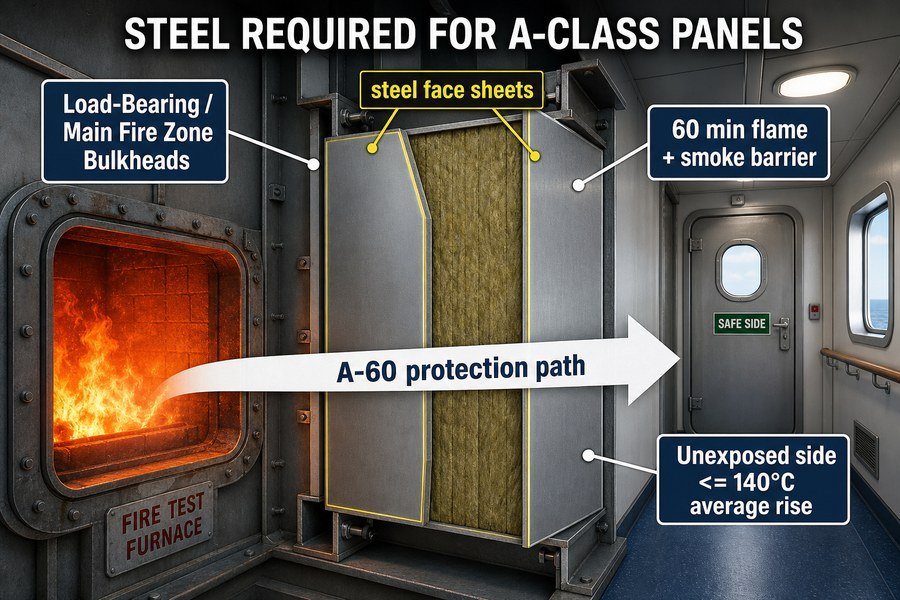
Many procurement officers ask me if they can skip heavy steel sheets to save money. The short answer is no, but the real details depend on safety rules. Let us look closer at why steel is the only choice for A-Class zones.
Why Do A-Class Marine Accommodation Panels Use Steel Face Sheets?
Do your marine panels melt during fire tests? Failing safety checks stops shipyard payments fast. You need to know why steel prevents these expensive disasters.
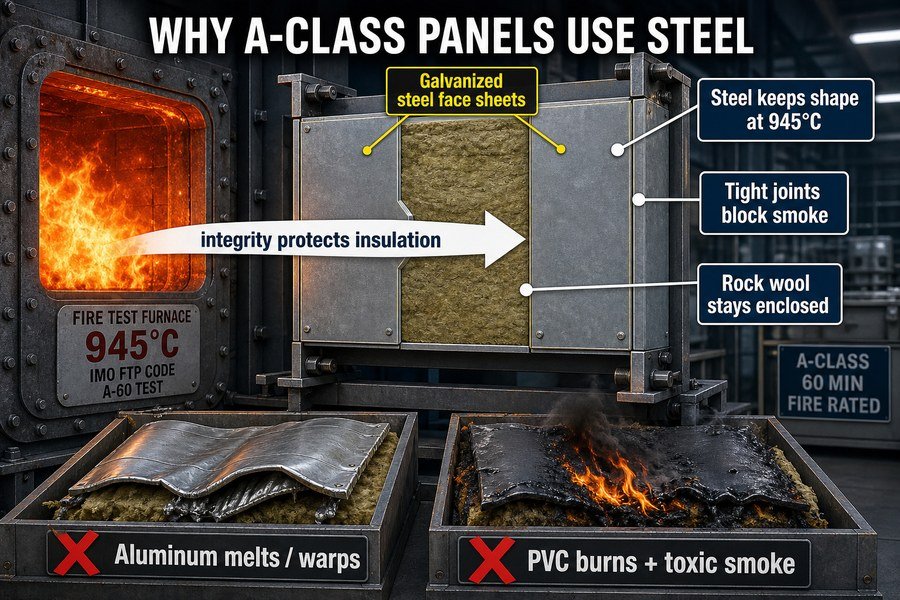
A-Class marine accommodation panels use steel face sheets because steel provides critical structural integrity, prevents toxic smoke passage, and resists melting at test temperatures reaching 945°C. Steel does not warp like aluminum or burn like PVC, ensuring the rock wool core stays intact during a 60-minute fire test.
Structural Integrity of Steel in High-Heat Tests
I worked at a factory where we tested different panel materials. According to the International Maritime Organization (IMO) Fire Test Procedures (FTP) Code, an A-Class panel must face a furnace fire that reaches up to 945°C in the first 60 minutes. We saw that steel is the only practical material that keeps its shape here. Standard steel has a melting point of around 1370°C to 1520°C. This means the steel face sheets provide critical structural integrity during the whole test. Without steel, the panel simply falls apart. For example, a standard A-60 panel uses rock wool with a high density of 120 kg/m³. This heavy insulation core weighs a lot. The steel face sheets act like a strong box to hold this heavy wool in place. If we tried to use a weaker plastic or thin metal sheet, the weight of the rock wool combined with the extreme 945°C heat would cause the whole panel to collapse in less than ten minutes. The steel stops this collapse.
Melting Points and Smoke Prevention of Face Sheets
Next, preventing smoke passage is a strict SOLAS rule1. Steel joints, when put together right, block toxic smoke perfectly. When the heat hits, the steel expands slightly, pushing the panel joints tightly together. This tight seal physically blocks dangerous smoke from passing into the next cabin room. Steel does not melt or warp quickly. Aluminum, however, warps and melts at just 660°C. PVC plastics will burn and release thick toxic smoke at even lower heat levels.2 Because steel stays strong and does not melt, it protects the inner rock wool core. The rock wool insulation needs a tough outer layer to stay in place and block the heat. If the face sheet fails and melts away, the rock wool falls out, and the fire spreads. This is why steel gives you the total package of structural integrity, heat resistance, and smoke blocking.
| Face Sheet Material | Melting Point | Structural Integrity at 945°C | Smoke Prevention Ability |
|---|---|---|---|
| Galvanized Steel | 1370°C - 1520°C | Excellent (Maintains shape) | High (Joints expand and seal) |
| Aluminum | 660°C | Fails completely (Melts) | Low (Warps and opens joints) |
| PVC Plastic | 100°C - 260°C | Fails completely (Burns) | Zero (Creates toxic smoke) |
What Minimum Steel Face Sheet Gauge Passes A-60 Fire Tests on Marine Accommodation Panels?
Are you buying panels that are too thick and heavy? Wasting money on extra steel kills your project profit. You must know the exact minimum thickness required.
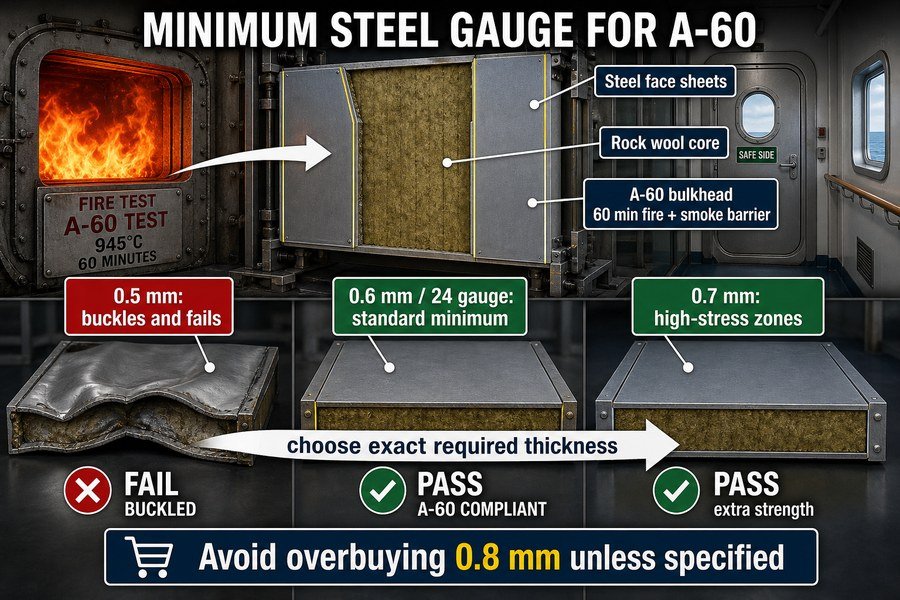
The minimum steel face sheet gauge that passes A-60 fire tests on marine accommodation panels is 0.6 mm (24 gauge) for standard bulkheads, while 0.7 mm is required for high-stress zones. Using anything thinner than 0.6 mm results in structural buckling and instant failure under IMO FTP Code standards.
The 0.6 mm Standard for A-60 Bulkhead Panels
Clients often ask me how thin they can go to save weight. According to most major classification societies like DNV and Lloyd's Register, the standard minimum steel face sheet gauge for an A-60 fire-rated marine panel is 0.6 mm. This is roughly equal to a 24-gauge steel sheet. During the strict IMO FTP Code A-60 fire test, the furnace heat reaches 945°C. At this heat, a 0.5 mm sheet simply fails3. It twists, buckles, and causes the panel joints to break open. When the joints break, fire gets through, and the test is an instant failure. Therefore, 0.6 mm is the absolute bottom limit for standard cabin bulkheads. A standard 0.6 mm steel sheet costs around $4 to $5 per square meter, depending on the zinc coating. Picking the correct 0.6 mm minimum saves both ship weight and material costs, without failing the fire test. You cannot use 0.5 mm because no inspector will pass it.
When to Use 0.7 mm Steel Sheets in High-Stress Zones
However, not all areas on a ship are standard. We must use 0.7 mm thick steel face sheets for high-stress zones. These zones include engine room borders or main corridors with heavy vibration. The extra 0.1 mm adds vital strength against both fire and daily ship movements. If you use thinner sheets here, you risk long-term damage and fire safety issues. Sometimes buyers want to be extra safe and buy 0.8 mm steel sheets. But if you jump to a 0.8 mm sheet just to be safe, you are paying $6 to $7 per square meter. That destroys your profit margin on a big cruise ship project. For a 1000 square meter project, using 0.6 mm galvanized steel instead of 0.8 mm saves about 1570 kg of weight. Steel costs around $800 to $1000 per metric ton right now. You must buy the exact 0.6 mm or 0.7 mm thickness depending on the specific zone requirements.
| Steel Thickness (Gauge) | Cost per Square Meter | Fire Test Performance (945°C) | Recommended Ship Zone |
|---|---|---|---|
| 0.5 mm | $3 - $4 | Fails (Buckles and breaks joints) | Not permitted for A-Class |
| 0.6 mm (24 Gauge) | $4 - $5 | Passes (Maintains shape) | Standard Cabin Bulkheads |
| 0.7 mm | $5 - $6 | Passes (High structural strength) | High-Stress Zones / Corridors |
| 0.8 mm | $6 - $7 | Passes (Over-engineered) | Unnecessary, wastes money |
Are Aluminum Face Sheets Allowed on A-Class Marine Accommodation Bulkhead Panels?
Do you want to use aluminum to make the ship lighter? Using the wrong metal causes immediate rejection by marine inspectors. Learn the strict rules about aluminum here.
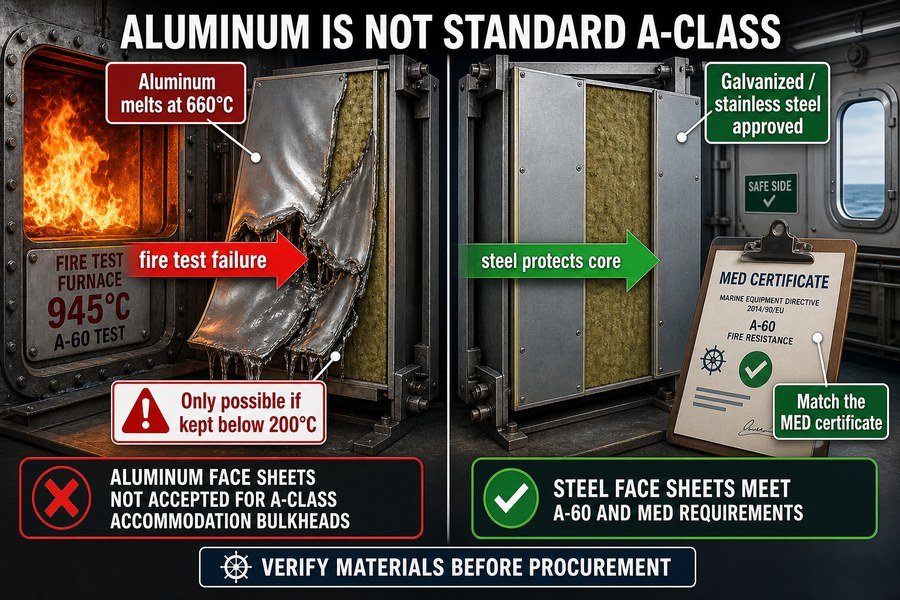
Aluminum face sheets are strictly prohibited on A-Class marine accommodation bulkhead panels under SOLAS regulations unless specifically insulated to restrict the aluminum core temperature below 200°C. Manufacturers only use galvanized or stainless steel because aluminum melts at 660°C and fails standard 945°C A-Class fire tests.
SOLAS Regulations on Aluminum in A-Class Fire Zones
I have seen many buyers try to order aluminum A-Class panels to lower the ship's weight. Aluminum weighs only 2.7 grams per cubic centimeter, while steel weighs 7.8 grams. I understand why buyers want to use it. But SOLAS regulations are very clear and strict. Aluminum face sheets are practically prohibited on A-Class marine accommodation bulkhead panels. The rule says you can only use aluminum if you add enough extra insulation to keep the aluminum's temperature strictly below 200°C during the whole 60-minute fire test. This rule exists because aluminum loses its structural strength rapidly at around 200°C.4 To keep the aluminum below 200°C, you would need so much heavy insulation that you lose any weight advantage. This makes aluminum completely useless for this job.
Why Galvanized and Stainless Steel Replace Aluminum
Because of this strict 200°C limit, manufacturers rely entirely on galvanized steel or stainless steel instead. As we know, the standard A-60 test hits 945°C. Aluminum melts completely at 660°C. If the aluminum face sheet melts, the rock wool core is exposed, and the panel fails instantly. Both galvanized and stainless steel easily survive the 945°C test heat without melting. The rules do not care about weight when safety is at risk. During a final ship inspection, a marine surveyor will check the MED certificate. If the certificate says the panel was tested with steel, but you installed aluminum to save weight, the surveyor will stop the ship from sailing.5 You will have to tear out every aluminum panel and buy steel ones, which will double your project costs. Always choose steel for A-Class zones.
| Metal Type | Density (Weight) | Melting Point | SOLAS A-Class Compliance |
|---|---|---|---|
| Aluminum | 2.7 g/cm³ | 660°C | Prohibited (Unless heavily insulated <200°C) |
| Galvanized Steel | 7.8 g/cm³ | 1370°C+ | Approved (Standard choice) |
| Stainless Steel | 7.9 g/cm³ | 1400°C+ | Approved (Used in wet areas) |
Which Face Sheet Metals Appear on MED-Approved A-Class Marine Accommodation Panel Certificates?
Are you confused by marine certificates? Buying a panel without the right paperwork means the shipyard cannot install it. See exactly which metals the MED approves.
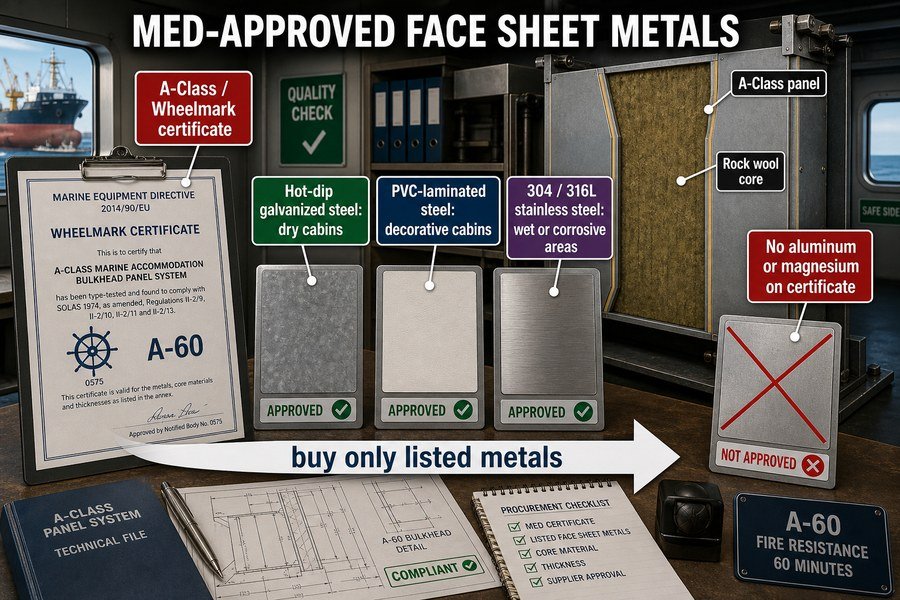
MED-approved A-Class marine accommodation panel certificates strictly feature three face sheet metals: hot-dip galvanized steel for dry cabins, PVC-laminated galvanized steel for decorative finish areas, and 304 or 316L stainless steel for wet or corrosive areas like galleys. No other metals pass the required fire certification.
Hot-Dip Galvanized Steel and PVC-Laminated Steel on Certificates
When you look at a Marine Equipment Directive (MED) certificate, also known as the Wheelmark certificate, the allowed materials are strictly listed. I review these documents every day. You will only see three specific face sheet metals on MED-approved A-Class marine accommodation panel certificates. First, you will see hot-dip galvanized steel. This is the base metal for 90% of dry cabin walls. It usually has a zinc coating of Z80 to Z120, meaning 80 to 120 grams of zinc per square meter. This zinc layer prevents basic air moisture from rusting the steel before installation. Second, the certificates list PVC-laminated galvanized steel. The strong steel is still the core fire barrier, but it has a thin 150-micron PVC film glued on top. This film gives the cabin a beautiful finish, like wood grain or soft fabric, while keeping the strong steel fire barrier underneath. You must never try to paint normal steel yourself to save money, as standard paint releases toxic gas during a fire and will fail the MED smoke test.
Stainless Steel 304 and 316L for Wet Marine Environments
Third, the certificates will specify stainless steel, specifically grades 304 or 316L. We must use stainless steel in wet or highly corrosive areas. For example, a ship's galley or a public bathroom requires 304 stainless steel because it stops food acids and cleaning chemicals from eating the metal. But if you are building an offshore oil rig accommodation module where salt water sprays directly onto the walls, 304 stainless steel will still rust. You must step up to 316L stainless steel because it contains 2% molybdenum to fight salt rust effectively6. If a supplier offers you a panel with a magnesium or standard aluminum face sheet, ask for the MED certificate. You will find that these metals are missing because they simply cannot pass the A-Class fire certification. You must only buy the three metals I listed to guarantee shipyard acceptance.
| Approved Metal Type | Key Surface Feature | Ideal Ship Area |
|---|---|---|
| Hot-Dip Galvanized Steel | Z80 to Z120 zinc coating | Dry cabins, hidden bulkheads |
| PVC-Laminated Steel | 150-micron decorative film | Passenger cabins, public lounges |
| 304 Stainless Steel | Resists food acids and chemicals | Ship galleys, public bathrooms |
| 316L Stainless Steel | Contains 2% molybdenum for salt | Offshore rigs, exterior-facing wet walls |
How Does Steel Face Sheet Contribute to A-60 Temperature Rise on Marine Accommodation Panels?
Do you know how panels block heat? Failing the temperature rise limit is the main reason panels fail tests. Learn how steel controls this critical heat transfer.
The steel face sheet contributes to the A-60 temperature rise by acting as an initial thermal barrier that absorbs and evenly spreads the 945°C furnace heat. This prevents localized hot spots and delays heat transfer to the rock wool core, keeping the unexposed side below the 140°C limit.
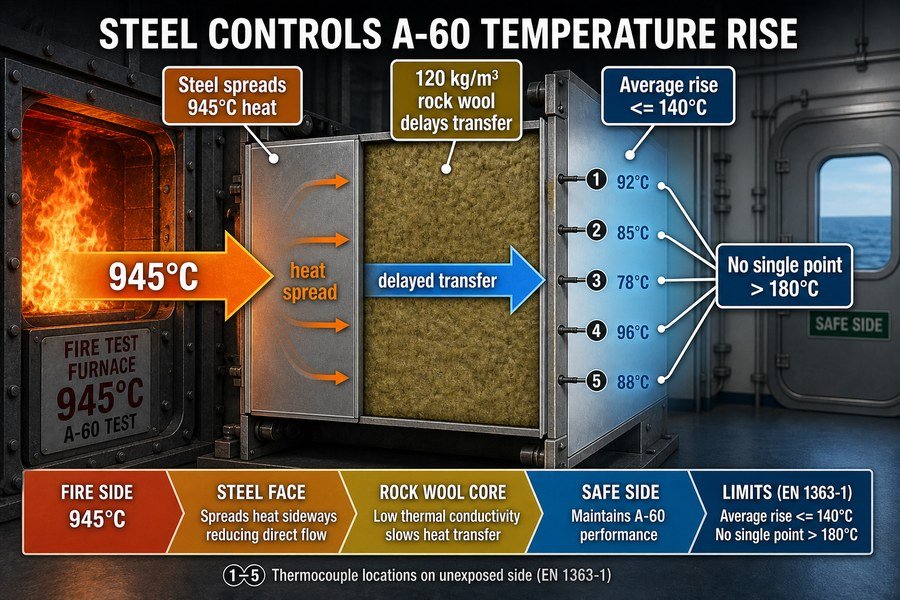
Absorbing and Spreading Furnace Heat Across the Steel Face
I want to explain the technical side of how heat moves through a panel. The IMO FTP Code says an A-60 panel must keep the unexposed side (the safe side) from rising more than 140°C above the starting room temperature. The steel face sheet plays a massive role in meeting this A-60 temperature rise rule. First, the fire side steel sheet acts as the initial thermal barrier. When the test furnace hits 945°C, the fire does not hit the insulation directly. The steel sheet absorbs this extreme heat. Because steel conducts heat well, it quickly spreads the heat evenly across the whole surface of the panel.7 This spreading action is very important. It prevents dangerous localized hot spots from forming. During the official laboratory test, technicians place five thermocouples on the safe side of the panel. One goes in the exact center, and four go near the corners. The rule states that no single point can rise more than 180°C. By spreading the heat, the steel face sheet stops single hot spots from forming, which protects that strict 180°C single-point limit.
Protecting the Rock Wool Core to Maintain the 140°C Limit
Next, spreading the heat delays the overall heat transfer into the core and protects the rock wool. For an A-60 rating, we usually use rock wool with a density of 120 kg/m³. As the heat finally moves from the steel into the rock wool, the rock wool traps the heat. Because the steel rapidly conducts the heat sideways across the panel face, it forces the entire rock wool core to absorb the heat equally. Without the steel spreading the heat, the fire would burn a concentrated hole straight through the rock wool. This teamwork between the steel face and the rock wool ensures the unexposed side stays safely below the 140°C average limit for a full 60 minutes. If the steel face sheet fails, the insulation is quickly destroyed, and the temperature on the safe side shoots up instantly.
| Heat Transfer Stage | Role of the Steel Face Sheet | Result on the Panel |
|---|---|---|
| Initial Furnace Heat (945°C) | Acts as the first thermal barrier | Stops direct fire contact with insulation |
| Heat Distribution | Spreads heat evenly across the surface | Prevents hot spots; protects 180°C limit |
| Core Transfer Delay | Forces equal absorption by 120 kg/m³ rock wool | Protects the 140°C average limit for 60 mins |
Conclusion
Steel face sheets are not optional; they are a strict legal requirement for A-Class marine panels. Choosing the correct thickness and metal type ensures fire safety and smooth shipyard approvals.
-
"46 CFR Part 116 Subpart D -- Fire Protection - eCFR", https://www.ecfr.gov/current/title-46/chapter-I/subchapter-K/part-116/subpart-D. SOLAS defines A-class divisions in terms of non-combustible construction and the prevention of smoke and flame passage during the specified standard fire exposure, supporting the statement that smoke passage is a regulatory concern for such divisions. Evidence role: definition; source type: institution. Supports: SOLAS treats prevention of smoke passage as part of the fire-integrity requirements for A-class divisions.. Scope note: This supports the regulatory requirement for fire divisions, but it does not independently verify that a particular steel joint design blocks smoke under all installation conditions. ↩
-
"Polyvinyl chloride toxicity in fires. Hydrogen chloride ... - PubMed", https://pubmed.ncbi.nlm.nih.gov/946083/. Fire-toxicity studies and government fire-safety references report that PVC can decompose or burn to produce dense smoke and toxic or corrosive gases such as hydrogen chloride, supporting the article’s contrast between PVC and metal face sheets in fire exposure. Evidence role: mechanism; source type: government. Supports: PVC plastics can burn or thermally decompose under fire conditions and release dense, toxic smoke at temperatures below those required to melt steel.. Scope note: Smoke yield and toxicity depend on PVC formulation, additives, ventilation, and fire temperature, so the source would support the general hazard rather than a fixed failure temperature. ↩
-
"[PDF] 727-01 white and yellow thermoplastic reflectorized pavement ...", https://www.dot.ny.gov/main/business-center/engineering/specifications/specs-repository/sec727to730_p7-257to285.pdf. Fire-test reports, type-approval certificates, or classification guidance comparing approved A-60 panel constructions can support whether 0.5 mm face sheets are excluded or shown to deform under A-60 furnace exposure. Evidence role: case_reference; source type: institution. Supports: A 0.5 mm steel face sheet is not acceptable for the described A-60 bulkhead panel construction because it fails by distortion or joint opening during the fire test.. Scope note: Evidence may be design-specific; failure of one 0.5 mm construction would not prove that all possible 0.5 mm A-60 panel systems fail without broader test data. ↩
-
"[PDF] Properties of Wrought Aluminum and Aluminum Alloys", https://materialsdata.nist.gov/bitstream/handle/11115/179/Properties%20of%20Wrought%20Aluminum.pdf?sequence=3. Materials-engineering references and elevated-temperature studies show that common aluminium alloys experience substantial reductions in yield strength and stiffness as temperature rises into the 200°C range and above. Evidence role: mechanism; source type: paper. Supports: Aluminum alloys can lose structural strength rapidly at elevated temperatures around 200°C.. Scope note: The exact loss of strength depends on alloy, temper, exposure time, and loading condition, so the source should be used to support the general mechanism rather than a universal threshold. ↩
-
"[PDF] Marine Safety: Port State Control", https://media.defense.gov/2022/Feb/09/2002935707/-1/-1/0/CI_16000_73.PDF. Marine-equipment conformity systems require installed fire-protection products to match the type-approved and certified construction, so substituting a different material from the certified test specimen can invalidate compliance during survey or inspection. Evidence role: general_support; source type: government. Supports: Installing aluminum panels when the certificate covers steel-tested panels can create a non-conformity during marine inspection.. Scope note: This supports the compliance risk of material substitution; enforcement outcomes such as detention, replacement scope, and cost depend on flag state, class society, port-state control, and project facts. ↩
-
"[PDF] Corrosion of Stainless Steel Type 316L in a Seepage Water ...", https://www.nrc.gov/docs/ML1124/ML112490377.pdf. Materials references and corrosion studies identify 316L stainless steel as a molybdenum-bearing austenitic grade, typically about 2–3% Mo, and associate molybdenum with improved resistance to chloride pitting and crevice corrosion; actual service life still depends on chloride concentration, temperature, cleaning, and exposure geometry. Evidence role: mechanism; source type: paper. Supports: 316L stainless steel contains about 2% molybdenum, which improves resistance to salt/chloride corrosion compared with 304 stainless steel.. Scope note: The evidence supports the metallurgical mechanism and typical composition, not a guarantee that 316L will not corrode in all marine or offshore conditions. ↩
-
"[PDF] Fouriers Law of Heat Conduction (PDF)", https://etrl.mechanical.illinois.edu/pdf/ME320/Lecture%202%20-%20Fouriers%20Law%20of%20Heat%20Conduction.pdf. Materials references and heat-transfer texts report that carbon steel has substantially higher thermal conductivity than mineral-wool insulation, and Fourier conduction explains lateral heat spreading in continuous metal sheets. Evidence role: mechanism; source type: education. Supports: Steel’s relatively high thermal conductivity allows a steel face sheet to spread heat laterally across the panel surface.. Scope note: This supports the physical mechanism in general; the degree of temperature equalization in a specific panel depends on sheet thickness, joints, insulation contact, and furnace exposure. ↩