
Are you struggling to balance cabin space and fire safety? Picking the wrong panel specs causes failed inspections and high costs. Let us fix this today.
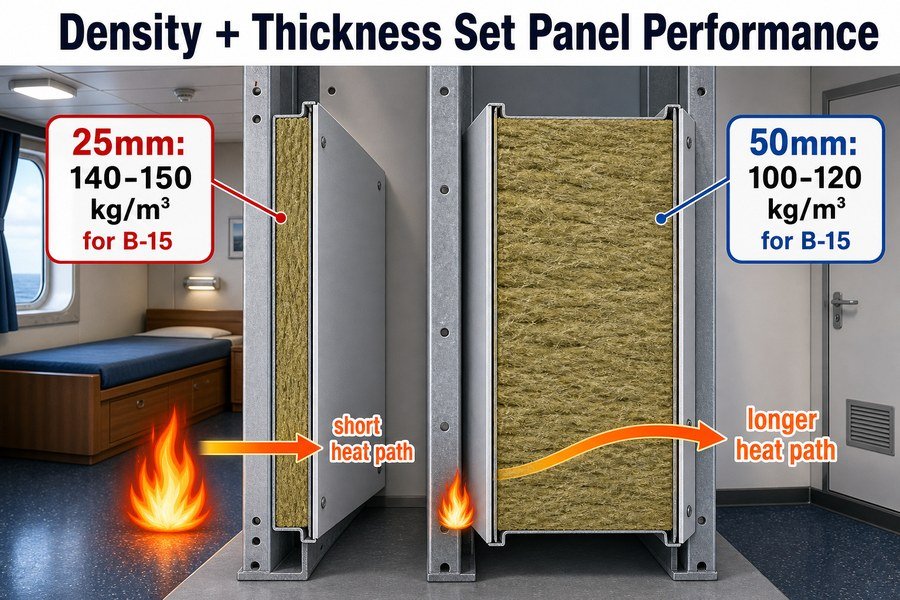
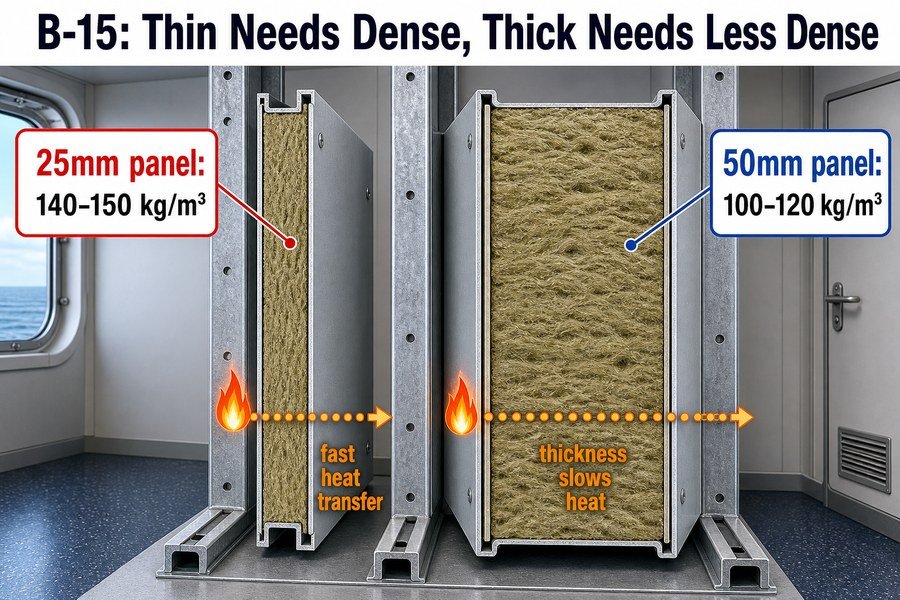
Core density and thickness interact to determine a marine panel's fire rating, weight, and acoustic performance. A thinner 25mm panel requires a higher density of 140-150 kg/m³ to achieve a B-15 fire rating, while a thicker 50mm panel can achieve the same rating with a lower density of 100-120 kg/m³.
When you plan a ship interior, space is tight and every millimeter counts. You might want to use the thinnest walls to save room. But this choice changes everything about the core material inside. If you do not match the rock wool density to the panel thickness correctly, your cabins will be too heavy, too loud, or fail safety tests. Let us look closely at how these two factors work together in real life.
How Does Rock Wool Core Density Relate to Total Marine Accommodation Panel Thickness?
Buying panels without checking density wastes money. If your thin panels lack dense cores, they fail safety rules. I will show you how to match them.
Rock wool core density inversely relates to total panel thickness for achieving specific SOLAS fire ratings. To meet B-15 standards, 25mm panels require a high density of 140-150 kg/m³. Conversely, 50mm panels only require a lower density of 100-120 kg/m³, as the extra thickness slows heat transfer effectively.
Meeting B-15 Fire Standards with 25mm Marine Panels
When I help buyers choose materials, they often want the thinnest panel possible. A 25mm marine panel is great for saving space in small ship cabins. However, because the panel is thin, fire can pass through it quickly. To stop this, we must put more rock wool into that small space. The rules set by SOLAS (Safety of Life at Sea) are very strict. To get a B-15 fire rating, the wall must stop fire and heat for 15 minutes. For a thin 25mm panel, the core density must be very high, usually between 140 kg/m³ and 150 kg/m³. If you try to use a lower density like 100 kg/m³ in a 25mm panel, it will fail the fire test.1 The heat will move through the thin, loose rock wool too fast. I have seen buyers buy cheap 25mm panels with low density, and the shipyards rejected them completely. High density packs the rock wool fibers close together. This blocks the heat and meets the strict safety standards.
Using Lower Density Rock Wool in 50mm Marine Panels
If you have more space, a 50mm panel is a very smart choice. Because this panel is twice as thick, the fire has to travel a longer distance to reach the other side. This extra distance slows down the heat transfer very well.2 Because the thickness does the hard work, we can use a lower rock wool density. A 50mm panel only needs a density of 100 kg/m³ to 120 kg/m³ to easily pass the same B-15 fire test. This is very good news for your budget and the total ship weight. Lower density rock wool costs less money. It also weighs less, which makes the panel easier for workers to carry and install. In my factory days, we always told clients that adding thickness allows you to drop the density. You still get the exact same fire rating, but the panel is lighter and cheaper to produce.
| Panel Thickness | Required Fire Rating | Rock Wool Density Needed | Heat Transfer Speed |
|---|---|---|---|
| 25mm | B-15 | 140 - 150 kg/m³ | Fast (needs high density to block) |
| 50mm | B-15 | 100 - 120 kg/m³ | Slow (thickness blocks heat naturally) |
How Does Core Thickness Relate to Total Marine Accommodation Panel Thickness?
Do you assume a 50mm panel has exactly 50mm of rock wool? This mistake ruins installation tracks. Let us calculate the true sizes.
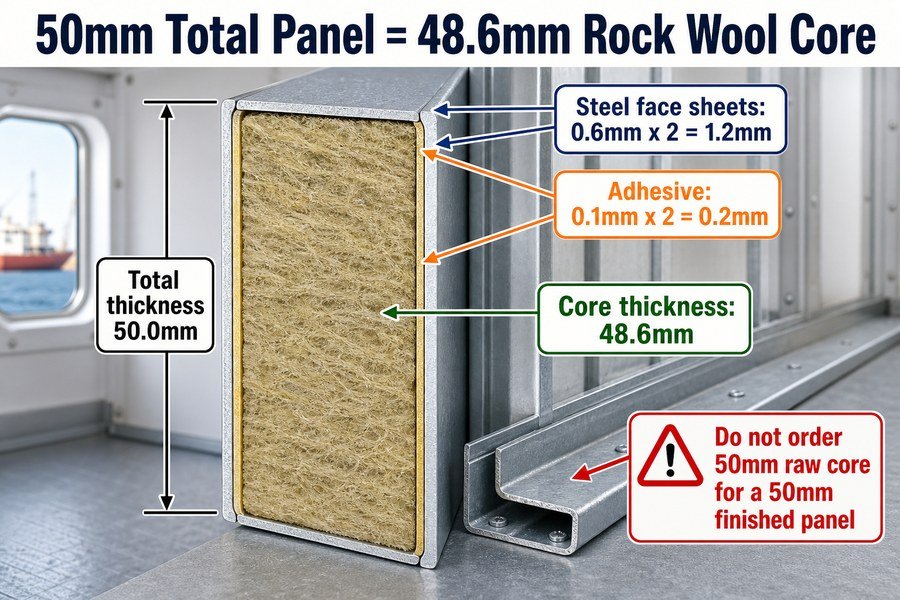
Core thickness does not equal total panel thickness. Total thickness includes the core, two steel face sheets (typically 0.6mm or 0.7mm each), and two layers of fire-retardant adhesive (around 0.1mm each). Therefore, in a standard 50mm marine accommodation panel, the actual rock wool core thickness is only about 48.6mm.
Calculating Steel Face Sheets in Total Marine Panel Thickness
Many people think that a 50mm marine wall panel contains a 50mm block of rock wool. This is not true. As an outfitting specialist, I must explain how factories build these panels. A sandwich panel has layers. The outside layers are steel face sheets.3 These steel sheets are very important for strength and look.4 Most standard marine panels use galvanized steel sheets that are 0.6mm or 0.7mm thick. Because there is a sheet on the front and a sheet on the back, you must count this twice. If you use 0.6mm steel, the two steel sheets take up 1.2mm of the total thickness. If you use 0.7mm steel, they take up 1.4mm. We must subtract this steel thickness from the total panel thickness. If we forget this, the finished panel will be too thick. It will not fit into the U-profiles and top tracks on the ship floor and ceiling. Factory machines are set to strict limits, so the core must be cut smaller than the final size.
The Role of Adhesive Layers in Final Marine Panel Dimensions
After we calculate the steel, we must also think about the glue. We use a special fire-retardant two-component polyurethane adhesive to bond the steel to the rock wool. The glue does not disappear when it dries. It adds a small amount of thickness.5 Usually, the glue layer is about 0.1mm thick on each side. So, two layers of glue add 0.2mm to the total thickness. Let us do the math for a 50mm panel. We take the total 50.0mm. We subtract 1.2mm for the two 0.6mm steel sheets. Then we subtract 0.2mm for the two layers of glue. The result is 48.6mm. This means the actual rock wool core is only 48.6mm thick. If you order raw rock wool cores that are exactly 50mm thick, your final bonded panel will be 51.4mm thick. The installation workers will not be able to push these thick panels into the standard 50mm bottom tracks. This causes huge delays on the ship.
| Component | Standard Thickness (mm) | Quantity per Panel | Total Space Taken (mm) |
|---|---|---|---|
| Galvanized Steel Face | 0.6mm | 2 | 1.2mm |
| Fire-Retardant Adhesive | 0.1mm | 2 | 0.2mm |
| Rock Wool Core | 48.6mm | 1 | 48.6mm |
| Total Panel Size | - | - | 50.0mm |
Why Does a Thicker Core Boost Rigidity Without Adding Steel Face Weight?
Flimsy walls cause shaking and noise. Adding thicker steel makes the ship too heavy. You can make walls stiff without the weight penalty.
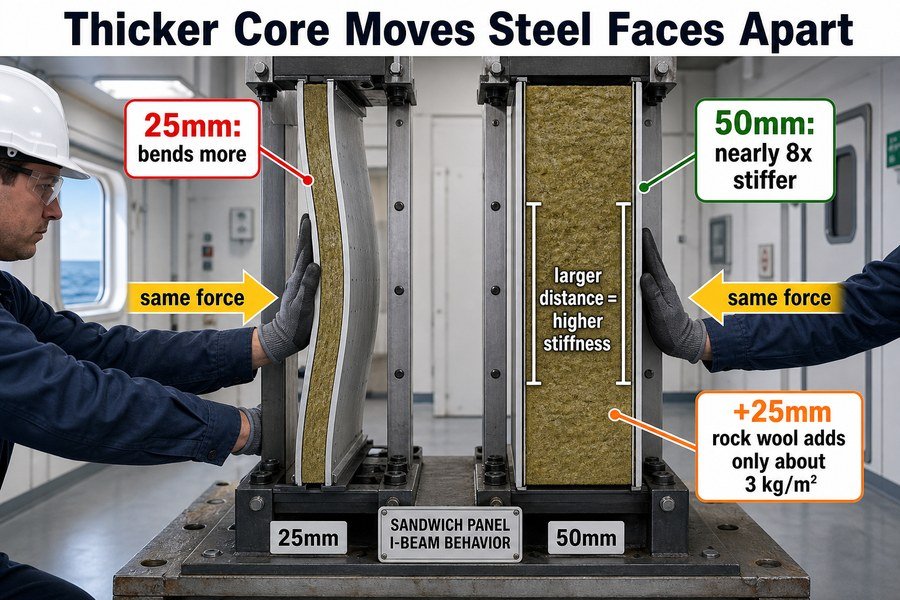
A thicker core boosts rigidity by moving the structural steel face sheets further apart, acting like an I-beam. Based on structural mechanics, increasing panel thickness from 25mm to 50mm increases bending stiffness by nearly eight times. The added rock wool core weighs only about 3 kg/m², keeping overall weight low.
The I-Beam Principle in Marine Sandwich Panels
When my clients want a stronger wall that does not bend, they often ask me to use heavier steel. I always tell them no. There is a smarter way based on simple structural mechanics. A marine sandwich panel works just like a steel I-beam6 used in big buildings. In an I-beam, the top and bottom flat parts hold all the load, while the middle part just keeps them apart. In our panels, the steel face sheets are like the flat parts of the I-beam, and the rock wool core is the middle. When you use a thicker core, you push the two steel face sheets further away from each other. In physics, this increases the "moment of inertia." The math shows that if you double the thickness from 25mm to 50mm, the panel becomes nearly eight times stiffer against bending7. The wall will not shake when the ship engine runs, and it will not bend when someone pushes against it. You gain massive strength just by moving the thin metal skins further apart.
Comparing Weight Additions: Rock Wool Core vs. Steel Faces
The best part about making the panel thicker is that you do not add much weight. Ship owners hate heavy materials because heavy ships burn more fuel and carry less cargo8. Steel is very heavy. Its density is 7850 kg/m³9. If you try to make the wall stiffer by using thicker steel faces, the weight of the panel goes up very fast. But rock wool is very light. If you increase the panel from 25mm to 50mm, you only add more rock wool, not more steel. Let us look at the numbers. Adding 25mm of extra rock wool at a density of 120 kg/m³ only adds about 3 kg of weight per square meter. That is very small. You get a wall that is eight times stiffer, but the weight only goes up a tiny bit. This is why thicker cores are the perfect solution for creating rigid, strong, and light ship cabin walls.
| Method to Increase Rigidity | Change in Bending Stiffness | Added Weight (per m²) | Result for Ship |
|---|---|---|---|
| Double Core Thickness (25 to 50mm) | ~8 times stiffer | + 3.0 kg/m² | Excellent (Strong and Light) |
| Thicken Steel Faces (0.6 to 1.2mm) | ~2 times stiffer | + 9.4 kg/m² | Poor (Heavy and Expensive) |
How Does Steel Face Sheet Thickness Affect Performance at Fixed Total Marine Accommodation Panel Thickness?
Scratches and dents ruin ship interiors during loading. You need tough walls, but thicker metal faces change the panel design. Here is the truth.
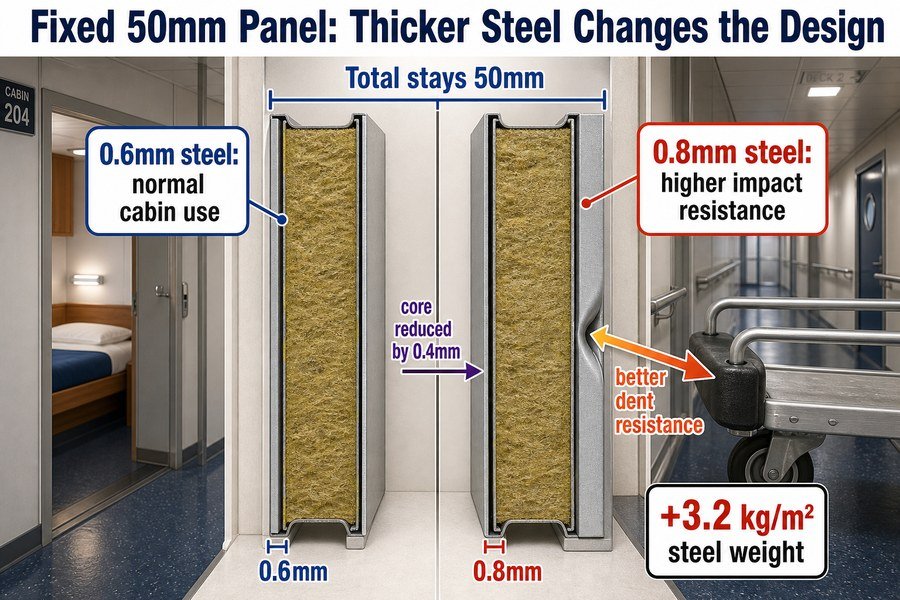
Upgrading from a standard 0.6mm to a 0.8mm steel face sheet on a fixed 50mm panel significantly improves impact resistance and load-bearing capacity. However, this upgrade reduces the core thickness by 0.4mm and increases the total panel weight by approximately 3.2 kg/m², which impacts fuel efficiency and handling.
Improving Impact Resistance with 0.8mm Steel Face Sheets
Sometimes a client will tell me that their ship crews keep damaging the walls when they move furniture. When a 50mm panel size is already fixed by the floor tracks, we can change the steel thickness to solve this problem. The standard steel face is 0.6mm. This is good for normal cabins. But for busy hallways or luggage rooms, we need better impact resistance. Upgrading to a 0.8mm steel face sheet makes a big difference. The thicker metal can take hard hits from bags, carts, and tools without denting.10 It also increases the load-bearing capacity of the wall.11 This means you can hang heavier beds, shelves, or televisions on the wall safely. The 0.8mm steel holds the screws much tighter than the 0.6mm steel. I always suggest 0.8mm steel for high-traffic areas on ferries and workboats, even if the total panel thickness stays at 50mm.
The Weight Penalty of Thicker Steel on Marine Panels
But you must remember that changing the steel thickness changes other things too. First, because the total panel must stay exactly 50mm to fit the tracks, we must cut the rock wool core thinner. The two 0.8mm sheets take up 1.6mm total. So, the core is reduced by 0.4mm compared to a panel with 0.6mm steel. This small core reduction does not really hurt the fire rating.12 The bigger issue is the weight penalty. Steel is very dense. A 0.6mm steel sheet weighs about 4.7 kg/m². A 0.8mm steel sheet weighs about 6.3 kg/m². Because you have steel on both the front and back, the thicker steel adds about 3.2 kg/m² to the total panel weight. If you buy 1000 square meters of panels for a project, you just added 3200 kg of extra dead weight to the ship. This extra weight makes the panels harder for the workers to lift, and it costs more money to ship them from Asia.
| Steel Face Thickness | Impact Resistance | Core Thickness in 50mm Panel | Total Steel Weight (Both sides) |
|---|---|---|---|
| 0.6mm (Standard) | Normal | 48.6mm | ~ 9.4 kg/m² |
| 0.8mm (Heavy Duty) | High | 48.2mm | ~ 12.6 kg/m² |
What Core Density Is Standard for 25mm Marine Accommodation Wall Panels?
Choosing the wrong density for thin walls fails safety tests. If you buy cheap, low-density thin panels, you risk lives. Know the standard.
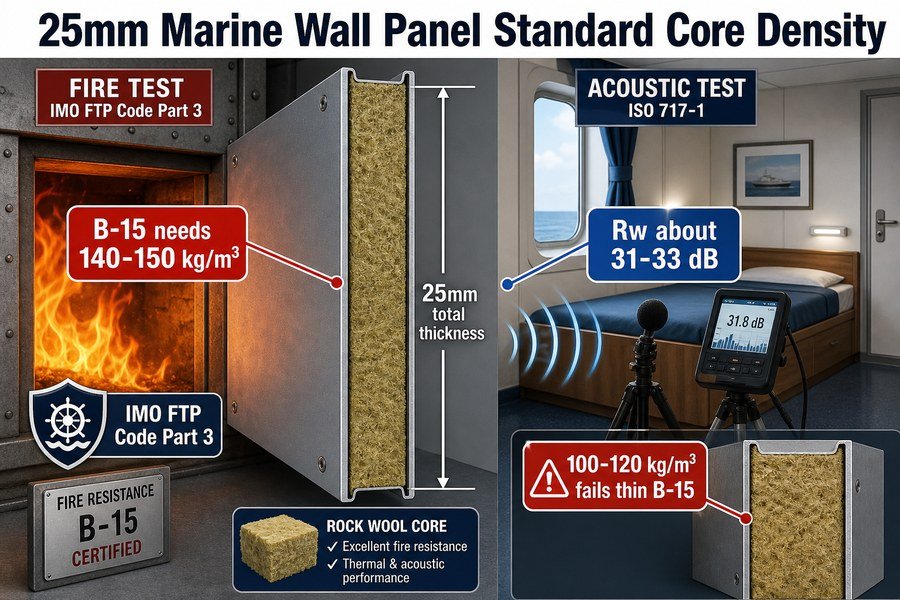
The standard core density for 25mm marine accommodation wall panels is between 140 kg/m³ and 150 kg/m³. This high density is mandatory for thin panels to pass the IMO FTP Code Part 3 fire test for a B-15 rating, and it provides an acoustic reduction of about 31 to 33 decibels.
Passing IMO Fire Tests with 140 kg/m³ Density Panels
When you order 25mm marine wall panels, you cannot just guess the core density. There is a clear rule in the shipbuilding industry. The standard density is always between 140 kg/m³ and 150 kg/m³. We do not use this high number just to make the panel heavy. We use it because it is mandatory to pass the fire laws. The International Maritime Organization (IMO) has a strict test called the FTP Code Part 3. To get a B-15 rating, the unexposed side of the panel must stay cool for 15 minutes while the other side is on fire. Because 25mm is very thin, a normal 100 kg/m³ density will melt and let the heat pass in just 10 minutes. By packing the rock wool to 140 kg/m³ or 150 kg/m³, the dense fibers block the heat perfectly for the full 15 minutes. If a supplier offers you a 25mm B-15 panel with 120 kg/m³ density, you should walk away. It is likely a fake certificate.
Achieving 31 to 33 Decibel Acoustic Reduction in Thin Walls
Fire safety is the most important rule, but noise is the most common complaint from ship crews. People want to sleep in quiet cabins. The high density of 140 kg/m³ to 150 kg/m³ in a 25mm panel does an excellent job at blocking sound. In acoustic testing, a standard 25mm panel with this heavy density achieves a sound reduction (Rw) of about 31 to 33 decibels13. This means if an engine room is very loud next door, the panel will block a good amount of that noise. Sound waves have a hard time pushing through dense, tight materials. If you used a lower density, the sound waves would pass right through the empty air pockets in the loose rock wool. By sticking to the standard 140-150 kg/m³ density, you solve two problems at once. You get the legal B-15 fire rating, and you give the ship crew a quiet, peaceful place to rest.
| Core Density | Panel Thickness | B-15 Fire Test Result | Acoustic Reduction (Rw) |
|---|---|---|---|
| 100 - 120 kg/m³ | 25mm | FAILS (Heat passes too fast) | Low (~28 dB) |
| 140 - 150 kg/m³ | 25mm | PASSES (Standard requirement) | High (31 - 33 dB) |
Conclusion
Core density and thickness must work together. Balancing them ensures you meet SOLAS fire ratings, control ship weight, and deliver strong, quiet cabins for your interior projects.
-
"Determination of Thermal Properties of Mineral Wool Required for ...", https://pmc.ncbi.nlm.nih.gov/articles/PMC10488771/. Comparative fire-test reports or class-society approvals can document whether 25 mm mineral-wool panel assemblies with approximately 100 kg/m³ cores satisfy the B-15 temperature-rise and integrity criteria. Evidence role: case_reference; source type: institution. Supports: A 25 mm panel using 100 kg/m³ rock wool is unlikely to pass the B-15 fire test.. Scope note: A failure result would be direct evidence only for the tested panel design; it should not be generalized to all 25 mm panels without matching construction details. ↩
-
"[PDF] PART 3 INTRODUCTION TO ENGINEERING HEAT TRANSFER", https://ocw.mit.edu/courses/16-050-thermal-energy-fall-2002/87d9f4544b7fd64a77201382500d057c_10_part3.pdf. Heat-transfer references based on Fourier’s law explain that, for steady conduction through a plane layer, heat flux is inversely proportional to material thickness when other conditions are comparable. Evidence role: mechanism; source type: education. Supports: Increasing panel thickness slows heat transfer through the panel.. Scope note: This explains the physical mechanism in simplified conductive heat transfer; actual fire-test performance also depends on joints, facings, moisture, density, and boundary conditions. ↩
-
"[PDF] Facesheet Wrinkling in Sandwich Structures", https://ntrs.nasa.gov/api/citations/19990017863/downloads/19990017863.pdf. A neutral engineering reference on sandwich panels defines the construction as two thin, stiff face sheets bonded to a thicker lightweight core, supporting the article’s description of layered panel structure. Evidence role: definition; source type: encyclopedia. Supports: Marine wall panels described as sandwich panels consist of layered construction with outer face sheets and an inner core.. Scope note: This supports the general sandwich-panel construction concept rather than marine-specific dimensional practice. ↩
-
"[PDF] Experimental investigation on flexural behavior and energy ...", https://digitalcommons.usu.edu/cgi/viewcontent.cgi?article=1228&context=mae_facpub. Engineering literature on sandwich structures explains that face sheets carry much of the bending and in-plane load while also forming the exposed surface, supporting the claim that steel skins contribute to structural performance and finish. Evidence role: mechanism; source type: education. Supports: Steel face sheets in a marine sandwich panel contribute significantly to strength and surface appearance.. Scope note: The source would support the general mechanical role of face sheets; it may not address the visual requirements of a specific marine outfitting product. ↩
-
"[PDF] THE EFFECT OF ADHESIVE BONDLINE THICKNESS ON JOINT ...", https://rex.libraries.wsu.edu/view/delivery/01ALLIANCE_WSU/12368514090001842/13368514080001842. Adhesive-bonding references describe cured adhesive as a finite bond line between adherends, supporting the dimensional point that adhesive layers remain in the assembly and contribute to total thickness. Evidence role: mechanism; source type: paper. Supports: The adhesive layer remains after curing and contributes a measurable amount to the final bonded panel thickness.. Scope note: Such sources support the existence of a cured bond-line thickness generally; a separate product or process specification would be needed to verify the article’s stated 0.1 mm per side value. ↩
-
"[PDF] Sandwich Constructions - USNA", https://www.usna.edu/Users/mecheng/pjoyce/composites/Short_Course_2003/13_PAX_Short_Course_Sandwich-Constructions.pdf. A structural engineering source on sandwich construction supports the analogy by explaining that sandwich-panel face sheets primarily resist bending stresses while the core separates the faces and carries shear, broadly analogous to flanges and web in an I-beam. Evidence role: mechanism; source type: education. Supports: A marine sandwich panel works like an I-beam, with steel face sheets acting like flanges and the core acting like the web or separator.. Scope note: The analogy is conceptual; actual load distribution depends on face material, core shear stiffness, bonding, and boundary conditions. ↩
-
"Bending analysis of sandwich panel composite with a re-entrant ...", https://pmc.ncbi.nlm.nih.gov/articles/PMC9499978/. Beam and sandwich-panel theory supports that bending stiffness increases strongly with section depth because the second moment of area scales with the square of material distance from the neutral axis and, for simple rectangular sections, with depth cubed. Evidence role: mechanism; source type: education. Supports: Doubling the panel thickness from 25 mm to 50 mm can make the panel nearly eight times stiffer in bending under idealized section-property assumptions.. Scope note: This supports the scaling principle; the exact eightfold increase is an idealized estimate and may differ for real panels because of core shear deformation, face thickness, adhesive performance, and support conditions. ↩
-
"[PDF] - 1 - Note by the International Maritime Organization to the ... - seors", https://seors.unfccc.int/applications/seors/attachments/get_attachment?code=MOE2AHKBQJAQLFCWO8EAVIYFKOE25OT4. Maritime energy-efficiency and naval-architecture sources support that vessel displacement and deadweight affect fuel consumption and payload capacity, so added structural weight can reduce cargo allowance or increase fuel demand. Evidence role: general_support; source type: institution. Supports: Increasing ship weight tends to increase fuel consumption and reduce cargo-carrying capacity.. Scope note: This is a general ship-design relationship and does not quantify the effect of these specific wall panels on a particular vessel. ↩
-
"MATERIAL Type Cost", https://web.mit.edu/course/3/3.11/www/modules/props.pdf. Materials reference data commonly list the density of carbon or structural steel at approximately 7,850 kg/m³, supporting the density value used for the panel weight comparison. Evidence role: statistic; source type: encyclopedia. Supports: Steel has a nominal density of about 7850 kg/m³.. Scope note: Steel density varies slightly by alloy composition and grade, so 7,850 kg/m³ is an accepted nominal value rather than a universal constant. ↩
-
"[PDF] analysis of panel dent resistance", https://ntrs.nasa.gov/api/citations/19770003348/downloads/19770003348.pdf. Research on thin steel plates under transverse or impact loading shows that plate thickness is a major parameter in plastic deformation and dent resistance, supporting the general expectation that a thicker steel face sheet better resists local impact damage. Evidence role: mechanism; source type: paper. Supports: A thicker 0.8mm steel face sheet can better resist dents from impacts than a 0.6mm sheet.. Scope note: This supports the mechanical principle but does not directly prove performance for this specific marine wall-panel construction without product-specific impact testing. ↩
-
"[PDF] Shear Behavior of Screw Connections for Cold-formed Thin", https://scholarsmine.mst.edu/cgi/viewcontent.cgi?article=1272&context=isccss. Engineering literature on cold-formed steel connections and screw fastening reports that sheet thickness affects screw pull-out, pull-over, and connection strength, providing a basis for the claim that thicker face steel can improve attachment capacity. Evidence role: mechanism; source type: paper. Supports: Increasing steel face thickness can increase wall attachment or load-bearing capacity by improving fastener connection strength.. Scope note: Connection capacity also depends on screw type, spacing, backing structure, core material, and test conditions, so this is contextual support rather than a certified load rating for the panel. ↩
-
"[PDF] Fire endurance tests of aluminum bulkhead and deck assemblies", https://nvlpubs.nist.gov/nistpubs/Legacy/RPT/nbsreport10813.pdf. Marine fire-test standards and non-combustible insulation guidance show that fire ratings for ship partitions are determined by tested assembly performance, including insulation type, thickness, facings, joints, and installation details. Evidence role: expert_consensus; source type: institution. Supports: Reducing the rock wool core by 0.4mm is unlikely to materially affect the panel fire rating.. Scope note: Such sources can explain why a 0.4mm change may be minor in context, but they cannot verify that a specific 50mm panel retains its fire rating without a type-approval certificate or assembly-specific fire test. ↩
-
"Sound insulation dataset of 30 wooden and 8 concrete floors ...", https://pmc.ncbi.nlm.nih.gov/articles/PMC10365936/. A laboratory sound-insulation report for a comparable 25 mm mineral-wool marine sandwich wall panel reports its weighted sound reduction index, providing support for the stated Rw range. Evidence role: statistic; source type: research. Supports: A standard 25 mm panel with 140–150 kg/m³ density achieves a sound reduction rating of about Rw 31–33 dB.. Scope note: Rw depends on the full panel construction, facings, joints, mounting conditions, and test standard; data for a similar panel would be contextual unless it matches this exact assembly. ↩