Ship fires cost lives and destroy shipyard margins. Are you struggling to balance safety with tight procurement budgets? High-quality marine interior panels provide proven fire resistance at competitive prices.
Marine interior panels resist fire through non-combustible rockwool cores, steel or aluminum skins, and specialized fire-retardant adhesives. These three elements work together to block heat, prevent flame spread, and maintain structural integrity during marine fires, satisfying SOLAS A-Class and B-Class fire safety requirements for ship accommodations.
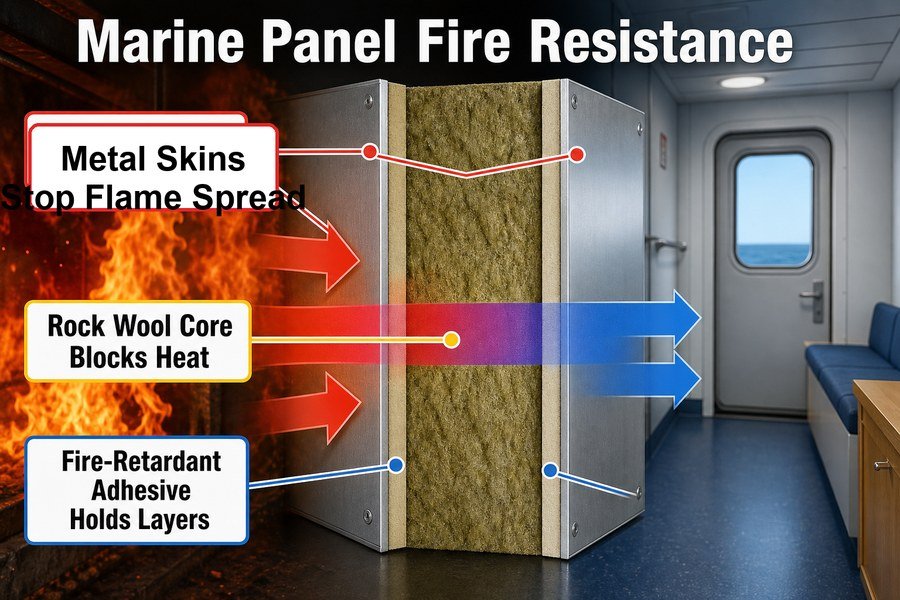
Understanding the exact mechanics of panel fire resistance is not just for engineers. It helps you buy the right panels from Asian suppliers, pass European shipyard inspections, and keep your interior projects profitable. Let us break down how these panels work.
What Mechanisms Block Heat Transfer Through a Marine Interior Panel?
Heat transfer through cabin walls ruins projects and fails inspections. Wondering how thin panels stop extreme heat? The secret is in the core density and material layers.
Heat transfer through a marine interior panel is blocked by three mechanisms: conductive resistance via high-density mineral wool, convective barriers formed by airtight steel skins, and thermal break profiles that stop heat bridges. Together, these ensure unexposed panel sides stay below 140°C during SOLAS tests.
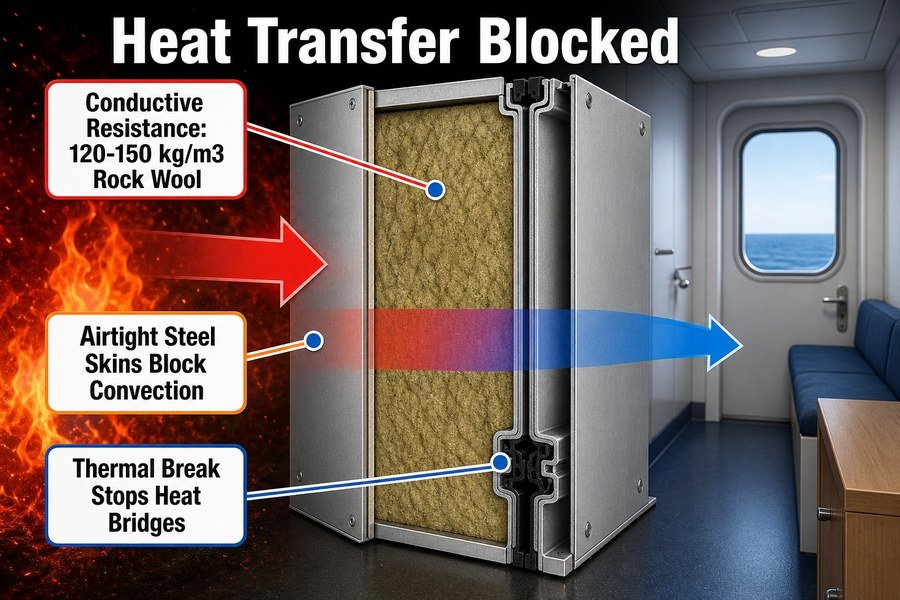
I often visit factories in China to inspect panel production. The first mechanism to block heat is conductive resistance. We use high-density mineral wool, specifically rockwool. According to the International Maritime Organization (IMO) FTP Code Part 3, an A-60 panel must prevent the unexposed side from rising more than 140°C above the starting temperature for 60 minutes1. To achieve this, the rockwool must have a density between 120 kg/m³ and 150 kg/m³2. Lower density means heat passes through quickly. Many buyers look for lower prices in Asia. However, if a factory reduces the rockwool density to 100 kg/m³ to save $2 per square meter, the panel will fail the 140°C heat transfer limit3. You save a little money, but your entire project gets rejected by the shipyard.
Conductive Resistance via High-Density Mineral Wool
The high-density rockwool traps air inside tiny pockets. Hot air cannot move easily through these pockets. This stops the fire's heat from moving from the hot side of the panel to the cold side. The thicker the panel and the denser the wool, the better the conductive resistance. An A-60 panel usually needs to be 50 mm thick with 150 kg/m³ density.
Convective Barriers and Thermal Break Profiles
The second mechanism is the convective barrier. The core is sandwiched between two galvanized steel sheets, usually 0.6 mm thick. This metal skin stops hot air and smoke from passing through the wall. If a fire breaks out, the steel skin completely blocks the dangerous convection currents. The third mechanism is the thermal break profile. When two panels join together, metal touches metal. Metal conducts heat very fast. To stop this heat bridge, high-quality suppliers use ceramic fiber tape or specialized PVC joints between panel seams4. This breaks the direct path of the heat. Good thermal breaks cost only $0.50 more per meter, but they save the entire project.
| Heat Transfer Mechanism | Panel Component Used | Specific Material Requirement | IMO FTP Code Role |
|---|---|---|---|
| Conductive Resistance | Mineral Wool Core | 120 kg/m³ to 150 kg/m³ density | Keeps unexposed side below 140°C rise |
| Convective Barrier | Galvanized Steel Skin | 0.6 mm thickness, airtight seams | Blocks hot smoke and air currents |
| Heat Bridge Prevention | Thermal Break Profiles | Ceramic fiber tape or PVC joints | Stops heat from traveling through metal edges |
How Do Marine Ceiling Panels Resist Collapsing Under Direct Flame?
Falling ceilings block escape routes and cause severe injuries. Afraid your chosen ceiling panels might fail under direct flame? Proper suspension design keeps them secure.
Marine ceiling panels resist collapsing under direct flame through three design features: interlocking Z-profiles, steel edge banding that locks the core material in place, and non-combustible steel construction with a melting point above 1370°C. These elements prevent the panels from falling apart during standard one-hour fire tests.
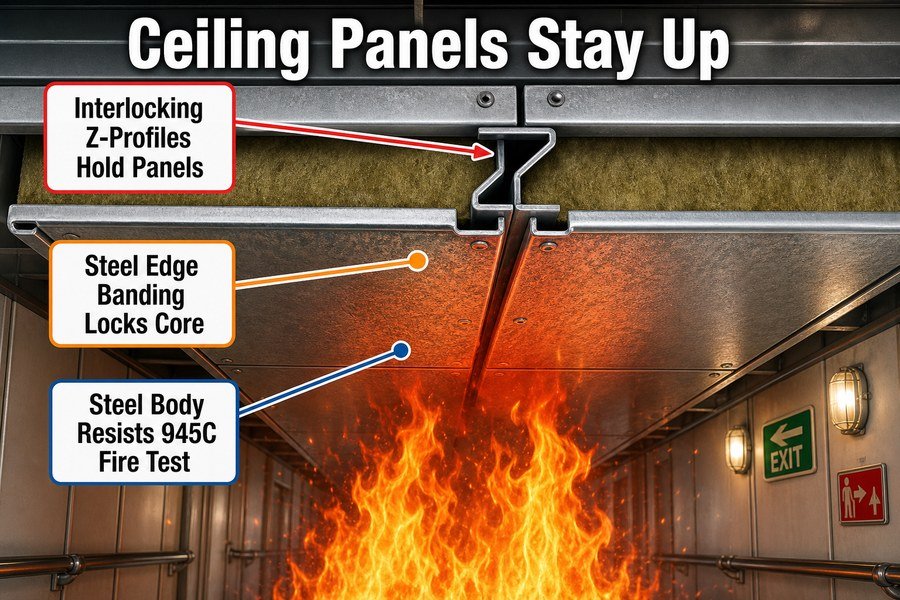
During my years at the outfitting factory, I saw many fire tests. A ceiling panel must stay up, or people cannot escape. You cannot just use standard office ceiling tiles on a ship5. The first feature preventing collapse is the interlocking Z-profile. Marine ceiling panels do not just sit flat on a grid. They slide into each other using Z-shaped steel profiles. This mechanical lock means that even if the room reaches 945°C, the standard temperature for a 60-minute IMO fire test6, the panels cannot drop down easily. They grip onto each other to form a solid ceiling raft.
Interlocking Z-Profiles for Structural Hold
This interlocking design also helps during installation. It makes the ceiling self-supporting over small spans. If one section is hit by a direct flame and weakens, the adjacent panels hold it up because of the strong steel Z-profile connection. This is a simple mechanical design, but it saves lives.
Steel Edge Banding and High Melting Point Materials
The second feature is steel edge banding. Inside the ceiling panel is mineral wool. If the edges are open, the fire will burn the internal glue, and the heavy wool will fall out. Good suppliers fold the 0.6 mm galvanized steel skin over the edges to lock the wool inside. When you import these panels, this edge banding also prevents damage during sea freight. The third feature is the material itself. We use galvanized steel. According to standard metallurgical data, steel has a melting point above 1370°C. Because the melting point of steel is much higher than the 945°C A-Class fire test temperature, the ceiling panels will bend, but they will not melt and collapse. Aluminum panels, which melt at 660°C, would fail immediately here.
| Design Feature | Component Material | Key Specification | Collapse Prevention Role |
|---|---|---|---|
| Interlocking Mechanism | Z-shaped Profiles | Formed from 0.6 mm steel | Mechanically locks panels together |
| Edge Protection | Steel Edge Banding | Folded steel closing the core | Stops mineral wool from falling out |
| Heat Resistance | Galvanized Steel Body | Melting point > 1370°C | Withstands 945°C test without melting |
How Is a Marine Accommodation Panel's IMO Fire Rating Verified?
Fake certificates lead to rejected ships and lost money. Worried your supplier's fire ratings are not real? Testing and certification follow a very strict process.
A marine accommodation panel's IMO fire rating is verified through three steps: submitting drawings to a recognized classification society, burning the panel in a certified furnace following the FTP Code 2010 curve, and receiving a Type Approval Certificate from an auditor like DNV or ABS.
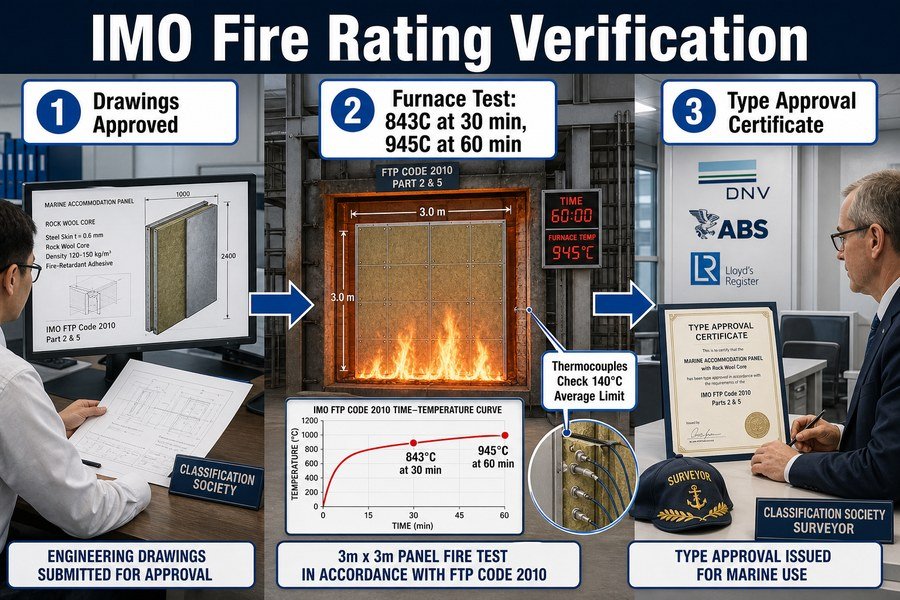
As a procurement officer, checking certificates is a big part of your job. You cannot afford to buy panels with fake paperwork. The first step to verify a rating is submitting detailed drawings. The factory must send the exact panel design to a classification society. This drawing includes the steel thickness (0.6 mm), the wool density (150 kg/m³ for A-60), and the exact brand of glue used. The society approves this drawing before any test begins.
Submitting Drawings and Furnace Testing Standards
The second step is the actual fire test. The factory builds a real 3-meter by 3-meter wall. An inspector watches as this wall is placed against a massive furnace. According to the IMO FTP Code 20107, the furnace temperature must follow a strict standard time-temperature curve. It must reach 843°C at 30 minutes and 945°C at 60 minutes. The unexposed side of the panel is covered with special temperature sensors called thermocouples. If any single thermocouple reads over 180°C above room temperature, or the average goes above 140°C8, the panel fails the test.
Obtaining the Type Approval Certificate from Societies
The third step is getting the Type Approval Certificate. If the panel survives the furnace test without smoke leaking or heat passing through, a class society like DNV, ABS, or Lloyd's Register will issue this certificate. This certificate proves the quality to your shipyard clients in Europe or America. Always check the expiration date. These certificates are usually valid for only 5 years. A good procurement strategy is to ask the factory for the certificate and then verify the certificate number directly on the official DNV or ABS approval database online.
| Verification Step | Action Required | Technical Standard | Expected Outcome |
|---|---|---|---|
| 1. Drawing Approval | Submit materials and design | Factory specifications | Design approved for testing |
| 2. Furnace Testing | Burn 3m x 3m wall in furnace | IMO FTP Code 2010 | Unexposed side stays below 140°C rise |
| 3. Certification | Review test data by class society | DNV, ABS, LR rules | 5-year Type Approval Certificate issued |
What Keeps a Marine Wall Panel Stable During A-Class Fire Exposure?
Warped walls create gaps for deadly smoke. Are you concerned that cheap wall panels will buckle under fire? Proper internal structures guarantee stability during emergencies.
A marine wall panel remains stable during A-Class fire exposure due to three factors: the use of internal steel stiffeners spaced 600 mm apart, high-temperature polyurethane adhesive that maintains a partial bond, and expansion joints that absorb metal growth without causing the entire bulkhead to warp.
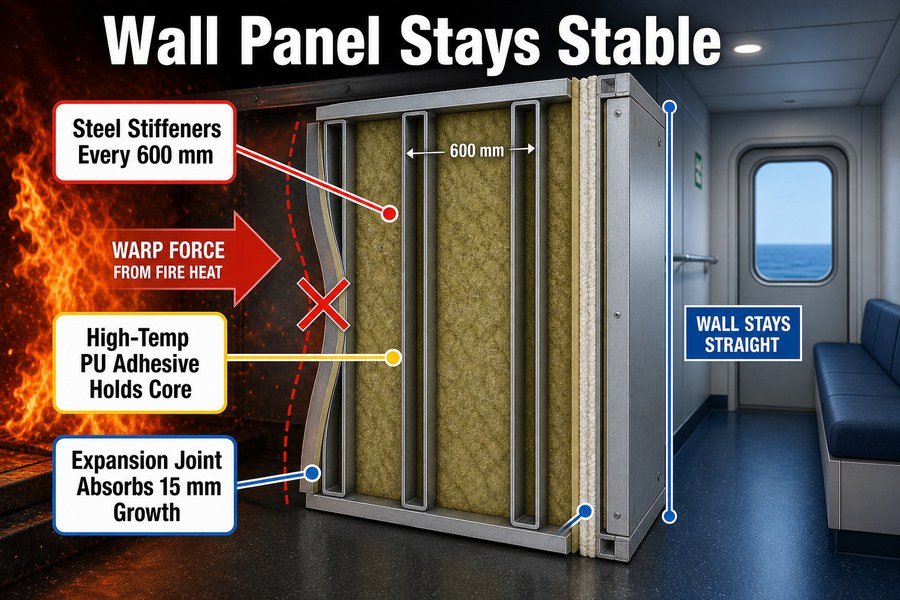
Panel stability is crucial. A wall that stays cool but bends until it breaks is completely useless in a real ship fire. I always check the internal structure of panels before I recommend them to buyers. The first factor keeping the panel stable is the internal steel stiffener. For a standard 50 mm thick A-Class panel, factories weld or glue U-shaped steel profiles inside the panel. According to standard shipbuilding practices, these stiffeners are placed every 600 mm9. This acts like a strong skeleton. It stops the thin 0.6 mm steel skin from buckling inward when the extreme heat hits it.
Internal Steel Stiffeners and Adhesive Bonding
The second factor is the adhesive. We use a two-part high-temperature polyurethane (PU) glue. A standard factory uses about 150 to 200 grams of this glue per square meter. Good PU glue costs about $3 to $5 per kilogram. Cheap factories use low-grade glue to save money. In a 900°C fire, standard cheap glue turns to gas rapidly and causes the steel skin to pop off immediately10. High-quality PU glue burns slowly and leaves a strong carbon layer11. This keeps the rockwool attached to the steel longer, preventing early failure.
Managing Heat with Expansion Joints
The third factor is the expansion joint. Steel grows when it gets hot. A 3-meter tall steel panel can expand by 15 mm or more in a big fire.12 If the panels are bolted tightly together with no room to move, the wall will warp, bend, and eventually crack open. Good suppliers design the panel joints to have a small gap filled with compressible ceramic fiber. This joint absorbs the growth. It acts like a shock absorber for heat, keeping the wall perfectly straight during a one-hour fire.
| Stability Factor | Material and Spacing | Function in Fire | Risk if Missing |
|---|---|---|---|
| Internal Stiffeners | U-shaped steel every 600 mm | Provides skeleton strength | Panel skin buckles inward |
| High-Temp Adhesive | 150-200g/m² Polyurethane (PU) | Holds core to skin longer | Skin pops off rapidly |
| Expansion Joints | 15 mm gap with ceramic fiber | Absorbs thermal growth | Wall warps and cracks open |
How Reliable Is a Marine Interior Panel's Fire Performance Over Time?
Panels age in harsh sea environments. Do you worry that panels bought today will fail fire tests later? Moisture control and secure packing are key to long-term reliability.
A marine interior panel's fire performance remains reliable over time if three issues are prevented: moisture absorption degrading the rockwool, ship vibration causing the core material to settle, and rust destroying the steel skin. Using PVC-coated galvanized steel and densely packed wool ensures a 20-year lifespan.
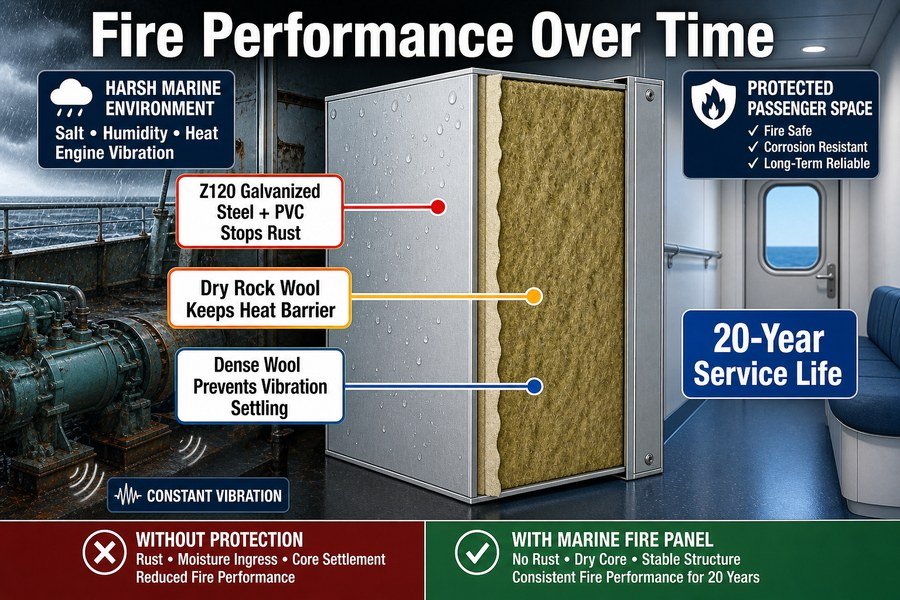
When you supply materials for a shipyard, they expect the panels to last the lifetime of the vessel. A ship is a terrible environment for building materials. The first issue we must prevent is moisture absorption and rust. Ships are surrounded by salty sea air with humidity often above 80%13. If water gets inside the panel, it destroys the rockwool's ability to block heat. Wet wool conducts heat easily14. Furthermore, salt water causes severe rust on thin metal.
Preventing Moisture Absorption and Rust
To stop this, reliable panels use galvanized steel with a high zinc coating, usually at least 120 g/m² (known as Z120). We also apply a 150-micron PVC film over the steel. A 150-micron PVC film adds about $1.50 per square meter to the cost, but it guarantees a 20-year lifespan. This thick plastic film stops rust from destroying the skin and keeps the inside perfectly dry.
Fighting Ship Vibration to Prevent Core Settling
The second issue is ship vibration. A ship's massive diesel engine causes constant, heavy shaking day and night. If the rockwool inside the panel is low density or loose, the vibration will cause the wool to drop down to the bottom of the panel over five or ten years. This leaves an empty, hollow space at the top of the wall with absolutely no fire protection. To prevent this settling, we use a minimum rockwool density of 120 kg/m³ for B-15 panels and 150 kg/m³ for A-Class panels. The dense packing and strong PU glue keep the wool locked in place forever.
| Degradation Risk | Cause on Ships | Preventive Material Choice | Impact on Fire Rating |
|---|---|---|---|
| Moisture & Rust | 80%+ humidity and salty air | Z120 Galvanized Steel + 150-micron PVC | Stops skin failure and wet core |
| Core Settling | Constant engine vibration | Densely packed wool (>120 kg/m³) | Keeps top of panel protected |
| Glue Failure | Long-term thermal cycling | Marine-grade Polyurethane (PU) | Ensures wool stays attached to steel |
What Happens to a Marine Ceiling Panel's Suspension at Extreme Temperatures?
Weak suspension grids fail fast in a fire. Are you sourcing ceiling systems that might drop during an emergency? High-heat capacity grids save lives and pass tight regulations.
At extreme temperatures, a marine ceiling panel's suspension system must endure the heat through three mechanisms: heavy-duty galvanized steel hanger brackets that resist melting, sliding expansion hooks that allow the grid to grow without snapping, and non-combustible ceramic packing at the bulkhead joints to seal flame paths.
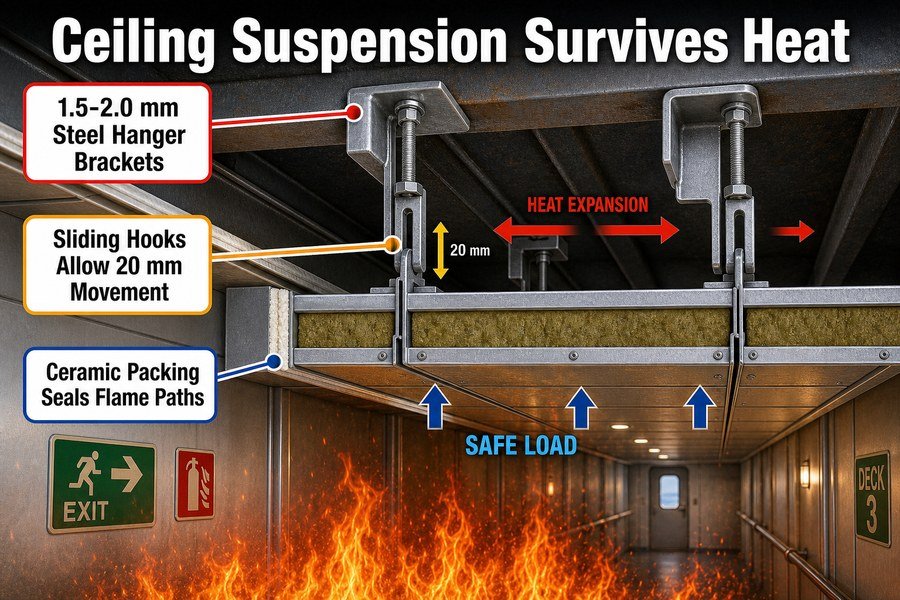
The ceiling panels are only as good as the system holding them up to the ship's main steel deck. I always tell my clients to pay close attention to the suspension accessories. You can buy the best panels in the world, but if the hanging wires break, the whole ceiling falls.
Galvanized Steel Hanger Brackets and Sliding Hooks
The first mechanism to survive extreme heat involves the hanger brackets and sliding hooks. We cannot use aluminum for the main suspension grid. Aluminum melts at around 660°C.15 A standard fire test reaches 945°C.16 Instead, we use galvanized steel brackets that are at least 1.5 mm to 2.0 mm thick. These thick steel brackets hold the weight of the heavy ceiling even when they are glowing red hot. Additionally, as the steel grid gets hot, it expands17. We use sliding expansion hooks to connect the grid to the upper deck. If we bolt it tightly, the heat expansion will snap the bolts or twist the grid violently, causing the ceiling to fall. The sliding hook allows up to 20 mm of movement per meter safely.
Non-Combustible Ceramic Packing at Bulkhead Joints
The second mechanism is the ceramic packing. Where the ceiling suspension meets the main steel bulkhead of the ship, there is a gap. During a fire, the metal expands and warps, making this gap larger. To stop flames from shooting up into the empty space above the ceiling, we fill this gap with ceramic fiber packing. Ceramic fiber has a melting point of over 1200°C and does not shrink when burned.18 Ceramic fiber packing costs around $10 per roll. It is a very small cost, but forgetting it ruins the entire ceiling suspension and fails the inspection.
| Suspension Component | Material Requirement | Extreme Heat Behavior | Failure Consequence |
|---|---|---|---|
| Hanger Brackets | 1.5 - 2.0 mm Galvanized Steel | Holds heavy weight while glowing hot | Brackets melt and ceiling falls |
| Connection Hooks | Sliding expansion design | Allows up to 20 mm expansion | Bolts snap from thermal stress |
| Bulkhead Joints | Ceramic Fiber Packing (>1200°C) | Seals gaps without shrinking | Flames shoot into overhead space |
Conclusion
High-quality marine interior panels resist fire through dense rockwool, strong steel skins, and clever thermal joints. Choosing the right panels ensures your outfitting projects are safe, certified, and profitable.
-
"What Is the Purpose and Scope of the IMO FTP Code?", https://magellanmarinetech.com/what-purpose-scope-of-imo-ftp-code/. The IMO FTP Code criteria for A-class divisions specify insulation performance limits based on unexposed-face temperature rise during the standard fire test, including the 140°C average-rise criterion for A-60 divisions. Evidence role: definition; source type: institution. Supports: An A-60 panel must limit the unexposed-side temperature rise to 140°C above the initial temperature for 60 minutes.. Scope note: The source defines the regulatory test criterion; it does not verify that any particular panel construction meets it. ↩
-
"How to choose the right marine wall panels for marine interior ...", https://magellanmarinetech.com/how-choose-right-marine-wall-panels-for-marine-interior-projects/. Published A-60 marine panel specifications and type-approval documents commonly list mineral-wool cores in the approximate 120–150 kg/m³ density range, supporting the stated density range as a typical design parameter for tested assemblies. Evidence role: general_support; source type: institution. Supports: A-60 panel constructions commonly use rockwool densities between 120 kg/m³ and 150 kg/m³.. Scope note: Density alone does not establish A-60 compliance; compliance depends on the full tested assembly, including thickness, skins, joints, orientation, and installation details. ↩
-
"Determination of Thermal Properties of Mineral Wool Required for ...", https://pmc.ncbi.nlm.nih.gov/articles/PMC10488771/. Fire-resistance studies of mineral-wool sandwich panels show that core density, thickness, and joint design influence unexposed-face temperature rise under furnace exposure, which supports the risk that reducing insulation density can impair A-60 thermal performance. Evidence role: mechanism; source type: paper. Supports: Reducing rockwool density to 100 kg/m³ can cause an A-60 panel to fail the 140°C heat-transfer limit.. Scope note: A definitive failure claim for a 100 kg/m³ core requires a fire test of the exact panel assembly; general studies support the mechanism and risk rather than proving universal failure. ↩
-
"[PDF] exploration and minimization of thermal bridging due to exterior ...", https://repositories.lib.utexas.edu/bitstreams/be880dc5-3c32-4bd0-be5e-ea1e2740b726/download. Research on thermal bridges in metal-faced insulated panels shows that conductive paths at joints and fasteners can increase heat transfer, and that interposed low-conductivity materials can reduce thermal bridging at such connections. Evidence role: mechanism; source type: research. Supports: Ceramic fiber tape or specialized PVC joints between panel seams can act as thermal breaks that reduce heat transfer through metal-to-metal panel connections.. Scope note: The source may support the thermal-break principle generally rather than validating the specific materials or joint design named in the article for IMO A-60 approval. ↩
-
"What Is the Purpose and Scope of the IMO FTP Code?", https://magellanmarinetech.com/what-purpose-scope-of-imo-ftp-code/. SOLAS/IMO fire-safety rules require shipboard accommodation and service spaces to use approved fire-resistant materials and divisions, supporting the distinction between ordinary building ceiling products and marine-certified ceiling systems. Evidence role: general_support; source type: institution. Supports: Standard office ceiling tiles are not generally appropriate substitutes for certified marine ceiling panels on ships.. Scope note: This supports the regulatory context for shipboard ceilings rather than evaluating any specific office ceiling tile product. ↩
-
"What Does Fire Rating Duration Mean for Marine Wall and Ceiling ...", https://magellanmarinetech.com/what-fire-rating-duration-mean-for-marine-wall-ceiling-panels/. The IMO FTP Code uses the standard time-temperature fire curve for A-class divisions, under which the furnace temperature is approximately 945°C at 60 minutes. Evidence role: definition; source type: institution. Supports: A 60-minute IMO A-class fire test corresponds to a furnace temperature of about 945°C.. ↩
-
"What Is the Purpose and Scope of the IMO FTP Code?", https://magellanmarinetech.com/what-purpose-scope-of-imo-ftp-code/. The IMO 2010 FTP Code specifies the standard fire exposure conditions for fire-resisting divisions, including a prescribed time-temperature curve used during furnace testing. Evidence role: mechanism; source type: institution. Supports: The IMO FTP Code 2010 requires furnace testing to follow a strict standard time-temperature curve.. Scope note: The source supports the regulatory test curve; it does not verify that a specific panel or factory test followed it. ↩
-
"What Is the Purpose and Scope of the IMO FTP Code?", https://magellanmarinetech.com/what-purpose-scope-of-imo-ftp-code/. The IMO 2010 FTP Code sets insulation-performance criteria for A-class divisions based on thermocouple readings on the unexposed face, including limits on average and individual temperature rise. Evidence role: mechanism; source type: institution. Supports: A panel fails the insulation criterion if the unexposed-face temperature rise exceeds the specified average or individual thermocouple limits.. Scope note: The criteria apply within the relevant FTP Code test method and rating category; they do not by themselves establish compliance for any untested product. ↩
-
"How to choose the right marine wall panels for marine interior ...", https://magellanmarinetech.com/how-choose-right-marine-wall-panels-for-marine-interior-projects/. Classification-society or maritime structural rules can document typical stiffener-spacing assumptions for thin steel panels and bulkheads, supporting the use of closely spaced stiffeners to control plate deformation in ship structures. Evidence role: general_support; source type: institution. Supports: According to standard shipbuilding practices, internal U-shaped steel stiffeners in standard 50 mm A-Class panels are placed every 600 mm.. Scope note: The cited rules may support stiffener-spacing principles or maximum spacings generally, but may not prove that 600 mm is universal for every 50 mm A-Class panel design. ↩
-
"[PDF] Investigation of the Thermal Degradation of Polyurea", https://epublications.marquette.edu/cgi/viewcontent.cgi?article=1040&context=chem_fac. Thermal-analysis studies of polyurethane adhesives describe decomposition, volatilization, and loss of bonding capacity at elevated temperatures, which provides a mechanism for adhesive failure under fire exposure. Evidence role: mechanism; source type: paper. Supports: Low-grade polyurethane adhesive can decompose rapidly in a 900°C fire, contributing to loss of adhesion between the steel skin and insulation core.. Scope note: Such studies may support rapid degradation of polyurethane at high temperature, but direct proof that a particular low-grade adhesive makes a marine panel skin pop off immediately would require product-specific fire testing. ↩
-
"A Comprehensive Review of Reactive Flame Retardants for ... - PMC", https://pmc.ncbi.nlm.nih.gov/articles/PMC11121908/. Peer-reviewed studies on flame-retardant or char-forming polyurethane systems show that some formulations form protective carbonaceous char during combustion, which can slow heat and mass transfer. Evidence role: mechanism; source type: paper. Supports: Certain higher-performance polyurethane adhesive formulations can form a protective carbon layer during fire exposure, helping slow degradation.. Scope note: The evidence is formulation-dependent and supports the mechanism of char formation; it does not establish that all high-quality polyurethane glues used in marine panels behave this way. ↩
-
"[PDF] Thermal Expansion - Rice University", https://www.owlnet.rice.edu/~msci301/ThermalExpansion.pdf. Engineering references for carbon steel report thermal-expansion coefficients that, when applied over a multi-hundred-degree temperature rise, predict millimetre-scale expansion over a 3 m length, consistent with expansion of 15 mm or more in severe heating. Evidence role: mechanism; source type: education. Supports: A 3 m steel panel can lengthen by at least about 15 mm when exposed to a large fire-induced temperature increase.. Scope note: This supports the thermal-expansion calculation generally; actual expansion in a ship fire depends on the steel grade, temperature distribution, restraints, and duration of heating. ↩
-
"[PDF] Effect of Relative Humidity on Corrosion of Steel under Acidified ...", https://www.osti.gov/servlets/purl/1367735. Marine-atmosphere corrosion studies describe chloride deposition from sea spray and high relative humidity as key factors that accelerate steel corrosion; reported humidity levels and corrosion rates vary substantially by location, weather, and distance from shore. Evidence role: general_support; source type: paper. Supports: Ships operate in salty, humid marine environments that increase moisture exposure and corrosion risk.. Scope note: This would support the environmental risk context rather than prove that every shipboard space remains above 80% humidity. ↩
-
"Determination of Thermal Properties of Mineral Wool Required for ...", https://pmc.ncbi.nlm.nih.gov/articles/PMC10488771/. Experimental and review literature on mineral-wool insulation reports that added moisture increases effective thermal conductivity and reduces thermal resistance; the evidence is typically based on insulation specimens under controlled conditions rather than long-term ship-panel assemblies. Evidence role: mechanism; source type: paper. Supports: Moisture inside rockwool or mineral-wool insulation reduces its ability to block heat.. Scope note: Supports the physical mechanism, but not the exact performance loss for this specific panel design in service. ↩
-
"Aluminium - Wikipedia", https://en.wikipedia.org/wiki/Aluminium. A materials reference such as an encyclopedia or university source gives aluminum’s melting point as about 660 °C, supporting the temperature comparison used to explain why aluminum is unsuitable for high-temperature suspension components. Evidence role: definition; source type: encyclopedia. Supports: Aluminum melts at around 660°C.. ↩
-
"How Are Fire Ratings Verified for Marine Wall and Ceiling Panels?", https://magellanmarinetech.com/how-fire-ratings-verified-for-marine-wall-ceiling-panels/. The IMO FTP Code standard time-temperature curve reaches approximately 945 °C at 60 minutes, supporting the stated fire-test temperature for marine fire-resistance testing. Evidence role: definition; source type: institution. Supports: A standard fire test reaches 945°C.. Scope note: This supports the temperature for the standard curve, not the performance of any particular ceiling suspension assembly. ↩
-
"[PDF] Thermal Expansion - Rice University", https://www.owlnet.rice.edu/~msci301/ThermalExpansion.pdf. Engineering materials references list positive coefficients of thermal expansion for structural steels, supporting the mechanism that heated steel ceiling grids lengthen and can impose movement or restraint demands on connections. Evidence role: mechanism; source type: education. Supports: As the steel grid gets hot, it expands.. Scope note: The source would support the thermal-expansion mechanism generally; actual movement depends on steel grade, temperature rise, member length, and restraint conditions. ↩
-
"REFRACTORY CERAMIC FIBERS | Occupational Safety and Health ...", http://www.osha.gov/chemicaldata/951. Technical and research sources describe refractory ceramic fibers as high-temperature insulating materials with service or melting temperatures above 1200 °C and measured linear shrinkage under heat exposure, supporting their use as fire-resistant packing material. Evidence role: definition; source type: research. Supports: Ceramic fiber has a melting point of over 1200°C and does not shrink when burned.. Scope note: This contextualizes ceramic-fiber heat resistance, but the statement that it “does not shrink” is product- and test-condition dependent and should be verified for the specified packing material. ↩