
Refurbishing ship interiors is stressful when downtime costs money. Delays eat your profits quickly. Fast marine panel installation solves this by keeping your schedule on track and cutting expensive days.
Installation speed drives marine interior panel selection in refurbishment by directly determining vessel downtime costs, labor man-hour expenses, passenger revenue loss, and crew disruption. Fast-install systems—specifically modular tongue-and-groove panels, prefabricated wet units, clip-on acoustic ceilings, and pre-cut honeycomb bulkheads—reduce refit times by 30-50% compared to traditional buildup methods.
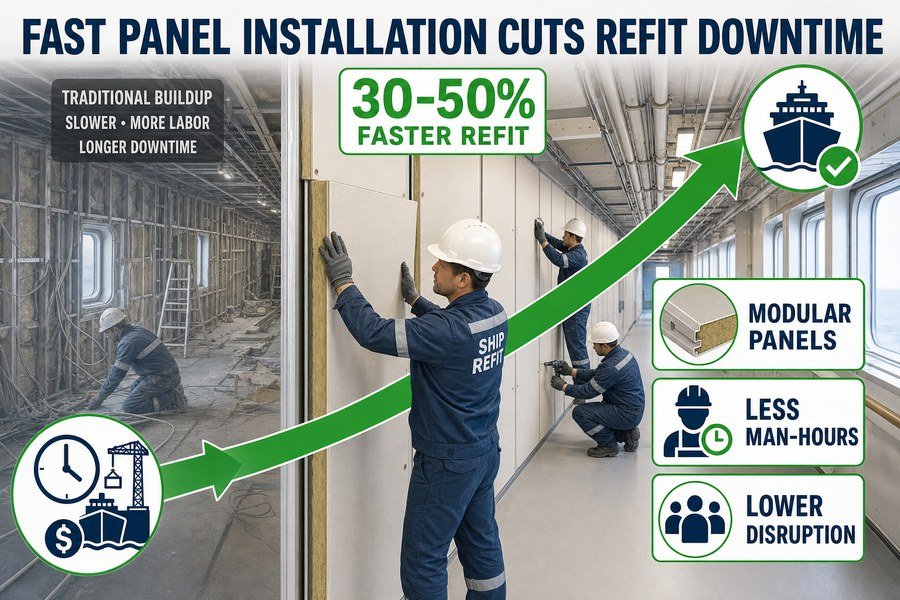
I remember walking through a messy refit project in a Singapore shipyard where late panel arrivals delayed everything else. The electrical team just sat there waiting. I want to show you how picking the right fast-install panels prevents this exact nightmare and protects your profit margin.
Why Do Fast-Installation Marine Interior Panel Systems Matter for Tight Refit Schedules?
Tight refit schedules leave zero room for error. Late installations mean missed charter dates. Fast-installation marine panel systems eliminate this risk, keeping your project exactly on the timeline.
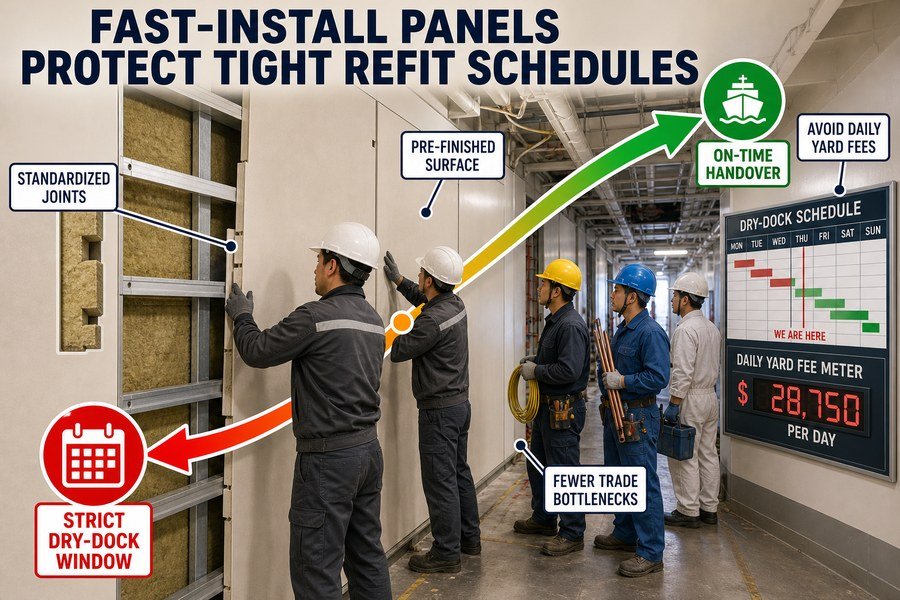
Fast-installation marine interior panel systems matter for tight refit schedules because they mitigate strict dry-docking windows, high daily shipyard fees, and sequential trade bottlenecks. Standardized joints, pre-finished surfaces, and toolless mounting systems ensure rapid assembly, allowing electricians and plumbers to start sooner and finish on time.
Mitigating Strict Dry-Docking Windows and High Shipyard Fees
When you book a vessel into a shipyard, you get a very strict dry-docking window1. If you stay longer than planned, you face huge penalties. Based on standard shipyard tariff reports in Asia and Europe, daily shipyard fees range from 10,000 USD to over 50,000 USD depending on the vessel size. You simply cannot afford slow work. Fast-installation marine interior panel systems matter because they lock in your schedule. By choosing panels designed for rapid assembly, you mitigate these strict windows. You get the ship out of the dock on the exact day you promised. This avoids the high daily shipyard fees that quickly destroy your project budget. I always tell my clients that spending a little more on a fast-install panel saves them ten times that amount in avoided shipyard penalties.
Solving Sequential Trade Bottlenecks with Joint and Mounting Systems
Ship interior work usually happens in a strict order. This creates sequential trade bottlenecks2. The electricians cannot run wires until the bulkhead is up. The plumbers wait for the electricians. If the panel installation is slow, every other trade stops working. You pay men just to stand around. We solve this by using panels with standardized joints. These joints slot together instantly without complex measuring. We also use panels with pre-finished surfaces. You do not need to wait for a paint crew to finish the wall. Finally, toolless mounting systems allow workers to snap panels into place by hand. This ensures rapid assembly. Because the walls go up so fast, electricians and plumbers start their work sooner and finish on time.
| Feature of Fast-Install Panel | Problem Solved During Refit | Cost Impact |
|---|---|---|
| Standardized joints | Sequential trade bottlenecks | Saves lost labor hours |
| Pre-finished surfaces | Waiting for paint to dry | Cuts out painting contractor fees |
| Toolless mounting systems | Slow manual assembly | Reduces installation man-hours by 30%3 |
| Adherence to schedule | Strict dry-docking windows | Avoids $10,000+ daily shipyard fees |
How Does Marine Accommodation Panel Selection Affect Man-Hours During In-Service Refits?
High labor costs quickly destroy a refit budget. Wasted man-hours on complex panels kill your margins. The right marine accommodation panels drastically reduce installation time, saving you serious money.
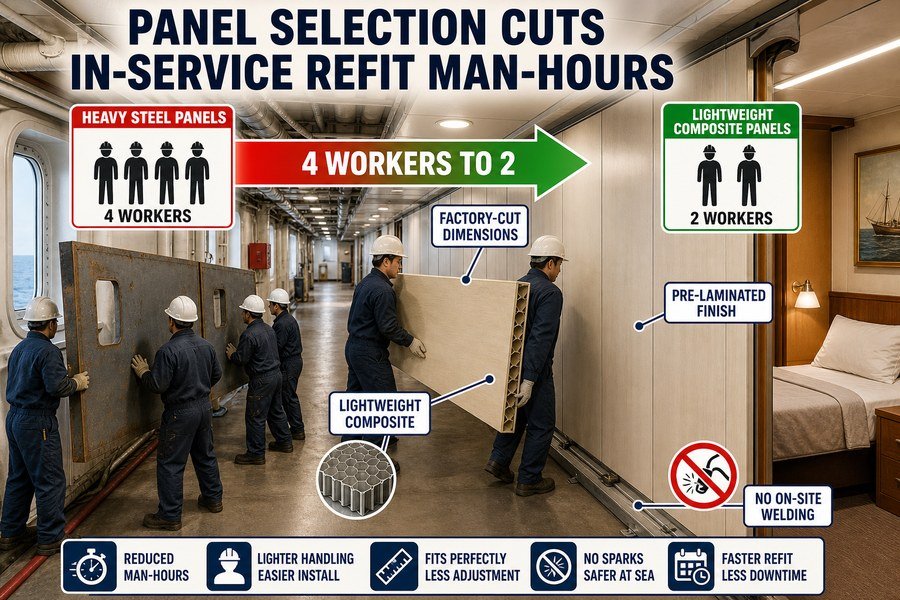
Marine accommodation panel selection affects man-hours during in-service refits by controlling handling speed, cutting requirements, and finishing labor. Selecting lightweight composite panels, factory-cut custom dimensions, and pre-laminated finishes eliminates on-site welding, reduces heavy lifting teams from four men to two, and removes post-installation painting hours completely.
Speeding Up Handling and Cutting with Lightweight Composite Panels and Factory Cuts
During an in-service refit, every minute counts. The crew is still living on the ship, so your workers must move fast. Marine accommodation panel selection directly controls handling speed. If you choose heavy steel panels, handling speed drops. It takes a lot of effort to move them down narrow ship stairs. By selecting lightweight composite panels, you solve this problem. According to SOLAS material guidelines, modern aluminum honeycomb panels weigh up to 50% less than traditional steel panels4. This weight reduction directly reduces heavy lifting teams from four men to two men per panel5. This cuts your handling labor in half. Also, panel selection controls cutting requirements. If you order standard blank panels, your workers spend hours measuring and cutting them on the ship. If you order factory-cut custom dimensions based on the ship's drawings, you eliminate this step. Workers just take the panel and put it on the wall.
Eliminating Finishing Labor with Pre-Laminated Finishes and Avoiding Welding
The old way of installing panels required a lot of hot work. Workers had to weld the panel frames to the ship deck. Welding requires fire watchers, safety permits, and special equipment6. It eats up man-hours. Proper panel selection eliminates on-site welding entirely by using modern floor track systems that bolt or glue down. Next, panel selection controls finishing labor. If you buy bare panels, you must hire a team to paint or cover them after installation. This adds days to the job. By choosing panels with pre-laminated finishes7, the wall looks perfect the second it clicks into place. This removes post-installation painting hours completely. You do not need to pay painters, and you do not need to wait for paint to dry in a damp ship environment.
| Panel Selection Strategy | Man-Hour Impact | Labor Team Requirement |
|---|---|---|
| Lightweight composite panels | Increases handling speed | Reduces heavy lifting from 4 men to 2 |
| Factory-cut custom dimensions | Removes cutting requirements | Saves 1 hour per panel |
| No on-site welding | Eliminates fire watch duties | Saves 2 workers per zone |
| Pre-laminated finishes | Removes finishing labor | Eliminates post-installation painting hours |
What Marine Bulkhead Panel Designs Enable Rapid Replacement in Occupied Ship Areas?
Replacing bulkheads near active crew or passengers causes noise and dust complaints. Disruption harms the onboard experience. Specific marine bulkhead designs allow quiet replacements without stopping operations.
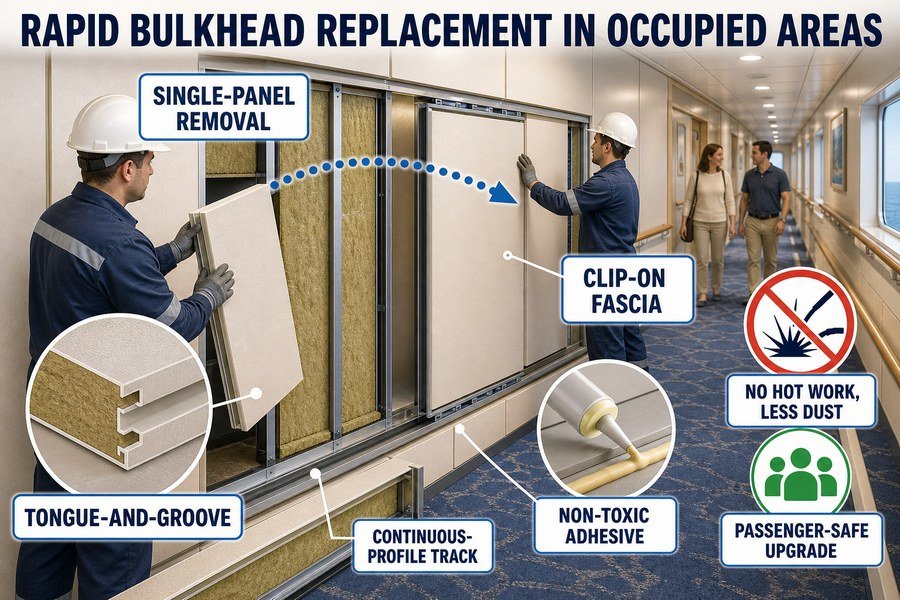
Three marine bulkhead panel designs enable rapid replacement in occupied ship areas: interlocking tongue-and-groove profiles, independent clip-on decorative fascia boards, and modular continuous-profile track systems. These designs require no hot work, eliminate dust-heavy cutting, utilize non-toxic adhesives, and allow single-panel removal without dismantling adjacent bulkheads.
Utilizing Interlocking Tongue-and-Groove and Modular Continuous-Profile Track Systems
Working in occupied ship areas is tricky. You cannot make loud noises. You cannot block the hallways for long. Interlocking tongue-and-groove profiles are a brilliant marine bulkhead panel design for this situation. The edges of these panels slide perfectly into each other. You just push them together. This design requires no hot work8, meaning no welding sparks or fire alarms will disturb the passengers. Another great design is modular continuous-profile track systems. In older ships, if one panel gets damaged by a luggage cart, you have to take down the whole wall to fix it. Modular continuous-profile track systems hold each panel individually. This allows single-panel removal without dismantling adjacent bulkheads9. You just pop out the broken panel and slide the new one in. It takes five minutes. I once supervised a corridor repair on a working cruise ship using this system, and the passengers walking by hardly even noticed we were working.
Using Independent Clip-On Fascia Boards and Non-Toxic Adhesives for Clean Upgrades
Sometimes you do not need to replace the core fire bulkhead. You just need to update the look of the room. Independent clip-on decorative fascia boards are perfect for this. The core wall stays in place. You just clip a new, fresh surface over the old one. This enables rapid replacement of the room's style. Because the boards are made to fit perfectly, this design eliminates dust-heavy cutting on board10. You keep the passenger air clean. When workers do need to secure these boards or seal the edges, they utilize non-toxic adhesives. Standard industrial glues release strong chemical smells that make passengers sick11 and cause complaints. Non-toxic adhesives keep the air smelling normal. This ensures the ship stays fully occupied and happy while you finish the refit.
| Marine Bulkhead Panel Design | Key Replacement Feature | Benefit in Occupied Areas |
|---|---|---|
| Interlocking tongue-and-groove profiles | Requires no hot work | Prevents fire alarms and smoke |
| Modular continuous-profile track systems | Allows single-panel removal | Avoids dismantling adjacent bulkheads |
| Independent clip-on decorative fascia boards | Eliminates dust-heavy cutting | Keeps passenger corridors clean |
| Installation with non-toxic adhesives | Releases no strong smells | Maintains good air quality for crew |
How Can Vessel Dry-Docking Time Be Reduced Through Optimal Marine Interior Panel Selection?
Every extra day in dry-dock drains your cash reserves. Slow material handling extends this expensive stay. Optimal marine interior panel selection directly shrinks dry-docking time, putting ships back to work.
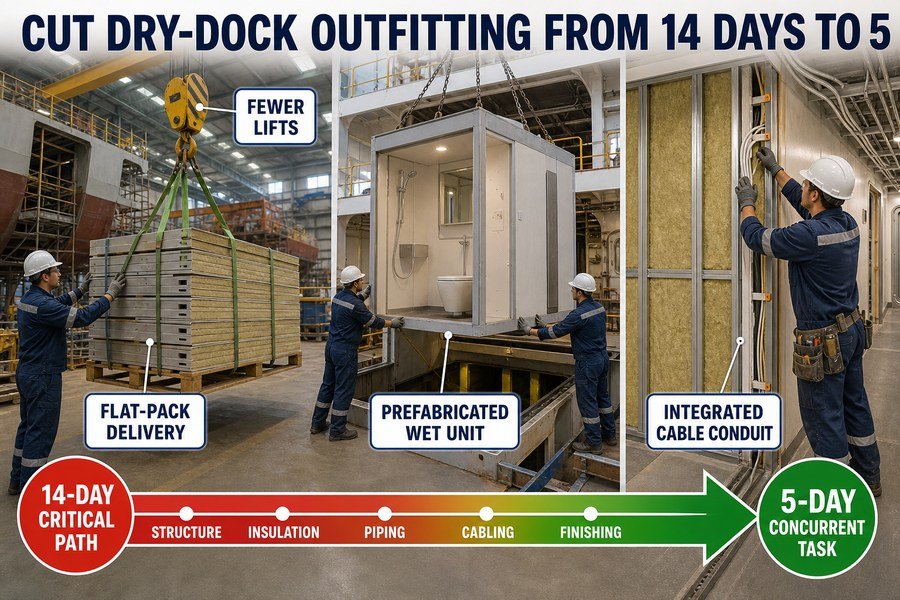
Vessel dry-docking time is reduced through optimal marine interior panel selection by deploying flat-pack delivery systems, prefabricated wet units, and integrated cable conduit panels. These choices consolidate logistics, eliminate sequential on-board construction, and reduce interior outfitting from a 14-day critical path activity to a 5-day concurrent task.
Consolidating Logistics with Flat-Pack Delivery Systems and Prefabricated Wet Units
Getting materials onto a ship in dry-dock is a massive headache. The cranes are always busy. Optimal marine interior panel selection solves this by deploying flat-pack delivery systems. Instead of shipping bulky, pre-built wall sections that waste space, flat-pack systems stack tightly12. You can load an entire deck's worth of panels in one crane lift.13 This consolidates logistics and saves hours of crane rental time. Next, you must consider the bathrooms. Bathrooms take the most time to build because they require pipes, tiles, and electrics in a tiny space. We reduce dry-docking time by deploying prefabricated wet units. These are complete bathroom boxes built in a factory. The shipyard crane drops the whole unit into the cabin space in one move. You just connect one water pipe and one power plug. This completely removes the slow process of building a bathroom piece by piece inside the ship.
Eliminating Sequential Construction Using Integrated Cable Conduit Panels
Sequential on-board construction is the biggest enemy of a fast dry-dock. As I mentioned before, trades waiting on other trades kills your timeline. Optimal panel selection eliminates sequential on-board construction by using integrated cable conduit panels. These panels come from the factory with hollow tubes already built inside the insulation core. When you install the wall, the path for the electrical wires is already there. The electrician does not have to drill holes or run external metal trays. They just push the wire straight through the panel. Because the wall builders and the electricians can work at almost the same time, this choice reduces interior outfitting from a 14-day critical path activity to a bare 5-day concurrent task14. Shaving 9 days off a dry-dock schedule saves a massive amount of money.
| Optimal Panel Selection Choice | Logistical Benefit | Impact on Dry-Docking Time |
|---|---|---|
| Flat-pack delivery systems | Consolidates logistics | Reduces crane lifting operations |
| Prefabricated wet units | Installs whole bathrooms at once | Saves weeks of plumbing work |
| Integrated cable conduit panels | Eliminates sequential on-board construction | Allows concurrent electrical wiring |
| Overall strategy implementation | Shifts critical path tasks | Reduces outfitting from 14 days to 5 days |
Why Do Newbuild Marine Interior Panel Installations Allow More Flexible Sequencing Than Refits?
Applying newbuild timelines to refit projects leads to disastrous delays. You cannot sequence them the same way. Newbuild marine panel installations offer flexibility that refits simply do not possess.
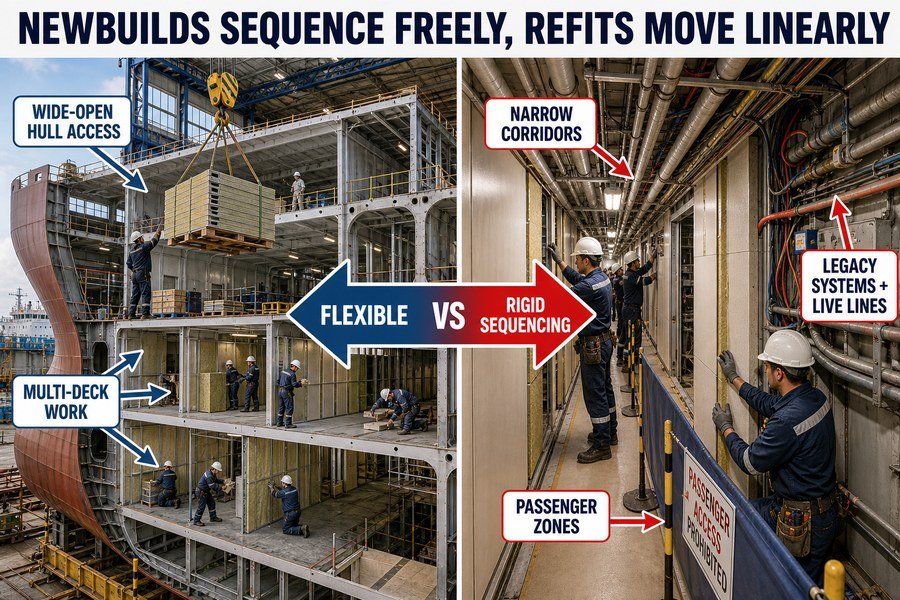
Newbuild marine interior panel installations allow more flexible sequencing than refits due to wide-open hull access, the absence of legacy systems, lack of passenger boundaries, and simultaneous multi-deck availability. Refits force rigid, linear panel installation through narrow corridors while working around live electrical lines and strict passenger zones.
Leveraging Wide-Open Hull Access and Multi-Deck Availability in Newbuilds
Building a brand new ship is very different from fixing an old one. Newbuild marine interior panel installations allow more flexible sequencing because of wide-open hull access15. Before the top decks are welded on, the ship is open to the sky. You can use giant shipyard cranes to drop massive pallets of panels directly into the center of the ship. You can sequence the installation however you want because nothing is blocking your path. Also, newbuilds offer simultaneous multi-deck availability. Because the ship is empty, you can have panel crews working on Deck 3, Deck 5, and Deck 7 at the exact same time. You can flood the project with labor to get it done fast. Furthermore, you have a complete lack of passenger boundaries. There are no paying customers to worry about. You can make noise, create dust, and run cables anywhere without setting up safety zones.
Refits are the exact opposite. Refits force rigid, linear panel installation. You cannot use giant cranes to drop pallets inside. You must carry every single panel by hand through narrow corridors. If one team blocks a corridor, no other team can pass. This ruins flexible sequencing. Next, refits suffer from the presence of old ship parts. You are constantly dealing with the absence of legacy systems in newbuilds, but in refits, legacy systems are everywhere. You have to carefully cut panels to fit around old pipes that are not on the original drawings16. Also, you are often working around live electrical lines17. You cannot just rip walls down quickly; you must move slowly to avoid cutting power to active parts of the ship. Finally, in-service refits involve strict passenger zones. You must put up temporary walls, keep noise down, and respect passenger boundaries.
| Sequencing Factor | Newbuild Installation Reality | Refit Installation Reality |
|---|---|---|
| Access points | Wide-open hull access for cranes | Narrow corridors requiring manual carry |
| Existing obstacles | Absence of legacy systems | Working around live electrical lines and old pipes |
| Work areas | Simultaneous multi-deck availability | Rigid, linear panel installation |
| Human factors | Lack of passenger boundaries | Strict passenger zones limiting work hours |
Conclusion
Fast installation speed dictates marine interior panel choices during refits. By selecting modular, pre-finished panels, you drastically cut man-hours, avoid shipyard delays, and maximize your refit project profitability.
-
"Dry Docking vs. Afloat Repairs in Istanbul Operational, Cost, and ...", https://www.academia.edu/164769677/Dry_Docking_vs_Afloat_Repairs_in_Istanbul_Operational_Cost_and_Scheduling_Comparison. Maritime maintenance and dry-docking planning literature describes dock availability, survey deadlines, and repair sequencing as time-constrained factors in vessel dry-docking projects, supporting the characterization of dry-docking periods as tightly scheduled. Evidence role: general_support; source type: paper. Supports: Vessels booked into a shipyard operate within strict dry-docking windows.. Scope note: Such sources support the general scheduling constraint, not the exact penalty terms of a particular shipyard contract. ↩
-
"CPM Schedule Density: A New Predictor for Productivity Loss", https://digital.lib.washington.edu/researchworks/items/b6cce1ab-9ba0-4b55-8308-dc3c5af7e8cb. Construction and shipbuilding scheduling studies describe precedence relationships among activities and the productivity losses that can arise when dependent trades cannot begin until predecessor tasks are complete, supporting the bottleneck mechanism described here. Evidence role: mechanism; source type: paper. Supports: Ship interior work can create sequential trade bottlenecks when later trades depend on earlier installation tasks.. Scope note: General scheduling evidence supports the dependency mechanism but may not match every vessel-refit workflow or yard practice. ↩
-
"[PDF] Kuzdas, Jacob C. Title: Prefabricated Wall Panels Schedule and ...", https://minds.wisconsin.edu/bitstream/handle/1793/82630/2021kuzdasj.pdf?sequence=1&isAllowed=y. Empirical studies of prefabricated or modular wall and panel systems report reductions in on-site labor time compared with conventional built-up methods, providing contextual support for a claimed man-hour reduction from faster panel installation. Evidence role: statistic; source type: paper. Supports: Toolless mounting systems or fast-install panels can reduce installation man-hours by 30%.. Scope note: Comparable prefabrication studies may not directly verify a 30% reduction for this exact marine panel system; product- or project-specific measurement would be needed for direct proof. ↩
-
"Ballistic Resistance of Honeycomb Sandwich Panels under In-Plane ...", https://pmc.ncbi.nlm.nih.gov/articles/PMC3800671/. Comparative engineering data on aluminum honeycomb sandwich panels indicate that they can provide substantially lower areal mass than steel panel constructions used for similar structural or interior applications; this supports the stated weight-saving rationale but does not by itself verify the specific labor reduction claimed later in the paragraph. Evidence role: statistic; source type: paper. Supports: Modern aluminum honeycomb panels can weigh up to 50% less than traditional steel panels.. Scope note: The article attributes the figure to SOLAS, but SOLAS primarily sets safety and fire-protection requirements rather than publishing a universal weight-comparison table for panel products. ↩
-
"[PDF] WHEN IS IT SAFE TO MANUALLY LIFT A PATIENT? - CDC Stacks", https://stacks.cdc.gov/view/cdc/186586/cdc_186586_DS1.pdf. Occupational manual-handling guidance explains that reduced load weight can lower the number of workers needed for team lifting and material handling; this provides a safety and ergonomics basis for the claim, although it does not directly prove the specific reduction from four workers to two for every panel type. Evidence role: mechanism; source type: government. Supports: Reducing panel weight can reduce the number of workers needed to handle each panel.. Scope note: The exact crew-size reduction depends on panel dimensions, route constraints, lifting aids, company safety rules, and local regulations. ↩
-
"[PDF] Fire Watch Duties during Hot Work - OSHA", https://www.osha.gov/sites/default/files/publications/OSHA4188.pdf. Hot-work safety regulations and maritime safety guidance commonly require authorization or permits, fire-watch arrangements, and suitable fire-prevention equipment for welding and similar operations; this supports the labor and compliance burden associated with on-site welding. Evidence role: general_support; source type: government. Supports: Welding on ships generally requires fire-watch controls, permits or authorization, and specialized safety equipment.. Scope note: Specific permit and fire-watch requirements vary by flag state, shipyard, vessel procedure, and the location of the hot work. ↩
-
"[PDF] Kuzdas, Jacob C. Title: Prefabricated Wall Panels Schedule and ...", https://minds.wisconsin.edu/bitstream/handle/1793/82630/2021kuzdasj.pdf?sequence=1&isAllowed=y. Building and marine interior fit-out literature describes factory-finished or prefinished panels as reducing site-applied finishing work such as painting or surface covering; this supports the claimed mechanism for reducing finishing labor, though not the article's assertion that painting hours are eliminated in every installation. Evidence role: mechanism; source type: research. Supports: Pre-laminated or factory-finished panels can reduce on-site painting and finishing labor.. Scope note: Some projects may still require touch-up, sealing, edge treatment, or repair after installation. ↩
-
"[PDF] Hot Work Program NFPA 51B - SUNY Cortland", https://www2.cortland.edu/information/campus-safety/environmental-health/policies/Hot%20Work%20Program%202022.pdf. Occupational-safety guidance defines hot work as operations such as welding, cutting, and grinding that can generate heat, flames, or sparks and create fire hazards, supporting the claim that avoiding hot work reduces ignition-related disruption during installation. Evidence role: definition; source type: government. Supports: This design requires no hot work, meaning no welding sparks or fire alarms will disturb the passengers.. Scope note: This supports the safety rationale for avoiding hot work, but it does not prove that a specific bulkhead system will never trigger shipboard alarms. ↩
-
"[PDF] Whole Building Design Guide - Sustainable Historic Buildings ...", https://www1.eere.energy.gov/femp/pdfs/ee_historicbldgs_paradis.pdf. Guidance on demountable or modular partition systems describes their use for adaptable interiors and lower-disruption maintenance or reconfiguration, which contextually supports the claim that modular panelized wall systems can allow localized replacement rather than full wall demolition. Evidence role: general_support; source type: institution. Supports: Modular continuous-profile track systems allow single-panel removal without dismantling adjacent bulkheads.. Scope note: The source would support the general modular-partition principle, not direct performance of the specific continuous-profile track system described in the article. ↩
-
"[PDF] OSHA's Respirable Crystalline Silica Standard for Construction", https://www.osha.gov/sites/default/files/publications/OSHA3681.pdf. Occupational-health sources note that cutting, grinding, or sanding construction materials can generate airborne dust and respirable particles, supporting the rationale that prefabricated clip-on surfaces that avoid onboard cutting can reduce dust generation during refits. Evidence role: mechanism; source type: government. Supports: Independent clip-on decorative fascia boards eliminate dust-heavy cutting on board and help keep passenger air clean.. Scope note: This supports the dust-generation mechanism; it does not verify that the described fascia boards always eliminate all cutting or all airborne dust in shipboard use. ↩
-
"Volatile Organic Compounds in Indoor Air: Sampling, Determination ...", https://pmc.ncbi.nlm.nih.gov/articles/PMC12115474/. Indoor-air-quality authorities identify many adhesives and sealants as sources of volatile organic compounds, and note that VOC exposure can cause odors and symptoms such as eye, nose, and throat irritation, headaches, or nausea, supporting the plausibility of odor and comfort complaints from some industrial adhesives. Evidence role: mechanism; source type: government. Supports: Standard industrial glues can release strong chemical smells that make passengers sick and cause complaints.. Scope note: This does not establish that all standard industrial glues cause sickness, nor that every product marketed as non-toxic is odor-free or suitable for occupied marine spaces. ↩
-
"How Modular Construction Is Solving Modern Building ...", https://www.evergladesuniversity.edu/blog/modular-construction-solving-building-challenges/. A neutral source on flat-pack or knock-down modular systems supports the general principle that disassembled components can reduce transport volume and improve handling efficiency compared with fully assembled modules. Evidence role: mechanism; source type: paper. Supports: Flat-pack delivery systems consolidate logistics because panels can be stacked more densely than bulky pre-built wall sections.. Scope note: This would support the logistics mechanism generally, not prove the specific crane-lift capacity of the project described. ↩
-
"What Handling Constraints Affect the Modular Sizing of Retrofit ...", https://magellanmarinetech.com/what-handling-constraints-affect-modular-sizing-retrofit-marine-panels/. A shipbuilding or marine-outfitting case study documenting panel weights, palletization, and crane-load planning would support whether deck-level batches of interior panels can be lifted in a single operation. Evidence role: case_reference; source type: institution. Supports: An entire deck's worth of panels can be loaded in one crane lift.. Scope note: The claim is highly project-specific and depends on deck size, panel weight, packaging, crane capacity, and shipyard access constraints. ↩
-
"How to Prevent Rework When Fitting Retrofit Marine Panels in ...", https://magellanmarinetech.com/how-prevent-rework-when-fitting-retrofit-marine-panels-confined-spaces/. A shipbuilding productivity study or documented retrofit case can support schedule reductions from pre-outfitting, modular interiors, or integrated service routing by comparing sequential onboard work with more concurrent installation methods. Evidence role: case_reference; source type: paper. Supports: Integrated cable conduit panels can reduce interior outfitting duration by shifting work from sequential onboard installation to concurrent tasks.. Scope note: Such evidence would be case-specific; it would not establish that every integrated conduit-panel installation reduces outfitting from exactly 14 days to 5 days. ↩
-
"[PDF] by April, 1990 - VTechWorks", https://vtechworks.lib.vt.edu/bitstream/handle/10919/41819/LD5655.V851_1990.T368.pdf?sequence=1&isAllowed=y. A shipbuilding-process source should document that modern vessels are assembled from large hull blocks or sections using shipyard cranes, which can leave major openings available for equipment and material loading before final closure. Evidence role: mechanism; source type: education. Supports: Newbuild marine interior panel installations allow more flexible sequencing because the unfinished hull provides open access for cranes and material loading.. Scope note: This would support the construction-access mechanism generally, but may not directly address marine interior panel pallets unless the source discusses outfitting logistics. ↩
-
"How to Assess Allowable Dead Load for Retrofit Marine Wall Panels?", https://magellanmarinetech.com/how-assess-allowable-dead-load-for-retrofit-marine-wall-panels/. A ship retrofit or naval modernization source should note that existing-vessel documentation and as-built conditions may be incomplete or outdated, requiring field verification of legacy systems before modification. Evidence role: general_support; source type: paper. Supports: Refit work often requires adapting new installations around legacy systems whose actual locations may differ from original drawings.. Scope note: The source may establish the documentation problem broadly for refits or retrofits rather than specifically for interior wall panel cutting. ↩
-
"eTool : Shipyard Employment - General Requirements - Electrical ...", http://www.osha.gov/etools/shipyard/general-requirements/electrical-circuits. An occupational-safety source for ship repair should describe electrical and hazardous-energy risks in shipyard repair work and the need for controls such as isolation, lockout, or verification before disturbing systems. Evidence role: expert_consensus; source type: government. Supports: Refit crews may need to work cautiously around active or potentially energized electrical systems to avoid service interruption or injury.. Scope note: This supports the safety concern around energized systems in ship repair; it does not quantify how much it slows panel installation. ↩