
Replacing marine wall panels during a retrofit can cause serious vessel stability issues. If your ship gets too heavy, it fails inspection. Here is how to handle dead load assessment safely.
Assessing allowable dead load for retrofit marine wall panels involves calculating existing deck margins, reviewing the stability booklet, comparing the weight of old versus new panels, and keeping cumulative weight changes below class society thresholds (typically 2% of lightweight) to avoid mandatory and expensive inclining tests.
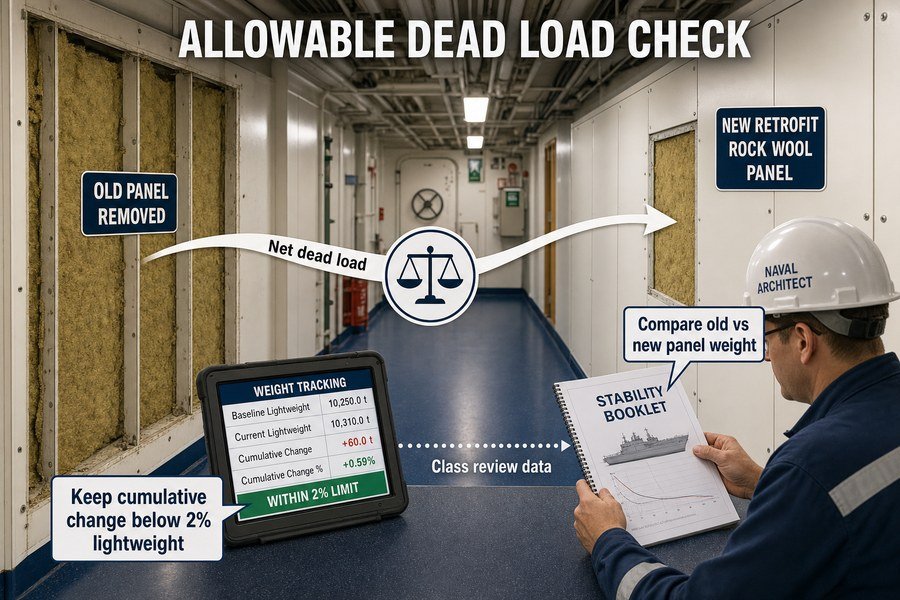
Let us look at the exact numbers and steps you need to follow for a safe retrofit.
What Is the Maximum Wall Panel Weight Capacity per Square Meter on Retrofitted Decks?
Adding heavy marine wall panels to old decks can cause deck plates to buckle. You must know the maximum weight limit before buying panels to avoid structural damage.
The maximum wall panel weight capacity on retrofitted decks depends on the deck type, typically ranging from 15 to 20 kg/m² for standard accommodation decks, and up to 35 kg/m² for structural bulkheads, according to standard DNV and ABS ship construction rules for interior outfitting.
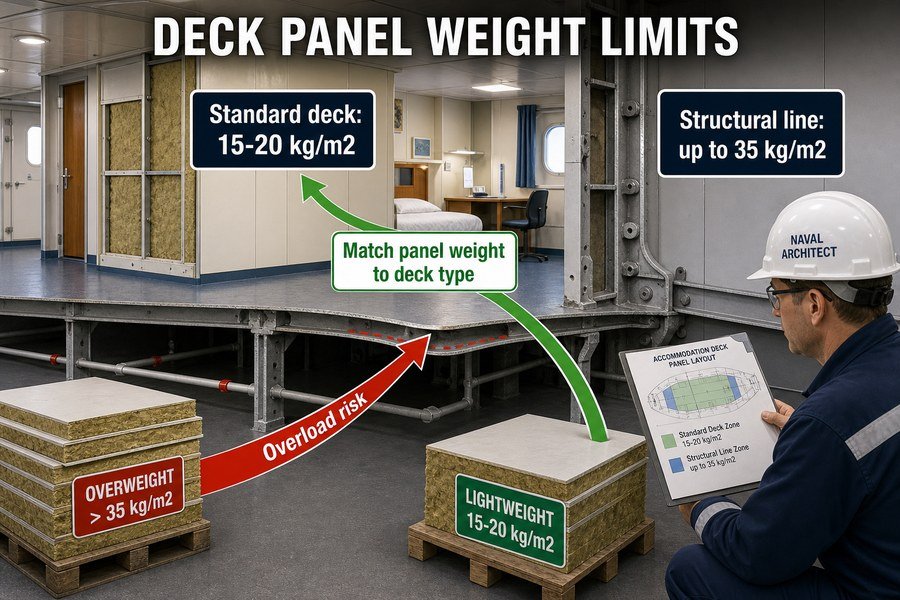
Weight Limits for Standard Accommodation Decks
When I worked at the marine outfitting factory, I saw many buyers make the same mistake. They bought cheap, heavy marine wall panels without checking the deck capacity. For standard accommodation decks, the safety limit is usually between 15 and 20 kg/m²1. This rule comes from DNV Part 3 Chapter 4 guidelines for outfitting. Standard decks are built to carry people and light furniture. They are not built for very heavy steel panels. If you install a 22 kg/m² A-60 panel on a standard deck designed for 15 kg/m², the deck will bend over time. This causes the doors to jam and the ceiling panels to crack. You must always check the original ship drawings before you buy new panels. If you need a high fire rating like A-60, you should look for lightweight core materials. Ceramic wool cores can keep the weight under 18 kg/m²2. This keeps you safe and passes the class inspection.
Weight Limits for Structural Bulkhead Areas
Structural bulkheads are different from standard decks. These are the main steel walls that hold the ship together. Because the steel deck below them is much thicker, they can hold more weight. According to ABS rules, you can install marine wall panels weighing up to 35 kg/m² along these structural lines3. This allows you to use heavy-duty marine fire doors and thick steel panels for extra soundproofing. But there is a catch. You can only put this heavy weight directly over the strong structural beams. You cannot put 35 kg/m² panels in the middle of a cabin floor. I always tell my clients to map out the heavy zones before ordering. This saves money. You can buy cheaper, heavier panels for the strong areas, and buy high-quality, lightweight panels for the weak areas.
| Deck Area Type | Allowed Panel Weight (kg/m²) | Typical Panel Type | Class Rule Reference |
|---|---|---|---|
| Standard Cabin Deck | 15 - 20 kg/m² | B-15 or B-0 lightweight panels | DNV Part 3 Ch 4 |
| Structural Bulkhead | 25 - 35 kg/m² | A-60 heavy steel panels | ABS Steel Vessel Rules |
| Wet Unit Floors | 20 - 25 kg/m² | B-15 stainless steel coated | IMO SOLAS Guidelines |
How to Calculate the Added Dead Load From Replacement Marine Wall Panels?
Calculating added dead load is hard if you do not have the right formula. A wrong calculation leads to buying the wrong panels and failing your final safety survey.
Calculating added dead load from replacement marine wall panels requires subtracting the total weight of the removed panels (area × old panel weight/m²) from the total weight of the new panels (area × new panel weight/m²), plus the weight of new mounting profiles and insulation materials.
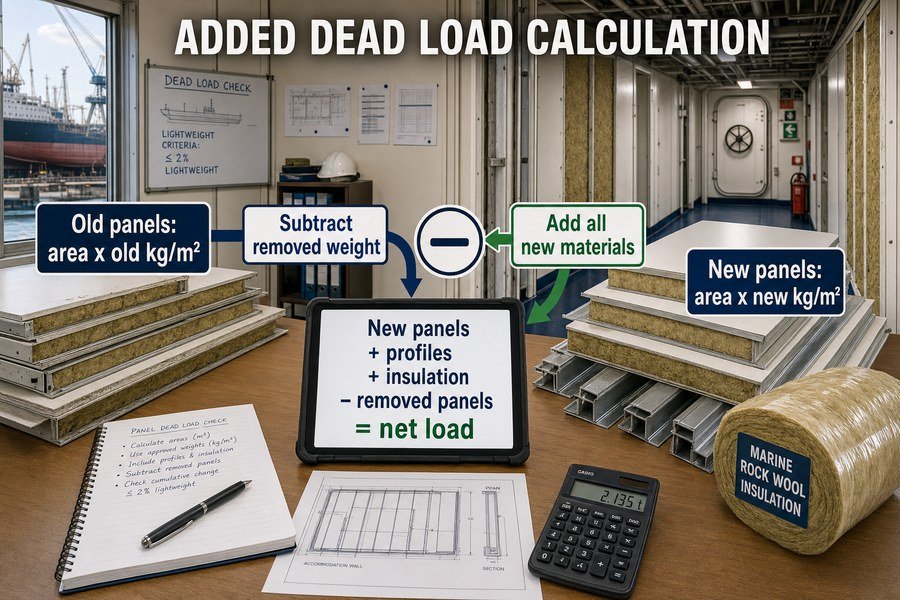
Calculating the Total Weight of Removed Marine Panels
The first step is to calculate what you are taking off the ship. You must measure the total square meters of the old marine wall panels. Then, you multiply this area by the old panel weight per square meter. For example, old 1990s steel-faced rockwool panels usually weigh about 19 kg/m²4. If you remove 1,000 square meters of these panels, you remove 19,000 kg from the ship. You must record this exact number. I helped a buyer from Asia last year who forgot to do this. He only tracked the weight of the new panels. When the European shipyard asked for the net weight change, he had no data. We had to guess the old weight, which made the class surveyor very angry. Always weigh a sample of the old panel before you throw it away.
Calculating the Total Weight of New Marine Panels, Profiles, and Insulation
The next step is to calculate the new weight. You take the total square meters and multiply it by the new panel weight. If your new panels weigh 15 kg/m², the new panel weight is 15,000 kg for 1,000 square meters. But you are not done. You must add the weight of the new mounting profiles (top and bottom tracks). Standard steel U-profiles add about 1.5 kg per linear meter5. If you have 500 meters of track, that is 750 kg. Finally, you must add the weight of any extra insulation stuffed behind the panels6. A common mistake is forgetting the profiles and insulation. If you only look at the panel weight, your calculation will be wrong. By adding the panels, profiles, and insulation together, you get the true new weight. Then, you subtract the old weight from the new weight to find the added dead load7.
| Calculation Step | Item Description | Formula | Example Value (1000m² area) |
|---|---|---|---|
| Step 1 | Total Weight of Removed Panels | Area × Old Weight/m² | 1,000m² × 19 kg = 19,000 kg |
| Step 2 | Total Weight of New Panels | Area × New Weight/m² | 1,000m² × 15 kg = 15,000 kg |
| Step 3 | Weight of New Profiles | Linear Meters × Weight/m | 500m × 1.5 kg = 750 kg |
| Step 4 | Weight of Extra Insulation | Area × Insulation Weight/m² | 1,000m² × 2 kg = 2,000 kg |
| Final Result | Net Added Dead Load | (Step 2 + 3 + 4) - Step 1 | 17,750 kg - 19,000 kg = -1,250 kg (Weight Saved) |
What Deck Strength Data Is Required Before Installing Heavier Retrofit Marine Ceiling Panels?
Ceilings are just as important as walls. Hanging heavy marine ceiling panels without checking deck strength data first can pull down the entire support grid.
Before installing heavier retrofit marine ceiling panels, you must obtain the deck plate thickness, the point load capacity of the deck overhead (usually 0.5 to 1.0 kN), and the maximum allowable hanging mass from the vessel's General Arrangement plan or structural drawings.
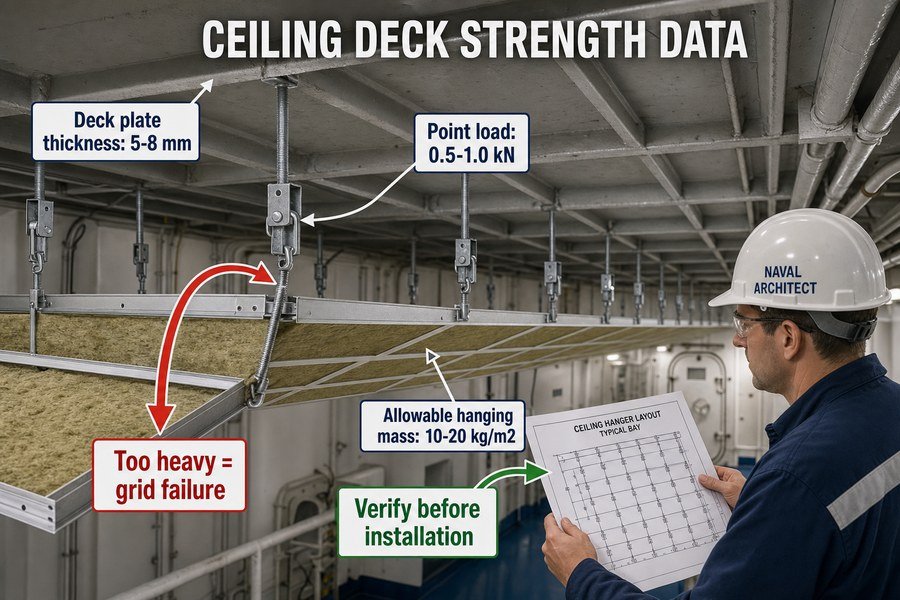
Obtaining Deck Plate Thickness and Point Load Capacity
When you install marine ceiling panels, you hang them from the steel deck above. You do this using threaded rods and hanger brackets. Before you drill into that steel, you need to know the deck plate thickness. This data comes straight from the ship's structural drawings8. If the deck plate is too thin (less than 5mm9), welding or drilling heavy hangers can damage the deck. Next, you must check the point load capacity. This is how much pulling force one specific point on the deck can handle. For standard marine ceilings, the point load capacity must be between 0.5 kN and 1.0 kN per hanger10. I once saw a project where the workers installed heavy A-60 ceiling panels on weak hangers. The point load was too high. The ceiling dropped two inches after a week at sea. Knowing the point load stops disasters and keeps your installation safe.
Reviewing the General Arrangement Plan for Hanging Mass
You cannot just guess how much weight the ceiling can hold. You must read the ship's General Arrangement (GA) plan. The GA plan will tell you the maximum allowable hanging mass for different rooms. A corridor might allow a hanging mass of 15 kg/m², but a large dining room might only allow 10 kg/m² because the span is wider. If you buy marine ceiling panels that weigh 18 kg/m², you will have a big problem. You will fail the class survey. If your customer is a strict European shipyard, they will make you tear it all down. As a procurement officer, you must ask the shipyard for the allowable hanging mass data before you ask me for a price quote. This way, I can find a panel that matches both your budget and your strength limits.
| Required Deck Strength Data | Where to Find It | Safe Range for Ceilings | Consequence of Ignoring Data |
|---|---|---|---|
| Deck Plate Thickness | Ship Structural Drawings | 5mm to 8mm | Drilling causes leaks or cracks |
| Point Load Capacity | Deck Load Plan | 0.5 kN to 1.0 kN | Hanger brackets tear out |
| Allowable Hanging Mass | General Arrangement Plan | 10 kg/m² to 20 kg/m² | Entire ceiling grid collapses |
| Fire Zone Rating Limits | SOLAS Fire Plan11 | Varies (e.g., A-0 vs A-60) | Fails class safety inspection |
Does Replacing Steel Marine Panels With Lightweight Composites Affect Retrofit Vessel Stability?
Saving weight sounds good, but changing your panel material drastically changes the ship's center of gravity. This shifts how the vessel rolls in the water.
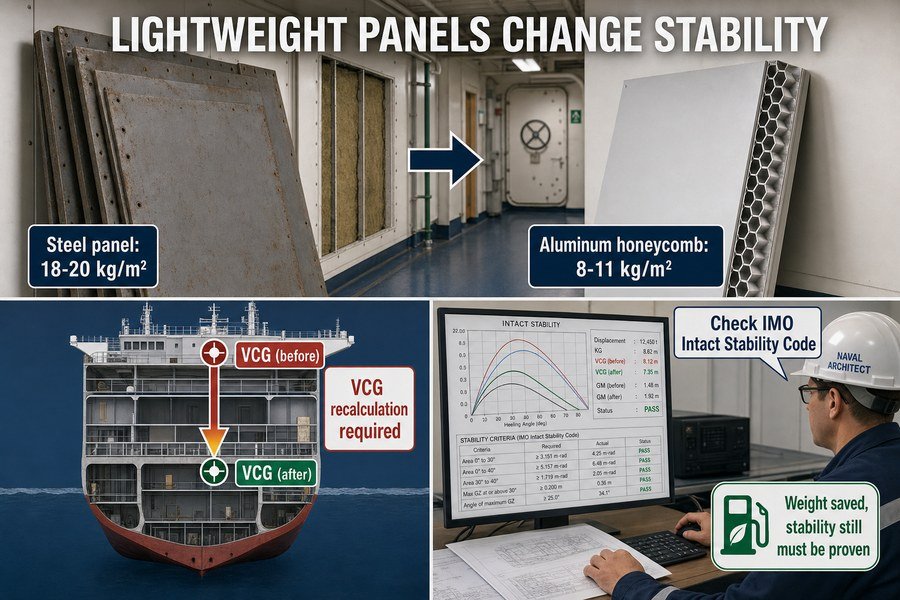
Replacing steel marine panels with lightweight composites absolutely affects retrofit vessel stability by lowering the total deadweight and potentially shifting the Vertical Center of Gravity (VCG), which must be recalculated to ensure the ship still meets the International Maritime Organization (IMO) Intact Stability Code requirements.
The Impact of Lightweight Marine Panels on Total Deadweight
When you switch from old steel panels to modern lightweight composites, you change the ship's deadweight. Deadweight is the total weight the ship can carry safely.12 A standard steel B-15 marine wall panel weighs about 18 kg/m². A modern composite B-15 panel with an aluminum honeycomb core weighs only 10 kg/m². If you replace 5,000 square meters of panels, you remove 40,000 kg from the ship. This sounds like a great thing. A lighter ship uses less fuel.13 However, removing too much weight too fast changes how the ship sits in the water. The draft (how deep the ship sits) decreases. The ship might sit too high in the water, which exposes the propeller.14 You must track this deadweight change very carefully.
How Panel Replacements Shift the Vertical Center of Gravity (VCG)
The Vertical Center of Gravity (VCG) is the most critical factor for ship stability. If the VCG is too high, the ship will roll dangerously in rough seas. If the VCG is too low, the ship snaps back too quickly, which makes passengers sick. Marine wall panels are mostly installed on the upper decks of a ship (the superstructure). When you take away heavy steel panels from the top decks and replace them with light composite panels, you lower the VCG. This is usually good. It makes the ship more stable. But you must prove it. The International Maritime Organization (IMO) Intact Stability Code requires a naval architect to recalculate the VCG after major retrofits.15 Even if you improve the stability, you must submit the new VCG numbers to the class society. I always provide my clients with exact weight certificates for my panels so their engineers can do this math easily.
| Panel Material Type | Average Weight (B-15 Rating) | Impact on Total Deadweight | Impact on VCG (if on upper decks) |
|---|---|---|---|
| Traditional Steel/Rockwool | 18 - 20 kg/m² | Very High | Raises VCG (Less stable) |
| Aluminum/Rockwool | 14 - 16 kg/m² | Medium | Neutral |
| Aluminum Honeycomb Composite | 8 - 11 kg/m² | Low (Saves massive weight) | Lowers VCG (More stable) |
| Calcium Silicate Board | 15 - 17 kg/m² | Medium-High | Neutral to slightly raised |
How to Control Cumulative Marine Wall Panel Weight to Prevent Mandatory Class Inclining Tests?
A class inclining test stops your ship from sailing and costs thousands of dollars. You must track every kilogram of your new panels to avoid this penalty.
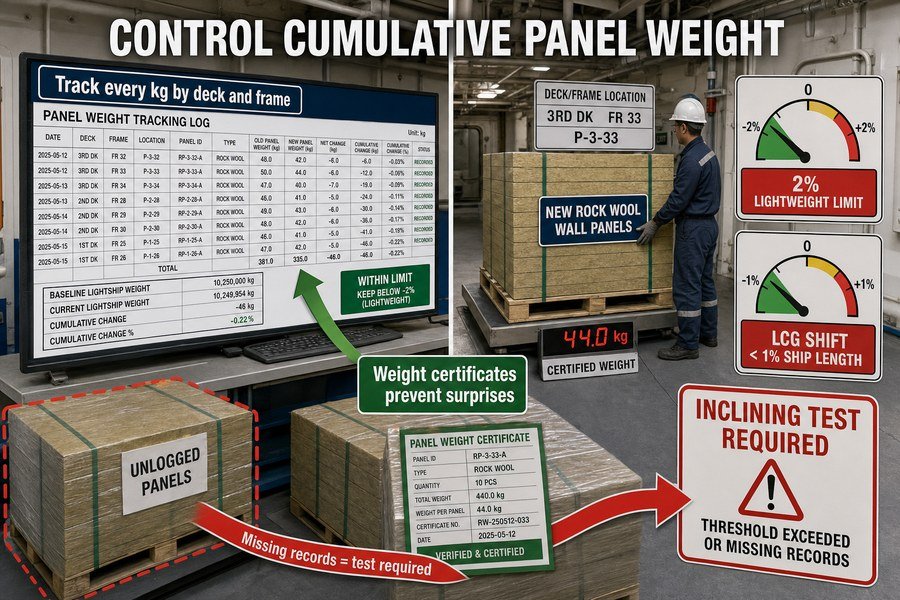
To control cumulative marine wall panel weight and prevent mandatory class inclining tests, you must maintain a detailed weight tracking log showing that the total weight variation remains below 2% of the ship's original lightweight and the longitudinal center of gravity shifts less than 1%.
Maintaining a Detailed Weight Tracking Log for Marine Panels
An inclining test16 is a physical test done in the water to find the ship's true center of gravity. It is slow and very expensive. To avoid it, class societies like DNV and ABS allow you to do a "deadweight calculation" instead, but only if you have perfect records. You must keep a detailed weight tracking log. Every time you remove an old marine ceiling panel or marine fire door, you write down the minus weight. Every time you bring a new panel on board, you write down the plus weight. You must also track where the item is located on the ship (the frame number and deck level). When I supply panels, I give my clients an Excel sheet with every panel's exact weight and location. This makes it easy to update the log. If the class surveyor asks for proof, you just show them the log.
Staying Below the Two Percent Lightweight Variation Limit
The class rules are very strict about weight changes. According to standard maritime rules, if the cumulative weight change exceeds 2% of the ship's original lightweight, you must do a new inclining test17. Also, if the longitudinal center of gravity (LCG) moves more than 1% of the ship's length, you must do the test18. For a ship with a 5,000-ton lightweight, a 2% change is just 100 tons. 100 tons sounds like a lot, but marine wall panels, ceiling grids, wet units, and floors add up very fast during a full interior retrofit. You must buy panels that keep you safely under this 2% limit. Sometimes, paying a little more for a lightweight panel saves you $30,000 by avoiding the inclining test. This is why cheap, heavy panels are often a bad deal in the end.
| Weight Management Factor | Class Rule Limit | Consequence of Failing Limit | Solution for Procurement |
|---|---|---|---|
| Cumulative Weight Change | < 2% of Original Lightweight | Mandatory physical inclining test | Buy lighter certified panels |
| LCG Shift | < 1% of Ship Length | Mandatory physical inclining test | Balance heavy panels front to back |
| Weight Documentation | Must be 100% accurate | Surveyor rejects the stability book | Require weight certificates from supplier |
| Scale Weighing | Required for unknown items | Project delays in shipyard | Weigh old panels during demolition |
How Does Marine Wall Panel Dead Load Impact Existing Stability Booklets During Retrofits?
The stability booklet is the most important safety document on the ship. If your new marine wall panels change the dead load, this book becomes invalid.
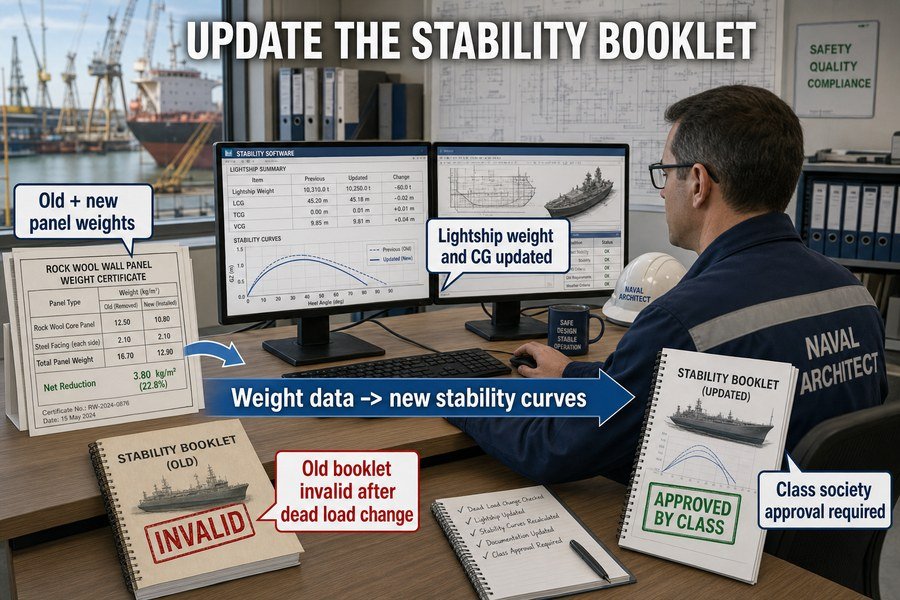
Marine wall panel dead load impacts existing stability booklets during retrofits by altering the ship's lightship weight and centers of gravity, requiring a naval architect to update the booklet with the new panel data and submit it to the class society for final approval.
Altering Lightship Weight and Centers of Gravity in the Booklet
Every commercial ship has an approved stability booklet on the bridge. The captain uses it to load cargo safely. This book is based on the ship's "lightship weight19"—the weight of the empty ship. The marine wall panels, ceilings, and marine fire doors are all part of this lightship weight. When you do a retrofit and change the dead load, the old lightship weight is no longer true. The vertical, longitudinal, and transverse centers of gravity have all moved.20 If the captain uses the old booklet, he might load the ship wrong and cause it to flip over. Therefore, any change to the outfitting weight directly breaks the validity of the stability booklet. You cannot ignore this. Even a small change of 5 tons needs to be recorded as an addendum21 to the book.
You cannot just cross out numbers in the stability booklet with a pen. There is a strict legal process. First, you must give your weight tracking log to a certified naval architect. The architect will use computer software to see how the new marine wall panels change the ship's safety curves. If the ship still meets IMO Intact Stability rules, the architect prints a new stability booklet. But you are still not finished. You must send this new booklet to the class society (like ABS, DNV, or Lloyd's Register). The class society engineers will review the math. If they agree, they stamp the book "Approved." Only then can the ship legally sail. My job as your supplier is to give you accurate product data sheets and IMO test certificates so the class society approves your book on the first try.
| Stability Booklet Update Step | Responsible Party | Required Action for Marine Panels | Typical Timeframe |
|---|---|---|---|
| 1. Record Weight Data | Shipyard / Procurement | Log exact weights of old and new panels | Ongoing during retrofit |
| 2. Calculate New Stability | Naval Architect | Input panel weights into stability software | 1 to 2 weeks |
| 3. Create Draft Booklet | Naval Architect | Print updated stability curves and LCG/VCG | 1 week |
| 4. Class Society Approval | Class Surveyor | Review and stamp the new booklet | 2 to 4 weeks |
Conclusion
Managing the dead load of retrofit marine wall panels requires precise weight calculation and strict rule compliance to ensure safety, pass class inspections, and keep your retrofit budget on track.
-
"[PDF] Regulations concerning construction and supervision of smaller ...", https://www.eftasurv.int/cms/sites/default/files/documents/regulation-Draft-Regulation-and-Annex-in-English.pdf. A classification-society rule table on accommodation-area design loads would support the stated order of magnitude for allowable outfitting weight on standard accommodation decks. Evidence role: statistic; source type: institution. Supports: For standard accommodation decks, the safety limit is usually between 15 and 20 kg/m².. Scope note: The cited values may depend on vessel type, rule edition, load category, and whether the rule refers to distributed deck load rather than wall-panel mass specifically. ↩
-
"[PDF] Bulkhead Insulation Systems - NIST Technical Series Publications", https://nvlpubs.nist.gov/nistpubs/Legacy/IR/nbsir76-1012.pdf. Technical literature on ceramic-fiber or mineral-wool fire-rated sandwich panels can support that low-density noncombustible cores are used to reduce panel mass while maintaining fire resistance. Evidence role: mechanism; source type: paper. Supports: Ceramic wool cores can keep A-60 marine wall panel weight under 18 kg/m².. Scope note: A general materials source would support the weight-saving mechanism, but the specific under-18 kg/m² figure should be verified by a certified panel test report or type-approval certificate for a particular construction. ↩
-
"Rules for Building and Classing Steel Barges ... - Academia.edu", https://www.academia.edu/28538749/Rules_for_Building_and_Classing_Steel_Barges_RULES_FOR_BUILDING_AND_CLASSING_American_Bureau_of_Shipping_Incorporated_by_Act_of_Legislature_of_the_State_of_New_York_1862_RULES_FOR_BUILDING_AND_CLASSING. ABS steel vessel rules or guidance on structural members and distributed outfitting loads would support whether heavier panel weights may be assigned over primary structural supports. Evidence role: general_support; source type: institution. Supports: According to ABS rules, marine wall panels weighing up to 35 kg/m² can be installed along structural bulkhead lines.. Scope note: The source may support the principle of higher permissible loads near primary structure without confirming a universal 35 kg/m² allowance for all structural bulkhead locations. ↩
-
"(PDF) Steel Sandwich Panels in Marine Applications P. Kujala", https://www.academia.edu/64432540/Steel_Sandwich_Panels_in_Marine_Applications_P_Kujala. Technical data for steel-faced mineral-wool marine accommodation panels report area weights in the same approximate range as 19 kg/m², supporting this as a representative planning value rather than a universal constant. Evidence role: statistic; source type: other. Supports: Old 1990s steel-faced rockwool marine wall panels usually weigh about 19 kg/m².. Scope note: Panel mass varies by thickness, steel gauge, core density, coating, and manufacturer, so the cited value should be treated as an example and verified by weighing samples or checking project documents. ↩
-
"[PDF] Mild Steel Channel Weight Chart - extnag.tacc.utexas.edu", https://extnag.tacc.utexas.edu/default.aspx/u30814/244287/Mild%20Steel%20Channel%20Weight%20Chart.pdf. Structural steel section tables give mass per unit length as a function of profile dimensions and thickness, providing a basis for estimating the added linear weight of steel U-profiles used as mounting tracks. Evidence role: statistic; source type: education. Supports: Standard steel U-profiles can add about 1.5 kg per linear meter to the installation weight.. Scope note: A value of 1.5 kg/m is only valid for particular profile dimensions and steel thickness; project-specific profile schedules should override this estimate. ↩
-
"[PDF] NSMV Phase 3 Design LIGHTSHIP WEIGHT ESTIMATE", https://www.maritime.dot.gov/sites/marad.dot.gov/files/docs/national-defense/office-ship-operations/rrf/2611/lightship-weight-report.pdf. Ship weight-estimation and stability references treat outfitting, insulation, and joinery as components of a vessel’s lightship or dead-load accounting, supporting the inclusion of insulation when calculating the weight effect of an interior refit. Evidence role: mechanism; source type: institution. Supports: Extra insulation installed behind marine panels should be included in the new-weight calculation.. Scope note: Such references support the accounting principle; they do not prescribe the exact insulation mass for a specific vessel or product. ↩
-
"[PDF] Aircraft Weight and Balance Handbook - FAA", https://www.faa.gov/sites/faa.gov/files/2023-09/Weight_Balance_Handbook.pdf. Marine stability guidance for vessel alterations requires accounting for weight added, removed, and relocated; this supports calculating the net change as new installed weight minus removed weight for assessing the alteration’s effect on loading and stability. Evidence role: expert_consensus; source type: government. Supports: The added dead load from a panel replacement is found by subtracting the removed weight from the total new installed weight.. Scope note: The source would support the net-weight accounting method, while formal stability approval may require additional data such as vertical and longitudinal centers of gravity. ↩
-
"[PDF] Reliability-Based Optimal Design of Steel Box Structures. II", https://www.ctsm.umd.edu/archive/akpanukokotayyu00083.pdf. A ship’s structural drawings and scantling-related plans are used to document deck plating and structural member dimensions relevant to outfitting attachments. Evidence role: general_support; source type: institution. Supports: Deck plate thickness data comes from the ship's structural drawings.. Scope note: This supports the usual source of plate-thickness information, not the specific thickness of any individual vessel. ↩
-
"46 CFR Part 57 -- Welding and Brazing - eCFR", https://www.ecfr.gov/current/title-46/chapter-I/subchapter-F/part-57. Marine structural and outfitting guidance commonly treats plate thickness, weld size, and local reinforcement as limiting factors for attachments to thin steel plating. Evidence role: mechanism; source type: institution. Supports: Deck plating that is too thin can be damaged by drilling or welding heavy ceiling hangers.. Scope note: A source may explain the engineering mechanism and minimum-thickness considerations generally, but the 5 mm threshold may depend on vessel rules, loading, weld procedure, and classification approval. ↩
-
"[PDF] IR 25-1: Maximum Allowable Load for Ceiling Wires", https://www.dgs.ca.gov/-/media/Divisions/DSA/Publications/interpretations_of_regs/IR_25-1.pdf. Ceiling suspension design guidance and marine outfitting specifications may define allowable hanger loads or require verification of point loads for suspended ceilings. Evidence role: statistic; source type: institution. Supports: Standard marine ceiling hangers require point-load capacity in the range of 0.5 kN to 1.0 kN per hanger.. Scope note: The cited range should be treated as project- or system-specific unless the source explicitly states it as a general marine-ceiling requirement. ↩
-
"46 CFR Part 116 Subpart D -- Fire Protection - eCFR", https://www.ecfr.gov/current/title-46/chapter-I/subchapter-K/part-116/subpart-D. SOLAS Chapter II-2 requires fire protection arrangements and fire-control plans that identify fire divisions and related safety features on ships. Evidence role: historical_context; source type: institution. Supports: Fire-zone rating limits for ceiling installations are tied to SOLAS fire plans and can affect class safety inspection outcomes.. Scope note: SOLAS establishes the regulatory context for fire divisions and plans, while the exact A-0 or A-60 requirements for a particular ceiling depend on vessel type, space category, flag administration, and class interpretation. ↩
-
"Deadweight tonnage - Wikipedia", https://en.wikipedia.org/wiki/Deadweight_tonnage. A maritime reference source defines deadweight tonnage as the difference between a vessel’s loaded and lightweight displacement, representing the mass of cargo, fuel, stores, passengers, and crew that the ship can carry within its assigned load limits. Evidence role: definition; source type: encyclopedia. Supports: Deadweight is the total weight the ship can carry safely.. Scope note: The wording in the article is simplified; formal definitions usually describe deadweight as a displacement difference rather than only as 'weight carried safely.' ↩
-
"[PDF] Chapter 7 Resistance and Powering of Ships - USNA", https://www.usna.edu/NAOE/_files/documents/Courses/EN400/02.07%20Chapter%207.pdf. Naval-architecture and maritime-energy literature links vessel displacement and resistance to propulsion power demand, supporting the general claim that reducing ship weight can reduce fuel consumption when operating conditions and speed are otherwise comparable. Evidence role: mechanism; source type: paper. Supports: A lighter ship uses less fuel.. Scope note: Fuel savings depend on speed, hull form, loading condition, propulsion system, and operational profile; weight reduction alone does not determine total fuel use. ↩
-
"[PDF] Principles of Ship Performance Course Notes - USNA", https://www.usna.edu/NAOE/_files/documents/Courses/EN400/EN400_Course_Notes,_Summer_2020.pdf. Marine-engineering guidance on propeller immersion and ventilation explains that inadequate draft or insufficient propeller submergence can allow air to be drawn into the propeller flow, reducing thrust and causing vibration or loss of propulsive efficiency. Evidence role: mechanism; source type: education. Supports: If weight removal reduces draft too much, the propeller may become insufficiently submerged or exposed.. Scope note: The source would support the mechanism of inadequate propeller immersion; it may not address this specific panel-replacement scenario directly. ↩
-
"46 CFR Part 170 -- Stability Requirements for All Inspected Vessels", https://www.ecfr.gov/current/title-46/chapter-I/subchapter-S/part-170. The IMO Intact Stability Code and related stability guidance require ship stability information to reflect the vessel’s actual loading and lightship characteristics, and substantial alterations affecting lightweight or center of gravity generally require updated stability assessment. Evidence role: expert_consensus; source type: institution. Supports: Major retrofits that change vessel weight distribution require updated stability calculations, including vertical center of gravity.. Scope note: The Code may not use the exact phrasing 'a naval architect must recalculate the VCG after major retrofits'; the support is for the regulatory principle that stability data must be updated when alterations affect weight or center of gravity. ↩
-
"[PDF] EN400 LAB #3 PRELAB INCLINING EXPERIMENT - USNA", https://www.usna.edu/NAOE/_files/documents/Courses/EN400/05.03%20Lab%203.pdf. A naval-architecture or maritime-safety source should define an inclining test as an in-water procedure used to determine a vessel’s lightship displacement and centers of gravity for stability assessment. Evidence role: definition; source type: institution. Supports: An inclining test is a physical test done in the water to find the ship's true center of gravity.. ↩
-
"46 CFR 28.535 -- Inclining test. - eCFR", https://www.ecfr.gov/current/title-46/chapter-I/subchapter-C/part-28/subpart-E/section-28.535. An official stability-guidance source should document the commonly used threshold that a vessel with cumulative lightship weight change exceeding 2% may require a new inclining experiment or equivalent stability reassessment. Evidence role: expert_consensus; source type: government. Supports: If the cumulative weight change exceeds 2% of the ship's original lightweight, a new inclining test is required.. Scope note: The 2% threshold is commonly found in regulatory guidance, but the mandatory action can depend on flag-state rules, class requirements, and vessel category. ↩
-
"46 CFR 28.535 -- Inclining test. - eCFR", https://www.ecfr.gov/current/title-46/chapter-I/subchapter-C/part-28/subpart-E/section-28.535. A maritime-regulatory or classification source should support that a significant longitudinal center-of-gravity shift, often expressed as 1% of vessel length in stability guidance, can trigger a requirement for a new inclining experiment or stability verification. Evidence role: expert_consensus; source type: government. Supports: If the longitudinal center of gravity moves more than 1% of the ship's length, a new inclining test is required.. Scope note: The precise trigger and required verification method may differ among administrations and vessel types. ↩
-
"[PDF] NSMV Phase 3 Design LIGHTSHIP WEIGHT ESTIMATE", https://www.maritime.dot.gov/sites/marad.dot.gov/files/docs/national-defense/office-ship-operations/rrf/2611/lightship-weight-report.pdf. Naval architecture references define lightship or lightweight condition as the ship’s fixed weight, including hull, machinery, equipment, and permanent outfit, while excluding variable loads such as cargo, fuel, stores, and ballast; this supports treating installed panels, ceilings, and doors as part of lightship weight. Evidence role: definition; source type: education. Supports: The marine wall panels, ceilings, and marine fire doors are all part of this lightship weight.. Scope note: The exact classification of an item can depend on whether it is permanently installed or treated as owner’s outfit under the vessel’s approved weight account. ↩
-
"[PDF] COURSE OBJECTIVES CHAPTER 4 4. STABILITY - USNA", https://www.usna.edu/NAOE/_files/documents/Courses/EN400/02.04%20Chapter%204.pdf. Basic ship-stability texts explain that adding, removing, or relocating fixed weights changes a vessel’s total displacement and shifts its vertical, longitudinal, and transverse centers of gravity according to the moments of the changed weights; this supports the mechanism described for retrofit weight changes. Evidence role: mechanism; source type: education. Supports: When retrofit work changes dead load, the vessel’s vertical, longitudinal, and transverse centers of gravity move.. Scope note: The magnitude and operational significance of the shift depend on the amount of weight changed and its position relative to the vessel’s existing centers of gravity. ↩
-
"[PDF] 46 CFR Ch. I (10–1–24 Edition) § 28.501 - GovInfo", https://www.govinfo.gov/link/cfr/46/28?link-type=pdf§ionnum=510&year=mostrecent. Flag-state and classification rules generally require stability information to be amended or reapproved when alterations materially affect a vessel’s lightweight data or stability characteristics; this gives regulatory context for recording retrofit weight changes. Evidence role: general_support; source type: government. Supports: Even a small change of 5 tons needs to be recorded as an addendum to the stability booklet.. Scope note: A universal 5-ton threshold is not established across all vessels; applicable thresholds usually depend on ship type, size, percentage change in lightweight displacement, longitudinal center-of-gravity shift, flag-state rules, and class requirements. ↩