Worried your marine interior panels might fail in a real ship fire? Standard certificates do not tell the whole story, leaving your crew and vessel at serious risk.
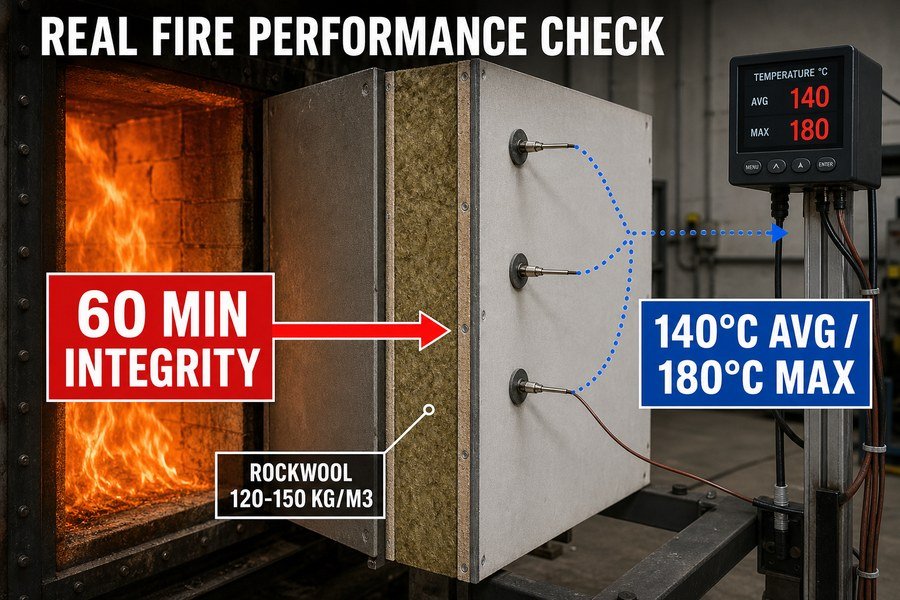
Real-world fire performance of marine interior panels is evaluated by looking at specific test data like temperature rise limits (average 140°C, max 180°C), core density (typically 120 to 150 kg/m³ for rockwool), structural integrity after 60 minutes, and toxic gas emission levels during actual fire exposure.
Let's dig into the details to stop buying panels that look good on paper but fail when it matters most.
What Metrics Beyond Certificates Reveal a Marine Interior Panel's True Fire Resistance?
Do you just check the A-60 label and move on? Many buyers do this, but they miss hidden flaws that cause sudden panel failures during real emergencies.
Beyond basic certificates, true fire resistance is revealed by three metrics: the actual time it takes unexposed faces to reach 140°C, the core material density (strictly 120 to 150 kg/m³ for rockwool), and the panel's deflection rate under heat stress.
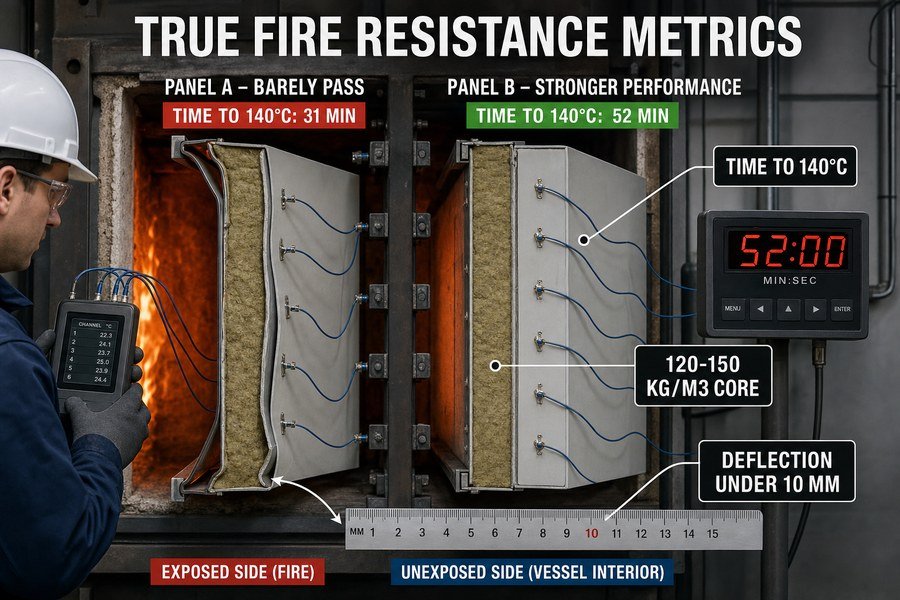
I often see buyers buy panels just because they have a certificate. But a certificate only means the panel passed a single test once. To know the true quality, you must look at the specific test metrics. I will break down the three metrics you must check.
Tracking Unexposed Face Temperature Rise
The first metric is the unexposed face temperature. During a fire test, the fire hits one side of the panel. The IMO FTP Code Part 3 states that the average temperature on the side without fire must not rise more than 140°C above the starting temperature. If a panel reaches this limit in 61 minutes, it barely passes an A-60 test. If another panel takes 75 minutes to reach the same limit, it has much better true fire resistance. Always ask the factory for the exact time it took to reach 140°C.
Verifying Panel Core Material Density
The second metric is the density of the rockwool core. For A-Class marine wall panels, the standard density required is 120 kg/m³ to 150 kg/m³1. Some factories try to save money by using 100 kg/m³ rockwool. A lower density means there is less material to block the heat. If the density drops, the fire resistance drops with it. Always check the factory records to confirm the exact density they use for your order.
Monitoring Panel Deflection Rates Under Heat
The third metric is the deflection rate. Deflection means how much the panel bends when it gets very hot. Even if the rockwool stops the heat, the steel skin can warp. If it warps too much, the joints between the panels will break open. Once the joints open, smoke and fire can pass right through.2 A high-quality panel uses internal steel strips to keep the deflection under 10mm during a 60-minute test.
| Metric for Fire Resistance | Poor Quality Panel Value | High Quality Panel Value | Authoritative Source |
|---|---|---|---|
| Time to reach 140°C rise | 61 minutes | 75+ minutes | IMO FTP Code Part 3 |
| Rockwool Core Density | 100 kg/m³ (Fails often) | 120 - 150 kg/m³ | Standard Shipyard Specs |
| Heat Deflection (Bending) | > 15 mm | < 10 mm | Laboratory Test Reports |
Which Datasheets Confirm a Marine Wall Panel's Actual Fire Limits?
Are you tired of vague sales brochures? Relying on marketing fluff can lead to ordering panels that fail shipyard inspections and delay your whole interior project.
To confirm a marine wall panel's actual fire limits, you must review three specific datasheets: the full IMO FTP Code Part 3 test report, the manufacturer's technical data sheet (TDS) detailing core specifications, and the mill test certificate (MTC) for the raw steel surface.
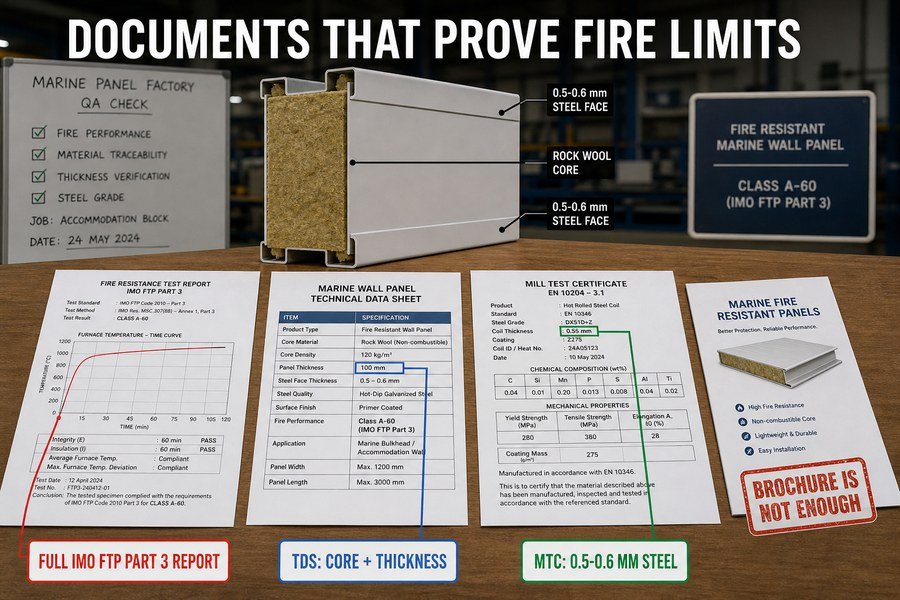
When I worked at the factory, I learned that sales brochures only show the best features. To really know a panel's fire limits, you need hard data. There are three exact documents you must request from your supplier before you buy anything.
Analyzing the Full IMO FTP Code Part 3 Test Report
The most important document is the full IMO FTP Code Part 3 test report. Do not just accept the single-page certificate. The full report is usually 15 to 20 pages long. It shows minute-by-minute data of the fire test3. It tells you exactly when the panel started to fail. By reading this full report, you can see if the panel survived an A-60 test easily or if it almost failed. It also lists the exact type of glue and steel used during the test.
Reviewing the Technical Data Sheet (TDS) for Core Specs
Next, you need the Technical Data Sheet (TDS). This sheet gives the exact physical details of the panel being produced for you. It must list the rockwool density, the total panel thickness (like 50mm or 25mm), and the fire class rating. You must compare the TDS to the IMO test report. The materials listed on the TDS must match the materials listed in the test report exactly4. If they do not match, the factory might be using cheaper materials for your order.
Using the Mill Test Certificate (MTC) for Steel Surfaces
Finally, you must get the Mill Test Certificate (MTC). This document comes from the steel factory, not the panel factory. It proves the quality and thickness of the steel skin. For marine wall panels, SOLAS regulations and shipyard standards usually require a minimum steel thickness of 0.5mm or 0.6mm. The MTC will show you the exact chemical makeup and thickness of the steel roll before it was glued to the rockwool.
| Required Datasheet | What It Proves | Red Flags to Avoid |
|---|---|---|
| Full IMO Test Report | Real test behavior and limits | Only giving a 1-page certificate |
| Technical Data Sheet (TDS) | Daily production materials | Values do not match the IMO report |
| Mill Test Certificate (MTC) | Raw steel thickness (0.6mm) | MTC is missing or shows 0.3mm steel |
What Warning Signs Indicate a Marine Ceiling Panel Will Fail Prematurely?
Have your ceiling panels ever sagged after just a few months? Ignoring early warning signs leads to expensive rework and ruined reputations with major shipyards.
Four main warning signs indicate premature failure of a marine ceiling panel: inconsistent panel weight suggesting uneven core density, visible gaps in joint profiles larger than 1mm, brittle surface paint that flakes easily, and an overall thickness deviation of more than 0.5mm.
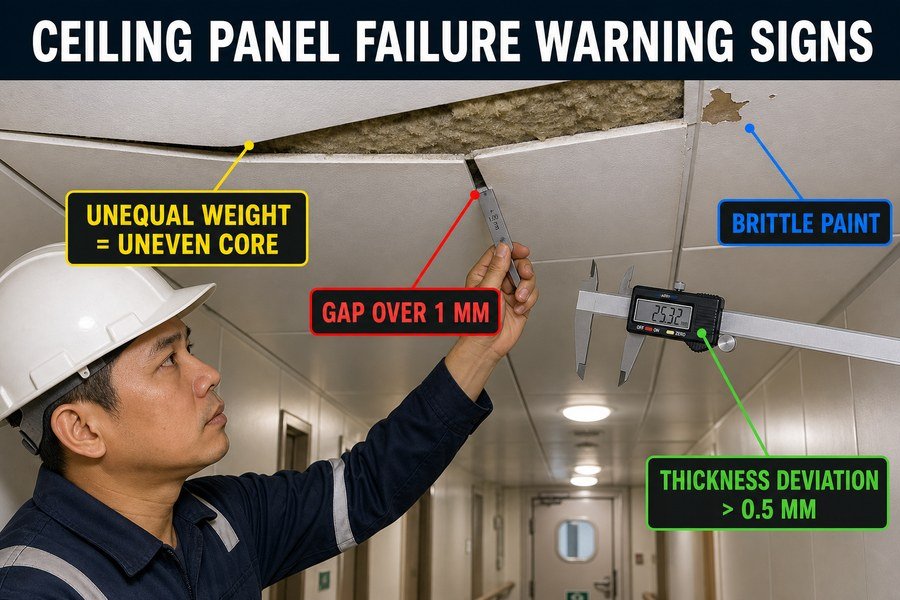
Ceiling panels have a tough job. They hang above the crew and face constant ship vibrations. A failure here is dangerous and costly to fix. In my experience, bad panels show signs of trouble long before they actually break. You need to look for these four specific warning signs when you inspect your goods.
Spotting Inconsistent Panel Weight and Uneven Core Density
The first warning sign is inconsistent weight. If you weigh five different ceiling panels from the same batch and the weights are very different, you have a big problem. This means the rockwool core density is uneven.5 One panel might have 120 kg/m³ rockwool, while another has only 90 kg/m³. A panel that is too light will not stop a fire. A panel that is too heavy might pull out of its ceiling track when the ship shakes.6
Measuring Gaps in Panel Joint Profiles
The second sign is visible gaps in the joints. Ceiling panels usually lock together. If you push two panels together and see a gap larger than 1mm, the fire can jump right through that space.7 Shipyards will fail your installation if they see these gaps. These gaps usually happen because the metal bending machines at the factory are old and not accurate.
Identifying Brittle Paint and Thickness Deviations
The third sign is brittle surface paint. If you scratch the edge of the panel and the paint flakes off easily, the factory did not bake the paint correctly. In a fire, this cheap paint will burn fast and create toxic smoke.8 The fourth sign is thickness deviation. A standard panel is 25mm thick. If you measure it and it is 26mm on one side and 24mm on the other (more than 0.5mm deviation), the panels will not line up flat on the ceiling. This creates uneven surfaces where fire can easily penetrate.
| Warning Sign on Ceiling Panel | Method to Check | Unacceptable Limit |
|---|---|---|
| Inconsistent Weight | Weigh 5 random panels | > 5% weight difference |
| Gaps in Joint Profiles | Join two panels together | Gap > 1.0 mm |
| Brittle Surface Paint | Tape peel test or scratch test | Paint comes off easily |
| Thickness Deviation | Measure 4 corners with calipers | Difference > 0.5 mm |
How Is Compromised Fire Performance Spotted in Budget Marine Ceiling Panels?
Struggling to find cheap panels that still pass strict fire tests? Buying low-cost options often means hidden fire hazards that can cost you the whole project.
Compromised fire performance in budget ceiling panels is spotted by checking three cost-cutting areas: the use of low-grade adhesives that melt below 100°C, rockwool cores with density below 100 kg/m³, and steel skins thinner than the required 0.5mm minimum.
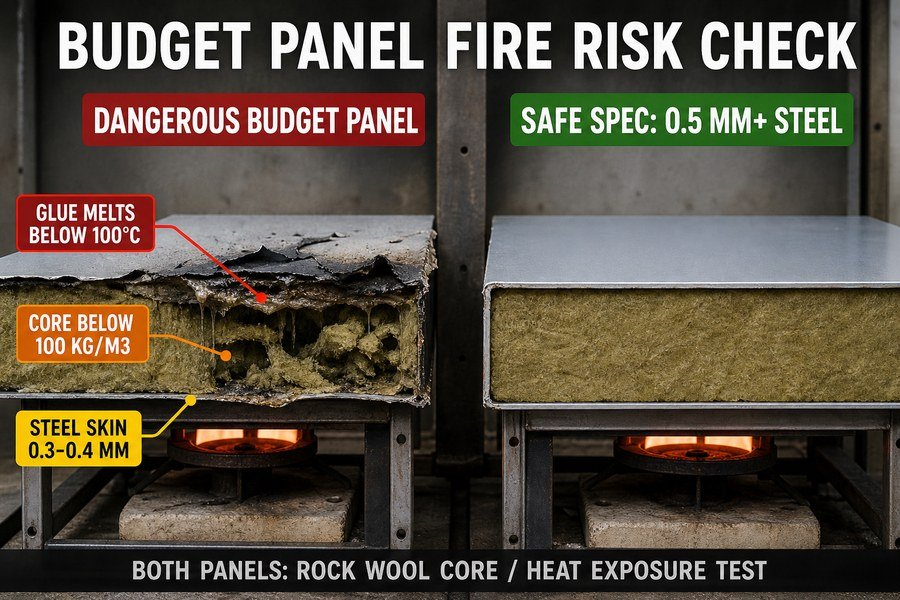
Everyone wants a good price. But when you buy budget marine ceiling panels, you must be very careful. Factories can lower the price, but they often do it by lowering the fire safety. I always tell my clients to check three specific areas to see if a cheap panel is actually a dangerous panel.
Testing Adhesives Used in Budget Marine Panels
The most common way factories save money is on glue. Marine panels need high-temperature, two-part polyurethane adhesives.9 This glue holds the steel to the rockwool even when things get hot. Budget panels often use cheap glue that melts when temperatures hit just 100°C.10 If a fire starts, this cheap glue melts quickly. The steel skin will fall right off the ceiling, exposing the bare rockwool and letting the fire spread. You must ask the factory for the temperature rating of their adhesive.
Checking Rockwool Density in Low-Cost Panels
The second area is the rockwool core. High-quality marine ceiling panels use a rockwool density of at least 100 kg/m³ to 120 kg/m³ to meet B-15 or A-30 fire classes11. Rockwool is expensive. Budget factories will secretly swap it for 80 kg/m³ rockwool. It looks exactly the same from the outside. But this low-density core has too much air inside and will not block the heat for the required time.
Measuring Steel Skin Thickness on Budget Ceilings
The third area is the steel skin thickness. To pass fire tests and shipyard rules, the steel skin must be at least 0.5mm thick12. Steel is priced by weight. Budget factories will use 0.4mm or even 0.3mm steel to cut costs. This thin steel warps very fast in a fire. I always bring a digital caliper to the factory to check the bare steel thickness before it gets painted.
| Cost-Cutting Area | Budget Panel Spec (Dangerous) | Safe Panel Spec (Required) | Impact on Fire Safety |
|---|---|---|---|
| Adhesive Glue | Melts < 100°C | Resists high temperatures | Steel skin falls off in a fire |
| Rockwool Density | 80 kg/m³ | 100 to 120 kg/m³ | Heat passes through too fast |
| Steel Skin Thickness | 0.3mm or 0.4mm | 0.5mm or 0.6mm minimum | Panel warps and joints break open |
Which Structural Weaknesses Increase Fire-Maintenance Risks for Marine Wall Panels?
Do your maintenance costs keep going up because of wall panel damage? Weak structural designs make panels fail faster, creating constant headaches for ship owners.
Three structural weaknesses increase fire-maintenance risks for marine wall panels: weak tongue-and-groove joint connections, inadequate internal steel reinforcement strips, and poor bonding between the rockwool core and the metal skin, which leads to delamination under normal ship vibrations.
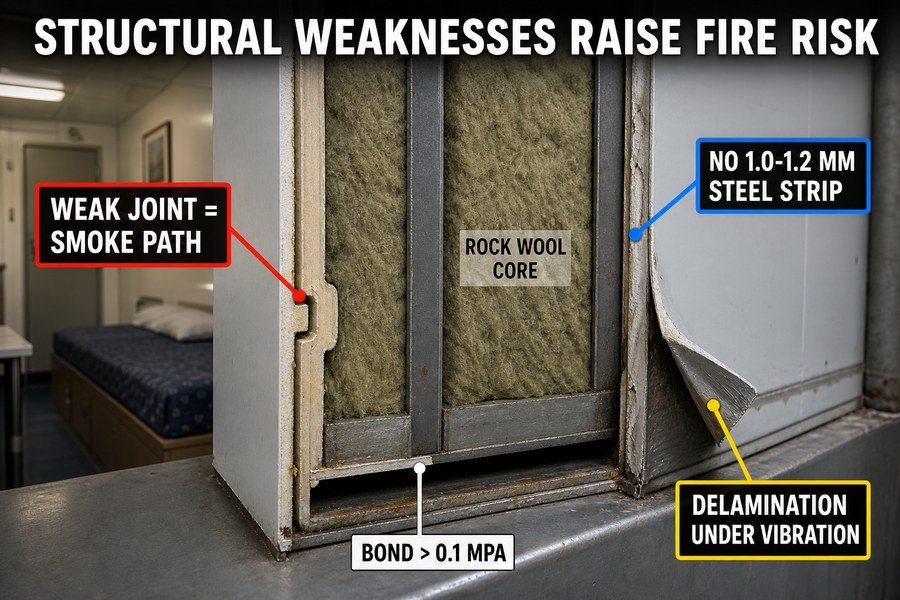
Fire safety is not just about the test day. It is about how the panel survives years of shaking on a ship. If a panel gets weak over time, it will not protect the crew when a real fire happens. I have seen panels fall apart just from normal use. Here are the three structural weaknesses you must avoid.
Evaluating Tongue-and-Groove Joint Connections
Marine wall panels connect using a tongue-and-groove system. This joint must be very tight. If the joint is made with thin metal, it becomes weak. Every time the ship rolls on the waves, the walls move slightly.13 A weak joint will get loose over time. Once the joint is loose, normal maintenance becomes a nightmare. Worse, in a fire, a loose joint is an open door for smoke and flames14. The joints should fit tightly and require force to pull apart.
Inspecting Internal Steel Reinforcement Strips
Good A-Class marine wall panels have steel reinforcement strips built inside the edges15. These strips are usually 1.0mm to 1.2mm thick. They give the panel rigidity and help hold the shape during a fire. Some factories leave these strips out to save labor and material costs. Without these strips, the panel is weak. If a crew member bumps the wall with a heavy cart, a panel without strips will bend easily. A bent panel loses its structural integrity and fire rating.
Checking Bonding Strength to Prevent Delamination
The third weakness is poor bonding. Delamination means the steel skin peels away from the rockwool core. This happens when the factory does not use enough glue or does not press the panel long enough. Normal ship vibrations will shake a poorly glued panel until the skin pops off. The standard shear strength for this bond should be > 0.1 MPa.16 If delamination happens, the panel has zero fire resistance and must be replaced immediately, increasing your costs.
| Structural Weakness | Result During Normal Ship Use | Result During a Ship Fire |
|---|---|---|
| Weak Joint Connections | Joints rattle and come loose | Smoke and fire pass through gaps |
| No Steel Edge Strips | Panel bends easily when bumped | Panel loses shape and collapses |
| Poor Glue Bonding | Steel skin peels off (Delamination) | Bare rockwool burns and falls apart |
How Is Fire Safety Quality Compared Between Competing Marine Interior Panel Brands?
Overwhelmed by too many panel suppliers in Asia? Picking the wrong brand can leave you with delayed shipments and failed shipyard safety inspections.
To compare fire safety quality between competing marine panel brands, evaluate four factors: their historical failure rates in IMO tests, the consistency of raw material sources, the presence of in-house fire testing facilities, and their ability to provide custom thickness tolerances.
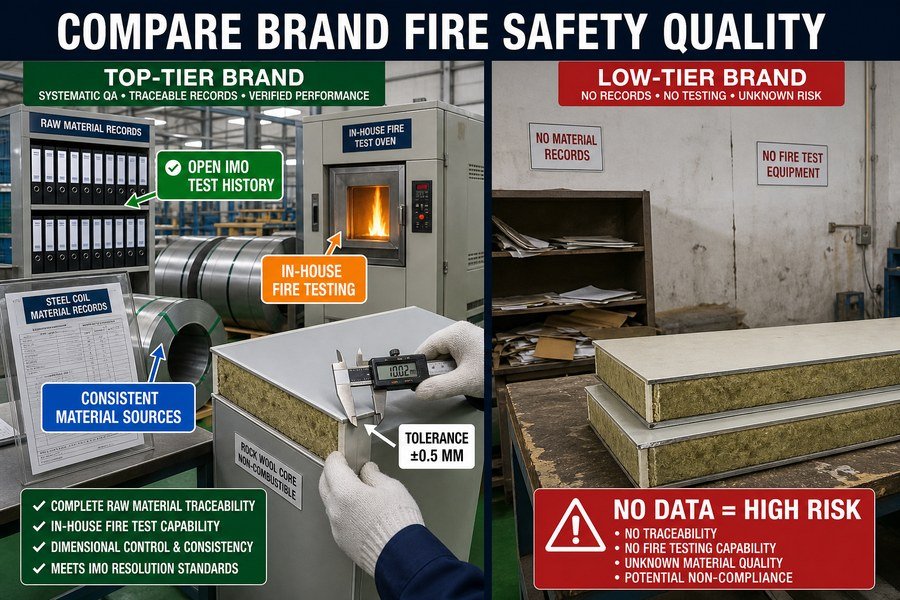
When you search for suppliers in China or Vietnam, almost all of them claim to have the best quality. It is hard to know who is telling the truth. I use a strict system to compare brands for my clients. You need to look deeply at their operations by checking these four specific factors.
Reviewing Historical IMO Test Failure Rates and Material Sources
First, ask the factory about their historical failure rate in IMO tests. No factory passes every test on the first try. If they say they never fail, they are lying. A good factory will explain past failures and show how they improved the product. Second, check their raw material sources. The best brands buy steel from huge, reliable mills like Baosteel. Cheaper brands buy steel from unknown local mills. The steel from unknown mills is often uneven, making the final panel weak. Always ask to see the purchase records for their raw materials.
Verifying In-House Fire Testing Facilities and Custom Tolerances
Third, look for in-house testing facilities. High-quality brands have their own small fire test ovens. They test their panels every month to make sure the quality stays high. Brands that do not have their own ovens only test their products once every five years when they renew their certificates17. Finally, check their thickness tolerances. A top brand can promise a thickness tolerance of ±0.5mm. They can do this because their machines are new and precise. A poor brand will only promise ±1.0mm or worse. Strict tolerances mean the panels will fit together perfectly, keeping the fire out.18
| Comparison Factor | Top Tier Panel Brand | Low Tier Panel Brand |
|---|---|---|
| IMO Test History | Open about past tests | Claims to have never failed |
| Raw Material Source | Big name mills (e.g., Baosteel) | Unknown local markets |
| In-House Testing | Has own QC fire oven | No testing equipment at all |
| Thickness Tolerance | ± 0.5 mm (Very exact) | ± 1.0 mm (Often uneven) |
Conclusion
Evaluating true fire performance means looking past basic certificates. Check core densities, measure skin thicknesses, and demand full test reports to ensure your marine interior panels keep ships completely safe.
-
"How to choose the right marine wall panels for marine interior ...", https://magellanmarinetech.com/how-choose-right-marine-wall-panels-for-marine-interior-projects/. Technical standards and shipbuilding specifications commonly identify mineral-wool density as a design parameter for marine fire-rated panels, and examples of A-class panel specifications often fall in the 120–150 kg/m³ range; this is contextual support and does not prove that the FTP Code itself mandates that density range. Evidence role: general_support; source type: institution. Supports: For A-Class marine wall panels, the article presents 120–150 kg/m³ rockwool core density as the standard required range.. Scope note: The IMO FTP Code is performance-based, so a neutral source may support this as a common specification range rather than a universal regulatory requirement. ↩
-
"What Is the Purpose and Scope of the IMO FTP Code?", https://magellanmarinetech.com/what-purpose-scope-of-imo-ftp-code/. Fire-resistance test criteria for divisions treat integrity failure as the formation of openings, sustained flaming, or passage of flames/hot gases through the construction, supporting the mechanism by which opened joints compromise smoke and fire separation; this evidence addresses the general failure mode rather than a specific panel design. Evidence role: mechanism; source type: institution. Supports: If heat deflection opens panel joints, smoke and fire can pass through the wall assembly.. Scope note: The source would support the integrity-failure mechanism, not quantify the joint-opening size or deflection limit for this product. ↩
-
"What Is the Purpose and Scope of the IMO FTP Code?", https://magellanmarinetech.com/what-purpose-scope-of-imo-ftp-code/. The IMO FTP fire-resistance procedure uses a prescribed time-temperature exposure and records performance criteria such as insulation temperature rise and integrity during the test, which explains why time-based test data are material to judging panel performance. Evidence role: mechanism; source type: institution. Supports: The full fire test report contains time-based data that show when and how the panel approached or reached failure criteria.. Scope note: A source may describe required observations and temperature recording intervals without using the phrase “minute-by-minute.” ↩
-
"How Are Fire Ratings Verified for Marine Wall and Ceiling Panels?", https://magellanmarinetech.com/how-fire-ratings-verified-for-marine-wall-ceiling-panels/. Fire-resistance classifications and marine type approvals are tied to the tested construction, including materials, dimensions, and assembly details, so changes in core, facing, adhesive, or thickness may fall outside the evidence provided by the original test. Evidence role: expert_consensus; source type: institution. Supports: The materials in the Technical Data Sheet should match the materials described in the IMO test report for the test evidence to apply to the supplied panel.. Scope note: The source may state the principle generally for tested assemblies or type approval rather than naming this specific panel supplier or product. ↩
-
"[PDF] Experiment 1: Mass, Volume, and Density (Two Lab Periods)", https://science.valenciacollege.edu/chemistry/experiments/1045-exp1-massvolumedensity.pdf. A materials or engineering source should establish that, for panels of the same dimensions and facings, mass variation can indicate variation in core density because density is mass per unit volume. Evidence role: mechanism; source type: education. Supports: Different weights among ceiling panels from the same batch can indicate uneven rockwool core density.. Scope note: This would not prove that density variation is the only possible cause of weight differences; adhesive, facings, moisture, or dimensional variation could also affect weight. ↩
-
"Vibration Mechanics", https://cse.sc.edu/~adowney2/publications/textbooks/Vibration-Mechanics/Vibration_Mechanics.pdf. An engineering dynamics source should support that vibration produces inertial forces proportional to mass and acceleration, providing a mechanical basis for heavier suspended panels imposing greater loads on ceiling tracks. Evidence role: mechanism; source type: education. Supports: A heavier ceiling panel can impose greater dynamic loads on its support track during ship vibration.. Scope note: This is contextual support; whether a specific panel will pull out depends on the certified ceiling system, fastener design, vibration spectrum, and installation quality. ↩
-
"What Is the Purpose and Scope of the IMO FTP Code?", https://magellanmarinetech.com/what-purpose-scope-of-imo-ftp-code/. IMO or SOLAS fire-test documentation should support that fire-resisting divisions are assessed for integrity against flame and hot-gas passage, which explains why gaps in joints can compromise fire separation. Evidence role: expert_consensus; source type: institution. Supports: Visible gaps in ceiling panel joints can undermine the fire integrity of a marine ceiling assembly.. Scope note: Such sources may support the general fire-integrity principle without validating the article’s specific 1 mm failure threshold. ↩
-
"Combustion Products and Their Effects on Life Safety", https://tsapps.nist.gov/publication/get_pdf.cfm?pub_id=900093. Fire-safety research should support that burning organic coatings and polymeric materials can generate smoke containing toxic combustion products such as carbon monoxide and other irritant or asphyxiant gases. Evidence role: general_support; source type: research. Supports: Combustion of unsuitable surface paint on ceiling panels can contribute to toxic smoke during a fire.. Scope note: This would support the general toxic-smoke concern, not prove that the specific paint used on these panels burns faster or is unusually toxic. ↩
-
"Which Adhesives Bond Marine Accommodation Panels? - Magellan ...", https://magellanmarinetech.com/which-adhesives-bond-marine-accommodation-panels/. Research on insulated sandwich panels and bonded assemblies shows that adhesive thermal stability and bond retention at elevated temperature are important factors in maintaining panel integrity during fire exposure. Evidence role: mechanism; source type: paper. Supports: Marine panels need high-temperature, two-part polyurethane adhesives to maintain the bond between steel skins and the mineral-wool core under heat.. Scope note: This supports the importance of high-temperature adhesives generally, but it may not prove that all marine ceiling panels specifically require a two-part polyurethane formulation. ↩
-
"Improving Glass Transition Temperature and Toughness of Epoxy ...", https://pmc.ncbi.nlm.nih.gov/articles/PMC9864282/. Studies of polymer adhesives document that some adhesive systems lose stiffness, soften, or suffer major reductions in bond strength at elevated temperatures near or above their glass-transition or softening ranges. Evidence role: mechanism; source type: paper. Supports: Some lower-grade adhesive systems can soften or lose bond strength at temperatures around 100°C, creating a fire-performance risk.. Scope note: Such evidence would support the plausibility of heat-related adhesive failure, but it would not establish that budget marine panels generally use adhesives that melt exactly at 100°C. ↩
-
"What Is the Purpose and Scope of the IMO FTP Code?", https://magellanmarinetech.com/what-purpose-scope-of-imo-ftp-code/. The IMO Fire Test Procedures Code defines A- and B-class divisions by standardized fire-test performance criteria, including insulation time requirements such as 30 minutes for A-30 and 15 minutes for B-15 divisions. Evidence role: definition; source type: institution. Supports: B-15 and A-30 are formal marine fire-class ratings based on standardized fire-test performance times.. Scope note: The IMO criteria define required fire performance, but they do not by themselves prescribe a universal rockwool density for every approved ceiling-panel design. ↩
-
"How to choose the right marine wall panels for marine interior ...", https://magellanmarinetech.com/how-choose-right-marine-wall-panels-for-marine-interior-projects/. Marine type-approval certificates and fire-test documentation for accommodation ceiling or sandwich panels commonly specify the tested steel facing thickness, allowing comparison between approved constructions and thinner untested variants. Evidence role: case_reference; source type: institution. Supports: Approved marine ceiling-panel systems often specify steel skins around 0.5 mm or thicker as part of their tested fire-rated construction.. Scope note: This would support the claim only for the tested panel systems cited; minimum steel thickness can vary by certified design and is not necessarily a universal rule across all marine ceiling panels. ↩
-
"(PDF) Ship Vibrations: Lecture Notes", https://www.academia.edu/47649651/Ship_Vibrations_Lecture_Notes. Ship-vibration guidance describes marine structures and outfitting as being exposed to repeated excitation from waves, machinery, and propulsion, supporting the contextual claim that panel joints experience cyclic movement in service. Evidence role: mechanism; source type: institution. Supports: Ship motion and vibration can cause repeated movement in marine wall panels and their joints.. Scope note: This supports the general operating mechanism, not the specific failure rate of tongue-and-groove wall-panel joints. ↩
-
"What Is the Purpose and Scope of the IMO FTP Code?", https://magellanmarinetech.com/what-purpose-scope-of-imo-ftp-code/. SOLAS/IMO fire-safety rules define A-class divisions as steel or equivalent divisions capable of preventing the passage of smoke and flame for the duration of the standard fire test, supporting the importance of intact joints for fire containment. Evidence role: expert_consensus; source type: institution. Supports: A loose or gapped joint in an A-class wall panel can compromise the intended barrier against smoke and flames.. Scope note: The source establishes the fire-integrity requirement for A-class divisions; it does not directly test the article’s specific loose-joint scenario. ↩
-
"[PDF] Miami-Dade County Product Control Section", http://www.miamidade.gov/building/library/productcontrol/noa/14022005.pdf. A classification-society approval, technical standard, or certified construction drawing documenting steel edge reinforcement in A-class bulkhead or wall-panel assemblies would support the statement that such reinforcement is an established feature in some approved marine panel designs. Evidence role: case_reference; source type: institution. Supports: A-class marine wall panels may include steel reinforcement strips inside the panel edges to improve rigidity and maintain assembly integrity.. Scope note: Such evidence would show accepted practice in documented designs, but would not prove that all good A-class panels must use this exact construction or the same strip thickness. ↩
-
"How to choose the right marine wall panels for marine interior ...", https://magellanmarinetech.com/how-choose-right-marine-wall-panels-for-marine-interior-projects/. A recognized sandwich-panel test standard, class requirement, or certified product test report specifying a minimum facing-to-core bond or shear strength above 0.1 MPa would substantiate the numerical threshold used for the steel-skin-to-rockwool bond. Evidence role: statistic; source type: institution. Supports: The bond between the steel skin and rockwool core should meet a shear-strength threshold greater than 0.1 MPa.. Scope note: The threshold may be standard-, product-, or approval-specific, so the citation should clarify whether it is a universal marine requirement or a value from a particular testing regime. ↩
-
"Marine Equipment on Board Vessels and Offshore Units or Facilities", https://www.federalregister.gov/documents/2024/09/18/2024-20380/marine-equipment-on-board-vessels-and-offshore-units-or-facilities. Marine-equipment conformity rules commonly limit type-examination certificates to a maximum validity period of five years, supporting the reference to periodic certificate renewal for IMO-related products. Evidence role: general_support; source type: government. Supports: Brands that do not have their own ovens only test their products once every five years when they renew their certificates.. Scope note: This supports the five-year renewal context, but it does not directly prove that factories without in-house ovens test only at renewal time. ↩
-
"[PDF] Quantifying fire behaviour in gaps in CLT panel-to-panel connections", https://research.fs.usda.gov/download/treesearch/69601.pdf. Fire-resistance testing and installation guidance for building and marine assemblies recognize that joints, gaps, and installation tolerances can affect fire and smoke resistance, providing technical context for why dimensional tolerances matter in panel systems. Evidence role: mechanism; source type: institution. Supports: Strict tolerances help panels fit together properly and maintain fire resistance.. Scope note: This supports the mechanism linking fit, gaps, and fire performance generally; it does not independently verify the specific ±0.5 mm tolerance threshold stated in the article. ↩