Choosing the wrong panels can lead to project delays and failed inspections. Understanding smoke test results solves this problem and keeps your ship interior project on track and budget.
Smoke tests influence marine panel selection by dictating material compliance under SOLAS and IMO FTP Code Part 2. Panels must pass strict limits on smoke density (Ds) and specific toxic gas concentrations, forcing buyers to balance these safety metrics with cost, weight, and aesthetic requirements for ship interiors.
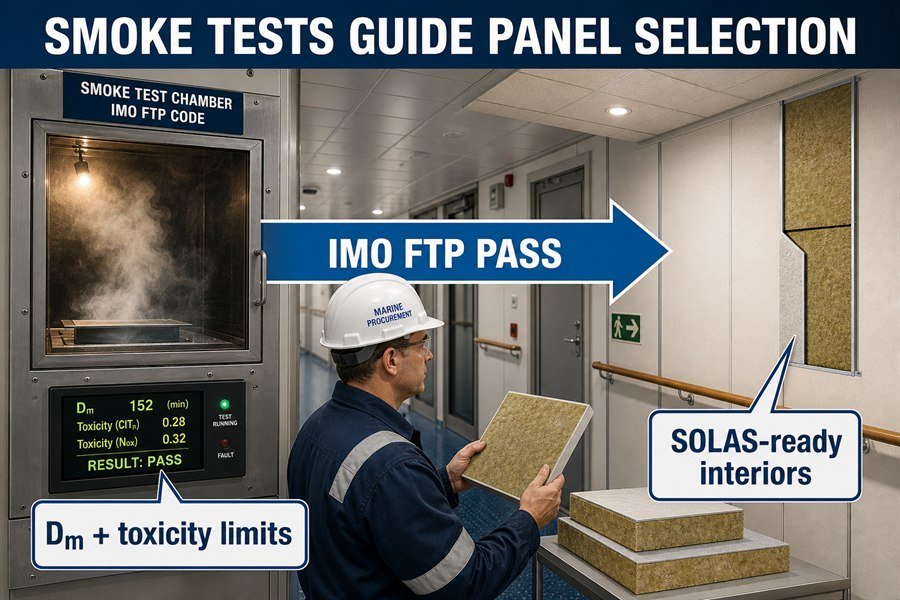
Let me break down exactly how these smoke tests work and what you need to look for when choosing your panels, so you can buy with confidence and avoid costly mistakes.
How Should Smoke Toxicity Be Read When Specifying Marine Accommodation Panels?
Staring at a test report full of chemical acronyms is frustrating. If you misread the toxicity data, your panels will fail certification. Here is how you read them correctly.
When specifying marine accommodation panels, read smoke toxicity by checking the IMO FTP Code Part 2 limits for seven specific gases: Carbon Monoxide (CO), Hydrochloric Acid (HCl), Hydrogen Fluoride (HF), Nitrogen Oxides (NOx), Hydrobromic Acid (HBr), Hydrogen Cyanide (HCN), and Sulfur Dioxide (SO2). All seven must stay below mandatory thresholds.
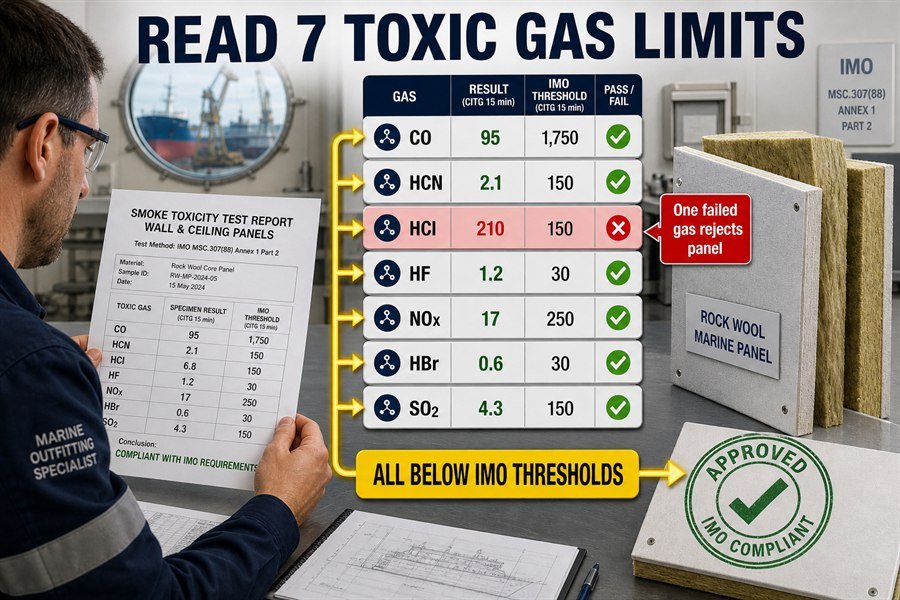
I remember my first time reading a marine wall panel test report. I felt very confused. However, as a marine outfitting specialist, I learned a simple rule. You only need to look at seven specific gases. The International Maritime Organization (IMO) Fire Test Procedures (FTP) Code, Annex 1, Part 2 requires these gases. You must compare the factory numbers against the maximum allowed limits. If you miss even one gas limit, the shipyard will reject your products.
Reading Limits for the Primary Asphyxiant Gases: CO and HCN
Let us look at the primary asphyxiant gases first. Carbon Monoxide (CO) is the most common danger in a fire. According to the IMO FTP Code, the maximum allowed concentration for CO is 1450 ppm (parts per million). Hydrogen Cyanide (HCN) is highly deadly. It has a strict limit of 140 ppm1. When you buy marine ceiling panels or marine wall panels, you must ensure the test data shows values lower than these exact numbers. If a supplier from China or Vietnam shows a CO level of 1500 ppm, you must reject that panel immediately. It does not matter how low their price is.
Understanding Thresholds for Irritant Gases: HCl, HF, NOx, HBr, and SO2
Next, we have the irritant gases. These gases cause severe eye and lung damage. The IMO sets very strict limits for these five gases. Hydrochloric Acid (HCl) is limited to 600 ppm. Hydrogen Fluoride (HF) is limited to 600 ppm. Nitrogen Oxides (NOx) are limited to 350 ppm. Hydrobromic Acid (HBr) is limited to 600 ppm. Sulfur Dioxide (SO2) is limited to 120 ppm2. Often, factories in developing countries use cheaper glues or surface PVC films3. These cheap materials produce high levels of HCl or SO2 during a fire. You want to save money, but you cannot compromise on these IMO limits. You will lose the whole interior decoration project in Europe or the United States if you fail these checks.
| Gas Name | Chemical Formula | IMO FTP Code Part 2 Maximum Limit |
|---|---|---|
| Carbon Monoxide | CO | 1450 ppm |
| Hydrogen Cyanide | HCN | 140 ppm |
| Hydrochloric Acid | HCl | 600 ppm |
| Hydrogen Fluoride | HF | 600 ppm |
| Nitrogen Oxides | NOx | 350 ppm |
| Hydrobromic Acid | HBr | 600 ppm |
| Sulfur Dioxide | SO2 | 120 ppm |
Which Smoke Parameters Matter Most for Marine Accommodation Panels?
Overwhelmed by too much technical data? Focusing on the wrong parameters wastes your time and risks safety. You only need to track two core smoke parameters for marine panels.
The two smoke parameters that matter most for marine accommodation panels are Smoke Density (maximum specific optical density, Dm) and Smoke Toxicity (concentration of hazardous gases). Under IMO FTP Code Part 2, Dm must not exceed 200, and toxicity must remain below the strict ppm limits for seven specific gases.
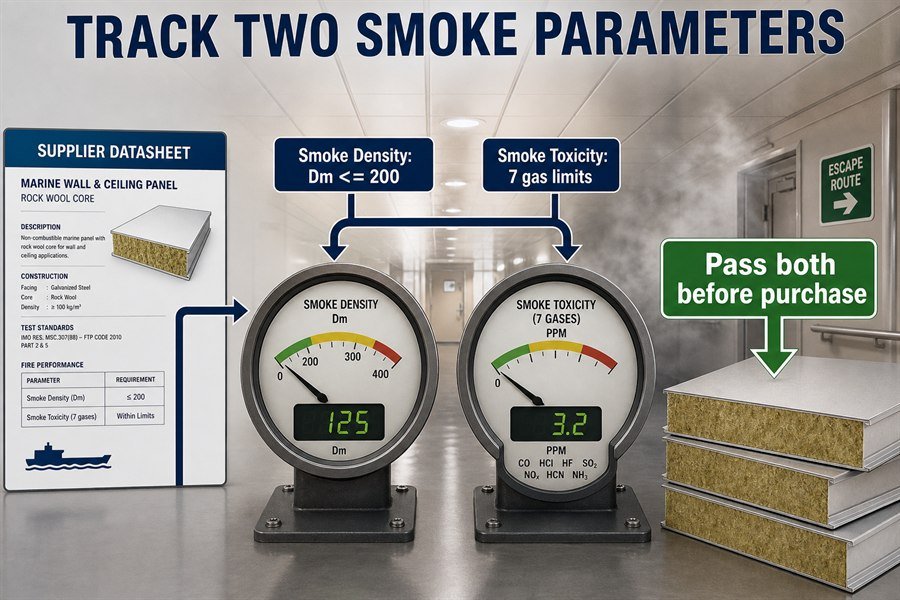
When you buy marine interior outfitting products, the supplier datasheets have many numbers. But for smoke performance, you only need to look at two parameters. These are Smoke Density and Smoke Toxicity. I always tell my clients to check these two first. If these two fail, the other details do not matter.
Analyzing Smoke Density (Dm) in Marine Wall Panels
The first key parameter is Smoke Density. The test report calls this maximum specific optical density (Dm). This measures how thick the smoke is.
Thick smoke blocks light. It makes it hard for people to find the exit door during a ship fire.4 The IMO FTP Code Part 2 clearly states that the Dm value for surface materials on bulkheads and ceilings must not exceed 200. If you buy PVC-covered marine wall panels, you must check the Dm value carefully. Some cheap PVC films produce a Dm of 250 or 300. This will fail the test. Good quality panels usually have a Dm between 100 and 150. You can easily find compliant B-15 wall panels from reliable Asian suppliers for around $16 to $22 per square meter.
Evaluating Smoke Toxicity in Marine Ceiling Panels
The second parameter is Smoke Toxicity. We already talked about the seven gases. Toxicity measures how poisonous the smoke is. This is crucial because
toxic smoke hurts people faster than the actual fire heat5. You must check the lab report to see the parts per million (ppm) for each of the seven gases. If a supplier cannot provide a clear test report from a recognized lab like DNV, ABS, or MED showing both Dm and Toxicity, do not buy from them. Finding a balance between a low price and passing these two parameters is the secret to a successful and profitable interior project.
| Key Smoke Parameter | Official Name in Test Report | Maximum Allowed Limit (IMO) | Why It Matters for Ship Interiors |
|---|---|---|---|
| Smoke Density | Maximum specific optical density (Dm) | 200 | Controls visibility so passengers can find escape routes. |
| Smoke Toxicity | Toxic gas concentration (ppm) | Limits vary by gas (e.g., CO < 1450 ppm) | Prevents poisoning from breathing burning panel materials. |
How Do Smoke Requirements Differ for Machinery-Space Marine Wall Panels?
Buying standard accommodation panels for a machinery space will cause instant failure. This mistake costs thousands of dollars. You must understand the different, stricter requirements for machinery spaces.
Smoke requirements for machinery-space marine wall panels differ by demanding non-combustible core materials (like mineral wool) and strictly regulating surface finishes to prevent rapid fire spread and heavy smoke. They must meet IMO FTP Code Part 1 for non-combustibility and Part 5 for surface flammability, prioritizing structural fire protection.
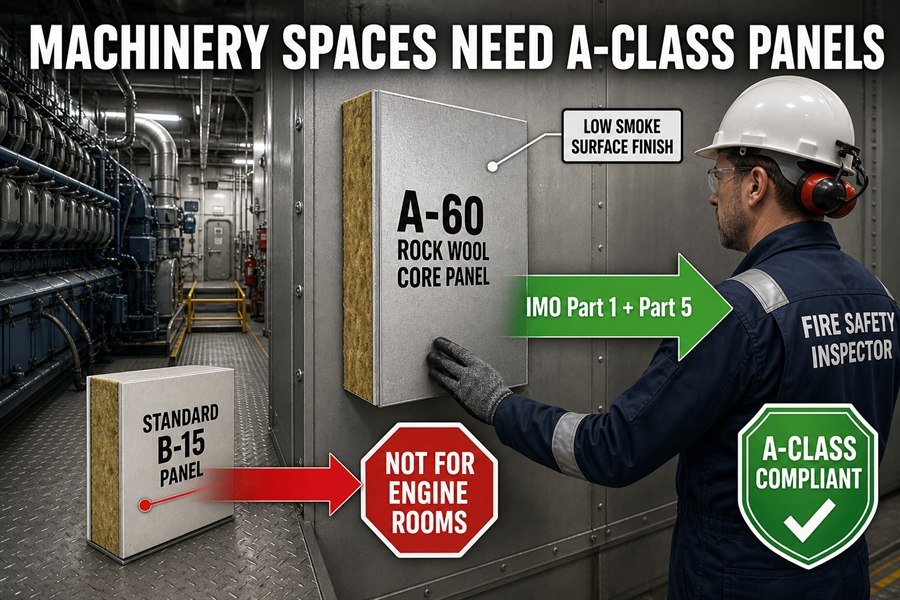
Machinery spaces on a ship, like the engine room, have a very high risk of fire. Therefore, the rules for marine wall panels here are very different from the passenger cabins. You cannot use the same interior panels. I have seen buyers try to save money by using standard B-15 panels in an engine room. The marine inspector stopped the whole project. You must buy the correct class of panels.
Meeting Non-Combustibility Standards for Machinery Space Panels
First, machinery space panels must meet the non-combustibility requirements of IMO FTP Code Part 1. This means the core material must not burn at all. We typically use high-density rock wool for this core. According to the regulations, the temperature rise in the testing furnace cannot exceed 30 degrees Celsius. Standard accommodation panels might use lighter cores. However, machinery spaces require heavy A-Class panels, like A-60 panels. These panels are thicker and heavier to stop massive engine fires. A standard A-60 machinery space panel usually costs between $45 and $65 per square meter. The price depends on the steel thickness and the rock wool density.
Second, the surface flammability rules under IMO FTP Code Part 5 are very strict in machinery spaces. Because the core is non-combustible rock wool, the only thing that can create smoke is the surface finish. For machinery spaces, we often use galvanized steel or stainless steel with no PVC film at all. This guarantees zero smoke from the surface. If the shipyard requires paint,
its calorific value must not exceed 45 MJ/m²6. By choosing bare metal or low-flame paint, you eliminate the risk of failing the smoke density and toxicity tests completely. This makes your purchasing job much safer and easier.
| Space Type | Required Core Standard | Typical Panel Type | Estimated Price Range (per sqm) |
|---|---|---|---|
| Passenger Cabin | Low flame spread | B-15 Panel | $16 - $22 |
| Machinery Space | IMO FTP Part 1 (Non-combustible) | A-60 Panel | $45 - $65 |
What Smoke Performance Is Required for Passenger Ship Marine Ceiling Panels?
Passenger ships pack thousands of people into tight spaces. If your ceiling panels create toxic smoke, a small fire becomes a disaster. Meeting passenger ship standards is non-negotiable.
Passenger ship marine ceiling panels require the highest level of smoke performance, mandating low flame spread, a maximum Smoke Density (Dm) of 200, and strict adherence to the seven toxicity limits under IMO FTP Code Part 2. Furthermore, they must maintain structural integrity to prevent smoke transfer between decks.
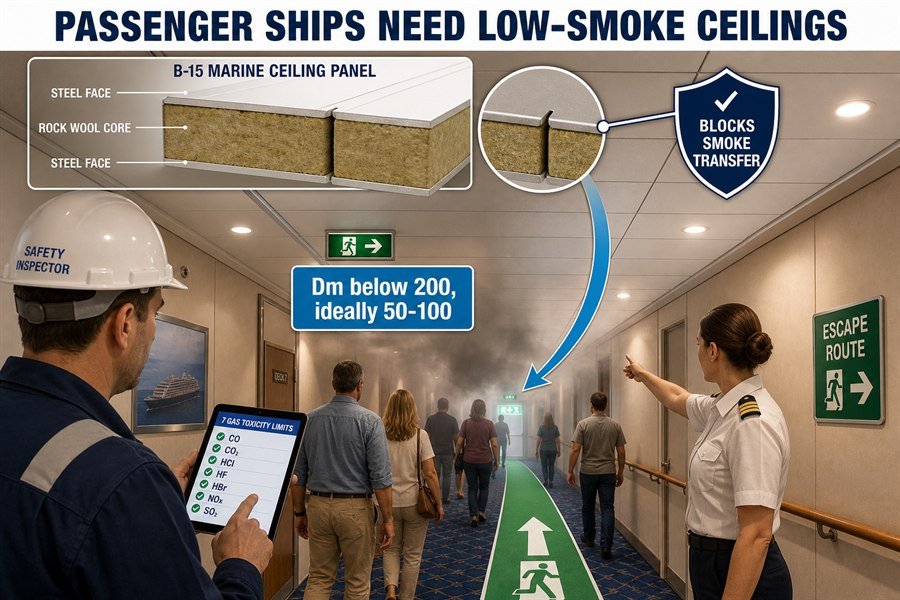
Passenger ships, like large cruise ships crossing from Europe to the United States, have the strictest safety rules in the world. When you buy marine ceiling panels for these ships, you face extreme scrutiny from inspectors. You must ensure the ceiling panels perform perfectly in two main areas.
Controlling Smoke Density and Toxicity in Passenger Areas
First, you must control smoke density and toxicity perfectly. As required by IMO FTP Code Part 2,
the maximum smoke density (Dm) for ceiling surfaces cannot exceed 2007. However, for large passenger ship projects, shipyards often prefer materials that test much lower. They like to see a Dm of 50 to 100. This low number gives them a large safety margin. The toxicity must also stay well below the limits for the seven gases. For example, keep
CO under 1450 ppm and HCN under 140 ppm8. When buying panels from Asia, always ask the factory to send you the exact Dm and toxicity numbers from their latest MED (Marine Equipment Directive) certificate.
Ensuring Structural Integrity to Block Smoke Transfer
Second, the marine ceiling panel must act as a physical barrier to smoke. This means the panel must not collapse during a fire. It must not let smoke pass through the joints.
A standard B-15 marine ceiling panel must block smoke and flames for at least 15 minutes. A B-0 panel must block them for 30 minutes9, even though it has no temperature insulation requirement. The joint profiles and the suspension system must fit perfectly. If the ceiling drops, the smoke from the fire will spread across the entire deck. This is fatal on a passenger ship. The cost for a high-quality B-15 ceiling panel that meets these strict passenger rules is usually around $25 to $35 per square meter.
| Feature | Performance Requirement | Purpose on Passenger Ship |
|---|---|---|
| Smoke Density (Dm) | Less than 200 (Ideally 50-100) | Keeps escape corridors clear for passengers. |
| Smoke Toxicity | Below IMO limits for 7 gases | Prevents mass poisoning in enclosed spaces. |
| Structural Integrity | 15 mins (B-15) or 30 mins (B-0) | Stops smoke from traveling to the deck above. |
How Can Smoke Toxicity Be Compared Across Marine Interior Panel Datasheets?
Comparing different suppliers is hard when their datasheets look completely different. Making the wrong choice means buying non-compliant materials. Here is a simple method to compare them accurately.
To compare smoke toxicity across marine interior panel datasheets, you must first verify all reports use the IMO FTP Code Part 2 testing standard. Then, align the test results side-by-side to compare the Smoke Density (Dm) and the specific ppm concentrations of the seven regulated toxic gases.
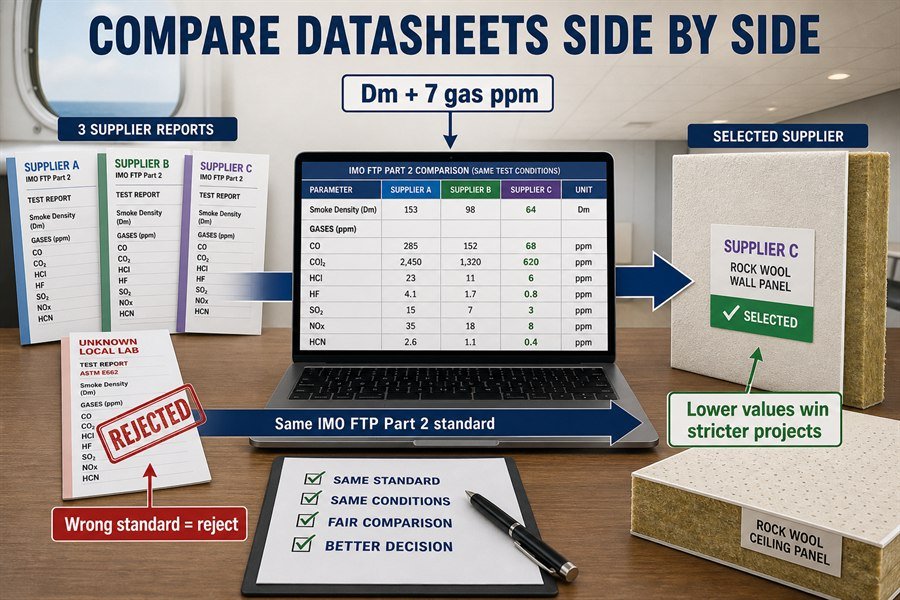
I know your pain. You have three quotes from three different factories. The prices are different, and the test reports look completely different. How do you choose the right marine wall panel or ceiling panel? You need a clear process to compare the smoke toxicity data. I use a very simple two-step method.
Verifying the Testing Standard and Certification Body
First, you must verify the testing standard. Always look for "IMO 2010 FTP Code, Annex 1, Part 2" on the datasheet. If a supplier gives you a report based on a local building standard, throw it away. It is useless for your shipyard client. Also, check who issued the report. A report from an internationally recognized society like Lloyd's Register (LR), Bureau Veritas (BV), or DNV is highly reliable. Make sure the certificates are valid and not expired. This step filters out the bad suppliers immediately.
Creating a Side-by-Side Comparison of Gas Concentrations
Second, create a side-by-side comparison table. Take the maximum specific optical density (Dm) and the ppm values for the
seven toxic gases10 from each supplier's report. Put them in a spreadsheet. This makes it very easy to see who has the best quality. For example, Supplier A offers a panel for $18 per square meter with a CO level of 1300 ppm. Supplier B offers a panel for $20 per square meter with a CO level of 800 ppm. Both pass the 1450 ppm limit. However, Supplier B offers much better safety. Depending on how strict your European or US shipyard client is, spending that extra $2 might win you the whole decoration project.
| Comparison Point | Supplier A (Cheaper Option) | Supplier B (Higher Quality Option) | Action to Take |
|---|---|---|---|
| Price per sqm | $18 | $20 | Note the $2 difference. |
| Carbon Monoxide (CO) | 1300 ppm | 800 ppm | Supplier B is safer (limit is 1450 ppm). |
| Smoke Density (Dm) | 190 | 110 | Supplier B provides much clearer visibility ( |
| limit is 20011). | |||
| Test Lab | Local unknown lab | DNV / ABS | Choose Supplier B to satisfy US/EU shipyards. |
Conclusion
Understanding smoke density and toxicity limits is essential. By comparing IMO FTP Code data carefully, you can choose high-quality, compliant marine panels that keep your interior decoration projects profitable and safe.
-
"Hydrogen cyanide and carboxyhemoglobin assessment in an ...", https://pmc.ncbi.nlm.nih.gov/articles/PMC8246848/. The IMO FTP Code Part 2 acceptance criteria specify maximum average gas concentrations of 1450 ppm for carbon monoxide and 140 ppm for hydrogen cyanide in the smoke toxicity test. Evidence role: definition; source type: institution. Supports: The IMO FTP Code Part 2 limit is 1450 ppm for CO and 140 ppm for HCN.. Scope note: This supports the regulatory limits; a separate toxicology source would be needed for a detailed medical characterization of HCN lethality. ↩
-
"https://response.epa.gov/sites/9720/files/HCl%20Su...", https://response.epa.gov/sites/9720/files/HCl%20Summary%20Table.pdf. The IMO FTP Code Part 2 smoke toxicity criteria list maximum average concentrations of 600 ppm for HCl, 600 ppm for HF, 350 ppm for NOx, 600 ppm for HBr, and 120 ppm for SO2. Evidence role: definition; source type: institution. Supports: The IMO FTP Code Part 2 limits HCl, HF, NOx, HBr, and SO2 to the stated ppm values.. ↩
-
"Analysis of toxic effluents released from PVC carpet under different fire ...", https://pmc.ncbi.nlm.nih.gov/articles/PMC7112043/. Fire-chemistry literature describes hydrogen chloride as a major toxic and corrosive decomposition product released when polyvinyl chloride burns or thermally decomposes. Evidence role: mechanism; source type: paper. Supports: PVC surface films can contribute to elevated HCl production during a fire.. Scope note: This supports the mechanism for PVC-related HCl formation; it does not prove that low-cost suppliers or all PVC-coated marine panels will exceed IMO limits, nor does it directly account for SO2 formation. ↩
-
"An Analysis of the Performance of Smoke Alarms", https://tsapps.nist.gov/publication/get_pdf.cfm?pub_id=906889. Fire-safety research on smoke optical density explains that smoke attenuates light transmission and reduces visibility, which can impair occupants’ ability to identify exits and navigate escape routes during fires. Evidence role: mechanism; source type: paper. Supports: Higher smoke density reduces visibility and can hinder evacuation during a ship fire.. Scope note: This evidence supports the visibility mechanism generally; ship-specific evacuation outcomes may also depend on layout, lighting, signage, and crew procedures. ↩
-
"Smoke inhalation injury during enclosed-space fires: an update", https://pmc.ncbi.nlm.nih.gov/articles/PMC4075838/. Fire fatality and toxicology literature identifies inhalation of toxic combustion products, particularly carbon monoxide and other fire gases, as a major cause of incapacitation and death in fires, often before direct thermal injury becomes the primary hazard. Evidence role: expert_consensus; source type: government. Supports: Toxic smoke can incapacitate or injure occupants before fire heat becomes the dominant threat.. Scope note: The statement is a general fire-safety principle; the relative timing of toxic exposure and heat injury varies with fire size, ventilation, distance from the fire, and material composition. ↩
-
"What Is the Purpose and Scope of the IMO FTP Code?", https://magellanmarinetech.com/what-purpose-scope-of-imo-ftp-code/. SOLAS Chapter II-2 provisions on combustible materials set a 45 MJ/m² calorific-value limit for combustible materials used on specified exposed interior surfaces, providing regulatory context for the stated threshold. Evidence role: definition; source type: institution. Supports: A 45 MJ/m² calorific-value limit is used in marine fire-safety rules for certain combustible interior surface materials.. Scope note: The applicability of the 45 MJ/m² limit depends on the ship area, surface type, and governing rule set; it does not by itself establish smoke-density or toxicity compliance. ↩
-
"What Is the Purpose and Scope of the IMO FTP Code?", https://magellanmarinetech.com/what-purpose-scope-of-imo-ftp-code/. The IMO 2010 FTP Code, Part 2, sets smoke-density criteria for surface materials used in ship accommodation and service spaces, including a maximum specific optical density threshold of Dm 200 for applicable surface products. Evidence role: definition; source type: institution. Supports: IMO FTP Code Part 2 limits the maximum smoke density for applicable ceiling surface materials to Dm 200.. Scope note: The code provision supports the regulatory threshold, but the exact applicability depends on the material category and installation location defined in the certificate or test report. ↩
-
"What Is the Purpose and Scope of the IMO FTP Code?", https://magellanmarinetech.com/what-purpose-scope-of-imo-ftp-code/. The IMO FTP Code smoke-and-toxicity test criteria list gas concentration limits for combustion products, including carbon monoxide and hydrogen cyanide thresholds commonly cited as CO 1450 ppm and HCN 140 ppm. Evidence role: definition; source type: institution. Supports: The IMO smoke-toxicity criteria include limits of CO 1450 ppm and HCN 140 ppm.. Scope note: This supports the stated gas-limit values, but the full compliance assessment also includes other regulated gases and test conditions. ↩
-
"What Is the Purpose and Scope of the IMO FTP Code?", https://magellanmarinetech.com/what-purpose-scope-of-imo-ftp-code/. SOLAS fire-test classifications define B-class divisions by their ability to prevent flame passage during the standard fire test, while B-15 and B-0 denote different insulation-performance ratings within that classification. Evidence role: definition; source type: institution. Supports: B-class marine ceiling systems are classified according to fire integrity and insulation performance, including B-15 and B-0 ratings.. Scope note: The source may contextualize rather than exactly repeat the article’s wording, because B-class integrity and insulation duration are distinct criteria in SOLAS/FTP terminology. ↩
-
"nitric acid, other than red fuming - CAMEO Chemicals", https://cameochemicals.noaa.gov/report?key=CH19337. The IMO FTP Code smoke and toxicity method specifies analysis of toxic gas components including CO, HCl, HF, NOx, HBr, HCN, and SO2, supporting the reference to seven measured toxic gases in test reports. Evidence role: definition; source type: institution. Supports: Supplier smoke toxicity reports should provide ppm values for seven toxic gases under the IMO FTP Code Part 2 framework.. Scope note: The source supports the standard gas categories; it does not establish that every supplier report is complete or correctly performed. ↩
-
"What Is the Purpose and Scope of the IMO FTP Code?", https://magellanmarinetech.com/what-purpose-scope-of-imo-ftp-code/. The IMO FTP Code Part 2 acceptance criteria include a maximum specific optical density threshold of 200 for relevant tested materials, supporting the stated Dm comparison limit. Evidence role: statistic; source type: institution. Supports: A smoke density Dm value of 190 passes while 110 is further below the stated Dm limit of 200.. Scope note: The threshold must be applied in the context of the correct material category and test conditions specified by the Code. ↩