Arctic winds freeze standard marine panels, causing cabin temperatures to plummet. This ruins crew comfort and damages your shipyard reputation. Arctic-grade exterior bulkhead panels solve this with specialized cold-weather engineering.
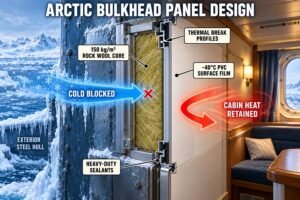
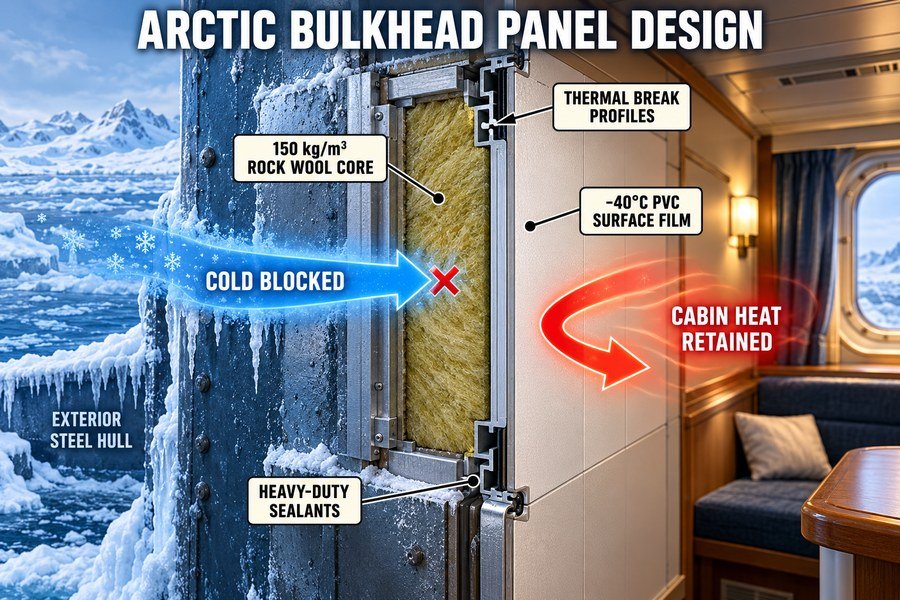
Extreme cold shapes exterior bulkhead panel design by requiring four structural upgrades: 150kg/m³ high-density rock wool core, thermal break profiles to stop condensation, PVC surface films rated for -40°C, and heavy-duty sealants. These features block cold radiation, prevent thermal bridging, and meet strict Polar Class (PC) regulations.
If you only build ships for tropical waters and you do not care about the strict demands of shipyards operating in polar regions, you should stop reading now. But if you want to win lucrative Arctic vessel outfitting contracts, you must understand these cold-weather design rules.
What Marine Lining Panel Insulation Blocks Cold Radiation from Arctic Steel Hulls?
Freezing steel hulls radiate severe cold into cabins. Standard insulation fails under these conditions. Specialized marine lining panel insulation completely blocks this thermal transfer and keeps the interior warm.
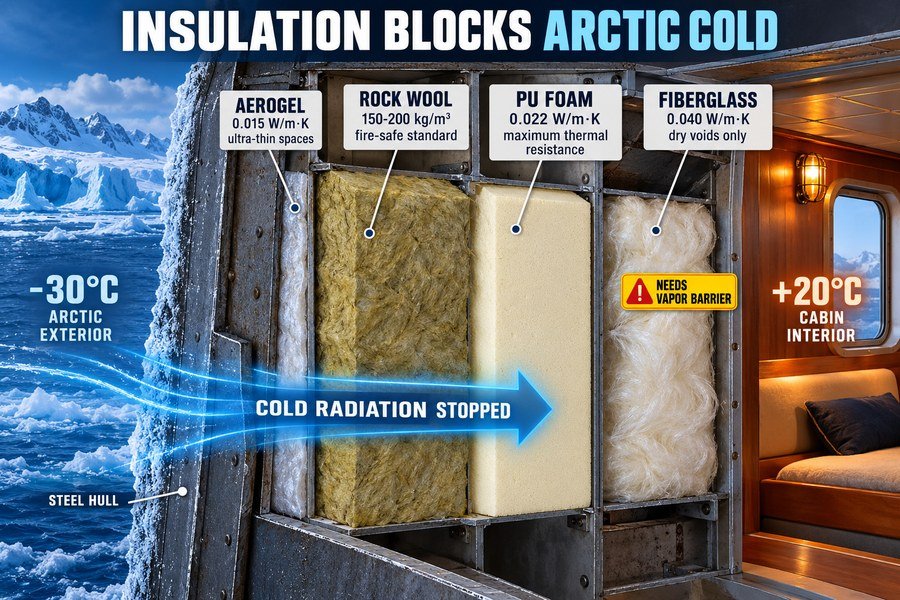
Four types of marine lining panel insulation block Arctic cold radiation: high-density rock wool (150-200 kg/m³) for fire safety, polyurethane (PU) foam for maximum thermal resistance, aerogel blankets for ultra-thin spaces, and fiberglass for budget-friendly non-structural voids. These materials stop freezing temperatures from reaching the cabin interior.
High-Density Rock Wool and Polyurethane (PU) Foam for Primary Insulation
You need the right material to block cold radiation from a freezing steel hull. I always tell my shipyard clients to start with high-density rock wool. You must use rock wool with a density between 150 kg/m³ and 200 kg/m³. This material provides excellent thermal insulation and meets mandatory fire safety rules. According to the International Maritime Organization (IMO) SOLAS regulations, rock wool is the standard choice for A-class bulkheads. It has a thermal conductivity of about 0.034 W/m·K.
Sometimes, you need maximum heat retention in a small space. This is where you use polyurethane (PU) foam. PU foam has a much lower thermal conductivity. The ASHRAE Fundamentals Handbook rates rigid PU foam at 0.022 W/m·K1. This means it blocks cold radiation much better than rock wool. However, PU foam is combustible. You can only use it behind approved fire-rated steel or composite layers. I recommend PU foam for specialized cold-storage areas on polar ships.
Aerogel Blankets and Fiberglass for Specialized Hull Areas
You will often find very tight spaces near the ship's outer steel hull. Standard thick panels do not fit here. For these ultra-thin spaces, you must use aerogel blankets. Aerogel is an advanced material. It offers an incredible thermal conductivity of just 0.015 W/m·K. A 10mm layer of aerogel blocks as much cold as 25mm of standard rock wool.2 The price is very high. Aerogel costs roughly $40 to $60 per square meter. I suggest using aerogel only when space is critically tight.
Finally, you can use fiberglass for budget-friendly, non-structural voids. Fiberglass has a thermal conductivity of about 0.040 W/m·K. It is cheap. It costs around $5 to $8 per square meter. However, fiberglass absorbs moisture easily3. You must wrap it in a strong vapor barrier. If you do not wrap it, hull condensation will ruin the fiberglass. I only use fiberglass inside sealed, dry compartments far from the main exterior bulkheads.
| Insulation Material | Density Range | Thermal Conductivity (W/m·K) | Estimated Cost ($/m²) | Best Use Case |
|---|---|---|---|---|
| High-Density Rock Wool | 150-200 kg/m³ | 0.034 | $15 - $25 | Standard exterior bulkheads |
| Polyurethane (PU) Foam | 40-60 kg/m³ | 0.022 | $20 - $35 | Maximum thermal resistance areas |
| Aerogel Blankets | 150 kg/m³ | 0.015 | $40 - $60 | Ultra-thin spaces |
| Fiberglass | 20-40 kg/m³ | 0.040 | $5 - $8 | Non-structural dry voids |
How Does Arctic Wind Chill Alter R-Values for Perimeter Marine Bulkhead Panels?
Arctic wind chill strips heat from ship superstructures fast. Your calculated R-values drop under these freezing gales. Dynamic thermal resistance adjustments solve this heat loss problem and protect the crew.
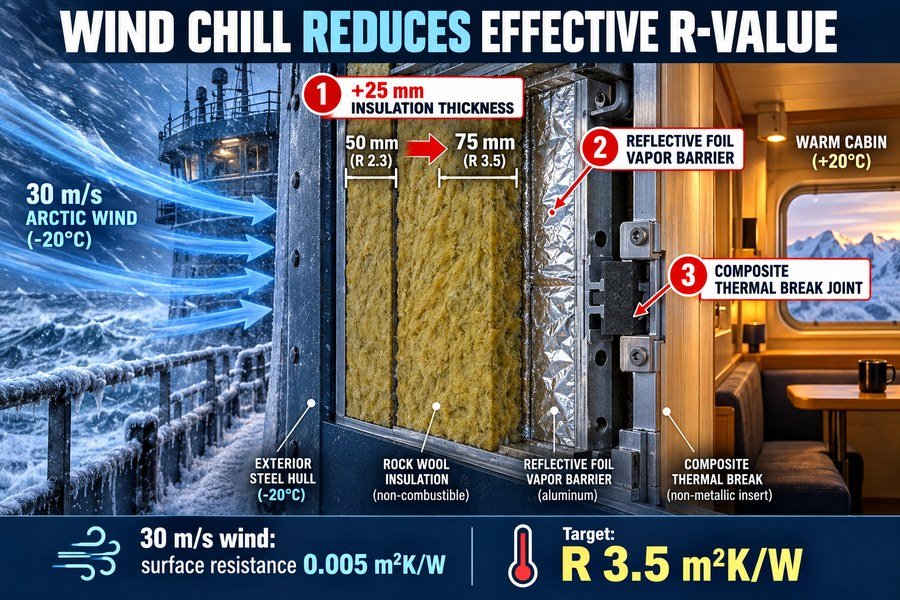
Arctic wind chill alters perimeter marine bulkhead panel R-values by increasing the exterior surface film conductance by up to 400%. This requires three design adjustments: increasing base insulation thickness by 25mm, adding reflective foil vapor barriers, and upgrading to composite thermal break joints to maintain a minimum R-value of 3.5 m²K/W.
Increasing Base Insulation Thickness Against Wind Chill
Arctic winds destroy the thermal barrier of a ship. Wind chill drastically alters the effective R-value of perimeter marine bulkhead panels. The ASHRAE Fundamentals Handbook explains this clearly. In still air, the exterior surface resistance is about 0.03 m²K/W. But at a wind speed of 30 meters per second, this resistance drops to just 0.005 m²K/W.4 This is an increase in conductance of nearly 400%. The fast-moving air rips the heat right off the steel hull.
To fight this, the first design adjustment you must make is increasing the base insulation thickness by exactly 25mm. I see many buyers purchase standard 50mm panels to save money. This is a mistake for Arctic routes. A 50mm rock wool panel offers an R-value of about 1.4 m²K/W. By adding 25mm and upgrading to a 75mm panel, you push the R-value up to 2.2 m²K/W. This extra thickness compensates for the heat loss caused by the harsh wind chill outside.
Adding Reflective Foil Vapor Barriers and Thermal Break Joints
The second design adjustment is adding reflective foil vapor barriers. In my experience at Magellan Marine, standard PVC films fail in polar winds. You need a layer of pure aluminum foil laminated to the back of the panel. This foil acts as a radiant barrier. It reflects interior cabin heat back into the room. More importantly, it stops the freezing wind from pushing moisture into the insulation. The DNV GL polar rules require strict condensation control, and this foil achieves that goal.
The third design adjustment is upgrading to composite thermal break joints. Standard steel joint profiles act as thermal bridges. Freezing cold travels straight through the steel joint into the cabin. This causes ice to form on the interior walls. You must replace solid steel joints with composite thermal breaks. These breaks use polyamide or dense PVC inserts between the steel skins. This stops the cold transfer completely. By combining the extra 25mm thickness, the foil barrier, and the thermal breaks, your bulkhead panel will achieve the required minimum R-value of 3.5 m²K/W.
| Wind Speed (m/s) | Exterior Surface Resistance (m²K/W) | Heat Loss Impact | Required Design Adjustment |
|---|---|---|---|
| 0 (Still Air) | 0.030 | Baseline | Standard 50mm insulation |
| 10 (Breeze) | 0.015 | Moderate heat loss | Reflective foil vapor barrier |
| 20 (Strong Gale) | 0.008 | Severe heat loss | Composite thermal break joints |
| 30 (Hurricane) | 0.005 | Extreme heat loss | Increase thickness by +25mm |
Why Do Polar Exterior Bulkhead Panels Need High-Density Rock Wool?
Loose insulation sags inside panels during rough Arctic sea crossings. This creates empty cold spots at the top of the wall. High-density rock wool stays rigid and stops this structural failure entirely.
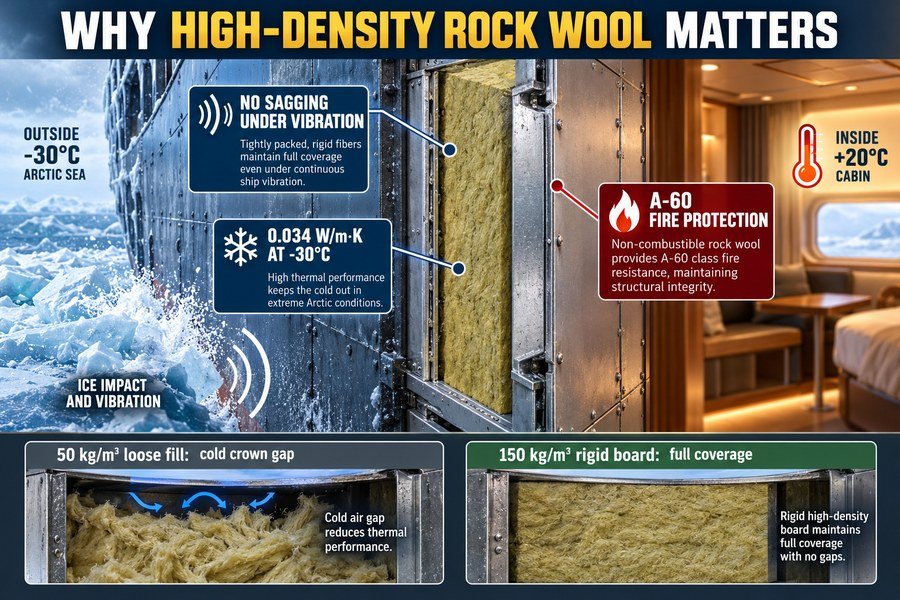
Polar exterior bulkhead panels need high-density rock wool for three specific reasons: it prevents structural sagging under heavy ship vibrations, maintains a stable thermal conductivity of 0.034 W/m·K at -30°C, and provides mandatory A-60 class fire protection as required by the International Maritime Organization (IMO).
Preventing Structural Sagging Under Heavy Ship Vibrations
A ship crashing through Arctic ice creates intense vibrations. These vibrations destroy low-quality insulation. This is the first reason you must use high-density rock wool for polar exterior bulkhead panels. Standard land-based panels use 50 kg/m³ rock wool. When you subject a 50 kg/m³ panel to continuous heavy ship vibrations5, the fibers compress and sink. Over a few months, the top 10 centimeters of the panel become completely empty. I call this the "cold crown effect." Freezing air enters the cabin directly through this empty space.
You solve this by using 150 kg/m³ high-density rock wool. At this density, the rock wool fibers are tightly packed and glued together with high-temperature binders. The insulation becomes a rigid board. It will not sag. It will not compress. I have inspected panels with 150 kg/m³ density after five years of Arctic service, and the insulation remained perfectly in place. The structural integrity of high-density rock wool guarantees the entire wall stays insulated.
Maintaining Stable Thermal Conductivity and A-60 Fire Protection
The second reason you need high-density rock wool is thermal stability. Low-density materials lose their effectiveness in extreme cold. According to technical data from Paroc Marine, a leading insulation manufacturer, 150 kg/m³ rock wool maintains a stable thermal conductivity of 0.034 W/m·K even when the outside temperature drops to -30°C. The dense fibers trap millions of microscopic air pockets. These air pockets cannot move. This stops convective heat loss inside the panel itself.
The third reason is mandatory fire safety. The International Maritime Organization (IMO) enforces strict fire codes under the 2010 FTP Code. An exterior bulkhead must often meet an A-60 fire rating6. This means the panel must stop a severe fire for 60 minutes without the unexposed side exceeding 180°C. Only high-density rock wool can pass this test reliably. Low-density foam melts. Fiberglass burns away. High-density rock wool withstands temperatures above 1000°C. You must use it to pass shipyard safety inspections.
| Rock Wool Density | Sag Resistance under Vibration | Thermal Conductivity at -30°C | IMO Fire Rating Capability |
|---|---|---|---|
| 50 kg/m³ | Poor (Sags up to 10cm) | 0.042 W/m·K | B-15 only |
| 100 kg/m³ | Fair (Minor compression) | 0.038 W/m·K | B-15 or A-30 |
| 150 kg/m³ | Excellent (No sagging) | 0.034 W/m·K | A-60 Compliant |
| 200 kg/m³ | Excellent (Rigid board) | 0.035 W/m·K | A-60 Compliant |
How Do High-Performance Marine Bulkhead Panels Prevent Cold Drafts?
Invisible gaps between wall panels let freezing Arctic air leak into cabins. This draft makes cabin heating systems work overtime. High-performance connection systems block these leaks completely and seal the room.
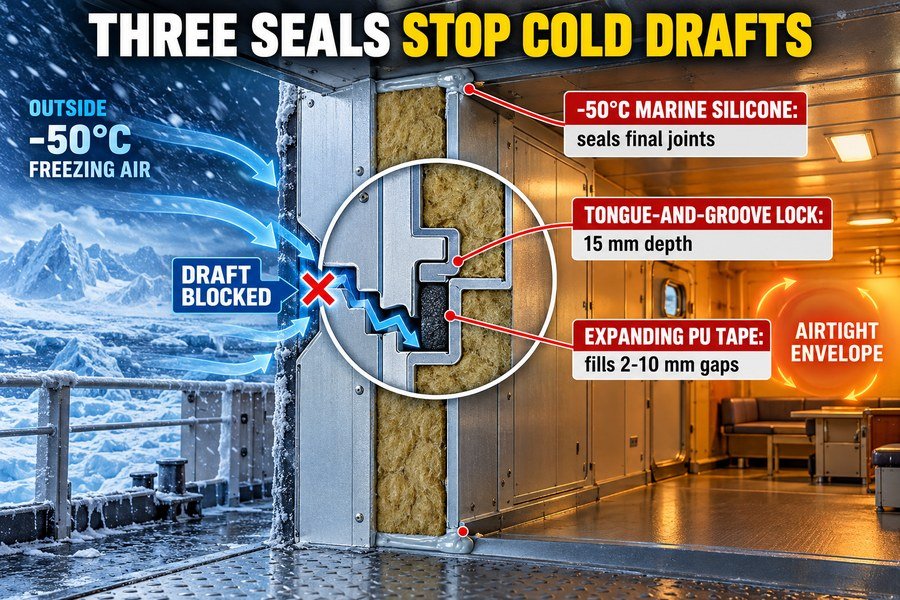
High-performance marine bulkhead panels prevent cold drafts using three specific sealing methods: tight-fitting tongue-and-groove joint profiles, pre-installed expanding polyurethane sealing tapes inside the seams, and cold-resistant silicone caulking applied over the final joints. These three methods create a completely airtight structural envelope.
Utilizing Tongue-and-Groove Joint Profiles for Structural Alignment
Cold drafts are the biggest complaint on Arctic ships. A tiny gap of just 1 millimeter will let freezing air ruin the cabin temperature.7 High-performance marine bulkhead panels prevent these drafts using three specific sealing methods. The first method is the tongue-and-groove joint profile. Cheap panels use flat edges that sit next to each other. When the ship bends in the waves, flat edges pull apart and create gaps.
You must buy panels with a deep tongue-and-groove design. The edge of one panel slides deeply into the slot of the next panel. This creates a mechanical lock. Even if the ship twists heavily in the ice, the panels remain locked together. The cold air cannot travel in a straight line. It must navigate a zig-zag path, which stops the wind pressure.8 I always check the depth of the groove. A proper marine profile should have a groove depth of at least 15mm to ensure a secure, draft-free connection.
Applying Expanding Polyurethane Tapes and Cold-Resistant Silicone
The second method is using pre-installed expanding polyurethane sealing tapes. You place this tape inside the groove before you push the panels together. The tape starts very thin, around 2mm. Once you install the panel, the tape expands up to 10mm. It fills every microscopic scratch and gap inside the joint. This completely stops any air movement. This tape must remain flexible. If it turns hard in the cold, it will crack and fail.
The third method is applying cold-resistant silicone caulking over the final exterior joints. You cannot use standard bathroom silicone. Standard silicone freezes, shrinks, and falls out at -10°C. You must use marine-grade polyurethane or advanced silicone sealants. Products like Sikaflex-291 are rated to perform at -50°C. You apply this caulking along the ceiling lines and floor tracks. By combining the tongue-and-groove mechanical lock, the expanding internal tape, and the external cold-resistant silicone, you build a 100% airtight bulkhead.
| Sealing Method | Location | Primary Function | Material Specification |
|---|---|---|---|
| Tongue-and-Groove Joint | Panel Edges | Mechanical lock against ship bending | Galvanized steel, 15mm depth |
| Expanding Polyurethane Tape | Inside the Joint Seam | Fills microscopic gaps | PU Foam, expands 2mm to 10mm |
| Cold-Resistant Silicone | External ceiling/floor tracks | Blocks final exterior draft paths | Rated for -50°C (e.g., Sikaflex-291) |
What Polar Class Rules Apply to Perimeter Marine Lining Panels?
Failing a shipyard inspection delays your payment and ruins your interior project. Ignorance of polar rules causes these expensive failures. Following specific Polar Class standards guarantees your compliance and secures your profit.
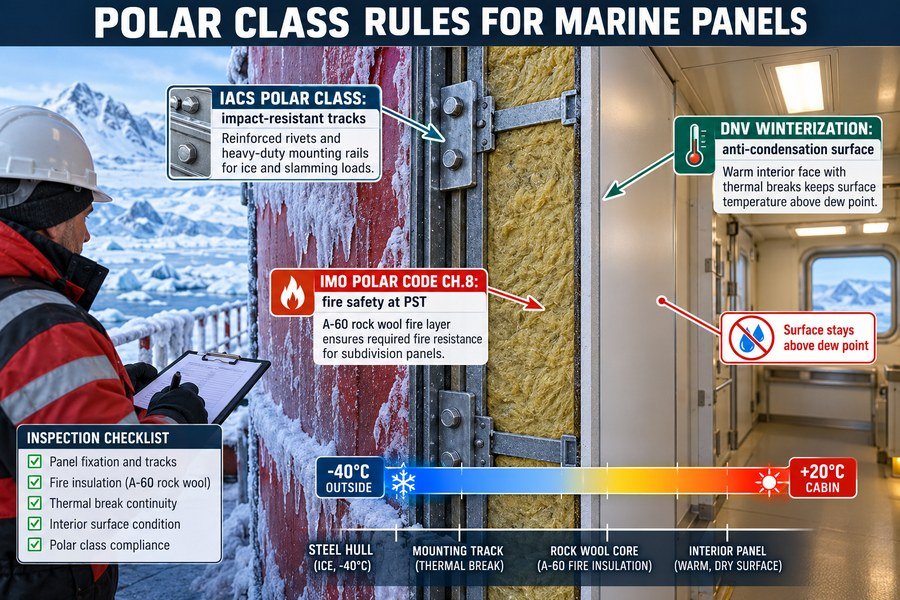
Three major Polar Class (PC) rules apply to perimeter marine lining panels: IACS Polar Class structural requirements for impact resistance, IMO Polar Code Chapter 8 for mandatory fire safety under extreme cold, and DNV GL Winterization guidelines for anti-condensation performance and minimum cabin heating requirements.
IACS Polar Class and IMO Polar Code Chapter 8 Regulations
Selling panels to a shipyard building an Arctic vessel is strict. You cannot just guess the specifications. You must follow three major rules. The first rule comes from the International Association of Classification Societies (IACS) Polar Class requirements. These rules divide ships into categories from PC1 (year-round operation in all polar waters) to PC7 (summer operation in thin ice). For perimeter marine lining panels, IACS requires high structural impact resistance. The panels must not crack or detach when the outer hull slams into heavy ice. The mounting tracks must use heavy-duty rivets.
The second rule is the IMO Polar Code, specifically Chapter 8. This chapter focuses on fire safety under extreme cold conditions. Materials behave differently when frozen. Fire doors and bulkhead panels must still operate perfectly at the Polar Service Temperature (PST). The PST is often designated as -30°C or even -40°C. The IMO Polar Code mandates that all fire insulation materials, like the 150 kg/m³ rock wool, must be tested and certified to maintain their A-60 fire ratings at these freezing temperatures.
DNV GL Winterization Guidelines for Anti-Condensation
The third major rule comes from the DNV GL Winterization guidelines. Shipowners use DNV GL classifications to prove their ships are safe. For interior outfitting, the DNV winterization rules focus heavily on anti-condensation. When it is -30°C outside and +20°C inside, condensation will form rapidly on any cold surface. Water inside the cabin destroys electronics and causes mold.
DNV rules require that the interior surface of the perimeter marine lining panel must never drop below the dew point of the cabin air. For example, the surface temperature of the panel must stay above 5°C at all times. This forces you to use the exact thermal break profiles and thick insulation I mentioned earlier. If your panels cannot meet this anti-condensation rule, the DNV inspector will reject the entire installation. Understanding these three rules ensures your products pass inspection every time.
| Regulatory Body | Specific Rule/Guideline | Core Requirement for Panels | Impact on Panel Design |
|---|---|---|---|
| IACS | Polar Class (PC1 - PC7) | Structural impact resistance | Heavy-duty mounting tracks and rivets |
| IMO | Polar Code Chapter 8 | Fire safety at Polar Service Temp | Materials certified for fire ratings at -40°C |
| DNV GL | Winterization Guidelines | Anti-condensation performance | Surface temp must remain above cabin dew point |
Conclusion
Designing exterior bulkhead panels for Arctic routes requires high-density rock wool, strict thermal break joints, and full compliance with Polar Class rules to ensure crew safety and cabin warmth.
-
"Green buildings model: Impact of rigid polyurethane foam on ...", https://pmc.ncbi.nlm.nih.gov/articles/PMC10025904/. ASHRAE and building-material references report low thermal conductivity values for rigid polyurethane foam, commonly near 0.02 W/m·K under standard test conditions, supporting the stated order of magnitude. Evidence role: statistic; source type: institution. Supports: Rigid polyurethane foam can have a thermal conductivity of about 0.022 W/m·K.. Scope note: Thermal conductivity varies with foam formulation, density, temperature, aging, and test method, so a single value should be treated as representative rather than universal. ↩
-
"Study on Thermal Insulation Performance of Silica Aerogel ...", https://pmc.ncbi.nlm.nih.gov/articles/PMC11593504/. For plane insulation, conductive thermal resistance is calculated as thickness divided by thermal conductivity; using representative conductivities for aerogel blankets and mineral wool gives comparable resistance for roughly 10 mm of aerogel and 20–25 mm of mineral wool. Evidence role: mechanism; source type: education. Supports: A thin aerogel blanket can provide thermal resistance comparable to a thicker layer of standard rock wool.. Scope note: This comparison assumes steady-state one-dimensional heat flow and does not account for installation gaps, compression, moisture, fasteners, or thermal bridges. ↩
-
"Moisture Durability with Vapor-Permeable Insulating ...", https://docs.nlr.gov/docs/fy14osti/58062.pdf. Building-science and energy-efficiency references describe how moisture accumulation in fibrous insulation can increase heat transfer and reduce effective insulating performance, supporting the need for moisture control and vapor-retarder detailing. Evidence role: mechanism; source type: government. Supports: Fiberglass insulation requires moisture control because wet fibrous insulation loses thermal effectiveness and can contribute to condensation problems.. Scope note: Most available evidence is from building-envelope research rather than ship-hull compartments, so it supports the moisture-performance mechanism more directly than the specific marine application. ↩
-
"ASHRAE: Fundamentals", https://www.aspen.gov/DocumentCenter/View/124/ASHRAE-Fundamentals-Handbook-PDF?bidId=. ASHRAE heat-transfer guidance tabulates exterior surface film resistance as a function of air movement, supporting the general claim that external surface resistance falls sharply as wind speed rises. Evidence role: statistic; source type: institution. Supports: Exterior surface resistance decreases substantially as wind speed increases, with values in the approximate range stated.. Scope note: The exact values depend on the assumed surface orientation, emissivity, temperature difference, and whether the cited table is for buildings or directly applicable to marine hull panels. ↩
-
"Numerical analysis method of ship-ice collision-induced ...", https://ui.adsabs.harvard.edu/abs/2023JOES....8..323S/abstract. Studies of ship structural dynamics and ice–hull interaction describe polar vessels as being exposed to substantial vibration and transient loads during icebreaking, supporting the premise that exterior bulkhead assemblies can experience severe cyclic mechanical excitation. Evidence role: general_support; source type: paper. Supports: Ships operating through Arctic ice can experience intense, continuous vibrations that may stress insulation systems.. Scope note: Such sources support the presence of significant ship vibration in ice service, but they may not directly quantify vibration effects on a specific insulation density or panel design. ↩
-
"What Is the Purpose and Scope of the IMO FTP Code?", https://magellanmarinetech.com/what-purpose-scope-of-imo-ftp-code/. The IMO FTP Code and SOLAS fire-test framework define A-class divisions and A-60 insulation criteria, including a 60-minute standard fire exposure and temperature-rise limits on the unexposed face. Evidence role: definition; source type: institution. Supports: An A-60 marine fire rating requires a bulkhead or deck assembly to resist a standard fire test for 60 minutes while limiting heat transmission to the unexposed side.. Scope note: The code defines the rating and test criteria; it does not by itself establish that a particular rock wool panel assembly will pass without a certified test report for that assembly. ↩
-
"nistir 7238", https://nvlpubs.nist.gov/nistpubs/Legacy/IR/nistir7238.pdf. Building-envelope research on air infiltration explains that pressure differences can drive outdoor air through small cracks and joints, increasing heat loss and affecting thermal comfort. Evidence role: mechanism; source type: research. Supports: Small gaps in an exterior or partition assembly can allow cold air infiltration that affects thermal comfort.. Scope note: This supports the general draft and heat-loss mechanism, not the precise cabin-temperature effect of a 1 mm gap on an Arctic ship. ↩
-
"An experimental investigation of the tongue and groove ...", https://pubmed.ncbi.nlm.nih.gov/9814543/. Research on labyrinth and tortuous-path seals shows that non-straight flow paths increase flow resistance and reduce leakage compared with direct gaps. Evidence role: mechanism; source type: paper. Supports: A tongue-and-groove or labyrinth-like joint can reduce air leakage by forcing air through a tortuous path rather than a straight gap.. Scope note: The evidence is mechanistic and contextual; it does not prove that a particular tongue-and-groove bulkhead joint fully stops wind pressure under shipboard loading. ↩