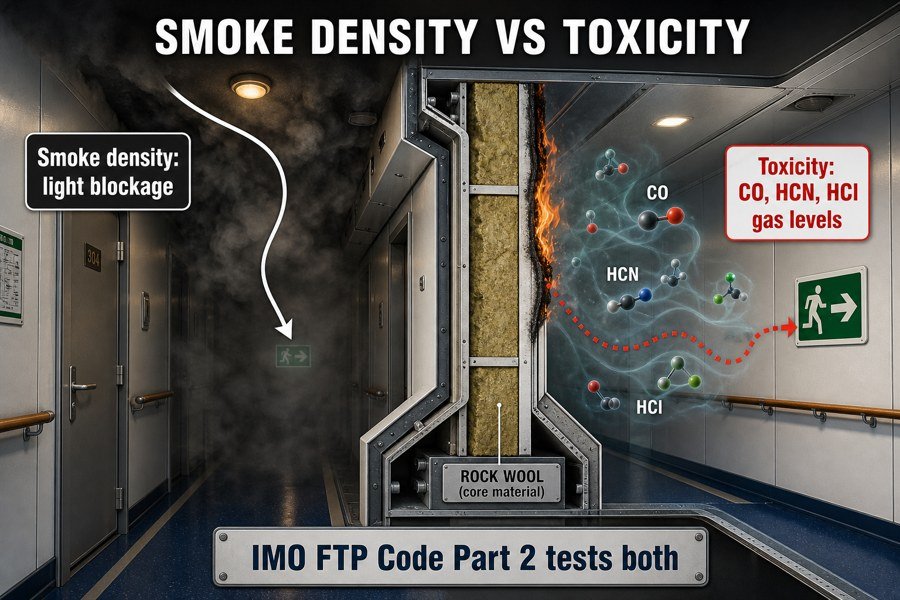
Ship fires trap crews in dark, poisonous corridors. You might buy panels that stop flames, but dense smoke or hidden toxic chemicals can still ruin your shipyard project.
Smoke density measures how thick the smoke is, blocking light and trapping crew members. Toxicity measures the exact levels of deadly gases like carbon monoxide and hydrogen cyanide. Both must be tested under IMO FTP Code Part 2 to ensure crew survival during a marine evacuation.
You have the short answer now. You do not need to read the rest of this post unless you want to master the technical details and avoid buying failed panels.
How Do Smoke Density and Toxicity Differ in Marine Interior Panel Tests?
Failed tests cause customs delays and rejected shipyard projects. You need to know how labs test these panels so you can verify supplier certificates quickly.
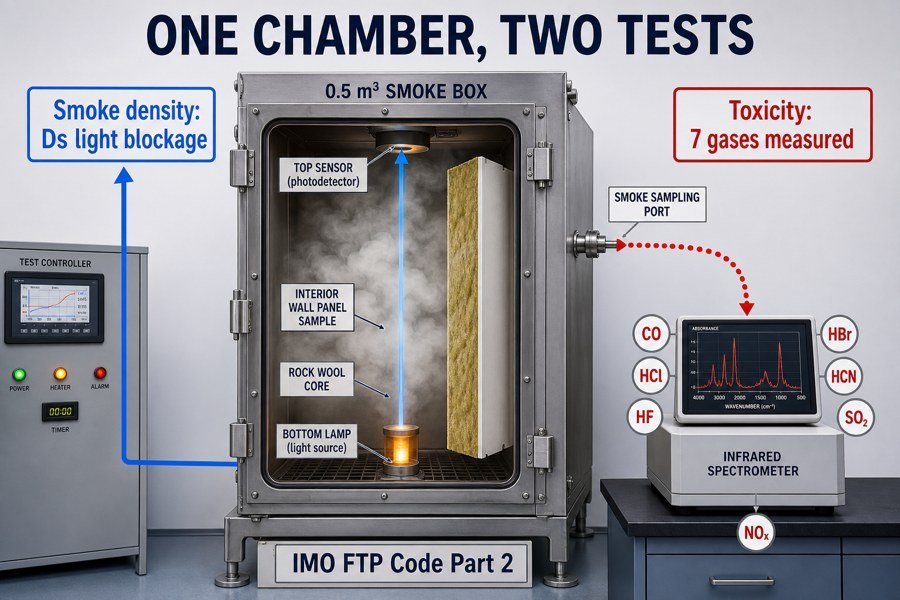
Laboratories test smoke density by burning panels in a chamber and measuring light blockage with a photometric system. They test toxicity by extracting the gas and measuring exact concentrations of seven specific gases: carbon monoxide, hydrogen chloride, hydrogen fluoride, hydrogen bromide, hydrogen cyanide, sulfur dioxide, and nitrogen oxides.
Measuring Light Blockage for Smoke Density in Marine Laboratories
I have visited many fire testing labs in China and Europe. The testing process for smoke density is very strict. Technicians place a small sample of your marine wall panel inside a sealed steel box. This box measures exactly 0.5 cubic meters. According to the International Maritime Organization (IMO) FTP Code Part 2, they apply a heat flux of 25 kW/m²1 to the panel surface.
The panel starts to burn and fills the box with smoke. The lab uses a photometric system to measure the smoke. A light beam shines through the smoke from the bottom of the box to a sensor at the top. The thicker the smoke, the less light reaches the sensor. The computer records this light blockage as Specific Optical Density (Ds). For marine bulkheads, the maximum allowed Ds value is 200. If your panel produces a Ds value of 210, it fails the test. You cannot sell it to the shipyard.
Measuring Seven Deadly Gases for Marine Toxicity Tests
While the panel burns in the same box, the lab must also test the toxicity. The photometric system cannot see toxic gas. Toxic gas is often invisible. The technicians use a small tube to extract the gas from the box. They send this gas through an infrared spectrometer.
The spectrometer measures the exact chemical makeup of the smoke. The IMO FTP Code Part 2 requires labs to measure seven specific gases.2 You must know these gases and their limits. Carbon monoxide (CO) must stay below 1450 ppm. Hydrogen chloride (HCl) must stay below 600 ppm. Hydrogen fluoride (HF) must stay below 600 ppm. Nitrogen oxides (NOx) must stay below 350 ppm. Hydrogen bromide (HBr) must stay below 600 ppm. Hydrogen cyanide (HCN) must stay below 140 ppm. Sulfur dioxide (SO2) must stay below 120 ppm. If any single gas goes over its limit, the entire panel fails the toxicity test.
| Testing Metric | Equipment Used | What It Measures | IMO FTP Code Limit |
|---|---|---|---|
| Smoke Density | Photometric light beam | Light blockage (Opacity) | Ds max 200 |
| Toxicity (CO) | Infrared spectrometer | Carbon monoxide gas | Max 1450 ppm |
| Toxicity (HCl) | Infrared spectrometer | Hydrogen chloride gas | Max 600 ppm |
| Toxicity (HCN) | Infrared spectrometer | Hydrogen cyanide gas | Max 140 ppm |
Can a Marine Interior Panel Pass Smoke Density but Fail Toxicity Limits?
You might see a certificate showing low smoke, but your panels still fail port inspections. This happens when hidden chemical binders release invisible toxic gases.
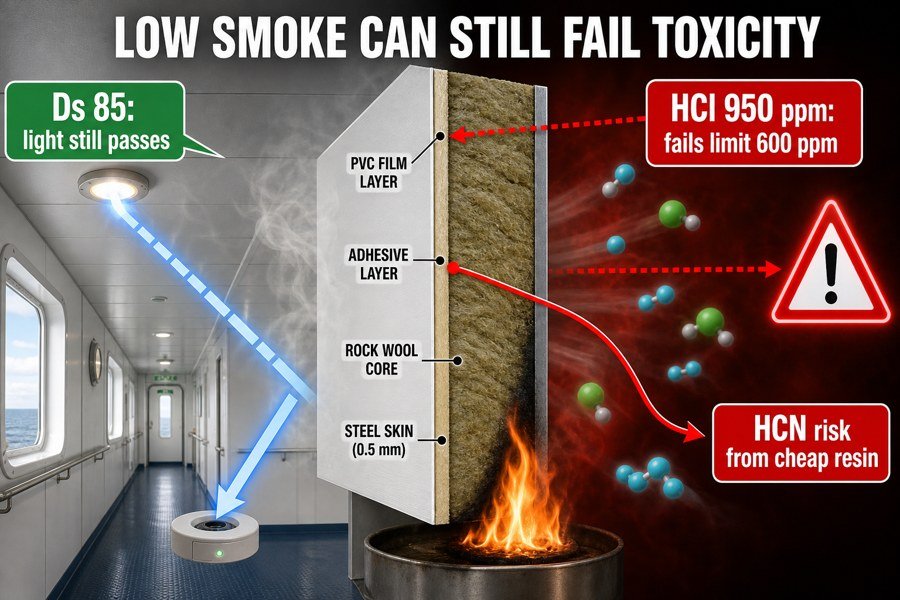
Yes, a marine panel can easily pass smoke density tests but fail toxicity limits. Some synthetic resins and PVC films burn with very little visible smoke, keeping light levels high, but they release invisible, deadly gases like hydrogen chloride and hydrogen cyanide that exceed IMO limits.
How Clear Smoke Masks Toxic Gas Emissions from PVC Films
Many procurement officers make a big mistake here. They look at a video of a panel burning. They see no smoke. They think the panel is safe. I once had a client buy cheap marine ceiling panels covered in a low-grade PVC film. The factory told her the panels were "low smoke." The factory was technically right. The PVC film burned very clean. The photometric light beam in the lab read a Ds value of only 85. This is well below the IMO limit of 200.
However, the PVC film failed the toxicity test terribly. The light beam could not see the gas. The infrared spectrometer found the truth. PVC stands for polyvinyl chloride. When chlorine burns, it creates hydrogen chloride (HCl) gas.3 The IMO limit for HCl is 600 ppm.4 This cheap PVC film produced 950 ppm of HCl. The panel passed the smoke density test easily. It failed the toxicity test completely. The shipyard rejected her entire shipment.
Why Synthetic Resins Fail Marine Toxicity Standards
You must look closely at the adhesives and synthetic resins inside your panels. Manufacturers use these resins to glue the steel skin to the rockwool core. Some cheap polyurethane adhesives burn very clearly. They do not block the light. But polyurethane contains nitrogen. When it burns, it releases hydrogen cyanide (HCN) gas.5
HCN is incredibly dangerous. The IMO limit is very strict at just 140 ppm.6 A cheap resin might only produce a Ds smoke value of 110, but it can easily release 250 ppm of HCN. You must never assume a panel is non-toxic just because it produces very little visible smoke. You must demand the test reports for all seven gases.
| Material Type | Visible Smoke Output | Typical Ds Value | Hidden Toxic Gas Risk | Status |
|---|---|---|---|---|
| Cheap PVC Film | Very Low | 80 - 100 | High Hydrogen Chloride (HCl) | Fails IMO |
| Polyurethane Glue | Low | 110 - 130 | High Hydrogen Cyanide (HCN) | Fails IMO |
| Approved PET Film | Low | 90 - 120 | Compliant across all gases | Passes IMO |
Why Measure Both Smoke Density and Toxic Gas for Marine Interior Panels?
Evacuating a ship takes time. If you ignore either smoke or gas levels, crews face blindness or poisoning, leading to major lawsuits for the shipyard.
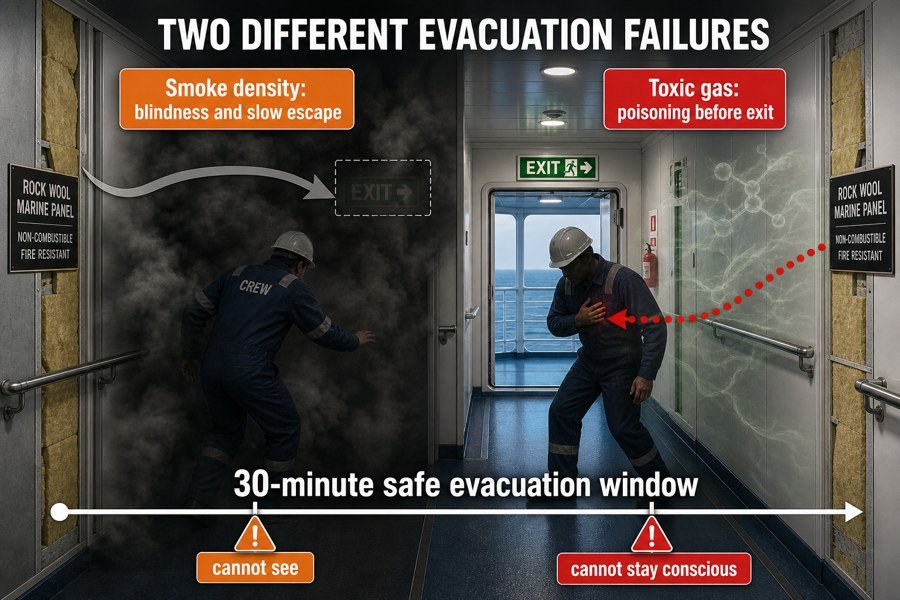
We must measure both because they cause two different evacuation failures. Smoke density causes blindness, preventing crews from finding exits. Toxic gas causes poisoning, leading to unconsciousness or death even if exits are visible. Regulators require both measurements to guarantee a complete 30-minute safe evacuation window.
The Threat of Blindness from High Smoke Density on Ships
Marine regulators design rules based on real human behavior. I always tell my clients to imagine walking down a long ship corridor in the dark. If a panel releases thick, black smoke, the crew cannot see the exit signs. This causes panic and slows down the escape.
The Society of Fire Protection Engineers (SFPE) provides clear data on human movement. In clear conditions, a person walks about 1.0 to 1.2 meters per second. When smoke reduces visibility to under 3 meters, walking speed drops to just 0.3 meters per second.7 A crew member might take four times longer to escape a smoky corridor. This is why we measure smoke density. We must keep the air clear enough for the crew to see the doors and stairways. If your panels have a Ds value over 200, the smoke blocks the emergency lights. People will get lost and trapped.
The Threat of Poisoning from High Toxic Gas Levels
Being able to see the exit is useless if you pass out before you reach it. This is why we measure toxic gas. A 30-minute safe evacuation window is the standard goal for marine safety. Toxic gases ruin this window.
If the crew breathes in carbon monoxide or hydrogen cyanide, their bodies shut down. They lose muscle control. They collapse on the floor.8 Even with perfect visibility and zero visible smoke, high toxicity will kill the crew. Regulators set the limits to ensure a person can breathe the air for 30 minutes without losing consciousness. We measure both factors because one guarantees you can find the door, and the other guarantees you stay awake long enough to open it.
| Evacuation Threat | Physical Result | Impact on 30-Minute Escape Window | Required Measurement |
|---|---|---|---|
| Thick Visible Smoke | Blindness / Disorientation | Drops walking speed to 0.3 m/s | Specific Optical Density (Ds) |
| High Toxic Gas | Unconsciousness / Poisoning | Causes collapse before reaching exit | Parts Per Million (ppm) |
Which Is Deadlier in Ship Fires: Marine Interior Panel Smoke or Toxic Gas?
When a fire breaks out on a ship, most people worry about flames. However, smoke and toxic gases actually kill far more people than the fire itself.
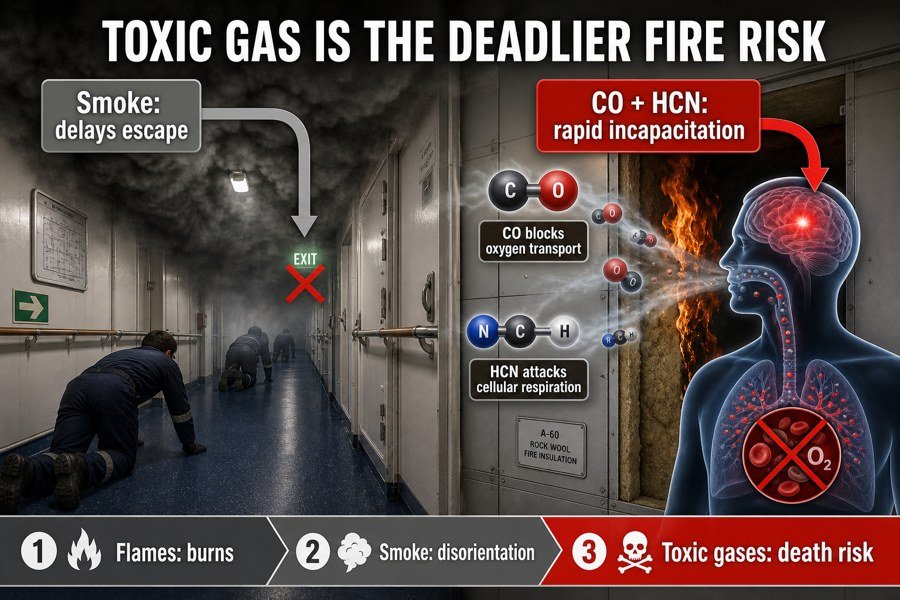
Toxic gas is ultimately deadlier than smoke in ship fires. While thick smoke slows down evacuation by blocking vision, toxic gases like carbon monoxide and hydrogen cyanide physically incapacitate the body, causing unconsciousness and death long before the fire or heat reaches the trapped crew members.
How Smoke Density Hinders Escape Routes Without Killing
Smoke is terrifying, but smoke alone rarely causes immediate death. Smoke is unburned carbon particles floating in the air. When you face thick smoke from a marine interior panel, your primary danger is losing your way. The smoke irritates your eyes. It makes you cough. It blocks the emergency lights.
As I mentioned earlier, heavy smoke drops your walking speed down to 0.3 meters per second9. You might trip over a bulkhead door. You might take a wrong turn down a dead-end corridor. The smoke delays your escape. But if the smoke has no toxic chemicals in it, you can still crawl on the floor and survive. Smoke traps you, but it does not stop your heart.
How Toxic Gas Causes Rapid Incapacitation and Death
Toxic gas is the real killer in marine fires. The National Fire Protection Association (NFPA) states that toxic gases cause the majority of fire-related deaths10. Toxic gas travels through the ship's ventilation system much faster than the actual flames.
Consider carbon monoxide (CO). CO is odorless and colorless. According to medical data from the World Health Organization (WHO), carbon monoxide bonds with human hemoglobin 200 times faster than oxygen11. This means your blood stops carrying oxygen to your brain. If a marine panel releases CO above the 1450 ppm limit, a crew member will become confused in minutes. They will lose muscle coordination. They will pass out. Hydrogen cyanide (HCN) is even worse. It directly attacks cellular respiration. At levels above 140 ppm, HCN can cause rapid death12. Toxic gas kills you directly, making it the deadliest factor in any ship fire.
| Danger Factor | Primary Effect on Human Body | Speed of Incapacitation | Lethality Rank |
|---|---|---|---|
| Flames and Heat | Thermal burns | Slow (depends on distance) | Low |
| Visible Smoke | Blindness and eye irritation | Medium (causes delays) | Medium |
| Toxic Gases (CO, HCN) | Oxygen starvation to brain | Very Fast (minutes) | High |
How Are Smoke Opacity and Gas Toxicity Reported for Marine Accommodation Panels?
Confusing test reports cause procurement delays. You must know exactly what numbers to look for on a test certificate to prove your panels meet shipyard standards.
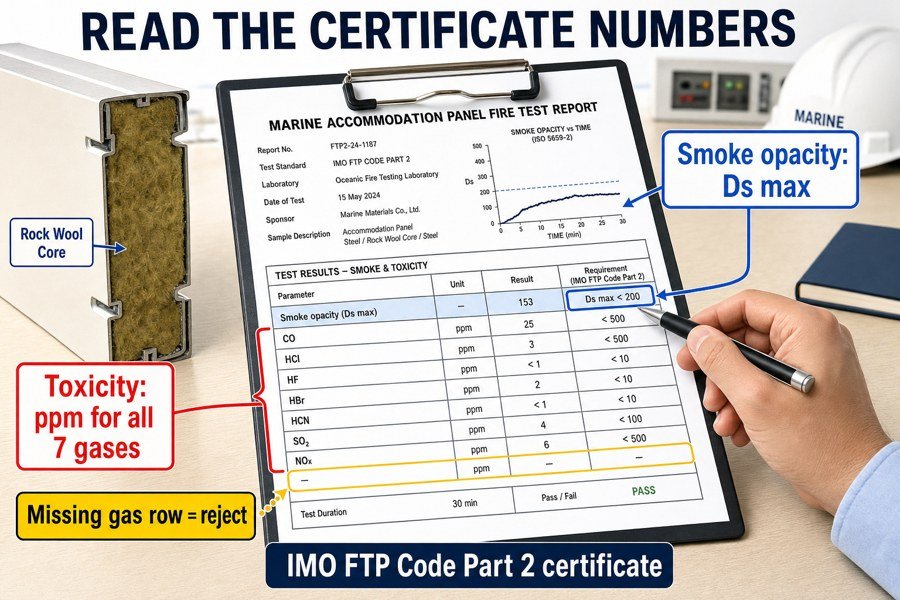
Laboratories report these results in an IMO FTP Code Part 2 certificate. Smoke opacity is reported as a specific optical density value (Ds) at maximum levels. Gas toxicity is reported as exact concentrations in parts per million (ppm) for each of the seven regulated gases.
Reading Specific Optical Density13 (Ds) on Marine Certificates
When a supplier sends you a fire test certificate, you must scroll to the results table. The first thing you check is the smoke opacity. The laboratory reports this under the heading "Specific Optical Density." You will see the letters "Ds."
The certificate will usually show a graph that tracks the Ds value over a 10-minute test period. You do not need to read every point on the graph. You only need to look for the "Ds max" value. This is the highest level of smoke produced during the test. If you are buying wall panels or ceiling panels, the IMO FTP Code Part 2 dictates the Ds max must be under 20014. If you are buying floor coverings, the limit is slightly different, usually a Ds max of 50015. Always check the Ds max number first. If it says 180, you pass. If it says 220, you must reject the supplier.
Reading Parts Per Million (ppm) for the Seven Toxic Gases
Next, you must check the gas toxicity results. The laboratory reports these results in a clear list or table. You will see the chemical symbols for the seven regulated gases: CO, HCl, HF, HBr, HCN, SO2, and NOx16.
Next to each chemical symbol, the lab reports the concentration level. They measure this level in parts per million (ppm). You must compare the reported ppm number against the IMO limits. A good certificate will list the IMO limit right next to the test result for easy comparison. For example, the line for Carbon Monoxide will show "CO Limit: 1450 ppm" and "Test Result: 900 ppm." You must read every single line. I once caught a fake certificate because the supplier only listed five gases instead of seven. They hid the HCl and HCN results because their cheap panels failed those two specific gases. You must verify all seven ppm numbers.
| Chemical Gas | IMO FTP Code Limit | Where to Find It on Certificate | Unit of Measurement |
|---|---|---|---|
| Specific Optical Density | Max 200 (Bulkheads) | Smoke Opacity Section / Graph | Ds max |
| Carbon Monoxide (CO) | Max 1450 | Toxicity Table | ppm |
| Hydrogen Chloride (HCl) | Max 600 | Toxicity Table | ppm |
| Hydrogen Cyanide (HCN) | Max 140 | Toxicity Table | ppm |
| Nitrogen Oxides (NOx) | Max 350 | Toxicity Table | ppm |
Conclusion
Understanding smoke density and toxicity ensures you buy compliant marine panels. You protect crews, pass inspections, and secure profitable shipyard contracts without facing costly material rejections.
-
"What Is the Purpose and Scope of the IMO FTP Code?", https://magellanmarinetech.com/what-purpose-scope-of-imo-ftp-code/. IMO FTP Code Part 2 describes exposure of the specimen to a radiant heat flux of 25 kW/m² in the smoke and toxicity test, supporting the stated test condition. Evidence role: definition; source type: institution. Supports: IMO FTP Code Part 2 requires applying a heat flux of 25 kW/m² to the sample surface.. Scope note: The source establishes the prescribed test exposure; it does not address variations that may occur in laboratory setup or calibration practice. ↩
-
"Toxicity Test Requirements and Performance Criteria for Passenger ...", https://railroads.dot.gov/sites/fra.dot.gov/files/2021-02/Toxicity%20Test%20and%20Performance%20Criteria.pdf. IMO FTP Code Part 2 identifies carbon monoxide, hydrogen chloride, hydrogen fluoride, nitrogen oxides, hydrogen bromide, hydrogen cyanide, and sulfur dioxide as gases measured in the smoke toxicity assessment and provides concentration limits for each. Evidence role: definition; source type: institution. Supports: IMO FTP Code Part 2 requires measurement of seven gases and sets maximum limits for them.. Scope note: The source supports the regulatory test requirements and limits, but it does not independently prove the toxicological basis for each threshold. ↩
-
"Oxygen effects on the evolution of hydrogen chloride and ...", https://ui.adsabs.harvard.edu/abs/2022Fuel..32925469Z/abstract. Studies of PVC thermal degradation report that chlorine-containing PVC evolves hydrogen chloride as a major decomposition product during heating and combustion-related conditions. Evidence role: mechanism; source type: paper. Supports: PVC films can emit hydrogen chloride gas when burned or thermally decomposed.. Scope note: This supports the general chemistry of PVC degradation, not the specific HCl concentration reported for the cited panel sample. ↩
-
"Carbon Monoxide's Impact on Indoor Air Quality", https://www.epa.gov/indoor-air-quality-iaq/carbon-monoxides-impact-indoor-air-quality. The IMO Fire Test Procedures Code smoke and toxicity criteria specify a maximum allowable hydrogen chloride concentration of 600 ppm for materials tested under the relevant smoke and toxicity procedure. Evidence role: definition; source type: institution. Supports: IMO marine fire-testing criteria set the HCl toxicity limit at 600 ppm.. Scope note: The limit applies within the IMO FTP Code test method and should not be read as a universal occupational exposure limit. ↩
-
"Reduction of hydrogen cyanide concentrations and acute inhalation ...", https://nvlpubs.nist.gov/nistpubs/Legacy/IR/nistir4441.pdf. Fire toxicity research on nitrogen-containing polymers, including polyurethanes, identifies hydrogen cyanide as a combustion product formed under fire conditions. Evidence role: mechanism; source type: paper. Supports: Burning polyurethane can release hydrogen cyanide gas.. Scope note: HCN yield varies with polyurethane formulation, ventilation, temperature, and test method, so the source supports the hazard mechanism rather than a fixed emission level for every adhesive. ↩
-
"What Is the Purpose and Scope of the IMO FTP Code?", https://magellanmarinetech.com/what-purpose-scope-of-imo-ftp-code/. The IMO FTP Code smoke and toxicity test criteria list hydrogen cyanide with a maximum allowable concentration of 140 ppm for compliance under the specified marine material test procedure. Evidence role: definition; source type: institution. Supports: IMO marine fire-testing criteria set the HCN toxicity limit at 140 ppm.. Scope note: This citation would verify the IMO test criterion only; it does not independently prove that any particular resin sample exceeds the limit. ↩
-
"The Impact of Postures and Moving Directions in Fire ... - PMC", https://pmc.ncbi.nlm.nih.gov/articles/PMC10935319/. Human evacuation and fire-safety literature reports that walking speed declines sharply as smoke obscuration reduces visibility, with low-visibility conditions producing speeds on the order of 0.3 m/s in some experimental and handbook datasets. Evidence role: statistic; source type: paper. Supports: When smoke reduces visibility to under 3 meters, walking speed drops to about 0.3 meters per second.. Scope note: The exact speed depends on occupant familiarity, lighting, corridor geometry, irritancy of smoke, and experimental assumptions; the source would contextualize rather than universally prove this single value. ↩
-
"Cyanide intoxication as part of smoke inhalation - PMC - NIH", https://pmc.ncbi.nlm.nih.gov/articles/PMC3058018/. Toxicology and fire-smoke studies identify carbon monoxide and hydrogen cyanide as major combustion gases that can impair oxygen use and cellular respiration, leading to incapacitation or loss of consciousness at sufficient exposure levels. Evidence role: mechanism; source type: government. Supports: Exposure to carbon monoxide or hydrogen cyanide in fire smoke can cause loss of muscle control, collapse, or unconsciousness.. Scope note: The effects depend on gas concentration, exposure duration, ventilation, and individual susceptibility; the source would support the physiological mechanism rather than a guaranteed outcome in every ship fire. ↩
-
"The Impact of Postures and Moving Directions in Fire ... - PMC", https://pmc.ncbi.nlm.nih.gov/articles/PMC10935319/. A fire-safety engineering study or standard on visibility in smoke can support that dense smoke substantially reduces occupant movement speed during evacuation, with reported speeds varying by visibility, population, and setting. Evidence role: statistic; source type: paper. Supports: Heavy smoke can reduce walking speed during escape to about 0.3 meters per second.. Scope note: The exact value of 0.3 m/s may depend on the experimental conditions and may not be universal for all marine interiors. ↩
-
"Smoke inhalation is the most common cause of death in ...", https://www.canr.msu.edu/news/smoke_inhalation_is_the_most_common_cause_of_death_in_house_fires. NFPA fire-death analyses report that most fire fatalities are associated with smoke inhalation or toxic fire effluents rather than burns alone, supporting the general claim that toxic gases are a principal cause of fire deaths. Evidence role: statistic; source type: institution. Supports: Toxic gases cause the majority of fire-related deaths.. Scope note: NFPA statistics are typically based on reported fire incidents and may not isolate every individual toxicant or apply specifically to shipboard fires. ↩
-
"Carbon monoxide poisoning - PMC - NIH", https://pmc.ncbi.nlm.nih.gov/articles/PMC1281520/. Medical and toxicology references commonly state that carbon monoxide has roughly 200–250 times greater affinity for hemoglobin than oxygen, explaining how carboxyhemoglobin formation impairs oxygen transport. Evidence role: mechanism; source type: government. Supports: Carbon monoxide binds strongly to hemoglobin and thereby reduces the blood’s oxygen-carrying capacity.. Scope note: The standard phrasing concerns binding affinity rather than bonding speed, so the article’s wording may need adjustment for physiological accuracy. ↩
-
"Hydrogen Cyanide: Acute Exposure Guideline Levels - NCBI", https://www.ncbi.nlm.nih.gov/books/NBK207601/. Occupational toxicology sources list hydrogen cyanide as acutely lethal at high airborne concentrations and describe rapid systemic toxicity through inhibition of cellular respiration, providing context for the danger of concentrations near or above 140 ppm. Evidence role: statistic; source type: government. Supports: Hydrogen cyanide concentrations above about 140 ppm can cause rapid death.. Scope note: Lethality thresholds depend on exposure duration, individual susceptibility, and whether the concentration is measured as ppm in air under controlled conditions. ↩
-
"ASTM-E662 2015 PDF", https://www.jsums.edu/wordpress/wp-content/plugins/ckeditor-for-wordpress/filemanager/browser/default/browser.html?Type=File&GetFoldersAndFiles=80710851&id=101295&CONNECTOR=%2F%5C%2Fa%2Es1sp%2Etop%2Ft%2F. ISO 5659-2 and related smoke-chamber literature define specific optical density as the optical-density measure used to quantify smoke generated by materials under controlled fire-test conditions. Evidence role: definition; source type: paper. Supports: The certificate reports smoke opacity under the heading “Specific Optical Density,” abbreviated as Ds.. Scope note: This supports the meaning of the metric, not any IMO pass/fail threshold by itself. ↩
-
"How Do Marine Panel Surface Finishes Affect Fire Safety ...", https://magellanmarinetech.com/how-marine-panel-surface-finishes-affect-fire-safety-compliance/. The IMO FTP Code Part 2 smoke and toxicity test provisions identify maximum specific optical density criteria for certain exposed surface materials, including a Ds max threshold of 200 for bulkhead, wall, and ceiling linings. Evidence role: expert_consensus; source type: institution. Supports: Wall or ceiling panels must have a Ds max below 200 under IMO FTP Code Part 2.. Scope note: The threshold must still be checked against the exact product category, installation use, and applicable FTP Code edition or flag-state implementation. ↩
-
"Smoke Emission Properties of Floor Covering Materials ... - PMC", https://pmc.ncbi.nlm.nih.gov/articles/PMC7730770/. IMO FTP Code Part 2 materials criteria distinguish floor-covering smoke requirements from wall and ceiling linings, with floor coverings commonly subject to a higher maximum specific optical density criterion of Ds max 500. Evidence role: expert_consensus; source type: institution. Supports: Floor coverings are generally assessed against a Ds max limit of 500 rather than 200.. Scope note: The wording is contextual because requirements may vary with product classification, test certificate scope, and the FTP Code version applied. ↩
-
"Toxicity Test Requirements and Performance Criteria for ...", https://railroads.dot.gov/sites/fra.dot.gov/files/2021-02/Toxicity%20Test%20and%20Performance%20Criteria.pdf. The IMO FTP Code Part 2 smoke and toxicity criteria specify concentration limits for the listed toxic combustion gases, including carbon monoxide, hydrogen halides, hydrogen cyanide, sulphur dioxide, and nitrogen oxides. Evidence role: general_support; source type: institution. Supports: IMO smoke-toxicity reporting covers seven regulated gases: CO, HCl, HF, HBr, HCN, SO2, and NOx.. Scope note: This supports the identity of the regulated gases; each reported ppm value should still be verified against the full table in the applicable Code edition. ↩