Ship fires are deadly, and toxic smoke often kills before flames do. If your panels fail safety checks, your whole shipyard project stops. I will show you how testing works.
Marine interior panels are tested for smoke and toxicity using the IMO 2010 FTP Code Annex 1 Part 2. This mandates exposing materials to radiant heat in a sealed chamber to measure specific optical smoke density and analyze the concentrations of seven specific toxic gases using FTIR or colorimetric tubes.
When I worked at the marine outfitting factory, I saw many beautiful panels fail these safety tests. Finding good suppliers in Asia means you must check their test reports carefully. If you understand how the testing works, you can easily spot fake certificates and keep your buyers in Europe and the US happy. Let us look at the exact rules.
How Does the Marine Interior Panel Smoke and Toxicity Test Work?
You buy cheap panels, but they fail port inspections because they release thick smoke. You lose money and trust. Here is the exact test process to ensure your panels pass.
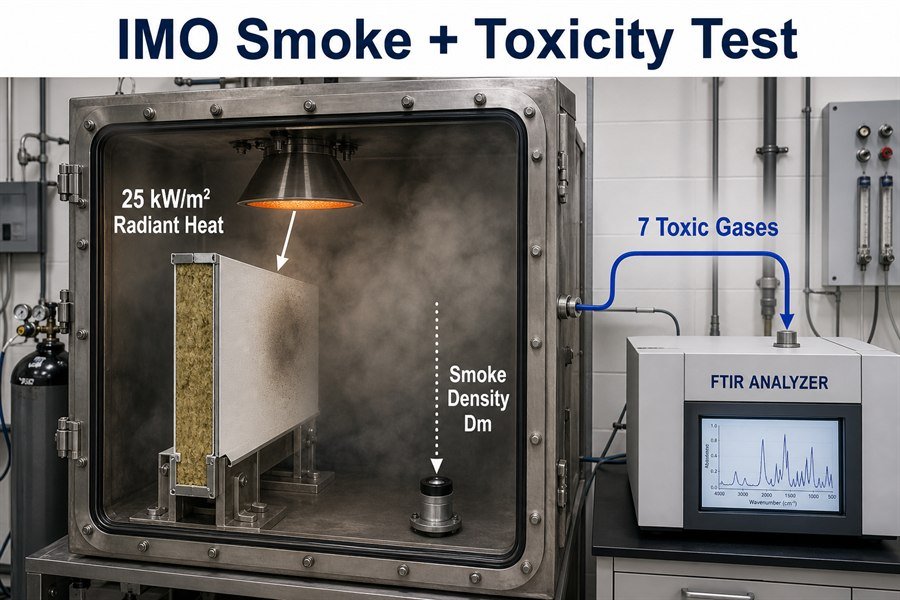
The test works by placing a panel sample inside a 0.5-cubic-meter sealed chamber. The material faces a 25 kW/m² radiant heat source under both flaming and non-flaming conditions. Sensors measure light blocking for smoke density, while probes extract gas samples to check toxicity levels over a 20-minute period.
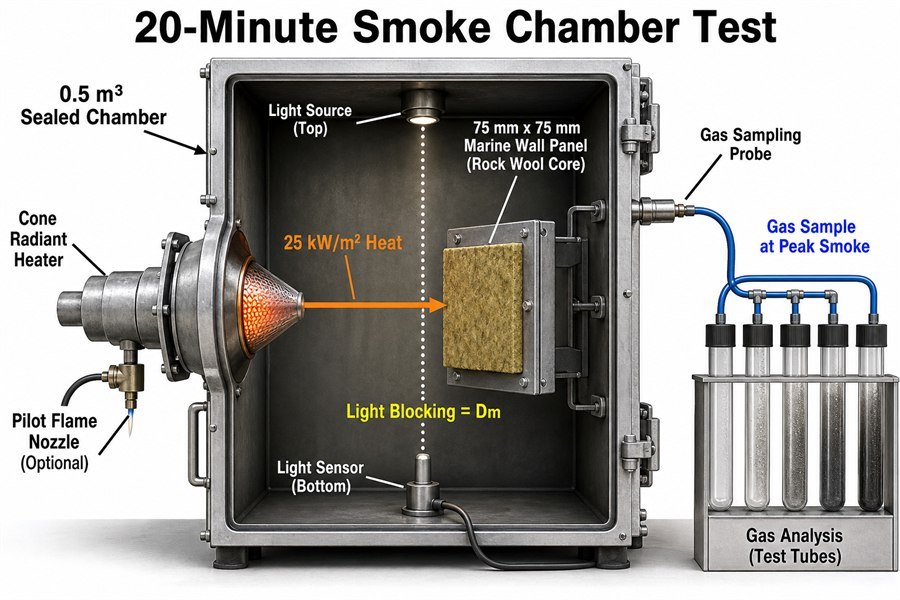
To help you understand this process, we need to look at the International Maritime Organization (IMO) rules. The exact rule is the IMO 2010 FTP Code, Part 2. This code uses a specific testing method called ISO 5659-2. The test is very strict. It ensures that passengers and crew have enough time to escape a fire without choking on black smoke.
Setting Up the Test Chamber for Marine Panels
The testing lab uses a small, completely sealed metal box. The volume of this box is exactly 0.5 cubic meters. The lab technician cuts a sample of your marine wall panel or ceiling panel. The size of the sample is 75 mm by 75 mm. The thickness is the real thickness of the panel, up to 25 mm. The technician wraps the back and edges of the sample in aluminum foil. This forces the fire to attack only the front face of the panel. The front face is the part people see in the ship cabin.
The lab uses a cone-shaped electrical heater. This heater acts like a real ship fire. According to the IMO standard, this heater delivers exactly 25 kW/m² (kilowatts per square meter) of radiant heat to the panel surface. The lab tests the panel in two different ways. First, they use the heat without a small flame. This is the non-flaming condition. Second, they use the heat and add a small pilot flame to ignite the gases. This is the flaming condition. A good marine panel must pass both tests.
Execution of the 20-Minute Fire Test
The test runs for exactly 20 minutes. A light beam shines straight down through the box. A light sensor sits at the bottom. When the panel burns, smoke fills the 0.5-cubic-meter box. The smoke blocks the light. The computer records how much light gets blocked. This tells us the smoke density. At the same time, the technician uses small tubes or an FTIR (Fourier-transform infrared spectroscopy) machine to suck air out of the box. The machine checks this air to see how much poison gas is inside.
| Test Condition | Heat Level | Pilot Flame | Primary Purpose |
|---|---|---|---|
| Non-Flaming Test | 25 kW/m² | OFF | Simulates a smoldering fire before open flames appear. |
| Flaming Test | 25 kW/m² | ON | Simulates a fully ignited fire spreading across the cabin. |
| Smoke Measurement | Light Beam | N/A | Measures how much the smoke blocks visibility in the room. |
| Gas Extraction | Probe Tube | N/A | Captures air at maximum smoke density to test for poisons. |
Which Gases Are Analyzed in Marine Interior Panel Toxicity Tests?
Toxic gases in a ship cabin leave crew with nowhere to run. Picking the wrong panel material causes fatal accidents. Let us look at the exact gases you must control.
Marine interior panel toxicity tests analyze seven specific gases mandated by the IMO FTP Code: Carbon Monoxide (CO), Hydrochloric Acid (HCl), Hydrogen Fluoride (HF), Nitrogen Oxides (NOx), Hydrogen Bromide (HBr), Hydrogen Cyanide (HCN), and Sulfur Dioxide (SO2). All seven must stay below strictly defined concentration limits.
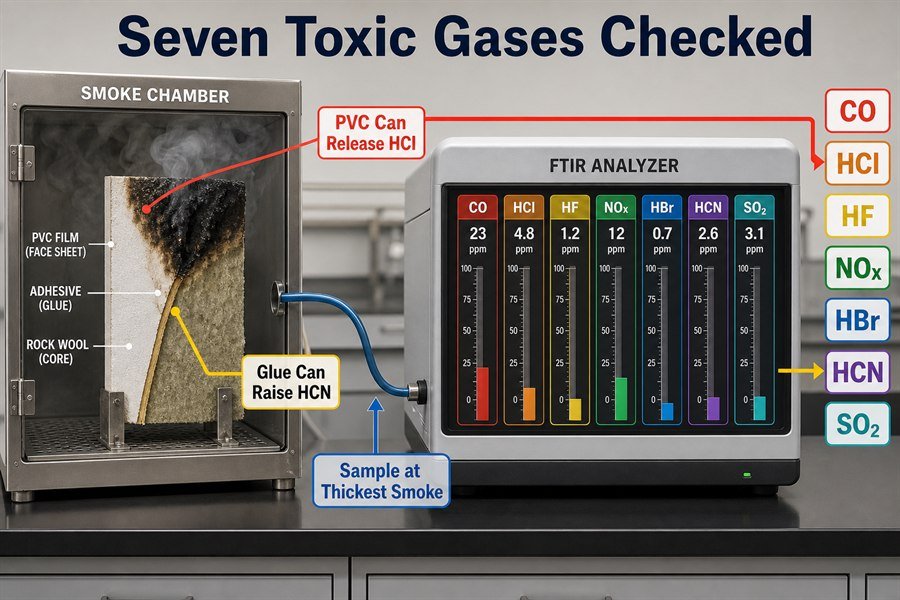
You must know what makes smoke dangerous. Wood and plastic do not burn the same way. In my early days doing marine outfitting, one client bought cheap PVC-covered wall panels from a small factory. The panels looked great and the price was very low. But when the lab burned them, the PVC coating released massive amounts of poison gas. The panels failed the test completely. The client lost a huge contract.
Breakdown of the Seven Regulated Toxic Gases
The IMO 2010 FTP Code strictly monitors seven gases1. The first gas is Carbon Monoxide (CO). All burning things make CO. It stops your blood from carrying oxygen. The second gas is Hydrochloric Acid (HCl). Materials like PVC plastic release HCl2. It burns your eyes and throat instantly. The third gas is Hydrogen Fluoride (HF). Some special waterproof coatings create HF when they burn. It is highly toxic to the lungs.
The fourth gas group is Nitrogen Oxides (NOx). Many modern glues and resins release NOx. It causes severe breathing problems. The fifth gas is Hydrogen Bromide (HBr). Factories often use bromine to make plastics fireproof. But when this plastic finally burns, it releases toxic HBr3. The sixth gas is Hydrogen Cyanide (HCN). Materials like melamine and polyurethane foam release HCN. HCN acts very fast and kills people in minutes4. The seventh gas is Sulfur Dioxide (SO2). Certain rubbers and cheap insulation materials release SO2.
Measuring Gas Concentrations During the Test
The testing lab measures these seven gases when the smoke in the chamber is at its thickest. They measure the gases in "ppm". This means parts per million. You can think of this as counting how many poison gas particles exist in one million normal air particles. If your supplier uses low-quality glue to stick the PVC film to the rockwool core, the glue will burn and release huge amounts of HCN and CO. You must ask the factory what surface materials and glues they use before you buy.
| Regulated Gas Name | Chemical Symbol | Common Source in Marine Panels |
|---|---|---|
| Carbon Monoxide | CO | All organic materials burning |
| Hydrochloric Acid | HCl | PVC films, cheap plastic edge bands |
| Hydrogen Fluoride | HF | Teflon coatings, specialized plastics |
| Nitrogen Oxides | NOx | Polyurethane adhesives, urea-formaldehyde glues |
| Hydrogen Bromide | HBr | Brominated flame retardants in plastics |
| Hydrogen Cyanide | HCN | Melamine surfaces, polyurethane foams |
| Sulfur Dioxide | SO2 | Rubber sealants, low-quality core materials |
How Do Marine Interior Panel Smoke Chambers Differ from Building Material Tests?
You might think standard building panels work for ships. But marine standards are much stricter, and standard panels will fail. Here is why the ship testing chambers are different.
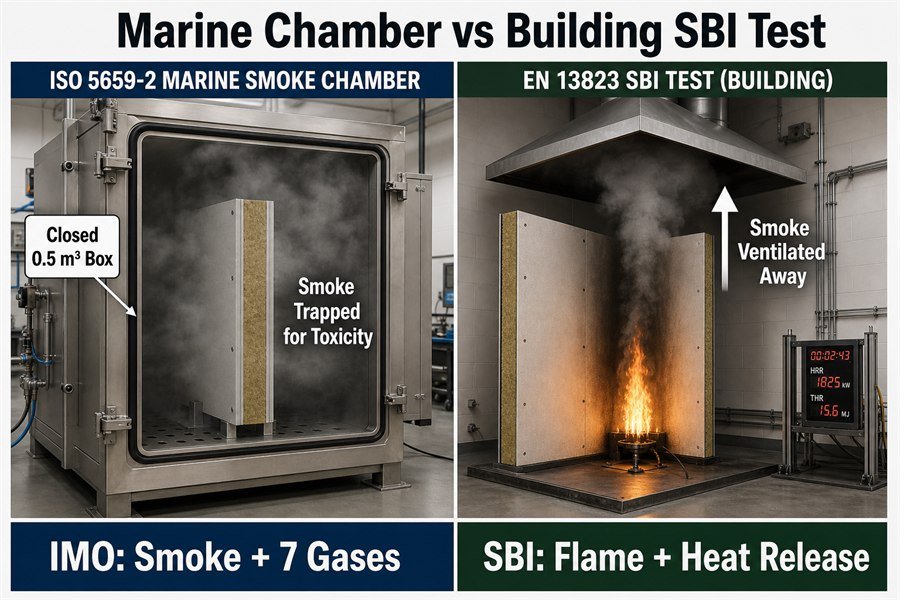
Marine smoke chambers differ from building material tests in size, heat exposure, and measurement scope. Marine tests use a closed 0.5-cubic-meter ISO 5659-2 chamber capturing all smoke for toxicity, whereas building tests often use open-air flow like the SBI test (EN 13823) focusing primarily on flame spread and heat release.
Many procurement officers try to save money by buying regular building materials. They tell me the building panels already passed land-based fire tests. But ships are not hotels. If a hotel catches fire, you can run outside. If a ship catches fire, you are trapped in a steel box on the ocean. Therefore, the International Maritime Organization uses a very different testing method.
Understanding the Closed Marine Smoke Chamber (ISO 5659-2)
The marine test relies entirely on the ISO 5659-2 chamber. This is a closed box. I mentioned before that it is exactly 0.5 cubic meters5. The box is sealed tight. When the panel sample burns under the 25 kW/m² heater6, the smoke has nowhere to go. It builds up inside the small space. This simulates a small ship cabin with a closed door. The test measures how quickly the room goes completely dark. It also holds all the poison gases inside so the lab can measure the exact toxicity. Because the box is closed, the conditions become extreme very quickly.
Why Open-Air Building Tests Fail Marine Standards
Building material tests work completely differently. A common European building test is the Single Burning Item (SBI) test, also known as EN 13823. The SBI test places the panel in a large corner setup. A big fire burns at the bottom. But the room is not sealed. A large exhaust fan pulls the smoke away through a pipe. The SBI test mostly cares about how fast the flame travels up the wall and how much heat the wall creates.
Because the SBI test constantly pulls fresh air into the room, the smoke never gets extremely thick. The building test also does not usually measure the exact parts per million of the seven toxic gases like the IMO code does7. A standard commercial wall panel will easily pass the EN 13823 test. But if you put that same panel into the closed ISO 5659-2 marine chamber, it will fail the smoke density limit in just a few minutes.
| Feature | Marine Test (IMO FTP Part 2) | Building Test (EN 13823 / SBI) |
|---|---|---|
| Chamber Type | Completely closed box | Open room with exhaust fan |
| Chamber Volume | 0.5 cubic meters | Large test room |
| Primary Focus | Smoke density and 7 toxic gases | Flame spread and heat release rate |
| Smoke Escape | None. Smoke is trapped. | Smoke is pulled out by ventilation. |
| Heat Source | 25 kW/m² radiant cone | 30 kW sand-box gas burner |
What Thresholds Apply to Marine Interior Panel Smoke and Toxicity?
A failed lab report means your decorative panels cannot go on the ship. Missing the legal thresholds costs you the whole project. Here are the exact numbers to meet.
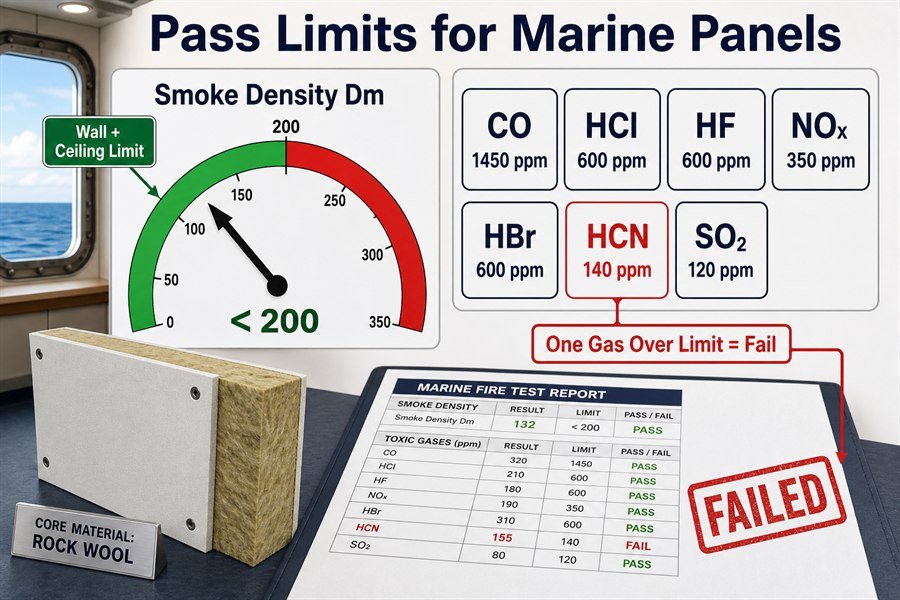
For marine interior panels, the IMO FTP Code sets strict thresholds: maximum specific optical smoke density (Dm) must not exceed 200. For toxicity, maximum limits are: CO 1450 ppm, HCl 600 ppm, HF 600 ppm, NOx 350 ppm, HBr 600 ppm, HCN 140 ppm, and SO2 120 ppm.
When you get a test report from a supplier, you need to read the numbers. Many factory sales reps will just say "We passed." But you must check the actual data. If the numbers are very close to the legal limit, the factory has poor quality control.8 The next batch of panels might fail. Let us break down the exact numbers you need to look for on the lab certificate.
Understanding the Maximum Optical Smoke Density Limit (Dm < 200)
Smoke density is measured by a value called "Dm". Dm stands for maximum specific optical density. The IMO FTP Code Part 2 sets different rules depending on where you put the material. For marine wall panels and marine ceiling panels, the maximum Dm must be less than 200. This number is absolute. If a wall panel scores 201, it fails.
Floor coverings have a slightly easier rule. The maximum Dm for floor coverings must be less than 500.9 Why is the floor rule different? Because smoke goes up. In a real fire, people crawl on the floor to find clean air. Ceiling and wall panels burn at eye level and trap the smoke up high. So, the rules for walls and ceilings are much stricter. A Dm of 200 means a person can still see exit signs in a hallway for a few minutes while escaping.10
Adhering to the Maximum Parts Per Million for Toxic Gases
The toxicity thresholds are the same for walls, ceilings, and floors. The lab takes the gas sample when the smoke density hits its peak. The IMO FTP Code provides hard limits for all seven gases in parts per million (ppm).
Carbon Monoxide (CO) cannot go over 1450 ppm. Hydrochloric Acid (HCl) cannot go over 600 ppm. Hydrogen Fluoride (HF) also has a limit of 600 ppm. Nitrogen Oxides (NOx) must stay under 350 ppm. Hydrogen Bromide (HBr) is limited to 600 ppm. Hydrogen Cyanide (HCN) is extremely dangerous, so its limit is very low: just 140 ppm. Finally, Sulfur Dioxide (SO2) has the lowest limit at 120 ppm. If even one gas goes over its limit, the entire panel fails the test.
| Test Metric | Limit for Wall & Ceiling Panels | Limit for Floor Coverings |
|---|---|---|
| Max Smoke Density (Dm) | Less than 200 | Less than 500 |
| Carbon Monoxide (CO) | Max 1450 ppm | Max 1450 ppm |
| Hydrochloric Acid (HCl) | Max 600 ppm | Max 600 ppm |
| Hydrogen Fluoride (HF) | Max 600 ppm | Max 600 ppm |
| Hydrogen Cyanide (HCN) | Max 140 ppm | Max 140 ppm |
| Sulfur Dioxide (SO2) | Max 120 ppm | Max 120 ppm |
How Are Smoke Density and Toxicity Evaluated Together for Marine Interior Panels?
Good smoke results do not matter if toxicity is high. Balancing both is very hard for cheap suppliers. Here is how testing labs evaluate these two factors together.
Smoke density and toxicity are evaluated together in a single continuous test under the IMO FTP Code Part 2. The panel must pass both metrics simultaneously under multiple heat scenarios (flaming and non-flaming). Failing either the Dm limit of 200 or any single toxic gas limit means total product failure.
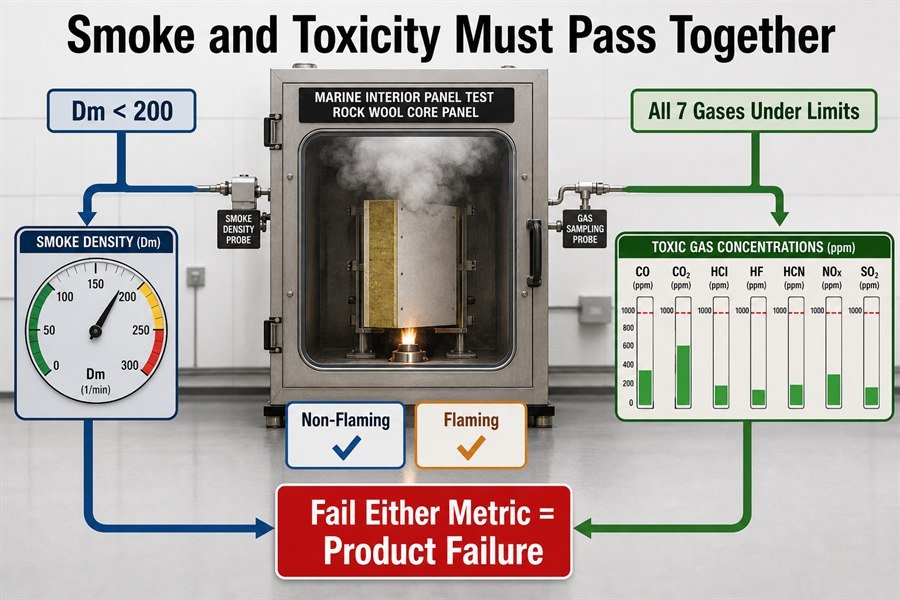
When you negotiate prices with factories in China or Vietnam, you must remember this test. A factory might use a cheap fireproof glue. This glue might keep the smoke density very low. But that same cheap glue might release too much Hydrogen Cyanide. The factory cannot fix one problem and ignore the other. The IMO rules force the manufacturer to balance both.
The Simultaneous Testing Process for Smoke and Gas
The lab does not do a smoke test on Monday and a toxicity test on Tuesday. They test both at the exact same time. During the 20-minute test in the 0.5-cubic-meter box11, the computer constantly watches the light sensor for the Dm value. When the light sensor detects the thickest smoke, the computer triggers the gas collection tubes.
This means the toxicity is measured at the worst possible moment of the fire. If the panel produces low smoke but high poison gas, it fails. If it produces thick black smoke but zero poison gas, it fails. Both conditions must pass. For a marine interior outfitting factory, passing this combined test requires high-quality raw materials. They must use marine-grade rockwool, specialized steel plates, and low-toxicity PVC or PET surface films.
How Flaming and Non-Flaming Conditions Affect Results
The lab evaluates the panels under both flaming and non-flaming conditions. This is the hardest part for suppliers. A panel might pass all limits under the flaming test. But when the lab turns off the pilot flame for the non-flaming test, the panel might smolder. Smoldering fires often create much more smoke and much more Carbon Monoxide.12
The panel must pass the Dm limit and the seven gas limits in BOTH conditions. This results in four complete sets of data. One single failure in any of the four sets ruins the certificate. A real IMO fire test costs between $3,000 and $5,000 USD at a certified lab like DNV or ABS. If a cheap factory fails, they lose money and time. For you, the buyer, this means a massive delay in your delivery schedule. Always demand to see the full IMO test report before you pay a deposit.
| Test Scenario | Smoke Density (Dm) Result | Toxicity Result (7 Gases) | Final Outcome |
|---|---|---|---|
| Non-Flaming | Pass (Dm < 200) | Pass (All under limits) | Proceed to next test |
| Flaming | Pass (Dm < 200) | Pass (All under limits) | Total Pass (Certificate Issued) |
| Non-Flaming | Fail (Dm = 250) | Pass (All under limits) | Total Failure |
| Flaming | Pass (Dm = 150) | Fail (HCN = 200 ppm) | Total Failure |
Conclusion
Marine interior panels must pass strict IMO smoke and toxicity tests to keep ships safe. Knowing these standards helps you buy the right panels and keep your shipyard clients happy.
-
"What Is the Purpose and Scope of the IMO FTP Code?", https://magellanmarinetech.com/what-purpose-scope-of-imo-ftp-code/. The IMO 2010 FTP Code’s smoke and toxicity test specifies measurement of carbon monoxide, hydrogen chloride, hydrogen fluoride, nitrogen oxides, hydrogen bromide, hydrogen cyanide, and sulfur dioxide in combustion effluents. Evidence role: definition; source type: institution. Supports: The IMO 2010 FTP Code monitors seven specified toxic gases during smoke/toxicity testing.. Scope note: This supports the regulated-gas list for the relevant FTP Code test method, not the toxicity performance of any specific panel product. ↩
-
"Toxicity of the Pyrolysis and Combustion Products of Poly ...", https://www.nist.gov/publications/toxicity-pyrolysis-and-combustion-products-polyvinyl-chlorides-literature-assessment. Studies of polyvinyl chloride combustion and thermal decomposition report hydrogen chloride as a major acid gas product, reflecting the chlorine content of the polymer. Evidence role: mechanism; source type: paper. Supports: PVC-containing materials can release hydrogen chloride when heated or burned.. Scope note: The quantity released depends on formulation, additives, temperature, ventilation, and fire conditions. ↩
-
"Brominated flame retardant", https://en.wikipedia.org/wiki/Brominated_flame_retardant. Combustion research on brominated flame-retarded polymers identifies hydrogen bromide as a common bromine-containing fire effluent and notes its irritant and toxic character. Evidence role: mechanism; source type: paper. Supports: Brominated flame-retarded plastics can release toxic hydrogen bromide during burning.. Scope note: This is general support for brominated materials; actual HBr yields vary by polymer, flame retardant chemistry, and combustion conditions. ↩
-
"Hydrogen Cyanide (AC): Systemic Agent | NIOSH", https://www.cdc.gov/niosh/ershdb/emergencyresponsecard_29750038.html. Public-health toxicology sources describe hydrogen cyanide as a rapidly acting systemic poison that can cause death within minutes after high-level inhalation exposure by disrupting cellular oxygen use. Evidence role: expert_consensus; source type: government. Supports: High-concentration hydrogen cyanide exposure can rapidly be fatal within minutes.. Scope note: The timing and lethality are concentration-dependent and cannot be inferred for all smoke exposures. ↩
-
"Effects of Moisture Content and Burning Period on Concentration ...", https://www.academia.edu/80073318/Effects_of_Moisture_Content_and_Burning_Period_on_Concentration_of_Smoke_Particles_and_Particle_Bound_Polycyclic_Aromatic_Hydrocarbons_from_Rubber_Wood_Combustion. Technical descriptions of ISO 5659-2 identify the smoke-density apparatus as a closed chamber of approximately 0.5 m³, used to measure optical smoke density from burning material specimens. Evidence role: definition; source type: paper. Supports: The ISO 5659-2 smoke chamber has a chamber volume of 0.5 cubic meters.. Scope note: Many accessible sources summarize ISO 5659-2 rather than reproducing the full standard, which is usually paywalled; the citation should be checked against an authoritative standard description where possible. ↩
-
"Toxicity Test Requirements and Performance Criteria for ...", https://railroads.dot.gov/sites/fra.dot.gov/files/2021-02/Toxicity%20Test%20and%20Performance%20Criteria.pdf. ISO 5659-2-based smoke-density testing commonly exposes specimens to a specified external radiant heat flux, including a 25 kW/m² condition used in marine smoke and toxicity assessment. Evidence role: mechanism; source type: institution. Supports: The marine smoke test can expose panel samples to a 25 kW/m² radiant heat source.. Scope note: Some ISO 5659-2 applications use multiple irradiance and flaming/non-flaming conditions, so the citation should support the specific 25 kW/m² condition in the marine FTP context. ↩
-
"What Smoke Toxicity and Density Limits Must Marine Wall and ...", https://magellanmarinetech.com/what-smoke-toxicity-density-limits-must-marine-wall-ceiling-panels-meet/. IMO FTP Code Part 2 smoke and toxicity procedures require analysis of specified toxic combustion gases, commonly listed as CO, HCl, HBr, HF, HCN, NOx, and SO₂, in addition to smoke density measurements. Evidence role: definition; source type: institution. Supports: The IMO marine smoke test measures seven specified toxic gases.. Scope note: The citation supports the gases required under the IMO marine procedure; it does not establish the toxicity profile of any particular wall panel without product-specific test data. ↩
-
"6. Process or Product Monitoring and Control", https://www.itl.nist.gov/div898/handbook/toolaids/pff/pmc.pdf. A process-capability source explains that measurements close to a specification limit indicate limited capability margin and a higher probability of nonconforming future output, supporting the quality-control interpretation in this sentence. Evidence role: mechanism; source type: education. Supports: Test results close to a legal limit can indicate weak process capability and increased risk that later batches may fail.. Scope note: This would support the general statistical reasoning, not prove that any specific supplier has poor quality control. ↩
-
"What Is the Purpose and Scope of the IMO FTP Code?", https://magellanmarinetech.com/what-purpose-scope-of-imo-ftp-code/. The IMO FTP Code Part 2 distinguishes floor coverings from wall and ceiling linings and specifies a higher maximum specific optical density criterion, commonly summarized as Dm below 500 for floor coverings. Evidence role: case_reference; source type: institution. Supports: Floor coverings under IMO FTP Code Part 2 are subject to a maximum smoke-density limit of Dm below 500.. Scope note: This supports the regulatory threshold but not the article’s explanatory rationale for why the floor-covering limit differs. ↩
-
"Evaluation of exit signs in clear and smoke conditions", https://nvlpubs.nist.gov/nistpubs/Legacy/IR/nistir4399.pdf. Fire-safety research on smoke optical density and visibility explains the relationship between smoke obscuration and the ability to see signs or egress routes, providing contextual support for linking lower smoke-density values to evacuation visibility. Evidence role: mechanism; source type: research. Supports: Lower smoke optical density can improve visibility of exit signs and evacuation routes during escape.. Scope note: Such sources may not directly prove that Dm 200 guarantees exit-sign visibility for a few minutes in every hallway, since visibility depends on geometry, lighting, sign type, ventilation, and fire growth. ↩
-
"What Is the Purpose and Scope of the IMO FTP Code?", https://magellanmarinetech.com/what-purpose-scope-of-imo-ftp-code/. ISO 5659-2 describes a smoke-density test using a 0.5 m³ chamber and a 20-minute exposure period, which is incorporated into marine smoke and toxicity testing procedures. Evidence role: definition; source type: institution. Supports: The smoke and gas test uses a 20-minute procedure in a 0.5-cubic-meter chamber.. Scope note: The source supports the test apparatus and duration; specific marine pass/fail limits are defined separately in the IMO FTP Code. ↩
-
"A Comparison of Carbon Monoxide Gas Sensing to ...", https://tsapps.nist.gov/publication/get_pdf.cfm?pub_id=923413. Fire-safety research describes smoldering combustion as an incomplete, low-temperature process that can produce substantial smoke and elevated carbon monoxide compared with more efficient flaming combustion. Evidence role: mechanism; source type: paper. Supports: Smoldering combustion can generate higher smoke and carbon monoxide levels than flaming combustion.. Scope note: The source would support the general combustion mechanism; actual smoke and carbon monoxide output depends on the material, ventilation, and test conditions. ↩