Smoke in a ship fire causes instant panic. It stops evacuation. If the crew cannot see, they cannot escape. Good visibility saves lives during marine emergencies.
Smoke visibility matters for marine accommodation panels because dense smoke obscures escape routes, causes disorientation, and increases evacuation time. Low-smoke panels ensure passengers can see exit signs and low-level lighting, which is required by SOLAS regulations to maintain a safe evacuation path during a fire.
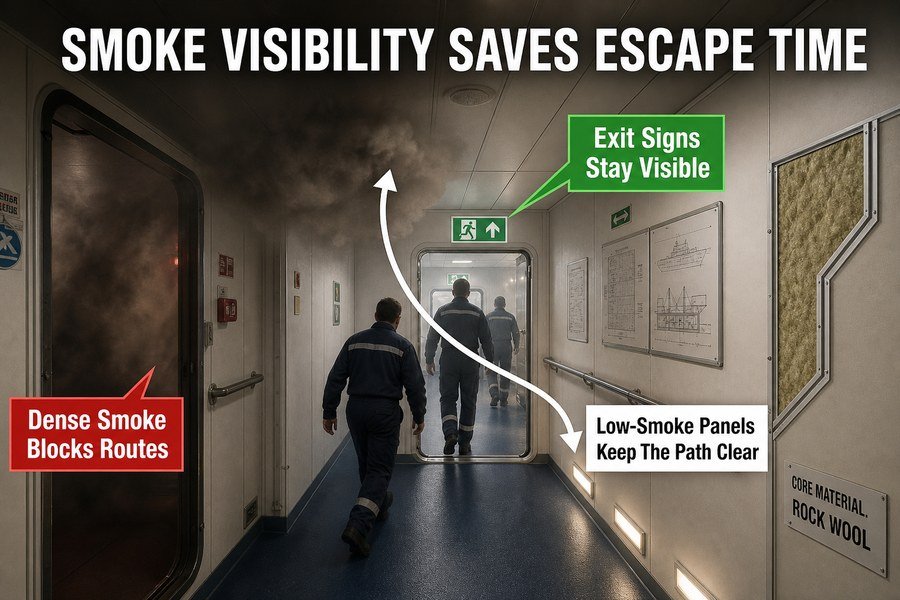
Choosing the right marine wall and ceiling panels is hard. You want a low price. But you also need high quality. If you buy cheap panels that create heavy smoke, your shipyard client will fail the safety inspection. Let us look deeper into this problem.
How Does Marine Accommodation Panel Smoke Reduce Escape-Route Visibility?
Thick smoke blinds people in ship corridors. If panels burn and release black smoke, escape routes become dead ends. How does this happen exactly?
Marine accommodation panel smoke reduces escape-route visibility through three main mechanisms: light absorption by carbon particles, light scattering by aerosols, and physical eye irritation from toxic gases. These combined factors block emergency lighting and prevent passengers from finding exits in confined ship corridors.
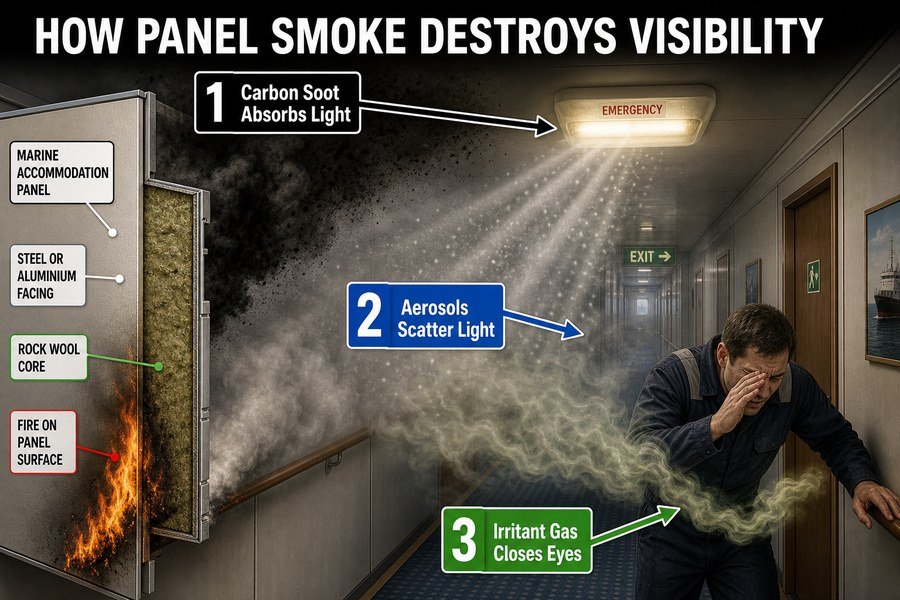
I see many buyers look for suppliers in China or Vietnam to save money. They often buy panels with poor quality decorative films or cheap adhesives. When a fire happens, these cheap materials burn. They create smoke that stops people from escaping. The first mechanism is light absorption by carbon particles. When poor quality PVC finishes burn, they release heavy black soot.1 This soot absorbs the light from emergency lamps.2 The corridor goes completely dark. I always tell my clients to check the soot yield of the surface materials. You must ask your factory for this data.
The second mechanism is light scattering by aerosols. Sometimes, the core material, like cheap glue inside a sandwich panel, burns and creates white or gray smoke. This smoke is full of tiny liquid drops called aerosols. These aerosols act like tiny mirrors. When the ceiling lights shine on them, the light scatters in all directions.3 It creates a thick fog. People lose their sense of direction. They cannot see the walls or the doors.
The third mechanism is physical eye irritation from toxic gases. Burning plastics release gases like hydrogen chloride. This gas mixes with the moisture in human eyes. It creates a weak acid. It causes severe pain and forces people to close their eyes. Even if there is some light left, they cannot open their eyes to see it. All three mechanisms work together to destroy visibility. If you supply interior decoration projects for large shipyards in Europe or the US, they will test your materials for these exact problems.
Light Absorption by Carbon Particles in Marine Panels
Carbon particles are the main reason for black smoke. High-quality marine wall panels use low-carbon decorative finishes. They do not release enough soot to absorb emergency lighting. According to the Society of Fire Protection Engineers (SFPE) Handbook, soot particles larger than 0.5 micrometers are highly effective at absorbing visible light.
Aerosol Light Scattering and Physical Eye Irritation
Aerosols create a fog effect. They bounce light away from the human eye. At the same time, irritant gases make it impossible to look for exits. The SFPE notes that a concentration of just 50 parts per million (ppm) of hydrogen chloride causes immediate eye watering and involuntary eye closure.4
| Mechanism | Main Cause in Marine Panels | Effect on Visibility |
|---|---|---|
| Light Absorption | Carbon soot from PVC films | Makes the corridor completely dark |
| Light Scattering | Aerosols from cheap adhesives | Creates a blinding fog |
| Eye Irritation | Acid gases (Hydrogen Chloride) | Forces people to close their eyes |
What Is a Safe Visibility Distance During Marine Accommodation Panel Fires?
You need to see the exit door to reach it. But how far is safe? If the distance is too short, people get lost.
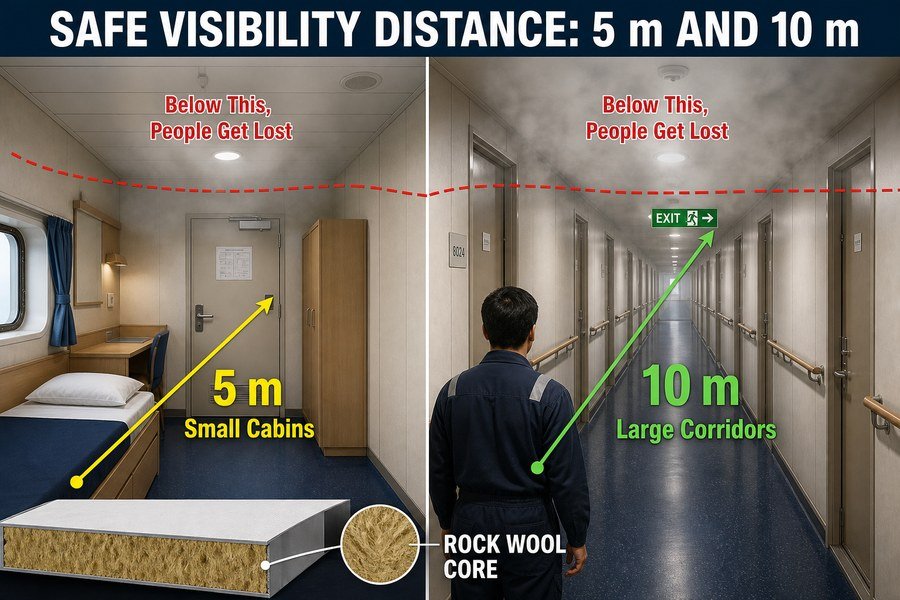
A safe visibility distance during marine accommodation panel fires is defined as 5 to 10 meters. The IMO and SFPE guidelines state that a minimum visibility of 10 meters is required for large ship spaces and 5 meters for small cabins to ensure safe evacuation.
When you buy marine outfitting products, you must understand the rules of the shipyards. European and American shipyards strictly follow the International Maritime Organization (IMO) rules. The IMO Fire Safety Systems (FSS) Code demands clear escape routes. A key part of this is the safe visibility distance. I help many procurement officers solve technical issues with their local sales reps. The first thing we check is if the panel supports the 5-meter and 10-meter visibility rules during a fire.
The first standard is the 5-meter rule for small spaces. The SFPE Handbook (3rd Edition) states that in small rooms, like a standard crew cabin or a small office on a ship, passengers must be able to see at least 5 meters ahead5. If the visibility drops below 5 meters, a person will hit walls and furniture. They will not find the door handle. I always advise buyers to select ceiling panels that guarantee this 5-meter visibility for at least the first 10 minutes of a fire. This gives a sleeping crew member enough time to wake up and get out.
The second standard is the 10-meter rule for large spaces. For long public corridors, dining rooms, and large public spaces on a ship, the requirement is 10 meters. In a long corridor, a 5-meter visibility is not enough. A passenger must see the green exit sign at the end of the hallway. If the marine wall panels produce too much smoke and cut the visibility down to 8 meters, people will walk in the wrong direction. They will waste precious time. High-quality panels from reliable suppliers will pass tests proving they keep the smoke thin enough to meet this 10-meter rule.
Visibility Requirements for Small Ship Cabins (5 Meters)
Small cabins require a minimum visibility of 5 meters. This ensures a person can see the main cabin door from their bed. A standard marine cabin is usually 3 to 4 meters long, so a 5-meter visibility covers the entire room.
Visibility Standards for Large Marine Corridors (10 Meters)
Long corridors and public spaces need 10 meters of visibility6. This distance allows passengers to spot illuminated exit signs or low-location lighting systems. The IMO FSS Code Chapter 13 requires escape routes to be marked, and these marks are useless if smoke reduces visibility below 10 meters.
| Space Type | Minimum Visibility Distance | Source Standard | Reason |
|---|---|---|---|
| Small Cabins | 5 meters (16 feet) | SFPE Guidelines | Allows finding the cabin door from the bed |
| Large Corridors | 10 meters (32 feet) | SFPE & IMO FSS Code | Allows spotting exit signs down the hallway |
How Does Marine Ceiling Panel Smoke Affect Corridor Evacuation Times?
Fast evacuation is critical on a burning ship. Ceiling panels that produce smoke slow people down. How much time is lost?
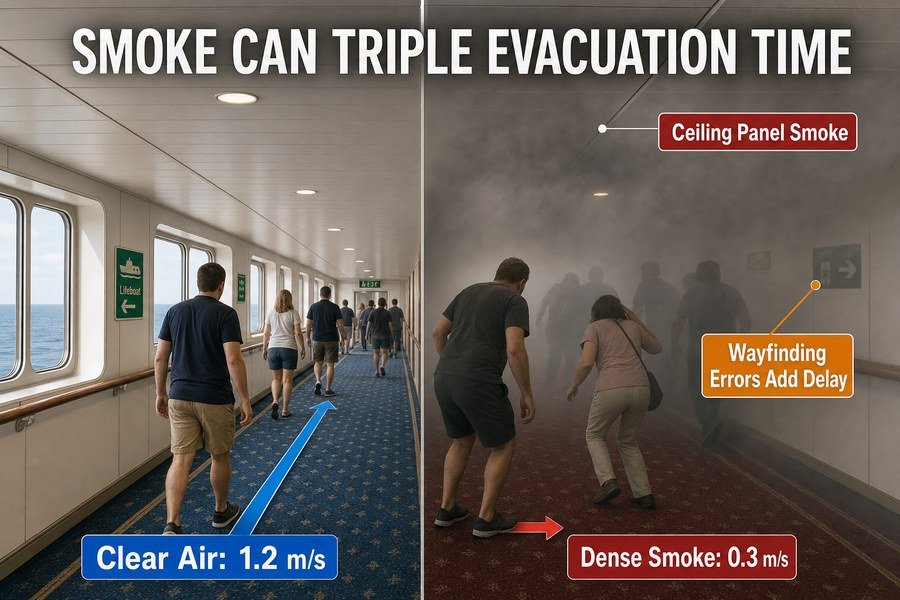
Marine ceiling panel smoke affects corridor evacuation times by reducing walking speed from a normal 1.2 meters per second down to 0.3 meters per second. It also increases decision-making time and causes wayfinding errors, potentially tripling the total time needed to abandon ship.
Many buyers focus only on price and certifications. They forget how the product actually performs in a real emergency. The lead time and cost are important. But if a marine ceiling panel creates heavy smoke, the shipyard will face huge problems during safety drills. The smoke directly changes how fast people can escape. I have seen this happen. The smoke affects evacuation times in three specific ways: walking speed, decision-making time, and wayfinding errors.
First, smoke drastically reduces walking speed. On a normal day, a person walks down a ship corridor at a speed of 1.2 meters per second7. This is the standard speed used in evacuation models by the IMO. However, when smoke fills the corridor, people cannot see the floor. They become scared of tripping over door sills or cables. According to studies by the SFPE, when the smoke extinction coefficient reaches 0.5 per meter (thick smoke), the average walking speed drops down to 0.3 meters per second8. This means a walk that normally takes 10 seconds will now take 40 seconds.
Second, smoke increases decision-making time. When people hear a fire alarm, they do not run immediately9. They look around to understand what is happening. If the ceiling panels release thick smoke instantly, people freeze. They spend valuable time trying to figure out if it is a real fire or a false alarm.
Third, smoke causes wayfinding errors. A ship is a complex maze of steel corridors. When smoke hides the signs, people take the wrong turns. They walk into dead ends. They have to turn back. This extra walking can double or triple the total evacuation time. When you buy interior outfitting products, you must choose low-smoke ceiling panels10. They keep the walking speed high and prevent wayfinding errors.
Reduction of Walking Speeds in Smoke-Filled Ship Corridors
Smoke directly forces people to walk slower. They shuffle their feet to avoid tripping. The SFPE data shows a direct link between smoke density and human walking speed, dropping from a normal pace of 1.2 m/s to a very slow crawl of 0.3 m/s.
Impact of Smoke on Decision-Making and Wayfinding Times
Without clear vision, people make bad decisions. They take wrong turns in ship corridors. Wayfinding errors are the leading cause of death in large ship fires, as people get trapped in areas far away from the lifeboats.
| Smoke Condition | Extinction Coefficient | Average Walking Speed | Evacuation Delay |
|---|---|---|---|
| Clear Air | 0.0 per meter | 1.2 meters per second | None |
| Light Smoke | 0.2 per meter | 0.8 meters per second | Moderate |
| Dense Smoke | 0.5 per meter | 0.3 meters per second | Severe (Triples time) |
Why Do Low-Smoke Marine Ceiling Panels Improve Passenger Safety?
Buying cheap panels puts lives at risk. Low-smoke panels cost more, but they protect passengers. Why are they so effective?
Low-smoke marine ceiling panels improve passenger safety by extending the available safe egress time (ASET), keeping emergency low-location lighting (LLL) visible, and reducing toxic gas inhalation. These three benefits ensure passengers can exit the ship before conditions become fatal.
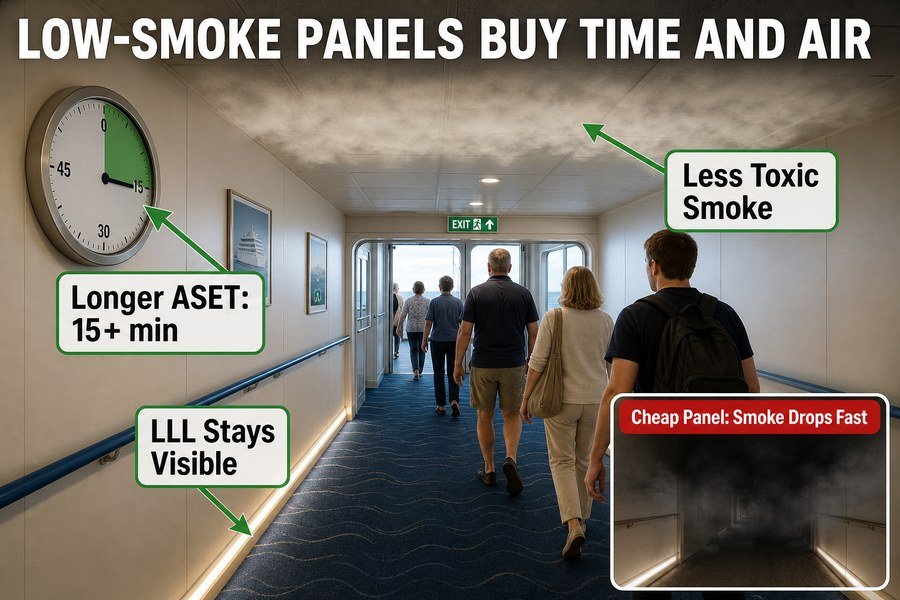
When you negotiate with suppliers in developing countries, you might find some very low prices. But you must ask them if their panels are truly low-smoke. I know communication with local sales in English can be difficult. You just need to ask for their IMO test reports. Low-smoke ceiling panels are crucial for winning contracts with high-end shipyards. They improve safety in three very measurable ways.
First, they extend the Available Safe Egress Time (ASET)11. ASET is a strict engineering term. It means the amount of time between the start of the fire and the moment the environment becomes deadly. If a cheap panel burns, the room fills with smoke in 3 minutes. The ASET is 3 minutes. If you use a high-quality low-smoke panel with a good rockwool core, the room might take 15 minutes to fill with smoke. The ASET becomes 15 minutes. This gives the crew much more time to guide passengers to safety.
Second, low-smoke panels keep the Low-Location Lighting (LLL) visible. The SOLAS Convention Chapter II-2 Regulation 13 mandates that all ships carrying more than 36 passengers must have LLL systems. These are the glowing strips on the deck or at the bottom of the wall panels. Smoke rises to the ceiling first. If the ceiling panel produces massive amounts of heavy smoke, the smoke layer drops to the floor very quickly. It covers the LLL strips. Low-smoke ceiling panels keep the smoke layer high. They allow the LLL strips to guide people out.
Third, low-smoke panels reduce toxic gas inhalation. Smoke is not just dark air; it is poison. Less smoke means less carbon monoxide. This stops passengers from passing out in the hallways. When you buy these panels, you are buying time and air for the people on the ship.
Extending Available Safe Egress Time (ASET) with Low-Smoke Panels
ASET is the critical window for survival. High-quality marine ceiling panels delay the production of thick smoke. This delay extends the ASET from a dangerous 3 minutes to a much safer 15 minutes12, allowing for full ship evacuation.
Maintaining Visibility of Marine Low-Location Lighting (LLL) and Reducing Toxicity
SOLAS Chapter II-2 Regulation 13 requires LLL strips to guide passengers. Low-smoke panels prevent the smoke layer from descending to the floor, ensuring these lights remain visible. They also limit the release of toxic carbon monoxide.
| Safety Benefit | Standard Cheap Panel | High-Quality Low-Smoke Panel |
|---|---|---|
| Available Safe Egress Time (ASET) | Short (approx. 3 to 5 minutes) | Long (approx. 15 to 20 minutes) |
| Low-Location Lighting Visibility | Blocked quickly | Remains visible |
| Toxic Gas Levels | High Carbon Monoxide | Low Carbon Monoxide |
How Is Light Transmission Loss Quantified in Marine Interior Panel Tests?
We cannot just guess if a panel is safe. We must measure the smoke exactly. How do labs test this light loss?
Light transmission loss in marine interior panel tests is quantified using the IMO FTP Code Part 2 test. It measures the specific optical density and maximum optical density. A photometric system uses a light beam to measure the exact percentage of obscured light.
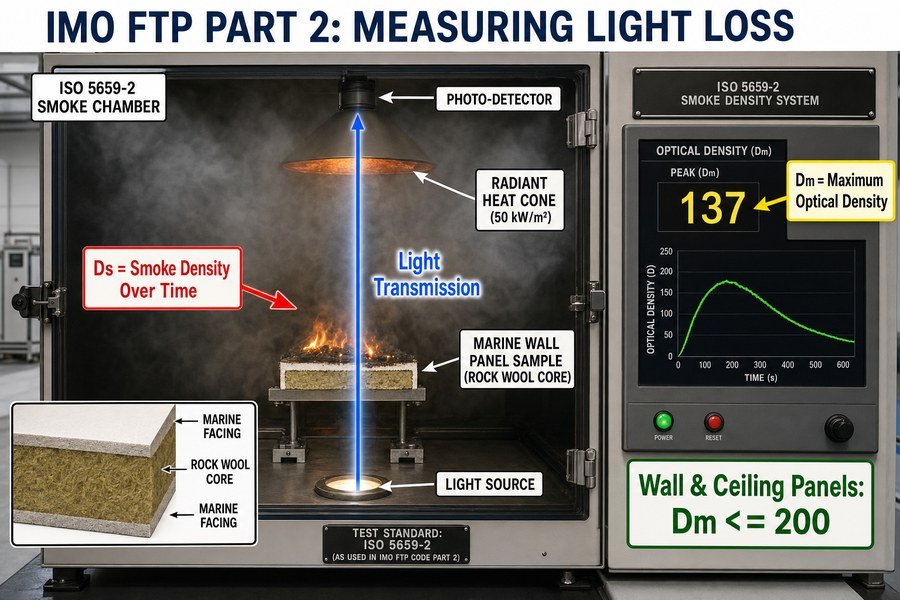
When you purchase a marine fire door or a wall panel, the factory will send you a test certificate. If you lack technical expertise, this paper looks like a mess of numbers. I have helped many buyers read these reports. You just need to look for one specific test: The IMO Fire Test Procedures (FTP) Code, Annex 1, Part 2. This test quantifies exactly how much smoke the panel makes. It measures three specific things: specific optical density, maximum optical density, and it uses a photometric system.
First, the lab measures the specific optical density. The symbol for this is Ds. They place a small piece of your marine panel inside a closed metal box. The box has a volume of exactly 0.51 cubic meters, according to the ISO 5659-2 standard. They burn the sample with a radiant heat cone. The smoke fills the box. The Ds value tells you the density of the smoke at any given minute during the test.
Second, the lab finds the maximum optical density. The symbol for this is Dm. This is the most important number on your certificate. It shows the peak thickness of the smoke during the whole test. The IMO has strict limits. For marine bulkheads and wall panels, the Dm value must not be greater than 200. For floor coverings, it must be under 400.13 If the factory in Asia gives you a panel with a Dm of 250 for a wall, it fails. You cannot sell it to the European shipyard.
Third, they use a photometric system to get these numbers. Inside the test box, there is a light bulb at the bottom and a light sensor at the top. The light shines up through the smoke. The sensor measures how much light makes it through. If the smoke blocks 50% of the light, the system calculates the optical density based on that exact light transmission loss. This is a scientific, completely exact method.
Understanding Specific Optical Density (Ds) in Marine Panel Testing
The specific optical density (Ds) measures smoke thickness over time. The test uses an ISO 5659-2 standard chamber of 0.51 cubic meters. A radiant heater burns the sample, and the Ds is recorded continuously to track smoke generation rates.
The Photometric System for Measuring Maximum Optical Density (Dm)
The Maximum Optical Density (Dm) is the highest Ds value reached during the test. The IMO FTP Code Part 2 requires that wall panels have a Dm below 200. A photometric system, using a light source and a photo-detector, measures this exact light loss.
| Material Type | IMO FTP Code Part 2 Limit (Maximum Optical Density - Dm) | Test Standard Used |
|---|---|---|
| Bulkheads and Wall Panels | Dm ≤ 200 | ISO 5659-2 Chamber |
| Ceiling Panels | Dm ≤ 200 | ISO 5659-2 Chamber |
| Floor Coverings | Dm ≤ 400 | ISO 5659-2 Chamber |
Conclusion
Smoke visibility directly impacts survival on a ship. By understanding these technical mechanisms and IMO test standards, you can confidently source high-quality, low-smoke marine panels for major shipyard projects.
-
"Releases of Fire-Derived Contaminants from Polymer Pipes ...", https://pmc.ncbi.nlm.nih.gov/articles/PMC6958356/. Combustion research on poly(vinyl chloride) and other chlorinated polymers documents that these materials can generate dense smoke and soot under fire conditions, supporting the general link between PVC finishes and black smoke. Evidence role: mechanism; source type: paper. Supports: Burning PVC decorative finishes can release heavy black soot.. Scope note: Such evidence would support PVC combustion behavior generally, but it would not prove that every low-cost decorative film has the same soot yield. ↩
-
"Measurement of Visible and Near-IR Optical Properties of ...", https://tsapps.nist.gov/publication/get_pdf.cfm?pub_id=861126. Smoke-optics studies identify carbonaceous soot as a strong absorber of visible radiation and a contributor to optical extinction, supporting the claim that soot can attenuate emergency lighting in smoke-filled spaces. Evidence role: mechanism; source type: research. Supports: Soot particles can absorb visible light from emergency lamps and reduce visibility.. Scope note: The source would support the optical mechanism, not the exact degree of darkness in a particular corridor. ↩
-
"Light Scattering Characteristics and Size Distribution of Smoke and ...", https://tsapps.nist.gov/publication/get_pdf.cfm?pub_id=861092. Aerosol optics literature shows that suspended droplets and fine particles scatter visible light, reducing contrast and producing fog-like visibility loss, which supports the described scattering mechanism. Evidence role: mechanism; source type: education. Supports: Aerosols in smoke scatter light from lamps and can create a fog-like loss of visibility.. Scope note: This would support aerosol light scattering generally, but not specifically prove that a given sandwich-panel adhesive produces such aerosols. ↩
-
"Hydrogen chloride - NIOSH Pocket Guide to Chemical ...", https://www.cdc.gov/niosh/npg/npgd0332.html. Fire toxicology or occupational-health references on hydrogen chloride exposure report strong eye and respiratory irritation at low tens-of-ppm concentrations, supporting the claim that HCl in fire smoke can impair vision and escape behavior. Evidence role: statistic; source type: government. Supports: Hydrogen chloride at about 50 ppm can cause immediate eye watering and involuntary eye closure.. Scope note: Reported irritation thresholds vary by exposure duration, individual sensitivity, and experimental method; the source should be checked for whether it specifically states 50 ppm and involuntary eye closure. ↩
-
"Visibility of Emergency Exit Signs and ...", https://publications.iafss.org/publications/aofst/6/5b-2/view/aofst_6-5b-2.pdf. Fire-safety engineering literature on human movement in smoke commonly uses minimum visibility distances of several meters for occupants to maintain orientation in small or familiar spaces, which provides contextual support for a 5-meter tenability threshold. Evidence role: expert_consensus; source type: paper. Supports: A 5-meter visibility distance is used in fire-safety engineering as a minimum threshold for orientation in small spaces.. Scope note: This is an engineering tenability guideline rather than a direct IMO requirement for marine ceiling or wall panels. ↩
-
"[PDF] Evaluation of exit signs in clear and smoke conditions", https://nvlpubs.nist.gov/nistpubs/Legacy/IR/nistir4399.pdf. Studies and fire-safety engineering handbooks on smoke visibility identify longer sight distances, often around 10 meters or more, as relevant for wayfinding and exit-sign recognition in larger or unfamiliar spaces. Evidence role: expert_consensus; source type: research. Supports: A 10-meter smoke visibility distance is an accepted fire-safety engineering target for wayfinding in larger or unfamiliar spaces.. Scope note: This supports the engineering rationale for a 10-meter target, but it does not by itself prove that IMO regulations impose a universal 10-meter requirement for all marine corridors. ↩
-
"(PDF) Simplified and Advanced Approaches for Evacuation ...", https://www.academia.edu/79095296/Simplified_and_Advanced_Approaches_for_Evacuation_Analysis_of_Passenger_Ships_in_the_Early_Stage_of_Design. IMO evacuation-analysis guidance uses specified walking-speed assumptions for passenger-ship evacuation modelling, providing a regulatory context for the stated clear-air walking speed. Evidence role: general_support; source type: institution. Supports: A person walks down a ship corridor at 1.2 meters per second, and this is the standard speed used in IMO evacuation models.. Scope note: The source may give speed ranges or model input values by population and route type rather than proving a universal corridor speed for every ship. ↩
-
"Reappraisal of Jin's visibility through fire smoke experiment", https://ui.adsabs.harvard.edu/abs/2026FirSJ.15904573C/abstract. Fire-safety engineering studies summarized in SFPE literature report that increasing smoke density or extinction coefficient reduces visibility and is associated with slower occupant walking speeds during evacuation. Evidence role: statistic; source type: paper. Supports: At a smoke extinction coefficient of 0.5 per meter, average walking speed can drop to about 0.3 meters per second.. Scope note: The exact 0.5 m⁻¹ to 0.3 m/s pairing may depend on the experimental population, route geometry, lighting, and the specific SFPE table or study cited. ↩
-
"Occupant Behavior in a High-rise Office Building Fire", https://www.nist.gov/document/tn1664pdf. Research on pre-evacuation behaviour shows that occupants often spend time interpreting alarms, seeking information, or confirming danger before beginning movement. Evidence role: mechanism; source type: paper. Supports: When people hear a fire alarm, they do not necessarily begin evacuation immediately.. Scope note: Most studies report general building-evacuation behaviour; transfer to shipboard settings is plausible but may require maritime-specific validation. ↩
-
"What Is the Purpose and Scope of the IMO FTP Code?", https://magellanmarinetech.com/what-purpose-scope-of-imo-ftp-code/. IMO fire-test procedures for shipboard materials include smoke and toxicity assessment for interior surface materials, supporting the relevance of low-smoke performance in marine outfitting. Evidence role: historical_context; source type: institution. Supports: Marine interior outfitting products, including ceiling panels, should be evaluated for low-smoke performance because smoke affects evacuation conditions.. Scope note: Such standards establish that smoke production is a regulated safety property, but they do not by themselves prove that any specific ceiling panel will maintain walking speed or prevent wayfinding errors in an actual fire. ↩
-
"Calculating Available Safe Egress Time (ASET)", https://www.nist.gov/publications/calculating-available-safe-egress-time-aset-computer-program-and-users-guide. Fire-safety engineering literature defines Available Safe Egress Time as the interval from ignition to conditions becoming untenable for occupants, commonly compared with Required Safe Egress Time in performance-based design. Evidence role: definition; source type: paper. Supports: ASET is an engineering term for the time from fire initiation until conditions become unsafe for occupants.. ↩
-
"https://dataverse.unc.edu/dataset.xhtml?persistent...", https://dataverse.unc.edu/dataset.xhtml?persistentId=doi:10.15139/S3/M8QFP0. Fire dynamics and evacuation studies show that smoke production, heat release, and tenability criteria can determine ASET and that lower smoke production may increase the time before untenable conditions occur. Evidence role: mechanism; source type: research. Supports: Lower-smoke ceiling materials can delay untenable smoke conditions and thereby extend ASET.. Scope note: This would support the general mechanism, not the specific 3-minute-to-15-minute improvement unless the source reports the same test scenario and materials. ↩
-
"What Has Changed in the 2010 IMO FTP Code Compared to ...", https://magellanmarinetech.com/what-has-changed-in-2010-imo-ftp-code-compared-to-the-original-version/. The IMO FTP Code Part 2 acceptance criteria set maximum specific optical density limits for certain shipboard surface materials, including lower limits for bulkhead, wall, and ceiling linings than for floor coverings. Evidence role: general_support; source type: institution. Supports: IMO FTP Code Part 2 sets Dm limits of 200 for bulkheads/wall panels and 400 for floor coverings.. Scope note: The source should be checked for the exact product category and edition of the FTP Code, because limits can depend on material classification and regulatory context. ↩