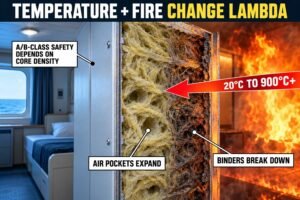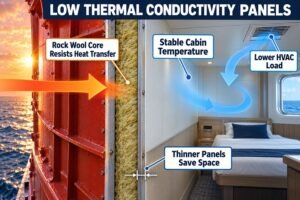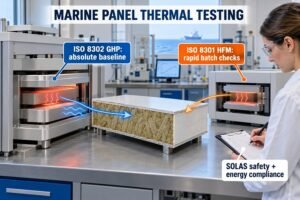
Toxic gases kill more people on ships than the actual flames. Are your interior panels putting crews at risk? Let us look at how panel materials dictate smoke safety.
Panel composition directly dictates marine interior panel toxic gas release. The core material, surface finishes, and adhesive binders combined determine the emission levels of carbon monoxide, hydrogen chloride, and hydrogen cyanide under IMO 2010 FTP Code Part 2 testing, ultimately deciding if a panel passes safety certifications.
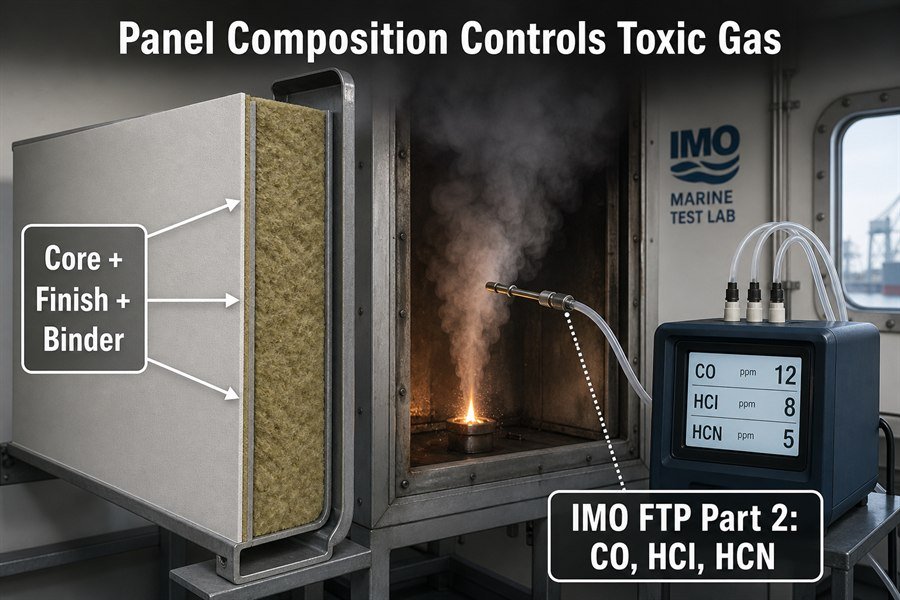
When you buy interior panels for large shipyards in Europe and the United States, failing smoke and toxicity tests means the whole project stops. Shipyards will reject the cargo, and you will lose money. I have seen many procurement officers struggle with this problem. To control quality and cost, you must understand the chemistry of the panels you buy from factories in Asia. Let me break down exactly how each panel component affects toxic gas release.
Which Marine Interior Panels Emit Hydrogen Cyanide During Combustion?
Hydrogen cyanide is deadly even in very small amounts. Are you worried your panels might fail tests due to this gas? We must check the core and resin types.
Marine interior panels containing polyurethane (PU) foams, polyisocyanurate (PIR) foams, or melamine-based resins emit hydrogen cyanide (HCN) during combustion. Any core or adhesive containing nitrogen-based organic polymers releases HCN when burned, requiring strict adherence to the IMO 2010 FTP Code limit of 140 ppm.
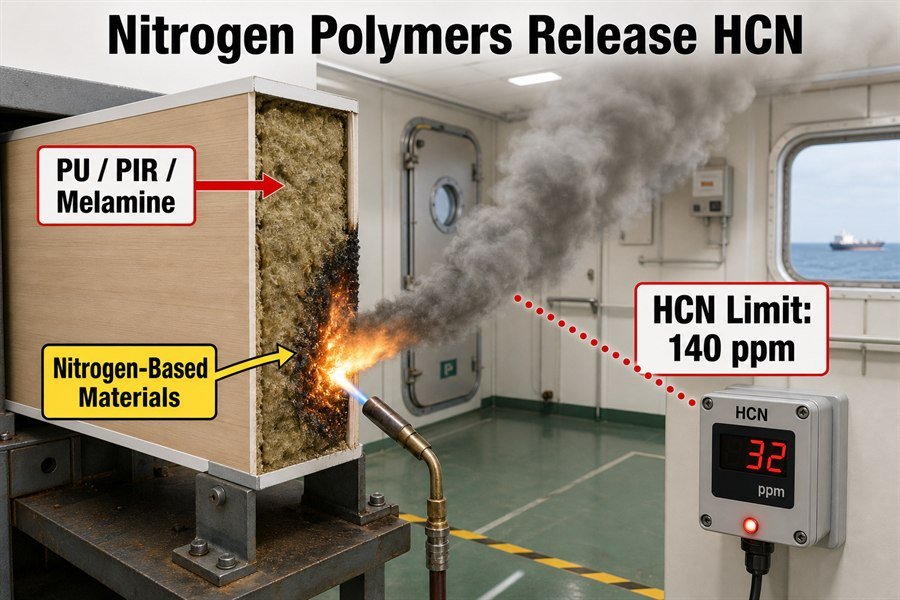
To understand why some panels fail the hydrogen cyanide test, we have to look at the chemical makeup of the materials. The rule is simple: if the material contains nitrogen, it will produce hydrogen cyanide (HCN) when it burns1. In the marine outfitting industry, we mainly see three materials that cause this problem: polyurethane (PU), polyisocyanurate (PIR), and melamine resins.
I always tell my clients to ask the factory exactly what is inside the panel. A cheap price often means cheap materials, and those materials are usually the ones that produce HCN. Let us look at how these three specific materials release this deadly gas.
Hydrogen Cyanide Emission from Polyurethane and PIR Cores
In the past, shipbuilders loved polyurethane (PU) foam. A standard PU core panel is cheap, costing about $15 to $25 per square meter, and it keeps the cabin warm. However, PU foam is an organic polymer that contains a lot of nitrogen. When a fire heats the PU foam, the molecular bonds break. The nitrogen reacts with carbon to form HCN gas.
Polyisocyanurate (PIR) is an upgraded version of PU foam. Factories use PIR because it resists fire slightly better than PU2. But do not let this fool you. PIR also contains a high amount of nitrogen. When PIR burns, it also releases high levels of HCN. According to the IMO 2010 FTP Code Part 2, the maximum allowed HCN limit is 140 ppm3. If your panel uses a thick PU or PIR core, the gas test will quickly show levels above 200 ppm, resulting in a failed certificate.
The Role of Melamine Resins in Hydrogen Cyanide Release
Melamine is the third major source of HCN. Factories often use melamine-based resins as a glue or as a hard surface coating on cheap furniture panels. Melamine is notorious because its chemical structure is about 66% nitrogen by mass.4
When a fire hits a melamine-treated surface, the material breaks down rapidly. This causes a sudden, sharp spike in HCN gas release during the first few minutes of the fire. Even if you use a safe rockwool core, applying a heavy layer of melamine resin can cause your panel to fail the IMO test.
| Material Type | Primary Location in Panel | Nitrogen Presence | Typical HCN Emission Risk |
|---|---|---|---|
| Polyurethane (PU) | Insulation Core | High | Very High (Often >140 ppm) |
| Polyisocyanurate (PIR) | Insulation Core | High | High (Close to 140 ppm) |
| Melamine Resin | Glue / Surface Coating | Very High | High (Causes rapid gas spikes) |
Do PVC Surfaces Raise HCl Emissions in Marine Accommodation Panels?
PVC films are cheap and look beautiful on cabin walls. But do they ruin your toxicity test results? Yes, PVC is a major risk factor for certification.
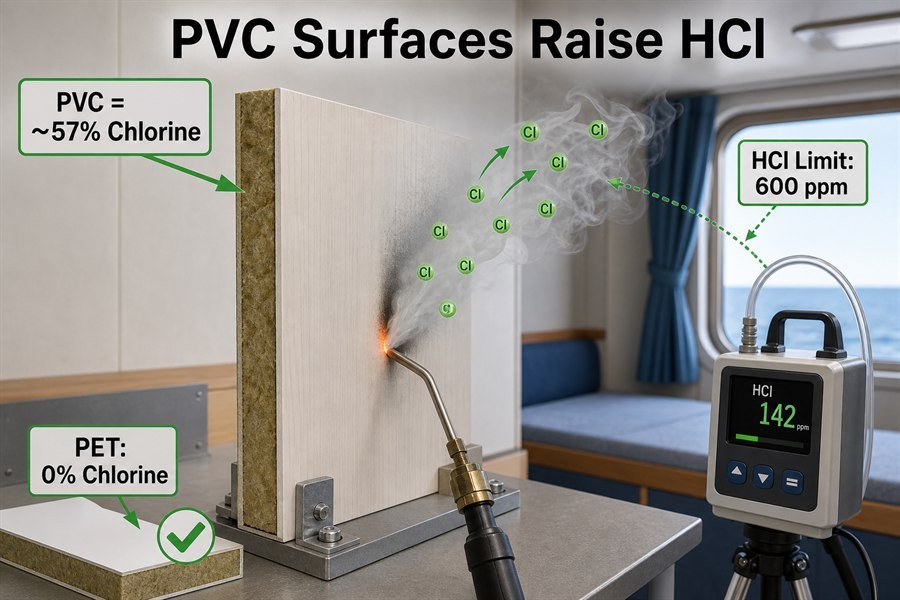
Yes, PVC (polyvinyl chloride) surfaces significantly raise HCl (hydrogen chloride) emissions in marine accommodation panels. Because PVC contains roughly 57% chlorine by weight, burning it releases high levels of corrosive and toxic HCl gas, often pushing emissions near the IMO limit of 600 ppm.
Many interior decoration companies buy panels with PVC surface films. PVC is very popular in China and Vietnam because it is easy to make and very cheap. A standard PVC film only adds about $1.50 to $2.00 per square meter to the panel cost. It gives the panel a nice wood grain or solid color look. However, from a technical safety perspective, PVC is a massive headache for marine outfitting.
To give you a complete picture, we must look at both the chemical makeup of PVC and the real-world impact of the hydrogen chloride gas it produces. If you do not control the PVC thickness, you will not be able to sell these panels to strict shipyards.
Chemical Makeup of PVC Surface Films
Polyvinyl chloride (PVC) is a plastic polymer. The important word here is "chloride". By total weight, PVC is approximately 57% chlorine.5 When a fire starts, the heat melts and burns the thin PVC film on the surface of your wall panel.
During this burning process, the chlorine atoms break away from the plastic chain. These chlorine atoms instantly mix with hydrogen in the air to form Hydrogen Chloride (HCl) gas6. Because the surface film burns first, this gas releases almost immediately when the fire touches the wall. The IMO 2010 FTP Code Part 2 strictly limits HCl emissions to 600 ppm. If the factory uses a thick PVC film, like 0.20mm or 0.25mm, the panel can easily release 400 to 550 ppm of HCl. This pushes your panel dangerously close to the failure line.
Impact of Hydrogen Chloride on Crew and Certification
HCl gas creates two severe problems. First, it is highly toxic to the crew. When inhaled, it burns the lungs and throat. Second, HCl gas is highly corrosive. When it mixes with the moisture in the air, it forms hydrochloric acid. This acid will eat through the expensive electronic equipment and wiring on the ship.
Because of this damage, European and American shipyards are becoming very strict about HCl levels. Many shipowners now demand "halogen-free" panels. This means they want panels with zero chlorine. To meet this demand, you must stop using PVC and switch to alternative films like PET (Polyethylene Terephthalate), which contains zero chlorine and produces zero HCl gas.
| Surface Film Type | Chlorine Content | Gas Produced on Burning | IMO HCl Limit |
|---|---|---|---|
| Standard PVC (0.15mm) | ~57% by weight | Hydrogen Chloride (HCl) | 600 ppm |
| Thick PVC (0.25mm) | ~57% by weight | Heavy Hydrogen Chloride | 600 ppm |
| PET Film (0.15mm) | 0% | Carbon Oxides only | 600 ppm |
How Do Mineral Cores Reduce Toxic Gas in Marine Wall Panels?
Combustible cores release heavy, toxic smoke. Are you struggling to meet the strict safety rules of European shipyards? Mineral cores are your best solution.
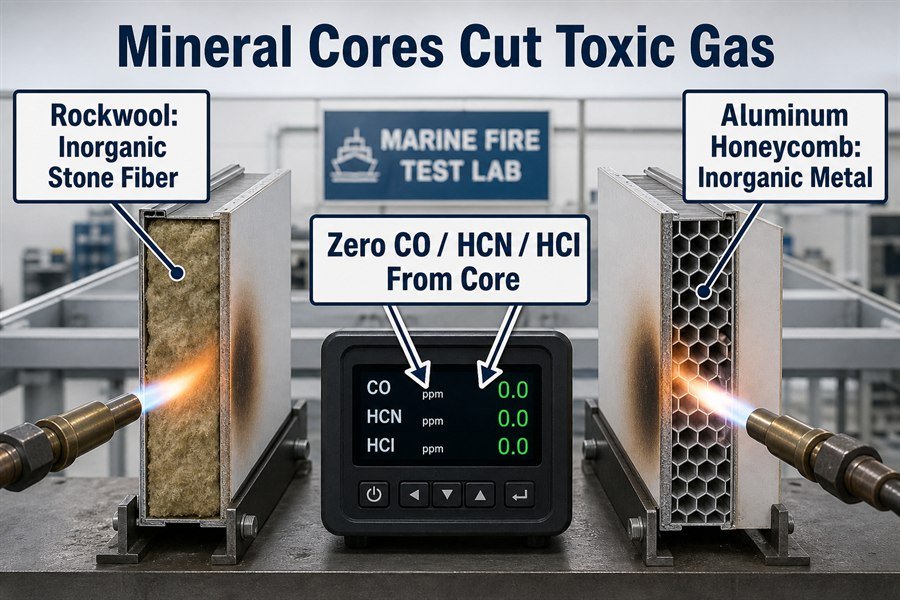
Mineral cores, specifically rockwool and aluminum honeycomb, reduce toxic gas in marine wall panels because they are strictly non-combustible inorganic materials. They do not contain carbon or nitrogen chains, meaning they release zero carbon monoxide, hydrogen cyanide, or other toxic gases when exposed to fire.
If you want to sleep well at night knowing your panels will pass every fire test, you must focus on the core material. The core makes up 90% of the panel's volume.7 If the core burns, you will fail the test. The best way to reduce toxic gas is to use materials that simply do not burn.
In the marine outfitting industry, we rely on two primary mineral cores: rockwool (also called stone wool) and aluminum honeycomb. Because they are inorganic, they change the entire safety profile of the panel. Let us look closely at how these two specific mineral cores completely eliminate core-based toxic gas emissions.
Rockwool Core Non-Combustibility and Gas Reduction
Rockwool is the most common safe core in the marine industry. Factories make it by melting basalt stone at very high temperatures and spinning it into fibers.8 A typical marine-grade rockwool core has a density of 100 to 150 kg/m3. The cost is very reasonable, usually making the finished panel price around $30 to $45 per square meter.
Because rockwool is made of pure stone, it is completely inorganic. It has zero carbon chains and zero nitrogen chains in its structure. According to the IMO FTP Code Part 1, rockwool is classified as a "non-combustible material". When a fire hits a rockwool panel, the core does not burn, melt, or release gas. It simply blocks the heat. This means the core produces exactly zero Carbon Monoxide (CO), zero Hydrogen Cyanide (HCN), and zero Hydrogen Chloride (HCl).9
Aluminum Honeycomb Core as a Zero-Emission Alternative
Aluminum honeycomb is the second mineral core option. Factories make this by expanding thin aluminum foils into a hexagon shape. Just like rockwool, aluminum is a basic metal element. It is 100% inorganic.
Aluminum honeycomb panels are lighter than rockwool panels, which is great for fast ships. When exposed to fire, the aluminum will eventually melt if the fire gets hot enough, but it will never ignite or burn. Because it does not burn, it cannot release toxic smoke. By using an aluminum honeycomb core, you guarantee that the inside of your panel adds absolutely no toxic gas to the room during a fire emergency.
| Core Material | Material Type | Carbon/Nitrogen Content | Toxic Gas Emission Risk |
|---|---|---|---|
| Rockwool (120 kg/m3) | Inorganic Stone Fiber | Zero | None |
| Aluminum Honeycomb | Inorganic Metal Alloy | Zero | None |
| Polyurethane Foam | Organic Polymer | High | High (CO, HCN) |
Why Do Organic Binders Increase Marine Interior Panel Carbon Monoxide?
Even panels with stone cores can fail toxicity tests. The hidden culprit? The glue used to build the panel. Organic binders create massive gas problems.
Organic binders increase marine interior panel carbon monoxide (CO) because they contain carbon-based chemical chains, such as polyurethane adhesives or epoxy resins. During the incomplete combustion of a fire, these carbon molecules break down and combine with limited oxygen to form dangerous CO gas.
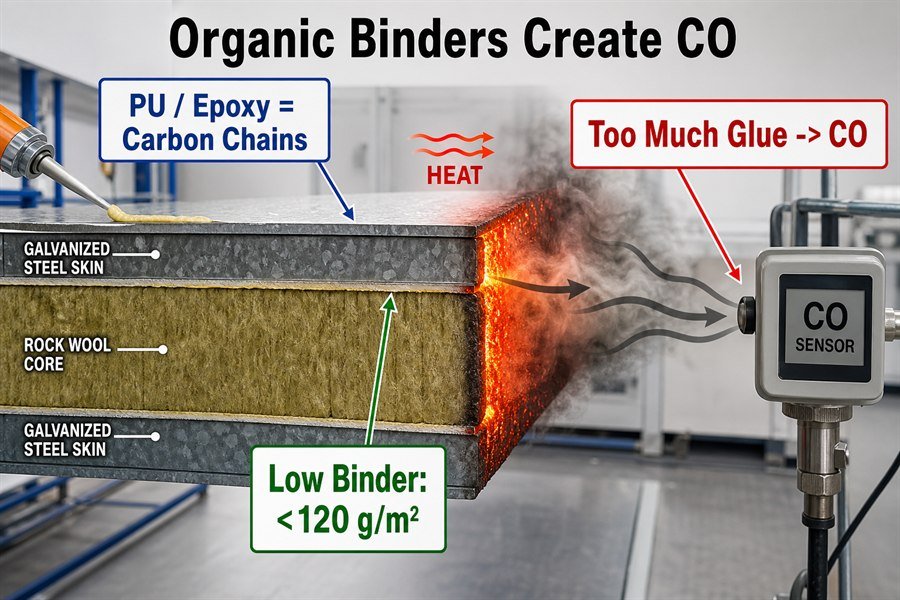
Many buyers focus entirely on the metal skin and the rockwool core, but they forget how the factory holds those parts together. You need a binder, or glue, to stick the steel skin to the core. This invisible layer of glue is often the main reason a good panel fails the smoke test.
To understand why, we have to look at the two most common organic binders used in Asian factories today: polyurethane (PU) adhesives and epoxy binders10. Both are organic, meaning they are built from carbon atoms. Let me explain how these two specific glues generate carbon monoxide during a ship fire.
Carbon Monoxide Generation from Polyurethane Adhesives
Most factories use a two-part polyurethane (PU) glue. It is strong and cures quickly. However, PU glue is a carbon-heavy organic material. During a fire, the metal skin of the wall panel gets extremely hot. This heat transfers directly into the layer of PU glue sitting just behind the metal.
Because the glue is trapped between the metal and the dense rockwool, there is very little oxygen available. When the carbon in the PU glue burns without enough oxygen, it undergoes "incomplete combustion11." Instead of forming safe Carbon Dioxide (CO2), the carbon forms Carbon Monoxide (CO). CO is a silent killer. The IMO 2010 FTP Code Part 2 strictly limits CO emissions to 1450 ppm. If a factory sprays too much PU glue on the panel, the CO levels will shoot past this limit easily.
Controlling Epoxy Binder Volume to Manage CO Levels
Epoxy resin is the other common organic binder. Some factories use it for specialized high-strength panels. Just like PU glue, epoxy is built from long carbon chains. When heated, epoxy will also break down and release CO gas.
The secret to passing the certification test is controlling the volume of the binder. A good factory knows they must use the absolute minimum amount of glue required to hold the panel together. Usually, applying 100 to 150 grams of organic binder per square meter is safe. At this low weight, there is not enough carbon present to generate dangerous levels of CO. If a factory uses 300 grams of epoxy per square meter just to be lazy, the panel will fail the CO test every time.
| Binder Type | Chemical Base | Combustion Behavior | CO Emission Risk if Over-Applied |
|---|---|---|---|
| Polyurethane (PU) Glue | Organic Carbon Chain | Incomplete Combustion | High Risk |
| Epoxy Resin | Organic Carbon Chain | Incomplete Combustion | High Risk |
| Silicate Adhesive | Inorganic Mineral | Does not burn | Zero Risk |
How Do Decorative Films Affect Marine Accommodation Panel Smoke Chemistry?
The surface film is very thin, usually just 0.15mm. Does it really matter for smoke chemistry? Yes, it changes everything during the early stages of a fire.
Decorative films affect marine accommodation panel smoke chemistry based on their specific material type: PVC films generate acidic hydrogen chloride, PET films release basic carbon oxides, and fluoropolymer films emit deadly hydrofluoric acid. Since films burn first, they dictate the initial flush of toxic smoke during evacuation.
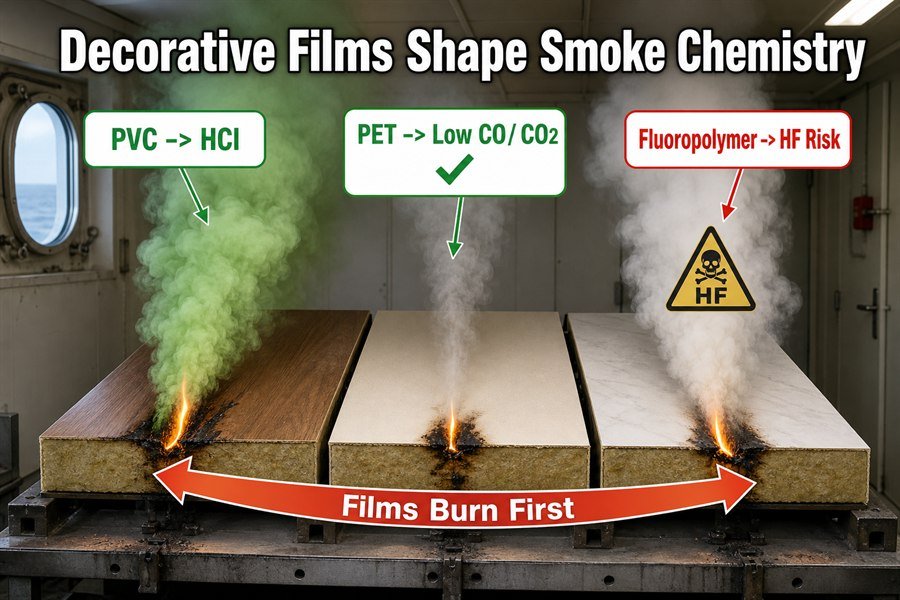
The decorative film is the face of your panel. It is the part the crew sees and touches every day. But in a fire, the film is the very first thing to burn. Even though it is paper-thin, it burns extremely fast and releases its gases all at once. This creates a sudden cloud of toxic smoke right when the crew is trying to escape.
To buy safely, you must know exactly what plastic the factory uses for this film. We deal with three main types of decorative films in the marine industry: PVC, PET, and Fluoropolymers. Each one creates a completely different chemical reaction in a fire. Let us examine the exact smoke profiles of these three films.
Early-Stage Combustion of PVC Decorative Films
We already discussed PVC (polyvinyl chloride), but it is important to emphasize its role in the early stages of a fire. Because PVC is on the outside of the panel, it takes the direct hit from the flames.
Within the first 3 to 5 minutes of a fire, the PVC film melts and vaporizes. This rapid burning dumps all its chlorine into the air at once, creating a dense, acidic cloud of Hydrogen Chloride (HCl) gas12. The IMO limit for HCl is 600 ppm.13 During a lab test, the gas sensors often read a massive spike of HCl in the first few minutes before the film burns away completely. This sudden toxic cloud is exactly what shipyards want to avoid.
Alternative PET and Fluoropolymer Film Smoke Profiles
To avoid the HCl problem, many smart buyers now request PET (Polyethylene Terephthalate) films. PET is made of carbon, hydrogen, and oxygen. It contains zero halogens like chlorine or fluorine.14 When PET film burns, it only releases Carbon Monoxide (CO) and Carbon Dioxide (CO2). Because the film is so thin, the CO produced is very small and easily stays under the IMO 1450 ppm limit.
On the other hand, some high-end panels use fluoropolymer films (like PVDF) because they resist dirt and stains beautifully. However, fluoropolymers contain fluorine atoms. When these burn, they release Hydrofluoric Acid (HF) gas.15 HF is terrifyingly toxic. The IMO limit for HF is 600 ppm. You must be very careful when buying stain-resistant films to ensure they pass the HF emission tests.
| Film Material | Halogen Content | Primary Toxic Gas Emitted | IMO Gas Limit |
|---|---|---|---|
| PVC Film | Chlorine | Hydrogen Chloride (HCl) | 600 ppm |
| PET Film | None | Carbon Monoxide (CO) | 1450 ppm |
| Fluoropolymer | Fluorine | Hydrofluoric Acid (HF) | 600 ppm |
What Marine Interior Panel Constructions Minimize Smoke and Toxic Gas?
You need safe, certified panels that do not cost a fortune. What is the best panel recipe to buy? Let me show you the winning combination of materials.
Marine interior panel constructions that minimize smoke and toxic gas combine a non-combustible rockwool or aluminum honeycomb core, low-grammage inorganic or water-based silicate binders (under 120 g/m2), and PVC-free PET or galvanized steel surface finishes, ensuring full compliance with all IMO smoke and toxicity limits.
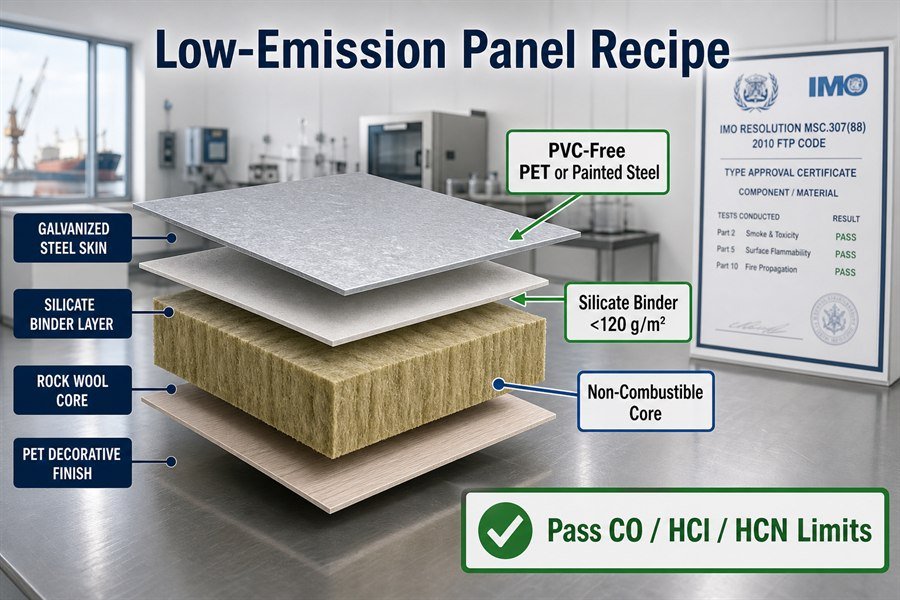
After years of working as a marine outfitting specialist, I know exactly what works and what fails. When you buy panels for demanding clients in the US and Europe, you cannot guess. You need a specific formula that balances reasonable costs with perfect safety test scores.
The perfect low-emission panel is built by combining the right core, the right glue, and the right surface. We must eliminate carbon, nitrogen, and halogens wherever possible. Let me show you exactly how to specify this construction to your suppliers in Asia to guarantee you get a safe product.
Optimal Core and Binder Selection for Low Emissions
The foundation of a safe panel is a strictly non-combustible core. You must specify a high-density rockwool core (at least 120 kg/m3) or a pure aluminum honeycomb core. This choice immediately removes the risk of the core generating Hydrogen Cyanide (HCN) or Carbon Monoxide (CO).16
Next, you must control the binder. Do not let the factory use thick layers of cheap polyurethane glue. Instead, specify a low-grammage application. Demand that the factory uses less than 120 grams of PU glue per square meter. Better yet, ask them to use a water-based silicate binder. Silicate is an inorganic mineral glue. It produces zero CO when heated. Combining a stone core with a mineral glue makes the inside of your panel 100% emission-free.
Choosing Surface Finishes for Zero Toxicity Panel Constructions
The final step is fixing the outside of the panel. You must ban PVC films completely. Tell your supplier you only accept PET decorative films. PET is slightly more expensive, maybe adding $0.50 per square meter, but it eliminates the Hydrogen Chloride (HCl) gas risk entirely.17
If your client does not need wood grain patterns, the absolute safest choice is powder-coated galvanized steel. A thin layer of baked paint on a 0.6mm steel sheet produces almost zero toxic gas. By combining a rockwool core, silicate binder, and a PET or painted steel surface, you create a panel that will easily pass the IMO 2010 FTP Code Part 2 tests every single time18.
| Panel Component | Poor Choice (High Gas Risk) | Ideal Choice (Low Gas Risk) | Cost Impact |
|---|---|---|---|
| Core Material | Polyurethane (PU) Foam | Rockwool (120 kg/m3) | Moderate increase |
| Adhesive Binder | Heavy PU Glue (>200 g/m2) | Silicate Binder (<120 g/m2) | Neutral |
| Surface Finish | PVC Film (0.20mm) | PET Film or Painted Steel | Slight increase |
Conclusion
By carefully selecting non-combustible mineral cores, low-volume organic or silicate binders, and halogen-free PET surface films, you can easily control toxic gas release and pass all IMO safety certifications.
-
"Hydrogen Cyanide and Smoke Particle Characteristics ...", http://stacks.cdc.gov/view/cdc/10156. A fire-toxicity review or combustion chemistry source should support that hydrogen cyanide is a recognized toxic product from the combustion or pyrolysis of many nitrogen-containing organic materials. Evidence role: mechanism; source type: paper. Supports: Nitrogen-containing materials can produce hydrogen cyanide when they burn.. Scope note: This support would be contextual because HCN formation depends on material chemistry, temperature, oxygen availability, and fire conditions; it should not be read as proving that every nitrogen-containing material always produces HCN. ↩
-
"Comparative Thermal and Fire Behavior of Rigid Polyurethane ...", https://pmc.ncbi.nlm.nih.gov/articles/PMC12897936/. A comparative materials study should support that polyisocyanurate foams generally show higher thermal stability, greater char formation, or improved fire performance compared with conventional polyurethane foams. Evidence role: expert_consensus; source type: paper. Supports: PIR resists fire slightly better than PU.. Scope note: The comparison is formulation-dependent and does not establish that every PIR panel outperforms every PU panel in all fire tests. ↩
-
"What Is the Purpose and Scope of the IMO FTP Code?", https://magellanmarinetech.com/what-purpose-scope-of-imo-ftp-code/. The IMO 2010 FTP Code Part 2 should be cited for the smoke and toxicity test criterion specifying a hydrogen cyanide concentration limit of 140 ppm under the prescribed test method. Evidence role: definition; source type: institution. Supports: The IMO 2010 FTP Code Part 2 sets a maximum allowed HCN limit of 140 ppm.. Scope note: The limit applies to the FTP Code Part 2 test conditions and acceptance criteria, not to all real-fire exposure scenarios. ↩
-
"Melamine | C3N3 (NH2)3 | CID 7955 - PubChem", https://pubchem.ncbi.nlm.nih.gov/compound/Melamine. A chemical database or encyclopedia source should support melamine鈥檚 molecular formula, C3H6N6, from which nitrogen accounts for approximately two-thirds of the molecular mass. Evidence role: definition; source type: encyclopedia. Supports: Melamine鈥檚 chemical structure is about 66% nitrogen by mass.. Scope note: The molecular composition supports the nitrogen-content claim but does not by itself prove the amount or timing of HCN released during combustion. ↩
-
"Dechlorination of Waste PVC (Polyvinyl chloride) Using ...", https://repository.fit.edu/cgi/viewcontent.cgi?params=/context/etd/article/2322/&path_info=GHALANDARI_DISSERTATION_2023.pdf. Chemical reference data for PVC鈥檚 repeat unit, C鈧侶鈧僀l, support that chlorine accounts for about 56.7% of the polymer鈥檚 molecular mass, commonly rounded to 57%. Evidence role: definition; source type: encyclopedia. Supports: PVC is approximately 57% chlorine by weight.. Scope note: This percentage applies to pure PVC resin; commercial PVC films may contain plasticizers, pigments, fillers, or stabilizers that change the chlorine percentage by total product weight. ↩
-
"Toxicity of the pyrolysis and combustion of poly(vinyl ...", https://www.govinfo.gov/content/pkg/GOVPUB-C13-1216c17eb433dd191ff5df1d55a1c900/pdf/GOVPUB-C13-1216c17eb433dd191ff5df1d55a1c900.pdf. Fire-safety and polymer-chemistry literature describes PVC thermal decomposition as involving dehydrochlorination, with hydrogen chloride released as a major early decomposition product. Evidence role: mechanism; source type: paper. Supports: When PVC burns or thermally decomposes, it releases hydrogen chloride gas.. Scope note: The exact amount and timing of HCl release depend on formulation, additives, film thickness, oxygen availability, and fire conditions. ↩
-
"A Brief Review on Advanced Sandwich Structures with ... - PMC", https://pmc.ncbi.nlm.nih.gov/articles/PMC9608463/. Technical literature on sandwich panels describes the core as the dominant thickness/volume component separating thin face sheets and providing much of the panel depth. Evidence role: general_support; source type: education. Supports: In sandwich panels, the core commonly accounts for most of the panel volume, potentially around 90% in typical constructions.. Scope note: The 90% figure depends on panel design and face-sheet thickness, so a source may support it only as a typical proportion rather than a universal value. ↩
-
"Mineral wool - Wikipedia", https://en.wikipedia.org/wiki/Mineral_wool. Reference sources on mineral wool production describe stone wool as being manufactured by melting basalt or similar rock and spinning the melt into fibers. Evidence role: mechanism; source type: encyclopedia. Supports: Rockwool/stone wool is produced by melting basalt or other rock at high temperature and fiberizing the molten material.. ↩
-
"reduction of hydrogen cyanide concentrations and acute", https://nvlpubs.nist.gov/nistpubs/Legacy/IR/nistir4441.pdf. Combustion science and fire-testing literature indicate that inorganic mineral cores do not provide the carbon, nitrogen, or chlorine-bearing organic fuel sources associated with CO, HCN, or HCl generation from polymeric materials. Evidence role: mechanism; source type: paper. Supports: A purely inorganic rockwool core is not expected to generate CO, HCN, or HCl as combustion products, unlike organic polymer cores.. Scope note: This supports the chemical rationale for very low or absent emissions from the mineral core itself, but the word 鈥渆xactly鈥?should be verified by product-specific fire testing because binders, facings, adhesives, or contaminants can contribute emissions. ↩
-
"Natural Sciences - An-Najah journals", https://journals.najah.edu/media/journals/full_texts/a-203.pdf. A technical or industry source should document that polyurethane and epoxy adhesive systems are used for bonding metal-faced mineral-wool sandwich panels; if the source is not Asia-specific, it supports binder relevance but not regional prevalence. Evidence role: general_support; source type: paper. Supports: Polyurethane adhesives and epoxy binders are among the common organic binders used to bond steel skins to rockwool cores in sandwich panels.. Scope note: Likely sources may verify common use in sandwich-panel production generally rather than prove that these are the two most common binders across Asian factories. ↩
-
"Analysis of Flammability and Smoke Emission of Plastic ... - PMC", https://pmc.ncbi.nlm.nih.gov/articles/PMC10054394/. A combustion chemistry source should explain that carbon-containing materials can form carbon monoxide under oxygen-limited or incomplete-combustion conditions; this supports the mechanism described for organic adhesives in general rather than measuring emissions from a specific panel design. Evidence role: mechanism; source type: education. Supports: Carbon in polyurethane adhesive can generate carbon monoxide when heated or burned under oxygen-limited conditions.. Scope note: This would support the chemical mechanism but not the exact CO concentration produced by a given PU adhesive formulation or panel assembly. ↩
-
"Kinetic Study of Polyvinyl Chloride Pyrolysis with Characterization of ...", https://www.osti.gov/servlets/purl/2352421. Combustion and thermal decomposition studies of polyvinyl chloride report hydrogen chloride as a major early gaseous product because PVC contains chemically bound chlorine. Evidence role: mechanism; source type: paper. Supports: PVC decorative film can generate hydrogen chloride gas during combustion because of its chlorine content.. Scope note: The source would support the chemical mechanism generally; actual HCl concentration and timing depend on film thickness, formulation, ventilation, and test conditions. ↩
-
"What Is the Purpose and Scope of the IMO FTP Code?", https://magellanmarinetech.com/what-purpose-scope-of-imo-ftp-code/. The IMO Fire Test Procedures Code specifies a 600 ppm concentration limit for hydrogen chloride in smoke-toxicity testing of materials used on ships. Evidence role: statistic; source type: institution. Supports: The IMO smoke-toxicity limit for HCl is 600 ppm.. Scope note: This supports the regulatory test threshold, not the claim that any specific decorative film will exceed it in service or in a particular laboratory test. ↩
-
"Polyethylene terephtalate", https://simple.wikipedia.org/wiki/Polyethylene_terephtalate. Chemical references describe polyethylene terephthalate as a polyester composed of carbon, hydrogen, and oxygen, which explains why neat PET is not a halogenated polymer. Evidence role: definition; source type: encyclopedia. Supports: PET is a non-halogenated polymer composed of carbon, hydrogen, and oxygen.. Scope note: This supports the composition of pure PET; additives, coatings, pigments, or laminated layers in commercial films may introduce other elements. ↩
-
"Kinetics of thermal degradation and lifetime study of poly ...", https://pmc.ncbi.nlm.nih.gov/articles/PMC7398943/. Fire-safety and polymer-decomposition literature reports that fluoropolymers can generate hydrogen fluoride during thermal decomposition or combustion because their backbones contain fluorine. Evidence role: mechanism; source type: paper. Supports: Burning fluoropolymer films can release hydrofluoric acid or hydrogen fluoride gas.. Scope note: The source would support HF formation as a known hazard of fluoropolymers generally; emission levels vary by fluoropolymer type, additives, oxygen availability, and test method. ↩
-
"Toxicity of Carbon Monoxide Hydrogen Cyanize Gas ...", https://www.faa.gov/sites/faa.gov/files/data_research/research/med_humanfacs/oamtechreports/AM94-07.pdf. Fire-toxicology literature identifies carbon monoxide as a product of incomplete combustion of carbonaceous materials and hydrogen cyanide as associated with nitrogen-containing fuels such as polyurethane foams, providing mechanistic context for why inorganic cores such as mineral wool or aluminum would not themselves be expected to generate these gases. Evidence role: mechanism; source type: paper. Supports: Selecting an inorganic rockwool or aluminum honeycomb core reduces the likelihood that the core itself will generate HCN or CO during fire exposure.. Scope note: This supports the chemistry of the core material, not an assertion that the assembled panel has no CO or HCN emissions from adhesives, facings, coatings, or organic binders. ↩
-
"Toxicity of the Pyrolysis and Combustion Products of Poly ...", https://www.nist.gov/publications/toxicity-pyrolysis-and-combustion-products-polyvinyl-chlorides-literature-assessment. Polymer fire literature reports that PVC can release hydrogen chloride during thermal decomposition, while PET is a chlorine-free polyester; this supports reduced HCl formation when substituting PET for PVC. Evidence role: mechanism; source type: paper. Supports: Replacing PVC film with PET film reduces the likelihood of hydrogen chloride generation from the surface film in a fire.. Scope note: It does not prove an entire decorative film system is entirely free of HCl because pigments, adhesives, and additives may contain chlorine or other halogens. ↩
-
"What Is the Purpose and Scope of the IMO FTP Code?", https://magellanmarinetech.com/what-purpose-scope-of-imo-ftp-code/. The IMO 2010 FTP Code Part 2 establishes procedures and acceptance criteria for smoke generation and toxicity of fire effluents from marine materials, including measured gases such as CO, HCl, and HCN. Evidence role: definition; source type: institution. Supports: IMO 2010 FTP Code Part 2 is the relevant marine test framework for smoke and toxicity performance of panel materials.. Scope note: The Code can document the test requirements but cannot substantiate that a specified construction will pass 'every single time' without accredited test reports for that exact panel assembly. ↩