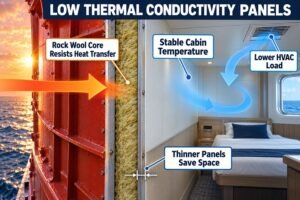
Excessive cabin noise ruins passenger experience and crew rest. But what exact numbers mean "comfortable"? Let us look at the reference values that define real acoustic comfort onboard ships.
Comfortable onboard cabin noise is defined by reference values ranging from 45 dB(A) for high-comfort luxury passenger cabins to 60 dB(A) for standard commercial crew quarters. These values are mandated by IMO Resolution MSC.337(91) to prevent hearing loss and ensure adequate rest and sleep quality.
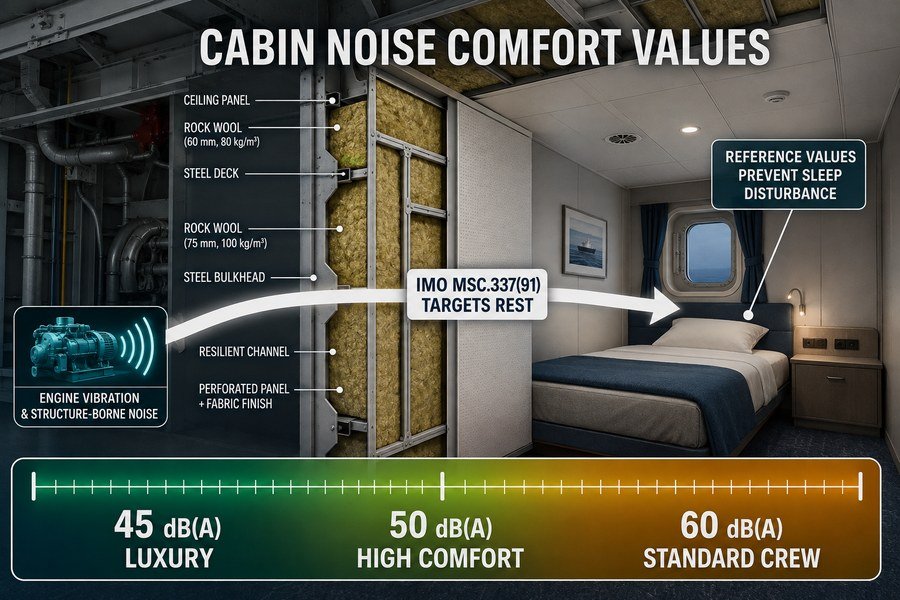
Meeting these numbers is not just about passing inspections. It is about building a space where people actually want to sleep. In my years dealing with marine outfitting, I see buyers struggle to hit these acoustic targets without overspending. European shipyards demand high quality, but you still need to find cost-effective materials in Asia. Let us break down the specific numbers you need to know.
What dB(A) Range Is Considered Comfortable for a Marine Sleeping Cabin?
Choosing the wrong acoustic panels leads to failed sea trials and angry shipowners. You need specific decibel targets to buy the right materials for sleeping cabins.
The comfortable range for a marine sleeping cabin is 45 dB(A) to 60 dB(A). Luxury passenger cabins target 45 dB(A) to 50 dB(A), while standard crew cabins aim for 55 dB(A) to 60 dB(A), strictly regulated by the IMO Code on Noise Levels on Board Ships.
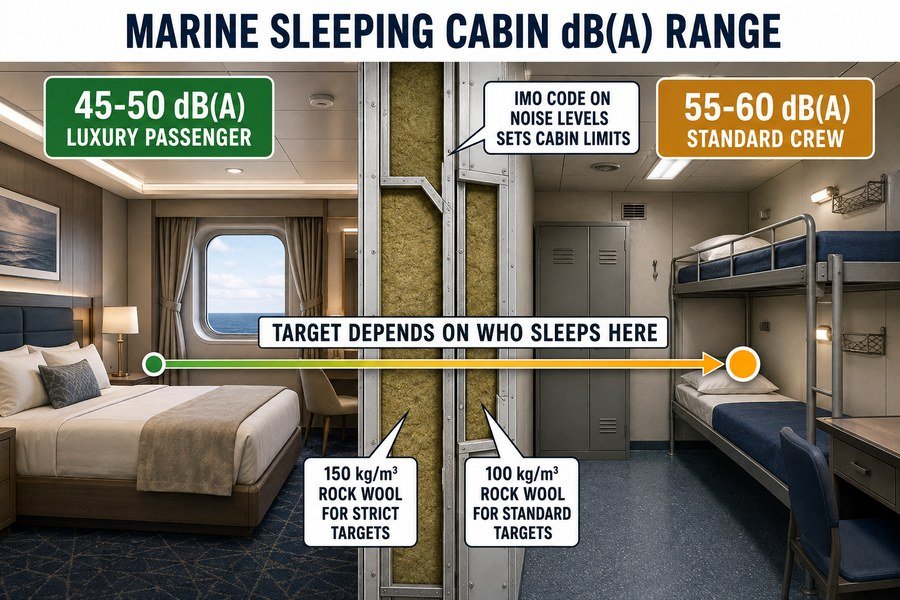
I worked in a marine outfitting factory for years. I saw firsthand how different noise targets change the way we make wall and ceiling panels. The comfortable dB(A) range is not a single number. It depends entirely on who sleeps in that cabin. You must buy different products for different ship types to keep your costs down.
Target Noise Limits for Luxury Passenger Sleeping Cabins
When you buy materials for cruise ships or luxury yachts, the target range is 45 dB(A) to 50 dB(A). This is very quiet. For comparison, a quiet library is around 40 dB(A). To reach this 45 dB(A) limit, you cannot use cheap panels. The IMO MSC.337(91) standard sets this strict limit1 to make sure paying passengers do not hear the engine or their neighbors. When I help clients source for European cruise projects, I always tell them to look for high-density rockwool panels. You usually need panels with a density of at least 150 kg/m3. The cost for these high-end panels in China is usually around $35 to $45 per square meter.
Maximum Noise Limits for Standard Crew Sleeping Cabins
For standard commercial vessels like bulk carriers or container ships, the comfortable range is higher. The IMO sets the limit at 55 dB(A) to 60 dB(A) for crew sleeping cabins. This sounds like normal conversation level. Because the limit is less strict, you can save money here. You can use standard 25mm or 50mm marine wall panels with a lower rockwool density of 100 kg/m3. These panels cost around $20 to $25 per square meter in Asia. You must understand this difference. If you buy the $45 panels for a standard crew cabin, you waste your budget.
| Cabin Type | Occupant | Comfortable Noise Range | IMO Regulation Reference | Typical Panel Cost (per sqm) |
|---|---|---|---|---|
| Luxury Cabin | Passengers | 45 dB(A) to 50 dB(A) | MSC.337(91) Chapter 4 | $35 - $45 |
| Standard Cabin | Crew Members | 55 dB(A) to 60 dB(A) | MSC.337(91) Chapter 4 | $20 - $25 |
What Noise Level Distinguishes a Standard Marine Cabin From a High-Comfort Cabin?
Buyers often pay too much for standard projects or fail high-end specs. Knowing the exact noise difference helps you pick the right marine wall panels.
A 5 to 10 dB(A) difference distinguishes standard from high-comfort marine cabins. Standard cabins accept 55 to 60 dB(A) based on baseline IMO rules. High-comfort cabins require 45 to 50 dB(A) limits, following voluntary class notations like DNV SILENT or Lloyd's Register Passenger and Crew Accommodation Comfort.
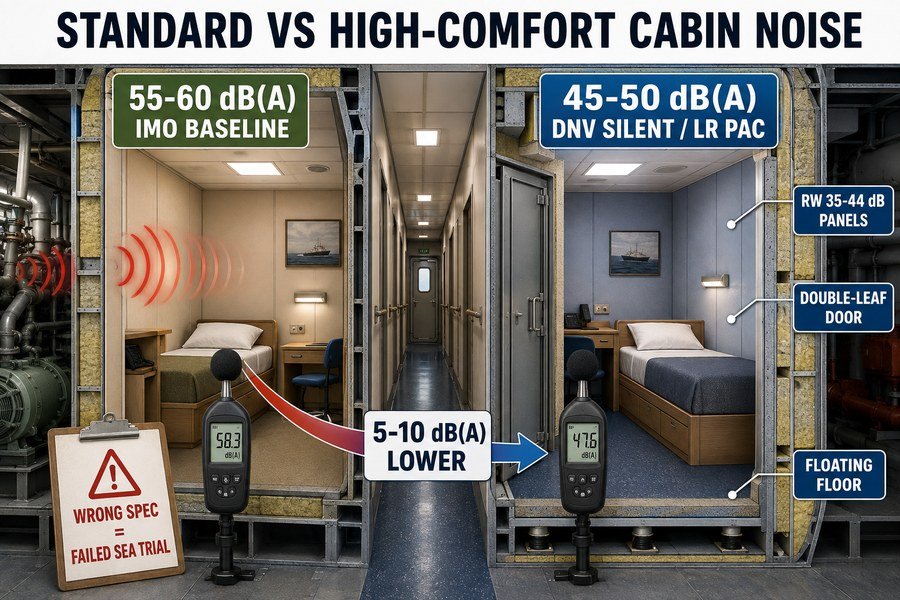
A 5 to 10 dB(A) difference might look small on paper. But in the world of acoustics, it is massive. Sound energy doubles with every 3 dB increase.2 So, an acoustic jump from standard to high-comfort requires completely different interior outfitting strategies. If you take an interior decoration project for a European shipyard, they will check these numbers carefully.
The Baseline IMO Rules for Standard Marine Cabins
Standard cabins just follow the basic safety laws. They accept 55 to 60 dB(A)3. The shipowner only wants to pass the mandatory IMO sea trials. They do not want to spend extra money. For these projects, you just need basic B-15 class fire doors and standard 50mm wall panels. The sound reduction index (Rw) of your panels only needs to be around 30 dB. You can easily find these standard products from many suppliers in China or Vietnam. Communication with basic suppliers is usually enough because the technical requirements are very simple and standard.
Voluntary Class Notations for High-Comfort Marine Cabins
High-comfort cabins follow strict voluntary rules. Shipowners pay extra for class notations like DNV SILENT or Lloyd's Register PAC (Passenger and Crew Accommodation Comfort). These rules force the noise down to 45 to 50 dB(A)4. To get this 5 to 10 dB(A) improvement, you must buy specialized acoustic products. You will need double-leaf doors and floating floor systems5. You must find top-quality suppliers. Many cheap suppliers say they can meet these rules, but their test reports fail in Europe. You must check their acoustic test certificates from labs like SGS or Lloyd's before you pay the deposit.
| Cabin Classification | Accepted Noise Level | Governing Standard | Panel Acoustic Demand (Rw) | Supplier Quality Needed |
|---|---|---|---|---|
| Standard Marine Cabin | 55 to 60 dB(A) | Mandatory IMO Baseline | Approx. 30 dB | Basic / Competitive |
| High-Comfort Cabin | 45 to 50 dB(A) | DNV SILENT / LR PAC | 35 dB to 44 dB | Premium / Certified |
How Much Does a 5 dB(A) Limit Reduction Increase Marine Panel Acoustic Demands?
Dropping cabin noise by just 5 dB(A) sounds easy, but it changes everything. It directly increases the weight, thickness, and cost of your interior materials.
A 5 dB(A) limit reduction increases marine panel acoustic demands significantly, requiring sound reduction index (Rw) upgrades from 30 dB to 35 dB. This mandates changing from standard 25mm single-layer rockwool panels to 50mm double-skin panels with visco-elastic damping layers, increasing material costs by 30% to 50%.
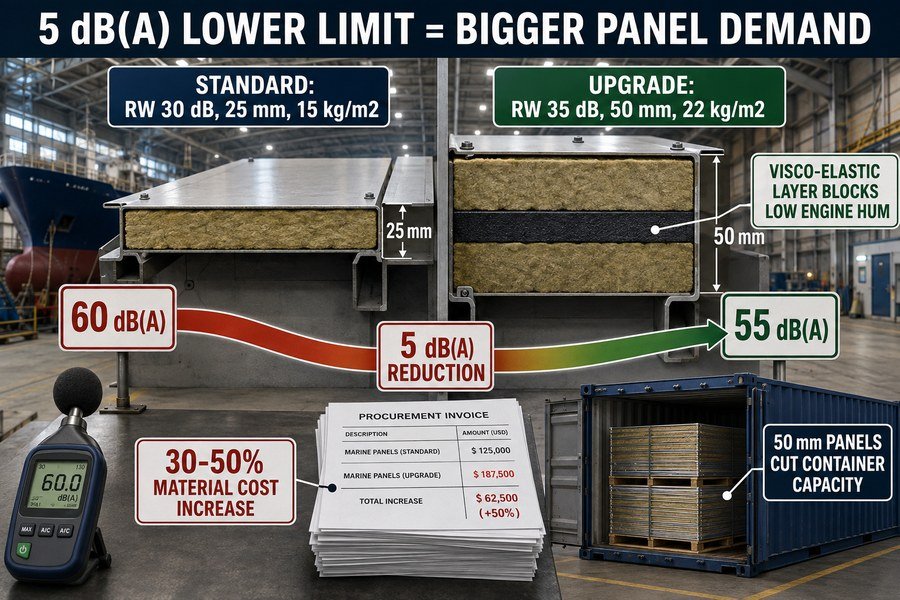
I often get calls from clients who need to improve their cabin noise by 5 dB(A) late in the project. They think they can just add some cheap foam. They are wrong. A 5 dB(A) reduction requires a major upgrade to the marine wall and ceiling panels. You must know exactly what changes physically and financially so you can quote the shipyard correctly.
Physical Changes Required for a 5 dB(A) Acoustic Upgrade
To get a 5 dB(A) limit reduction, your panel's Sound Reduction Index (Rw) must go from 30 dB to at least 35 dB. You cannot achieve this with a standard 25mm single-layer rockwool panel. You must upgrade to a 50mm double-skin panel6. Sometimes, you also need panels with a visco-elastic damping layer7 built inside the steel sheets. This blocks low-frequency engine vibrations. This change makes the panels much heavier. A standard panel weighs about 15 kg per square meter. The acoustic upgrade panel weighs around 22 kg per square meter. This extra weight affects the whole ship design.
Cost and Lead Time Impacts of Increasing Marine Panel Demands
This 5 dB(A) upgrade increases your material costs by 30% to 50%. If your standard budget was $50,000 for panels, expect to pay $65,000 to $75,000. It also hurts your logistics. Thicker panels take up more space. A 20-foot shipping container holds about 900 square meters of 25mm panels8. But it only holds about 450 square meters of 50mm panels. Your shipping costs double. Also, factories in Asia need more time to make custom acoustic panels. You must add at least two extra weeks to your lead time. You must plan this early so your project stays on schedule.
| Panel Specification | Standard Demand (Target 60 dB) | Upgraded Demand (Target 55 dB) | Impact of 5 dB(A) Reduction |
|---|---|---|---|
| Panel Thickness | 25mm | 50mm | Takes more container space |
| Required Rw Value | 30 dB | 35 dB | Requires better materials |
| Panel Construction | Single-layer rockwool | Double-skin with damping | Heavier and harder to install |
| Average Cost | $25 per sqm | $35 to $40 per sqm | 30% to 50% cost increase |
How Do Reference Cabin Noise Values Guide Early Marine Panel Specification?
Guessing materials early on leads to budget blowouts later. You must use reference noise values to lock in your marine panel specifications during the design phase.
Reference cabin noise values guide early marine panel specification by setting the required Sound Reduction Index (Rw), dictating panel thickness, determining mineral wool density, and establishing the need for floating floors. Defining these four factors early prevents costly refits and ensures compliance with acoustic targets.
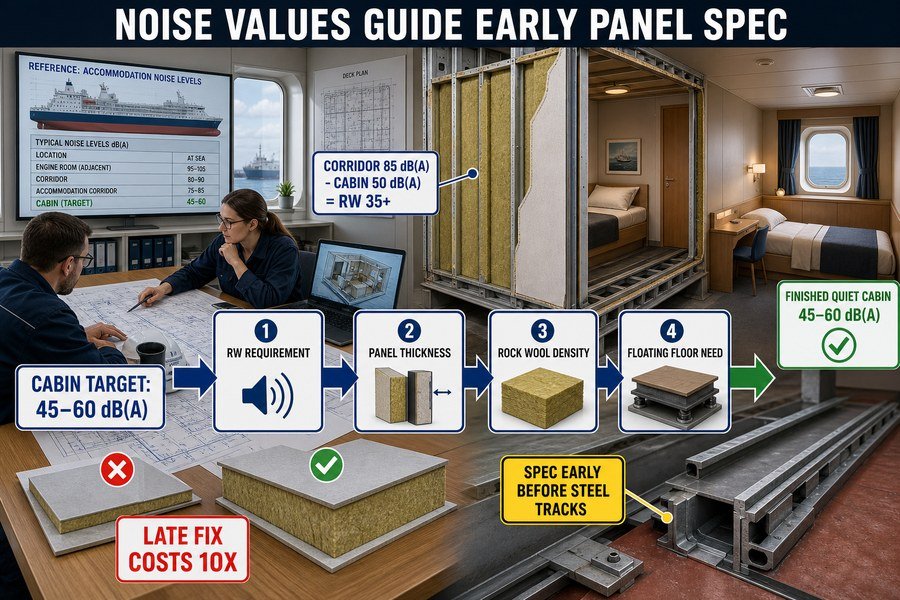
I have seen many ship decoration projects fail because the procurement team bought panels before checking the reference cabin noise values. They bought standard panels, installed them, and failed the acoustic test. Fixing this mistake costs ten times more9 than buying the right panels first. You must use the noise reference values to set your four main material specifications on day one.
Setting the Required Sound Reduction Index (Rw) and Thickness
First, the reference value sets your required Sound Reduction Index (Rw)10. If the reference value for a cabin is 50 dB(A), and the corridor noise is 85 dB(A), your panel must block 35 dB(A) of sound. This math tells you to specify a panel with an Rw of 35 or higher. Second, this Rw requirement dictates panel thickness. You cannot get an Rw of 40 dB from a thin 25mm panel. You must specify a 50mm or even 100mm panel. If you do not specify this early, the shipyard might build the steel deck tracks too small for your thick acoustic panels.
Determining Mineral Wool Density and Floating Floor Requirements
Third, the reference value determines your mineral wool density. To stop sound, you need mass. Early on, you must specify rockwool cores with a density of 120 kg/m3 or 150 kg/m3 instead of the cheap 100 kg/m3 options. Fourth, strict reference values establish the need for floating floors. If the reference target is below 50 dB(A), wall panels alone are not enough. Structure-borne noise will come up through the floor. You must specify floating floor systems, which use 50mm mineral wool covered by a 3mm steel plate. Knowing this early saves you from huge budget surprises.
| Design Factor Guided by Noise Value | Specification Decision | Example for Strict Noise Target (45 dB) | Example for Loose Noise Target (60 dB) |
|---|---|---|---|
| Required Sound Reduction (Rw) | Acoustic performance rating | Rw > 40 dB | Rw = 30 dB |
| Panel Thickness | Physical space needed | 50mm to 100mm | 25mm to 50mm |
| Mineral Wool Density | Mass of the core material | 150 kg/m3 | 100 kg/m3 |
| Need for Floating Floors | Sub-floor acoustic treatment | Mandatory | Usually not required |
What Comfort Noise Range Applies to Long-Duration Marine Accommodation Cabins?
Seafarers on long voyages suffer from constant engine hum. Long-duration accommodation cabins need stricter noise ranges to protect mental health and maintain crew focus.
The comfort noise range for long-duration marine accommodation cabins spans 50 dB(A) to 55 dB(A) for sleeping areas, and 55 dB(A) to 60 dB(A) for day cabins and mess rooms. The Maritime Labour Convention enforces these limits to protect crew health on voyages exceeding four weeks.
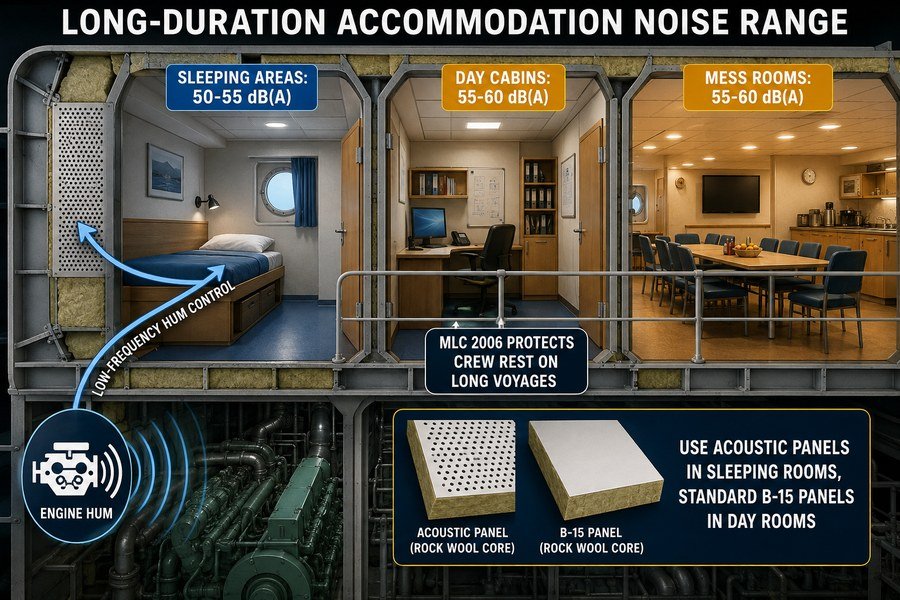
When a ship sails for months without stopping, the crew cannot escape the engine noise. The Maritime Labour Convention (MLC, 2006) takes this very seriously. I help many clients buy materials for these long-duration vessels, like deep-sea tankers or large fishing vessels. You cannot just use the same panels everywhere. You must buy specific products for specific rooms to meet the MLC rules while keeping your prices competitive.
Maritime Labour Convention Noise Limits for Long-Duration Sleeping Cabins
For long-duration voyages lasting more than four weeks, the MLC enforces a comfort noise range of 50 dB(A) to 55 dB(A) for sleeping areas. This is lower than a standard short-trip crew cabin. The goal is to stop sleep disruption.11 When you buy wall and ceiling panels for these sleeping rooms, you must look for products that block low-frequency noise. Low frequencies travel far through the ship's steel.12 I recommend buying panels with perforated steel skins on one side. These cost a bit more, maybe $30 per square meter, but they absorb the dangerous low hum of the main engine perfectly.
Noise Acceptability for Day Cabins and Mess Rooms
For day cabins, mess rooms, and recreation areas, the MLC comfort range is 55 dB(A) to 60 dB(A). Because the crew is awake and talking in these rooms, the rules are slightly relaxed. As a smart procurement officer, you can use this difference to save money. You do not need the expensive acoustic panels in the mess room. You can buy standard 50mm B-15 class wall panels for these areas. By mixing the high-quality acoustic panels in the sleeping rooms and standard panels in the day rooms, you win the shipyard's approval and keep your profit margins high.
| Long-Duration Cabin Area | Comfort Noise Range | MLC 2006 Standard Focus | Recommended Panel Strategy |
|---|---|---|---|
| Sleeping Areas | 50 dB(A) to 55 dB(A) | Sleep quality and recovery | Perforated acoustic panels, Rw > 35 dB |
| Day Cabins & Offices | 55 dB(A) to 60 dB(A) | Communication and work focus | Standard 50mm B-15 panels, Rw 30 dB |
| Mess Rooms | 55 dB(A) to 60 dB(A) | Relaxation and eating | Standard 50mm B-15 panels, Rw 30 dB |
Conclusion
To build comfortable cabins, you must follow strict reference noise values. Proper planning with specific decibel targets helps you buy the right panels, control costs, and pass inspections easily.
-
"What Are Cabin Noise Level Standards on Ships?", https://magellanmarinetech.com/what-are-cabin-noise-level-standards-on-ships/. IMO Resolution MSC.337(91), the Code on Noise Levels on Board Ships, is the primary regulatory text for maximum A-weighted noise levels in shipboard spaces, including accommodation areas such as cabins. Evidence role: case_reference; source type: institution. Supports: The IMO MSC.337(91) standard sets a strict noise limit for luxury passenger sleeping cabins.. Scope note: The source should be checked against the article's 45-50 dB(A) passenger-cabin range, because the IMO code may state general cabin limits rather than a distinct luxury-passenger standard. ↩
-
"Physics 4060, Acoustics Laboratory - HyperPhysics", http://hyperphysics.phy-astr.gsu.edu/hbase/Ph4060/p406i.html. Acoustics references explain that decibels are logarithmic and that a 3 dB increase corresponds approximately to a doubling of acoustic power, supporting the statement about sound-energy change. Evidence role: mechanism; source type: education. Supports: Sound energy doubles with every 3 dB increase.. Scope note: This relationship concerns sound power or energy; perceived loudness does not double at 3 dB. ↩
-
"What Are Cabin Noise Level Standards on Ships?", https://magellanmarinetech.com/what-are-cabin-noise-level-standards-on-ships/. The IMO Code on Noise Levels on Board Ships sets maximum A-weighted sound-pressure levels for accommodation spaces, including cabin limits near this range, supporting the use of 55-60 dB(A) as a baseline reference. Evidence role: general_support; source type: institution. Supports: Standard marine cabins accept 55 to 60 dB(A) under baseline IMO rules.. Scope note: The IMO code may specify particular maximum values by space type and ship category rather than a general 55-60 dB(A) range for all standard cabins. ↩
-
"What Are Cabin Noise Level Standards on Ships?", https://magellanmarinetech.com/what-are-cabin-noise-level-standards-on-ships/. Published comfort-class notation rules from classification societies set cabin noise criteria below mandatory IMO limits, with selected accommodation limits around 45-50 dB(A), supporting the stated high-comfort range. Evidence role: expert_consensus; source type: institution. Supports: High-comfort cabin notations such as DNV SILENT or Lloyd's Register PAC can require cabin noise levels around 45 to 50 dB(A).. Scope note: Exact limits vary by notation tier, vessel type, operating condition, and whether the space is a passenger or crew cabin. ↩
-
"Airborne sound insulation performance of lightweight double ...", https://pmc.ncbi.nlm.nih.gov/articles/PMC11666719/. Marine and building-acoustics literature describes double-leaf constructions and floating floors as decoupling or mass-spring systems used to improve airborne and structure-borne sound insulation, supporting their relevance to high-comfort cabin noise control. Evidence role: mechanism; source type: paper. Supports: Achieving a 5 to 10 dB(A) improvement in marine cabins may require specialized acoustic measures such as double-leaf doors and floating floor systems.. Scope note: Such evidence supports these systems as common acoustic strategies, not as proof that every 5-10 dB(A) improvement requires exactly these products. ↩
-
"Airborne sound insulation performance of lightweight double ...", https://pmc.ncbi.nlm.nih.gov/articles/PMC11666719/. Research on double-leaf partitions shows that increasing mass, cavity depth, and absorptive infill can improve airborne sound transmission loss compared with a single-leaf construction; this supports the physical rationale for specifying a thicker double-skin acoustic panel, although it does not verify the exact 25 mm-to-50 mm marine-panel threshold stated in the article. Evidence role: mechanism; source type: paper. Supports: A 50 mm double-skin panel is needed when a standard 25 mm single-layer rockwool panel cannot meet the higher acoustic target.. Scope note: The evidence would support the acoustic mechanism generally, not a universal rule that every 25 mm single-layer rockwool marine panel fails and every 50 mm double-skin panel succeeds. ↩
-
"Vibro-acoustical analysis and design of a multiple-layer ...", https://digitalcommons.mtu.edu/cgi/viewcontent.cgi?article=1382&context=etds. Studies of constrained-layer and viscoelastic damping in metal panels show that such layers can reduce panel vibration amplitudes and associated sound radiation near resonant frequencies; this supports the damping mechanism, but it is contextual rather than direct proof for a specific marine wall-panel product or engine-room frequency spectrum. Evidence role: mechanism; source type: paper. Supports: Panels with a visco-elastic damping layer can help block low-frequency engine vibrations.. Scope note: The source would need to be paired with project-specific vibration spectra or panel test data to prove adequacy for a particular vessel. ↩
-
"ISO 668 - Wikipedia", https://en.wikipedia.org/wiki/ISO_668. Published reference dimensions for ISO 20-foot containers give an internal volume on the order of 33 cubic meters, which provides a volumetric basis for estimating panel area capacity and for showing that doubling panel thickness roughly halves area capacity; this supports the logistics calculation only approximately, because real loading depends on panel length, pallets, packaging, void space, and weight limits. Evidence role: general_support; source type: encyclopedia. Supports: A 20-foot container can carry substantially less area of 50 mm panels than 25 mm panels because thicker panels consume more volume.. Scope note: Container dimensions support the volume constraint, not the exact 900 m2 loading figure or the claim that freight costs necessarily double. ↩
-
"How to choose the right marine wall panels for marine interior ...", https://magellanmarinetech.com/how-choose-right-marine-wall-panels-for-marine-interior-projects/. Research on construction rework and late design changes documents that correcting defects after installation can impose substantially higher direct and indirect costs than preventing them during design or procurement. Evidence role: statistic; source type: research. Supports: Fixing acoustic-panel procurement mistakes after installation costs much more than specifying the correct panels before purchase.. Scope note: This would support the general cost-escalation principle, not prove the exact tenfold multiplier for ship acoustic panels. ↩
-
"Sound reduction index - Wikipedia", https://en.wikipedia.org/wiki/Sound_reduction_index. Acoustic standards describe the weighted sound reduction index, Rw, as a laboratory rating of airborne sound insulation, supporting its use when translating allowable receiving-room noise levels into partition performance requirements. Evidence role: definition; source type: institution. Supports: Cabin noise reference values should be used to determine the required airborne sound insulation rating of partitions.. Scope note: Rw is a laboratory single-number rating; field performance on ships may differ because of flanking transmission and installation details. ↩
-
"The effects of occupational noise on sleep: A systematic ...", https://pubmed.ncbi.nlm.nih.gov/37683554/. Environmental and occupational health literature identifies noise exposure as a cause of sleep disturbance, supporting the rationale for lower noise limits in sleeping accommodation. Evidence role: expert_consensus; source type: institution. Supports: Noise limits for sleeping cabins are intended to reduce sleep disruption among crew.. Scope note: This supports the general health rationale for noise control, not the specific MLC compliance threshold stated in the article. ↩
-
"Transfer function of the structure-borne noise to underwater ...", https://www.academia.edu/120737806/Transfer_function_of_the_structure_borne_noise_to_underwater_radiated_noise_for_ships_with_hull_of_different_material. Studies of ship acoustics and structure-borne noise describe how machinery vibration can propagate through steel hull and deck structures, with low-frequency components often transmitting over long distances compared with higher-frequency airborne sound. Evidence role: mechanism; source type: paper. Supports: Low-frequency machinery noise can propagate through a ship's steel structure over substantial distances.. Scope note: The evidence would explain the physical mechanism generally and may not quantify transmission distance for the specific vessel types discussed. ↩