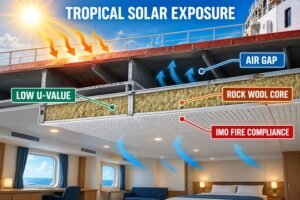
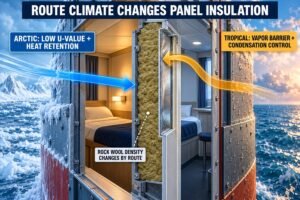
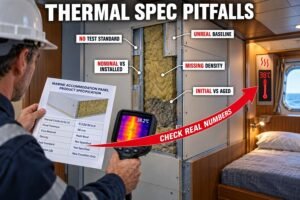
You buy expensive marine lining panels, but cabins still freeze. Moisture ruins insulation performance fast. Let me show you how water kills thermal efficiency and how to prevent it.
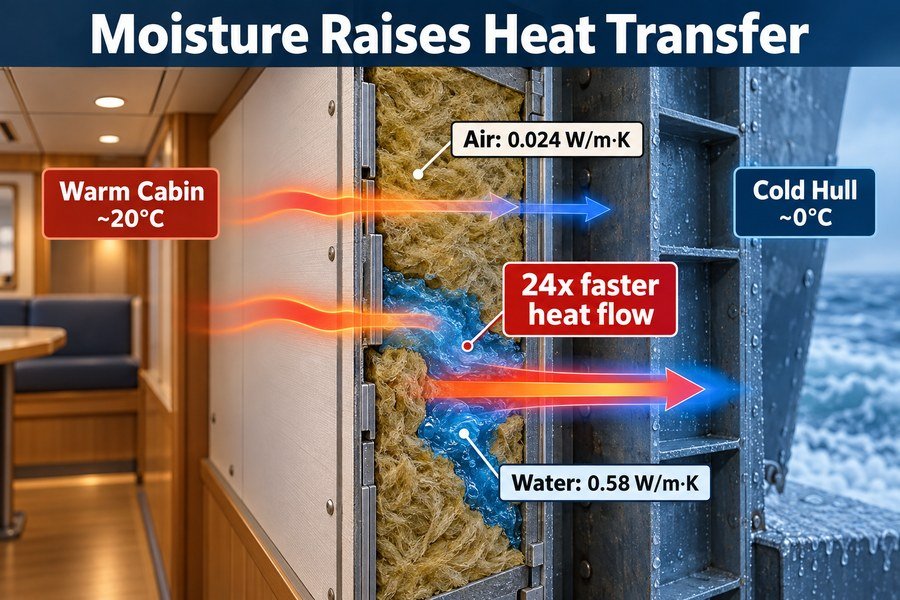
Moisture impacts marine lining panel thermal conductivity by replacing trapped air, which has a low thermal conductivity of 0.024 W/m·K, with water, which conducts heat at 0.58 W/m·K. This 24-fold increase in heat transfer ruins insulation, raises HVAC costs, and causes cabin condensation under SOLAS regulations.
When I first started at Magellan Marine, I saw shipyards waste thousands of dollars replacing perfectly good panels that just got wet. Let us dig into exactly why this happens and how to fix it.
How Does Water Absorption Raise Marine Lining Panel Thermal Conductivity?
Wet panels ruin your HVAC budget. Water destroys insulation fast, making your ship burn more fuel for heating and cooling. Here is exactly how water changes the panel material.
Water absorption raises marine lining panel thermal conductivity through three physical changes: filling air voids with highly conductive liquid water, creating thermal bridges across the panel core, and altering the panel's physical density. Together, these three changes destroy the temperature barrier between the cabin and the hull.
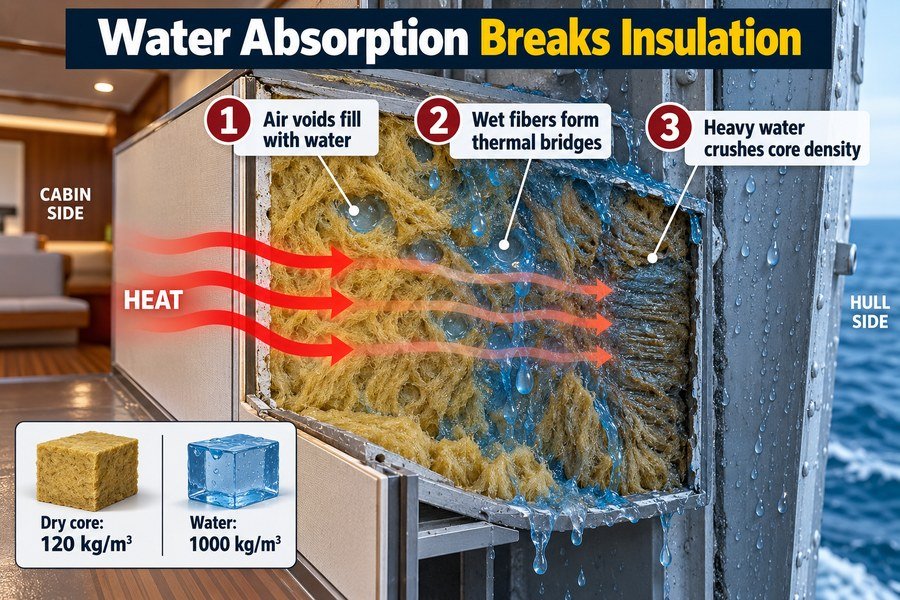
Filling Air Voids with Liquid Water in Panel Cores
Air is a great insulator. It has a thermal conductivity of 0.024 W/m·K based on ASHRAE data. Rockwool cores use trapped air to block heat. When water enters, it pushes the air out. Water has a thermal conductivity of 0.58 W/m·K. This means water transfers heat 24 times faster than air.1 You lose the basic temperature barrier immediately. Your HVAC system must work harder to fix this heat loss.
Creating Thermal Bridges Across Marine Wall Panels
The liquid water does not stay in one spot. It spreads across the mineral wool fibers. It creates a physical water bridge from the cold steel hull side to the warm cabin side. Heat travels directly along this wet path. This completely bypasses the dry insulation material left in the panel. The heat moves straight through the wall.
Altering the Physical Density of Insulation Materials
Wet mineral wool becomes very heavy. Standard marine rockwool has a density of 100 to 150 kg/m³. Water has a density of 1000 kg/m³. The heavy water crushes the soft rockwool fibers. The panel core shrinks and collapses. This leaves empty air gaps inside the top of the wall panel. I saw this ruin an entire accommodation block project last year because the heat escaped through the empty top gaps. When you buy panels, you must check the core density. The ISO 8301 testing standard shows how density affects thermal performance. I always advise buyers to select high-density cores. High-density cores resist water crushing better than cheap, low-density materials. This protects your investment.
| Material State | Thermal Conductivity (W/m·K) | Density (kg/m³) | Heat Transfer Rate |
|---|---|---|---|
| Dry Air (Reference) | 0.024 | 1.2 | Very Low |
| Dry Rockwool Core | 0.034 | 120 | Low |
| 5% Moisture Rockwool | 0.045 | 135 | Medium |
| Liquid Water (Reference) | 0.580 | 1000 | High (24x Air) |
Why Do Damp Marine Lining Panels Lose Insulation Near Cold Ship Hulls?
Steel hulls get freezing cold at sea. When panels near the hull get damp, cabins become iceboxes. This temperature clash causes massive heat loss. Let us explore the mechanics.
Damp marine lining panels lose insulation near cold ship hulls due to three factors: the high temperature differential (Delta T) accelerating heat flow, the freezing of trapped water which conducts heat at 2.22 W/m·K, and the continuous dew point shifting that traps more condensation inside the core.
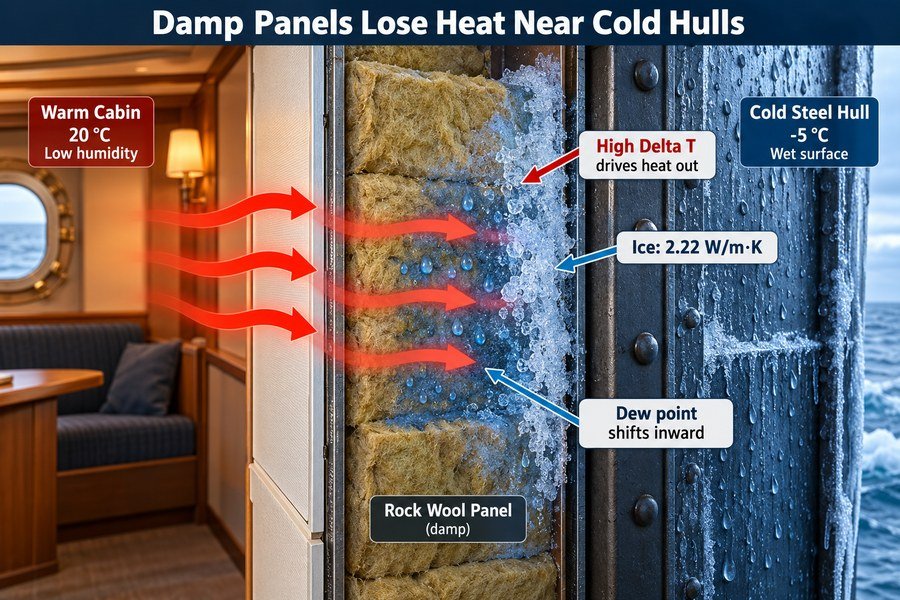
The Impact of High Temperature Differentials (Delta T) on Heat Flow
Ship hulls touch cold seawater. The ocean can be 2°C. The cabin is heated to 22°C. This 20°C difference is the Delta T. Heat moves from warm areas to cold areas. A high Delta T pushes heat out very fast2. Damp panels cannot stop this fast heat flow. Understanding Fourier's Law of Heat Conduction helps here. It proves that wet panels fail exponentially faster in cold climates.
The Freezing of Trapped Water in Marine Insulation
This is the most dangerous stage. When the hull is freezing, the water inside the damp panel turns to ice. Solid ice has a thermal conductivity of 2.22 W/m·K3. This is almost four times worse than liquid water. Ice acts like a solid metal wire. It pulls the heat out of the cabin rapidly. If you provide damp panels to a shipyard in Northern Europe, the cabins will freeze. The shipyard will reject the installation. They will force your decoration company to tear down the walls. This costs thousands of dollars in rework.
Continuous Dew Point Shifting and Core Condensation
The dew point is the temperature where air becomes water. As the panel gets colder from the ice, the dew point moves closer to the warm cabin side. Warm cabin air hits this cold area inside the panel. It creates more liquid water. This creates a cycle that destroys the whole panel. I always remind my clients to install proper vapor barriers to stop this cycle. Without a vapor barrier, the cold hull will always pull more water into the insulation.
| Material / State | Thermal Conductivity (W/m·K) | Relative Heat Loss Multiplier |
|---|---|---|
| Dry Rockwool (22°C) | 0.034 | 1x (Base) |
| Wet Rockwool (10°C) | 0.055 | 1.6x |
| Liquid Water (Reference) | 0.580 | 17x |
| Solid Ice (0°C) | 2.220 | 65x |
Dry vs. Conditioned Lambda Values: What Differs in Marine Ceiling Panels?
You read a panel spec sheet and see great insulation numbers. But in actual sea conditions, the panel fails. Spec sheets often hide the truth about moisture.
The difference between dry and conditioned lambda values in marine ceiling panels lies in two testing states: "Dry" measures the core completely baked free of moisture in a lab, while "Conditioned" measures the core after reaching equilibrium in a standard marine environment with 50% to 80% relative humidity.
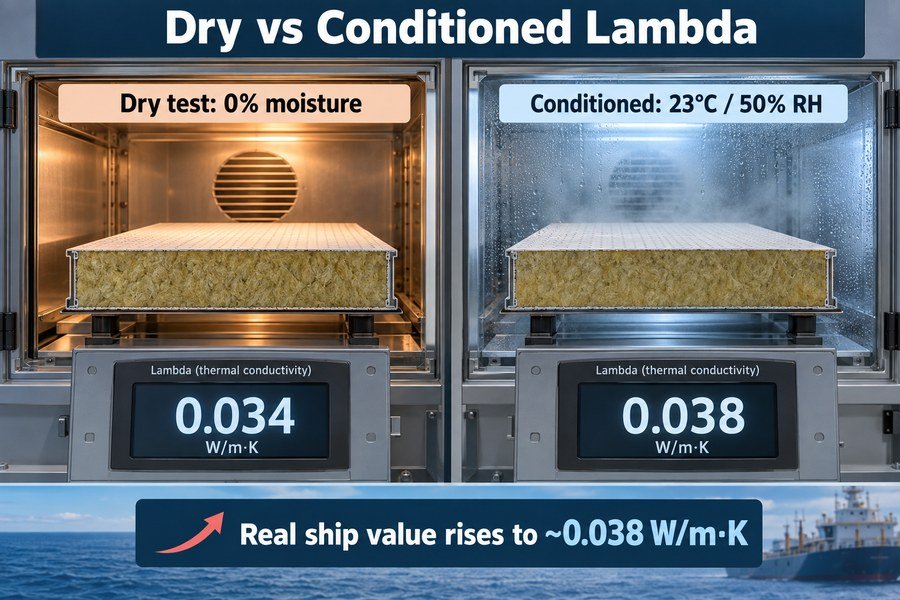
Understanding Dry Lambda Values in Laboratory Settings
Suppliers want to show the best numbers. They test panels in a laboratory oven. They follow the EN 12667 standard. The oven bakes the rockwool core until zero water remains. In this totally dry state, the panel shows a great thermal conductivity of 0.034 W/m·K. But ships do not sail in ovens. This number is not realistic for a working vessel. If you buy based only on the dry lambda value, you buy a lie.
Why Conditioned Lambda Values Reflect Real Marine Environments
You must demand conditioned test results. Laboratories use the ISO 10456 standard for this. They place the panel in a climate chamber. The room stays at 23°C and 50% relative humidity. The panel absorbs moisture from the air naturally. It reaches a stable, conditioned state. The lambda value will increase to about 0.038 W/m·K. This is the real thermal conductivity on a ship. When you negotiate with suppliers in Asia, you must specify this testing condition. I help buyers write this requirement into their purchasing contracts. If the air conditioning system is designed using a dry value of 0.034 W/m·K, the system will be 10% to 15% too small. When the ship enters high humidity areas, the panels will hold moisture. The real thermal conductivity becomes 0.038 W/m·K. The cabins will get too hot. The shipyard will hold you responsible for the poor insulation.
| Test Standard | Moisture Content | Environment | Expected Lambda (W/m·K) | Real-World Accuracy |
|---|---|---|---|---|
| Dry Test (EN 12667) | 0% | Oven baked | 0.033 - 0.035 | Very Low |
| Conditioned (ISO 10456) | 1% to 3% (Volume) | 23°C, 50% RH | 0.037 - 0.039 | High |
| Wet State (Flooded) | >10% | Direct water leak | > 0.050 | Failure State |
How Does Structural Condensation Alter Marine Lining Panel Thermal Conductivity?
Water does not just come from leaks. It grows inside your walls. Structural condensation silently ruins your panels from the inside out, making your cabins cold and damp.
Structural condensation alters marine lining panel thermal conductivity through two internal processes: water vapor diffusing through the panel surface, and that vapor condensing into liquid droplets within the core when it hits the dew point. These two processes saturate the insulation, permanently raising the panel's lambda value.
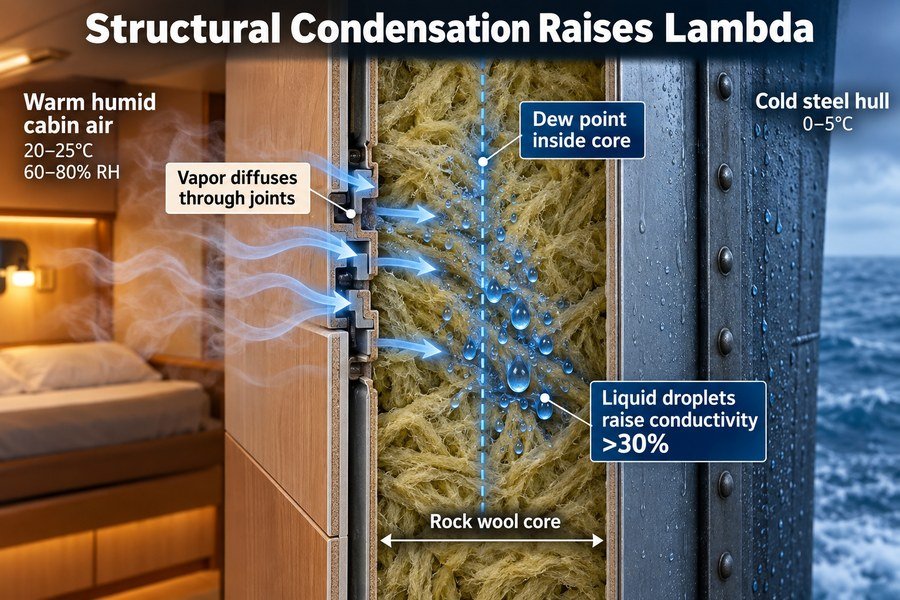
Water Vapor Diffusing Through the Panel Surface
Humans breathe, cook, and take showers inside ship cabins. This creates a lot of water vapor in the air. The vapor pressure inside the room becomes very high. The air outside the ship has low vapor pressure. The vapor wants to escape to the cold outside. It pushes through the tiny gaps between wall panels. It passes through the ceiling joints. The vapor enters the panel core as a gas. You do not need a leaking pipe to ruin a marine lining panel. Structural condensation happens silently every day.
Vapor Condensing into Liquid Droplets Within the Core
The gas moves through the rockwool toward the cold steel hull. The temperature drops as it moves deeper. Soon, the gas hits the dew point temperature line. At this exact spot, the gas changes into liquid water droplets. This is structural condensation.4 The droplets soak the rockwool fibers. The water permanently connects the fibers together. This raises the thermal conductivity significantly. As a marine outfitting specialist at Magellan Marine, I inspect many failed cabins. I often find panels soaked with water from the inside out. The insulation value drops by 30% or more.5 To prevent this, you must buy panels with high-quality joint profiles. You must also buy panels with an unbroken steel skin or thick PVC film. These materials act as vapor barriers. They stop the gas from entering the core. If you buy cheap panels with poor joints, the vapor will enter easily. You will face warranty claims from the shipyard within the first year of operation.
| Process Stage | Moisture State | Location | Impact on Thermal Conductivity |
|---|---|---|---|
| Cabin Environment | High Humidity Gas | Inside Room | None (Outside Panel) |
| Vapor Diffusion | Gas / Vapor | Entering Panel Joints | Minimal (Gas state) |
| Dew Point Reached | Phase Change | Middle of Panel Core | Moderate (Droplets form) |
| Core Saturation | Liquid Water | Deep inside Core | Severe (Lambda increases >30%) |
Why Must Marine Lining Panel Lambda Values Specify Moisture Conditions?
Choosing suppliers based on basic numbers is risky. If you buy panels without checking the exact moisture testing conditions, you will face huge project failures and rejected inspections.
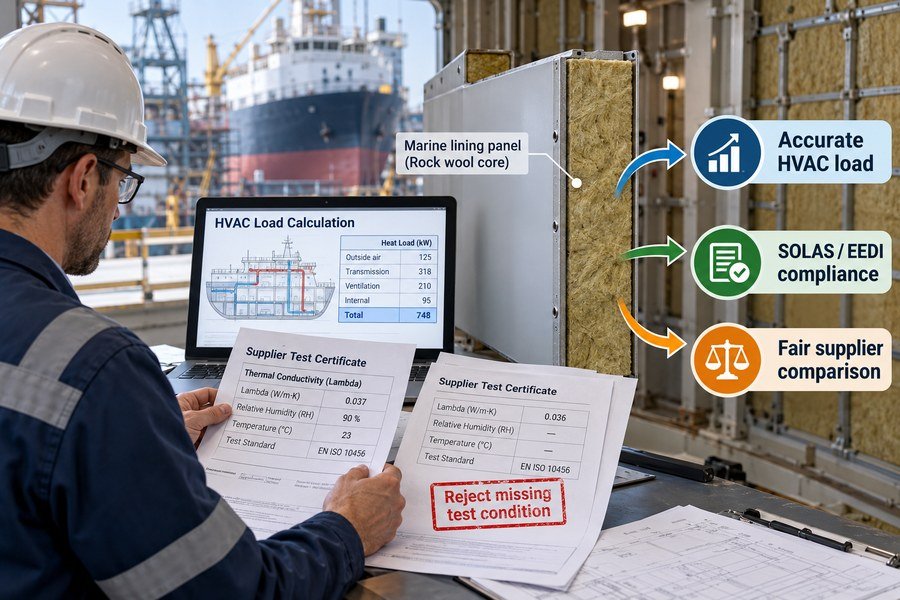
Marine lining panel lambda values must specify moisture conditions for three reasons: to ensure accurate HVAC load calculations for the shipyard, to comply with strict SOLAS energy efficiency regulations, and to allow honest price and quality comparisons among different Asian and European marine outfitting suppliers.
Ensuring Accurate HVAC Load Calculations for Shipyards
Shipyard engineers need exact data. They use the ISO 7547 standard to calculate the marine HVAC load. They use the panel's lambda value to size the air conditioning units. If you provide a dry lambda value, they calculate a smaller load. They buy smaller AC units. When the panels get normal moisture at sea, the AC units fail to cool the cabins. The shipyard will blame your materials. You will have to pay for the damages.
Complying with Strict SOLAS Energy Efficiency Regulations
The International Maritime Organization enforces strict rules. Modern ships must pass the Energy Efficiency Design Index (EEDI). The ship's insulation directly impacts this score.6 The inspectors use the stated lambda values. If the values are wrong because of hidden moisture conditions, the ship might fail the inspection. This is a massive legal risk for your company. You cannot afford to ignore these regulations.
Allowing Honest Price and Quality Comparisons Among Suppliers
When you buy from different factories, you must compare the same data. Supplier A might offer a low price and claim a lambda of 0.033 W/m·K. Supplier B offers a higher price and claims 0.038 W/m·K. Supplier A looks better. But Supplier A used a dry test. Supplier B used a conditioned test. Supplier B is actually selling a better product. You must force all suppliers to state their moisture testing conditions. I always tell procurement officers to read the fine print on the test certificates. Look for the exact relative humidity and temperature used during the test. If it is missing, reject the certificate. Honest comparison protects your project budget. It ensures you buy high-quality ship interior outfitting products that actually perform well on the ocean.
| Supplier Scenario | Claimed Lambda | Test Condition Disclosed? | HVAC System Result | Compliance Risk |
|---|---|---|---|---|
| Cheap Supplier A | 0.033 W/m·K | No (Hidden Dry Test) | Undersized by 10-15% | High Risk of Failure |
| Honest Supplier B | 0.038 W/m·K | Yes (ISO 10456, 50% RH) | Correctly Sized | Safe |
| Premium Supplier C | 0.036 W/m·K | Yes (Marine Conditioned) | Optimized Efficiency | Very Safe |
Conclusion
Moisture ruins marine lining panel thermal conductivity by replacing insulating air with conductive water. Always demand conditioned lambda values to ensure accurate HVAC sizing, compliance, and successful marine outfitting projects.
-
"Interpolation Correlations for Fluid Properties of Humid Air ...", https://srd.nist.gov/jpcrdreprint/1.555998.pdf. Reference thermal-conductivity data for still air and liquid water at room temperature support the order-of-magnitude comparison that water conducts heat roughly two dozen times more readily than air. Evidence role: statistic; source type: institution. Supports: Water has a much higher thermal conductivity than air, making the stated 24-times comparison plausible.. Scope note: The exact ratio varies with temperature, pressure, and the tabulated values used. ↩
-
"13.1 Heat Transfer in Soil – Rain or Shine", https://open.library.okstate.edu/rainorshine/chapter/13-1-heat-transfer-in-soil/. A heat-transfer textbook or university thermodynamics source states Fourier’s law for one-dimensional conduction, showing that conductive heat flux is proportional to the temperature gradient across a material. Evidence role: mechanism; source type: education. Supports: A larger temperature differential across a ship hull or insulation layer increases conductive heat flow from the warm cabin toward the colder seawater side.. Scope note: This supports the direction and proportional relationship of heat flow with temperature difference, but it does not by itself prove that wet panels fail exponentially faster. ↩
-
"properties of ice and supercooled water", https://tsapps.nist.gov/publication/get_pdf.cfm?pub_id=926353. A thermophysical-properties reference lists the thermal conductivity of ice near 0°C at about 2.2 W/m·K, providing support for the stated order of magnitude and comparison with liquid water. Evidence role: statistic; source type: institution. Supports: Solid ice has a thermal conductivity around 2.22 W/m·K, much higher than that of liquid water.. Scope note: Thermal conductivity varies with temperature, ice structure, and impurities, so the value should be treated as an approximate reference value rather than a universal constant. ↩
-
"Interstitial condensation", https://en.wikipedia.org/wiki/Interstitial_condensation. Hygrothermal and building-envelope literature defines interstitial condensation as condensation occurring within an assembly when water vapor reaches a surface or layer below the dew-point temperature. Evidence role: definition; source type: research. Supports: Water vapor within a panel core can condense into liquid droplets where the temperature falls to the dew point.. Scope note: The term commonly used in the literature is “interstitial condensation”; the article’s phrase “structural condensation” should be aligned with or distinguished from that terminology. ↩
-
"Determination of Thermal Properties of Mineral Wool ... - PMC", https://pmc.ncbi.nlm.nih.gov/articles/PMC10488771/. Experimental studies of mineral-wool or fibrous insulation report that moisture content increases effective thermal conductivity and reduces thermal resistance, with losses that can reach substantial percentages under wet conditions. Evidence role: statistic; source type: paper. Supports: Moisture saturation in rockwool or mineral-wool insulation can reduce insulation performance by 30% or more.. Scope note: The exact 30% threshold depends on insulation type, density, temperature, and moisture content; a cited study should be checked for conditions comparable to marine rockwool panels before presenting the figure as general. ↩
-
"(PDF) Ship Energy Efficiency Measures Status and Guidance", https://www.academia.edu/26268978/Ship_Energy_Efficiency_Measures_Status_and_Guidance. Research on ship energy systems and HVAC loads indicates that envelope insulation affects heating and cooling demand and auxiliary energy consumption, which is relevant to vessel energy-efficiency performance. Evidence role: mechanism; source type: paper. Supports: Ship insulation can affect a ship’s energy-efficiency performance through HVAC energy demand.. Scope note: This is contextual support; the EEDI formula does not use insulation lambda as a direct standalone input, so any effect on the score must be shown through the vessel’s energy model or auxiliary-power assumptions. ↩