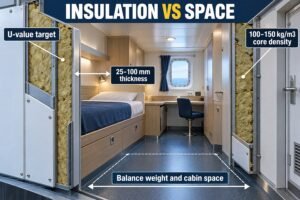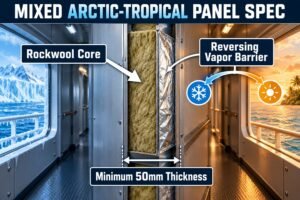
Designing for extreme weather often creates heavy, cramped cabins. I have seen procurement teams struggle with this. But climate-driven insulation does not have to ruin your ship layout or budget.
Climate-driven insulation affects marine panels by balancing thermal resistance (U-value) against panel thickness (25mm to 100mm) and core density (100kg/m³ to 150kg/m³). To meet SOLAS and HVAC demands, outfitting must balance core materials like standard rock wool, lightweight structural cores, and vacuum insulated panels to optimize weight and cabin space.
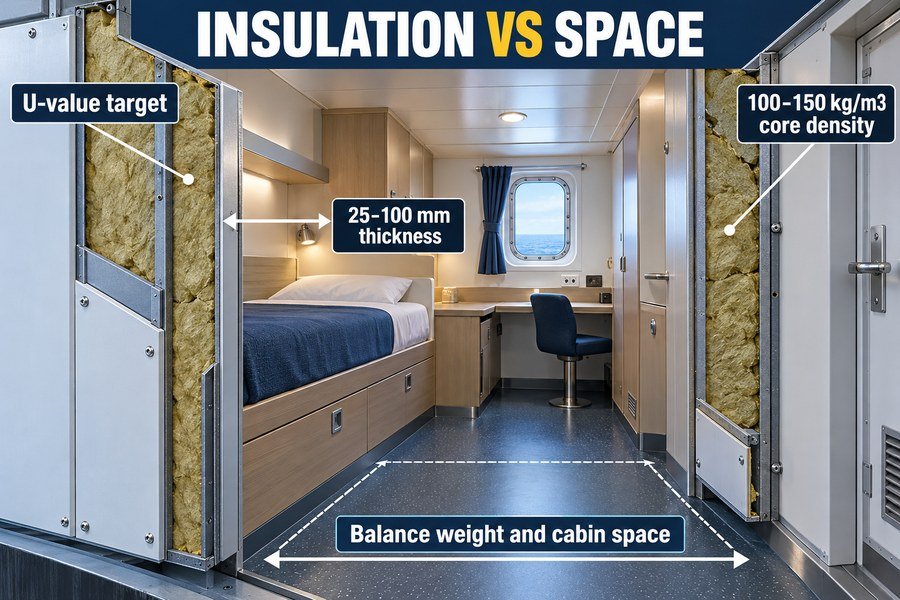
Let us look closely at how different environments force us to make smart choices about panel specifications. If you get this wrong, your shipyard will face serious weight limit problems and angry crew members with tiny cabins.
What Is the Weight Impact of Rock Wool in Arctic Exterior Bulkhead Panels?
Arctic winds demand high insulation, but adding too much rock wool makes the ship overweight. Let us solve this weight penalty before it ruins your ship stability and fuel efficiency.
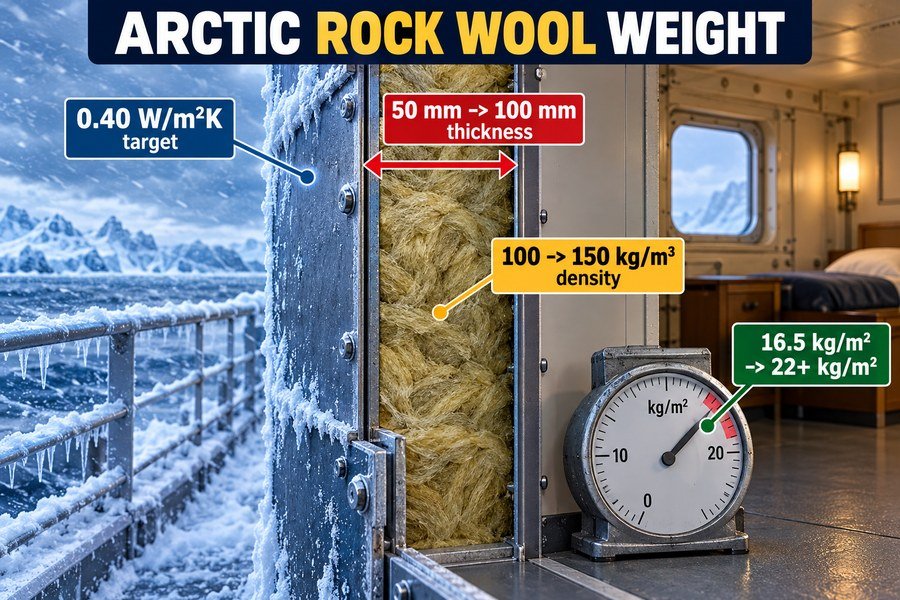
Rock wool in Arctic exterior bulkhead panels adds massive weight, increasing standard 16.5 kg/m² panels to 22 kg/m² or more. The impact comes from increasing core density up to 150 kg/m³ and thickness from 50mm to 100mm to achieve the required 0.40 W/m²K thermal transmittance for extreme cold climates.
Understanding Rock Wool Density and Panel Thickness in Arctic Conditions
At Magellan Marine, I deal with buyers who buy materials for vessels operating in the North Sea or the Arctic. These cold climates are brutal. According to ISO 7547 rules for marine air conditioning and ventilation, you need a very low U-value. For Arctic ships, you usually aim for a U-value of 0.40 W/m²K on the exterior bulkheads. To reach this number with standard materials, we must change the rock wool inside the panel. We increase the rock wool core density from the normal 100 kg/m³ up to 120 kg/m³ or even 150 kg/m³. We also must increase the panel thickness from the standard 50mm to 75mm or 100mm. This change traps more air and stops the freezing cold. But this physical change directly hurts the ship's deadweight.
Comparing the Weight Penalty of Different Arctic Panel Configurations
When you increase both density and thickness, the weight jumps up fast. A standard 50mm thick A-60 panel weighs about 16.5 kg/m². When we increase the thickness to 100mm and use 150 kg/m³ density rock wool, the weight goes up to 22 kg/m² or sometimes 24 kg/m² depending on the steel skin. If your ship needs 5,000 square meters of exterior bulkhead panels, this difference adds roughly 27,500 kilograms to the vessel. That is 27.5 extra tons just for wall insulation. This extra weight burns more marine fuel every single day. Procurement officers must calculate this penalty early. You can see the clear relationship between thickness, density, and weight in my comparison below.
| Panel Application | Thickness (mm) | Rock Wool Density (kg/m³) | U-Value (W/m²K) | Total Panel Weight (kg/m²) |
|---|---|---|---|---|
| Standard Interior | 50mm | 100 kg/m³ | 0.65 | 16.5 kg/m² |
| Mild Winter Exterior | 75mm | 120 kg/m³ | 0.50 | 19.0 kg/m² |
| Arctic Exterior | 100mm | 150 kg/m³ | 0.40 | 22.5 kg/m² |
How Do Thicker Marine Lining Panels Reduce Usable Cabin Floor Space?
Thick lining panels eat up expensive floor space. Your crew feels cramped, and the shipyard loses money. You need a way to stop panels from shrinking the room.
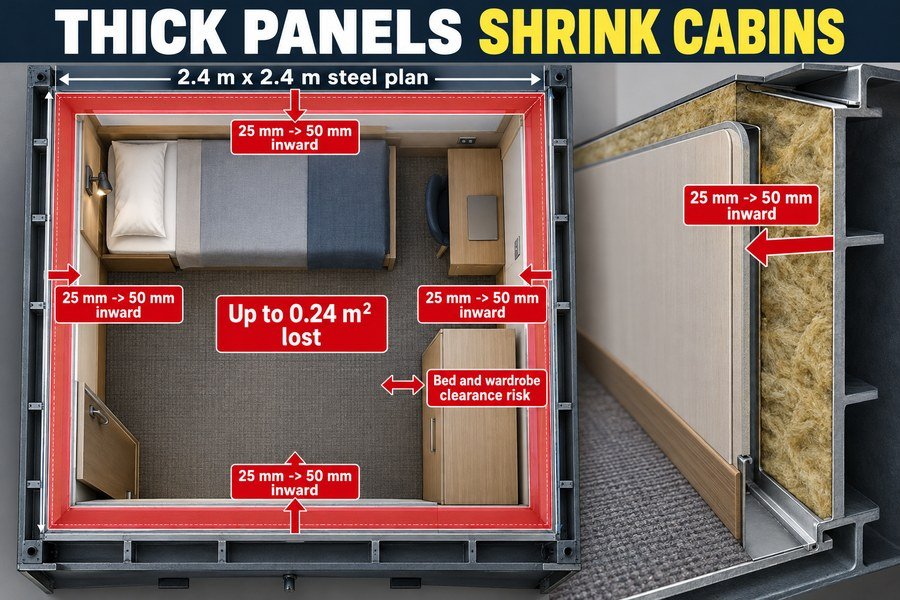
Thicker marine lining panels reduce usable cabin floor space by extending 50mm to 100mm inward per bulkhead. In a standard 2.4m by 2.4m cabin, increasing panel thickness from 25mm to 50mm shrinks the usable footprint by up to 0.24 square meters, significantly impacting furniture placement and crew comfort.
The Direct Impact of Panel Thickness on Cabin Footprint
Marine cabin space is very tight. Shipbuilders measure floor space in millimeters because every bit of space costs money. A standard crew cabin is often designed at 2.4 meters long by 2.4 meters wide on the steel deck plan. The lining panels attach to the bare steel walls to make the room look nice and provide insulation. When you face extreme cold, you might decide to upgrade the standard 25mm lining panel to a 50mm or even 100mm thick panel. Because the steel frame of the ship cannot move outward, the extra panel thickness must extend inward. If you add 25mm of extra thickness to all four walls of a cabin, you lose exactly 50mm in both length and width. This physical shrink removes about 0.24 square meters of usable floor space from the room.
Planning Furniture Layouts Around Thicker Marine Linings
Losing 0.24 square meters sounds small on paper, but it destroys furniture plans. A standard marine bunk bed measures 2000mm long by 800mm wide. A standard writing desk is 1200mm wide. If the room shrinks by 50mm, the bed might hit the opposite wall. The wardrobe door might hit the edge of the bed when a crew member opens it. The walking space between the bed and the desk becomes too narrow for a grown adult. I always warn buyers from interior decoration companies to check the final interior dimensions, not just the steel dimensions. If you buy 50mm panels instead of 25mm panels without checking the layout, the furniture from your other supplier will not fit inside the cabin.
| Panel Thickness | Inner Room Dimensions (mm) | Usable Area (m²) | Space Lost (m²) | Furniture Impact Risk |
|---|---|---|---|---|
| Bare Steel Room | 2400 x 2400 | 5.76 m² | 0.00 m² | None |
| 25mm Lining | 2350 x 2350 | 5.52 m² | 0.24 m² | Low |
| 50mm Lining | 2300 x 2300 | 5.29 m² | 0.47 m² | High (Beds may not fit) |
| 100mm Lining | 2200 x 2200 | 4.84 m² | 0.92 m² | Critical (Needs custom furniture) |
How to Achieve Low U-Values Without Exceeding Marine Accommodation Panel Weight Limits?
Hitting strict thermal rules usually means adding heavy rock wool. But heavy ships burn more fuel. We must find lighter ways to stop the cold from coming in.
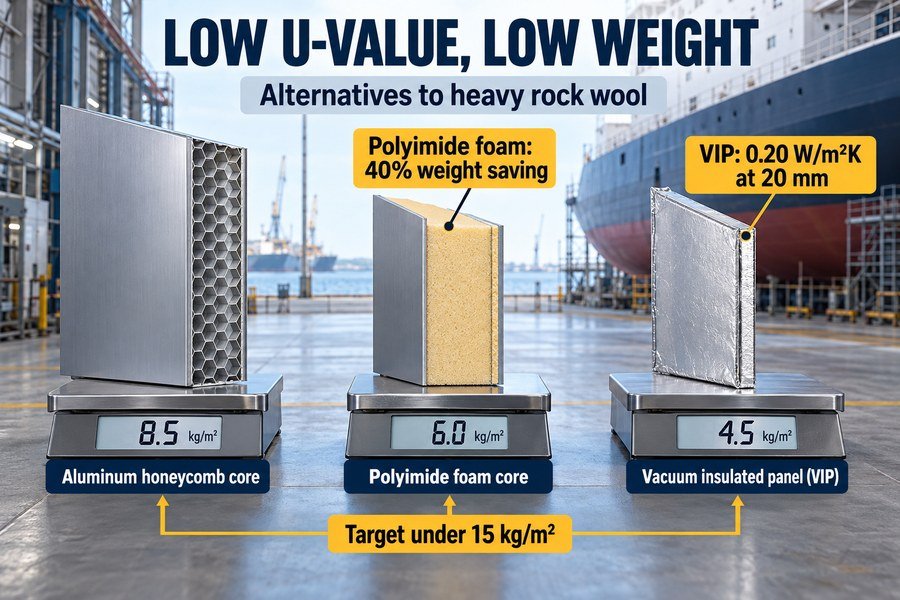
To achieve low U-Values without exceeding marine accommodation panel weight limits, builders use three strategies: adopting lightweight aluminum honeycombs, upgrading to high-performance polyimide foams (saving 40% weight), or utilizing Vacuum Insulated Panels (VIPs) which achieve 0.20 W/m²K at just 20mm thickness, keeping total panel weight under 15 kg/m².
Using High-Performance Foams and Honeycombs to Reduce Weight
The SOLAS convention sets strict fire safety rules, and this usually forces us to use heavy rock wool. But shipyards have strict deadweight limits. We have to achieve low U-values without making the ship sink deeper into the water. I help buyers solve this by moving away from traditional rock wool. First, we use lightweight aluminum honeycomb panels. The aluminum core has lots of empty air space, making it very light. We add thermal break strips to stop the cold metal from passing temperature through the panel. Second, we upgrade to high-performance polyimide foams. Polyimide foam is an amazing marine material. It has a density of only about 16 kg/m³, compared to rock wool at 100 kg/m³1. By using polyimide foam, you can save 40% of the panel weight while still meeting the A-Class fire regulations.
Implementing Vacuum Insulated Panels for Maximum Thermal Efficiency
The third and most advanced method is using Vacuum Insulated Panels, or VIPs. A VIP is like a flat thermos bottle. The factory takes a core material and removes all the air, then seals it in a foil envelope. Because there is no air inside, heat cannot travel through it. VIP technology allows us to achieve an incredibly low U-value of 0.20 W/m²K with a panel thickness of just 20mm2. This is better insulation than 100mm of standard rock wool. More importantly, the total weight of a VIP marine panel stays well under 15 kg/m². Cruise ships use these panels extensively because they save massive amounts of weight and keep the cabins very warm. They cost more, but the fuel savings pay for the panels very quickly.
| Core Material Type | Panel Thickness | Density of Core | U-Value (W/m²K) | Total Panel Weight |
|---|---|---|---|---|
| Standard Rock Wool | 100mm | 150 kg/m³ | 0.40 | 22.5 kg/m² |
| Aluminum Honeycomb | 50mm | 45 kg/m³ | 0.80 | 12.0 kg/m² |
| Polyimide Foam | 50mm | 16 kg/m³ | 0.35 | 9.5 kg/m² |
| Vacuum Insulated (VIP) | 20mm | N/A (Vacuum) | 0.20 | 14.5 kg/m² |
How Do Thinner Tropical Marine Partition Panels Maximize Cabin Volume?
Tropical routes do not need freezing protection, but space is still money. Thick panels steal room. Using thin partitions gives the crew more air and space to breathe.
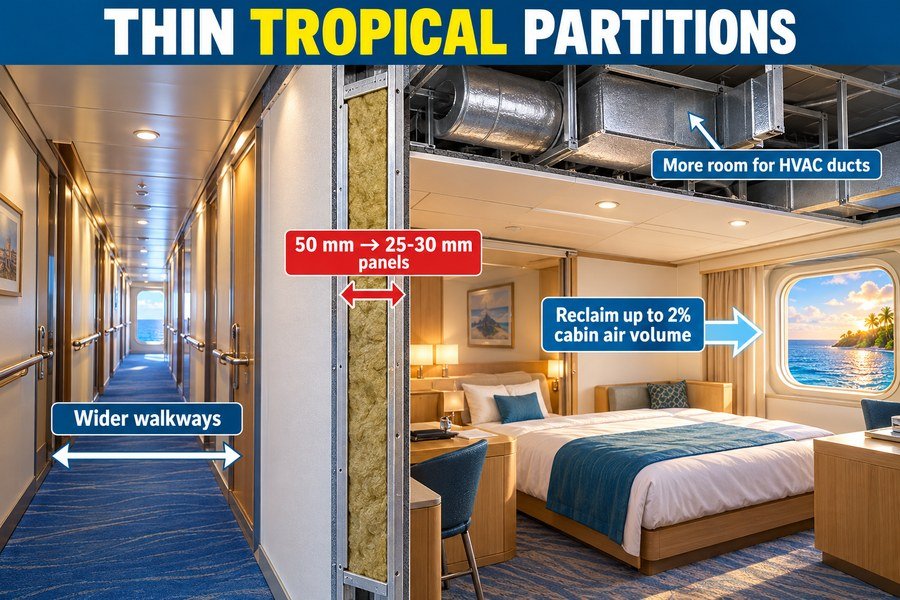
Thinner tropical marine partition panels maximize cabin volume by replacing standard 50mm cores with 25mm or 30mm alternatives. By utilizing lighter, thinner B-15 or C-Class rated materials, shipbuilders can reclaim up to 2% of total cabin air volume, allowing for wider walkways and larger HVAC vents in hot climates.
Shifting from 50mm Bulkheads to 25mm C-Class Partitions
When a ship operates in Southeast Asia or the Middle East, we fight intense heat, not snow. The exterior walls still need some insulation against the sun. But the internal partition panels between two cabins never touch the outside air. Therefore, we do not need thick 50mm thermal panels everywhere inside the ship. For these internal walls, I always advise buyers to use 25mm or 30mm thick panels. These are usually rated as B-15 Class or C-Class under the IMO FTP Code. A C-Class panel does not have strict fire containment requirements, so it can be very thin and light. A B-15 panel requires some rock wool to pass the 15-minute fire test, but 25mm is thick enough to pass. By changing from 50mm to 25mm or 30mm cores, we make the walls much thinner.
Reclaiming Space for HVAC and Walkways in Tropical Cabins
Making the walls thinner has a huge impact on the air volume inside the cabin. When you shrink the wall thickness by 25mm, you add that space back into the room. In a small 5-square-meter cabin, this change reclaims up to 2% of the total cabin air volume. This extra air volume is very important in tropical climates. First, it allows the shipyard to design wider walkways. The crew feels less trapped and more comfortable in the heat. Second, thinner panels leave more space in the ceiling areas for larger HVAC vents and air ducts. You need big air ducts to pump large volumes of cold air into tropical cabins. If the ceiling panels are too thick, the ducts get squeezed, and the air conditioning becomes noisy and weak.
| Panel Rating | Typical Thickness | Used For | Impact on Cabin Air Volume |
|---|---|---|---|
| A-60 Class | 50mm | High fire risk areas | Baseline volume |
| B-15 Class | 30mm | Standard cabin dividers | Reclaims ~1% volume |
| C-Class | 25mm | Low risk partitions | Reclaims ~2% volume |
How to Balance Weight and Comfort in Marine Interior Panel Cores?
A light ship is fast, but a noisy, cold ship makes a miserable crew. You must find the perfect middle ground between shedding kilos and keeping people comfortable.
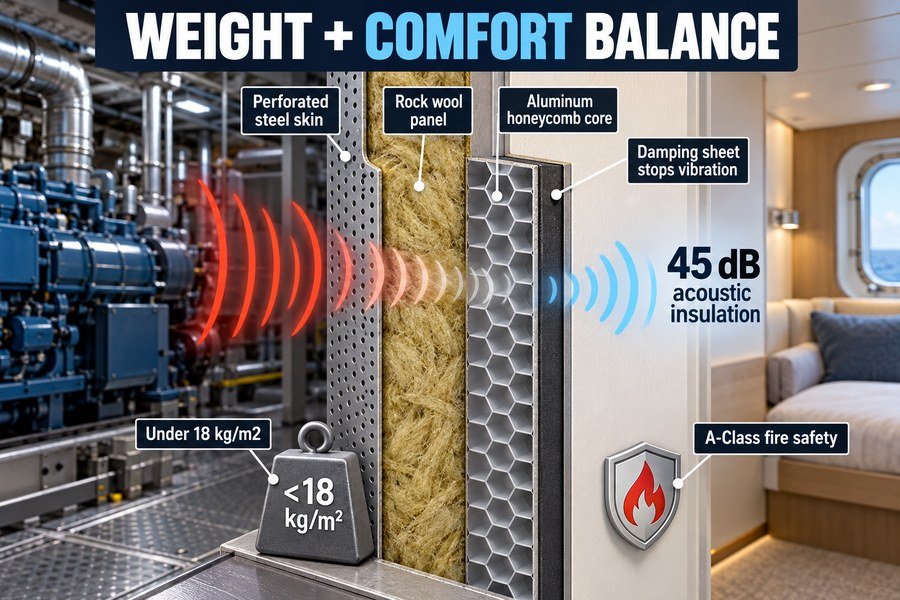
Balancing weight and comfort in marine interior panel cores requires selecting hybrid materials that offer three benefits: 45 dB acoustic insulation, A-Class fire safety, and low mass (under 18 kg/m²). Solutions include using composite rock wool with perforated skins or pairing lightweight aluminum cores with acoustic damping sheets.
Achieving 45 dB Acoustic Insulation with Lightweight Materials
Comfort on a ship means two specific things: temperature control and noise reduction. According to the IMO noise code, ship cabins need good sound reduction to protect crew hearing and sleep. We usually aim for 45 dB of acoustic insulation between noisy areas and cabins. In basic physics, heavy mass stops noise best. A thick steel plate blocks sound perfectly. But we cannot put heavy steel plates in cabins because the ship will become too heavy. To get 45 dB acoustic insulation while keeping the mass under 18 kg/m², we use composite rock wool panels with perforated steel skins. The tiny holes in the steel surface allow sound waves to enter the panel, where the rock wool fibers trap and absorb the noise. This gives excellent comfort without adding heavy steel plates to the ship.
Combining Aluminum Cores with Acoustic Damping Sheets
Another great solution for balancing weight and comfort is using aluminum honeycomb cores paired with acoustic damping sheets. The aluminum honeycomb provides incredible strength and keeps the panel perfectly flat. It is also extremely light. But aluminum is terrible at stopping noise; it actually rings like a bell when hit. To fix this, factories glue thin acoustic damping sheets inside the panel, right next to the aluminum core. These thin rubber-like sheets stop the aluminum from vibrating.3 This kills the noise transmission. When assembled correctly, this hybrid panel provides A-Class fire safety, blocks sound, and keeps the total weight very low. I recommend this setup for high-end ships where buyers want top quality but have strict weight limits.
| Core Configuration | Acoustic Rating (dB) | Fire Safety Class | Panel Weight (kg/m²) | Comfort Level |
|---|---|---|---|---|
| Standard 50mm Rock Wool | 35 dB | A-0 to A-30 | 16.5 kg/m² | Low (Noisy) |
| High Density 50mm Rock Wool | 42 dB | A-60 | 20.0 kg/m² | Good (Heavy) |
| Perforated Skin + Rock Wool | 45 dB | B-15 to A-30 | 17.5 kg/m² | Excellent (Balanced) |
| Aluminum Core + Damping | 46 dB | A-Class | 14.0 kg/m² | Premium (Very Light) |
Conclusion
Climate-driven insulation forces hard choices about panel weight and cabin space. By selecting the right core materials and thicknesses, you will build safe, comfortable ships without exceeding critical weight limits.
-
"Preparation and Properties of High-Temperature-Resistant ...", https://pmc.ncbi.nlm.nih.gov/articles/PMC10304918/. Technical literature on polyimide foams reports very low foam densities, while mineral or rock wool insulation is commonly supplied across substantially higher density ranges; this supports the general weight-saving comparison between the materials. Evidence role: statistic; source type: paper. Supports: Polyimide foam can have a much lower density than rock wool insulation, making it relevant for lightweight marine panels.. Scope note: Published density values vary by formulation, compression, facing, and fire-rating system, so a source may support representative ranges rather than the exact figures used in the article. ↩
-
"Vacuum insulation panel core materials and modelling the ...", https://dr.lib.iastate.edu/bitstreams/f77c7126-f49f-4b7f-b58d-7f1c941b1f20/download. Research on vacuum insulated panels reports effective thermal conductivities far below conventional fibrous insulation, making a U-value near 0.20 W/m²K plausible for thin VIP assemblies under ideal or well-protected conditions. Evidence role: mechanism; source type: paper. Supports: Vacuum insulated panels can achieve very low thermal transmittance at small thicknesses compared with conventional insulation.. Scope note: VIP performance depends on edge losses, aging, puncture resistance, installation details, and facings; a general VIP source may not directly verify the exact U-value for a finished marine panel. ↩
-
"Vibro-acoustical analysis and design of a multiple-layer ...", https://digitalcommons.mtu.edu/cgi/viewcontent.cgi?article=1382&context=etds. Research on viscoelastic and constrained-layer damping shows that thin polymer damping layers bonded to metal panels can reduce resonant vibration amplitudes by dissipating strain energy as heat. Evidence role: mechanism; source type: paper. Supports: Rubber-like acoustic damping sheets can reduce vibration in aluminum or metal panels.. Scope note: The evidence supports vibration reduction in principle; it does not by itself verify the claimed sound rating, fire class, or weight of the specific aluminum-core marine panel. ↩