Idle vessels often suffer hidden cabin moisture damage during layup. Ruined wall panels delay shipyard handovers and drain budgets. Understanding layup humidity physics protects your interior outfitting investment.
Layup and idle periods raise cabin relative humidity from standard operating levels of 40%–60% to 75%–95% because HVAC systems stop running. This causes four main problems: core mineral wool saturation, PVC film delamination, galvanized steel backing corrosion, and toxic mold growth unless desiccants or dehumidifiers hold humidity below 50%.
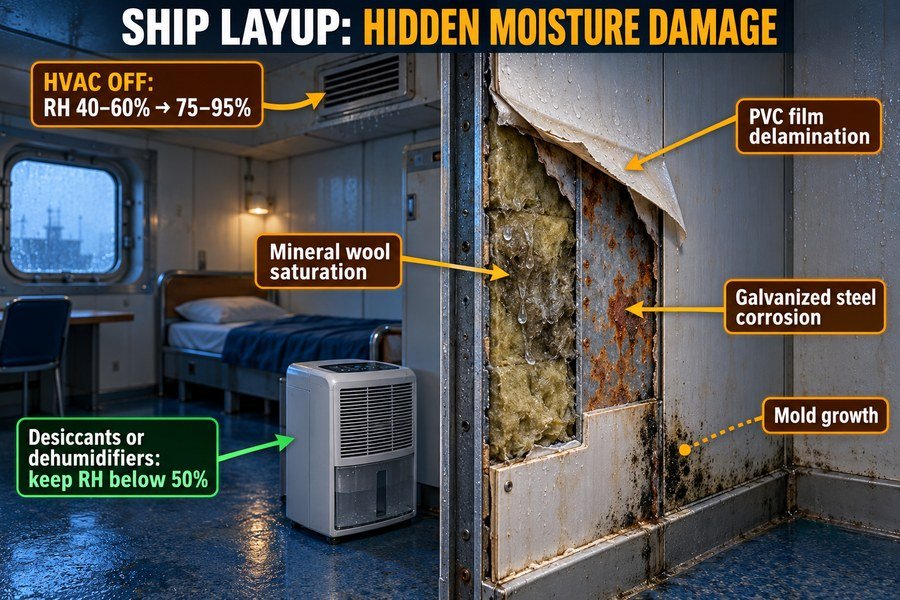
Last year, I inspected a refit vessel in Southeast Asia that sat idle for four months before final delivery to a European owner. The procurement officer bought certified B-15 wall panels and ceiling panels from a reliable factory, so she thought the cabin interiors were safe. However, the shipyard turned off the ship ventilation after installation to save fuel costs. When we walked onto the accommodation decks, we found bubbling PVC decorative films, rusted joint profiles, and wet rockwool cores across thirty cabins. The contractor lost over $45,000 replacing damaged panels and missed the delivery deadline by three weeks. I wrote this engineering guide based on my work at Magellan Marine so you can spot these hidden moisture traps early, protect your panel quality, and keep your outfitting budgets on track.
Why Does Rising Humidity During Cold Ship Layup Threaten Marine Interior Panels?
Cold layup turns off all ship power and heating. Unchecked moisture quickly ruins expensive B-15 cabin panels and blows your refit budget. Knowing exact humidity damage thresholds prevents costly replacements.
Rising humidity above 60% RH during cold ship layup threatens marine interior panels through three specific failure mechanisms: hygroscopic rockwool core moisture absorption exceeding 2% by weight, polyurethane adhesive hydrolysis peeling PVC films, and zinc-coating breakdown corroding 0.6 mm steel sheets. Keeping cabin RH between 40% and 50% prevents failure.
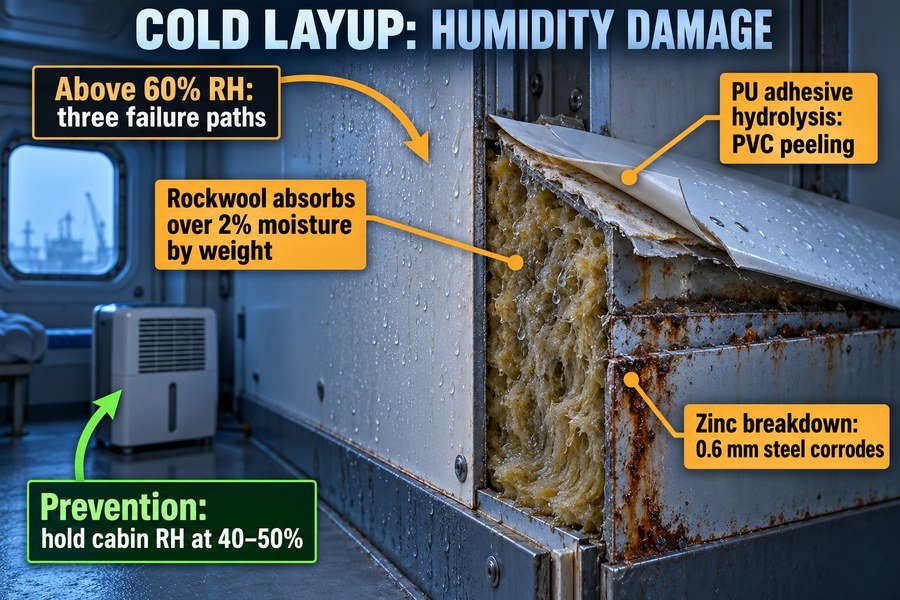
Hygroscopic Rockwool Core Saturation and Polyurethane Adhesive Hydrolysis During Cold Layup
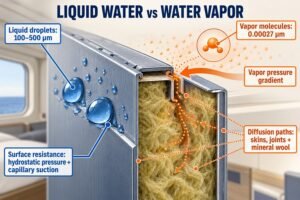
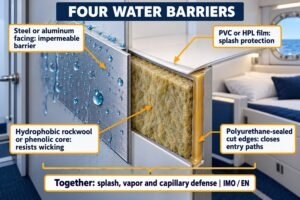
During normal vessel operation, marine HVAC systems follow ISO 7547 standards and keep cabin relative humidity (RH) between 40% and 60%. When a ship enters a cold layup, the crew shuts down main generators and auxiliary boilers. Without active climate control, cabin humidity quickly climbs to between 75% and 95% RH. This high humidity triggers the first failure mechanism: hygroscopic rockwool core moisture absorption exceeding 2% by weight. Marine composite wall panels use high-density mineral wool cores (120 kg/m³ to 150 kg/m³) tested under IMO 2010 FTP Code Part 1 for non-combustibility1. Good factories add water-repellent oils to the rockwool fibers, so liquid water beads off during short exposures. However, water vapor molecules are much smaller than liquid droplets. When ambient humidity stays above 80% RH for more than 30 days, water vapor diffuses through the open top and bottom panel edges into the core2. Once absorbed moisture passes 2% of the core weight, the mineral wool loses up to 35% of its internal compressive strength and starts sagging inside the steel skins.
At the same time, high humidity causes the second failure mechanism: polyurethane adhesive hydrolysis peeling PVC films. Most marine wall and ceiling panels bond a 0.15 mm flame-retardant PVC decorative film (certified to IMO FTP Code Part 5) onto the front galvanized steel sheet using a two-component polyurethane glue. In dry conditions, this glue maintains a strong peel strength of 12 N/25mm to 15 N/25mm. When cold layup humidity stays above 70% RH, water molecules react chemically with the ester and urethane links in the glue layer. This chemical breakdown is called hydrolysis.3 Within 45 to 60 days, the adhesive softens and loses its grip, dropping peel strength below 4 N/25mm4. You will see long air blisters and peeling film edges along the panel corners.
Galvanized Steel Sheet Corrosion and DNV-CG-0290 Layup Humidity Control Standards
The third failure mechanism is zinc-coating breakdown corroding the 0.6 mm galvanized steel sheets that form the structural shell of the panel. Standard marine B-15 composite panels use 0.5 mm to 0.7 mm hot-dip galvanized steel skins manufactured to EN 10346 standards, carrying a zinc coating weight between 120 g/m² and 275 g/m²5. While the front face has a thick PVC film, the back face touching the rockwool core only has a thin 5-micron to 7-micron epoxy primer. Furthermore, the sheared top, bottom, and slot edges of the steel sheet have raw steel exposed to the air.
According to the DNV-CG-0290 Class Guideline for Ship in Lay-up and the Lloyd's Register Ship Lay-up Guide, atmospheric corrosion of steel stays near zero when relative humidity stays below 50% RH. Once humidity rises past the critical 60% RH threshold, a thin electrolyte film forms on the metal surface. In salty marine air at 80% RH, white rust (zinc hydroxide) consumes a 120 g/m² zinc layer along unsealed panel edges in just 60 to 90 days. Red iron rust then spreads underneath the PVC film at the joints. I always advise my clients at Magellan Marine to follow DNV-CG-0290 rules strictly and place portable desiccant dehumidifiers inside the accommodation block to hold cold layup humidity between 40% and 50% RH.
| Cold Layup Failure Mechanism | Critical RH Threshold | Material Component Affected | Measured Performance Drop | Replacement Cost Impact (per 100 m²) |
|---|---|---|---|---|
| Rockwool Core Moisture Absorption | Above 80% RH for 30+ days | 120–150 kg/m³ mineral wool core | Moisture exceeds 2% by weight; 35% compression loss | $3,200 – $4,800 in material and labor |
| Polyurethane Adhesive Hydrolysis | Above 70% RH for 45+ days | Two-part PU glue under 0.15 mm PVC film | Peel strength drops from 15 N/25mm to under 4 N/25mm | $1,500 – $2,500 for re-skinning or swap |
| Galvanized Steel Sheet Corrosion | Above 60% RH (per DNV-CG-0290) | 0.6 mm EN 10346 steel skins (120 g/m² zinc) | White and red rust on cut edges within 60–90 days | $3,500 – $5,200 for full panel replacement |
How Does Switched-Off HVAC During Layup Trap Moisture Behind Marine Interior Panels?
Turning off ship HVAC stops air circulation right away. Stagnant damp air hides behind cabin linings and rots panel backs unseen. Understanding cavity airflow physics helps you stop trapped moisture.
Switched-off HVAC during layup traps moisture behind marine interior panels in three ways: eliminating the 6-to-10 hourly cabin air changes, halting negative pressure exhaust in wet units, and sealing humid air inside the 50 mm bulkhead air gap where zero air velocity stops natural evaporation.
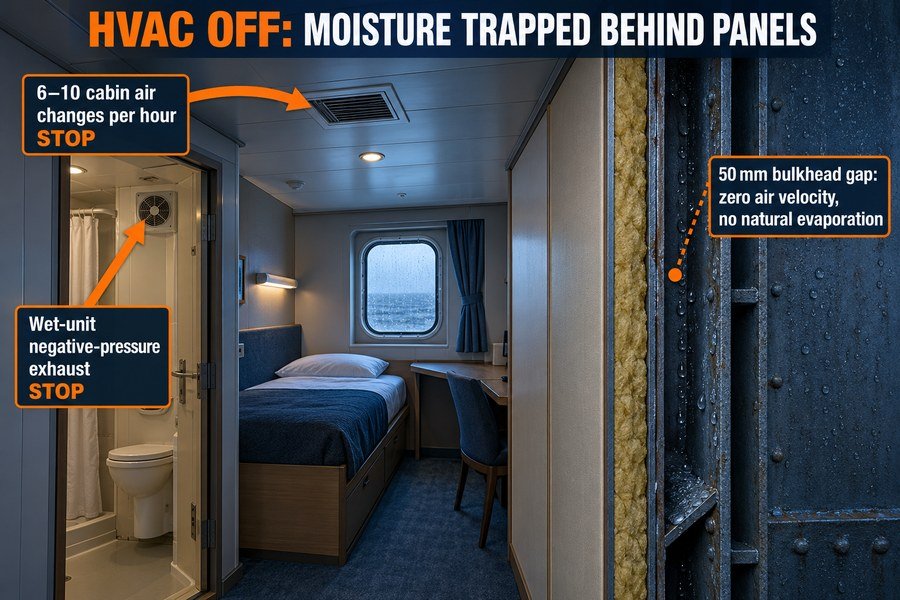
Loss of ISO 7547 Cabin Air Changes and Wet Unit Negative Pressure Exhaust
Many project managers assume that an empty ship cabin stays dry as long as the windows and exterior watertight doors remain shut. In reality, shutting down the heating, ventilation, and air conditioning (HVAC) system turns the cabin interior into a moisture trap. Under ISO 7547 and the ABS Guide for Crew Habitability on Ships, an active marine HVAC system supplies 6 to 10 air changes per hour (ACH) to crew cabins and public spaces. This steady airflow replaces humid indoor air with conditioned dry air every 6 to 10 minutes. The first way switched-off HVAC traps moisture is by dropping this air exchange rate from 8 ACH straight down to 0 ACH. Any humid air that enters the accommodation block during port inspections or wet weather remains locked inside the rooms.
The second way switched-off HVAC causes damage is by halting the negative pressure exhaust inside modular wet units and sanitary spaces. During normal service, dedicated extraction fans pull 50 m³/h to 80 m³/h of air out of each cabin bathroom6, maintaining a continuous negative pressure differential of 15 Pa to 25 Pa relative to the sleeping area. This negative pressure forces moist bathroom air out through the exhaust duct onto the open deck. When the shipyard turns off the exhaust fans during an idle period, the pressure differential drops to 0 Pa. Water sitting inside shower gullies, toilet bowls, and sink traps evaporates and drifts upward through ceiling panel joints directly into the overhead void space above the entire cabin deck.
Vapor Lock Inside the 50 mm Bulkhead Cavity Behind Marine Wall Panels
The third and most destructive mechanism happens inside the narrow 50 mm air gap between the ship steel hull bulkhead and the back of the marine interior lining panel. When installers erect a cabin wall system, they weld steel fixing angles to the bulkhead and leave a 30 mm to 50 mm service cavity behind the B-15 wall panels7 to run electrical cables, water pipes, and steel stiffeners. The bottom edge of the panel sits inside a galvanized steel U-channel track welded or glued to the deck, and the top edge slots into a ceiling perimeter angle.
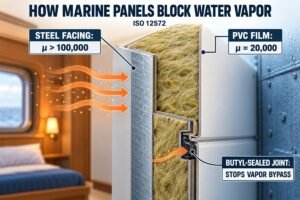
Because the front face of the marine wall panel is laminated with a 0.15 mm PVC film, the panel acts as a strong vapor retarder8. According to ASTM E96 water vapor transmission testing, marine PVC-steel composite sheets have a very low permeability below 1.5 g/m² per 24 hours. Humid air easily enters the 50 mm rear cavity through unsealed cable penetrations, light switch cutouts, and ceiling inspection gaps during humid afternoons. Once the moisture gets behind the panel, the impermeable PVC front skin blocks it from evaporating back into the room. Because the HVAC system is off, the air velocity inside that 50 mm bulkhead cavity sits at 0.0 m/s. I once opened a cabin wall on an idle offshore support vessel in Batam and measured the cavity air with a digital hygrometer. The open corridor measured 64% RH, but the stagnant air trapped behind the wall panel sat at 91% RH, soaking the rear rockwool insulation. Removing one B-0 ceiling inspection hatch every 8 to 10 meters and running a small portable circulation fan prevents this hidden vapor lock.
| Ventilation Parameter | Active HVAC Service (ISO 7547 Standard) | Switched-Off HVAC During Ship Layup | Direct Effect on Marine Interior Panels |
|---|---|---|---|
| Cabin Air Exchange Rate | 6 to 10 air changes per hour (ACH) | 0 ACH (stagnant indoor air) | Ambient humidity rises from 50% RH to over 80% RH |
| Sanitary Wet Unit Exhaust | -15 Pa to -25 Pa negative pressure (50–80 m³/h) | 0 Pa pressure differential | Drain water vapor rises into overhead ceiling panel voids |
| 50 mm Bulkhead Cavity Airflow | 0.15 to 0.30 m/s induced draft | 0.0 m/s (complete vapor lock behind PVC face) | Rear cavity reaches 85%–95% RH; wets back of rockwool core |
What Condensation Risks Do Marine Accommodation Panels Face When Vessels Sit Idle?
Steel ship hulls cool down fast at night while cabin air stays warm. Sweating steel drips water straight onto your panels. Knowing these condensation zones saves you from expensive rework.
When vessels sit idle, marine accommodation panels face four major condensation risks: hull-side sweating wetting panel backs, overhead deckhead dripping onto ceiling panels, thermal-bridge sweating along steel fixing profiles, and bottom C-channel water pooling that wicks up 150 mm into mineral wool cores.
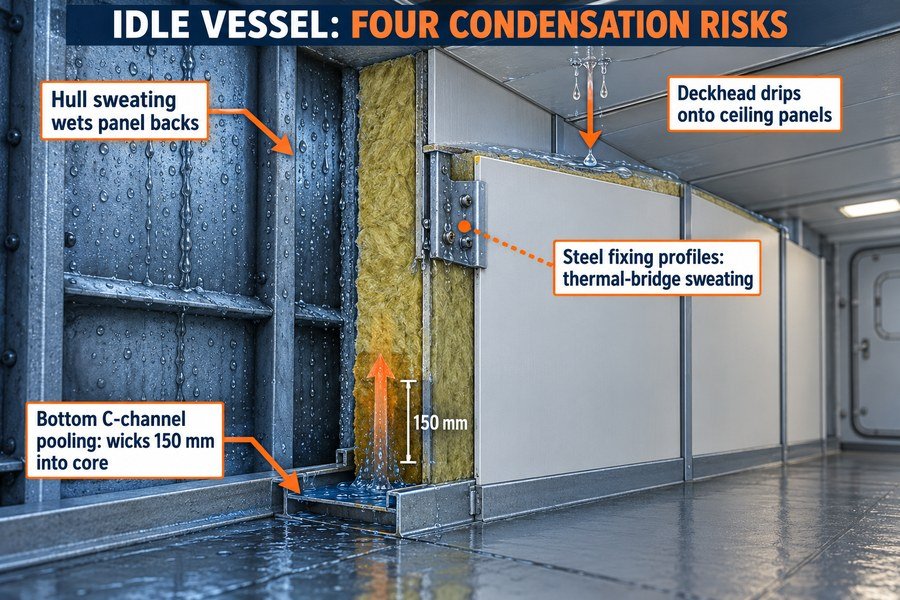
Hull-Side Sweating and Overhead Deckhead Dripping onto Marine Ceiling Panels
Liquid condensation causes much faster damage to marine accommodation panels than humid air alone.9 According to ISO 8502-4 psychrometric tables used in shipbuilding, condensation forms immediately whenever a steel surface drops below the dew point temperature of the surrounding air. For example, if cabin air sits at 28°C with 80% relative humidity during an idle period, the dew point temperature is 24.2°C. Any steel plate cooler than 24.2°C will sweat liquid water. This creates the first major risk: hull-side sweating wetting panel backs. Even when a ship hull has 50 mm of A-60 mineral wool pin-insulation, installers often leave small air gaps around hull frames or tear the aluminum foil vapor barrier while pulling cables. Cool seawater outside the hull chills the exposed steel ribs to 18°C or 20°C. The hull sweats 200 g/m² to 350 g/m² of liquid water per day, which runs down the ribs and splashes onto the rear face of the B-15 lining panels.
The second major risk is overhead deckhead dripping onto marine ceiling panels. When a vessel sits idle in port, intense sunlight heats the exposed steel weather decks to 50°C or 60°C during the afternoon10. After sunset, clear night skies cool the steel deck plates by 15°C to 20°C within four hours. Humid air trapped inside the 300 mm to 500 mm plenum space above the cabin ceiling condenses on the cold underside of the steel deckhead. Water droplets fall like indoor rain straight onto the flat backs of the B-0 and B-15 marine ceiling panels. Because ceiling panels hang horizontally over a 2,100 mm to 2,400 mm span, wet rockwool insulation adds 4 kg/m² to 6 kg/m² of extra weight. Within a month, the wet ceiling panels bow downward by 8 mm to 15 mm, exceeding the strict 3 mm/m flatness tolerance required by European and American shipyards.
Thermal-Bridge Sweating on Fixing Profiles and Bottom C-Channel Water Pooling
The third condensation risk is thermal-bridge sweating along the galvanized steel fixing profiles. Marine ceiling and wall panels connect to the steel hull structure using 1.2 mm to 1.5 mm galvanized steel threaded rods, angle brackets, and M-profiles or H-profiles. Carbon steel has a high thermal conductivity of 50 W/m·K, compared to just 0.038 W/m·K for rockwool insulation.11 When the ship hull or weather deck cools down at night, cold temperatures conduct straight down the steel hangers into the metal panel joints. Unless the installation team applies 3 mm closed-cell neoprene thermal break tape on the brackets, water beads up along every ceiling joint profile and stains the decorative PVC surface.
The fourth risk is bottom C-channel water pooling that wicks up 150 mm into the mineral wool cores. All marine wall panels stand inside a continuous galvanized steel bottom track (typically 25 mm high by 50 mm wide by 1.2 mm thick) fixed to the steel deck. When condensation drips down the hull bulkhead or down the back of the panel, gravity pulls the water straight into this U-shaped floor channel. Because the bottom C-channel has solid steel sides, water collects inside the trough to a depth of 10 mm to 20 mm. The raw, unsealed bottom edge of the rockwool core sits directly in this puddle. Capillary action pulls the standing water 100 mm to 150 mm upward into the mineral wool fibers within 14 days. On my projects at Magellan Marine, I always tell buyers to request pre-punched 5 mm weep holes every 1,000 mm along the back flange of the bottom track or apply a continuous bead of marine silicone sealant after final panel alignment.
| Idle Vessel Condensation Risk | Primary Physical Cause | Typical Water Volume or Spread | Practical Outfitting Prevention Method |
|---|---|---|---|
| Hull-Side Bulkhead Sweating | Hull steel drops below air dew point (ISO 8502-4) | 200 to 350 g/m² of water per day | Repair torn aluminum foil vapor barriers on A-60 hull pins |
| Overhead Deckhead Dripping | Night cooling of sun-heated steel decks (15°C–20°C drop) | Adds 4 to 6 kg/m² water weight to ceilings | Keep plenum ventilated; lay 25 mm foil-faced wool over ceilings |
| Fixing Profile Thermal Bridging | High steel conductivity (50 W/m·K) on ceiling hangers | Visible water beads and rust along H-joints | Install 3 mm closed-cell EPDM or neoprene thermal break tape |
| Bottom C-Channel Water Pooling | Gravity drainage collecting in 25x50 mm U-tracks | Standing water wicks 100–150 mm up rockwool | Punch drainage notches every 1,000 mm or seal bottom joint |
How Does Moisture Build Up on Marine Accommodation Panels in Unoccupied Cabins?
Empty cabins look safe behind locked doors during ship layup. However, sealed rooms silently build up heavy moisture that ruins wall finishes. Tracking these internal moisture sources prevents unpleasant surprises.
Moisture builds up on marine accommodation panels in unoccupied cabins through four internal mechanisms: diurnal temperature swings pumping damp air through door gaps, dried plumbing traps releasing sewer vapor, wet deck-screed curing releasing 15–25 liters of water per cabin, and hygroscopic soft furnishings cycling moisture onto cold panel faces.
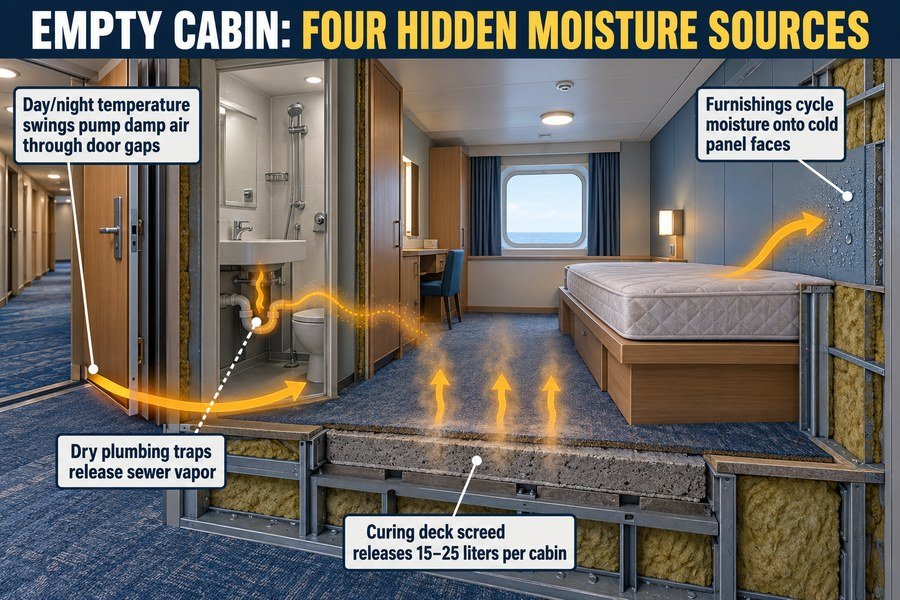
Diurnal Pressure Pumping and Plumbing Trap Evaporation in Locked Ship Cabins
A very common mistake I see among shipyard contractors is locking the cabin doors after outfitting and assuming no moisture can get inside. In reality, moisture builds up rapidly inside closed rooms through four internal mechanisms. The first mechanism is diurnal temperature swings pumping damp air through door ventilation gaps. According to ISO 7547 cabin ventilation rules, a marine B-15 cabin fire door cannot be completely airtight unless the room has a dedicated return air duct. Most cabin doors feature either a bottom ventilation louver (typically 400 mm x 150 mm with an intumescent fire damper) or a 10 mm to 15 mm clearance gap at the bottom threshold so air can reach the corridor exhaust. During an idle layup, daytime heat warms the cabin air by 8°C to 12°C, expanding the air volume by 3% to 4%. At night, the cabin cools and air contracts, drawing wet corridor air back through the door louver. This daily breathing cycle pumps humid air into the locked cabin every 24 hours.12
The second mechanism is dried plumbing traps releasing sewer and greywater vapor. Every crew cabin has a private wet unit equipped with a washbasin P-trap, a shower floor gully, and a toilet bowl connected to the ship greywater and blackwater piping network. Standard marine drain traps hold a 50 mm water seal. When a cabin sits unoccupied, this trap water evaporates into the room at a rate of 2 mm to 4 mm per week13, releasing 50 grams to 120 grams of water vapor per day. Once the 50 mm water seal evaporates completely after 10 to 12 weeks, warm, moisture-saturated air from the main sewage holding tank flows freely up the drainpipe directly into the cabin. Inside a small 30 m³ marine cabin, just 300 grams of water vapor is enough to push relative humidity from 45% RH all the way to 90% RH.
Wet Deck-Screed Off-Gassing and Hygroscopic Mattress Moisture Cycling
The third mechanism happens during extended newbuild outfitting or refit layups: wet deck-screed curing releasing 15 to 25 liters of water per cabin. Before installing vinyl flooring or carpet, workers pour a 15 mm to 25 mm layer of cementitious or latex primary deck covering (certified under IMO FTP Code Part 6) to level the uneven steel deck. Mixing that leveling compound for a standard 15 m² cabin requires 20 to 30 liters of clean water. While the floor feels hard enough to walk on after 24 hours, 15 to 25 liters of free mixing water remain trapped inside the cement matrix and evaporate slowly over 28 days. If workers install the marine wall panels and lock the cabin door before the deck screed cures below 4% moisture content (measured per ASTM F2659), all 20 liters of water vapor trap inside the room and soak directly into the wall panel joints.
The fourth mechanism is hygroscopic soft furnishings cycling moisture onto cold panel faces. When an idle ship already has crew mattresses, curtains, upholstered chairs, and carpets inside the cabin, these organic and synthetic textiles act like moisture sponges. According to ASTM D2495 textile moisture testing, foam mattresses and woven fabrics absorb 5% to 8% of their dry weight in water from humid air. When afternoon sunlight heats the cabin through the porthole window, the warm mattress bakes out 200 grams to 400 grams of water vapor. That warm vapor immediately hits the cooler 0.6 mm steel skin of the shady interior wall panels and condenses into liquid droplets on the PVC surface. On a delayed vessel build in Vietnam, I helped a client stop severe cabin wall sweating simply by taping heavy polyethylene film over all bathroom drains and waiting 14 days after pouring deck screeds before bringing marine panels onboard.
| Internal Cabin Moisture Source | Moisture Release Volume / Rate | Primary Testing or Design Reference | Field Action to Stop Moisture Buildup |
|---|---|---|---|
| Diurnal Door Gap Air Pumping | Exchanges 3%–4% of cabin air volume daily | ISO 7547 return air louver design | Seal door louvers with removable tape when using cabin desiccants |
| Plumbing Drain Trap Evaporation | 50 to 120 g/day; full sewer vapor after 10 weeks | 50 mm marine sanitary water seal rule | Pour 50 ml mineral oil into drains or tape drain grates shut |
| Wet Deck-Screed Curing | 15 to 25 liters of free water per 15 m² cabin | IMO FTP Code Part 6 / ASTM F2659 (<4% MC) | Cure deck screed for 14 days with fans before installing panels |
| Hygroscopic Furnishing Cycling | 200 to 400 g cycled per mattress daily | ASTM D2495 textile moisture regain | Vacuum-seal mattresses in plastic bags during ship layup |
Why Does Prolonged Layup Without Dehumidification Degrade Marine Accommodation Panels?
Skipping dehumidifiers during a long layup looks like an easy way to cut costs. Yet months of damp air permanently destroy panel certifications and strength. See what prolonged dampness costs.
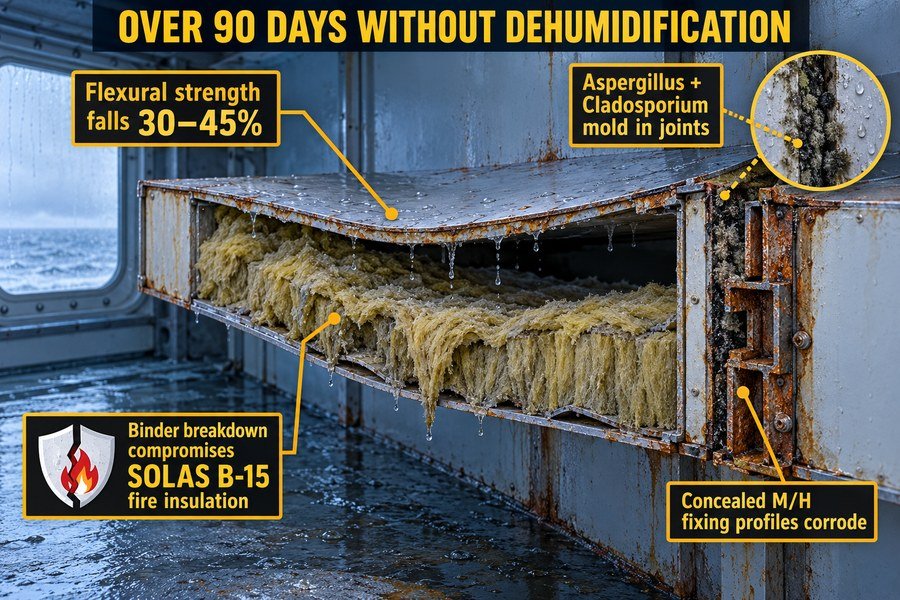
Prolonged layup over 90 days without dehumidification permanently degrades marine accommodation panels in four ways: reducing panel flexural strength by 30%–45%, growing Aspergillus and Cladosporium mold inside joints, corroding concealed M-profiles and H-profiles, and compromising IMO SOLAS B-15 fire-insulation performance due to binder breakdown.
Structural Flexural Strength Loss and Concealed Joint Profile Corrosion Over 90 Days
When a vessel stays in layup for more than 90 days without active dehumidification, moisture damage moves from cosmetic surface stains to irreversible structural failure. The first permanent degradation is reducing panel flexural strength by 30% to 45%. A standard 50 mm B-15 marine wall panel works like an structural I-beam14: the two 0.6 mm galvanized steel outer skins carry tension and compression loads, while the 140 kg/m³ mineral wool core carries shear loads. In dry factory bending tests over a 2,000 mm span, a new composite panel withstands a center load of 1,200 N to 1,500 N with less than 5 mm deflection. However, mineral wool manufacturers use 3% to 4% thermosetting phenolic-formaldehyde resin binder to glue the spun rock fibers together into a rigid board. When cabin humidity remains above 80% RH for 90 to 180 days, moisture breaks down the silane coupling agents on the rock fibers15 and weakens the polyurethane bond between the wool and the steel skin. In our quality lab at Magellan Marine, we tested panels pulled from a six-month unheated ship layup and found flexural load capacity dropped to just 750 N. When you press the center of a degraded panel with your thumb, the steel skin flexes inward because it has detached from the wet core.
The second structural failure is corroding the concealed M-profiles, H-profiles, and tongue-and-groove joints that hold the walls together. Whether you buy a modular tongue-and-groove panel system or a spline-joint panel system with decorative PVC-laminated H-profiles, the vertical connection between two panels forms a tight 0.5 mm capillary crevice. Capillary action draws condensed moisture straight into this vertical joint and holds it there for months. Because spline profiles are roll-formed from slit galvanized steel coils, their cut edges have zero zinc coating. After 120 days without dehumidification, heavy red iron oxide (Fe2O3) expands inside the joint to 6 times the volume of the original steel16. This rust expansion bulges the panel seam outward and rust-welds the spline to the panel edge, making it impossible for crew to dismantle a single panel for cable maintenance without tearing the steel.
Toxic Mold Colonization and IMO SOLAS B-15 Fire Certification Risks
The third degradation mechanism is growing Aspergillus and Cladosporium mold colonies inside panel joints and acoustic perforations. Under ASTM G21 fungal resistance testing, pure PVC film does not feed mold by itself. However, during ship outfitting, microscopic wood dust, skin oils from installers' hands, and organic plasticizers settle inside the panel grooves and acoustic micro-perforations (used on noise-reduction panels with a Weighted Sound Reduction Index Rw of 32 dB to 44 dB per ISO 10140). According to World Health Organization (WHO) guidelines for indoor dampness, mold spores germinate within 48 hours to 14 days once surface relative humidity exceeds 75% RH. After 90 days of layup, black fungal hyphae grow deep into the mineral wool core behind the joints. Wiping the front PVC face with chlorine bleach only cleans the visible plastic; the mold roots inside the rockwool release musty microbial volatile organic compounds (MVOCs) back into the cabin within days.
The fourth and most severe consequence is compromising IMO SOLAS B-15 fire-insulation performance due to binder breakdown and core slumping. Under the IMO 2010 FTP Code Part 3 fire test, a B-15 cabin bulkhead must stop flame passage for 30 minutes and keep the unexposed side temperature rise below an average of 140°C (and below 225°C at any joint) during the first 15 minutes17. When a rockwool core stays wet for four to six months and loses its phenolic binder stiffness, gravity pulls the heavy wet wool downward inside the vertical steel skins. The core settles by 5% to 8%, opening a 100 mm to 150 mm hollow air pocket at the top of the 2,100 mm wall panel. Furthermore, if a fire breaks out after reactivation, residual moisture trapped inside the panel flashes into high-pressure steam at 100°C, blowing the delaminated steel skins apart and failing the B-15 fire barrier. Classification society surveyors from DNV, ABS, or Lloyd's Register routinely condemn delaminated or slumped panels during reactivation surveys.
| Layup Duration Without Dehumidifier | Physical State of Marine Wall & Ceiling Panels | Measured Mechanical / Safety Impact | Required Remediation Action |
|---|---|---|---|
| 0 to 30 Days (>75% RH) | Surface condensation; initial vapor entry into joints | <1% core moisture; 0% strength loss | Wipe dry and start dehumidifiers immediately (40%–50% RH) |
| 30 to 90 Days (>80% RH) | PU glue softening; Aspergillus mold starts in seams | Peel strength drops 40%; white zinc rust on edges | Biocide joint treatment; replace blistered panels (5%–10% loss) |
| 90 to 180 Days (>80% RH) | Phenolic binder breakdown; red rust in M/H profiles | 30%–45% flexural strength loss; jammed spline joints | Replace affected cabin sections (25%–50% panel loss) |
| Over 180 Days (>85% RH) | Rockwool slumping (5%–8% gap); full skin delamination | Fails IMO FTP Code Part 3 B-15 fire integrity | Full strip-out and replacement required by Class surveyor |
How Does Warm-Climate Layup Accelerate Moisture Damage on Marine Interior Panels?
Laying up ships in tropical ports exposes cabins to extreme heat and dampness. Damage taking a year in Europe happens in weeks. Protect your panels now.
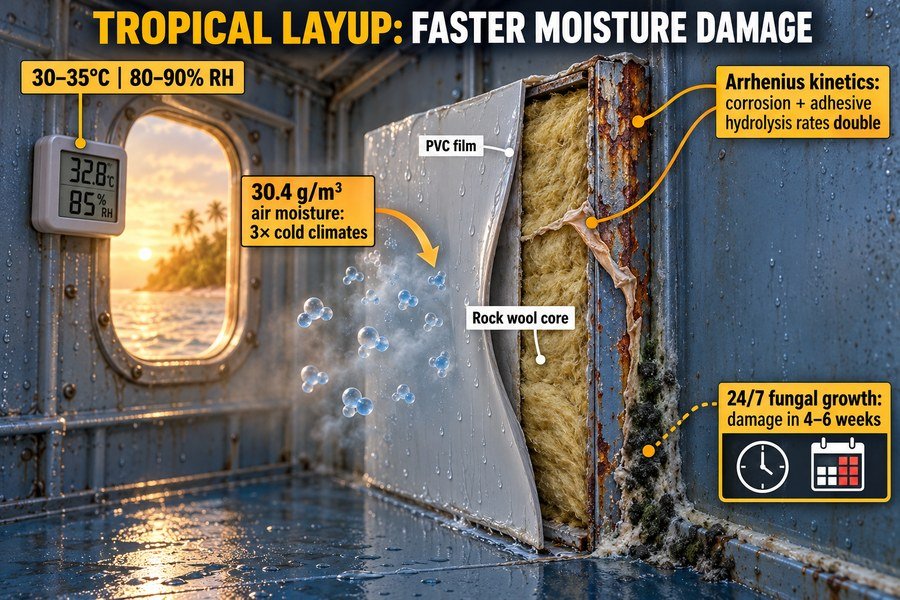
Warm-climate layup in tropical zones (30°C–35°C and 80%–90% RH) accelerates marine interior panel damage via three factors: holding 30.4 g/m³ of absolute air moisture (three times cold climates), doubling chemical corrosion and adhesive hydrolysis rates via Arrhenius kinetics, and driving 24/7 fungal growth that ruins panels in 4–6 weeks.
High Absolute Moisture Capacity and Arrhenius Acceleration of Adhesive Hydrolysis in the Tropics
Many international shipowners and interior outfitting contractors build, refit, or lay up vessels in developing maritime hubs across Indonesia, Vietnam, Malaysia, and southern China because yard rates are 30% to 50% more competitive than in Europe or the United States18. However, managing panel humidity in a tropical shipyard requires much stricter discipline because of three scientific factors. The first factor is that warm tropical air holds over three times more physical water than cold northern air at the exact same relative humidity percentage19. According to ASHRAE Fundamentals psychrometric equations, air at 10°C and 85% RH (typical of a winter layup in Rotterdam or Hamburg) holds an absolute moisture content of only 8.0 grams of water per cubic meter (g/m³)20. In contrast, tropical port air at 30°C and 100% RH holds 30.4 g/m³, and at 35°C and 85% RH (common in Batam, Jakarta, or Ho Chi Minh City), the air carries 33.7 g/m³ of water vapor. When nighttime cooling drops the steel hull temperature by just 4°C in the tropics, the air dumps three times more liquid water onto the backs of your marine panels than it would in Northern Europe.
The second factor is doubling chemical corrosion and polyurethane adhesive hydrolysis rates via Arrhenius reaction kinetics. In materials engineering, the Arrhenius equation proves that the speed of chemical reactions—including ester hydrolysis in polyurethane panel glue and electrochemical oxidation of galvanized steel—roughly doubles for every 10°C increase in temperature. Inside an unventilated ship moored under the tropical sun, daytime cabin temperatures regularly reach 35°C to 40°C, compared to 10°C to 15°C in a northern European port. That 20°C to 25°C temperature jump accelerates chemical glue breakdown and zinc coating corrosion by 400% to 500%21.
Rapid 4-to-6 Week Fungal Breakdown and Tropical Layup Cost-Prevention Strategies
The third factor in warm-climate layup is continuous 24/7 fungal growth that ruins unprotected marine interior panels in just 4 to 6 weeks. In cold climates, winter temperatures below 10°C put mold spores into dormancy, giving shipyards a wider safety margin if HVAC power is delayed. In tropical Southeast Asian ports, cabin temperatures stay inside the optimal 27°C to 35°C biological growth zone22 24 hours a day, 365 days a year. Combined with 80% to 90% RH, tropical mold species such as Aspergillus niger and Penicillium spread across PVC wall seams, silicone sealant beads, and ceiling panel edges within 28 to 42 days.
I learned this lesson firsthand two years ago when a procurement officer asked me to inspect an accommodation barge outfitted in Indonesia for an American offshore client. The yard installed 1,500 m² of B-15 wall panels and B-0 ceiling panels, then left the barge unpowered at anchorage for five weeks during a shipping delay. When we boarded the vessel, 420 m² of panels had severe film edge peeling, rusted C-channels, and black mold inside the joints. Buying replacement B-15 panels cost $28 to $42 per m² FOB, air and sea rush freight added $8 per m², and local labor to strip and reinstall the ruined walls cost $35 per m². The contractor spent $31,500 fixing damage that took only five weeks to happen. By comparison, renting three industrial dehumidifiers (each removing 90 liters of water per 24 hours at 30°C/80% RH) and plugging them into shore power costs only $1,200 to $1,800 per month. When purchasing panels from Asian factories for warm-climate projects, I also recommend paying an extra $1.20 to $1.80 per m² to upgrade the steel skins from standard 120 g/m² zinc coating to 275 g/m² zinc coating and requesting factory-applied edge sealant on cut ceiling panels.
| Layup Climate Parameter | Cold / Temperate Layup (North Europe: 10°C, 85% RH) | Warm / Tropical Layup (Southeast Asia: 30°C–35°C, 85% RH) | Financial & Schedule Impact on Outfitting |
|---|---|---|---|
| Absolute Air Moisture Content | 8.0 g/m³ (ASHRAE psychrometric chart) | 30.4 to 33.7 g/m³ (over 3x more physical water) | 3x heavier daily condensation inside 50 mm hull cavities |
| Chemical Degradation Speed | Baseline (1x rate for PU glue and zinc rust) | 4x to 5x faster (Arrhenius doubling per 10°C rise) | PVC delamination and edge rust appear in weeks, not months |
| Mold & Fungal Growth Window | Dormant below 10°C; slow seasonal growth | Active 24/7 year-round; ruins panels in 4–6 weeks | $28–$42/m² material + $35/m² labor loss vs. $1,500/mo dehumidifier |
Conclusion
Controlling cabin humidity between 40% and 50% RH during cold or tropical ship layups prevents rockwool saturation, PVC delamination, steel rust, and mold, protecting your marine interior outfitting investment.
-
"What Is the Purpose and Scope of the IMO FTP Code?", https://magellanmarinetech.com/what-purpose-scope-of-imo-ftp-code/. The IMO FTP Code Part 1 sets the non-combustibility test method used for materials in ship construction, and mineral wool is commonly used as a non-combustible insulation core in marine fire-rated panels. Evidence role: definition; source type: institution. Supports: Marine mineral-wool panel cores are evaluated for non-combustibility under IMO FTP Code Part 1, with high-density cores commonly used in fire-rated panel construction.. Scope note: The FTP Code supports the relevant fire-test framework, while the 120–150 kg/m³ density range may require product-specific or type-approval documentation. ↩
-
"Moisture Durability with Vapor-Permeable Insulating ...", https://docs.nlr.gov/docs/fy14osti/58062.pdf. Building-physics and insulation-material studies describe vapor diffusion through porous fibrous insulation and show that moisture transport can occur through unsealed edges or discontinuities. Evidence role: mechanism; source type: paper. Supports: Water vapor can diffuse into porous mineral-wool cores through exposed or unsealed panel edges.. Scope note: Most available studies concern building insulation rather than marine accommodation panels, so the evidence is mechanistic rather than a direct shipboard test. ↩
-
"Hydrolysis of poly(ester urethane): In-depth mechanistic ...", https://www.osti.gov/biblio/2477458. Polyurethane degradation literature explains that water can hydrolyze susceptible ester and urethane linkages in polyurethane networks, reducing molecular integrity and adhesive performance. Evidence role: mechanism; source type: paper. Supports: Moisture can chemically degrade polyurethane adhesive layers through hydrolysis of ester and urethane linkages.. Scope note: Hydrolysis rates vary strongly with polyurethane chemistry, temperature, humidity, catalysts, and formulation, so the source supports the chemical mechanism rather than a universal time-to-failure. ↩
-
"Accelerated Aging of Adhesively Bonded Composite Joints ...", https://repository.fit.edu/cgi/viewcontent.cgi?article=1525&context=etd. Accelerated-aging studies of polyurethane-bonded laminates and coated metals can document reductions in peel strength after exposure to high humidity or damp heat. Evidence role: statistic; source type: paper. Supports: High-humidity exposure can substantially reduce peel strength in polyurethane-bonded PVC or laminate systems.. Scope note: A source may support humidity-related peel-strength loss generally; the specific value below 4 N/25 mm should be treated as formulation- and test-condition-specific unless matched to the same adhesive/PVC/steel system. ↩
-
"How to choose the right marine wall panels for marine interior ...", https://magellanmarinetech.com/how-choose-right-marine-wall-panels-for-marine-interior-projects/. EN 10346 specifies continuously hot-dip coated steel flat products and includes zinc coating designations corresponding to coating masses such as Z120 through Z275. Evidence role: definition; source type: institution. Supports: Hot-dip galvanized steel skins can be specified under EN 10346 with zinc coating masses in the 120–275 g/m² range.. Scope note: EN 10346 supports the steel and zinc-coating designations, but the claim that these are standard for all marine B-15 composite panels may also require type-approval or manufacturer-independent panel specifications. ↩
-
"What Are Standard Dimensions And Configurations For Ship ...", https://magellanmarinetech.com/what-are-standard-dimensions-configurations-ship-wet-units/. Marine accommodation and sanitary-space ventilation guidance commonly treats bathrooms and toilets as exhaust spaces requiring dedicated extract airflow to remove moisture and odors. Evidence role: expert_consensus; source type: institution. Supports: Cabin bathrooms and sanitary spaces are normally served by dedicated exhaust ventilation, often with prescribed extract airflow rates.. Scope note: A cited standard may support the need for bathroom exhaust generally while specifying a different exact flow rate depending on cabin type, occupancy, or flag-state rules. ↩
-
"How to choose the right marine wall panels for marine interior ...", https://magellanmarinetech.com/how-choose-right-marine-wall-panels-for-marine-interior-projects/. Marine accommodation fire divisions such as B-class panels are standardized assemblies, and ship interior installation manuals commonly include service voids or cavities behind lining systems for cabling, piping, and supports. Evidence role: general_support; source type: institution. Supports: Marine cabin wall systems can include a rear service cavity behind B-class lining panels for utilities and structural fixing elements.. Scope note: A neutral source may verify the existence and function of service cavities behind marine lining systems but may not establish that 30–50 mm is universal across all B-15 wall-panel installations. ↩
-
"Water Vapor Permeation in Plastics", https://www.pnnl.gov/main/publications/external/technical_reports/PNNL-26070.pdf. Water-vapor transmission testing under ASTM E96 is used to characterize the vapor permeability of sheet materials, and low-permeance plastic films such as PVC can function as vapor retarders in assemblies. Evidence role: mechanism; source type: paper. Supports: A PVC-laminated panel face can restrict water-vapor diffusion and therefore behave as a vapor retarder.. Scope note: This supports the material behavior of PVC films generally; the exact permeability of a specific marine PVC-steel composite panel must be verified from its tested product data. ↩
-
"Moisture Control Guidance for Building Design, ...", https://www.epa.gov/sites/default/files/2014-08/documents/moisture-control.pdf. Building-physics literature distinguishes surface condensation from elevated humidity because liquid water directly wets porous and composite materials, accelerating moisture uptake, staining, corrosion, and biological or dimensional deterioration. Evidence role: mechanism; source type: paper. Supports: Liquid condensation is more damaging to marine accommodation panels than humid air alone.. Scope note: Most available evidence is from building-envelope and materials research rather than marine accommodation panels specifically. ↩
-
"Effect of insulation on the surface temperature of roof ...", https://www.govinfo.gov/content/pkg/GOVPUB-C13-17f97bffa41f995a072cc4f268819a8a/pdf/GOVPUB-C13-17f97bffa41f995a072cc4f268819a8a.pdf. Solar-radiation and roof-surface temperature studies report that exposed metal surfaces can reach temperatures around or above 50°C under strong sunlight, depending on color, solar absorptance, wind, and ambient temperature. Evidence role: general_support; source type: paper. Supports: Exposed steel weather decks can heat to roughly 50–60°C under intense afternoon sunlight.. Scope note: Most studies concern building roofs or outdoor metal surfaces; they support thermal plausibility rather than direct measurements on the specific vessel deck described. ↩
-
"Determination of Thermal Properties of Mineral Wool ... - PMC", https://pmc.ncbi.nlm.nih.gov/articles/PMC10488771/. Engineering material-property references list carbon steel thermal conductivity on the order of 45–60 W/m·K and mineral-wool insulation thermal conductivity near 0.035–0.040 W/m·K at ordinary temperatures. Evidence role: statistic; source type: education. Supports: Carbon steel conducts heat far more readily than rockwool insulation, with representative conductivities around 50 W/m·K and 0.038 W/m·K respectively.. Scope note: Exact values vary with alloy composition, density, temperature, and the specific mineral-wool product tested. ↩
-
"Building Science Introduction - Moisture Flow", https://basc.pnnl.gov/information/building-science-introduction-moisture-flow. Building-science literature on temperature-driven infiltration supports that cyclic indoor-outdoor temperature changes can cause pressure differences and air exchange through leakage openings; the evidence is contextual because ship cabins may differ from buildings in geometry and ventilation layout. Evidence role: mechanism; source type: research. Supports: Diurnal thermal expansion and contraction can drive air exchange through door gaps or louvers, allowing humid air to enter a closed cabin.. Scope note: The mechanism is transferable from enclosure physics, but the amount of humid air moved in a specific cabin depends on gap size, pressure coupling, and corridor humidity. ↩
-
"Using the Missouri Mesonet to Assess Evapotranspiration ...", https://extension.missouri.edu/publications/mp250. A study or plumbing-engineering reference on trap-seal evaporation supports that unused water traps lose seal depth over time through evaporation; any cited rate should be treated as condition-dependent because temperature, humidity, air movement, and trap geometry strongly affect evaporation. Evidence role: statistic; source type: paper. Supports: Unused plumbing traps can lose water seal depth by evaporation at rates on the order of millimeters per week.. Scope note: A 2–4 mm per week rate may apply only under specified laboratory or indoor conditions and may not generalize to every ship cabin. ↩
-
"Lectures 16-17: Sandwich Panels Transcribed", https://ocw.mit.edu/courses/3-054-cellular-solids-structure-properties-and-applications-spring-2015/17788388b717f5b5900281db3ebf15e3_MIT3_054S15_L17_trans.pdf. Sandwich-panel mechanics texts describe face sheets as carrying the principal tensile and compressive bending stresses while the core stabilizes the faces and carries transverse shear; this supports the I-beam analogy for metal-skinned mineral-wool panels in bending. Evidence role: mechanism; source type: education. Supports: A steel-skinned mineral-wool wall panel behaves mechanically like a sandwich beam, with skins carrying bending loads and the core carrying shear.. Scope note: The analogy is mechanical rather than a certification statement for any particular B-15 wall-panel product. ↩
-
"Effect of Corrosive Aging Environments on the Flexural ... - PMC", https://pmc.ncbi.nlm.nih.gov/articles/PMC9959837/. Studies of silane coupling agents and glass or mineral fiber composites describe hydrolysis and interfacial weakening under moisture exposure, supporting the mechanism by which humid conditions can degrade fiber-matrix bonding. Evidence role: mechanism; source type: paper. Supports: Sustained moisture can hydrolyze or weaken silane-mediated fiber interfaces, reducing bonding between mineral fibers and adjacent binders or adhesives.. Scope note: Most available studies are on glass-fiber or polymer composites; they provide mechanistic context rather than direct proof for every marine rockwool panel formulation. ↩
-
"Rust", https://en.wikipedia.org/wiki/Rust. Corrosion engineering references report that iron corrosion products occupy several times the volume of the original metal, supporting the mechanism by which rust expansion can exert wedging pressure in confined joints. Evidence role: mechanism; source type: education. Supports: Iron corrosion products can expand to several times the volume of the consumed steel, creating pressure in confined seams and joints.. Scope note: The exact expansion ratio varies with the specific oxide or hydroxide species, hydration state, and corrosion environment. ↩
-
"Are Marine Fire Divisions the Same as Marine Panel Ratings?", https://magellanmarinetech.com/are-marine-fire-divisions-same-as-marine-panel-ratings/. The IMO FTP Code and SOLAS fire-test criteria define B-class divisions by integrity duration and insulation temperature-rise limits, supporting the stated B-15 performance requirements. Evidence role: definition; source type: institution. Supports: IMO B-15 bulkhead certification requires specified fire integrity and insulation-temperature limits during standardized fire testing.. Scope note: Exact wording and test application should be checked against the current IMO FTP Code edition and any flag-state or classification-society interpretations. ↩
-
"Peer Review of the United Kingdom Shipbuilding Industry", https://www.oecd.org/en/publications/peer-review-of-the-united-kingdom-shipbuilding-industry_c5f4407d-en/full-report/global-context-and-peer-comparisons_5c83f412.html. Comparative shipbuilding or repair-cost data from an international maritime or industry institution can support the claim that labor- and yard-cost differentials often favor Asian maritime hubs over Europe or the United States. Evidence role: statistic; source type: institution. Supports: Developing Asian maritime hubs can offer vessel building, refit, or layup yard rates 30% to 50% lower than Europe or the United States.. Scope note: Published data may describe broader shipbuilding or repair cost structures rather than the exact yards, vessel types, or contract periods discussed here. ↩
-
"Chapter 10b: The Psychrometric Chart (Updated 7/22/2014)", https://people.ohio.edu/urieli/thermo/Applied/Chapt.7_11/Chapter10b.html. Psychrometric references show that saturation vapor density rises steeply with temperature, so air at tropical temperatures can contain several times more water vapor than colder air at the same relative humidity. Evidence role: mechanism; source type: education. Supports: Warm tropical air can hold over three times more water vapor than cold northern air at the same relative humidity.. Scope note: The exact ratio depends on the selected temperatures, atmospheric pressure, and whether moisture is expressed as absolute humidity, humidity ratio, or vapor density. ↩
-
"Chapter 10b: The Psychrometric Chart (Updated 7/22/2014)", https://people.ohio.edu/urieli/thermo/Applied/Chapt.7_11/Chapter10b.html. A psychrometric table or calculator based on standard moist-air equations can verify the approximate absolute humidity of air at 10°C and 85% relative humidity. Evidence role: statistic; source type: education. Supports: Air at 10°C and 85% relative humidity contains about 8.0 g/m³ of water vapor.. Scope note: The value is approximate and varies slightly with barometric pressure and the psychrometric formulation used. ↩
-
"Effects of Ambient Temperature and State of Galvanized Layer ...", https://pmc.ncbi.nlm.nih.gov/articles/PMC10220731/. Materials-science studies using Arrhenius analysis for polyurethane hydrolysis and temperature-dependent zinc corrosion can support the general conclusion that higher temperatures substantially accelerate adhesive degradation and corrosion. Evidence role: mechanism; source type: paper. Supports: A 20°C to 25°C increase can substantially accelerate polyurethane glue breakdown and zinc coating corrosion, on the order implied by Arrhenius-type temperature dependence.. Scope note: Such sources may not directly validate the exact 400% to 500% figure for the specific panel adhesive, zinc coating mass, salinity, or humidity conditions described. ↩
-
"Effect of Temperature and Relative Humidity on Growth ... - PMC", https://pmc.ncbi.nlm.nih.gov/articles/PMC6171444/. Mycology and indoor-environment studies report that common indoor fungi such as Aspergillus and Penicillium grow readily under warm temperatures and high relative humidity, with many species showing strong growth in the upper-20s to mid-30s Celsius range. Evidence role: expert_consensus; source type: paper. Supports: Tropical cabin temperatures around 27°C to 35°C fall within a favorable growth range for common mold species.. Scope note: Optimal temperature ranges vary by species, substrate, nutrient availability, and moisture conditions; the range is contextual rather than universal for all tropical molds. ↩