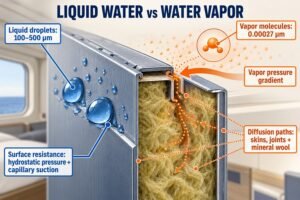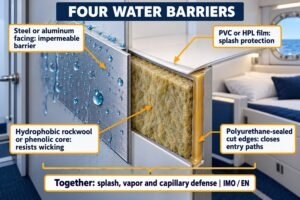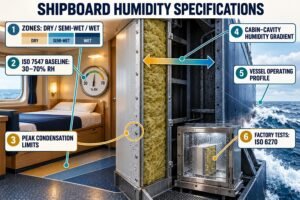
Wrong panel specs cause bubbling PVC films and moldy cores in humid cabins. These failures delay shipyard delivery and waste your profit. I help you match panels to vessel humidity.
Vessel type dictates marine interior panel humidity across six profiles: cruise ships (40%–65% RH), cargo ships (30%–85% RH), offshore platforms (75%–98% RH), ferries (45%–90% RH swings), naval ships (55%–85% RH), and superyachts (45%–55% RH), per ISO 7547. Specifying PVC-laminated, galvanized, or stainless panels prevents corrosion and delamination.
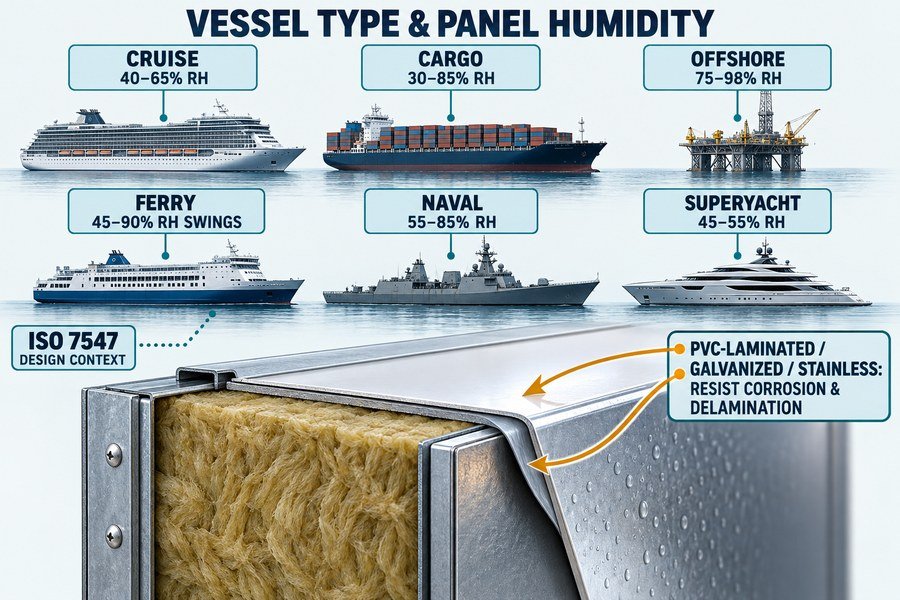
You buy marine wall panels and ceiling panels from Asian factories for European and American shipyards. You want low prices and top quality. However, many local sales reps only know how to quote standard B-15 rockwool panels. They do not ask about the ship type. If you put a standard cargo ship panel into an offshore platform or a busy ferry, the panel will rust or peel within one year. You must understand how each vessel creates its own moisture load. Let us break down the six specific vessel environments so you can buy the right panels every time.
What Humidity Conditions Do Marine Accommodation Panels Face in Cruise Ship Cabins?
Passenger complaints about damp smells and peeling cabin walls ruin cruise ship refit projects. If your panels trap bathroom steam, the shipyard rejects your work. Here is the exact moisture data.
Marine accommodation panels in cruise ship cabins face two distinct humidity zones: sleeping areas maintained at 40% to 60% relative humidity per ISO 7547, and wet modular bathrooms spiking to 75% to 95% relative humidity. Buyers must specify 0.6mm PVC-laminated galvanized steel in bedrooms and 304 stainless steel in wet units.
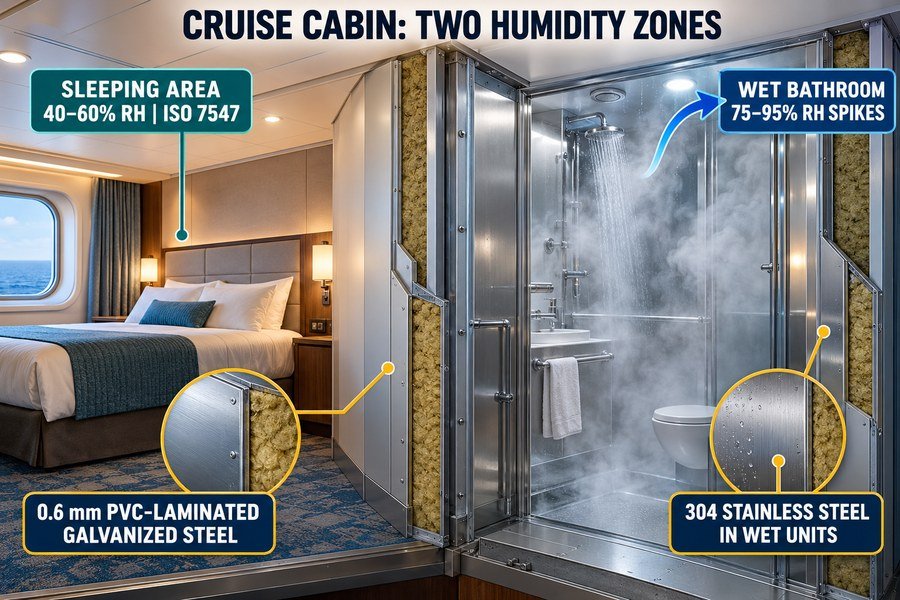
Managing 40% to 60% Relative Humidity in Cruise Ship Sleeping Areas
I worked on a European cruise ship project three years ago. The procurement buyer wanted to save money by using a 0.12mm decorative paper foil on the cabin wall panels instead of a real PVC film. I warned the buyer against this choice. Under ISO 7547 standards, cruise ship HVAC systems keep passenger sleeping spaces between 40% and 60% relative humidity (RH) at 22°C to 24°C1. While this seems safe, passengers open balcony doors in tropical ports. Outside air at 85% RH rushes into the cool 22°C cabin. Water condenses instantly on the cold steel wall panels.
To handle this condensation without paying too much, you must buy panels with a 0.5mm to 0.6mm hot-dipped galvanized steel skin. The zinc coating must be at least 120g/m² to 140g/m² according to EN 10346. On top of the steel, you need a 150-micron (0.15mm) marine-grade PVC film bonded with polyurethane (PU) glue. Water-based glue costs $1.50 less per square meter, but it dissolves when balcony condensation hits the seams2. A standard B-15 cabin wall panel with PU glue and 140kg/m³ mineral wool core costs $26 to $32 per square meter FOB China. This specification stops film peeling and passes strict European shipyard inspections.
Resisting 75% to 95% Relative Humidity Spikes in Cruise Ship Wet Bathrooms
The bathroom unit inside a cruise cabin faces much worse moisture than the bedroom. Passengers take hot showers two or three times a day. The relative humidity inside these wet units jumps from 50% to 95% in five minutes. Even with an exhaust fan pulling 50 to 60 cubic meters of air per hour per EN 16798-3, hot steam sits on the ceiling and walls for 30 minutes after each shower. Standard galvanized steel panels with cut edges will rust at the bottom C-channel within six months.
For wet bathrooms, you have two safe options. First, you can buy panels made with 0.5mm AISI 304 stainless steel coated with a 150-micron antibacterial PVC film. This option costs $45 to $55 per square meter. Second, if your budget is tight, you can use galvanized steel with a 275g/m² zinc layer (Z275 per EN 10346) and apply a 20-micron epoxy primer on the back side. You must also seal the bottom tracks with marine silicone sealant meeting IMO FTPC Part 5 fire rules. In my factory experience, sealing the bottom U-profile stops capillary water from soaking up into the rockwool core. Wet rockwool loses its B-15 fire insulation value3 and smells terrible.
| Cruise Cabin Zone | Relative Humidity Range (ISO 7547) | Daily Moisture Trigger | Required Steel Substrate (EN 10346) | Film & Adhesive Specification | Estimated FOB Price ($/m²) |
|---|---|---|---|---|---|
| Passenger Sleeping Area | 40% – 60% RH (peaks to 80% with open door) | Balcony door opening in humid ports | 0.6mm Galvanized Steel (Z120 – Z140) | 150-micron PVC film with two-part PU glue | $26.00 – $32.00 |
| Modular Wet Bathroom | 75% – 95% RH during and after showers | Frequent hot passenger showers | 0.5mm AISI 304 Stainless or Z275 Galvanized | Antibacterial PVC film or PVDF coating; silicone sealed base | $45.00 – $55.00 (SS304) / $34.00 – $38.00 (Z275) |
How Does Humidity Exposure on Marine Interior Panels Differ on Cargo Ships?
Buying over-spec panels for cargo ships destroys your bidding price, while under-spec panels rust during ocean crossings. Balancing cost and durability is hard. Let us look at cargo vessel moisture.
Humidity exposure on cargo ship interior panels varies between 30% and 85% relative humidity across two operational factors: trans-oceanic climate shifts from dry winter ports to 85% RH tropical zones, and simplified single-duct HVAC systems per ISO 7547. Specifying Z140 galvanized panels with 120-micron PVC film balances durability and cost.
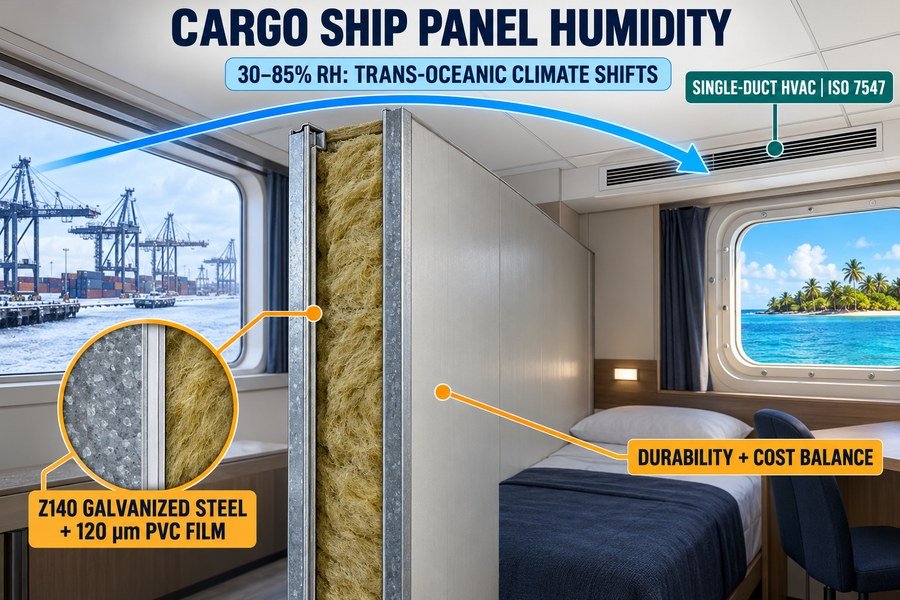
Coping with 30% to 85% Relative Humidity from Trans-Oceanic Climate Shifts
Cargo ships like bulk carriers and container vessels travel from dry northern winters at 30% RH into equatorial waters at 85% RH in just ten days4. I supplied 3,500 square meters of B-0 ceiling panels and B-15 wall panels for a series of 82,000 DWT bulk carriers built for a European owner. The procurement officer wanted the cheapest panel on the market to win the tender. However, when a cargo ship moves from 5°C winter air into 32°C tropical air, the steel hull sweats heavily5. That moisture moves into the accommodation block through corridor doors and ventilation intakes.
Because cargo ships have only 20 to 25 crew members, the internal human moisture load is small. Yet the ambient climate swings are huge. If the rockwool core inside your panel absorbs more than 2% moisture by weight, the panel bows outward by 3mm to 5mm over a 2,400mm height. To prevent this warping without spending extra money, you must demand hydrophobic (water-repellent) rockwool that meets ISO 29767 and absorbs less than 1.0 kg/m² of water. Chinese factories offer hydrophobic rockwool at the exact same price as regular rockwool—about $22 to $26 per square meter for a complete 50mm B-15 wall panel—if you put it into your purchase contract before paying the deposit.
Adapting to Simplified Single-Duct HVAC Systems Under ISO 7547
Unlike cruise ships that have individual cabin humidity controls, cargo ships use simple single-duct constant air volume (CAV) HVAC systems designed to ISO 7547 standards. These systems cool the air in the summer and heat it in the winter, but they rarely have precise dehumidification coils for mild weather. When the outside temperature is 24°C and it is raining at sea, the cooling compressor turns off. The indoor relative humidity inside the crew mess room and cabins climbs to 75% or 85% for days at a time.
In this environment, you do not need expensive 304 stainless steel in the normal corridors or cabins. You can control your purchasing budget by specifying a 0.5mm galvanized steel sheet with a 140g/m² zinc layer (Z140) and a standard 120-micron PVC film. However, you must tell the supplier to apply a 5-micron to 7-micron epoxy back-coat on the inside of the steel sheet where it touches the rockwool. Many small Asian workshops skip this back-coat to save $0.80 per square meter. Without the back-coat, the 85% RH air passes through the panel joints and rusts the steel from the inside out within 18 months. Checking the back-coat thickness with a simple digital gauge during pre-shipment inspection saves you from warranty claims.
| Cargo Ship Exposure Factor | Relative Humidity Range | Primary Technical Risk to Panels | Cost-Effective Panel Specification | Quality Control Inspection Metric |
|---|---|---|---|---|
| Trans-Oceanic Climate Shifts | 30% RH (Temperate Winter) to 85% RH (Tropics) | Rockwool core moisture absorption causing 3mm–5mm panel bowing | 50mm B-15 panel with hydrophobic rockwool core (140 kg/m³) | Water absorption under 1.0 kg/m² per ISO 29767 |
| Simplified Single-Duct HVAC | 65% – 85% RH during mild rainy sea days | Internal steel corrosion from moist air entering M/F joints | 0.5mm Z140 galvanized steel with 120-micron PVC front and epoxy back | Minimum 5-micron to 7-micron interior epoxy back-coat |
What Moisture Conditions Do Marine Accommodation Panels Face in Offshore Living Quarters?
Offshore rig failures bring huge financial penalties from oil companies. Salt fog and high humidity eat standard marine panels alive. You need exact offshore moisture specs to protect your company.
Marine accommodation panels in offshore living quarters endure extreme moisture between 75% and 98% relative humidity driven by two conditions: continuous salt-laden ambient air per NORSOK M-501, and positive-pressure HVAC condensation against cold A-60 bulkheads. Buyers must specify Z275 galvanized steel, 200-micron low-flame PVC film, and vapor barriers.
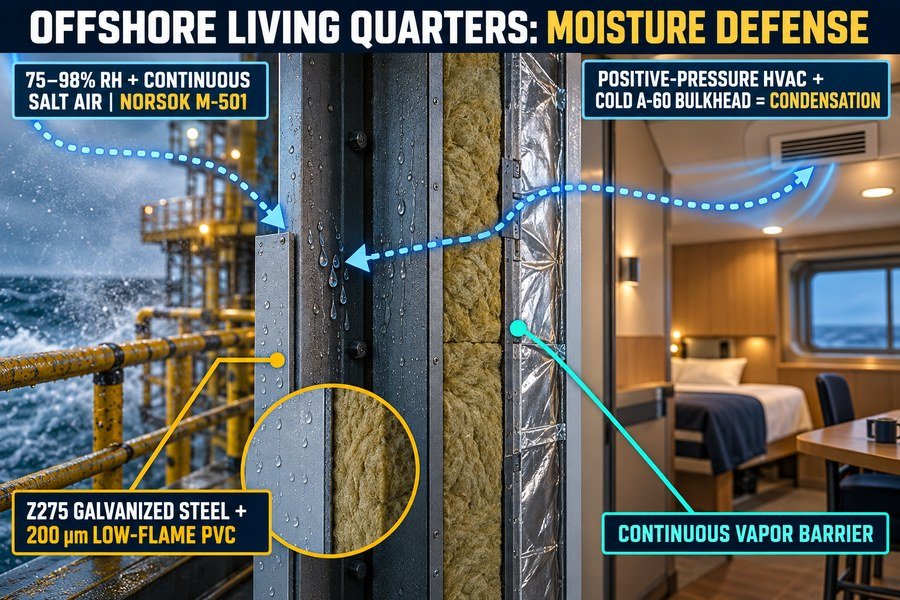
Surviving 75% to 98% Relative Humidity with Continuous Salt-Laden Air
Offshore platforms, FPSOs, and jack-up rigs stay stationary in harsh marine zones like the North Sea, the Gulf of Mexico, or Southeast Asia. The outside air stays between 75% and 98% relative humidity all year round6, and it carries heavy salt mist. When workers walk in from the drill floor into the living quarters (LQ), they bring salt water on their boots and coveralls. Salt accelerates steel corrosion five times faster than fresh water.7 Two years ago, I helped a client fix a rejected batch of ceiling panels for an offshore accommodation module. Their previous supplier used Z100 galvanized steel, and white zinc rust appeared at the edge joints before the rig even left the shipyard.
To meet offshore rules like NORSOK M-501 and DNV-OS-A101 without blowing your budget, you must upgrade the steel base of your accommodation panels. Do not use standard Z120 steel. You must order a minimum Z275 galvanized steel substrate (275g/m² zinc coating per EN 10346) at 0.6mm to 0.7mm thickness, or Galvalume (55% aluminum-zinc alloy, AZ150). On the visible face, specify a 150-micron to 200-micron heavy-duty PVC film certified to IMO FTPC Part 5 and Part 2. A heavy-duty offshore B-15 wall panel with Z275 steel costs $34 to $42 per square meter FOB China. This is only $6 more than a commercial ship panel, and it guarantees the panels survive the 98% RH salt air during long shipyard outfitting periods when the HVAC is turned off.
Preventing Positive-Pressure HVAC Condensation Against Cold A-60 Bulkheads
Offshore living quarters operate under positive internal air pressure of 50 Pascals (Pa) to 100 Pa8, as required by IMO MODU Code and ABS offshore guides, to stop explosive hydrocarbon gases from entering the building. This high pressure pushes conditioned indoor air (maintained at 22°C and 50% RH) through the tiny gaps between your B-15 lining panels into the void space behind the panel. In cold climates like the North Sea, the outer steel A-60 bulkhead sits at 0°C to 5°C. In hot tropical fields, the indoor air is cooled to 20°C while 90% RH outside air leaks into hull penetrations. Either way, the air hits its dew point inside the panel cavity9.
Water drips down the A-60 structural insulation and soaks the back of your marine wall panels. To stop this hidden moisture damage, you need a two-part engineering fix. First, specify a 0.05mm aluminum foil vapor barrier laminated onto the rockwool pins on the structural bulkhead, maintaining a water vapor transmission rate below 0.02 g/(m²·h) per ASTM E96. Second, order your B-15 lining panels with a 15-micron polyester or epoxy coating on the rear steel sheet instead of the standard 5-micron wash coat. When you discuss this technical detail with your European shipyard client, they will trust your engineering skill immediately.
| Offshore Moisture Condition | Humidity & Pressure Metric | Failure Mode on Standard Panels | Required Offshore Panel Specification | Authoritative Standard |
|---|---|---|---|---|
| Continuous Salt-Laden Air | 75% – 98% Ambient RH with high NaCl aerosol | Rapid red rust on cut edges and white zinc blistering under film | 0.6mm–0.7mm Z275 Galvanized or AZ150 Galvalume; 200-micron PVC | EN 10346 / IMO FTPC Part 5 |
| Positive-Pressure HVAC Cavities | 50 Pa – 100 Pa overpressure; 50% indoor RH | Interstitial dew-point condensation rotting panel back sheets | 15-micron rear epoxy coat on panels + 0.05mm aluminum foil vapor barrier | IMO MODU Code / ASTM E96 |
How Does Ferry Operation Cause Rapid Humidity Swings on Marine Interior Panels?
Ferry panels warp and delaminate faster than almost any other commercial ship panels. Short turnarounds create severe moisture shocks that ruin cheap interiors. Here is how to prevent ferry panel failure.
Ferry operations subject marine interior panels to rapid humidity swings from 45% to 90% relative humidity every 1 to 4 hours due to two factors: frequent bow and deck door openings during port turnarounds, and sudden boarding of wet passengers. Specifying rigid aluminum honeycomb or PU-bonded rockwool panels stops delamination.
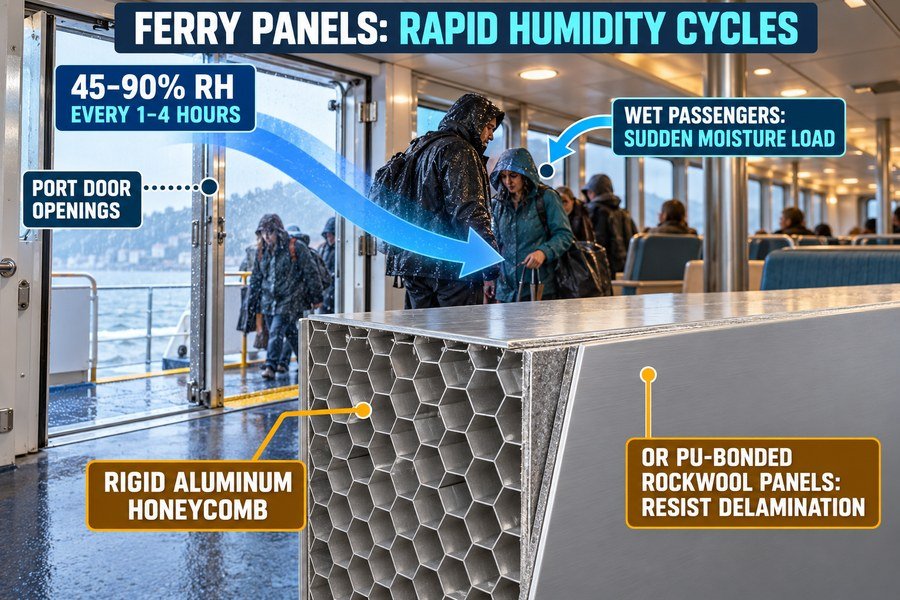
Withstanding 45% to 90% Relative Humidity Swings from Frequent Door Openings
Ro-Pax ferries and high-speed passenger ferries run short routes that last between 45 minutes and 4 hours. At every port stop, vehicle ramp doors and passenger access doors open wide for 20 to 30 minutes. During this loading time, the indoor climate control loses its balance. Unconditioned coastal air at 85% to 90% RH10 floods into the stairwells, lobbies, and passenger lounges. Once the ferry leaves port, the massive HVAC chillers blast cold, dry air to pull the cabin humidity back down to 45% or 50% RH within 30 minutes. This cycle repeats 6 to 12 times every single day.
These rapid 45% to 90% RH cycles create severe expansion and contraction stresses11 between the steel skin, the adhesive layer, and the core material. I saw a European ferry refit where the contractor bought cheap B-15 panels bonded with one-component PVA glue. Within four months of service, the rapid moisture and thermal shocks caused the steel skins to separate from the rockwool core, creating loud popping noises when the ship vibrated. For ferry lobbies and lounges, you must specify two-component reactive polyurethane (2K-PU) adhesive applied at 180g/m² to 220g/m². Under EN 14509 testing, 2K-PU glue keeps a tensile bond strength above 0.10 MPa (100 kPa) even after cyclic humidity aging at 90% RH and 40°C.
Handling Sudden Moisture Spikes from Boarding Wet Passengers
On rainy days in northern Europe or North America, 500 to 1,500 passengers walk onto a ferry wearing soaking wet coats and carrying wet umbrellas. According to ASHRAE marine ventilation guidelines, a single passenger in wet clothing releases 150 to 250 grams of water vapor per hour12 into the lounge air. Multiplied by 1,000 passengers, the cabin air absorbs up to 250 kilograms of water in a single hour. This moisture settles directly onto cold aluminum or steel ceiling panels and wall linings, creating surface water droplets.
In addition, fast ferries have strict weight limits under the IMO 2000 HSC (High-Speed Craft) Code. If you use heavy 18 kg/m² steel-rockwool panels, the shipyard will reject your submittals for exceeding the deadweight budget, or worse, the rockwool will soak up the condensation and make the ship even heavier. For fast ferries, you should buy lightweight aluminum honeycomb panels with a 0.7mm marine-grade 5052-H32 aluminum skin and a 3003 aluminum foil core. Aluminum honeycomb does not absorb a single drop of water13, weighs only 5.5 to 7.0 kg/m² for a 25mm panel, and handles 90% RH condensation without rusting. These panels cost $48 to $65 per square meter from specialized Chinese marine factories, which is half the price of European equivalents.
| Ferry Operational Trigger | Humidity Cycle Metric | Mechanical Stress on Interior Panels | Recommended Panel Engineering Solution | Performance Standard |
|---|---|---|---|---|
| Frequent Port Door Openings | 45% to 90% RH swings every 1 – 4 hours (6–12 cycles/day) | Differential expansion causing skin-to-core delamination | Two-component PU adhesive (180–220 g/m²) on Z140 galvanized steel | Bond strength > 0.10 MPa per EN 14509 |
| Boarding of Wet Passengers | 150–250g H₂O/hr per person; instant surface condensation | Core waterlogging and excessive panel weight gain | 25mm Aluminum Honeycomb Panel (5052-H32 skins, 5.5–7.0 kg/m²) | IMO 2000 HSC Code / 0% water absorption |
Naval and coast guard vessels pack dozens of sailors into tight rooms. High latent heat and moisture destroy ordinary commercial panels. Let us review naval compartment humidity specifications.
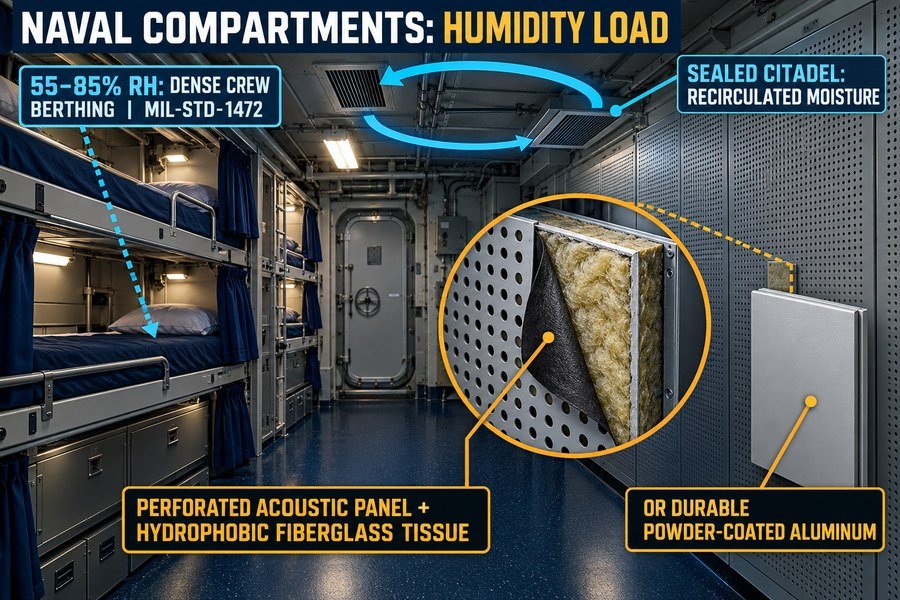
Marine interior panels in high-density naval compartments face sustained humidity loads of 55% to 85% relative humidity caused by two factors: concentrated human latent heat in multi-tier berthing spaces per MIL-STD-1472, and sealed Citadel battle-condition recirculation. Buyers must specify perforated acoustic panels with hydrophobic fiberglass tissue or durable powder-coated aluminum.
Absorbing 55% to 85% Relative Humidity from Concentrated Crew Berthing
Commercial cargo ships give each sailor a private room of 15 to 20 square meters. Naval patrol boats, coast guard cutters, and auxiliary vessels pack 12 to 40 sailors into a single multi-tier berthing compartment using triple bunks. Each sleeping or resting adult releases about 50 to 70 grams of water vapor per hour through breathing and sweat. Under naval design rules like MIL-STD-1472 and DEF STAN 02-107, the HVAC system aims to keep berthing humidity below 60% RH14. However, inside the narrow 600mm vertical space of a triple bunk, air circulation is weak, and localized humidity stays between 65% and 85% RH15 for eight hours every night.
Furthermore, naval compartments have high noise levels, so shipyards demand perforated acoustic wall and ceiling panels with a Noise Reduction Coefficient (NRC) of 0.65 to 0.80 per ISO 354. When you punch 2.5mm holes covering 22% of the steel panel face, moist 85% RH air from the sailors goes straight through the holes into the mineral wool core. To stop the insulation from getting damp and sagging, you must tell your factory to heat-laminate a 60g/m² black hydrophobic glass-fiber tissue directly behind the perforated steel sheet. This tissue lets sound waves pass into the rockwool while blocking moisture droplets and preventing rockwool fibers from falling onto sleeping sailors. A perforated B-15 acoustic panel with hydrophobic tissue costs $32 to $38 per square meter FOB China.
Enduring Moisture Accumulation During Sealed Citadel Recirculation Modes
Naval vessels and coast guard ships must operate in a sealed gas-tight state—known as "Citadel" or NBCD (Nuclear, Biological, Chemical Defense) mode—during drills and combat exercises. During Citadel operations, outside air intakes close down or pass through heavy filtration banks, and up to 80% or 90% of the internal cabin air is recirculated for 12 to 48 hours. When galley steam, scullery dishwashers, and crew showers run during sealed recirculation, the central dehumidifiers struggle to keep up. Relative humidity across corridors and mess decks rises to a steady 75% to 85% RH.
In these high-wear, high-humidity spaces, sailors also bump heavy gear and boots against the walls. A thin 120-micron PVC film scratches easily when wet, and moisture creeps under the scratch to blister the panel. For naval corridors and mess decks, I advise buyers to avoid PVC film and instead order panels finished with a 60-micron to 80-micron thermosetting polyester powder coating or a PVDF (polyvinylidene fluoride) liquid coating on 0.7mm Z275 steel or 1.0mm marine aluminum. Under ISO 6270-2 constant humidity testing, an 80-micron polyester powder coating withstands 1,000 hours at 100% RH and 40°C with zero blistering. It also gives a pencil hardness of 2H per ASTM D3363, preventing gear scratches.
| Naval Compartment Factor | Humidity Load Metric | Acoustic / Durability Challenge | Engineered Panel Solution | Testing & Compliance Standard |
|---|---|---|---|---|
| Concentrated Crew Berthing | 55% – 85% localized RH in triple-tier bunk spaces | Moisture entering open holes of perforated acoustic panels | 22% perforated Z140 steel + 60g/m² hydrophobic black glass tissue | NRC 0.65–0.80 per ISO 354 / MIL-STD-1472 |
| Sealed Citadel Recirculation | 75% – 85% sustained RH during 12–48 hr air recirculation | Film scratching and wet blistering in tight corridors | 60–80 micron polyester powder coat on 0.7mm Z275 steel or 1.0mm aluminum | 1,000 hrs humidity resistance per ISO 6270-2 |
How Does Superyacht Humidity Control Affect Marine Interior Panels Versus Commercial Ships?
Superyacht shipyards demand flawless mirror finishes but mount your panels right against cold, sweating hull spaces. One warp ruins a luxury cabin. Here is how yacht humidity works.
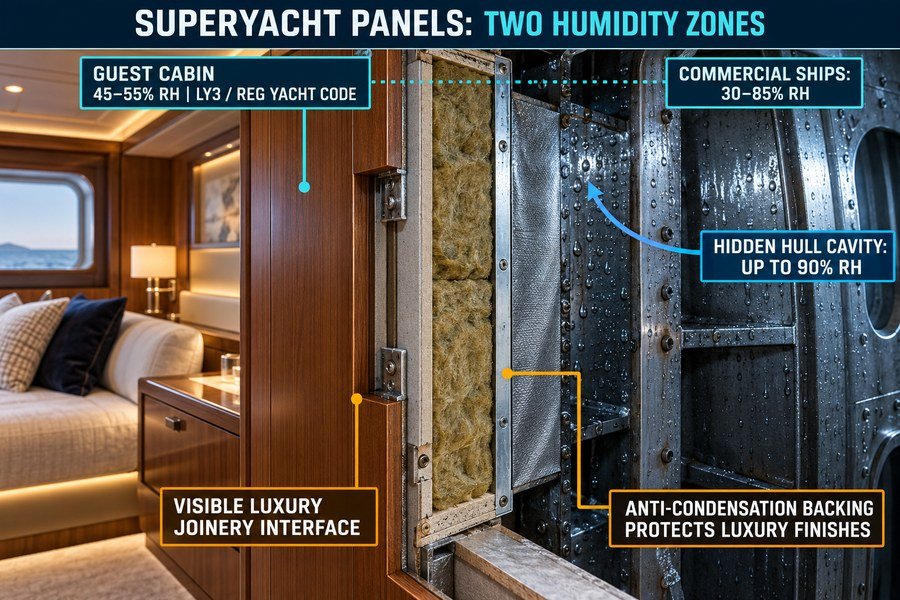
Superyacht humidity control maintains guest cabins at a tight 45% to 55% relative humidity per LY3 and REG Yacht Code standards, contrasting with commercial ships (30%–85% RH), across two panel zones: visible luxury joinery interfaces and hidden behind-panel hull cavities reaching 90% RH. Specifying anti-condensation backing protects luxury finishes.
Maintaining 45% to 55% Relative Humidity for Luxury Joinery Interfaces
When you supply interior packages for a 60-meter to 100-meter superyacht in Europe or the United States, the cabin environment is completely different from a commercial cargo ship. Under the Red Ensign Group (REG) Yacht Code (formerly LY3) and ISO 7547 luxury standards, superyacht HVAC systems use chilled-water fan coil units with electric reheat to hold guest cabins at a strict 45% to 55% relative humidity and 21°C±1°C. They do this because the visible walls are covered in real wood veneers, leather panels, and marble slabs that crack if the air drops below 40% RH or swell if it goes above 60% RH.
Where do your B-15 marine fire panels fit into this? On a superyacht, your B-15 rockwool panels act as the structural fire-rated sub-wall (the "blind bulkhead") behind the luxury wood joinery, and as the finished visible walls inside the crew quarters. Because the yacht owner mounts $500-per-square-meter wood panels onto your B-15 fire panels using Z-clips or Velcro, your panel flatness must stay within ±1.0mm over a 2,000mm span per EN 14509, even when the yacht sits in a humid shipyard during outfitting before the HVAC is turned on. You must specify 0.7mm galvanized steel skins on both sides of the B-15 sub-panel—never use a 0.5mm thin back sheet—so the panel stays completely rigid during construction humidity swings.
Isolating Behind-Panel Hull Cavities Reaching 90% Relative Humidity
While the inside of the superyacht cabin sits at a comfortable 50% RH, the hidden 100mm to 200mm air gap between the back of your B-15 fire panel and the outer steel or aluminum yacht hull is a moisture trap. Superyachts sail in the Mediterranean and the Caribbean, where seawater is 28°C and outside air is 80% RH. Cold 21°C air from the cabin leaks through electrical socket cutouts and ceiling light fixtures into the warm cavity behind the panel, or warm humid bilge air rises up into the wall cavity. The relative humidity inside that dark cavity easily hits 85% to 90% RH16, causing heavy condensation on the back of your marine panels and ceiling tiles.
If condensation drips off the back of a crew ceiling panel, it stains the surface and grows black mold, which fails yacht air quality tests. To solve this problem for superyacht tenders, I tell my clients to order B-15 ceiling and wall panels with a factory-applied non-woven anti-condensation fleece (120g/m² polyester felt) on the rear steel face, or a closed-cell 6mm nitrile rubber (Armaflex-style) backing certified to IMO FTPC Part 5. An anti-condensation fleece absorbs up to 800 milliliters of water per square meter without dripping17, holding the moisture until the cavity ventilation dries it out. Adding this fleece in a Chinese factory costs only $2.50 per square meter, yet it gives your panel a massive technical advantage over standard commercial suppliers.
| Vessel Comparison Metric | Superyacht Standard (REG Yacht Code) | Commercial Ship Standard (ISO 7547) | Superyacht Panel Risk | Required Superyacht Panel Spec |
|---|---|---|---|---|
| Cabin Interior RH Control | Strict 45% – 55% RH (±5% tolerance) | Wide 30% – 85% RH depending on weather | Sub-panel bowing (>1mm) ruining attached wood joinery during outfitting | Symmetrical 0.7mm / 0.7mm Z140 galvanized steel skins for ±1.0mm flatness |
| Behind-Panel Cavity RH | 85% – 90% RH in unventilated hull voids | 60% – 80% RH in standard service spaces | Hidden condensation dripping onto ceilings and breeding mold | Rear steel coated with 120g/m² anti-condensation fleece (holds 800 ml/m² H₂O) |
Conclusion
Matching marine panel coatings, adhesives, and cores to your specific vessel's humidity profile stops rust and peeling. Use these six specifications to buy durable, low-cost panels from Asia with confidence.
-
"Environmental Control - The Airliner Cabin Environment and ...", https://www.ncbi.nlm.nih.gov/books/NBK207472/. ISO 7547 specifies design criteria for air-conditioning and ventilation in ship accommodation spaces, supporting the use of temperature and relative-humidity comfort ranges for passenger cabins. Evidence role: expert_consensus; source type: institution. Supports: Cruise ship HVAC standards use roughly 40%–60% RH and 22°C–24°C as target conditions for passenger sleeping spaces.. Scope note: The standard provides design conditions; actual cabin humidity can vary with ship operation, passenger behavior, and local climate. ↩
-
"Strength and durability of one-part polyurethane adhesive ...", https://research.fs.usda.gov/treesearch/5964. Adhesive literature reports that water exposure can reduce bond strength or cause hydrolytic degradation in some water-based adhesive systems, while polyurethane systems are often selected for improved moisture resistance. Evidence role: mechanism; source type: paper. Supports: Water-based adhesives can be more vulnerable to moisture exposure at seams than suitable polyurethane adhesives.. Scope note: Formulation matters; this source would not prove that all water-based glues dissolve under balcony condensation or that a specific product will fail. ↩
-
"Determination of Thermal Properties of Mineral Wool ... - PMC", https://pmc.ncbi.nlm.nih.gov/articles/PMC10488771/. Research on mineral-wool insulation shows that moisture increases thermal conductivity and can impair insulating performance, which is relevant to fire-rated panel assemblies that rely on insulation to limit heat transfer. Evidence role: mechanism; source type: paper. Supports: Moisture in rockwool can reduce its insulation performance, potentially affecting fire-rated panel behavior.. Scope note: This supports the performance mechanism for wet mineral wool but does not by itself demonstrate failure of a specific B-15 marine fire test assembly. ↩
-
"What Are the Different Climate Types? | NESDIS - NOAA", https://www.nesdis.noaa.gov/about/k-12-education/understanding-our-planet/what-are-the-different-climate-types. Climatological references on marine humidity and global shipping-route distances support that vessels can encounter large humidity changes between temperate winter regions and tropical oceans over voyage times measured in days; this provides contextual support rather than verification of the exact 30% to 85% range or ten-day itinerary. Evidence role: general_support; source type: institution. Supports: Cargo ships can move quickly from relatively dry temperate winter conditions into highly humid tropical marine conditions.. Scope note: The source is likely to substantiate typical humidity gradients and voyage feasibility, not the specific route, vessel, or exact ten-day transition described. ↩
-
"Review of Humidity Effect on Humid Air-to-Water ...", https://docs.lib.purdue.edu/cgi/viewcontent.cgi?article=3162&context=iracc. Marine engineering and physics references on condensation explain that moisture condenses on steel surfaces when the surface temperature is below the surrounding air’s dew point, supporting the mechanism described as hull sweating during transitions from cold to warm humid air. Evidence role: mechanism; source type: education. Supports: A cold ship hull can develop condensation when exposed to warmer, humid tropical air.. Scope note: This supports the condensation mechanism generally and does not quantify how much condensation occurs on a particular vessel. ↩
-
"Gulf of Mexico Regional Climatology: Data Access", https://www.ncei.noaa.gov/access/gulf-of-mexico-climate/gulf-data.html. Marine climatology records for offshore regions document persistently high ambient relative humidity in areas such as the North Sea and Gulf of Mexico, supporting the use of high-humidity design assumptions for offshore accommodation materials. Evidence role: statistic; source type: government. Supports: The outside air in harsh marine offshore zones stays between 75% and 98% relative humidity all year round.. Scope note: The exact 75%–98% range is location- and season-dependent and may not apply uniformly to every offshore platform year-round. ↩
-
"Effect of chloride ions on the corrosion behavior of carbon ...", https://pmc.ncbi.nlm.nih.gov/articles/PMC9116111/. Corrosion studies show that chloride-containing seawater and marine aerosols substantially increase carbon-steel corrosion compared with low-chloride fresh water by promoting electrolyte conductivity and localized corrosion processes. Evidence role: mechanism; source type: paper. Supports: Salt accelerates steel corrosion five times faster than fresh water.. Scope note: The exact fivefold acceleration depends on steel grade, oxygen concentration, temperature, wet–dry cycling, and chloride concentration, so the source may support the direction and magnitude context rather than a universal multiplier. ↩
-
"building and classing facilities on offshore installations", https://web.mit.edu/12.000/www/m2005/a2/8/63FOI.pdf. Offshore unit ventilation guidance and classification rules commonly require non-hazardous enclosed spaces adjacent to hazardous areas to be maintained at positive pressure to reduce ingress of flammable gas, with pressure differentials often specified in pascals. Evidence role: expert_consensus; source type: institution. Supports: Offshore living quarters operate under positive internal air pressure of 50 Pa to 100 Pa to help prevent explosive gas ingress.. Scope note: The exact 50–100 Pa range may vary by code edition, space classification, and authority having jurisdiction. ↩
-
"ABE 372/AE406: Using Psychrometric Chart for Frost Protection", https://ask.ifas.ufl.edu/publication/AE406. Psychrometric principles establish that moist air cooled to or below its dew-point temperature will condense on colder surfaces, which explains the risk of interstitial condensation where conditioned air contacts cold structural steel. Evidence role: mechanism; source type: education. Supports: Conditioned indoor air leaking into a cold panel cavity can reach its dew point and condense inside the cavity.. Scope note: This supports the physical mechanism but does not calculate the exact condensation rate for the specific panel cavity geometry described. ↩
-
"Coastal Marine Forecasts by Zone - New York, NY", https://www.weather.gov/marine/okxmz. Coastal meteorological observations document that relative humidity can reach the 85–90% range in humid marine conditions, supporting the plausibility of high-moisture air entering ferry interiors during port operations. Evidence role: statistic; source type: government. Supports: Unconditioned coastal air entering ferry spaces during port calls can be as humid as 85% to 90% RH.. Scope note: This supports the environmental assumption contextually and does not prove the exact humidity at every ferry port or sailing. ↩
-
"Effects of Moisture Diffusion in Sandwich Composite ...", https://www.wichita.edu/industry_and_defense/NIAR/Documents/jams-presentations/13-Jayaram-Moisture-Diffusion.pdf. Research on sandwich panels and bonded metal–core assemblies shows that hygrothermal cycling can reduce adhesive bond performance and promote interfacial stresses, providing a mechanistic basis for concern about repeated RH swings. Evidence role: mechanism; source type: paper. Supports: Rapid humidity cycling can create expansion, contraction, and interfacial stresses in bonded sandwich panels.. Scope note: The evidence is mechanistic and may not use the exact 45% to 90% RH cycling profile or the same ferry-panel construction. ↩
-
"Moisture Control Guidance for Building Design, ...", https://www.epa.gov/sites/default/files/2014-08/documents/moisture-control.pdf. ASHRAE and indoor-air moisture-balance references provide latent moisture generation rates for occupants and wet clothing, supporting the use of per-person water-vapor release rates in ventilation calculations. Evidence role: statistic; source type: institution. Supports: A wet passenger can contribute on the order of 150 to 250 grams of water vapor per hour to indoor air under ferry-lounge conditions.. Scope note: Rates depend on activity level, clothing wetness, air temperature, and ventilation, so the cited range should be treated as an operating estimate rather than a fixed universal value. ↩
-
"Methods for Assessing Honeycomb Sandwich Panel Wrinkling Failures", https://ntrs.nasa.gov/api/citations/20120016636/downloads/20120016636.pdf. Materials references describe aluminum honeycomb cores as metallic, non-hygroscopic cellular structures, supporting the claim that the core material does not absorb water in the manner of fibrous insulation. Evidence role: general_support; source type: research. Supports: Aluminum honeycomb core material is non-hygroscopic and does not absorb water like porous or fibrous core materials.. Scope note: This supports the material property of aluminum honeycomb; real panel performance also depends on edge sealing, joints, coatings, and corrosion exposure. ↩
-
"Exploring Sleep-related Habitability Issues in Berthing Spaces ...", https://faculty.nps.edu/nlshattuck/docs/Matsangas%20and%20Shattuck%20(2017)%20-%20Exploring%20Sleep-related%20Habitability%20Issues%20in%20Berthing%20Spaces.pdf. Military habitability and environmental-control standards specify acceptable indoor temperature and humidity ranges for crew spaces, providing regulatory context for using an upper relative-humidity design target near 60% in berthing areas. Evidence role: expert_consensus; source type: government. Supports: Under naval design rules like MIL-STD-1472 and DEF STAN 02-107, the HVAC system aims to keep berthing humidity below 60% RH.. Scope note: The exact humidity limit may differ by standard edition, vessel class, compartment type, and operating condition. ↩
-
"Habitability in Berthing Compartments and Well-Being of ...", https://pubmed.ncbi.nlm.nih.gov/32109155/. Research on occupied sleeping microenvironments and poorly ventilated enclosed spaces shows that restricted air exchange can raise local relative humidity above the room average during occupancy, supporting the mechanism described for triple-bunk berthing. Evidence role: mechanism; source type: paper. Supports: Inside the narrow 600mm vertical space of a triple bunk, air circulation is weak, and localized humidity stays between 65% and 85% RH for eight hours every night.. Scope note: Such evidence would support the ventilation-and-humidity mechanism; direct proof of the exact 65%–85% range for naval triple bunks would require shipboard field measurements. ↩
-
"How Does Condensation Risk Differ for Marine ...", https://magellanmarinetech.com/how-condensation-risk-differ-for-marine-accommodation-panels-by-route/. Building-physics and marine-condensation references show that poorly ventilated cavities can reach high relative humidity when warm moist air contacts cooler surfaces or when air leakage changes temperature conditions; this supports the plausibility of high-RH behind-panel spaces, although it does not by itself prove the 85–90% range for every superyacht cavity. Evidence role: mechanism; source type: research. Supports: Unventilated behind-panel hull cavities can experience very high relative humidity and condensation risk.. Scope note: The expected support is mechanistic or contextual unless a study directly measures humidity in superyacht hull cavities. ↩
-
"Moisture Control Guidance for Building Design, ...", https://www.epa.gov/sites/default/files/2014-08/documents/moisture-control.pdf. Technical testing or product-standard documentation for anti-condensation fleece can show the water-retention capacity of non-woven condensation-control liners; this would support the stated absorption figure, although the value may depend on fleece mass, fiber structure, coating, test method, and installation angle. Evidence role: statistic; source type: research. Supports: A non-woven anti-condensation fleece can retain a specified volume of condensate per square meter before dripping.. Scope note: Support is likely product- or test-specific and may not apply to all 120 g/m² polyester fleeces. ↩