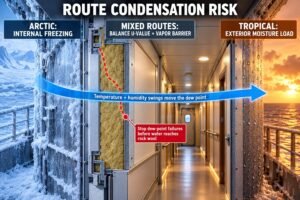
Ship interiors face wet walls on new routes. This ruins panels and delays yard approvals. I will show you how to match panel specs to your ship's route.
Condensation risk on marine accommodation panels differs by route based on extreme temperature and humidity swings. Arctic routes risk internal panel freezing, tropical routes face heavy exterior moisture loads, and mixed routes require balanced thermal resistance (U-values) and vapor barriers to stop dew-point failures across all climates.
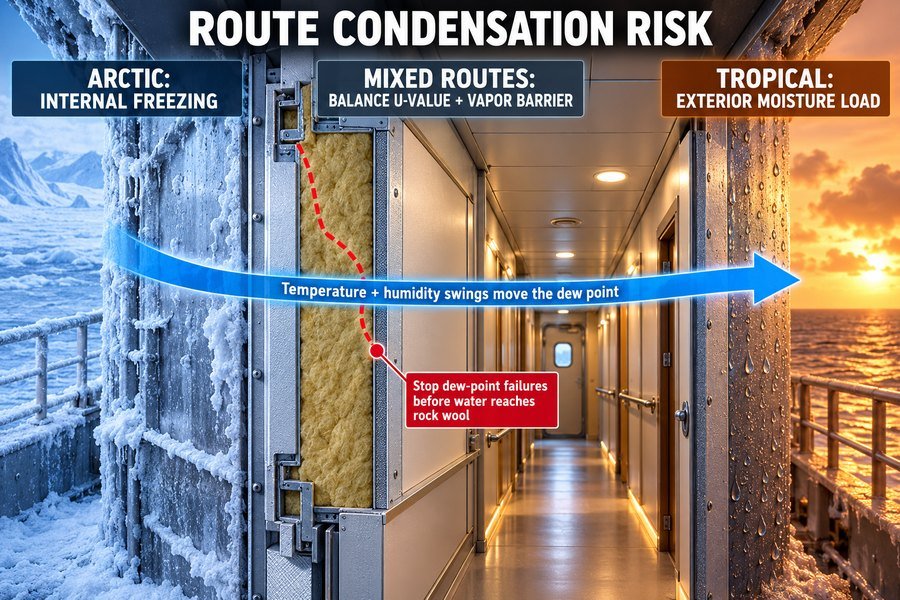
You might buy a panel that looks great in the factory, but when the ship sails, water drips from the ceiling. Let's look at the specific routes.
Why Do Arctic Climates Increase Condensation Inside Exterior Marine Lining Panels?
Arctic cold freezes ship steel. Warm cabin air hits this cold steel, causing hidden water damage inside panels. We must stop this before your client complains.
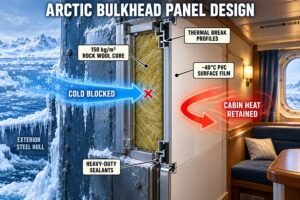
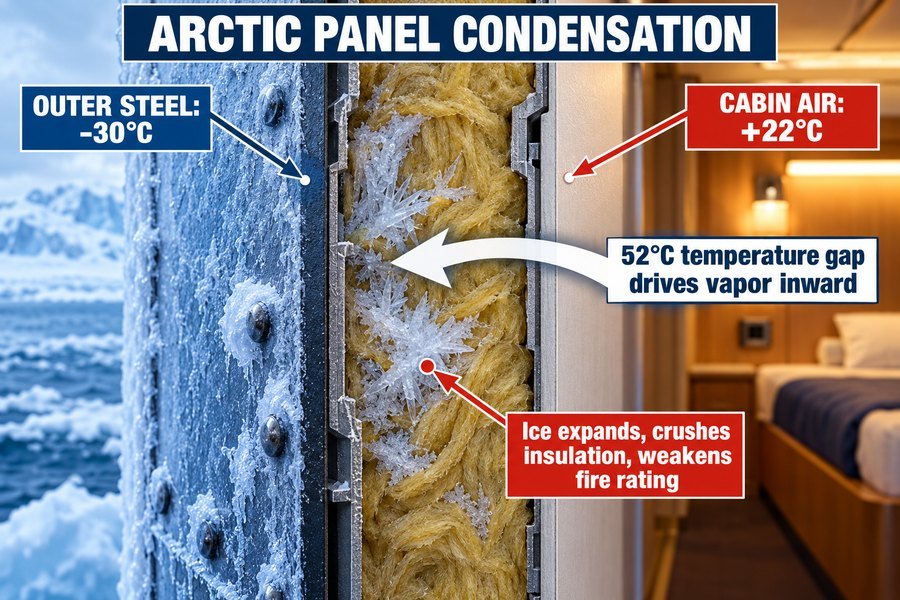
Arctic climates increase condensation inside exterior marine lining panels because the massive temperature gap between sub-zero outer steel (down to -30°C) and warm cabin air (+22°C) forces water vapor to rapidly condense and freeze within the insulation core, destroying structural integrity and reducing fire resistance ratings.
The Physics of Cold Steel and Warm Cabins on Arctic Routes
I remember my early days at the factory. We had a client who bought standard panels for an Arctic vessel. It was a disaster. According to DNV GL winterization rules, the outside steel temperature can drop to -30°C. The cabin inside is heated to +22°C for passenger comfort. This creates a massive 52-degree temperature gap. Moisture in the warm cabin air wants to move to the cold steel. When it hits the cold steel skin, it condenses into liquid water. Because the steel is so cold, this water instantly freezes into ice inside the panel.1 Ice expands and crushes the insulation structure. This physical reaction destroys the panel from the inside out. When the ship returns to a warmer port, the ice melts. Water pools at the bottom of the floor track. You will see rust within a few short months. To stop this, you need a physical air gap between the panel and the steel bulkhead. You also need heavy insulation applied directly on the steel itself, not just inside the marine panel.
Core Material Failures in Sub-Zero Marine Environments
When rockwool gets wet, it immediately loses its A-60 fire rating.2 This is a huge safety risk for the entire vessel. Standard marine panels use rockwool with a low density of 80 kg/m³. For Arctic routes, I always tell buyers to specify 120 kg/m³ rockwool.3 It costs a little bit more upfront. A standard Chinese panel might cost $18 per square meter. The 120 kg/m³ high-density panel costs about $22 per square meter. But you must think about the end user. If the panel fails, replacing a wet panel costs $150 to $200 per square meter in European shipyards. You save big money by buying the right core first. The dense core resists water damage better and keeps the ship safe. It stops the rapid temperature drop and keeps the internal dew point stable.
| Condition Element | Standard Marine Route | Arctic Marine Route |
|---|---|---|
| Outside Steel Temp | +10°C to +35°C | Down to -30°C |
| Cabin Air Temp | +22°C | +22°C |
| Core Density Needed | 80 kg/m³ | 120 kg/m³ to 150 kg/m³ |
| Internal Ice Risk | Low | Very High |
| Cost per Sqm (FOB Asia) | $18 USD | $22 USD |
How Does Tropical Humidity Dictate Marine Ceiling Panel Vapor Barriers?
Tropical heat brings heavy moisture. Without the right barrier, this humidity rots your ceiling panels. I use specific foil layers to block this water completely.
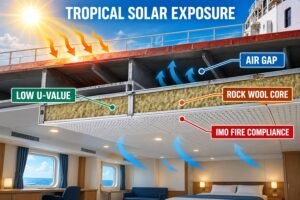
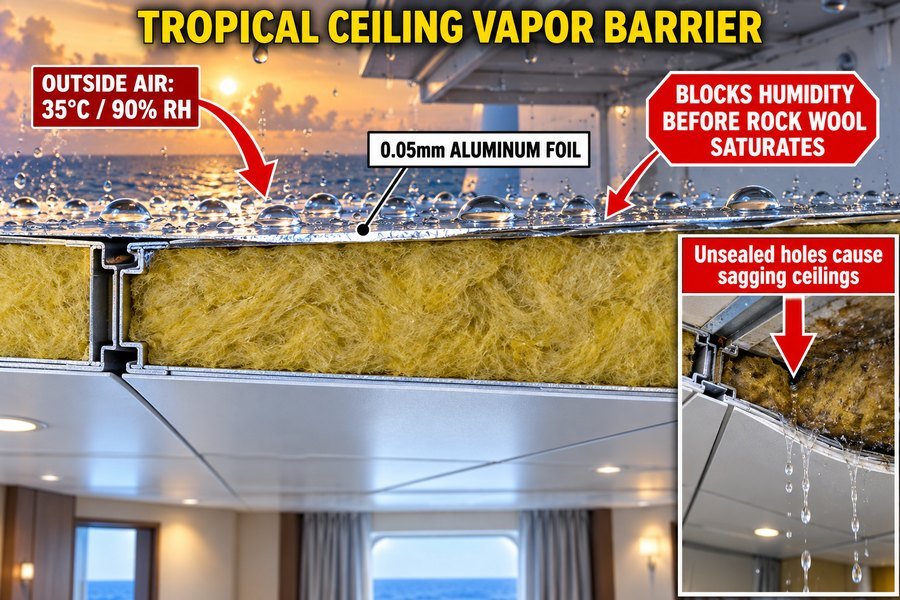
Tropical humidity dictates marine ceiling panel vapor barriers by requiring a continuous, unpunctured aluminum foil layer (typically 0.05mm thick) on the warm side of the insulation. This stops 90% relative humidity from penetrating the core, preventing saturation, sagging ceilings, and costly interior refits during shipyard warranty periods.
The Role of Aluminum Foil Vapor Barriers in Tropical Marine Climates
Tropical routes have totally different rules from Arctic routes. Ships sailing in Southeast Asia or the Middle East face outside temperatures of 35°C and 90% relative humidity4. The cabin inside is cooled by the AC to 22°C. This means the heavy moisture pushes from the outside hot air into the cool cabin5. According to SOLAS guidelines, we must use materials that stop this vapor path.6 I always insist on a continuous aluminum foil layer on the warm side of the ceiling panel. The standard thickness for this aluminum foil is 0.05mm. This thin layer is very powerful. It stops the 90% humidity from entering the rockwool core. If water gets into the ceiling panel, the rockwool gets very heavy.7 A standard dry ceiling panel weighs about 15 kg per square meter. When it gets wet, it can weigh 25 kg. This extra weight causes the metal ceiling profiles to bend and sag. It looks terrible and creates a safety hazard for passengers walking below.
Installation Mistakes That Destroy Marine Ceiling Panels
I see many procurement officers buy high-quality panels from Asia, but the project still fails at the shipyard. Why does this happen? Because the shipyard workers poke holes in the vapor barrier. They cut holes in the ceiling panels for LED lights, smoke detectors, and speakers. If they do not seal these cut holes with special foil tape, the barrier is completely useless. Moist air rushes into the open gaps. The water condenses directly inside the core. To fix this problem, you must buy panels with pre-cut and pre-sealed factory holes. If you cannot do that, you must supply your shipyard with marine-grade foil tape. Good foil tape costs $5 per roll. A ruined ceiling refit costs $300 per square meter in a Western yard. The math is simple. Protect the barrier layer at all costs.
| Barrier Component | Specification | Purpose in Tropical Climates |
|---|---|---|
| Foil Thickness | 0.05mm Minimum | Blocks 90% RH vapor penetration |
| Foil Location | Warm side of insulation | Stops condensation before the core |
| Joint Sealing | Marine-grade foil tape ($5/roll) | Prevents vapor leaks at panel seams |
| Hole Cutouts | Factory sealed or taped on site | Protects light and speaker openings |
| Wet Panel Weight | Increases from 15kg to 25kg/m² | Shows failure of the vapor barrier |
How Does U-Value Optimization Stop Surface Condensation on Marine Interior Panels?
Wet walls make ship cabins look cheap. High heat transfer causes this surface water. We fix it by optimizing the panel's U-value.
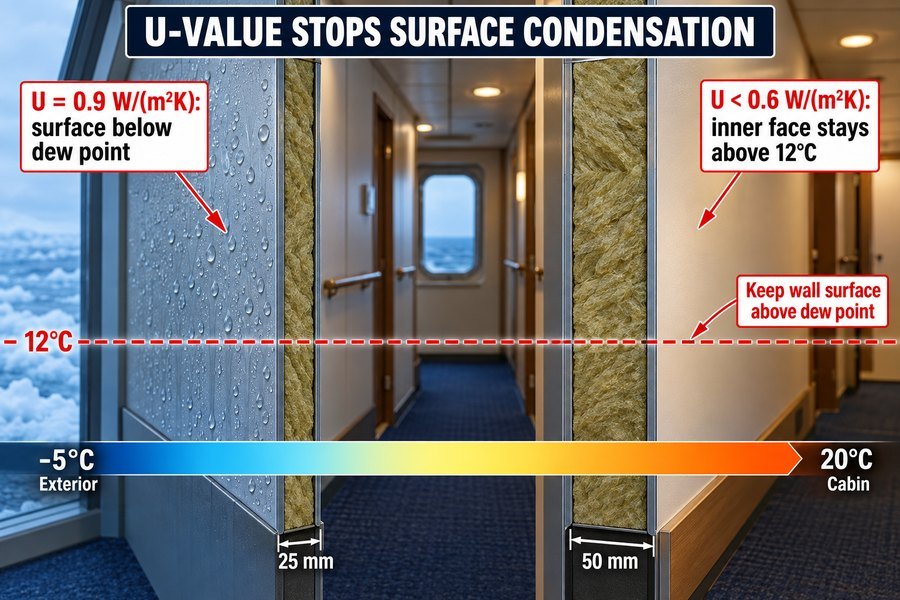
U-value optimization stops surface condensation on marine interior panels by increasing thermal resistance to keep the inner panel face above the cabin air's dew point. Achieving a U-value below 0.6 W/(m²K) prevents warm, moist air from forming water droplets on the visible surface, ensuring dry cabins.
Understanding U-Values for Marine Panel Surface Temperature Control
Surface condensation happens when warm, moist air touches a cold surface.8 It looks exactly like sweat on the walls. This happens when the panel's U-value is too high. U-value measures heat transfer through the wall. The lower the number, the better the insulation works. ISO 7547 standard for marine HVAC design requires shipbuilders to control surface temperatures carefully. To stop water droplets from forming in a standard cabin with 50% humidity and 22°C air, the wall surface must stay above 12°C9. To achieve this surface temperature, the panel needs a U-value below 0.6 W/(m²K). If the U-value is 0.9 W/(m²K), the surface gets too cold, and water forms quickly. I have seen angry clients reject entire blocks of cabins because the walls felt wet to the touch. It damages the reputation of the shipyard and the supplier. We must control the U-value to keep the walls warm and dry.
Balancing Panel Thickness and Thermal Resistance for Shipyards
Buyers always want thinner panels. A 25mm thick panel saves cabin space and adds room for furniture. But a 25mm panel usually has a bad U-value around 0.8 W/(m²K). This is simply too high for cold or mixed routes. A 50mm thick panel has a much better U-value around 0.5 W/(m²K). It provides much stronger thermal resistance. The price difference between the two is actually very small. A good 25mm panel from China costs $16 per square meter. A 50mm panel costs $19 per square meter. If your shipyard client operates vessels in mixed climates, I always advise you to buy the 50mm panel. The extra 25mm of space you lose is absolutely worth it. It completely prevents surface condensation and keeps the cabin dry and clean for the passengers. It also makes the HVAC system work less, saving fuel for the ship owner.10
| Panel Thickness | Typical U-Value (W/m²K) | Surface Condensation Risk | Estimated Cost (FOB) |
|---|---|---|---|
| 25mm | 0.8 to 0.9 | High Risk | $16 / m² |
| 50mm | 0.5 to 0.6 | Low Risk | $19 / m² |
| 100mm | 0.3 | Very Low Risk | $28 / m² |
What Dew-Point Logic Dictates Marine Accommodation Panel Core Specs?
Wrong core materials absorb water like a sponge. This ruins the panel from the inside. We use dew-point logic to pick the exact right core.
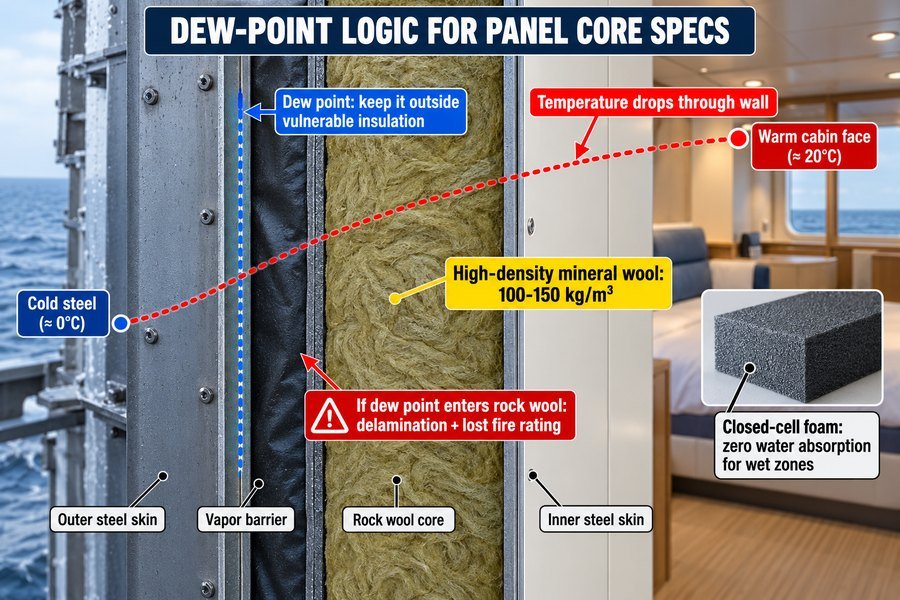
Dew-point logic dictates marine accommodation panel core specs by requiring materials that handle the exact location where vapor turns to liquid. Engineers specify high-density mineral wool (100-150 kg/m³) or closed-cell foams, and position vapor barriers precisely, ensuring the dew point occurs safely outside the vulnerable insulation zone.
Calculating the Dew Point Location Within Marine Wall Panels
Engineers use dew-point logic to design safe panels. The dew point is the exact temperature where water vapor turns into liquid water.11 According to ASHRAE fundamentals, the temperature drops slowly as you move from the warm side of the panel to the cold side.12 We map this temperature drop on a simple graph. We must find exactly where the dew point temperature happens inside the wall structure. Our main goal is to make sure the dew point happens outside the vulnerable insulation zone. If the dew point falls in the middle of standard rockwool, the water destroys the special glue holding the panel together. The steel skin will then peel away from the core. This is called delamination. Once a panel delaminates, it loses its fire rating and structural strength.13 The shipyard must throw it away and buy a new one.
Selecting Rockwool Density Based on Dew Point Analysis
To stop delamination, we specify high-density mineral wool or closed-cell foams for the core. High-density rockwool, between 100 kg/m³ and 150 kg/m³, slows down the air movement inside the panel. This keeps the moisture from reaching the cold steel skin too fast. If the ship sails in extreme climates with harsh dew points, we sometimes use closed-cell PVC foam cores for non-fire-rated bulkheads. Closed-cell foam does not absorb water at all. Foam panels cost about $35 per square meter, while dense rockwool costs $22 per square meter. As a procurement officer, you must read the technical drawings from the shipyard. Look carefully at where the naval architect placed the vapor barrier. Ensure your factory supplier puts the barrier exactly where the drawing says. This keeps the dew point harmless and protects your profit margin.
| Core Material Type | Density Range | Water Absorption Risk | Cost per Sqm | Best Use Case |
|---|---|---|---|---|
| Standard Rockwool | 80 kg/m³ | High | $18 | Mild routes, interior partitions |
| High-Density Rockwool | 120-150 kg/m³ | Medium | $22 | Arctic routes, exterior linings |
| Closed-Cell PVC Foam | 60-80 kg/m³ | Zero | $35 | Wet areas, non-fire bulkheads |
How Does Condensation Risk Affect Mold Prevention in Marine Interior Panels?
Mold spreads fast in damp ship cabins. This causes health issues and fails inspections. Stopping condensation is the only way to kill mold permanently.
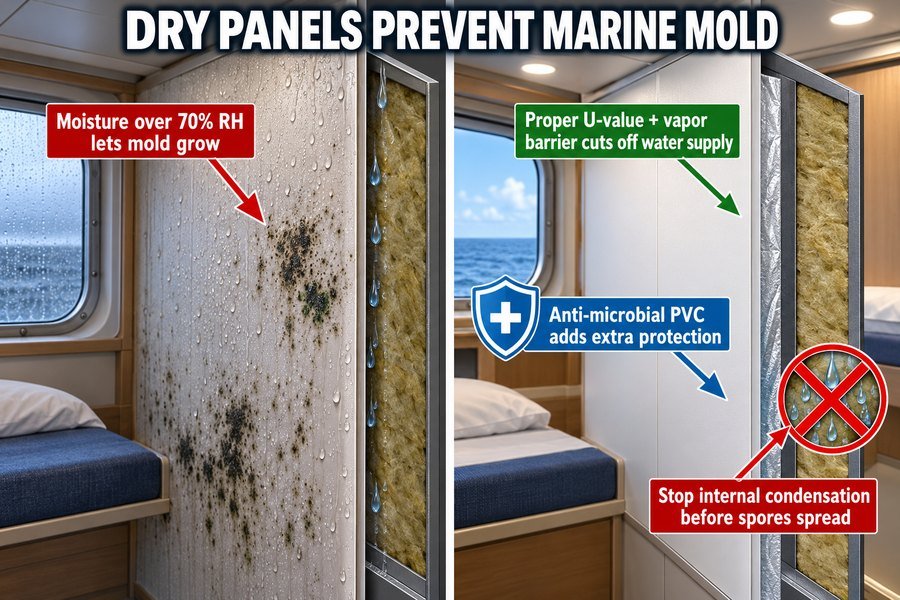
Condensation risk directly dictates mold prevention in marine interior panels because mold spores require sustained moisture (over 70% humidity) to grow. By eliminating surface condensation through proper U-values and internal condensation via vapor barriers, we cut off the water supply, completely preventing toxic mold growth on PVC film finishes.
The Relationship Between Panel Condensation and Toxic Marine Mold
Condensation and mold go hand in hand on ships. The World Health Organization (WHO) states that mold spores require a relative humidity over 70% to survive and grow. Condensation provides 100% liquid water. When surface condensation or internal condensation happens, mold will quickly follow. Most marine interior panels use a PVC film finish on the outside facing the cabin. This PVC film looks like beautiful wood or solid colors. If water sits on this PVC film in a dark cabin, mold spores will attach to it and spread fast. This creates toxic air for the crew and passengers. Ship inspectors from port authorities will fail a ship immediately if they see mold on the accommodation panels. This delays the ship from sailing and costs the owner massive daily fees.
Using Anti-Microbial Finishes and Dry Cores to Stop Spores
The only true way to stop mold is to cut off its water supply. By optimizing panel U-values and using strong vapor barriers, we keep the panel face dry. When the panel is completely dry, mold cannot grow. Period. As an extra step for my clients, I advise buyers to purchase panels with anti-microbial PVC films. These advanced films have special chemicals baked in that resist mold spores. Standard PVC film panels cost $18 per square meter in Asia. Adding an anti-microbial finish only adds $1.50 per square meter to your cost. If mold spreads, a European shipyard will charge you $500 per cabin just for mold remediation and chemical cleaning. Spending the extra $1.50 per square meter upfront saves you thousands of dollars in warranty claims later. It shows your clients that you care about long-term quality, not just the lowest price today.
| Prevention Method | Cost Addition | Effectiveness | Shipyard Remediation Cost |
|---|---|---|---|
| Standard PVC Film | $0.00 / m² | Low (if wet) | $500 per cabin |
| U-Value Optimization | $3.00 / m² | High | $0 |
| Anti-Microbial PVC | $1.50 / m² | Very High | $0 |
| Proper Vapor Barrier | $1.00 / m² | High | $0 |
Conclusion
Route climates dictate your panel choices. You must balance U-values, vapor barriers, and core density to stop condensation, prevent mold, and protect your shipyard client's budget.
-
"condensation: dew, fog and clouds", http://cimss.ssec.wisc.edu/wxwise/class/dewfog.html. Building-physics and heat-transfer references explain that water vapor condenses when air contacts a surface below its dew point and that condensate freezes when the surface temperature is below 0°C, supporting the described condensation-freezing mechanism in a cold steel assembly. Evidence role: mechanism; source type: education. Supports: Warm humid cabin air can condense on sufficiently cold steel and freeze if the steel surface is below freezing. Scope note: General psychrometric principles support the mechanism, but the exact rate and location of freezing inside a marine panel depend on panel construction, vapor barriers, humidity, and thermal bridging. ↩
-
"What Is the Purpose and Scope of the IMO FTP Code?", https://magellanmarinetech.com/what-purpose-scope-of-imo-ftp-code/. Marine fire-test standards for A-class divisions evaluate complete dry assemblies under specified furnace and insulation criteria; sources on mineral wool also note that moisture can degrade thermal insulation performance, providing contextual support that water ingress may compromise fire-rated panel performance. Evidence role: expert_consensus; source type: institution. Supports: Moisture in mineral wool can compromise the thermal insulation performance on which an A-60 fire-rated marine assembly depends. Scope note: A source is unlikely to show that wet rockwool 'immediately' loses an A-60 rating in all cases; the supported claim should be limited to moisture potentially compromising the tested fire-resistance performance of the certified assembly. ↩
-
"Determination of Thermal Properties of Mineral Wool ... - PMC", https://pmc.ncbi.nlm.nih.gov/articles/PMC10488771/. Technical literature on mineral-wool insulation shows that density influences mechanical strength, thermal behavior, and moisture-related performance, offering contextual support for specifying higher-density insulation in harsher service environments. Evidence role: general_support; source type: paper. Supports: Higher-density rockwool may be preferable for Arctic marine panels because density affects durability, thermal performance, and resistance to service degradation. Scope note: General material-property evidence may support the rationale for higher-density rockwool, but it may not establish 120 kg/m³ as a universal Arctic marine requirement unless a marine standard or classification document specifies that density. ↩
-
"Tropical Weather Systems", https://www.noaa.gov/jetstream/tropical. Meteorological climate summaries for tropical coastal and marine regions document that air temperatures in the mid-30°C range and very high relative humidity can occur in areas such as Southeast Asia and the Persian Gulf, supporting the plausibility of the stated operating conditions. Evidence role: general_support; source type: government. Supports: Ships sailing in tropical regions such as Southeast Asia or the Middle East can encounter approximately 35°C outdoor temperatures and 90% relative humidity. Scope note: Such sources support regional climatic plausibility rather than proving these exact conditions on every tropical route or voyage. ↩
-
"Moisture Durability with Vapor-Permeable Insulating ...", http://apps1.eere.energy.gov/buildings/publications/pdfs/building_america/moisture_durability_insulating_sheathing.pdf. Building-science guidance explains that water vapor diffusion and air leakage are driven by vapor-pressure differences, so warm humid exterior air adjacent to air-conditioned interiors can create inward vapor drive and condensation risk in cooled assemblies. Evidence role: mechanism; source type: research. Supports: In hot-humid climates, moisture tends to move from warm, humid outdoor air toward cooler air-conditioned interiors, increasing condensation risk in assemblies. Scope note: Most available guidance is from building-envelope research; the physics is transferable to ship interiors, but the source may not address marine ceiling panels specifically. ↩
-
"What Is the Purpose and Scope of the IMO FTP Code?", https://magellanmarinetech.com/what-purpose-scope-of-imo-ftp-code/. SOLAS Chapter II-2 and the IMO Fire Test Procedures Code set fire-safety requirements for materials used in ship construction, including restrictions on combustibility and surface flame spread; this provides regulatory context for material selection but does not by itself establish a specific vapor-barrier requirement. Evidence role: historical_context; source type: institution. Supports: Marine interior materials must comply with SOLAS/IMO safety requirements, though the article's specific statement about stopping vapor paths may require more precise regulatory or technical support. Scope note: SOLAS is primarily a maritime safety and fire-protection convention, so it may only contextualize material compliance rather than directly support the need for aluminum foil vapor barriers. ↩
-
"Hygrothermal Properties and Performance of Bio-Based ...", https://pmc.ncbi.nlm.nih.gov/articles/PMC11084737/. Technical literature on mineral wool insulation reports that moisture ingress can increase water content, reduce thermal performance, and add mass to insulation systems, supporting the general claim that wet rockwool can become heavier and compromise assemblies. Evidence role: mechanism; source type: paper. Supports: Water ingress into rockwool or mineral wool insulation can increase its mass and degrade the performance of insulated ceiling panels. Scope note: The source may support moisture absorption and performance degradation generally, but separate product-specific data would be needed to verify the article's exact 15 kg/m² to 25 kg/m² weight increase. ↩
-
"condensation: dew, fog and clouds", http://cimss.ssec.wisc.edu/wxwise/class/dewfog.html. A building-physics or psychrometric reference explains that condensation occurs when air adjacent to a surface is cooled to its dew-point temperature, causing water vapor to change phase on the surface. Evidence role: mechanism; source type: education. Supports: Surface condensation occurs when warm, moist air contacts a sufficiently cold surface. Scope note: The source would support the physical mechanism generally, not the specific marine-panel examples later in the article. ↩
-
"Dew Point and Relative Humidity Calculations", https://www.wpc.ncep.noaa.gov/html/dewrh.shtml. Psychrometric data show that air at 22°C and 50% relative humidity has a dew point of approximately 11°C, so maintaining an interior surface above about 12°C is consistent with avoiding condensation under those indoor conditions. Evidence role: mechanism; source type: research. Supports: For 22°C air at 50% relative humidity, a surface temperature above about 12°C is needed to remain above the dew point. Scope note: The threshold assumes standard atmospheric pressure and steady indoor air conditions; local air movement, thermal bridges, and humidity fluctuations can change the actual condensation risk. ↩
-
"Enhancing Marine HVAC Efficiency Through Free Cooling ...", https://ui.adsabs.harvard.edu/abs/2025IJT....46..172S/abstract. Thermal-envelope and marine energy-efficiency studies indicate that lower heat transfer through insulated boundaries reduces heating or cooling loads, which can reduce energy use associated with HVAC operation. Evidence role: general_support; source type: paper. Supports: Improving panel insulation can reduce HVAC load and thereby reduce energy or fuel use. Scope note: This supports the direction of the effect, but it does not quantify fuel savings for the specific 25 mm versus 50 mm panel comparison without vessel route, climate, HVAC efficiency, and operating profile data. ↩
-
"What Is Humidity?", https://www.nesdis.noaa.gov/about/k-12-education/atmosphere/what-humidity. A meteorological or psychrometric reference defines dew point as the temperature to which air must be cooled, at constant pressure and water-vapor content, for saturation and condensation to begin. Evidence role: definition; source type: government. Supports: The dew point is the temperature at which water vapor condenses into liquid water. Scope note: This supports the physical definition of dew point, not the later engineering conclusions about a specific wall panel. ↩
-
"Moisture Control Guidance for Building Design, ...", https://www.epa.gov/sites/default/files/2014-08/documents/moisture-control.pdf. ASHRAE building-physics guidance describes steady-state heat transfer through assemblies using temperature profiles across layers, which supports the use of a temperature gradient when assessing condensation risk. Evidence role: mechanism; source type: institution. Supports: ASHRAE fundamentals support plotting temperature change through an enclosure assembly to assess where condensation may occur. Scope note: The source would support the general method; the actual gradient in a marine wall panel depends on layer thicknesses, conductivities, and boundary conditions. ↩
-
"On Impact Damage and Repair of Composite Honeycomb ...", https://pmc.ncbi.nlm.nih.gov/articles/PMC10707668/. Research on sandwich panels indicates that debonding or delamination between skins and core can substantially reduce load transfer and structural capacity, while fire ratings are normally valid only for assemblies matching the tested construction. Evidence role: general_support; source type: paper. Supports: Delamination can compromise the structural performance and tested fire-rated status of sandwich wall panels. Scope note: This supports the general structural and certification concern; it does not prove that every delaminated marine panel automatically loses a specific fire rating without inspection or retesting. ↩