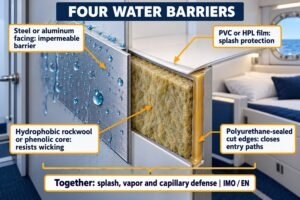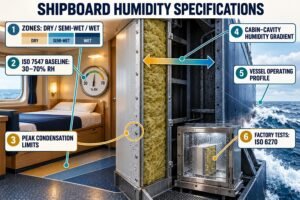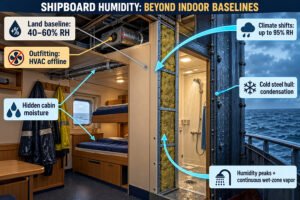
Moisture ruins ship cabins fast. Peeling PVC films and rusted steel cores trigger costly shipyard warranty claims. Understanding climate zone humidity helps you select durable marine interior panels.
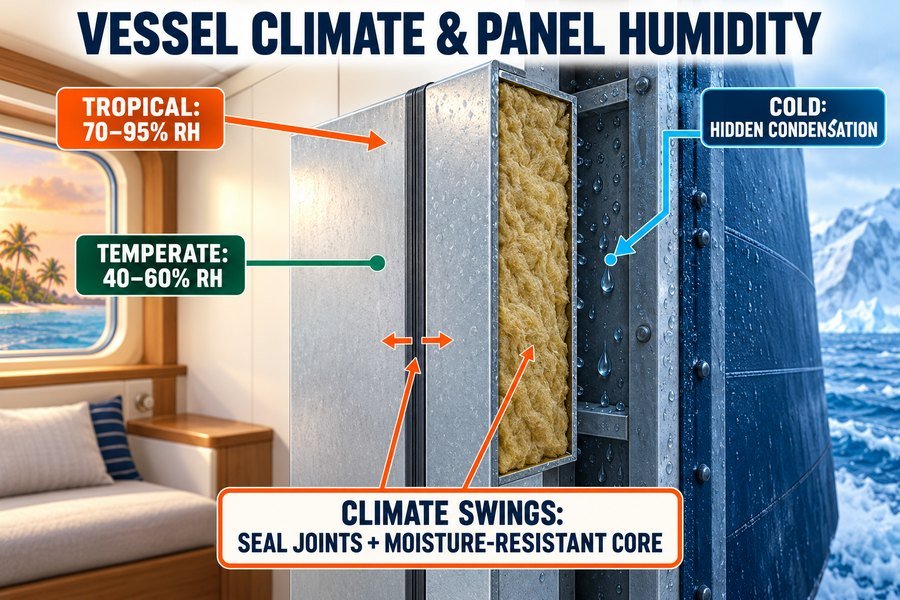
Vessel climate zones subject marine interior panels to four distinct humidity regimes under ISO 7547: tropical zones create high surface vapor pressure (70%–95% RH), cold zones drive behind-panel hull condensation, temperate zones maintain moderate 40%–60% RH, and cross-climate routes cause cyclic expansion, requiring sealed joints and moisture-resistant rockwool cores.
I have worked in the marine outfitting industry for many years, starting on a factory production line and now working as a specialist at Magellan Marine. Last year, a procurement manager for a European shipyard project called me because her cabin wall panels buckled just six months after vessel delivery. She bought standard panels from an Asian factory at a low price, and the local sales representative never asked about the ship's sailing route. In this guide, I will break down the exact humidity numbers, condensation rules, and material specs you need so you can source affordable, high-quality panels without risking project failure.
What Humidity Levels Do Marine Accommodation Panels Face on Tropical Routes?
Buying standard wall panels for tropical vessels is a costly mistake. Extreme dampness causes core delamination and mold within months. Knowing exact tropical humidity numbers protects your outfitting budget.
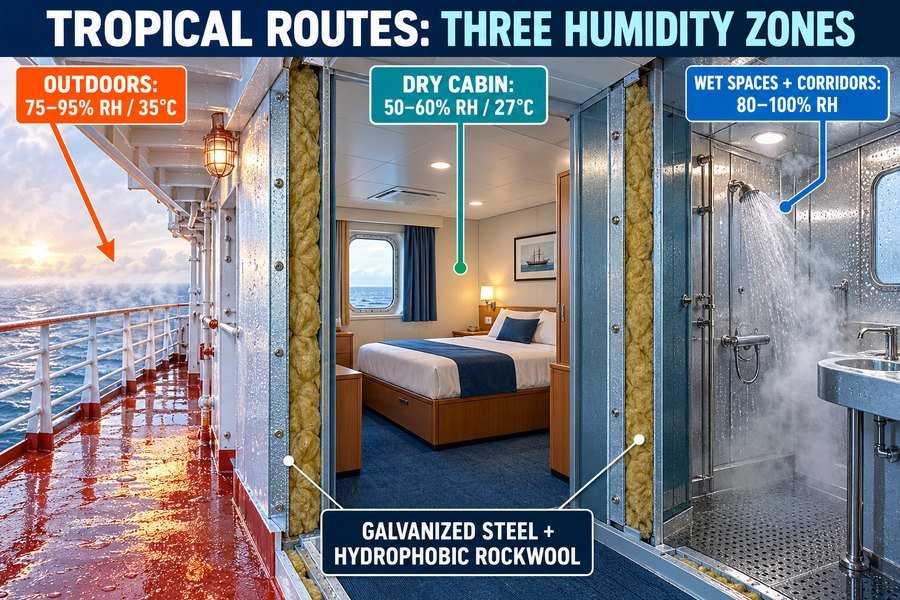
On tropical routes, marine accommodation panels face three distinct humidity levels per ISO 7547: outdoor ambient air reaches 75%–95% relative humidity (RH) at 35°C, air-conditioned dry cabins stay at 50%–60% RH at 27°C, and wet spaces or corridors reach 80%–100% RH, requiring galvanized steel sheets and hydrophobic rockwool cores.
Ambient Outdoor Humidity and Air-Conditioned Cabin Standards on Tropical Ships
When you purchase marine wall panels and ceiling panels for vessels operating near the equator, you must look at three specific micro-environments inside the ship. First, the outdoor ambient air on tropical routes stays between 75% and 95% relative humidity (RH) at temperatures of 32°C to 35°C1, according to ISO 7547 (Ships and marine technology — Air-conditioning and ventilation of accommodation spaces) and IACS environmental guidelines. During heavy tropical monsoon rain, outdoor humidity hits 95% RH for weeks at a time. Second, air-conditioned dry cabins, such as crew bedrooms and offices, are designed to stay at 50% to 60% RH at an indoor temperature of 27°C under ISO 7547 rules. Because the outside air is much hotter and wetter than the cabin air, a strong vapor pressure gradient pushes moisture from the passageway and hull side toward the cool cabin interior2. I once inspected an offshore support vessel in Southeast Asia where this constant pressure pushed damp air right through unsealed M-profile panel joints.
Wet Space Humidity Extremes and Panel Material Protection
Third, wet spaces and semi-conditioned zones—including sanitary units, galleys, laundries, and deck-access corridors—regularly face 80% to 100% RH at temperatures reaching 30°C to 40°C under ISO 15138 standards. In these areas, hot water vapor touches the cool surface of air-conditioned bulkhead panels and turns directly into liquid water droplets. To survive all three humidity levels without rusting or softening, you must specify two critical material protections when ordering from factories in China or Vietnam. First, the panel skins must use hot-dip galvanized steel sheets with a zinc coating weight of at least 180 to 275 g/m² (Z180 to Z275 under EN 10346), covered by a 150-micron marine-grade PVC decorative film. Cheap domestic panels often use only 60 g/m² of zinc, which rusts in six months at 80% RH. Second, the insulation inside the panel must be hydrophobic rockwool with a water repellency rate of at least 98% and water absorption below 1.0 kg/m² under EN 1609 testing. Standard non-water-repellent rockwool acts like a sponge in tropical corridors, adding weight and pulling the steel skin away from the core.
| Tropical Shipboard Zone | Design Temperature | Relative Humidity Range | Vapor Pressure (kPa) | Required Panel Material Spec | Authoritative Standard |
|---|---|---|---|---|---|
| Outdoor Ambient Air | 32°C – 35°C | 75% – 95% RH | 3.56 – 5.34 kPa | Weather-tight outer doors and sealed air plenums | ISO 7547 / IACS Rec. 103 |
| Air-Conditioned Dry Cabins | 25°C – 27°C | 50% – 60% RH | 1.78 – 2.14 kPa | 0.6 mm Z180 galvanized steel + hydrophobic rockwool | ISO 7547 Section 4 |
| Wet Spaces & Corridors | 30°C – 40°C | 80% – 100% RH | 3.40 – 7.38 kPa | 0.7 mm Z275 galvanized or SUS 304 steel + PVC film | ISO 15138 / EN 10346 |
How Does Cold-Climate Sailing Drive Sub-Surface Condensation Behind Marine Lining Panels?
Hidden water behind cabin linings destroys interiors silently. Freezing hull steel turns warm cabin vapor into ice and rust. Proper thermal barriers stop sub-surface condensation before it starts.
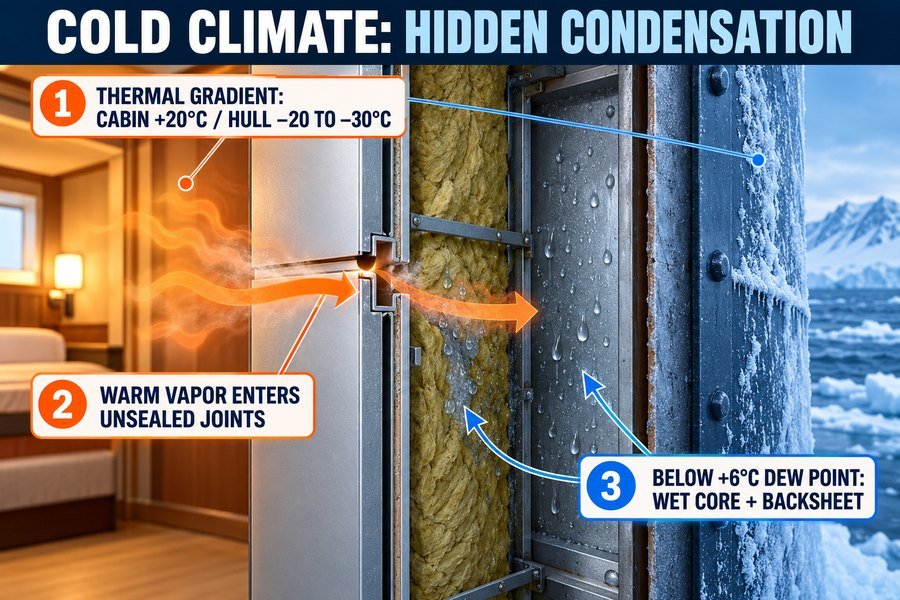
Cold-climate sailing drives sub-surface condensation through three physical stages under ISO 7547: sub-zero hull steel (-20°C to -30°C) creates steep thermal gradients against +20°C cabins, warm indoor vapor migrates through unsealed panel joints, and moisture condenses once temperatures drop below the +6°C dew point, soaking unprotected insulation and backsheets.
Thermal Gradients Between Sub-Zero Hull Steel and Heated Ship Cabins
Many procurement officers assume that cold winter routes are dry and safe for marine lining panels. In reality, cold-climate sailing causes severe hidden damage behind the panel where nobody can see it until rust stains bleed through the joints. This process happens in three clear physical stages. In the first stage, freezing outside air and icy seawater create a massive thermal gradient between the ship's outer steel hull and the heated cabin. According to ISO 7547 winter design criteria, standard vessels must handle -20°C outdoor air and 0°C seawater, while IMO Polar Code vessels face -30°C to -40°C outdoor temperatures. At the same time, the cabin heating system keeps the indoor living space at +20°C to +22°C with 30% to 45% RH3. This creates a 40°C to 60°C temperature difference across a total wall depth of just 100 mm to 150 mm. Even when the shipyard pins A-60 mineral wool hull insulation to the steel bulkhead, any tiny gap in the insulation pins or steel stiffeners creates a freezing cold bridge right behind your B-15 lining panel.
Vapor Migration Through Panel Joints and Dew-Point Condensation on Backsheets
In the second stage, warm indoor water vapor migrates from the heated cabin into the cold cavity behind the lining panel4. Inside a +20°C cabin at 40% RH, the water vapor partial pressure is about 0.94 kPa. Behind the lining panel, where the air near the hull drops to -5°C, the saturation vapor pressure is only 0.40 kPa. High pressure always flows toward low pressure, so warm cabin moisture pushes through unsealed spline joints, electrical socket cutouts, and ceiling inspection hatches. In the third stage, this warm vapor hits the dew point and turns into liquid water or frost. Based on ASHRAE Fundamentals psychrometric tables, air at +20°C and 40% RH has a dew point of +6.0°C. The moment migrating cabin air touches a hull pin or panel backsheet colder than +6.0°C, liquid water forms. I helped a client fix a Northern European Ro-Pax ferry where contractors skipped the aluminum foil vapor barrier on the hull insulation and mounted lining panels only 10 mm from the steel ribs. Within one winter, condensed water rusted through the 0.5 mm panel backsheets and soaked the rockwool cores. You must require a minimum 25 mm to 50 mm ventilated air gap behind lining panels and a 0.08 mm reinforced aluminum foil vapor barrier on the hull insulation.
| Wall Layer Location | Winter Temperature | Vapor Pressure (kPa) | Dew Point Status | Condensation Risk & Panel Impact | Reference Standard |
|---|---|---|---|---|---|
| Heated Cabin Interior | +20°C to +22°C | 0.94 – 1.12 kPa | Above (+6.0°C Dew Point) | Zero surface condensation; vapor pushes outward | ISO 7547 Winter Design |
| Lining Panel Joint & Backsheet | +4°C to +8°C | 0.81 – 0.94 kPa | Critical Dew Point Zone | Moisture condenses on backsheet; requires Z275 zinc coat | ASHRAE Fundamentals Ch. 1 |
| Air Gap & Hull Insulation Face | -2°C to +5°C | 0.52 – 0.87 kPa | Below Dew Point | Water drips into bottom C-channel track | ISO 15138 HVAC Standard |
| Outer Steel Hull Bulkhead | -20°C to -30°C | 0.05 – 0.10 kPa | Freezing Zone | Frost builds up on uninsulated steel stiffeners | IMO Polar Code / SOLAS |
Why Do Cross-Climate Voyages Cause Cyclic Condensation Swings on Marine Interior Panels?
Global container ships and LNG carriers cross from freezing ports to humid tropics in days. Rapid climate shifts warp panels and peel adhesives. Understanding cyclic condensation prevents premature failure.
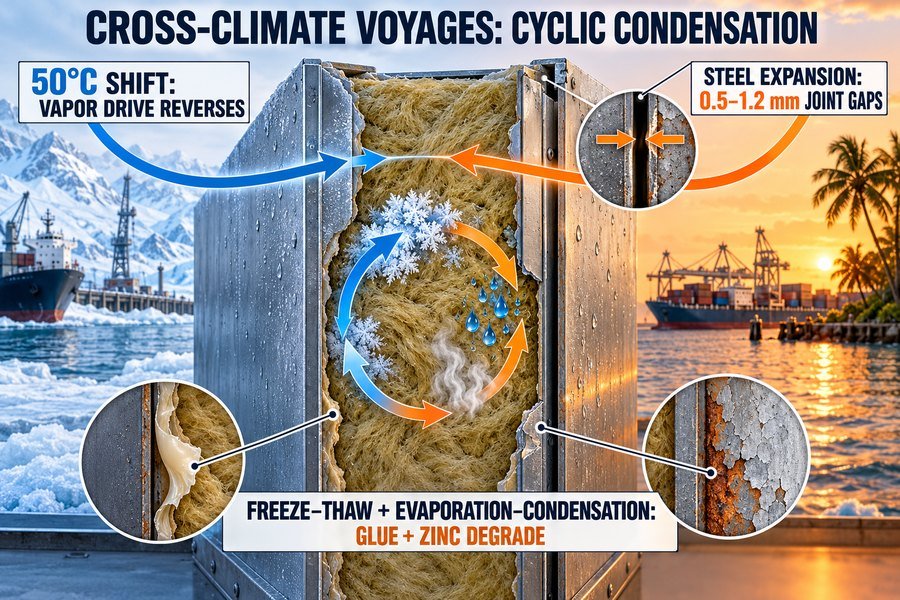
Cross-climate voyages cause cyclic condensation swings due to three factors: rapid vapor-drive reversal as outdoor temperatures jump 50°C between winter and tropical ports, thermal expansion of steel skins opening 0.5–1.2 mm joint gaps, and repeated freeze-thaw and evaporation-condensation cycles inside rockwool cores that degrade polyurethane glue and zinc coatings.
Vapor-Drive Reversal and Thermal Expansion Gaps During Route Transitions
Ships that sail fixed local routes only face one direction of moisture stress, but ocean-going vessels on Europe-to-Asia or US-to-Middle East routes suffer from cyclic condensation swings. Three mechanical and physical factors drive this damage. First, the ship undergoes rapid vapor-drive reversal. When a vessel leaves Rotterdam or Northern China in January at -15°C and sails through the Suez Canal or Singapore two weeks later at +35°C, the outside air temperature jumps by 50°C5. During the first week, water vapor moves outward from the warm cabin toward the cold hull. Ten days later, the air conditioner switches to full cooling mode, and high-pressure tropical moisture pushes inward from the hull and corridors toward the cooled cabin. Second, this 50°C external temperature swing causes thermal expansion and contraction of the panel steel skins and framing profiles. Carbon steel has a linear thermal expansion coefficient of 12 × 10⁻⁶ m/m°C under EN 1993-1-1.6 Across a standard 2400 mm high wall panel and a 6000 mm cabin bulkhead, temperature variations between the front skin and back skin cause 0.5 mm to 1.2 mm of mechanical movement7 at the tongue-and-groove or spline joints. If the installer uses cheap, brittle acrylic sealant instead of flexible marine silicone, the joints crack open and let humid air rush inside the panel cavity.
Freeze-Thaw and Evaporation Cycles Degrading Panel Adhesives and Zinc Layers
Third, moisture trapped inside the panel undergoes repeated freeze-thaw and evaporation-condensation cycles inside the rockwool core. When moist tropical air enters a micro-gap in the panel edge while docked in Singapore, a small amount of water vapor settles inside the mineral wool fibers. Two weeks later, when the ship reaches a freezing port, that trapped moisture condenses and freezes near the cold backsheet. When the ship returns to warm waters, the ice melts and turns back into hot water vapor, building internal vapor pressure between the steel skin and the rockwool core. I saw this exact problem on a batch of B-15 wall panels bought from a low-cost factory that used single-component water-based glue to save $1.50 per square meter. After four round-trip voyages between Europe and Asia, the cyclic steam pressure broke down the glue bond8, creating basketball-sized bubbles on the cabin walls. To prevent cyclic delamination, you must specify two-component solvent-free polyurethane adhesive and leave a 2 mm expansion tolerance inside the C-profile tracks.
| Voyage Phase | Outdoor Climate | Vapor Drive Direction | Joint Gap Movement | Internal Core Moisture State | Panel Stress Impact |
|---|---|---|---|---|---|
| Winter Port (e.g., Northern Europe) | -15°C / 80% RH | Outward (Cabin to Hull) | -0.6 mm contraction | Vapor condenses/freezes on backsheet | Frost stress on rear glue line |
| Mid-Ocean Transit | +15°C / 65% RH | Neutral / Balanced | Baseline (0.0 mm) | Ice thaws into liquid moisture | Wetting of bottom panel cut edges |
| Tropical Port (e.g., Singapore) | +35°C / 90% RH | Inward (Hull/Corridor to Cabin) | +0.6 mm expansion | Trapped water evaporates into vapor | Internal blistering pressure on PVC skin |
How Does Humid Outside Air Enter Cabins and Affect Marine Interior Panels?
You might think air conditioning keeps cabins dry. However, outside humidity sneaks in constantly and attacks wall panels. Knowing every entry path protects your interior outfitting.
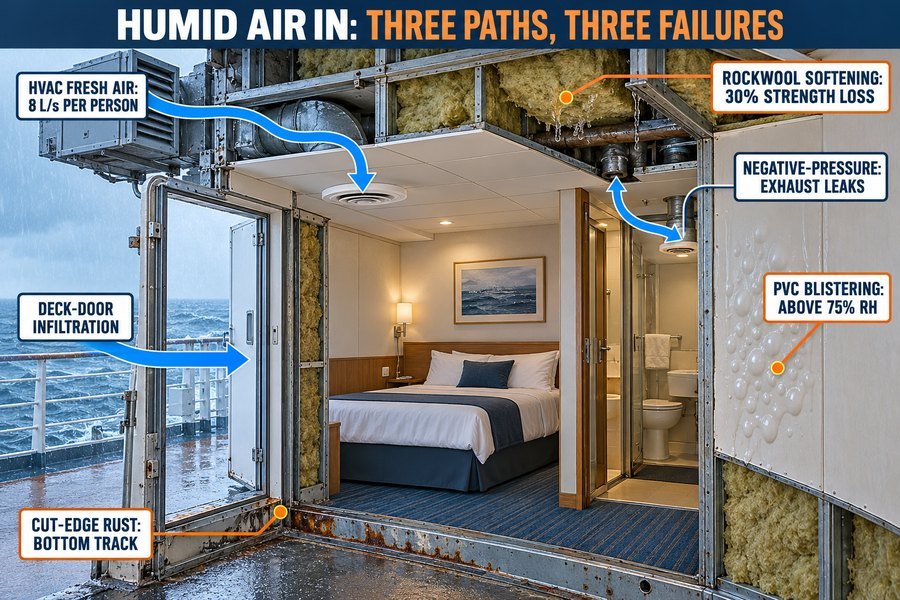
Humid outside air enters cabins via three pathways—HVAC fresh-air makeup (8 L/s per person under ISO 7547), deck-door opening infiltration, and negative-pressure exhaust leaks—causing three panel failures: PVC film blistering above 75% RH, cut-edge rust in bottom tracks, and rockwool softening that reduces strength by 30%.
Three Entry Pathways for Humid Outside Air Into Ship Accommodations
Even when a ship has a modern central HVAC system, humid outside air enters the accommodation block every single minute through three direct pathways. First, international marine ventilation rules require continuous fresh outdoor air makeup. Under ISO 7547 Section 6.2, the HVAC system must supply at least 8 liters per second (28.8 m³/h) of fresh outside air per person, or at least 40% of the total air volume supplied to the cabins. If the ship's central cooling coil does not cool the incoming air below its dew point (around 12°C to 14°C) before reheating it, humid air blows straight out of the ceiling diffuser onto the marine ceiling panels. Second, crew members constantly open weather-deck doors and staircase fire doors. Each door opening lets in 15 to 25 m³/h of unconditioned humid sea air into the accommodation corridors.9 Third, wet spaces like bathrooms, galleys, and laundries run on negative-pressure exhaust fans under ISO 7547 to keep smells out of bedrooms. This negative pressure pulls unconditioned humid air from cable penetrations, pipe ducts, and unsealed ceiling plenums right across the back of your ceiling and wall panels.
Three Physical Failure Modes on Marine Wall and Ceiling Panels
Once this humid outside air enters the cabin and ceiling void, it triggers three costly physical failures on low-grade marine interior panels. First, the decorative PVC film blisters and peels along the panel edges when surface humidity stays above 75% RH.10 Many small factories in Asia skip the heat-activated primer coat when laminating PVC film onto galvanized steel to speed up production. Without primer, moisture creeps under the 150-micron PVC film at the folded edge within 8 to 12 months. Second, cut-edge red rust forms inside the bottom U-channel floor tracks. When factories shear galvanized steel sheets to a 2100 mm or 2400 mm height, the raw steel edge of the 0.6 mm sheet is exposed without zinc protection. Condensed water runs down the panel, pools in the bottom floor track, and rusts the cut edge upward. Third, high humidity causes rockwool core softening. According to EN 12089 bending strength tests, when low-density rockwool (below 100 kg/m³) absorbs moisture from humid ceiling plenums, the panel's flexural strength drops by 30% to 35%.11 This makes B-15 ceiling panels sag visibly by 4 mm to 8 mm between hanger spans.
| Humid Air Entry Pathway | Airflow / Moisture Rate | Primary Panel Zone Affected | Resulting Panel Failure Mode | Prevention Method & Standard |
|---|---|---|---|---|
| HVAC Fresh-Air Supply | ≥ 8 L/s per person (≥ 40% total air) | Ceiling panels around air diffusers | PVC film blistering and peeling above 75% RH | Two-coat heat primer + 150 µm marine PVC (ISO 7547) |
| Weather-Deck Door Infiltration | 15 – 25 m³/h per door cycle | Corridor wall panels & fire door frames | Cut-edge red rust inside bottom U-channels | PVC edge-wrapping + sealant bead in bottom track |
| Negative-Pressure Exhaust Leaks | -10 to -25 Pa suction pressure | Ceiling plenum backs & wet unit walls | Rockwool softening (30% flexural strength loss) | ≥ 120 kg/m³ hydrophobic rockwool core (EN 12089) |
What Moisture Loads Do Marine Accommodation Panels Face in Year-Round Tropical Service?
Vessels working year-round in Southeast Asia or West Africa never get a dry season. Constant moisture loads overwhelm cheap interior panels. Calculating exact water vapor loads prevents expensive refits.
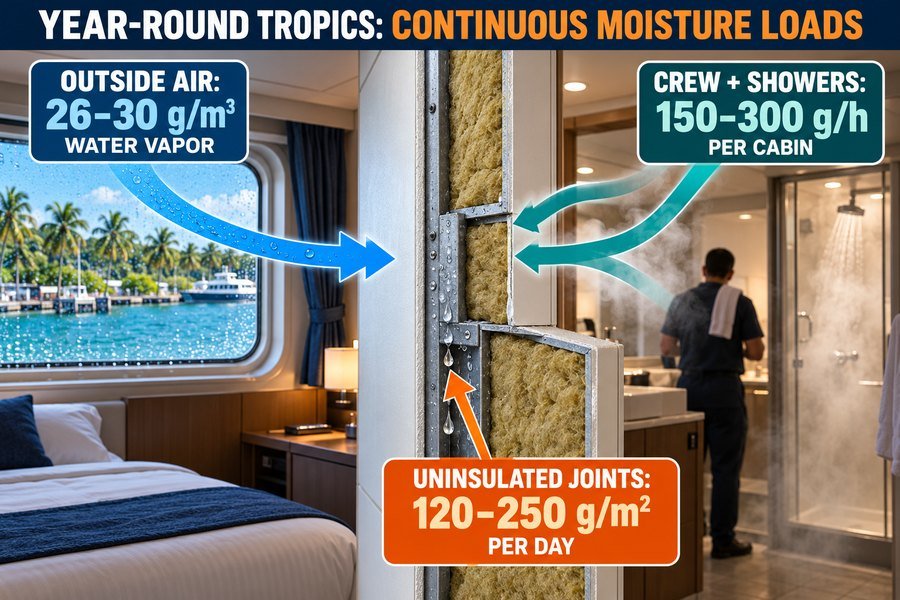
In year-round tropical service, marine accommodation panels face three continuous moisture loads under ISO 7547 and ASHRAE data: external ambient air holding 26–30 g/m³ of water vapor, internal crew and shower loads adding 150–300 g/h per cabin, and surface condensation loads reaching 120–250 g/m² per day on uninsulated joints.
External Ambient Vapor Content and Internal Crew Latent Moisture Loads
When you outfit an offshore accommodation barge, tugboat, or passenger ferry that works 365 days a year in tropical waters like Indonesia, Malaysia, or Nigeria, the panels never get a winter drying period. You must design for three continuous moisture loads that attack the panels at the same time. First, the external ambient air carries an extreme absolute moisture content of 26 to 30 grams of water vapor per cubic meter of dry air (26–30 g/m³), based on ISO 7547 psychrometric charts at 35°C and 80% to 85% RH. By comparison, European temperate air at 20°C and 50% RH holds only 8.6 g/m³ of water vapor. This means tropical air carries more than three times as much physical water. Second, internal crew activities and cabin showers generate a massive internal latent moisture load of 150 to 300 grams of water vapor per hour in every occupied cabin. According to the ASHRAE Handbook — HVAC Applications, a single crew member resting or doing light cabin work releases 50 to 70 g/h of moisture through breathing and sweat12, while a 15-minute hot shower in the modular wet unit releases 200 to 250 g of steam directly against the bathroom wall panels and door frame13.
Cumulative Daily Surface Condensation Loads on Panel Profiles and Cores
Third, uninsulated steel profiles, ceiling hanger rods, and door frames experience a surface condensation load of 120 to 250 grams per square meter per day (120–250 g/m²/day)14. Over a 365-day tropical operating year, that equals 43.8 to 91.2 kilograms of liquid water touching every square meter of exposed joint profile. Two years ago, I helped a client replace the wet-space wall panels on an Indonesian crew boat because the previous supplier sold standard B-15 galvanized panels at $18.50 per square meter for the shower rooms. Within 14 months, the 90 kg/m² annual moisture load rotted the bottom 300 mm of every panel. For year-round tropical service, spending $18 to $21 per square meter on basic dry-area panels for wet or corridor zones is a false economy. Instead, you should specify Z275 galvanized panels with sealed PVC returns at $23 to $26 per square meter for dry cabins, and SUS 304 stainless steel PVC-laminated panels at $32 to $38 per square meter for sanitary spaces and galleys. This extra $6 to $14 per square meter saves tens of thousands of dollars in shipyard rip-out labor.
| Moisture Load Source | Exact Moisture Load Value | Annual Cumulative Exposure | Recommended Panel Specification | Typical Asian Factory Price (FOB) | Authoritative Source |
|---|---|---|---|---|---|
| External Ambient Tropical Air | 26 – 30 g/m³ absolute humidity | 365 days continuous vapor drive | 50 mm B-15 panel, 0.6 mm Z275 steel, 140 kg/m³ rockwool | $22.00 – $25.50 / m² | ISO 7547 Psychrometric Data |
| Internal Crew & Shower Load | 150 – 300 g/h per cabin | 1,314 – 2,628 kg/year per cabin | 25/50 mm panel, SUS 304 stainless steel back & face in wet units | $32.00 – $38.00 / m² | ASHRAE HVAC Applications |
| Joint & Profile Condensation | 120 – 250 g/m² per day | 43.8 – 91.2 kg/m² per year | Thermal-break PVC gasket in M/C profiles + marine silicone | +$1.80 – $2.50 / m² for profiles | ISO 15138 / EN 1609 |
How Do Marine Interior Panel Specifications Reflect Multi-Climate and Unrestricted Service?
Ordering vague "standard B-15 panels" from Asian factories invites quality disasters on unrestricted vessels. Missing a single coating or glue spec causes rejection. Precise multi-climate specifications guarantee long-term compliance.
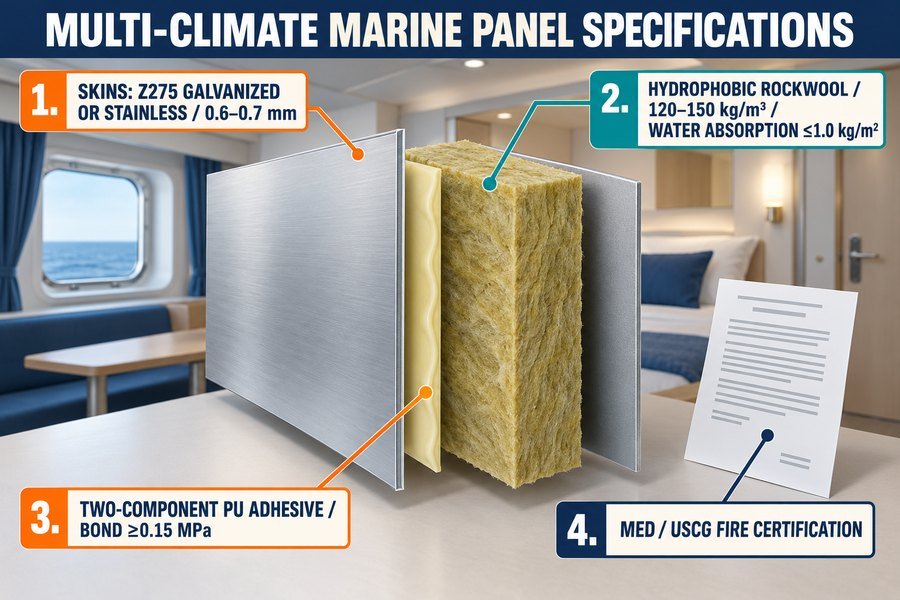
Marine interior panel specifications for unrestricted service cover four core technical parameters under IMO FTP Code and ISO standards: Z275 galvanized or stainless steel skins (0.6–0.7 mm), hydrophobic rockwool cores (120–150 kg/m³ density, ≤1.0 kg/m² water absorption), two-component polyurethane adhesive (≥0.15 MPa bond), and MED/USCG fire certification.
Steel Skin Coatings and Hydrophobic Rockwool Core Specifications
When you undertake interior outfitting contracts for European or American shipyards, the vessel almost always carries an "Unrestricted Service" notation from classification societies like DNV, ABS, or Lloyd's Register. Unrestricted service means the ship can sail anywhere in the world, from freezing Arctic ports to humid equatorial seas. To prevent Asian suppliers from cutting corners on materials, your purchase contract must lock down four core technical parameters. First, you must specify the steel skin thickness and anti-corrosion coating. Unrestricted marine wall panels require 0.6 mm to 0.7 mm thick steel skins (never 0.45 mm or 0.5 mm) with a hot-dip galvanized zinc coating of 275 g/m² (Z275 under EN 10346) or Alu-Zinc AZ150, laminated with a 150-micron flame-retardant PVC film. For ceiling panels, specify at least 0.5 mm to 0.6 mm Z275 steel. Second, you must specify the hydrophobic rockwool core properties. For a 50 mm B-15 wall panel, require a rockwool density of 120 to 150 kg/m³, a hydrophobic water-repellency rating of at least 98%, and a short-term water absorption value of ≤ 1.0 kg/m² tested under EN 1609. For 25 mm B-15 ceiling panels, require a higher rockwool density of 160 to 180 kg/m³ so the thin panel stays rigid in high humidity.
Two-Component Polyurethane Adhesive Bonding and MED/USCG Fire Certifications
Third, you must specify the chemical adhesive system that bonds the steel sheets to the rockwool core. Demand a two-component solvent-free polyurethane (PU) glue applied at 120 to 150 g/m², achieving a cross-tensile bond strength of at least 0.15 MPa (150 kPa) under EN 14509 testing after 48 hours of high-humidity heat aging at 70°C and 90% RH. Never accept one-component moisture-cured glue or sodium silicate glue, because sodium silicate absorbs water in the tropics and releases alkaline liquid that corrodes the steel from the inside out15. Fourth, verify that the exact multi-climate panel assembly holds valid IMO 2010 FTP Code Part 3 (B-15 / B-0 fire resistance) and Part 5 (low flame spread surface) certificates. For European and US shipyard projects, make sure the factory provides both EC-MED Module B and Module D certificates (Wheelmark) and USCG approval numbers16. At Magellan Marine, I always check the Module D production quality audit date before my clients pay their deposit, because an expired certificate will freeze your container at customs. In China, upgrading from a domestic-grade panel ($17 to $19/m²) to a true unrestricted MED/USCG-certified multi-climate panel ($22 to $26/m²) only adds about $5 per square meter, with a reliable factory lead time of 25 to 30 days.
| Specification Parameter | Cheap Domestic Grade (High Risk) | Unrestricted Multi-Climate Grade (Recommended) | Governing Test Standard | Price Impact (FOB China/Vietnam) |
|---|---|---|---|---|
| Steel Skin & Zinc Coating | 0.45 – 0.5 mm steel, Z60 – Z80 zinc (60 g/m²), 100 µm PVC | 0.6 – 0.7 mm steel, Z275 zinc (275 g/m²) or SUS 304, 150 µm PVC | EN 10346 / ISO 3575 | Base: $18/m² vs Upgrade: +$2.50/m² |
| Rockwool Core Density & Moisture | 80 – 100 kg/m³ density, non-hydrophobic (>3.5 kg/m² water uptake) | 120 – 150 kg/m³ density, ≥98% hydrophobic (≤1.0 kg/m² water uptake) | EN 1609 / ISO 29767 | Upgrade: +$1.50/m² |
| Adhesive Bonding System | 1-component glue or sodium silicate (<0.06 MPa wet bond) | 2-component solvent-free PU glue (120–150 g/m², ≥0.15 MPa bond) | EN 14509 Humidity Aging | Upgrade: +$1.00/m² |
| Fire & Class Certification | CCS only or expired test reports | Valid IMO 2010 FTP Code Part 3 & 5, EC-MED (B+D) & USCG | SOLAS II-2 / IMO FTP Code | Total Certified Price: $22 – $26/m² |
Conclusion
Matching marine interior panel coatings, rockwool cores, and adhesives to ISO 7547 climate humidity loads prevents condensation damage, controls Asian sourcing costs, and ensures long-term compliance for global shipyards.
-
"Tropical Weather Systems", https://www.noaa.gov/jetstream/tropical. Meteorological or marine-design guidance can substantiate that tropical maritime operating conditions commonly involve high temperatures and high relative humidity, providing contextual support for the stated design envelope. Evidence role: general_support; source type: institution. Supports: Outdoor ambient air on tropical routes is commonly very warm and humid, with relative humidity around 75%–95% and temperatures around 32°C–35°C.. Scope note: A climate source may support typical tropical marine conditions but may not prove that all equatorial routes remain within this exact range continuously. ↩
-
"The Kieper and MOISTWALL Moisture Analysis Methods ...", https://www.fpl.fs.usda.gov/documnts/pdf1983/tenwo83a.pdf. Building-physics literature explains that water vapor migrates from regions of higher vapor pressure to lower vapor pressure and can condense on cooler surfaces, supporting the mechanism described for humid shipboard zones adjacent to air-conditioned cabins. Evidence role: mechanism; source type: education. Supports: A vapor pressure gradient can drive moisture from hotter, more humid spaces toward cooler, drier air-conditioned interiors.. Scope note: General moisture-transport theory supports the mechanism but does not by itself document the specific vessel example or panel-joint leakage described in the article. ↩
-
"ASHRAE 55", https://en.wikipedia.org/wiki/ASHRAE_55. Thermal comfort and marine accommodation HVAC references commonly use indoor design temperatures near 20–22°C with controlled relative humidity ranges for occupied spaces. Evidence role: expert_consensus; source type: institution. Supports: Heated ship accommodation spaces are commonly designed around roughly 20–22°C and moderate relative humidity.. Scope note: The cited source may establish typical comfort-design ranges rather than proving the exact operating conditions on every vessel. ↩
-
"Water Vapor Generation in Residential Buildings", https://research.fs.usda.gov/download/treesearch/65595.pdf. Hygrothermal references explain that water vapour diffusion is driven by vapour-pressure gradients, so warm humid indoor air can transfer moisture toward colder, lower-vapour-pressure cavities when assemblies are not airtight or vapour controlled. Evidence role: mechanism; source type: education. Supports: Water vapour can migrate from a warm humid cabin into a colder cavity because of vapour-pressure gradients and leakage paths.. Scope note: This supports the physical mechanism; actual moisture flow in a ship panel also depends on air leakage paths, ventilation, materials, and pressure differences. ↩
-
"WMO Climatological Normals - WMO Community", https://community.wmo.int/site/knowledge-hub/programmes-and-initiatives/climate-services/wmo-climatological-normals. Meteorological climate data for northern winter ports and tropical transit ports support the plausibility of large route-related temperature contrasts between subfreezing winter conditions and hot tropical conditions. Evidence role: general_support; source type: government. Supports: A Europe-to-Asia or similar voyage can expose a vessel to an external air-temperature change on the order of 50°C.. Scope note: Such data would support the plausibility of the temperature range, not prove that every voyage experiences an exact 50°C change within two weeks. ↩
-
"Eurocode Training EN 1993-1-1 & EN 1993-1-2: Steel ...", https://www.academia.edu/5224260/Eurocode_Training_EN_1993_1_1_and_EN_1993_1_2_Steel_Structures. EN 1993-1-1 lists the coefficient of linear thermal expansion for structural steel as approximately 12 × 10^-6 per °C, supporting the coefficient used in the panel movement estimate. Evidence role: definition; source type: institution. Supports: The article’s stated thermal expansion coefficient for carbon or structural steel is consistent with Eurocode material properties.. ↩
-
"Thermal Expansion", http://hyperphysics.phy-astr.gsu.edu/hbase/thermo/thexp.html. The standard linear thermal expansion relation ΔL = αLΔT supports millimetre-scale movement estimates for steel members over panel-length dimensions when subjected to large temperature changes. Evidence role: mechanism; source type: education. Supports: A 50°C temperature variation across steel panel dimensions can produce approximately 0.5–1.2 mm of thermal movement at joints.. Scope note: This verifies the order of magnitude of thermal movement; actual joint displacement depends on temperature gradients, restraint, geometry, and connection details. ↩
-
"Hygrothermal Damage Monitoring of Composite Adhesive ...", https://pmc.ncbi.nlm.nih.gov/articles/PMC8840299/. Studies of hygrothermal ageing and freeze-thaw cycling in bonded sandwich or composite assemblies report that moisture and temperature cycling can reduce adhesive bond strength and contribute to debonding or delamination. Evidence role: mechanism; source type: paper. Supports: Moisture trapped in a panel and repeatedly heated, cooled, frozen, and evaporated can degrade adhesive bonds and contribute to delamination.. Scope note: Such studies support the proposed failure mechanism generally; they do not independently verify the reported batch, voyage history, or the exact adhesive formulation described in the article. ↩
-
"Effects of Air Infiltration and Ventilation", https://tsapps.nist.gov/publication/get_pdf.cfm?pub_id=861039. Studies of door-opening infiltration show that transient air exchange through doorways can be substantial and is governed by opening duration, pressure difference, temperature difference, and doorway geometry. Evidence role: general_support; source type: paper. Supports: Opening weather-deck or corridor doors can admit measurable volumes of unconditioned air into conditioned spaces.. Scope note: Such studies may support the plausibility of door-driven infiltration but may not directly establish the article’s specific 15–25 m³/h value for ship accommodation doors. ↩
-
"(PDF) Humidity effect on polyimide film adhesion", https://www.academia.edu/57046568/Humidity_effect_on_polyimide_film_adhesion. Materials and adhesion studies report that elevated relative humidity can reduce polymer-film adhesion and promote interfacial moisture damage, including blistering or delamination at vulnerable edges. Evidence role: mechanism; source type: paper. Supports: High relative humidity can contribute to blistering or peeling of PVC film laminates at panel edges.. Scope note: The literature may support the humidity-driven adhesion mechanism generally; a 75% RH threshold for this specific marine PVC-on-galvanized-steel laminate would require product-specific or test-specific evidence. ↩
-
"The Influences of Moisture on the Mechanical, Morphological and ...", https://pmc.ncbi.nlm.nih.gov/articles/PMC7288152/. Research on mineral wool insulation indicates that moisture uptake can change mechanical properties and reduce stiffness or strength, while EN 12089 provides a standardized method for determining bending behavior of thermal insulation products. Evidence role: mechanism; source type: paper. Supports: Moisture absorption in low-density mineral wool can reduce bending or flexural performance, and EN 12089 is an applicable bending-test method.. Scope note: A citation to EN 12089 supports the test method, not the claimed 30–35% strength loss; that percentage would need a separate experimental study on comparable density rockwool panels. ↩
-
"Interior Moisture Design Loads for Residences", https://research.fs.usda.gov/download/treesearch/25691.pdf. ASHRAE and building-science references report latent heat or moisture generation rates for sedentary and light activity occupants that are consistent with roughly tens of grams of water vapor per hour per person. Evidence role: expert_consensus; source type: institution. Supports: A resting or lightly active person can release approximately 50–70 g/h of moisture through respiration and perspiration.. Scope note: Published rates vary with activity level, clothing, metabolic rate, and indoor conditions, so the citation should be treated as support for the approximate range rather than a fixed human output. ↩
-
"Water Vapor Generation in Residential Buildings", https://research.fs.usda.gov/download/treesearch/65595.pdf. Indoor moisture-load studies identify showers as short-duration, high-intensity moisture sources and provide emission estimates that can be used to contextualize the stated 200–250 g release for a 15-minute shower. Evidence role: general_support; source type: paper. Supports: A 15-minute hot shower can add on the order of hundreds of grams of water vapor to a small bathroom or wet unit.. Scope note: Moisture release from a shower depends strongly on water temperature, flow rate, enclosure geometry, ventilation, and surface condensation, so a source may support the order of magnitude rather than this exact range. ↩
-
"Thermal Bridges", https://web.ornl.gov/sci/buildings/2016/docs/presentations/workshops/workshop-3/Workshop3_Bossche.pdf. Condensation and hygrothermal references describe how uninsulated metal thermal bridges can fall below the dew point and accumulate surface condensate under warm, humid conditions, providing a physical basis for daily condensate loading on exposed steel profiles. Evidence role: mechanism; source type: research. Supports: Uninsulated steel profiles and other thermal bridges can experience recurring surface condensation under tropical marine humidity.. Scope note: General condensation references support the mechanism but may not verify the exact 120–250 g/m²/day rate without a project-specific heat-transfer and climate calculation. ↩
-
"Industrial Experience on the Caustic Cracking of Stainless Steels and ...", https://www.osti.gov/servlets/purl/881876. Materials references describe sodium silicate as water-soluble and strongly alkaline in aqueous solution, while corrosion literature discusses alkaline or caustic environments as possible contributors to steel corrosion under certain exposure conditions. Evidence role: mechanism; source type: paper. Supports: Sodium silicate adhesives may create a moisture-sensitive, alkaline environment that can contribute to internal steel corrosion under humid conditions.. Scope note: This evidence supports the plausibility of the moisture/alkalinity mechanism but would not directly prove corrosion inside a specific marine wall-panel assembly without product-specific testing. ↩
-
"When Is MED Wheel Mark Required Over Class Society ...", https://magellanmarinetech.com/when-med-wheel-mark-required-over-class-society-approval-marine-accommodation-panels/. EU Marine Equipment Directive guidance describes Wheelmark conformity assessment for marine equipment, including Module B type examination and Module D production-quality assurance, while U.S. Coast Guard approval systems list approved equipment by approval number for regulated shipboard use. Evidence role: general_support; source type: government. Supports: European and U.S. shipyard projects may require MED Wheelmark conformity documentation and/or USCG approval identification for regulated marine equipment.. Scope note: The certification route required for a project depends on the vessel flag, class, equipment category, and any applicable mutual-recognition arrangements. ↩