Moisture destroys ship cabins fast. Peeling PVC films and rusted steel skins trigger costly warranty claims. You must define exact humidity limits before buying marine panels.
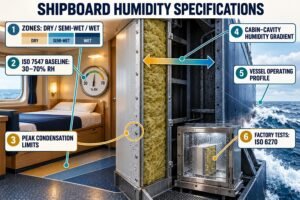
Shipboard humidity conditions in marine interior panel specifications are defined through six technical parameters: spatial zone classifications (dry, semi-wet, wet), ISO 7547 baseline relative humidity ranges (30% to 70%), peak condensation limits, front-to-back panel cavity gradients, vessel operating profiles, and factory testing protocols like ISO 6270.
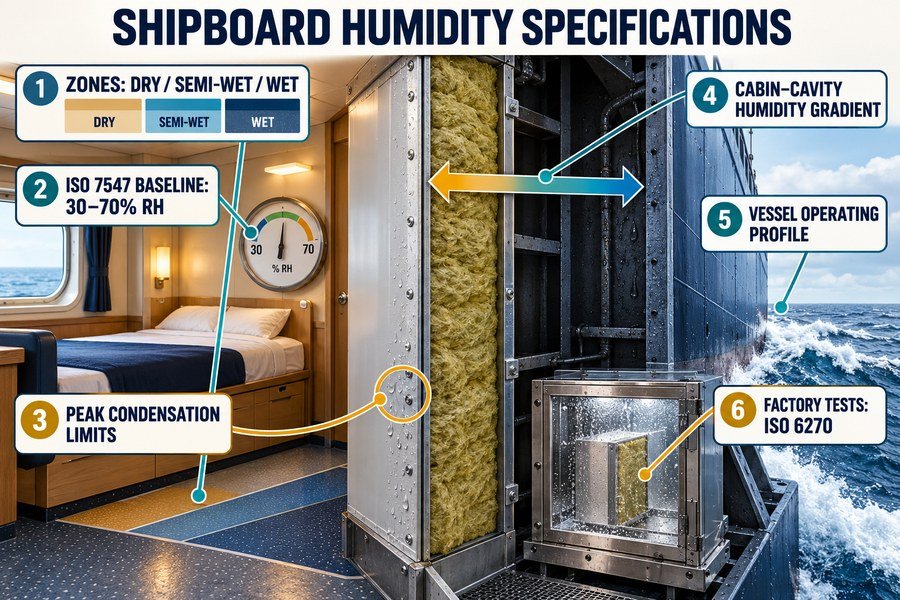
Buying marine panels from overseas factories is risky if your technical specifications are vague. I have seen many procurement officers lose money because a supplier sent standard dry-zone panels for a humid tropical vessel. Let us break down the exact humidity parameters you need to protect your next ship interior project.
How Do Marine Interior Panel Specifications Classify Dry, Semi-Wet, and Wet Zones?
Ordering one single panel type for an entire vessel is a massive mistake. Steam and water splashes will quickly rot standard rockwool cores. You need clear zone classifications.
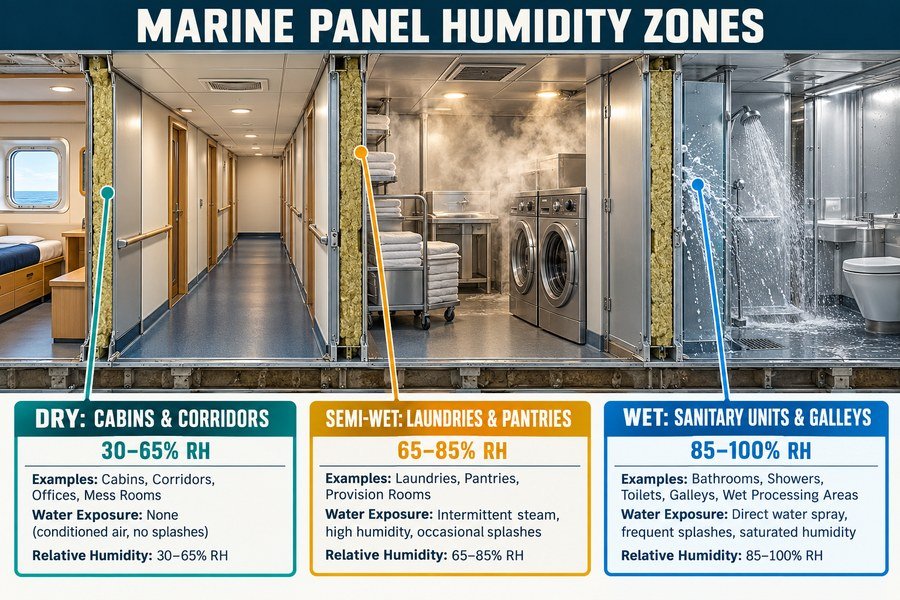
Marine interior panel specifications classify spaces into three humidity categories based on water exposure and relative humidity (RH): Dry Zones (cabins and corridors at 30%–65% RH), Semi-Wet Zones (laundries and pantries at 65%–85% RH), and Wet Zones (sanitary units and galleys at 85%–100% RH).
Technical Criteria for Dry and Semi-Wet Marine Accommodation Zones
When I worked on the factory floor, I saw buyers try to save money by using standard galvanized steel panels everywhere. That always fails in humid rooms. According to DNV Rules for Classification of Ships (Part 6, Chapter 5) and shipyard accommodation standards, you must separate Dry Zones from Semi-Wet Zones1. Dry Zones include crew cabins, passenger staterooms, wheelhouses, and general corridors. In these areas, the air conditioning system keeps relative humidity between 30% and 65%2. You can safely use standard 0.6 mm hot-dip galvanized steel skins with a zinc coating weight of 120 g/m² (per EN 10346) and a 150 µm PVC decorative film.
Semi-Wet Zones experience intermittent steam and higher moisture. These areas include changing rooms, pantries, mess rooms, and utility laundries. Relative humidity here sits between 65% and 85%. Liquid water does not hit the walls constantly, but damp air penetrates unprotected panel joints. For Semi-Wet Zones, I always tell my clients to upgrade the base steel zinc coating to 275 g/m² (Z275 per EN 10346). You also need to specify hydrophobic rockwool insulation with a water absorption rate under 1.0 kg/m² according to EN 1609. If you use standard rockwool in a laundry room, it will absorb moisture from the air, sag inside the steel skins, and ruin the B-15 fire rating within two years.
Material Upgrades Required for Wet Zone Bulkhead Panels
Wet Zones face direct water spray, standing floor water, and constant steam saturation. These spaces include shower cubicles, communal washrooms, wet galleys, and dishwashing rooms. Relative humidity stays between 85% and 100%. Standard PVC-laminated steel panels will delaminate here in less than six months. Last year, I helped a client fix a project for a European shipyard where the original supplier used standard carbon steel panels in crew showers. The bottom edges rusted completely through before the vessel even finished sea trials.
For Wet Zones, your purchasing specification must require AISI 304 or AISI 316L stainless steel skins (0.6 mm to 0.8 mm thick) or galvanized steel coated with a 25 µm PVDF (polyvinylidene fluoride) paint system. In addition, the bottom U-profiles must be made of 1.5 mm thick AISI 316L stainless steel, raised 50 mm to 100 mm above the steel deck coaming. Every vertical tongue-and-groove joint in a Wet Zone requires a continuous bead of marine-grade, mold-resistant silicone sealant tested to ISO 846.
| Zone Classification | Typical Shipboard Spaces | Relative Humidity (RH) Range | Minimum Steel Substrate & Coating (EN 10346) | Bottom Profile Requirement |
|---|---|---|---|---|
| Dry Zone | Cabins, offices, corridors, lounges | 30% – 65% RH | 0.6 mm Galvanized Steel (Z120) + 150 µm PVC Film | 1.0 mm Galvanized Steel U-track |
| Semi-Wet Zone | Laundries, pantries, locker rooms, mess halls | 65% – 85% RH | 0.6 mm Galvanized Steel (Z275) + 150 µm PVC / Polyester | 1.2 mm Galvanized Steel (Z275) + Sealant |
| Wet Zone | Showers, galleys, sculleries, sanitary units | 85% – 100% RH (plus direct splash) | 0.7 mm AISI 304/316L Stainless Steel or PVDF Coated | 1.5 mm AISI 316L Stainless Steel on Coaming |
What Baseline Humidity Ranges Does ISO 7547 Set for Marine Accommodation Panels?
Relying on a supplier's verbal promise of "humidity resistance" leaves you unprotected. Without international ISO benchmarks in your contract, factories can ship inferior materials. You need exact baseline numbers.
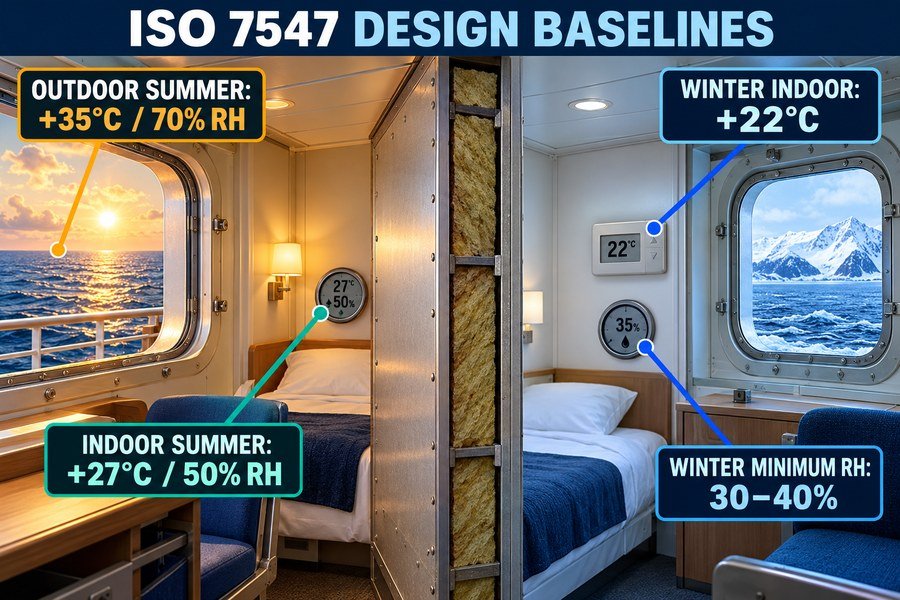
ISO 7547 sets the baseline indoor design conditions for marine air-conditioned accommodation spaces at a summer relative humidity of 50% (at +27°C indoor temperature against +35°C, 70% RH outdoor air) and a winter minimum relative humidity of 30% to 40% (at +22°C indoor temperature).
Summer Design Humidity Benchmarks Under ISO 7547
When European and American shipyards write interior specifications, they almost always reference ISO 7547 (Ships and marine technology — Air-conditioning and ventilation of accommodation spaces — Design conditions and basis of calculations). As a procurement officer, you do not need to calculate HVAC loads, but you must know how these numbers affect your wall and ceiling panels. Under ISO 7547 Section 4, the outdoor summer design condition is +35°C with 70% relative humidity. The ship's air conditioning system is designed to pull the indoor cabin air down to +27°C with 50% relative humidity.
However, a single point of 50% RH is only the HVAC target. In real panel manufacturing specs, we translate this into a continuous summer operating window of 45% to 65% RH3. Why does this matter for your purchasing contract? Because the adhesive glue that bonds the PVC decorative film to the steel sheet reacts to heat and humidity. If an Asian factory uses cheap water-based acrylic glue instead of a two-component polyurethane (PU) adhesive, constant exposure to 65% RH at +27°C will soften the glue line4. When I audit panel factories in China, I verify that their adhesive bond strength exceeds 2.5 N/mm under ISO 8510-2 peel testing at these exact summer baseline conditions.
Winter Design Humidity Limits and Low-Moisture Material Stability
People always worry about high humidity, but extreme low humidity in winter also ruins marine interior panels. According to ISO 7547, the winter outdoor design temperature is -20°C. When the ship's heating system warms that freezing air up to the indoor target of +22°C, the indoor relative humidity drops sharply to between 30% and 40%. If the vessel lacks a steam humidifier in the HVAC unit, cabin humidity can fall as low as 20% RH during North Atlantic or Baltic Sea winter voyages.
This dry baseline creates two major problems for ship interior products. First, low humidity causes static electricity buildup on synthetic wall surfaces5, which attracts dust and fails comfort standards on passenger vessels. Second, if you are buying marine fire doors or wall panels with High-Pressure Laminate (HPL) faces (typically 0.8 mm to 1.2 mm thick per EN 438), dropping from 65% RH to 25% RH causes the phenolic resin core of the HPL to shrink. If the factory did not condition the HPL sheets at 45%–55% RH for 48 hours before gluing them to the calcium silicate or rockwool core, the HPL will crack at the corners or pull the panel into a bow shape exceeding the allowable 1.5 mm per meter flatness tolerance.
| Seasonal Condition (ISO 7547) | Outdoor Ambient Parameter | Indoor Cabin Target | Operational Panel Spec Range | Primary Panel Material Risk |
|---|---|---|---|---|
| Summer Baseline | +35°C Temp / 70% RH | +27°C Temp / 50% RH | 45% – 65% RH continuous | Polyurethane adhesive softening and PVC film edge peeling |
| Winter Baseline | -20°C Temp / Dry Air | +22°C Temp / 30%–40% RH | 20% – 40% RH continuous | HPL laminate shrinkage, corner cracking, and panel bowing |
| Tropical / Red Sea Extension | +40°C to +45°C / 80% RH | +28°C Temp / 55%–60% RH | 55% – 75% RH continuous | Accelerated corrosion at cut steel edges and joint seal failure |
How Do Marine Interior Panel Specifications Address Peak Humidity and Condensation Risks?
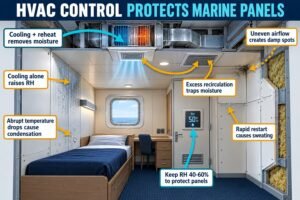
Air conditioning systems break down during port stays, and crew showers create massive steam spikes. Ignoring peak humidity causes hidden mold and ceiling collapse. Your specs must address condensation.
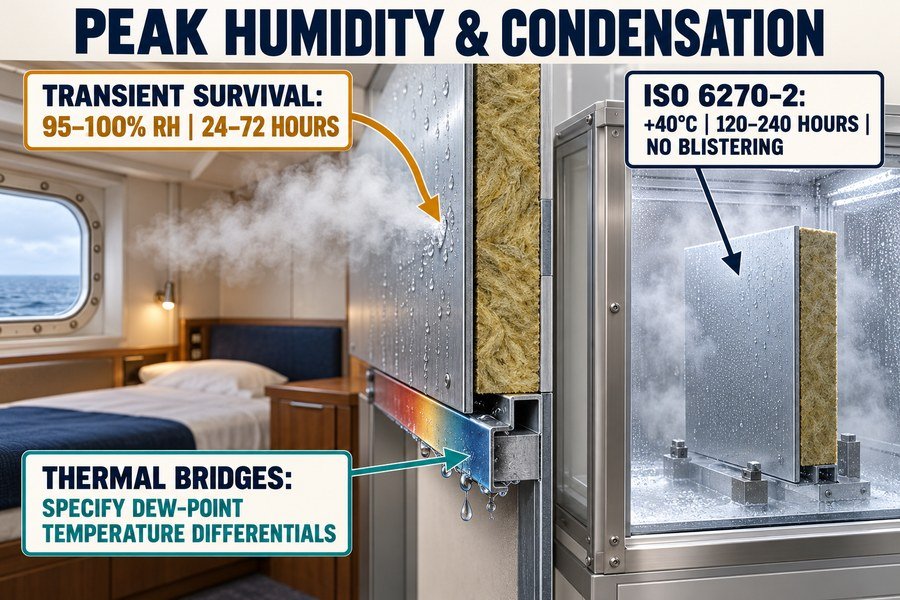
Marine interior panel specifications address peak humidity and condensation by mandating 95% to 100% transient RH survival for 24 to 72 hours, specifying dew point temperature differentials across thermal bridges, and requiring ISO 6270-2 constant condensation chamber testing (120 to 240 hours at +40°C) without blistering.
Transient Humidity Spikes During HVAC Shutdowns and Port Turnarounds
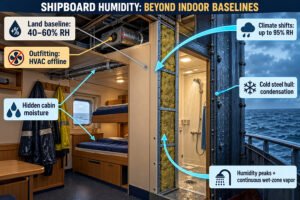
A ship does not maintain a polite 50% RH all year round. During shipyard outfitting, dry-docking, or port turnarounds in places like Singapore or Jakarta, the main chillers are often shut off for maintenance. Within four hours, indoor cabin humidity matches the tropical outdoor air—hitting 85% to 95% RH at +32°C to +35°C6. Similarly, when a crew member opens a bathroom door after a hot shower, a blast of 98% RH air7 hits the cabin corridor ceiling panel.
To protect your company from defects during the 12-month or 24-month shipyard warranty period, your purchase specification must include a "Transient Peak Humidity Clause." This clause states that all B-0 and B-15 wall and ceiling panels must withstand 95% RH at +40°C for up to 72 continuous hours without delamination, rust spotting, or core softening. When I review supplier test reports at Magellan Marine, I look for ISO 6270-2 (CH — Constant Humidity condensation atmosphere) test certificates. Under ISO 6270-2, a panel sample is placed over a heated water bath at +40°C with 100% RH condensing directly on the decorative surface for 120 to 240 hours. Afterward, the surface is evaluated under ISO 4628-2 and must show a blistering rating of 0 (S0) and a rust rating of Ri 0.
Dew Point Thresholds and Thermal Bridge Condensation Prevention
Condensation happens whenever warm, moist cabin air touches a metal surface that is colder than the air's dew point temperature. According to standard psychrometric charts, if a cabin is at +27°C and 60% RH, the dew point temperature is +18.4°C. If any part of your ceiling panel or fire door frame drops below +18.4°C—for example, where a ceiling C-profile touches a chilled water pipe hanger or a cold steel deckhead—liquid water droplets will form immediately.
This is a critical engineering point for B-15 and A-60 marine fire doors and continuous ceiling systems. Steel is a thermal bridge with a high thermal conductivity of about 50 W/(m·K). To stop condensation from dripping onto passenger beds, good specifications require two things:
- Thermal Break Profiles: Marine fire door frames and window casings connected to exterior bulkheads must include a 3 mm to 5 mm neoprene or ceramic fiber thermal break strip to keep the interior metal surface at least 3°C above the indoor dew point.
- Maximum U-Value Limits: Even for standard 50 mm B-15 rockwool wall panels (density 140 kg/m³), the specification should mandate a maximum thermal transmittance (U-value) of 0.68 W/(m²·K) per ISO 8301, ensuring the cabin-side steel skin stays warm enough to prevent surface sweating.
| Condensation & Peak Parameter | Test Standard / Engineering Reference | Required Specification Threshold | Acceptance Criteria |
|---|---|---|---|
| Constant Condensation Resistance | ISO 6270-2 (Method CH) | 120 to 240 hours at +40°C, 100% RH | Zero blistering (ISO 4628-2 Rating 0/S0) |
| Cyclic Damp Heat Resistance | IEC 60068-2-30 / ISO 6270-2 (AHT) | 6 cycles (24h each) between +25°C and +55°C at 95% RH | Adhesive peel strength remains above 2.0 N/mm |
| Surface Dew Point Margin | Psychrometric Chart / ISO 7547 | Interior skin temp at least +3°C above indoor dew point | Zero visible surface sweating at 60% indoor RH |
| Panel Thermal Transmittance | ISO 8301 / EN 12667 | Max U-value of 0.68 W/(m²·K) for 50 mm B-15 panel | Prevents cold-spot condensation on cabin face |
Why Must Marine Interior Panel Specifications Distinguish Cabin Faces From Back Cavities?
Many buyers only inspect the pretty front face of a sample panel. Meanwhile, condensation inside the dark hull cavity rots the panel from behind. You must specify both sides.
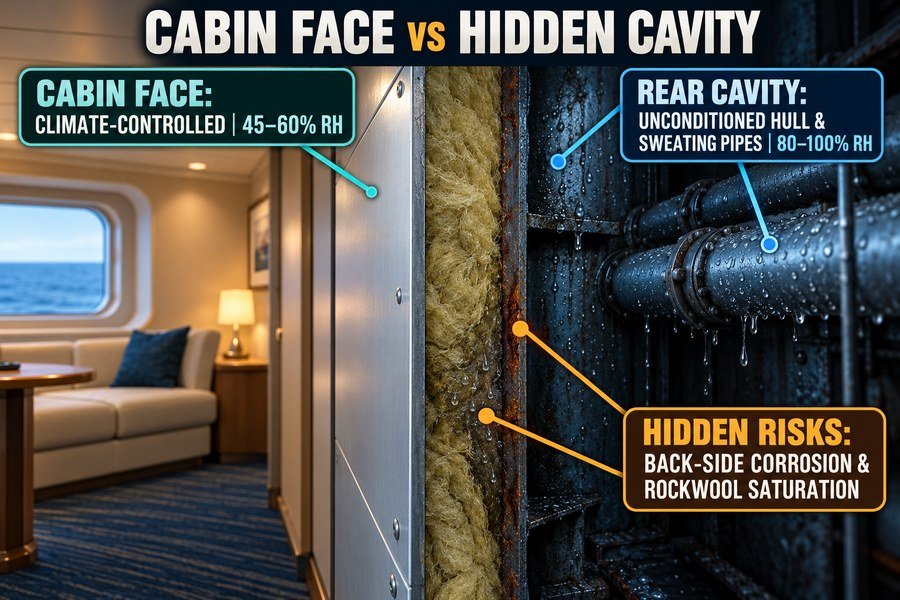
Marine interior panel specifications distinguish cabin faces from back cavities because while the front face enjoys climate-controlled air (45%–60% RH), the rear cavity faces unconditioned steel hulls, sweating chilled-water pipes, and 80%–100% RH microclimates that cause hidden back-side corrosion and rockwool saturation.
Microclimate Dynamics Inside Unventilated Bulkhead and Ceiling Cavities
When you install modular B-15 lining panels inside a ship, you leave a 50 mm to 150 mm air gap between the back of the panel and the ship's structural steel shell (or the A-60 hull insulation). Similarly, above a M-15 or B-15 marine ceiling panel, there is a 300 mm to 600 mm plenum space packed with electrical cable trays, HVAC ducts, and chilled-water pipes. The air conditioning system pumps dry, comfortable air into the living cabin, so the front PVC face of the panel sits happily at 50% RH.
However, the air behind the panel is trapped. When the ship sails through cold seawater (around +5°C to +10°C) or hot tropical waters (+32°C)8, the structural hull plate heats and cools rapidly. Moist air leaks from the cabin through light fixtures and electrical sockets into the back cavity. Once that warm air hits the cold hull area or an poorly insulated chilled-water pipe, the relative humidity inside the back cavity jumps to 85%–100% RH9. Because there is zero airflow behind the wall panels, that moisture never dries out10. I once inspected a vessel in dock where the cabin walls looked brand new from the inside, but when we removed a ceiling inspection hatch, the back of the panels was covered in white zinc oxide powder and black water stains.
Asymmetric Coating Specifications and Vapor Barrier Requirements
Because the front face and back cavity live in completely different humidity worlds, your technical specification must define asymmetric surface treatments. Most cheap factories in Asia try to save money on the back skin of a single-side visible lining panel (often called a 25 mm B-15 lining panel). They put a 150 µm PVC film on the front, but leave raw, unpainted galvanized steel on the back. In a humid cavity, raw Z120 galvanized steel will corrode within 18 months11.
To stop back-cavity failure, you must specify two protective barriers on the rear face:
- Back-Side Protective Primer: The rear galvanized steel sheet (minimum 0.5 mm to 0.6 mm thick) must be factory-coated with a 5 µm to 7 µm epoxy primer plus a 15 µm polyester backer coat (total 20 µm dry film thickness), tested to 250 hours of neutral salt spray under ISO 9227.
- Vapor Retarder Foil (For Perforated Panels): If you are buying micro-perforated acoustic ceiling panels or perforated engine control room walls (which have 1.5 mm to 2.0 mm holes covering 15% to 22% of the steel surface for sound absorption), humid cavity air goes straight into the rockwool core. Your spec must require a 30 g/m² non-woven glass fiber acoustic tissue backed by a 12 µm aluminum vapor barrier foil thermally bonded to the rockwool core, ensuring a water vapor transmission resistance (Z-value) greater than 15 GPa·s·m²/kg per ISO 12572.
| Panel Zone / Side | Typical Microclimate RH | Standard Factory Shortcut (Avoid) | Mandatory Specification Requirement | Relevant Test Standard |
|---|---|---|---|---|
| Cabin Front Face (Visible) | 40% – 60% RH (Climate Controlled) | 100 µm thin PVC with water-based glue | 150 µm marine low-flame PVC / 25 µm PVDF with PU glue | IMO FTPC Part 5 & Part 2 / ISO 8510-2 |
| Rear Cavity Face (Hidden) | 80% – 100% RH (Stagnant / Sweating) | Bare, unpainted Z120 galvanized steel | Z180/Z275 Galvanized + 20 µm Epoxy/Polyester Backer Coat | ISO 9227 (250 hours Salt Spray) |
| Perforated Acoustic Core | 75% – 95% RH (Direct Air Contact) | Loose rockwool exposed behind holes | Hydrophobic Rockwool + 30 g/m² Acoustic Fleece / Foil | EN 1609 (Water Absorption ≤ 1.0 kg/m²) |
How Do Marine Accommodation Panel Specifications Document Extreme Vessel Operating Profiles?
A cruise ship in the Caribbean and an offshore rig in the Persian Gulf face brutal moisture extremes. Using standard commercial specs on specialized vessels guarantees failure. You must match the vessel profile.
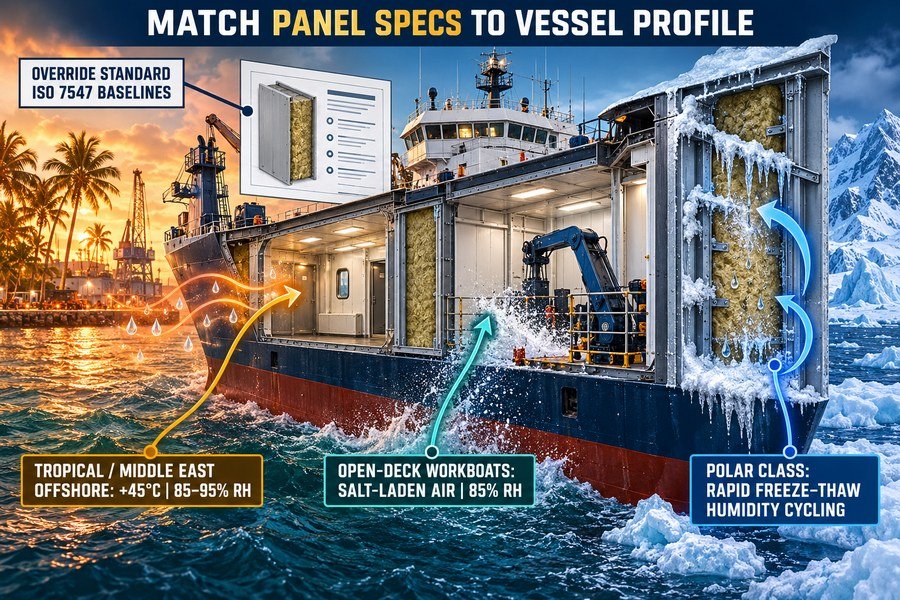
Marine accommodation panel specifications document extreme vessel operating profiles by overriding standard ISO 7547 baselines with region-specific ambient parameters—such as 85%–95% RH at +45°C for tropical/Middle East offshore units, constant salt-laden 85% RH for open-deck workboats, and rapid freeze-thaw humidity cycling for polar class vessels.
Tropical, Monsoon, and Offshore FPSO High-Humidity Profiles
When you bid on an interior outfitting project for a European or US shipyard, the first document you should check is the "Vessel General Arrangement and Operating Profile." Standard cargo ships use standard ISO 7547 numbers. However, Floating Production Storage and Offloading (FPSO) units, offshore support vessels (OSVs) operating in West Africa, Southeast Asia, or the Persian Gulf, and tropical cruise ships operate in extreme damp heat. In these regions, outdoor ambient air reaches +45°C with 80% to 90% relative humidity during the monsoon season12.
Furthermore, offshore rigs and workboats experience high crew traffic between open weather decks and interior corridors. Every time an exterior A-60 watertight door opens, warm, salt-saturated air at 85% RH rushes into the mudroom and main deck passageway. For these operating profiles, shipyard specifications override standard interior rules and invoke ISO 12944-2 Corrosion Category C4 (High) or C5-M (Very High Marine) for the entrance zones. As a buyer, when you see "Tropical Offshore Profile" in the tender documents, you must instruct your supplier to seal all cut steel edges of panels in deck-access corridors with polyurethane edge sealer and supply 316L stainless steel bottom tracks even in designated "Dry Zones" on the main deck.
Polar Code and Sub-Arctic Rapid Humidity Cycling Profiles
On the opposite end of the spectrum, icebreakers, polar expedition cruise vessels, and North Sea offshore wind service vessels operate under the IMO Polar Code13. These ships sail from temperate ports (+20°C, 70% RH) directly into sub-zero polar zones (-30°C to -40°C). This creates a severe thermal and humidity shock cycle across the accommodation envelope.
While the indoor cabin air becomes bone-dry (20%–30% RH), the temperature differential across an exterior bulkhead or wheelhouse console panel can exceed 55°C (from -35°C outside to +22°C inside). Any minor air leakage around a marine window box or fire door frame causes instant frost buildup inside the panel cavity. When the vessel sails back into warmer waters, that hidden ice melts all at once, flooding the bottom panel tracks with liquid water and spiking cavity humidity to 100% RH. For Polar Code vessels, panel specifications document a mandatory freeze-thaw humidity cycling test (typically 10 cycles between -20°C and +40°C at 90% RH per IEC 60068-2-38). They also require closed-cell polyisocyanurate (PIR) or phenolic foam vapor-sealed backing boards behind standard rockwool panels to completely block moisture migration toward the cold hull.
| Vessel Operating Profile | Ambient Outdoor Extreme | Interior / Cavity Humidity Impact | Required Specification Upgrade | Reference Standard |
|---|---|---|---|---|
| Tropical / Monsoon (SE Asia, West Africa) | +40°C to +45°C at 85%–95% RH | High moisture ingress at deck entrances; slow drying | Z275 steel base, anti-fungal sealant (ISO 846 Grade 0), PU adhesive | ISO 7547 Tropical Extension |
| Offshore FPSO / Workboat | Constant salt mist at 80%–90% RH | Salt-accelerated corrosion in main deck corridors | C4/C5-M coating system on main deck panels; 316L bottom tracks | ISO 12944-2 (Category C4/C5-M) |
| Polar / Sub-Arctic (IMO Polar Code) | -30°C to -40°C external temp | Freeze-thaw condensation flooding in exterior cavities | IEC 60068-2-38 cyclic freeze-thaw test; sealed vapor barriers | IMO Polar Code / IEC 60068-2-38 |
What Shipboard Humidity Parameters Should Shipyards Provide to Marine Interior Panel Suppliers?
Sending a purchase order that simply says "standard marine panels" invites suppliers to cut corners. When English communication with local factory sales teams is tough, vague specs lead to disaster. Give them an exact parameter checklist.
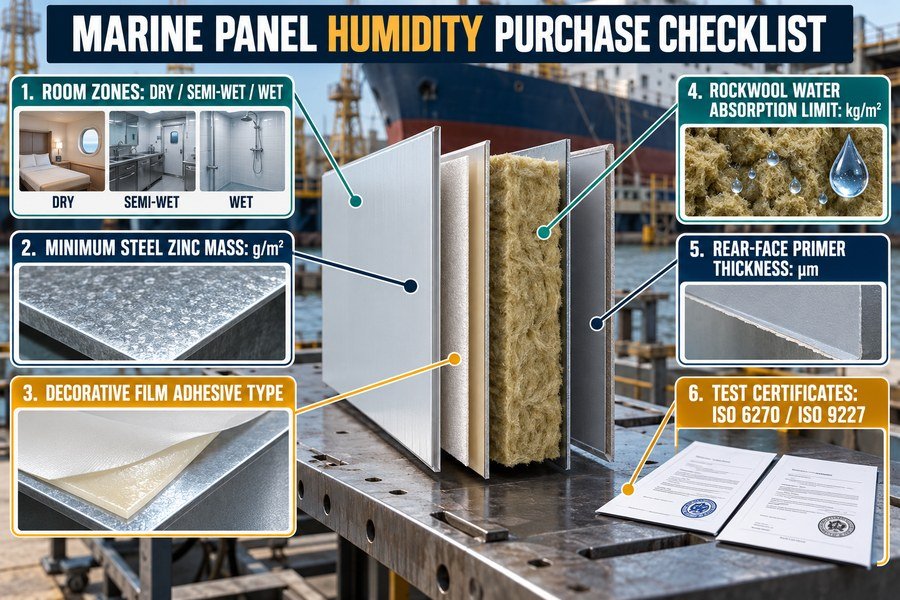
Shipyards and buyers must provide marine interior panel suppliers with six exact humidity parameters: a room-by-room Zone Schedule (Dry/Semi-Wet/Wet), minimum steel zinc mass (g/m²), decorative film adhesive type, rockwool hydrophobicity limits (kg/m²), rear-face primer thickness (µm), and required ISO 6270/ISO 9227 test certificates.
How to Translate Shipyard Humidity Specs Into Factory-Ready Purchase Numbers
I know how frustrating it is to deal with factory sales reps in Asia who do not speak strong technical English. If you copy and paste a 50-page European shipyard HVAC specification and send it to a panel factory in China or Vietnam, the sales rep will not read it. They will just quote you their cheapest standard cabin panel so they can win your order on price. Then, six months later when the panels arrive at the shipyard and fail inspection, you are stuck in the middle with delayed lead times and angry project managers.
To protect your profit margin and keep your lead time under control, you must translate the shipyard's environmental humidity conditions into hard manufacturing numbers before you ask for a price quote. Never tell a factory, "This panel goes in a room with 80% relative humidity." Instead, tell them, "For Item 4, quote 0.6 mm galvanized steel with 275 g/m² zinc coating, 2-component PU glue, 20 µm epoxy back coat, and hydrophobic rockwool with less than 1.0 kg/m² water absorption." When you give a factory exact material numbers, their purchasing department can calculate the exact raw material cost immediately, and their quality control team knows exactly what to inspect before loading the container.
Cost and Lead-Time Impact of Humidity Specification Upgrades
Upgrading panel materials for high humidity does increase your unit price and can add days to your production lead time, especially if the steel mill has to custom-roll Z275 galvanized coils or 316L stainless steel sheets. However, you do not need to upgrade every panel on the ship. Only 15% to 20% of a vessel's interior square meters fall into Semi-Wet or Wet zones.14 By separating your Bill of Quantities (BOQ) clearly by humidity zone, you keep 80% of your order at the lowest baseline price while spending small extra amounts only where moisture actually threatens the ship. Here is the exact cost and lead-time breakdown I use when helping my clients plan their budgets:
| Specification Parameter | Standard Dry Zone Spec (Baseline) | Semi-Wet Zone Upgrade Spec | Wet Zone Upgrade Spec | Unit Cost Impact ($/m²) & Lead Time Impact |
|---|---|---|---|---|
| Steel Substrate & Zinc Mass (EN 10346) | 0.6 mm GI Steel, Z120 (120 g/m²) | 0.6 mm GI Steel, Z275 (275 g/m²) | 0.7 mm AISI 304 / 316L Stainless Steel | Semi-Wet: +$1.80 to +$2.50/m² (+3 days) Wet: +$14.00 to +$22.00/m² (+7 to 10 days) |
| Decorative Surface & Adhesive | 150 µm PVC Film + Standard Acrylic Glue | 150 µm PVC Film + 2-Part PU Glue (ISO 8510-2 ≥ 2.5 N/mm) | 25 µm PVDF Coating or Brushed Stainless | Semi-Wet: +$0.80 to +$1.20/m² (No delay) Wet: Included in SS/PVDF coil price |
| Rockwool Core Hydrophobicity (EN 1609) | Standard Marine Rockwool (≤ 2.0 kg/m²) | Hydrophobic Rockwool (≤ 1.0 kg/m² water absorption) | Hydrophobic Rockwool (≤ 0.5 kg/m²) + Sealed Edges | Semi-Wet: +$1.00 to +$1.50/m² (No delay) Wet: +$2.00 to +$3.00/m² (+2 days) |
| Rear Cavity Primer Coating (ISO 9227) | 5 µm Wash Primer (100h Salt Spray) | 20 µm Epoxy/Polyester Backer (250h Salt Spray) | 25 µm Epoxy/PVDF Backer or Bare 304/316L SS | Semi-Wet: +$0.90 to +$1.40/m² (+2 days) Wet: +$1.50/m² (if painted GI) |
| Factory Humidity & Condensation Testing | Mill Certificate + IMO FTPC Fire Certs only | Batch Test per ISO 6270-2 (120h at +40°C, 100% RH) | Batch Test per ISO 6270-2 (240h) + ISO 846 Mold Test | Testing Fee: $400 to $800 per project batch (+5 to 10 days for lab report) |
Conclusion
Defining shipboard humidity conditions through clear zone schedules, ISO 7547 baselines, cavity coatings, and exact factory material numbers prevents panel delamination, eliminates warranty claims, and keeps your outfitting budget profitable.
-
"When Do Marine Wet Areas Require Accommodation Panels ...", https://magellanmarinetech.com/when-marine-wet-areas-require-accommodation-panels-with-built-in-moisture-hygiene-function/. DNV ship-classification and accommodation/habitability rules distinguish accommodation spaces by environmental exposure and service conditions, providing contextual support for treating dry and moisture-prone rooms differently in specification documents. Evidence role: historical_context; source type: institution. Supports: Marine accommodation specifications should distinguish dry spaces from spaces exposed to higher moisture when selecting bulkhead panel materials.. Scope note: The source may support environmental differentiation of shipboard spaces without using the article’s exact Dry/Semi-Wet/Wet terminology or prescribing the same thresholds. ↩
-
"ERGONOMIC & SAFETY DISCUSSION PAPER", http://maritime.lamar.edu/joomla2025/index.php/ergonomics?download=47:edp-habitability-and-comfort-no-8. Marine habitability and indoor-environment guidance commonly specifies moderate relative-humidity ranges for occupied accommodation spaces, supporting the use of a controlled low-to-moderate humidity band for cabins and similar rooms. Evidence role: statistic; source type: institution. Supports: Dry marine accommodation spaces are generally maintained within a moderate relative-humidity range by HVAC systems.. Scope note: Such sources usually provide comfort or habitability design ranges and may not prove that every vessel maintains exactly 30–65% RH in all dry accommodation zones. ↩
-
"INDOOR HUMIDITY LEVELS AND ASSOCIATIONS WITH ...", https://pmc.ncbi.nlm.nih.gov/articles/PMC10924614/. Indoor-environment guidance from building or HVAC institutions commonly treats moderate relative humidity ranges as operational comfort and materials-control ranges, which contextualizes a 45%–65% procurement envelope; such sources do not prove that this exact range is mandated for marine interior panels. Evidence role: expert_consensus; source type: institution. Supports: A 50% RH HVAC design point can be translated into a broader operational humidity range, such as 45%–65% RH, for procurement and material performance purposes.. Scope note: Support is contextual unless a marine-specific procurement standard or class guideline states the same operating window. ↩
-
"(PDF) Effect of moisture on the adhesion of CFRP-to-steel ...", https://www.academia.edu/43336016/Effect_of_moisture_on_the_adhesion_of_CFRP_to_steel_bonded_joints_using_peel_tests. Studies of adhesive joints and laminated composites report that heat and moisture exposure can reduce peel or bond strength through plasticization, hydrolysis, or interfacial weakening; this supports the mechanism but may not directly test 65% RH at +27°C on PVC-film-to-steel marine panels. Evidence role: mechanism; source type: paper. Supports: Sustained heat and humidity can soften or weaken adhesive bond lines in laminated panel constructions.. Scope note: The exact humidity, temperature, adhesive chemistry, and substrate combination may differ from the article’s marine panel example. ↩
-
"Some aspects of the polymers' electrostatic charging effects", https://www.academia.edu/55318225/Some_aspects_of_the_polymers_electrostatic_charging_effects. Electrostatic-control literature explains that lower relative humidity increases charge retention on insulating synthetic materials, supporting the link between dry indoor air and static buildup; it does not by itself establish passenger-vessel comfort compliance thresholds. Evidence role: mechanism; source type: research. Supports: Low relative humidity promotes static electricity buildup on synthetic wall or polymer surfaces.. Scope note: The source would support the physical mechanism, while comfort-standard implications require a separate marine accommodation or human-factors standard. ↩
-
"Association of COVID-19 pandemic with meteorological ... - PMC", https://pmc.ncbi.nlm.nih.gov/articles/PMC7289735/. Meteorological climate normals for Singapore and Jakarta document tropical temperature and humidity conditions consistent with high relative humidity and daytime temperatures in this range, providing contextual support for the environmental exposure assumed here. Evidence role: statistic; source type: government. Supports: Tropical port conditions in Singapore or Jakarta can involve 85% to 95% relative humidity at approximately +32°C to +35°C.. Scope note: Climate normals support the plausibility of the outdoor conditions, but they do not prove that a specific cabin will reach these levels within four hours. ↩
-
"A Field Study of Indoor Moisture Problems and Damage in ...", https://web.ornl.gov/sci/buildings/conf-archive/1992%20B5%20papers/073.pdf. Studies of residential bathroom ventilation and shower-generated moisture show that showering can produce near-saturation indoor air and sharp short-term increases in relative humidity, supporting the plausibility of very high transient humidity at a bathroom doorway. Evidence role: general_support; source type: paper. Supports: A hot shower can generate near-saturated air that briefly enters adjacent spaces when the bathroom door is opened.. Scope note: Most available studies are from buildings rather than ship cabins, so they support the moisture mechanism rather than the exact 98% value in this setting. ↩
-
"A warm pool in the Indo-Pacific Ocean has almost doubled in ...", https://www.climate.gov/news-features/featured-images/warm-pool-indo-pacific-ocean-has-almost-doubled-size-changing-global. Sea-surface-temperature records from an oceanographic or meteorological institution document that ship operating areas can include temperate/cold waters near 5–10°C and tropical warm pools approaching about 32°C; this supports the environmental-temperature context rather than the temperature of any specific hull on a specific voyage. Evidence role: statistic; source type: government. Supports: Ships may encounter seawater temperatures ranging from roughly +5°C to +10°C in cold waters and around +32°C in tropical waters.. Scope note: The source would support plausible seawater temperature ranges, not the exact temperatures encountered by every vessel or route. ↩
-
"Heat Index | National Oceanic and Atmospheric ...", https://www.noaa.gov/jetstream/synoptic/heat-index. A psychrometric reference explains that cooling moist air at constant water-vapor content raises relative humidity and can bring air to saturation at the dew point; this supports the condensation mechanism, although the exact 85%–100% RH range depends on the initial cabin humidity, leakage rate, and surface temperature. Evidence role: mechanism; source type: education. Supports: Warm moist cabin air entering a colder cavity can rise to very high relative humidity or saturation near cold hull plates or chilled-water pipes.. Scope note: Supports the mechanism of RH increase and saturation, not the exact RH values inside the described panel cavity without measurements or modeling. ↩
-
"Moisture control and ventilation - NCBI - NIH", https://www.ncbi.nlm.nih.gov/books/NBK143947/. Building-physics literature on enclosed cavities and ventilation shows that restricted air exchange reduces drying potential and can sustain elevated moisture levels; this supports the drying-risk claim, though the word “never” is stronger than what general evidence can prove for all installations. Evidence role: mechanism; source type: research. Supports: Moisture trapped in unventilated or poorly ventilated panel cavities has limited drying potential and may persist.. Scope note: General moisture-transport evidence supports reduced drying in stagnant cavities, but site-specific drying depends on leakage, temperature gradients, materials, and intermittent ventilation. ↩
-
"DoD 2013-3557", https://www.waru.edu/sites/default/files/Migrated/CopDocuments/Examination%20of%20Zinc%20Galvanized%20Steel%20Corrosion%20Rates%20in%20Various%20Atmospheric%20and%20Soil%20Exposure%20Conditions.pdf. Corrosion-rate classifications for zinc in humid or marine atmospheres show that thin zinc coatings can be consumed rapidly under high-corrosivity conditions; this provides contextual support for accelerated failure of Z120 galvanized steel, but does not by itself verify an 18-month service life for every ship cavity. Evidence role: general_support; source type: institution. Supports: Unpainted Z120 galvanized steel can have a short service life in humid, chloride-influenced marine cavities.. Scope note: The exact 18-month timeframe requires field data or a corrosion calculation using the actual coating thickness, chloride exposure, wetness time, and cavity humidity. ↩
-
"Comparative Climatic Data (CCD)", https://www.ncei.noaa.gov/products/land-based-station/comparative-climatic-data. Meteorological data from national weather services, WMO materials, or peer-reviewed climate studies can document that tropical and Gulf-region maritime climates may combine very high air temperatures with high humidity during monsoon or summer periods. Evidence role: statistic; source type: government. Supports: Outdoor ambient air in West Africa, Southeast Asia, or the Persian Gulf can reach +45°C with 80% to 90% relative humidity during monsoon-season or comparable hot-humid conditions.. Scope note: Regional climate sources may support the plausibility of these extremes but may not establish that all listed operating areas simultaneously reach +45°C and 80%–90% RH. ↩
-
"International Code for Ships Operating in Polar Waters", https://en.wikipedia.org/wiki/International_Code_for_Ships_Operating_in_Polar_Waters. The IMO Polar Code establishes mandatory safety and pollution-prevention requirements for ships operating in polar waters, providing regulatory context for vessels such as ice-class cruise ships and service vessels in polar routes. Evidence role: historical_context; source type: institution. Supports: Icebreakers, polar expedition cruise vessels, and certain high-latitude service vessels may operate under the IMO Polar Code when sailing in polar waters.. Scope note: The source supports the Polar Code’s scope for polar waters, but whether a specific North Sea offshore wind service vessel falls under it depends on its actual operating area. ↩
-
"When Do Marine Wet Areas Require Accommodation Panels ...", https://magellanmarinetech.com/when-marine-wet-areas-require-accommodation-panels-with-built-in-moisture-hygiene-function/. A ship-accommodation planning or naval-architecture source can contextualize which accommodation spaces are normally treated as sanitary, galley, laundry, or other moisture-prone areas; this supports the zoning logic but may not directly verify the 15%–20% area share for all vessel types. Evidence role: statistic; source type: education. Supports: Only 15% to 20% of a vessel's interior square meters fall into Semi-Wet or Wet zones.. Scope note: The percentage is likely project- and vessel-type-specific, so neutral sources may support the category distribution rather than the exact range. ↩