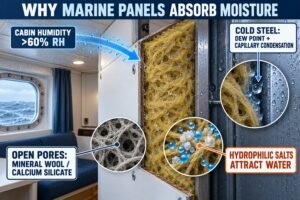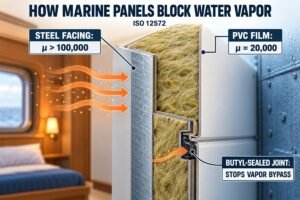
Buying identical panels for every ship deck causes costly moisture damage. Rusted steel and peeling PVC ruin your shipyard handover. Matching panels to hull zones prevents failure.
Hull position controls marine panel humidity across four zones: below-waterline spaces (70% to 95% RH from bilge moisture and cold seawater), exterior bulkheads (15°C to 40°C thermal gradients causing cavity sweat), weather deck overheads (solar-to-night cooling cycles), and inboard cabins (stable 40% to 60% RH per ISO 7547).
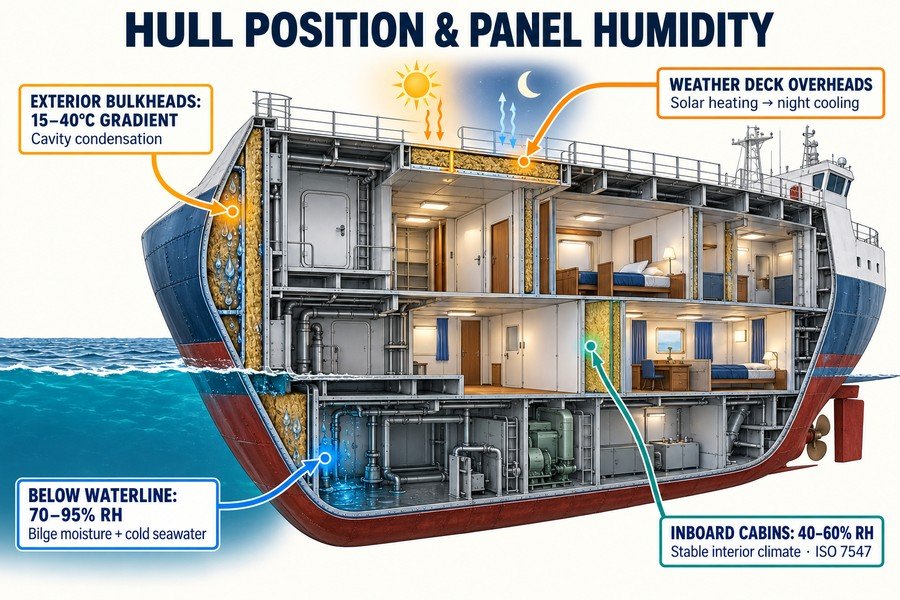
Many procurement managers order the exact same rockwool wall panel for the entire vessel to get a bulk factory discount. I saw a European cruise retrofit contractor lose $45,000 because their standard lower-deck panels blistered and rusted within eight months of delivery. The shipyard forced the contractor to rip out 1,200 square meters of lining panels at their own expense. You can avoid this expensive mistake when you understand how each hull zone attacks your panels and how to buy the exact right specification for every deck.
Why Do Marine Interior Panels in Below-Waterline Spaces Face Persistently Higher Humidity?
Peeling PVC film and wet rockwool in lower decks destroy your project profit. Replacing swollen panels delays ship delivery. Understanding lower-deck moisture traps helps you buy right.
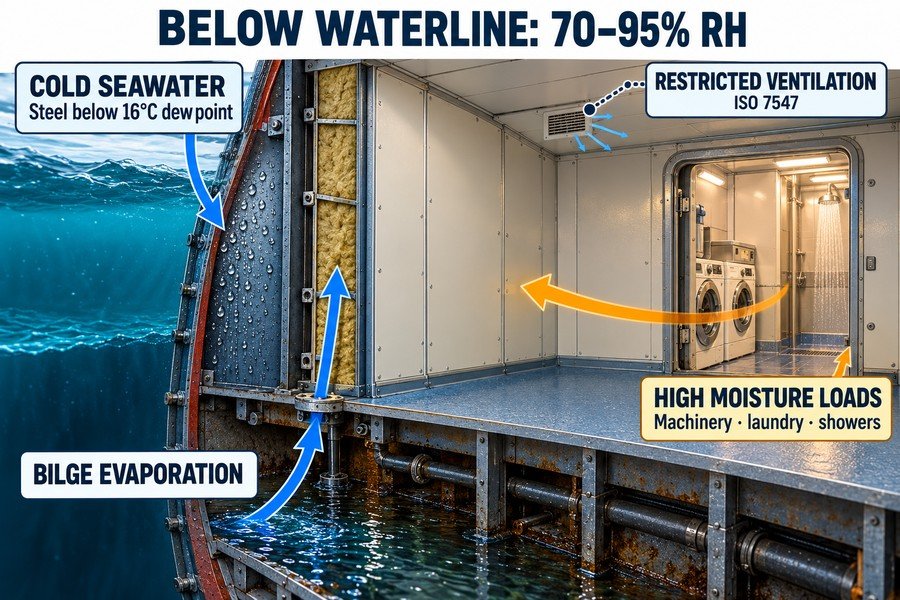
Below-waterline marine panels face 70% to 95% relative humidity due to four factors: cold seawater cooling steel plating below the 16°C dew point, bilge water evaporation, restricted natural ventilation under ISO 7547, and high latent moisture loads from machinery spaces, wet laundries, and crew showers.
Seawater Cooling and Bilge Evaporation in Below-Waterline Hull Zones
When I worked on the factory floor before joining Magellan Marine, I inspected hundreds of corroded B-15 wall panels returned from lower crew quarters. Below the waterline, the outer steel hull touches seawater all day and all night. According to DNV Rules for Classification of Ships, seawater temperatures often sit between 2°C and 15°C in temperate and northern shipping lanes1. This cold water pulls heat straight out of the 10 mm to 16 mm steel hull plate. The inner steel surface drops well below the 16°C dew point of the warm cabin air. At the same time, water collects in the bilge wells below the tank top deck. Warm air from the engine room heats this bilge water. The water evaporates and rises through cable penetrations, pipe trunks, and floor plates. Even a small unsealed gap lets damp bilge vapor push humidity behind your bottom panel tracks up to 90% RH. Standard galvanized steel tracks with only 80 g/m² of zinc will show white rust within three weeks and red rust within three months under these damp conditions.
Restricted Ventilation and Machinery Latent Loads in Lower Decks
Air movement below the waterline is completely artificial. Above the waterline, crew members open exterior doors, and wind moves across the superstructure. Below the waterline, SOLAS Chapter II-2 watertight integrity rules ban hull openings. The space relies 100% on mechanical HVAC ducts designed under ISO 7547 standards. ISO 7547 specifies a minimum outdoor air supply of 0.008 m³/s per person, but lower-deck dead corners behind lockers and lining cavities get almost zero airflow. Furthermore, ship designers pack high-humidity rooms into the lower decks to save prime upper-deck space for passengers. You will find the main ship laundry, drying rooms, crew communal showers, sculleries, and auxiliary machinery spaces right next to lower crew cabins. A single commercial marine washing extractor releases 1.5 kg to 3.0 kg of water vapor per hour into the corridor air. When crew members open laundry or shower doors, this wet air floods the passageway and pushes relative humidity to 85% or 95%. If you install standard non-hydrophobic rockwool panels here, the core acts like a sponge and rots from the bottom up.
| Below-Waterline Humidity Factor | Typical Measured Value | Authoritative Standard / Reference | Direct Impact on Marine Interior Panels |
|---|---|---|---|
| Cold Seawater Hull Cooling | 2°C to 15°C hull plate temp (below 16°C dew point) | DNV Ship Rules Pt.3 / ISO 7547 | Continuous condensation on the back steel sheet of lining panels |
| Bilge Water Evaporation | 75% to 90% RH at bottom C-channel floor track | SOLAS Chapter II-1 Bilge Systems | Bottom 150 mm of panel steel rusts and rockwool wicks water upward |
| Restricted Natural Ventilation | Less than 0.05 m/s air velocity in wall cavities | ISO 7547 Marine HVAC Design | Trapped moisture cannot dry out; mold grows behind decorative PVC film |
| Machinery & Wet Room Latent Loads | 80% to 95% RH spikes near laundries and showers | ASHRAE Standard 26 (Marine) | Delamination of standard water-based PVC glue within 6 to 12 months |
How Does Cold Hull Plating Raise Condensation Risk Behind Marine Lining Panels?
Hidden water dripping behind cabin walls rots insulation before anyone sees a stain. Shipyard inspectors reject cabins with wet rockwool. Understanding steel dew points helps you stop hidden condensation.
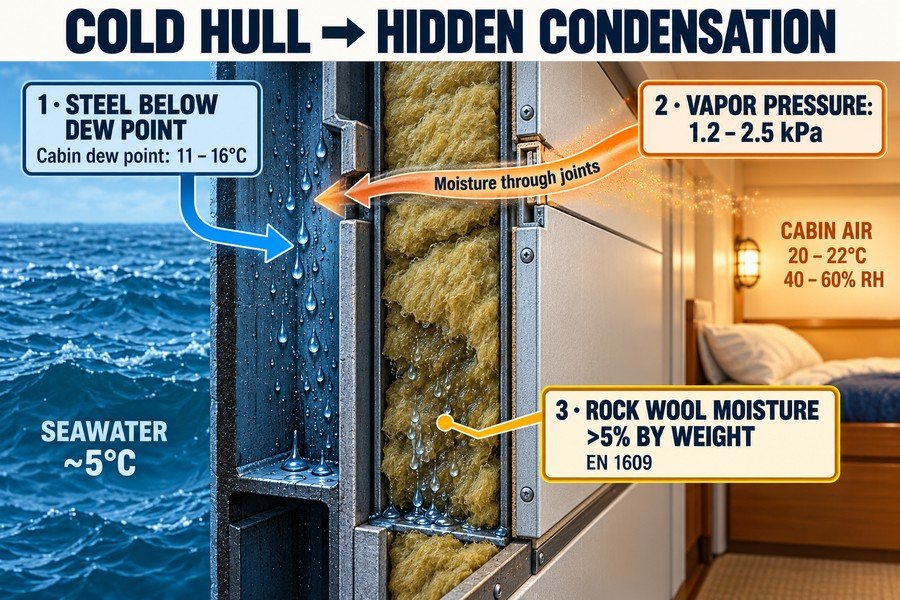
Cold hull plating raises condensation risk through three mechanisms: dropping steel temperatures below the cabin air dew point (11°C to 16°C), driving warm cabin moisture through panel joints via vapor pressure differentials (1.2 to 2.5 kPa), and saturating rockwool insulation above 5% moisture by weight per EN 1609.
Dew Point Drops and Vapor Pressure Movement Behind Marine Lining Panels
Many buyers think condensation only happens when a pipe leaks. In reality, the air inside a comfortable cabin holds enough water to flood your wall cavity. According to ISO 7547 indoor design conditions, a ship cabin is kept at 22°C with 50% to 60% relative humidity. Psychrometric charts from ASHRAE Standard 26 show that air at 22°C and 50% RH has a dew point of 11.1°C2. If two crew members sleep and breathe in that cabin, the humidity rises to 65% RH, and the dew point climbs to 15.2°C. Whenever the ship sails through water or air colder than 15°C, the bare hull steel and the cold face of the structural A-60 hull insulation drop below this 11°C to 16°C dew point threshold. Worse still, physics forces cabin moisture straight toward that cold steel. Warm air at 22°C and 60% RH has a water vapor pressure of about 1.59 kPa.3 Cold air trapped against 5°C hull steel has a saturation vapor pressure of only 0.87 kPa. In winter vs. tropical setups, this vapor pressure differential reaches 1.2 kPa to 2.5 kPa. This pressure pushes water vapor through every tiny 0.5 mm gap in your tongue-and-groove panel joints and electrical socket cutouts.4
Mineral Wool Saturation and Thermal Conductivity Loss in Cavity Spaces
Once water vapor passes through the panel joints and hits the cold steel or cold hull insulation, it turns into liquid water droplets. Last year, I helped a client inspect an offshore accommodation vessel in northern Europe. They used cheap rockwool lining panels without an aluminum foil vapor barrier. When we pulled one 550 mm wide lining panel off the bulkhead, nearly two liters of brown water poured out of the bottom track. Under EN 1609 testing standards, high-grade marine hydrophobic rockwool must absorb less than 1.0 kg/m² of water. However, when low-grade rockwool sits against sweating hull steel for months, moisture content rises above 5% by weight. According to ISO 8301 thermal conductivity measurements, dry marine rockwool has a thermal conductivity measurements, dry marine rockwool has a thermal conductivity (λ) of 0.035 to 0.038 W/(m·K). When that rockwool absorbs just 5% moisture by weight, its thermal conductivity jumps to 0.055 W/(m·K) or higher.5 Wet insulation loses 40% of its insulating power. This makes the inside face of your lining panel cold too, so condensation starts forming right inside the cabin on the decorative PVC surface.
| Hull Steel Temperature | Cabin Air Condition (ISO 7547) | Dew Point Threshold | Vapor Pressure Differential | Resulting Damage Behind Marine Lining Panels |
|---|---|---|---|---|
| 18°C (Tropical Sea) | 22°C at 50% RH | 11.1°C | 0.25 kPa | Safe zone; steel stays above dew point, cavity stays dry |
| 12°C (Temperate Sea) | 22°C at 65% RH (Occupied) | 15.2°C | 1.20 kPa | Mild sweating on hull frames; 0.15 L/m² moisture accumulation per week |
| 5°C (North Sea / Baltic) | 22°C at 60% RH | 13.9°C | 1.65 kPa | Heavy condensation; rockwool exceeds 5% moisture weight per EN 1609 |
| -10°C (Arctic Winter Air) | 22°C at 55% RH | 12.5°C | 2.50 kPa | Frost and ice buildup behind panels; rapid steel rust when ice melts |
What Moisture and Thermal Loads Hit Marine Wall Panels on Exterior Bulkheads?
Exterior bulkhead panels warp and peel when ships sail from freezing ports to tropical seas. Failed glue ruins your shipyard reputation. Knowing exact exterior loads protects your purchasing budget.
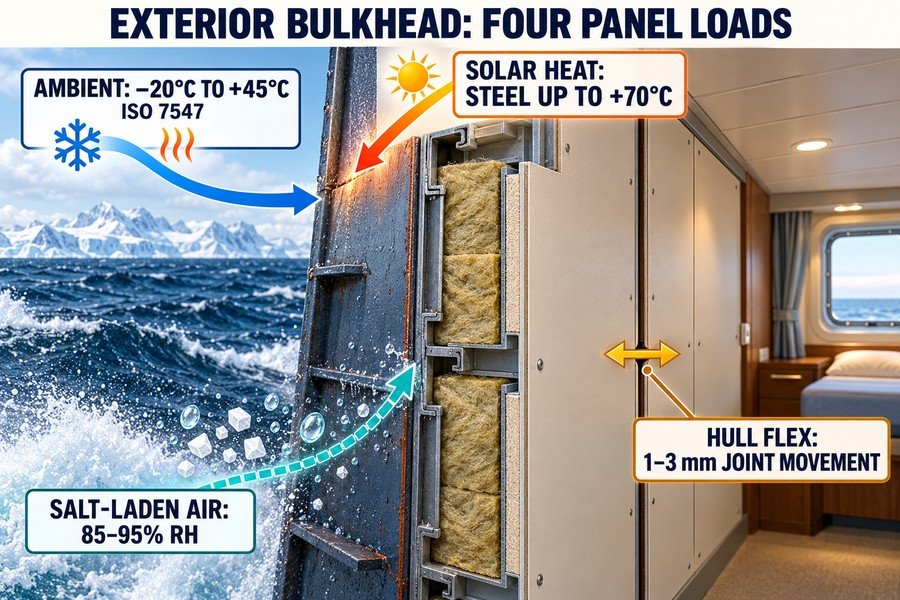
Marine wall panels on exterior bulkheads endure four primary loads: extreme ambient temperature swings (-20°C winter air to +45°C tropical heat per ISO 7547), solar radiation heating hull steel to +70°C, 85% to 95% salt-laden marine humidity, and cyclic hull flexing opening 1 mm to 3 mm joint gaps.
Extreme Ambient Temperature Swings and Solar Heat Gain on Exterior Bulkheads
Lining panels mounted against exterior superstructure bulkheads face brutal thermal stress compared to land buildings. A land hotel stays in one climate zone forever, but an ocean-going vessel crosses from northern Europe to Southeast Asia in three weeks. Under ISO 7547 design standards, exterior marine structures must handle winter outdoor air down to -20°C (and -30°C for polar vessels under the IMO Polar Code) and summer outdoor air up to +45°C. Furthermore, direct sunlight hits the exterior steel bulkhead all day. Dark-painted hull and superstructure steel absorbs intense solar radiation. Measurements recorded under ISO 7547 show that sun-baked exterior steel plates easily reach +65°C to +70°C6, while the air-conditioned cabin on the other side of the wall sits at +22°C. This creates a massive 48°C temperature difference across a 200 mm bulkhead cavity. Two years ago, a client bought cheap lining panels made with single-component water-based adhesive instead of two-component polyurethane glue. When the ship docked in Singapore and the bulkhead cavity hit 52°C, the glue softened and failed. Over 80 panels developed ugly air bubbles under the 150-micron PVC film, and the adhesive failed IMO FTPC Part 5 surface flammability stability checks during repair audits.
Salt-Laden Marine Humidity and Hull Flexing Stress on Panel Joints
Temperature is only half the problem on perimeter walls. Open ocean air carries 85% to 95% relative humidity loaded with sodium chloride aerosols.7 Whenever exterior bridge wing doors, pilot doors, or balcony doors open, salt-laden humid air rushes against the perimeter lining panels. Salt crystals settle inside panel micro-scratches and joint profiles. Salt is hygroscopic, which means it pulls moisture out of the air even when relative humidity drops to 75%.8 Under ISO 9227 neutral salt spray test benchmarks, unsealed panel cut edges corrode three times faster in marine salt air than in fresh water. In addition, a ship hull is not a rigid concrete box. When a vessel sails through 4-meter to 6-meter ocean swells, the steel hull girders bend and twist.9 DNV structural deflection guidelines allow local bulkhead stiffener deflections of L/200 to L/350. This continuous hull flexing forces the perimeter lining panels to shift against each other. Standard tongue-and-groove joints experience 1 mm to 3 mm of cyclic movement. This movement breaks brittle silicone seals and opens direct pathways for hot, salty moisture to penetrate behind the wall panels.
| Exterior Bulkhead Load Type | Engineering Value / Range | Governing Marine Standard | Effect on Exterior Wall Panel Assembly |
|---|---|---|---|
| Ambient Air Swings | -20°C winter to +45°C summer | ISO 7547 / IMO Polar Code | Thermal expansion/contraction of 0.6 mm per meter of steel panel10 |
| Solar Radiation Heat Gain | +65°C to +70°C on outer steel plate | ISO 7547 Solar Load Tables | Cavity heats above 50°C; weakens low-grade PVC adhesives |
| Salt-Laden Marine Humidity | 85% to 95% RH with NaCl aerosols | ISO 9227 Salt Spray Standard | Aggressive edge corrosion on cut galvanized sheets below Z180 rating |
| Cyclic Hull Flexing | 1 mm to 3 mm joint gap movement | DNV Hull Structural Rules | Cracks rigid sealants and pumps moist cabin air into the cold cavity |
Why Do Marine Ceiling Panels Directly Below Weather Decks Face Severe Condensation?
Brown rust water dripping from ceiling panels stains cabin carpets and beds. Fixing ceiling leaks costs thousands of dollars. You can prevent overhead drips by addressing deckhead physics.
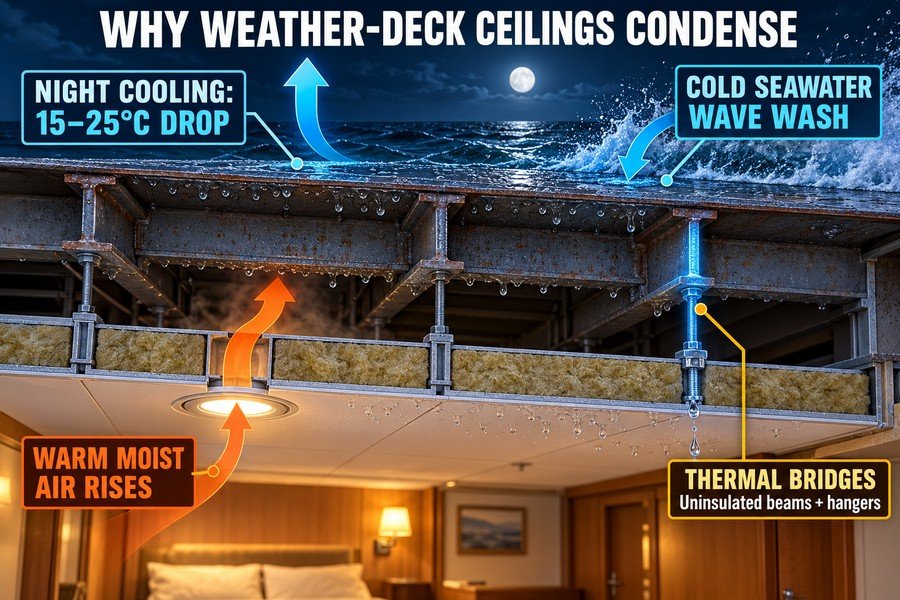
Marine ceiling panels below weather decks suffer severe condensation from four causes: rising warm moist cabin air pooling at the deckhead, nighttime radiative cooling chilling deck steel by 15°C to 25°C, cold seawater wave wash over the deck, and thermal bridging through uninsulated steel deck beams and hangers.
Rising Warm Air Pooling and Rapid Deck Cooling from Night Skies and Wave Wash
If you ask any ship repair superintendent which panels fail first on an upper deck, they will point straight at the ceiling panels below the exposed weather deck. First, warm and humid air inside a cabin is lighter than cool, dry air11. Warm air from human breathing, hot coffee makers, and open bathroom doors rises to the top of the cabin. It pushes straight through the recessed LED light cutouts, speaker grilles, and perimeter shadow gaps of your B-0 or B-15 ceiling panels. This creates a warm, damp air pocket in the plenum space right under the steel weather deck, often sitting at 26°C and 65% RH12. Second, the exposed steel weather deck above that plenum faces rapid nighttime radiative cooling. During the day, the sun heats the open steel deck to +55°C. At night under a clear sky, the steel deck radiates heat straight into space and drops by 15°C to 25°C within three hours13. Third, when the ship hits rough weather, cold green seawater washes right across the main weather deck and forecastle deck. A wave of 8°C seawater shocks the steel deck plate instantly. All the warm moisture pooled above your ceiling panels condenses into heavy water drops across the underside of the deck.
Thermal Bridging Across Steel Deck Beams and Ceiling Suspension Hangers
Even when the shipyard installs A-60 mineral wool insulation pins onto the underside of the weather deck per SOLAS Chapter II-2, condensation still attacks the ceiling panels through thermal bridges. A steel weather deck has deep longitudinal and transverse steel T-beams welded every 600 mm to 800 mm for strength. Insulation installers often leave the bottom flanges of these T-beams poorly wrapped, or they weld bare steel threaded rods (M8 or M10 ceiling hangers) directly onto the cold steel deck beams. Because steel has a high thermal conductivity of 50 W/(m·K), cold temperatures travel straight down those steel deck beams and threaded hanger rods into the warm ceiling plenum. Water condenses along the steel hangers and runs right down onto the top of your B-15 ceiling panels. I once visited a Ro-Pax ferry in Europe where the crew complained about a "roof leak" in twelve top-deck cabins. The weather deck had zero welds cracked. Instead, uninsulated M8 ceiling hanger rods were dripping 0.5 liters of condensation water per day onto the 300 mm wide ceiling planks, rusting the panel edges and soaking the 40 mm rockwool infill.
| Weather Deck Overhead Cause | Physical Mechanism & Value | Authoritative Reference | Consequence for Marine Ceiling Panels |
|---|---|---|---|
| Rising Moist Cabin Air | Buoyant air pools at 25°C to 27°C and 65% RH in plenum | ASHRAE Standard 26 Psychrometrics | Vapor enters ceiling plenum via IP20 light fixtures and panel joints |
| Nighttime Radiative Cooling | Deck steel drops 15°C to 25°C in 3 hours after sunset | ISO 7547 / WMO Marine Data | Rapid dew point crossover creates sheets of water above ceiling panels |
| Green-Water Wave Wash | 5°C to 12°C seawater floods exposed weather deck | IMO Load Line Convention | Instant thermal shock causes heavy rain-like dripping inside plenum |
| Deck Beam & Hanger Bridging | Steel conducts cold at 50 W/(m·K) down M8/M10 rods | SOLAS II-2 / ISO 8301 | Water runs down hanger rods and pools on top of B-15 ceiling planks |
Why Do Inboard Marine Bulkhead Panels Face Steadier Humidity Than Perimeter Panels?
Buying expensive waterproof panels for inside corridors wastes 30% of your material budget. Smart buyers save money on inboard walls. Understanding internal cabin climates helps you cut costs safely.
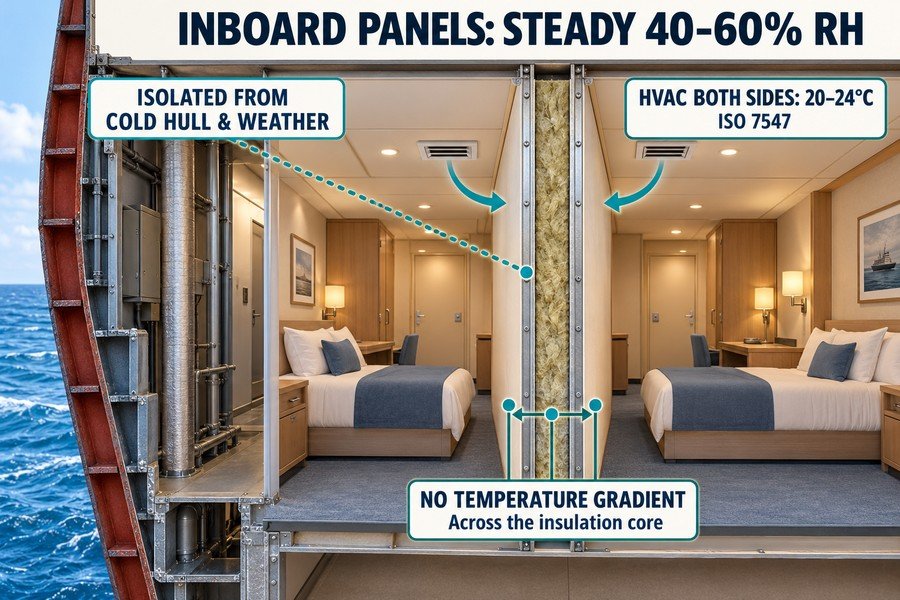
Inboard marine bulkhead panels experience steady 40% to 60% relative humidity due to three stabilizing factors: complete isolation from cold seawater and weather steel, continuous HVAC climate control maintaining 20°C to 24°C on both panel sides per ISO 7547, and zero temperature gradients across the insulation core.
Isolation from Hull Steel and Balanced HVAC Climates on Inboard Partitions
As a procurement officer, you want high quality where the ship needs it, and low prices where the risk is low. Inboard bulkhead panels—the partition walls between two dry passenger cabins, or between an inside cabin and an interior corridor—sit in the safest zone on the vessel. First, these inboard panels are completely isolated from the exterior steel hull and the exposed weather decks. A minimum of 1.5 meters to 6 meters of climate-controlled cabin space separates an inboard partition from the cold outer hull shell. Neither seawater thermal shock nor solar heat radiation ever touches an inboard panel. Second, both sides of an inboard partition wall are served by the ship's central air-conditioning system. According to ISO 7547 marine HVAC regulations, accommodation supply air is dehumidified at the central air handling unit (AHU) cooling coil and delivered to maintain cabin and corridor temperatures between 20°C and 24°C year-round, with relative humidity locked between 40% and 60% RH14. Even when the ship sails through a tropical monsoon at 95% outdoor humidity, the inboard corridor and cabin partitions remain dry and stable.
Zero Thermal Gradients and Cost Savings on Inboard B-15 and C-Class Panels
The third stabilizing factor is the complete absence of a temperature gradient across the panel core. When Cabin A is at 22°C and Cabin B next door is at 21°C, the temperature difference (ΔT) across the 50 mm B-15 partition panel is only 1°C. Because both faces of the panel sit at 21°C to 22°C, and the room dew point sits Down at 11°C to 12°C15, the temperature inside the rockwool core never gets anywhere near the dew point. Vapor pressure on both sides of the wall is equal at roughly 1.3 kPa, so zero moisture is pushed into the panel joints.16 Last year, I reviewed a purchasing list for an Asian interior contractor outfitting a 150-meter European river and coastal vessel. Their engineer had specified expensive Z275 galvanized steel and aluminum vapor barriers for all 4,500 square meters of wall panels. I showed the procurement manager that 2,800 square meters were dry inboard partitions. By switching those inboard walls to standard Z140 galvanized steel with standard 140 kg/m³ rockwool ($22 per square meter instead of $29 per square meter), my client saved $19,600 on one single order while still passing every DNV and SOLAS B-15 fire inspection on the first try.
| Comparison Parameter | Inboard Dry Bulkhead Panels | Exterior Perimeter Lining Panels | Authoritative Standard |
|---|---|---|---|
| Proximity to Seawater / Weather | Isolated by 1.5 m to 6.0 m of conditioned space | Mounted 50 mm to 200 mm from outer hull steel | SOLAS Chapter II-2 Arrangement |
| Surrounding Air Temperature | 20°C to 24°C on both sides of the panel | 22°C cabin side vs. -20°C to +70°C hull side | ISO 7547 HVAC Standard |
| Thermal Gradient (ΔT) | 0°C to 2°C across panel thickness | 15°C to 48°C across bulkhead assembly | ISO 8301 Thermal Calculation |
| Relative Humidity Exposure | Steady 40% to 60% RH year-round | 70% to 95% RH in cavity with condensation | ASHRAE Standard 26 |
| Typical FOB China Price (B-15) | $20 to $25 per m² (Standard Z140 spec) | $28 to $38 per m² (Z275 + Vapor Barrier spec) | Magellan Marine Factory Data |
How Do Marine Interior Panel Specifications Vary by Hull and Deck Location?
Ordering the wrong zinc coating or core material causes failed shipyard inspections. Fixing wrong orders ruins your lead time. Exact location specifications help you purchase panels accurately.
Marine interior panel specifications vary across four hull zones by adjusting five parameters: galvanized steel coating weight (Z140 to Z275 per EN 10346), surface finish (150-micron PVC film, PET, or 304/316L stainless steel), core material (140 kg/m³ hydrophobic rockwool or calcium silicate), vapor barriers, and B-0/B-15 fire ratings.
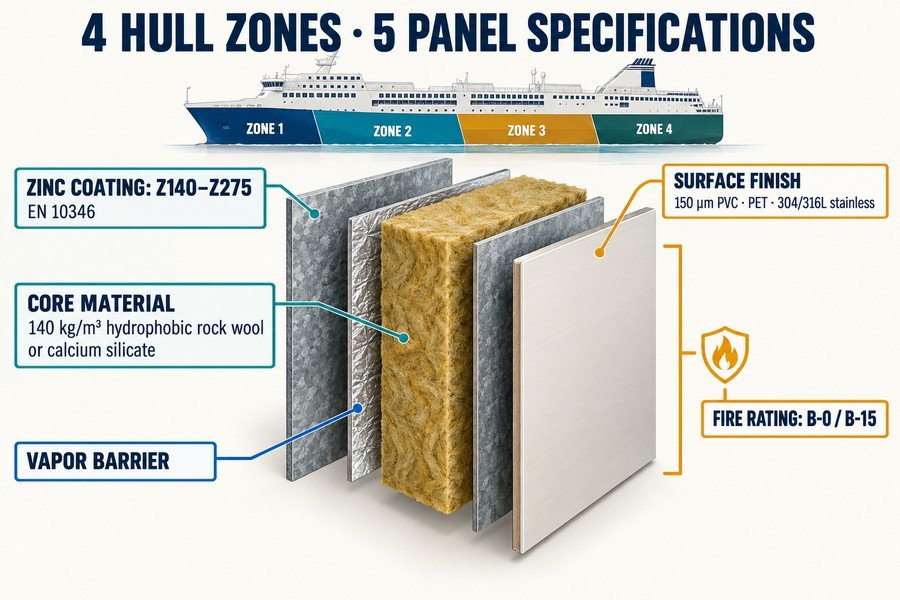
Steel Galvanization Weights, Surface Finishes, and Vapor Barriers by Hull Zone
When you send an inquiry to a Chinese or Vietnamese marine outfitting factory, you cannot just write "50 mm B-15 Marine Wall Panel." Many local sales reps do not speak strong technical English, so they will quote their cheapest standard workshop specification to win your order. You must specify the five parameters across all four hull locations yourself. First, look at the galvanized steel substrate under EN 10346 standards. For dry inboard partitions, a 0.6 mm galvanized steel sheet with a Z140 coating (140 g/m² total zinc on both sides) is completely sufficient. However, for below-waterline spaces, exterior perimeter linings, and weather deck overheads, you must specify Z275 galvanized steel (275 g/m² zinc coating, equal to about 20 microns per side) to stop red rust. Second, match the decorative surface finish to the moisture level. Standard 120-micron to 150-micron marine PVC film bonded with two-component polyurethane glue works well for exterior perimeter walls, weather deck ceilings, and inboard cabins, provided it holds IMO 2010 FTP Code Part 5 (Low Flame Spread) and Part 2 (Smoke and Toxicity) MED Module B+D certificates. For below-waterline wet spaces like galleys, laundries, and showers, upgrade the surface to 0.6 mm SUS 304 or SUS 316L brushed stainless steel or anti-bacterial PET film. Third, for exterior perimeter linings and weather deck ceilings in cold-water vessels, tell the factory to laminate a 50-micron aluminum foil vapor barrier onto the unexposed back sheet of the panel to block moisture migration17.
Core Material Densities and Fire Ratings for Perimeter, Wet, and Inboard Spaces
The fourth and fifth parameters are the insulation core material and the SOLAS fire rating. Under SOLAS Chapter II-2 and the IMO 2010 FTP Code Part 3, lining panels and cabin partitions require B-15 fire ratings (50 mm thickness) or B-0 fire ratings (25 mm thickness for linings and ceilings)18. For inboard dry partitions, standard marine rockwool with a density of 120 kg/m³ to 140 kg/m³ works great and keeps the panel weight around 16.5 kg/m². However, for exterior perimeter linings and weather deck overheads, you must require hydrophobic (water-repellent) rockwool at 140 kg/m³ to 150 kg/m³ density tested under EN 1609, with a water absorption rate under 1.0 kg/m² and a water repellency rate above 98%. For extreme wet zones in below-waterline laundries or sanitary modules, you can also specify non-hygroscopic calcium silicate cores or aluminum honeycomb cores (for C-class wet partitions) so the core never holds water even if a pipe bursts. By breaking your purchase order into these four clear zone groups, you control production lead time (usually 20 to 25 days ex-works in China), pass every European or US shipyard quality check, and avoid paying high wet-zone prices on dry inside cabins.
| Hull & Deck Location Zone | Galvanized Coating (EN 10346) | Surface Finish Specification | Core Material & Density | Vapor Barrier & Fire Rating (IMO FTPC) | Typical FOB China Price (USD/m²) |
|---|---|---|---|---|---|
| 1. Below-Waterline & Wet Spaces | Z275 (275 g/m² zinc) or solid Stainless Steel | 150 μm Waterproof PVC, PET, or 0.6 mm SUS 304/316L | 98% Hydrophobic Rockwool (150 kg/m³) or Calcium Silicate | Sealed polyurethane joints + Silicone; B-15 / C-Class | $32.00 – $65.00 / m² |
| 2. Exterior Perimeter Linings | Z275 (275 g/m² zinc) on 0.6 mm steel | 150 μm Marine PVC Film (2-part PU adhesive) | Hydrophobic Rockwool (140 kg/m³, EN 1609 < 1 kg/m²) | 50 μm Back Aluminum Foil Vapor Barrier; B-15 (25/50 mm) | $27.00 – $35.00 / m² |
| 3. Weather Deck Ceiling Panels | Z275 (275 g/m² zinc) on 0.5 mm / 0.6 mm steel | 120–150 μm Marine PVC or Polyester Powder Coat | Hydrophobic Rockwool (120–140 kg/m³) wrapped in foil | Insulated hanger bushings + Foil wrap; B-0 / B-15 | $24.00 – $32.00 / m² |
| 4. Inboard Dry Bulkheads | Z140 (140 g/m² zinc) on 0.6 mm steel | 120–150 μm Standard Marine PVC Film | Standard Marine Rockwool (120–140 kg/m³) | No extra vapor barrier required; B-15 (50 mm) | $20.00 – $25.00 / m² |
Conclusion
Hull position controls humidity damage on ships. Matching zinc coatings, vapor barriers, and hydrophobic cores to below-waterline, perimeter, deckhead, and inboard zones prevents rust and lowers purchasing costs.
-
"Sea Surface Temperature (SST) Contour Charts", https://www.ospo.noaa.gov/products/ocean/sst/contour/. Global sea-surface temperature climatologies from public oceanographic datasets document seasonal and regional seawater temperatures in northern and temperate waters that can fall within the low single digits to mid-teens Celsius, providing contextual support for this temperature range. Evidence role: statistic; source type: government. Supports: Temperate and northern shipping lanes can expose below-waterline hull plating to seawater temperatures around 2°C to 15°C.. Scope note: Sea-surface climatology is contextual evidence; actual hull-contact water temperature depends on route, depth, season, port conditions, and ship operation. ↩
-
"Chapter 10b: The Psychrometric Chart (Updated 7/22/2014)", https://people.ohio.edu/urieli/thermo/Applied/Chapt.7_11/Chapter10b.html. Psychrometric relations show that moist air at 22°C and 50% relative humidity has a dew-point temperature of about 11°C, consistent with standard HVAC psychrometric calculations. Evidence role: mechanism; source type: education. Supports: Air at 22°C and 50% relative humidity has a dew point close to 11.1°C.. Scope note: The value depends on the psychrometric formula and pressure assumptions; small differences may appear between calculators or charts. ↩
-
"Vapor Pressure Calculator", https://www.weather.gov/epz/wxcalc_vaporpressure. Standard saturation-vapor-pressure equations indicate that air at 22°C has a saturation vapor pressure near 2.64 kPa; at 60% relative humidity, the partial pressure of water vapor is therefore about 1.6 kPa. Evidence role: mechanism; source type: education. Supports: Warm air at 22°C and 60% relative humidity has a water-vapor partial pressure of roughly 1.59 kPa.. Scope note: The calculation assumes ideal moist-air behavior and typical atmospheric pressure; the result is approximate. ↩
-
"Determining the Vapour Resistance of Breather Membrane ...", https://pmc.ncbi.nlm.nih.gov/articles/PMC9571905/. Building-physics literature explains that water vapor migrates by diffusion and air leakage from regions of higher vapor pressure toward lower vapor pressure, especially through joints, penetrations, and discontinuities in vapor-control layers. Evidence role: mechanism; source type: research. Supports: A vapor-pressure gradient can drive moisture movement through small gaps, joints, and service penetrations in interior linings.. Scope note: The source can support vapor-pressure-driven moisture movement through gaps generally, but not the article’s implied magnitude of flow through every 0.5 mm joint without project-specific leakage data. ↩
-
"Determination of Thermal Properties of Mineral Wool Required for ... - PMC", https://pmc.ncbi.nlm.nih.gov/articles/PMC10488771/. Experimental studies on mineral-wool insulation report that increasing moisture content raises thermal conductivity because water conducts heat more readily than air-filled pores in dry insulation. Evidence role: mechanism; source type: paper. Supports: Moisture absorption can substantially increase the thermal conductivity of rockwool or mineral-wool insulation, potentially reaching values around or above 0.055 W/(m·K) at elevated moisture contents.. Scope note: Published values vary by mineral-wool density, fiber structure, test method, and moisture distribution, so the exact threshold of 0.055 W/(m·K) should be verified for the specific product type. ↩
-
"Solar heating of various surfaces", https://nvlpubs.nist.gov/nistpubs/Legacy/BMS/nbsbuildingmaterialsstructures64.pdf. Experimental and engineering studies of solar-heated metal surfaces show that dark steel exposed to strong solar radiation can reach temperatures substantially above ambient air temperature, including ranges near 65–70°C under high insolation; such sources provide contextual support rather than vessel-specific measurements. Evidence role: mechanism; source type: paper. Supports: Dark exterior steel plates exposed to direct sun can reach about 65°C to 70°C.. Scope note: The support would be contextual unless the source reports measurements on ship bulkheads under ISO 7547 conditions. ↩
-
"Revising the hygroscopicity of inorganic sea salt particles - PMC", https://pmc.ncbi.nlm.nih.gov/articles/PMC5500848/. Marine-atmosphere studies document high relative humidity over oceans and the presence of sea-salt aerosol, principally sodium chloride, generated by wave breaking and sea spray; the evidence supports the general environmental mechanism but may not establish the precise 85–95% range for all sea areas. Evidence role: general_support; source type: research. Supports: Open-ocean air commonly has high relative humidity and contains sodium-chloride-rich sea-salt aerosols.. Scope note: The exact humidity range varies by region, season, and weather conditions. ↩
-
"Water uptake coefficients and deliquescence of NaCl ...", https://pubmed.ncbi.nlm.nih.gov/19044878/. Physical chemistry references on sodium chloride deliquescence show that NaCl absorbs atmospheric moisture and forms brine at a deliquescence relative humidity of approximately 75% at room temperature; this supports the hygroscopic mechanism, though the threshold changes with temperature and impurities. Evidence role: mechanism; source type: paper. Supports: Sodium chloride is hygroscopic and can absorb moisture from air around 75% relative humidity.. Scope note: The 75% threshold is temperature-dependent and may shift in mixed sea-salt deposits. ↩
-
"course objectives chapter 6 6. ship structures", https://www.usna.edu/NAOE/_files/documents/Courses/EN400/02.06%20Chapter%206.pdf. Naval-architecture texts and classification-society guidance describe ship hulls as elastic girder structures that experience global bending and torsion under wave loading; such evidence supports the mechanism but does not by itself quantify deformation for a particular vessel in 4–6 m swells. Evidence role: mechanism; source type: education. Supports: Wave loading causes steel ship hull girders to bend and twist in service.. Scope note: Actual bending and torsional response depends on hull form, loading condition, speed, heading, and wave spectrum. ↩
-
"Thermal expansion", https://en.wikipedia.org/wiki/Thermal_expansion. Engineering references list the coefficient of linear thermal expansion for carbon steel at roughly 11–13 × 10⁻⁶/K, which implies approximately 0.6 mm of length change per meter for a temperature swing near 48–50 K; this calculation supports the order of magnitude rather than a unique value for every steel grade. Evidence role: mechanism; source type: education. Supports: A steel panel can expand or contract by roughly 0.6 mm per meter over a temperature change of about 50°C.. Scope note: The exact expansion varies with alloy composition, temperature range, and restraint conditions in the installed assembly. ↩
-
"(PDF) Psychrometrics overview (1)", https://www.academia.edu/16418326/Psychrometrics_overview_1_. Psychrometric references show that, at comparable pressure, warmer air has lower density than cooler air, and water-vapor content further lowers moist-air density; this supports the buoyancy mechanism described for cabin air. Evidence role: mechanism; source type: education. Supports: Warm, humid cabin air is less dense than cool, dry air and therefore tends to rise.. Scope note: The source would support the physical principle, not the specific air movement pattern in every cabin layout. ↩
-
"Chapter 10b: The Psychrometric Chart (Updated 7/22/2014)", https://people.ohio.edu/urieli/thermo/Applied/Chapt.7_11/Chapter10b.html. A psychrometric chart or dew-point calculation source shows that air at 26°C and 65% relative humidity has a dew point of roughly 19°C, giving context for why condensation can occur when adjacent steel surfaces fall below that temperature. Evidence role: mechanism; source type: institution. Supports: A warm, humid plenum condition around 26°C and 65% RH is close enough to its dew point that cooling deck steel can trigger condensation.. Scope note: This supports the dew-point implication of the stated condition, but not the frequency of those exact temperature and humidity values aboard ships. ↩
-
"Using outer space for cooling and energy on Earth", https://iee.psu.edu/news/blog/using-outer-space-cooling-and-energy-earth. Research on nocturnal radiative cooling explains that exposed surfaces under clear skies can lose heat by longwave radiation to the cold sky and cool below ambient air temperature; this supports the mechanism, although reported cooling rates depend on wind, humidity, cloud cover, and surface properties. Evidence role: mechanism; source type: paper. Supports: An exposed steel weather deck can cool rapidly at night through longwave radiative heat loss to the sky.. Scope note: The source may support clear-sky radiative cooling generally rather than the exact 15°C–25°C drop in three hours for a ship deck. ↩
-
"Heating, Ventilation and Air-conditioning Text Modules for ...", https://19january2017snapshot.epa.gov/indoor-air-quality-iaq/heating-ventilation-and-air-conditioning-text-modules-indoor-air-quality_.html. ISO 7547 and related marine HVAC guidance provide design-basis conditions for ship accommodation ventilation and air-conditioning, including thermal-comfort and humidity assumptions; such sources support the design intent but do not prove that operating spaces remain within those limits year-round. Evidence role: expert_consensus; source type: institution. Supports: Marine accommodation HVAC is commonly designed around controlled temperature and humidity ranges for comfort.. Scope note: Design standards specify calculation or comfort conditions, not guaranteed real-time operating performance in every cabin or corridor. ↩
-
"Chapter 10b: The Psychrometric Chart (Updated 7/22/2014)", https://people.ohio.edu/urieli/thermo/Applied/Chapt.7_11/Chapter10b.html. Psychrometric tables or a university dew-point calculator show that air at about 21–22 °C and roughly 50% relative humidity has a dew point near 11–12 °C, supporting the numerical estimate under mid-range humidity assumptions. Evidence role: mechanism; source type: education. Supports: The claimed indoor temperature and humidity conditions correspond to an approximate dew point of 11–12 °C only under mid-range RH conditions.. Scope note: The estimate does not cover the whole stated 40–60% RH range; at the upper end, the dew point is higher than 12 °C. ↩
-
"evaluation of moisture diffusion theories in porous", https://vtechworks.lib.vt.edu/bitstreams/b4915a21-ddcb-41b2-a26e-8fa464c73975/download. Building-physics and heat-and-moisture-transfer references describe water-vapor diffusion as driven by vapor-pressure gradients, which supports the mechanism that similar conditions on both sides reduce vapor drive; the source would not prove literally zero moisture movement at panel joints. Evidence role: mechanism; source type: paper. Supports: Equal or near-equal vapor pressure on both sides of a partition greatly reduces vapor diffusion through the panel assembly.. Scope note: Actual moisture transport can also occur through air leakage, workmanship defects, or transient pressure differences, so the support is mechanistic rather than absolute. ↩
-
"a field study of moisture damage in walls insulated", https://web.ornl.gov/sci/buildings/conf-archive/1985%20B3%20papers/041.pdf. Building-physics and marine-insulation guidance describe aluminum foil facings as low-permeance vapor barriers that reduce water-vapor diffusion through insulated assemblies, supporting the moisture-control mechanism in cold-side panel applications. Evidence role: mechanism; source type: research. Supports: An aluminum foil backing can act as a vapor barrier to reduce moisture migration in cold-water vessel perimeter linings and ceilings.. Scope note: Such sources support the general vapor-control function of aluminum foil but may not validate the specific 50 μm thickness or every shipboard installation detail. ↩
-
"What Is the Purpose and Scope of the IMO FTP Code?", https://magellanmarinetech.com/what-purpose-scope-of-imo-ftp-code/. The IMO fire-test framework defines B-0 and B-15 divisions by insulation performance time, supporting the meaning of these ratings; however, panel thicknesses such as 25 mm or 50 mm are product-design outcomes rather than universal regulatory dimensions. Evidence role: definition; source type: institution. Supports: B-0 and B-15 are standardized fire-resistance ratings for marine divisions, with B-15 requiring longer insulation performance than B-0.. Scope note: The source can confirm the B-0/B-15 rating definitions but may not directly support the stated thicknesses without product-specific test certificates. ↩