High cabin humidity ruins untreated marine walls fast. Wet insulation cores fail safety inspections and delay vessel delivery. Protective surface layers block moisture and prevent costly rework.
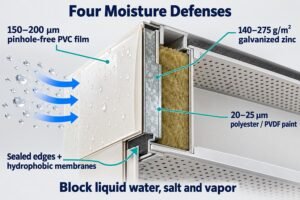
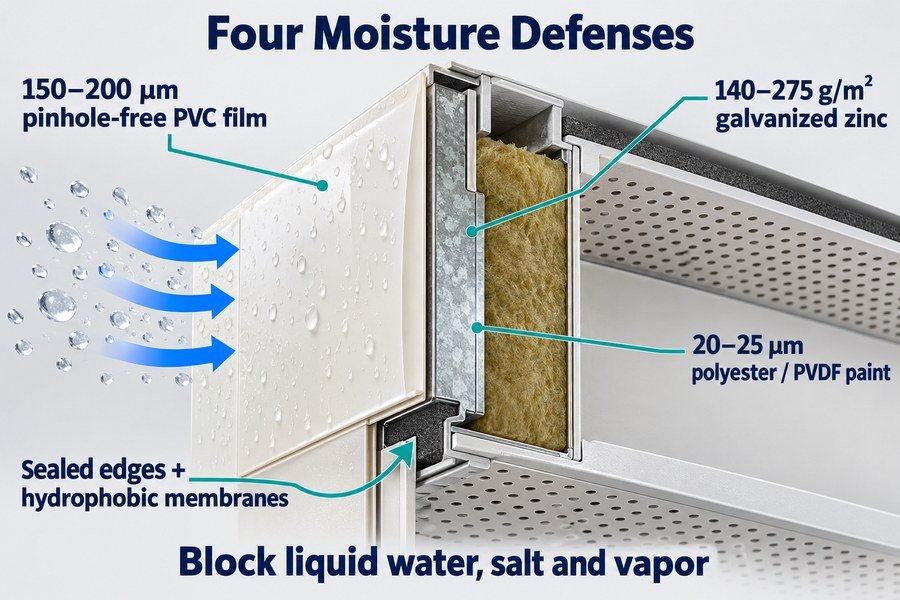
Protective surface layers improve marine interior panel moisture resistance through four barriers: laminating 150-to-200-micron pinhole-free PVC films, applying 140-to-275 g/m2 hot-dip galvanized zinc layers, baking 20-to-25-micron polyester or PVDF paints, and sealing cut edges and acoustic perforations with hydrophobic membranes to block liquid water, salt, and vapor.
I started my career on the production floor of a marine outfitting factory, and now I work as a marine outfitting specialist at Magellan Marine. Over the years, I have seen many ship interior buyers lose money on wall and ceiling panels. Most buyers check the fire certificate and the rockwool core density, and they think the job is done. But when those panels arrive at a European or American shipyard after four weeks inside a humid ocean container, white rust and peeling skins appear along the edges. A marine composite panel is only as strong as its outer skin. Below, I will break down how each protective layer works, what numbers you must put in your purchase contract, and how you can get durable panels from Asian factories at a fair price.
How Do PVC Films and Galvanized Coatings Block Moisture in Marine Interior Panels?
Damp sea air attacks bare cabin walls every day. Rust and peeling skins ruin expensive interiors fast. PVC films and galvanized coatings stop moisture completely.
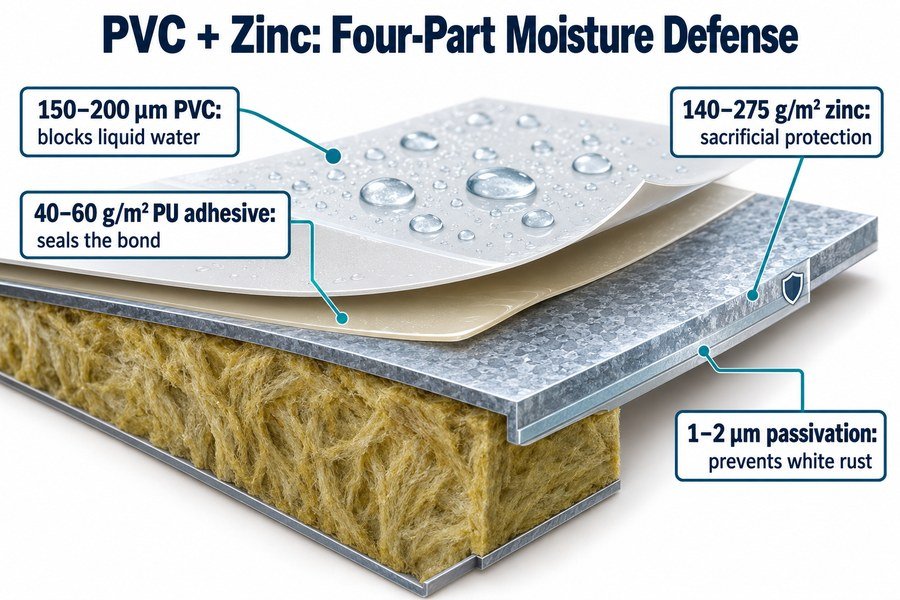
PVC films and galvanized coatings block moisture through a four-part defense: a 150-to-200-micron calendered PVC top layer stops liquid water, a 40-to-60 g/m2 polyurethane adhesive seals the bond, a 140-to-275 g/m2 zinc layer provides sacrificial cathode protection, and a 1-to-2-micron chromate-free passivation film prevents white rust.
Waterproofing Mechanics of Calendered PVC Films and Polyurethane Adhesives in Marine Panels
When I oversaw lamination lines in the factory, I learned that the outer plastic skin and the glue underneath work as one single water shield. The first barrier is the 150-to-200-micron calendered polyvinyl chloride (PVC) decorative film. This PVC film acts as a physical raincoat over the steel sheet. Under ASTM E96 water vapor transmission testing, a 150-micron marine-grade PVC film keeps moisture transmission below 1.5 g/m2 per 24 hours1. It also meets IMO Resolution MSC.307(88) (FTP Code Part 5 and Part 2)2 for low flame spread and smoke toxicity. Some low-cost factories try to save $0.40 per square meter by using 100-micron commercial wallpaper PVC. That thin film stretches during roll-forming and lets washdown water seep through.
The second barrier is the 40-to-60 g/m2 two-component reactive polyurethane (PU) adhesive layer. This glue bonds the PVC film to the metal skin under heated pinch rollers at 130°C to 150°C. Cheap factories often use water-based acrylic glue because it costs $0.25 less per square meter. But water-based glue softens when cabin relative humidity passes 80%. A cross-linked PU adhesive layer forms a waterproof chemical bridge. Even if someone cuts a seam in the PVC film, the PU adhesive stops water from spreading sideways under the plastic skin3.
Sacrificial Protection of Hot-Dip Galvanized Zinc Layers and Passivation Films on Marine Steel Sheets
Underneath the glue, the metal skin needs its own defense against salty air. The third barrier is a 140-to-275 g/m2 hot-dip galvanized zinc coating applied to both sides of the 0.5 mm to 0.7 mm cold-rolled steel sheet, defined as Z140 to Z275 under European standard EN 10346. Zinc is more chemically active than iron. When moisture reaches the steel at a cut edge or a screw hole, the zinc corrodes first and sacrifices itself to protect the base steel. For standard dry accommodation cabins, a Z140 coating (about 10 microns of zinc per side) is the minimum requirement. For corridors, galleys, and ocean transit, I always tell buyers to specify Z275 (about 20 microns of zinc per side). Moving from Z140 to Z275 only adds about $0.60 to $0.85 per square meter to the panel price, which normally sits between $16.50 and $22.00 per square meter FOB China.
The fourth barrier is a 1-to-2-micron chromate-free chemical passivation film applied directly over the zinc layer. Fresh zinc reacts quickly with pure condensation water when air cannot circulate. This reaction creates a powdery white zinc hydroxide called white rust. During a 30-day sea voyage from Asia to a European shipyard, tightly stacked panels sweat inside steel containers. The 1-to-2-micron passivation film seals the active zinc surface in compliance with RoHS and ISO 3613 standards, stopping white rust before installation even begins.
| Protective Layer | Standard Specification | Authoritative Standard | Primary Moisture Blocking Function | FOB Cost Share ($/m2) |
|---|---|---|---|---|
| Calendered PVC Top Layer | 150 to 200 microns thickness | IMO FTPC Part 5 / ASTM E96 | Blocks liquid washdown water and reduces vapor transfer below 1.5 g/m2/day | $1.20 - $1.80 |
| Polyurethane (PU) Adhesive | 40 to 60 g/m2 coat weight | ISO 8510-2 | Seals the steel-to-PVC interface and prevents sideways water creep | $0.45 - $0.65 |
| Hot-Dip Galvanized Zinc Layer | 140 to 275 g/m2 (Z140 - Z275) | EN 10346 / ASTM A653 | Provides sacrificial cathode protection at cut edges and joints | $0.90 - $1.50 |
| Chemical Passivation Film | 1 to 2 microns thickness | ISO 3613 | Prevents white rust formation on zinc during humid sea freight | $0.10 - $0.15 |
Why Must Marine Interior Panel PVC Films Be Pinhole-Free to Block Moisture?
Microscopic holes in cheap PVC film are invisible at first. Salty vapor sneaks through and blisters the steel underneath. Pinhole-free PVC film prevents hidden panel corrosion.
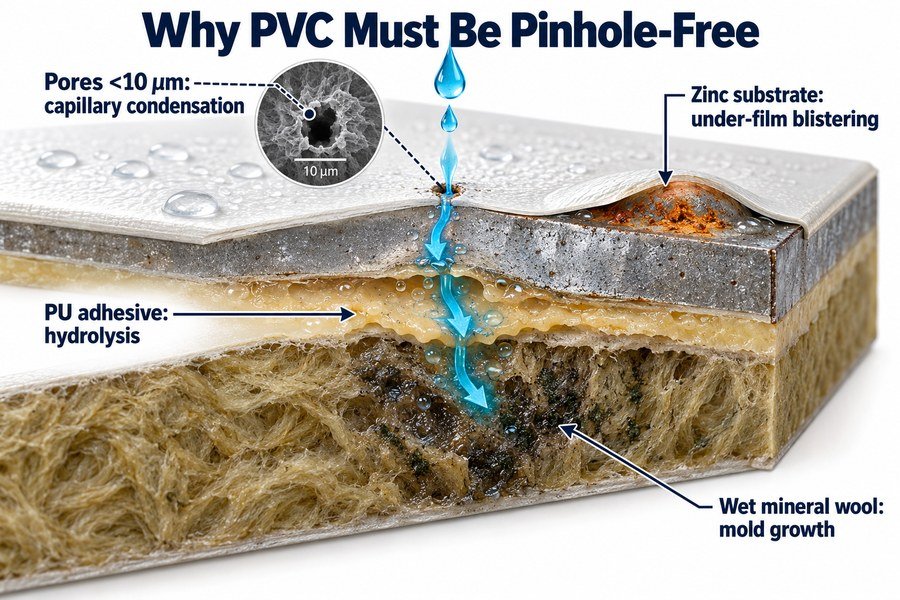
Marine interior panel PVC films must be pinhole-free to stop four failure modes: capillary condensation inside pores under 10 microns, galvanic under-film blistering on the zinc substrate, hydrolysis of the polyurethane laminating adhesive, and mold growth inside the wet mineral wool core.
Capillary Condensation and Under-Film Blistering Caused by Micro-Pinholes in Marine PVC Films
A few years ago, a client asked me to inspect a batch of B-15 cabin wall panels she bought from a small workshop. Six months after the ship entered service in Southeast Asia, hundreds of ugly bumps appeared across the cabin walls. The factory blamed the shipyard's air conditioning, but I knew the real cause. We stripped a sample and ran a high-voltage spark test at 1,500 V according to ASTM D5162. The detector beeped twelve times on a single square meter of film. Those tiny defects triggered the first failure mode: capillary condensation inside pores under 10 microns. According to the Kelvin equation in physics, water vapor condenses into liquid water at much lower humidity when it gets trapped inside a narrow pore4. Even when a ship cabin operates within the ISO 7547 marine HVAC design standard of 50% to 70% relative humidity, micro-pinholes below 10 microns suck moisture out of the air and turn it into liquid water drops right against the glue line.
Once liquid water sits at the bottom of that pinhole, it triggers the second failure mode: galvanic under-film blistering on the zinc substrate. Sea air carries sodium chloride particles that dissolve into the microscopic water drop. This salty electrolyte touches the zinc layer underneath the PVC film and starts an electrochemical corrosion cell5. Because oxygen cannot easily get back out through the narrow pinhole, the zinc breaks down into zinc hydroxide and zinc carbonate powder. This white powder takes up three times more volume than solid zinc metal6. As the corrosion products expand, they push the PVC film upward and create hard blisters measuring 5 mm to 15 mm wide across the panel face.
Adhesive Hydrolysis and Mineral Wool Mold Growth From Defective Marine Panel Facings
As those blisters grow, they set off the third failure mode: hydrolysis of the polyurethane laminating adhesive. The corrosion reaction under the PVC film creates a high-pH alkaline liquid with a pH between 10 and 12. This alkaline moisture attacks the ester chemical bonds inside the polyurethane glue7. Within three to six months, the adhesive breaks down and loses its grip. Under ISO 8510-2 180-degree peel testing, a healthy marine PVC bond holds at 25 N to 35 N per 25 mm strip width. After adhesive hydrolysis starts around a pinhole cluster, the peel strength drops below 5 N per 25 mm. A worker can literally peel the plastic skin off the wall by hand.
If the vessel owner ignores the peeling film, the panel reaches the fourth failure mode: mold growth inside the wet mineral wool core. Once the zinc and the 0.6 mm steel sheet pit through at the pinhole site, moisture enters the 120 to 150 kg/m3 rockwool insulation core. Mineral wool fibers do not rot by themselves, but they trap organic dust and condensation water inside the dark wall cavity. Under ASTM G21 fungal resistance testing conditions, wet cores breed dark mold spores inside the cabin air gaps within 28 days. To stop all four problems, I only source twin-ply calendered PVC films where two 75-to-100-micron sheets are fused together on hot rollers. Two separate plies never have pinholes in the exact same spot, giving you zero pinholes per square meter for only $0.35 per square meter more than single-ply film.
| Failure Mode | Trigger Threshold | Authoritative Test Standard | Measurable Impact on Marine Panel |
|---|---|---|---|
| Capillary Condensation in Pores | Pore diameter under 10 microns at 65%+ RH | ASTM D5162 / ISO 7547 | Condenses vapor into liquid water droplets inside the film at normal cabin temperatures |
| Galvanic Under-Film Blistering | Over 1 pinhole per m2 exposed to salt air | ISO 4628-2 (Blistering Degree) | Creates 5 mm to 15 mm raised surface blisters filled with white zinc corrosion powder |
| Polyurethane Adhesive Hydrolysis | Local under-film pH reaching 10 to 12 | ISO 8510-2 (Peel Strength Test) | Drops PVC peel adhesion from 25-35 N/25mm down to less than 5 N/25mm |
| Mineral Wool Core Mold Growth | Core moisture exceeding 2% by weight | ASTM G21 / EN 1609 | Breeds fungal spores in cabin walls and increases panel weight by 20% to 30% |
How Do Acoustic Perforations and Finishes Affect Marine Ceiling Panel Vapor Permeability?
Noisy ship cabins need perforated ceilings to absorb sound. Open holes let warm moisture soak straight into the core. Hydrophobic acoustic finishes stop vapor penetration.
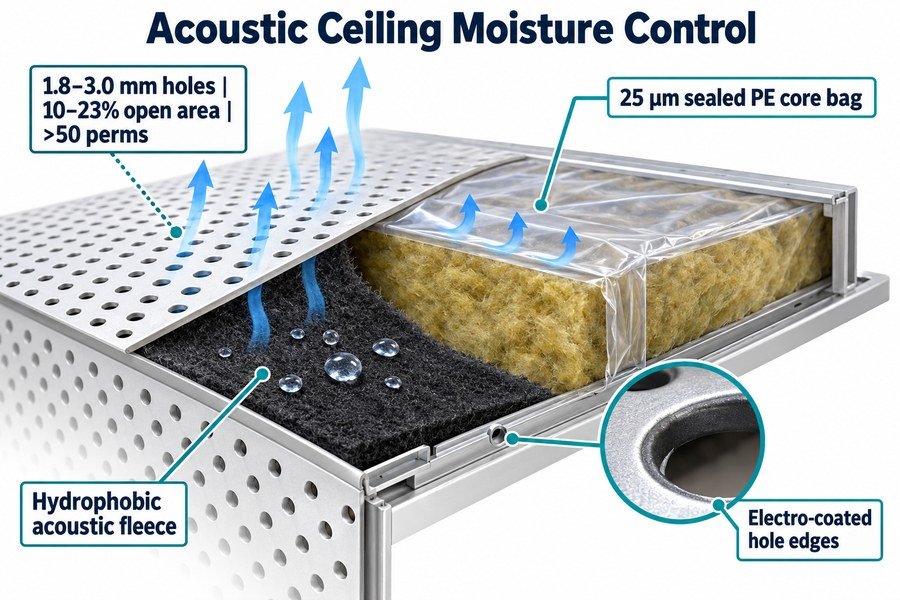
Acoustic perforations and finishes alter marine ceiling panel vapor permeability in four ways: punching 1.8-to-3.0 mm holes increases open area to 10%-23%, raising vapor permeance above 50 perms, while adding hydrophobic non-woven acoustic fleece, wrapping cores in 25-micron PE bags, and electro-coating punched hole edges restrict moisture entry.
Impact of Micro-Perforation Open Area on Marine Ceiling Panel Vapor Permeance
Shipyards face a tough engineering trade-off in engine control rooms, mess rooms, and cabins near bow thrusters. IMO Resolution MSC.337(91) sets strict noise limits, such as 60 dB(A) inside crew cabins and 65 dB(A) in mess rooms8. To absorb sound waves, we punch thousands of tiny holes through the bottom steel sheet of B-0 and B-15 marine ceiling panels. This brings us to the first mechanism: punching 1.8 mm to 3.0 mm holes increases the open surface area to 10% to 23%. This open pattern lets sound waves enter the mineral wool core and boosts the weighted sound absorption coefficient (alpha_w)9 from 0.10 up to 0.65 or 0.85 under ISO 354 testing. However, punching holes destroys the vapor barrier of the solid steel sheet. Under ASTM E96 testing, a solid galvanized steel ceiling panel has a water vapor permeance near 0.01 perms10. Once you punch a 20% open area into that sheet, its vapor permeance jumps above 50 perms. Warm, humid air from crew showers or galley steam rises straight through those holes into the cold ceiling plenum11.
Punching holes after coil coating also creates a major rust risk around every single hole rim. That is why the fourth mechanism in our list is critical: electro-coating or post-priming the punched steel hole edges. When a factory punches a pre-painted steel coil, the punch die shears through the zinc and paint, leaving a 0.6 mm ring of bare iron inside every hole. In a 1 m2 ceiling panel with 2.0 mm holes at 15% open area, there are over 47,000 exposed hole edges, which equals nearly 300 linear meters of bare cut steel. Good factories apply a 15-to-20-micron epoxy primer and polyester topcoat after perforation, or they use high-zinc Z275 steel so zinc wipes over the sheared edge during punching. This post-coat treatment adds $1.50 per square meter, but it stops brown rust rings from bleeding around the holes after one year at sea.
Moisture Control Using Hydrophobic Acoustic Fleece and Sealed Polyethylene Core Bags in Marine Ceilings
To keep moisture out of the insulation without blocking sound waves, we use two internal barriers behind the perforated steel face. The second mechanism is bonding a 50-to-70 g/m2 hydrophobic non-woven acoustic glass-fiber fleece directly to the back of the perforated steel sheet. This black fleece is treated with a fluorocarbon water-repellent finish. It has microscopic pores that let acoustic pressure waves pass into the rockwool core with zero loss in ISO 354 sound absorption. At the same time, its high surface tension blocks liquid condensation droplets from dripping down or splashing up into the wool, and it keeps rockwool dust from falling onto the crew.
In high-humidity zones or below chilled water pipes, acoustic fleece alone cannot stop water vapor gas. That requires the third mechanism: wrapping the mineral wool core inside a heat-sealed 25-micron polyethylene (PE) bag or an 18-micron reinforced aluminum-foil bag. I helped a buyer solve a ceiling sagging problem on a series of tropical offshore supply vessels using this exact method. Their bare mineral wool pads had absorbed condensation from uninsulated chilled water pipes in the overhead void, gaining 4 kg of water per square meter. By wrapping the 40 mm mineral wool pads inside 25-micron flame-retardant PE bags (certified under IMO FTPC Part 5), we dropped the core vapor permeance back below 0.15 perms under ASTM E96. The thin 25-micron film vibrates freely with mid- and high-frequency sound waves, keeping the ISO 354 sound absorption coefficient at 0.70 while keeping the wool bone dry.
| Marine Ceiling Panel Configuration | Open Perforation Area (%) | Water Vapor Permeance (Perms, ASTM E96) | Sound Absorption alpha_w (ISO 354) | FOB Price Range ($/m2) |
|---|---|---|---|---|
| Solid Unperforated B-15 Ceiling | 0% | Less than 0.05 Perms | 0.10 - 0.15 | $15.00 - $18.50 |
| Bare Perforated Ceiling (1.8-3.0 mm Holes) | 10% - 23% | Over 50.0 Perms | 0.65 - 0.85 | $17.50 - $21.00 |
| Perforated + 60 g/m2 Hydrophobic Fleece | 10% - 23% | 25.0 - 35.0 Perms (Stops Liquid Drops) | 0.65 - 0.85 | $18.50 - $22.50 |
| Perforated + Fleece + 25-Micron Sealed PE Bag + Edge Coat | 10% - 23% | Less than 0.15 Perms at Core | 0.60 - 0.75 | $20.50 - $25.00 |
What Makes a Marine Interior Panel Facing a Vapor Barrier Versus a Vapor Retarder?
Choosing the wrong panel facing causes condensation inside cold cabins. Trapped water rots insulation and corrodes steel frames. Knowing exact permeance ratings stops moisture failure.
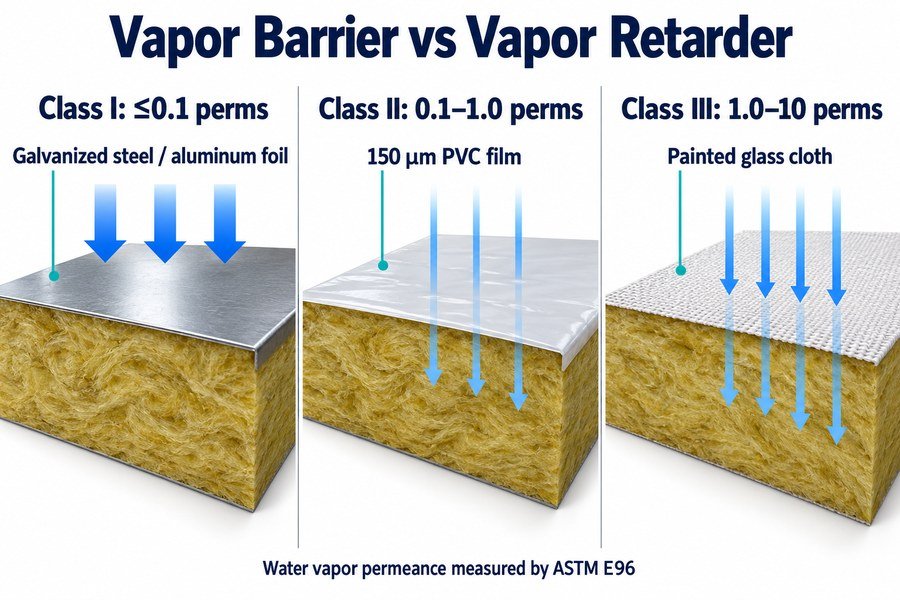
ASTM E96 water vapor permeance ratings define three classes: Class I vapor barriers allow 0.1 perms or less (galvanized steel and aluminum foil), Class II vapor retarders allow 0.1 to 1.0 perms (150-micron PVC film), and Class III retarders allow 1.0 to 10 perms (painted glass cloth).
Class I Marine Vapor Barriers Using Solid Galvanized Steel and Aluminum Foil Facings
Many buyers use the words "vapor barrier" and "vapor retarder" as if they mean the same thing. When you talk to shipyard engineers in Europe or the United States, mixing up these terms can lead to costly specification mistakes. Under ASTM E96 (and ISO 12572), materials are grouped by how many perms of water vapor pass through them. One imperial perm equals 57.2 ng/(Pa·s·m2) in metric units.12 The strictest category is a Class I Vapor Barrier, which allows 0.1 perms or less (under 5.7 ng/(Pa·s·m2)). In marine outfitting, two facing materials qualify as true Class I vapor barriers: solid 0.5 mm to 0.7 mm galvanized steel sheets and 30-to-50-micron glass-scrim-reinforced aluminum foil (ALU-foil).
A continuous steel sheet has a vapor permeance near zero, and a fully assembled tongue-and-groove steel wall system with PVC gasket seals tests at 0.03 to 0.08 perms. On single-skin lining panels that face the outer ship hull, we laminate a 0.6 mm PVC-coated steel sheet on the cabin side and a 40-micron reinforced aluminum foil on the back side facing the hull insulation. Because the aluminum foil holds a permeance below 0.05 perms per ASTM E96, it stops any stray moisture from entering the panel from the hull side while saving $4.50 per square meter and 4.7 kg/m2 in weight compared to a double-skin steel panel. Class I barriers are mandatory on wet-space bulkheads and cold-climate hull linings where outside sea temperatures drop to 0°C.
Class II and Class III Marine Vapor Retarders Using PVC Films and Woven Glass Cloth
When a facing lets small amounts of water vapor pass through at a controlled rate, engineers call it a vapor retarder. A Class II Vapor Retarder allows between 0.1 and 1.0 perms (5.7 to 57.2 ng/(Pa·s·m2)). A standalone 150-to-200-micron marine PVC film without a steel backing falls right into Class II, testing at around 0.3 to 0.8 perms under ASTM E96 Procedure A13 (desiccant method at 23°C and 50% RH). You will see Class II performance on lightweight marine panels made with calcium silicate cores or non-metallic FRP skins where no metal sheet is used. These panels slow down vapor entry enough for normal air-conditioned passenger cabins while keeping panel weight under 9 kg/m2.
A Class III Vapor Retarder allows between 1.0 and 10.0 perms (57.2 to 572 ng/(Pa·s·m2)). The most common Class III facing in shipbuilding is painted woven glass-fiber cloth (typically 200 to 400 g/m2 weight) glued over A-60 mineral wool bulkhead insulation inside technical spaces, machinery casings, and behind cabin linings. Why would a shipyard want a permeable Class III facing? Because of what I call the "double vapor barrier trap14." If you put a Class I aluminum foil barrier on the hull insulation AND a Class I steel lining panel 50 mm in front of it in a tropical climate, any humid air that leaks into the gap during construction gets trapped forever. Using a Class III woven glass cloth (testing at 3.5 to 8.0 perms) on the hidden insulation face lets the cavity breathe and dry out toward the dehumidified cabin airconditioning system.
| Vapor Control Classification | ASTM E96 Permeance Range (Perms) | Metric Permeance Range (ng/(Pa·s·m2), ISO 12572) | Marine Outfitting Facing Materials | Best Shipboard Application |
|---|---|---|---|---|
| Class I Vapor Barrier | 0.1 Perms or less | 5.7 ng/(Pa·s·m2) or less | 0.5-0.7 mm Galvanized Steel Sheet; 30-50 Micron Reinforced Aluminum Foil | Wet spaces, galleys, laundry rooms, cold hull linings |
| Class II Vapor Retarder | 0.1 to 1.0 Perms | 5.7 to 57.2 ng/(Pa·s·m2) | Standalone 150-200 Micron Calendered PVC Film; 1.5 mm Marine FRP Skin | Dry passenger cabins, lightweight non-metallic partitions |
| Class III Vapor Retarder | 1.0 to 10.0 Perms | 57.2 to 572 ng/(Pa·s·m2) | 200-400 g/m2 Painted Woven Glass-Fiber Cloth | Hidden hull insulation slabs, machinery room linings |
How Do Anti-Corrosion Steel Coatings Improve Marine Accommodation Panel Moisture Durability?
Salt fog and harsh washdowns eat through cheap steel panels in months. Corroded walls trigger costly warranty claims. Multi-layer anti-corrosion coatings protect panels for decades.
Anti-corrosion steel coatings extend marine panel durability to 15-25 years through four specialized finishes: 5-to-7-micron epoxy zinc-chromate primers, 20-to-25-micron polyester (PE) topcoats for dry cabins, 25-to-35-micron polyvinylidene fluoride (PVDF) coatings for high-salt areas, and 100-to-150-micron stainless steel or PVC plastisol finishes for wet spaces.
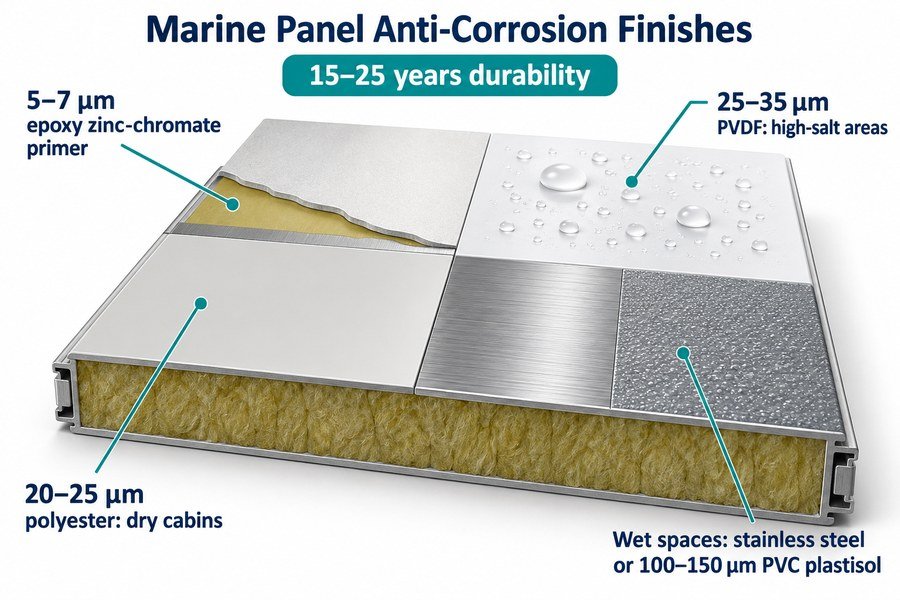
Epoxy Primers and Polyester Topcoats for Standard Marine Cabin Wall Panels
Not every ship interior uses laminated PVC film. Many cargo vessels, offshore platforms, and naval ships specify pre-painted coil-coated steel panels or stainless steel walls for fast cleaning and high durability15. The foundation of any painted marine panel is the first finish in our system: a 5-to-7-micron heat-cured epoxy primer baked onto both sides of the galvanized steel sheet. On the back side of the steel sheet—the hidden side glued to the mineral wool core—the coil line applies an additional 7-to-10-micron epoxy or polyester backer coat. I always tell buyers to check the backer coat thickness on their supplier's mill test certificate. Without a 7-micron epoxy backer coat, moisture trapped in the rockwool corrodes the steel sheet from the inside out while the front paint still looks brand new.
Over the front epoxy primer, standard dry cabins use the second finish: a 20-to-25-micron polyester (PE) coil coating. Baked at 220°C to 240°C on a continuous coil line, a 20-micron polyester topcoat delivers a smooth, wipeable surface that passes 500 hours of neutral salt spray testing under ISO 9227 (ASTM B117) without blistering. It also passes 100 double rubs with methyl ethyl ketone (MEK) solvent under ASTM D5402, proving full chemical cure. Polyester-coated B-15 wall panels are the most budget-friendly option in marine outfitting, costing $15.00 to $17.50 per square meter FOB China. They meet ISO 12944 Category C3 corrosion protection, giving you 15 years of trouble-free service in dry crew cabins and offices.
PVDF Coatings and Plastisol or Stainless Steel Finishes for Wet Marine Spaces
When panels are installed near weather-deck doors, semi-exposed corridors, or high-salt zones, standard polyester paint chalks and blisters too fast. For these areas, we step up to the third finish: a 25-to-35-micron polyvinylidene fluoride (PVDF) coating formulated with 70% Kynar or Hylar fluoropolymer resin. Because carbon-fluorine chemical bonds are extremely tight, PVDF coatings block salt water ion penetration and pass 1,000 to 1,500 hours of ISO 9227 salt spray testing. This upgrades the panel to ISO 12944 Category C4 or C5-M (marine high corrosion) durability for only $1.80 to $2.50 per square meter more than standard polyester.
For harsh wet spaces—such as ship galleys, dishwashing rooms, provision cold stores, and modular shower units—workers spray walls daily with hot water and alkaline degreasers. Here, we use the fourth finish category: either a 100-to-150-micron PVC plastisol leather-grain coating or a 0.6 mm AISI 304 / 316L brushed stainless steel skin bonded over the galvanized backing. A 120-micron plastisol coating absorbs heavy cart impacts without cracking and survives over 1,500 hours of salt spray under ISO 9227. Meanwhile, AISI 304 (with 18% chromium and 8% nickel) and AISI 316L (with 2% molybdenum added to stop chloride pitting) form a self-healing chromium-oxide passive film16 that exceeds 2,000 hours in salt fog tests and lasts 25 years. Last year, I helped a procurement client cut her wet-zone wall budget by 30%. Instead of paying $42.00 per square meter for double-sided 316L stainless panels in galley corridors, we used 316L stainless only on the wet inside face of the galley and 25-micron PVDF-coated Z275 steel on the dry corridor side, dropping her price to $29.50 per square meter while passing every class inspection.
| Anti-Corrosion Coating / Finish | Dry Film / Skin Thickness | Salt Spray Resistance (ISO 9227 / ASTM B117) | ISO 12944 Corrosion Category | Typical FOB Panel Price ($/m2) |
|---|---|---|---|---|
| Epoxy Primer + Backer Coat | 5-7 microns front / 7-10 microns back | 300 - 400 Hours (Base Layer) | C2 / Internal Core Protection | Included in base coil price |
| Polyester (PE) Topcoat | 20 to 25 microns | 500 Hours | C3 (Dry Indoor Cabins) | $15.00 - $17.50 |
| PVDF Fluoropolymer Coating | 25 to 35 microns (70% PVDF resin) | 1,000 - 1,500 Hours | C4 / C5-M (High-Salt Corridors) | $17.00 - $20.00 |
| PVC Plastisol / AISI 304-316L SS | 100-150 microns (Plastisol) / 600 microns (SS) | 1,500 - 2,000+ Hours | C5-M / CX (Galleys & Wet Units) | $21.00 (Plastisol) / $29.00-$45.00 (SS) |
How Do Surface Scratches Expose Marine Wall Panel Cores to Moisture Damage?
Workers often scratch wall panels during busy shipyard installation. One deep gouge lets cabin moisture rot the panel inside. Knowing scratch depth prevents costly damage.
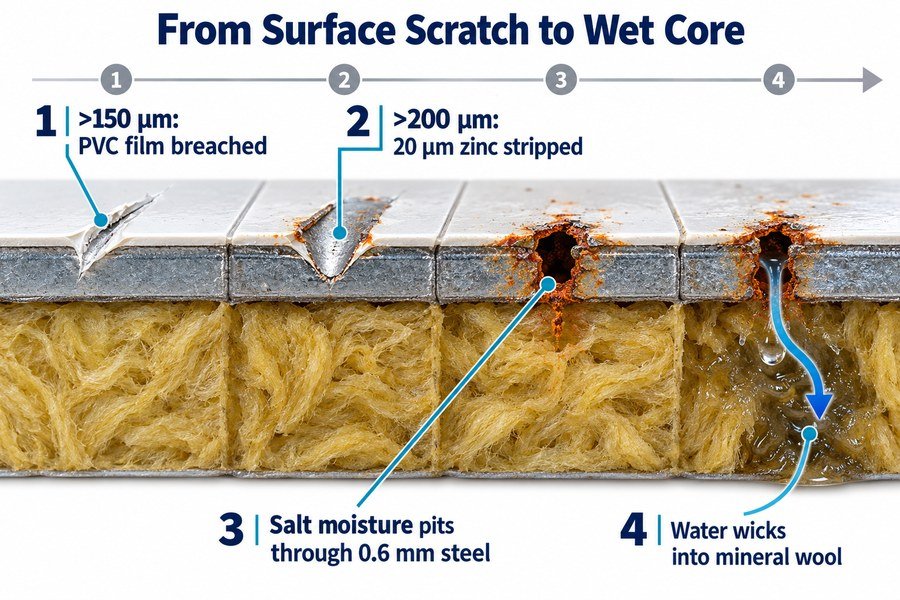
Surface scratches expose marine wall panel cores to moisture through four stages: gouges over 150 microns breach the PVC film, cuts over 200 microns strip the 20-micron zinc layer, salt moisture pits through the 0.6 mm steel sheet, and water wicks into the mineral wool core.
Breaching of PVC Films and Zinc Layers by Installation Gouges on Marine Wall Panels
Shipyards are crowded, tough workplaces. Electricians pull heavy cables, pipefitters carry steel brackets, and welders move scaffolding through narrow 900 mm cabin corridors. During this busy outfitting phase, wall panels take constant hits. The breakdown starts at Stage 1: gouges deeper than 150 microns breach the PVC decorative film. Under ISO 1518-1 needle scratch testing, a standard 150-micron marine PVC film resists loads up to 15 N to 20 N, and its surface hardness rates at 2H under the ASTM D3363 pencil test. However, a sharp metal corner on a toolbox easily exerts over 40 N of force, slicing straight through the 150-micron PVC layer and the 40-micron glue line. Once the PVC skin splits open, the panel loses its primary waterproof barrier along that scratch line.
If the tool presses just a fraction harder, the damage hits Stage 2: cuts exceeding 200 microns strip away the 20-micron Z275 hot-dip galvanized zinc layer17 and expose bare grey iron. As I explained earlier, zinc can protect exposed steel next to it through sacrificial cathodic action. However, this sacrificial "throwing power" has a strict physical limit. In marine humidity, zinc can only bridge a bare steel gap of about 1.5 mm to 2.0 mm wide18. If a deep installation gouge is wider than 2.0 mm, or if a worker uses an angle grinder to trim a panel edge and burns off the zinc layer, the sacrificial shield fails in the center of the cut. To stop Stage 1 and Stage 2 damage during installation, I always tell buyers to demand a 60-to-80-micron low-tack polyethylene (PE) protective peel-off film applied at the factory. This peel-off film costs just $0.15 per square meter and prevents 90% of handling scratches until the ship is ready for sea trials.
Steel Pitting Corrosion and Mineral Wool Core Wicking From Unrepaired Marine Panel Scratches
When a deep scratch stays uncovered in a humid ship cabin, it quickly moves to Stage 3: salt moisture pits through the 0.6 mm cold-rolled steel sheet. Within 48 hours of exposure to 75% relative humidity, red iron oxide rust forms in the center of the scratch19. Over the next 6 to 12 months, chloride ions drive anodic pitting corrosion downward into the 0.6 mm steel sheet while pushing alkaline creep sideways under the intact PVC edges. Under ISO 4628-8 scribe-creep testing after 500 hours of salt fog, an unrepaired scratch on a poor-quality panel shows 5 mm to 8 mm of under-film rust delamination on both sides of the cut. In wet spaces or near leaky window frames, pitting eats all the way through a 0.5 mm or 0.6 mm steel skin in less than 18 months.
Once rust perforates the steel sheet—or when scratches damage the seal along the 0.7 mm galvanized bottom U-channel track—the panel enters Stage 4: water wicks into the mineral wool core. High-quality marine rockwool contains 0.3% to 0.5% silicone oil water repellent so that short-term water absorption stays below 1.0 kg/m2 (or under 2% by weight) under EN 1609 testing. But when dirty, soapy washdown water seeps through a rusted scratch or an unsealed bottom cut edge, surfactants break the water tension of the rockwool fibers. Water climbs 150 mm to 300 mm up inside the core by capillary action. Wet mineral wool loses its thermal insulation power: its thermal conductivity lambda value jumps from a dry 0.036 W/(m·K) to over 0.065 W/(m·K) under ISO 8302, causing cold spots and surface sweating across the entire cabin wall. Whenever shipyard workers scratch a panel past 200 microns, I instruct their team to clean the cut with isopropyl alcohol, brush on a 40-micron coat of zinc-rich cold galvanizing primer containing at least 92% zinc dust in the dry film per ASTM A780, and seal the surface with a color-matched PVC repair paste or heat-welded film patch.
| Scratch Damage Stage | Scratch Depth & Width Threshold | Governing Test Standard | Structural & Moisture Impact | Field Repair Protocol & Material Cost |
|---|---|---|---|---|
| Stage 1: PVC Film Breach | Depth: 150 - 180 microns | ISO 1518-1 / ASTM D3363 | Opens primary water barrier; exposes glue line to humidity | Seal with color-matched liquid PVC seam sealer ($2.00 per repair) |
| Stage 2: Zinc Layer Stripping | Depth: Over 200 microns; Width: Over 2.0 mm | EN 10346 / ASTM A780 | Exceeds 2.0 mm zinc sacrificial bridge limit; exposes bare steel | Clean with alcohol; apply 92% zinc-dust primer + PVC patch ($5.00 per repair) |
| Stage 3: Steel Sheet Pitting | Depth: 200 - 800 microns (Full 0.6 mm Penetration) | ISO 4628-8 (Scribe Creep) | Causes 5-8 mm under-film rust blisters and pinholes through steel | Sand rust to bright metal, prime with epoxy-zinc, cover with full-height PVC overlay ($18.00/m2) |
| Stage 4: Mineral Wool Core Wicking | Through-hole or unsealed cut panel edge | EN 1609 / ISO 8302 | Core absorbs water over 2% weight; thermal lambda degrades to 0.065 W/(m·K) | Core cannot be dried in place; requires full panel replacement ($45.00 - $80.00 per panel) |
Conclusion
Specifying pinhole-free 150-micron PVC films, Z275 galvanized steel, and sealed acoustic backings blocks marine moisture completely. Verify these surface specs before shipping to protect your cabins.
-
"Water Vapor Permeation in Plastics", https://www.pnnl.gov/main/publications/external/technical_reports/PNNL-26070.pdf. ASTM E96/E96M defines standard cup-method procedures for measuring water-vapor transmission through sheet materials, and published polymer barrier data can be used to contextualize the stated low transmission rate for PVC film. Evidence role: statistic; source type: paper. Supports: A 150-micron marine-grade PVC film can have water-vapor transmission below 1.5 g/m² per 24 hours when tested under ASTM E96 conditions.. Scope note: A neutral source may support the test method and typical PVC barrier behavior, but the exact 1.5 g/m²/24 h value for a specific 150-micron marine-grade film usually requires a product-specific laboratory report. ↩
-
"What Is the Purpose and Scope of the IMO FTP Code?", https://magellanmarinetech.com/what-purpose-scope-of-imo-ftp-code/. IMO Resolution MSC.307(88), the 2010 FTP Code, sets test procedures for surface flammability and smoke/toxicity of materials used in ships, providing the regulatory context for evaluating PVC decorative films in marine interiors. Evidence role: historical_context; source type: institution. Supports: IMO Resolution MSC.307(88), FTP Code Parts 5 and 2, are relevant standards for low flame spread and smoke/toxicity testing of marine interior materials.. Scope note: The IMO code establishes the applicable tests; it does not prove that any particular PVC film complies unless accompanied by a product-specific test certificate. ↩
-
"Durability of Polymer Metal Multilayer: Focus on the Adhesive ...", https://pmc.ncbi.nlm.nih.gov/articles/PMC6262294/. Studies of cross-linked polyurethane adhesives describe their low water sensitivity and durable interfacial bonding, which can help limit interfacial moisture migration in laminated assemblies. Evidence role: mechanism; source type: paper. Supports: A cross-linked polyurethane adhesive layer can resist water and help limit lateral moisture migration at the PVC-to-metal interface.. Scope note: The source would support the adhesive mechanism generally; direct proof for a cut PVC-on-galvanized-steel marine panel would require a panel-specific water-ingress or peel test. ↩
-
"The Kelvin equation", https://glass.rutgers.edu/sites/default/files/uploads/kelvinEq.pdf. A physics or surface-science source on the Kelvin equation supports that curved liquid-vapor interfaces in small pores can produce capillary condensation below saturation humidity; this support is mechanistic and does not by itself establish the article’s specific pore-size threshold for marine PVC films. Evidence role: mechanism; source type: education. Supports: The Kelvin equation explains why vapor can condense as liquid water inside narrow pores at relative humidity below bulk saturation.. Scope note: The exact humidity threshold depends on pore radius, contact angle, temperature, and surface chemistry. ↩
-
"Initial formation of corrosion products on pure zinc in saline ...", https://pmc.ncbi.nlm.nih.gov/articles/PMC6351358/. A corrosion-science source supports that chloride-containing moisture acts as an electrolyte and can initiate electrochemical corrosion of zinc-coated steel; this is general corrosion mechanism evidence and not a direct test of the described panel assembly. Evidence role: mechanism; source type: paper. Supports: A sodium-chloride-containing water droplet in contact with zinc can form an electrolyte path that enables electrochemical corrosion.. Scope note: The evidence would support the mechanism generally, while the corrosion rate depends on coating thickness, oxygen availability, contaminants, and exposure conditions. ↩
-
"Pilling–Bedworth ratio", https://en.wikipedia.org/wiki/Pilling%E2%80%93Bedworth_ratio. A corrosion-products or materials-chemistry source giving densities and molar volumes for zinc corrosion products can support that conversion of metallic zinc to hydroxide, oxide, carbonate, or hydroxycarbonate can increase solid volume; the exact threefold expansion depends on which corrosion product forms. Evidence role: mechanism; source type: paper. Supports: Zinc corrosion products can occupy substantially more volume than the original metallic zinc, creating expansive pressure under coatings.. Scope note: Different zinc corrosion products have different molar volumes, so a single expansion factor may be approximate. ↩
-
"Hydrolysis of poly(ester urethane): In-depth mechanistic ...", https://www.osti.gov/biblio/2477458. Polymer-degradation literature supports that ester-containing polyurethane adhesives can undergo hydrolysis and that alkaline conditions accelerate ester-bond cleavage; this supports the chemical mechanism but not the article’s specific time-to-failure without matching aging data. Evidence role: mechanism; source type: paper. Supports: Alkaline moisture can hydrolyze ester bonds in polyester-based polyurethane adhesives and weaken the adhesive network.. Scope note: Polyurethane resistance varies by formulation, crosslink density, additives, and exposure temperature. ↩
-
"Which Regulations Set Cabin Noise Limits for Ships?", https://magellanmarinetech.com/which-regulations-set-cabin-noise-limits-for-ships/. IMO Resolution MSC.337(91), the Code on Noise Levels on Board Ships, lists maximum A-weighted noise limits for accommodation spaces, including crew cabins and mess rooms; the source supports the regulatory basis for the stated design constraint. Evidence role: historical_context; source type: institution. Supports: IMO Resolution MSC.337(91) sets maximum noise limits of about 60 dB(A) for cabins and 65 dB(A) for mess rooms.. Scope note: The citation verifies the limits in the IMO code but does not assess any particular ceiling-panel design. ↩
-
"Acoustic Absorption in Porous Materials", https://ntrs.nasa.gov/api/citations/20110011143/downloads/20110011143.pdf. Acoustics literature on perforated facings over porous absorbers explains that perforations allow acoustic energy to reach the porous backing, increasing absorption compared with a rigid imperforate facing; this supports the mechanism described for perforated mineral-wool ceiling panels. Evidence role: mechanism; source type: paper. Supports: Perforated steel facings can improve sound absorption by allowing sound waves to enter the mineral wool core.. Scope note: The source would support the acoustic mechanism generally; the exact alpha_w values remain product- and test-configuration-specific. ↩
-
"Permeability of Common Building Material to Water Vapor", https://www.uaf.edu/ces/publications/database/energy/permeability-water-vapor.php. Building-science and materials references classify continuous metal sheet as an essentially impermeable vapor barrier with very low water-vapor permeance, supporting the claim that an unperforated steel panel has negligible permeance. Evidence role: general_support; source type: education. Supports: A continuous galvanized steel sheet has very low water vapor permeance, on the order of hundredths of a perm.. Scope note: Published tables may give representative values for sheet metal rather than the exact 0.01-perm value for this specific galvanized panel construction. ↩
-
"Moisture Control Guidance for Building Design, ...", https://www.epa.gov/sites/default/files/2014-08/documents/moisture-control.pdf. Moisture-control guidance explains that warm humid indoor air can transport water vapor into cooler cavities, where condensation occurs if surfaces are below the dew point; this supports the described condensation risk in a cold ceiling plenum. Evidence role: mechanism; source type: government. Supports: Warm, humid air passing into a cooler ceiling plenum can create condensation risk.. Scope note: The citation supports the psychrometric mechanism, not the airflow rate or moisture load for the specific shipboard spaces described. ↩
-
"Perm (unit)", https://en.wikipedia.org/wiki/Perm_(unit). A standards or government conversion table gives the relationship between the inch-pound perm and SI permeance units, supporting the stated conversion of approximately 57.2 ng/(Pa·s·m²). Evidence role: definition; source type: government. Supports: One imperial perm is equivalent to about 57.2 ng/(Pa·s·m²).. ↩
-
"Water Vapor Permeation in Plastics", https://www.pnnl.gov/main/publications/external/technical_reports/PNNL-26070.pdf. Peer-reviewed or laboratory data on plasticized PVC films measured by ASTM E96 can document water-vapour permeance values in the Class II range for films of comparable thickness. Evidence role: statistic; source type: paper. Supports: Standalone 150-to-200-micron PVC film can test at approximately 0.3 to 0.8 perms and therefore fall within Class II vapor-retarder performance.. Scope note: PVC permeance varies with plasticizer content, film formulation, thickness, temperature, and humidity, so evidence for comparable films would be contextual rather than proof for all marine PVC films. ↩
-
"Moisture Control Guidance for Building Design, ...", https://www.epa.gov/sites/default/files/2014-08/documents/moisture-control.pdf. Hygrothermal building-science literature describes how low-permeance layers on both sides of a cavity can reduce drying potential and trap construction or leakage moisture, supporting the article’s caution about paired vapor barriers. Evidence role: mechanism; source type: research. Supports: Two Class I layers around a cavity can trap moisture and reduce the assembly’s ability to dry.. Scope note: Most available evidence comes from building-envelope assemblies; it supports the moisture-transport mechanism but may not directly test the specific marine hull-lining assembly described. ↩
-
"How to choose the right marine wall panels for marine interior ...", https://magellanmarinetech.com/how-choose-right-marine-wall-panels-for-marine-interior-projects/. General references on marine accommodation construction and hygienic wall finishes support that coated steel and stainless steel are commonly used where cleanability, corrosion resistance, and durability are required. Evidence role: general_support; source type: institution. Supports: Many marine interiors use pre-painted coil-coated steel or stainless steel walls because they are durable and easy to clean.. Scope note: Such sources support the general material rationale, but not the specification practices of every cargo vessel, offshore platform, or naval ship. ↩
-
"(PDF) Influence of molybdenum on passivation of polarised ...", https://www.academia.edu/26212784/Influence_of_molybdenum_on_passivation_of_polarised_stainless_steels_in_a_chloride_environment. Materials-science references identify 304 stainless steel as an 18Cr-8Ni austenitic grade and 316L as a molybdenum-bearing grade with improved resistance to chloride pitting; stainless corrosion resistance is attributed to a passive chromium-rich oxide film. Evidence role: mechanism; source type: education. Supports: 304 and 316L stainless steels resist corrosion through a chromium-oxide passive film, and molybdenum in 316L improves resistance to chloride pitting.. Scope note: The source supports composition and corrosion-resistance mechanisms, but the phrase “stop chloride pitting” should be read as improved resistance rather than absolute prevention. ↩
-
"How to calculate the thickness of zinc coating in a ...", https://www.academia.edu/8120559/How_to_calculate_the_thickness_of_zinc_coating_in_a_galvanized_sheet. A standards or metallurgical source should explain that Z275 denotes a nominal zinc coating mass of 275 g/m² on both sides of galvanized steel and that this corresponds approximately to a coating thickness on the order of 20 µm per side, depending on zinc density and coating distribution. Evidence role: definition; source type: institution. Supports: A Z275 hot-dip galvanized coating is approximately a 20-micron zinc layer.. Scope note: The thickness conversion is approximate because Z275 specifies coating mass, not a fixed single-side thickness. ↩
-
"Cathodic protection", https://en.wikipedia.org/wiki/Cathodic_protection. A corrosion engineering source should document the limited throwing power of zinc galvanic protection over exposed steel defects and provide measured or modeled protection distances under humid or chloride-containing conditions. Evidence role: mechanism; source type: paper. Supports: In marine humidity, zinc galvanic protection can protect only a limited bare-steel gap, approximately 1.5–2.0 mm wide.. Scope note: Protection distance varies with electrolyte conductivity, coating thickness, geometry, and chloride exposure, so a 1.5–2.0 mm value should be treated as condition-specific rather than universal. ↩
-
"Marine Atmospheric Corrosion of Carbon Steel: A Review - PMC", https://pmc.ncbi.nlm.nih.gov/articles/PMC5506973/. A corrosion study or government technical source should support that unprotected carbon steel can begin visibly corroding within short exposure periods under high humidity, especially when salts or surface contaminants are present. Evidence role: general_support; source type: paper. Supports: Red iron oxide rust can form in an exposed scratch within 48 hours at 75% relative humidity.. Scope note: The exact 48-hour timing at 75% relative humidity depends strongly on salt contamination, temperature, alloy, and surface condition; a source may provide contextual support rather than direct proof of this exact scenario. ↩