Are you trying to cut outfitting costs by using standard decorative panels? Buying cheap panels might save money now, but it will cause your ship to fail safety inspections later.
No, ordinary decorative panels cannot be used onboard SOLAS-regulated vessels. SOLAS regulations mandate that all marine interior panels must possess specific non-combustibility, low flame-spread characteristics, and certified smoke and toxicity limits, requiring official MED (Marine Equipment Directive) or classification society type approval certificates.
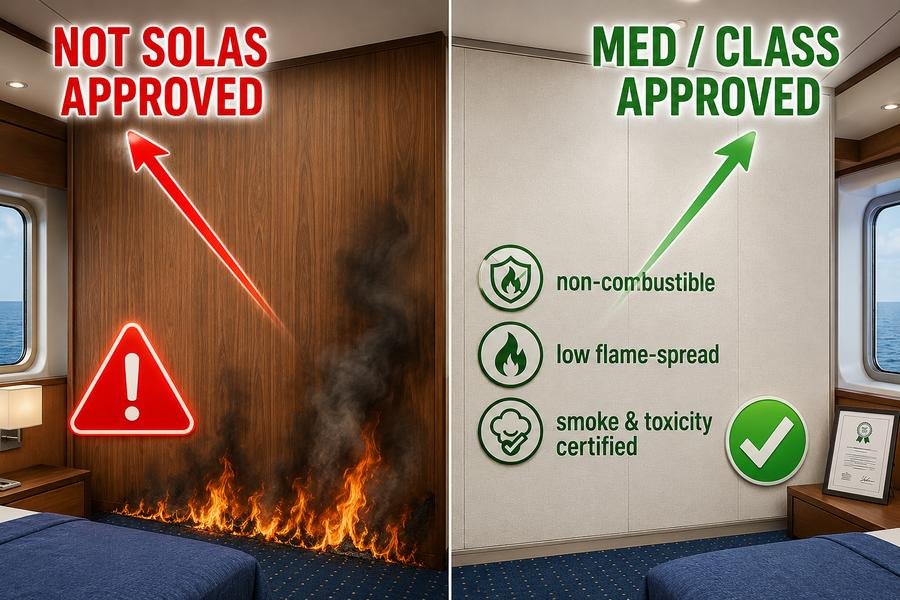
Let us look closely at why standard building materials fail at sea and what happens if you choose the wrong panels for your marine project.
Why Are Standard Gypsum Panels Banned On SOLAS Vessels?
Do your land-based suppliers push cheap gypsum panels for ship interiors? Using standard gypsum onboard invites rapid structural breakdown and severe safety risks at sea.
Standard gypsum panels are banned on SOLAS vessels due to three main reasons: they lack non-combustibility certifications, they disintegrate under constant marine vibration, and their moisture absorption exceeds 5% in high-humidity sea environments, leading to rapid mold growth and structural failure.
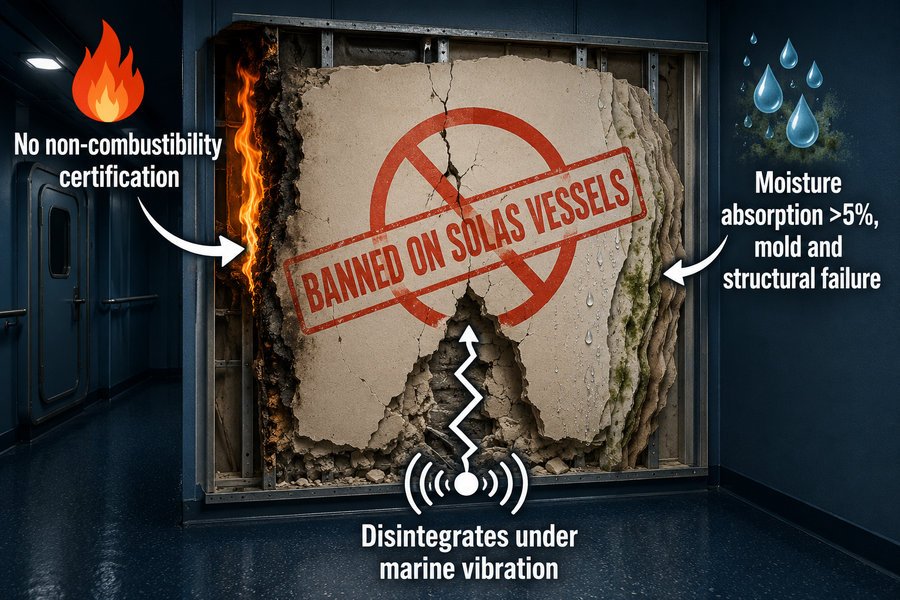
When I worked at the marine outfitting factory, a client asked me if they could use standard gypsum boards to save money. I told them no. Standard gypsum panels are banned on SOLAS vessels1 because of non-combustibility failures, vibration damage, and moisture issues. Let me explain these three points in detail.
The Impact of Marine Vibration on Standard Gypsum
Ships are not static buildings. The main engine and propellers create constant vibration. A typical commercial ship vibrates at a frequency of 5 to 30 Hz2. Standard gypsum boards are very rigid and brittle. Under constant marine vibration, standard gypsum panels will crack at the joints within just a few months. Once the panels crack, the fire integrity of the room is gone. On the other hand, marine panels use a rock wool core. Rock wool is flexible and absorbs this vibration without breaking. This ensures the wall remains whole and safe during the entire life of the ship.
Moisture Absorption and Fire Certification Failures
The marine environment is very wet. At sea, the relative humidity easily stays between 80% and 90%3. Standard gypsum boards have a moisture absorption rate of over 5%. When they absorb water, they become soft and lose their structural strength. This also leads to rapid mold growth.
More importantly, standard gypsum fails the basic non-combustibility certifications. According to the International Maritime Organization (IMO) FTP Code Part 1, any material used for marine bulkheads must pass a 750°C furnace test4. Standard gypsum contains paper layers on the outside. This paper will catch fire immediately in the furnace test. Therefore, it completely lacks the required non-combustibility certifications. Marine panels use galvanized steel or aluminum skins that do not burn.
| Feature | Standard Gypsum Panel | SOLAS Marine Rockwool Panel |
|---|---|---|
| Combustibility | Fails IMO 750°C Test | Passes IMO FTP Code Part 1 |
| Vibration Resistance | Poor (Cracks easily) | Excellent (Flexible core) |
| Moisture Absorption | > 5% | < 1% |
| Surface Material | Paper / Cardboard | Galvanized Steel / PVC Film |
Can Land-Based Fire-Rated Panels Replace SOLAS-Compliant Marine Panels?
Have you found a fire-rated panel for buildings that costs half the price of marine panels? Installing land-based fire panels on ships will still lead to failed inspections.
Land-based fire-rated panels cannot replace SOLAS-compliant marine panels because they miss four marine-specific tests: MED Wheelmark certification, SOLAS low flame-spread surface testing, marine smoke generation limits, and toxic gas emission thresholds, which are not required by standard building codes like ASTM E119.
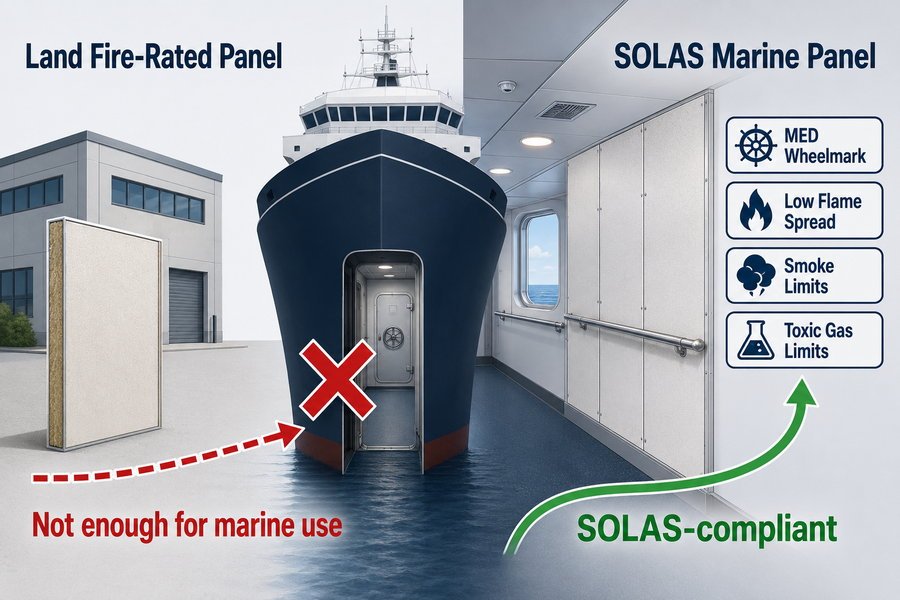
At Magellan Marine, buyers often ask me why they cannot use land-based fire panels. The answer is strict. Building codes and marine codes are very different. Land-based fire panels miss four critical tests required for ships.
Understanding MED Wheelmark and SOLAS Flame-Spread Testing
First, land-based panels do not have MED Wheelmark certification. The Marine Equipment Directive (MED) requires factory audits and strict quality control5 specifically for ships sailing to Europe or the US. You cannot get a Wheelmark for a land-based product.
Second, land panels fail the SOLAS low flame-spread surface testing. According to the IMO FTP Code Part 5, a marine panel surface must not spread flames quickly. Land-based fire doors might stop a fire from burning through, but their decorative surface might catch fire and spread flames down the hallway. Marine panels use special PVC films or painted finishes that stop the flame from moving.
Smoke Generation and Toxic Gas Emission Limits
The third and fourth missing tests are about smoke and toxicity. This is covered by the IMO FTP Code Part 26. When a land-based fire panel burns, the glue inside might create thick black smoke. It might also release toxic gas like carbon monoxide or hydrogen cyanide. In a building, people can run outside. On a ship, people are trapped in enclosed hallways. The IMO limits exactly how much smoke and toxic gas a panel can release. Most land-based fire panels use cheap adhesives that fail the marine smoke generation limits and toxic gas emission thresholds completely.
| Testing Standard | Land-Based Fire Panels (ASTM/EN) | Marine-Grade Panels (SOLAS/IMO) |
|---|---|---|
| MED Wheelmark | No | Yes (Mandatory) |
| Flame Spread Test | Optional for basic fire rating | Mandatory (FTP Code Part 5) |
| Smoke Limits | Relaxed | Very Strict (FTP Code Part 2) |
| Toxicity Limits | Rarely Tested | Mandatory (FTP Code Part 2) |
What Risks Do Shipyards Face Using Non-SOLAS Decorative Panels Onboard?
Are you worried about project delays caused by material compliance issues? Using non-SOLAS panels puts your entire shipbuilding contract at severe financial risk.
Shipyards face three major risks when using non-SOLAS decorative panels: immediate vessel detention by Port State Control, complete project rework costing hundreds of thousands of dollars, and the total voiding of the vessel's marine insurance policies due to non-compliant safety classifications.
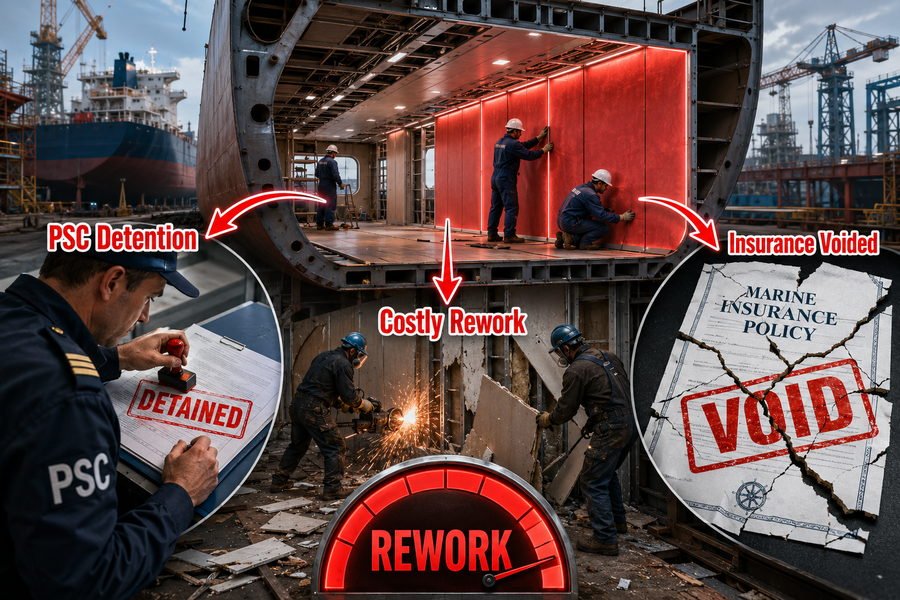
I have seen small shipyards try to hide cheap, non-SOLAS panels in crew cabins. They always get caught. Using non-SOLAS panels brings three major risks to the shipyard: vessel detention, massive rework costs, and insurance problems.
Financial Costs of Project Rework and Vessel Detention
The first two risks happen as soon as the ship tries to sail. Port State Control (PSC) inspectors will check the ship. If they find non-compliant panels, they will issue an immediate vessel detention7. The ship cannot leave the port. This costs the ship owner thousands of dollars every day8.
Next comes the complete project rework. The shipyard must rip out every single bad panel. If you install 1,000 square meters of wrong panels, the material cost is lost. The labor cost to remove them is huge. Buying new, correct panels from China might cost $30 per square meter, making it $30,000. But the labor to redo the whole ship interior can easily exceed $100,0009. The shipyard loses all its profit.
The Voiding of Marine Insurance Policies Due to Non-Compliance
The third risk is long-term. Ships need insurance. To get insurance, a ship needs a certificate from a classification society like DNV or Lloyd's Register. The surveyor will check the MED certificates for all marine panels. If you use non-SOLAS decorative panels, the surveyor will refuse to sign the certificate. This causes the total voiding of the vessel's marine insurance policies10. No ship owner will accept a ship without insurance. The shipyard will face legal action from the owner. You must always verify the certificates before buying.
| Risk Category | Consequence | Financial Impact (Estimate) |
|---|---|---|
| Port State Control | Immediate Vessel Detention | $5,000 - $15,000 per day |
| Project Rework | Remove and replace all panels | Over $100,000 for a medium vessel |
| Classification | Failed Survey / No Class Certificate | Millions (Ship cannot operate) |
| Marine Insurance | Voiding of Insurance Policies | Total loss of asset protection |
Are Commercial Laminate Panels Allowed In SOLAS Accommodation Areas?
Do your clients want the look of high-end commercial laminates in their cabins? Using standard commercial laminates will violate maritime fire safety rules instantly.
Standard commercial laminate panels are not allowed in SOLAS accommodation areas unless they specifically pass the FTP Code Part 5 test for low flame spread and have a calorific value not exceeding 45 MJ/m², ensuring they do not fuel a cabin fire.
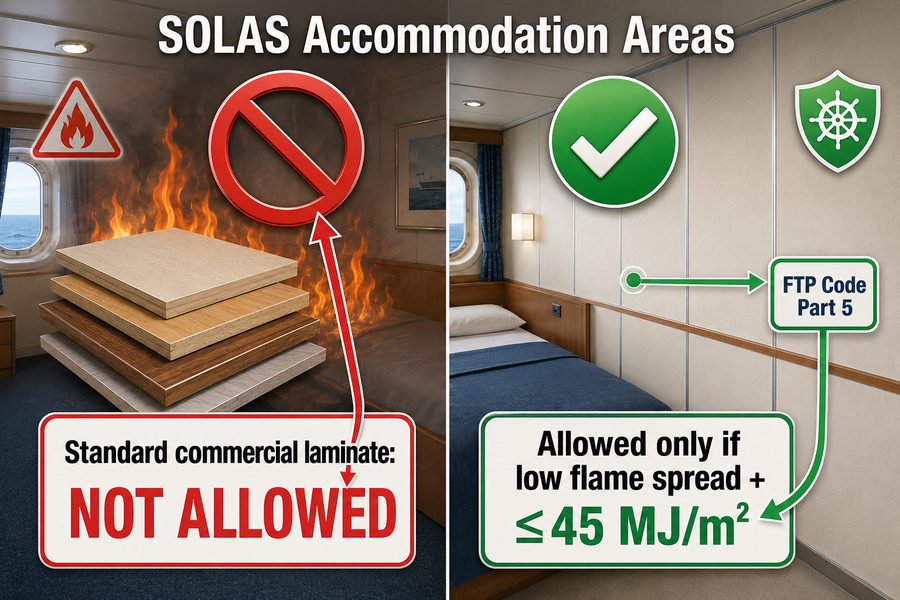
Many interior designers want to use beautiful wood-look laminates they find in commercial catalogs. I always have to stop them. Standard commercial laminate panels are not allowed in SOLAS accommodation areas. They must pass two very strict IMO rules: the FTP Code Part 5 test and the calorific value limit.
The FTP Code Part 5 Low Flame Spread Requirement for Laminates
Standard laminates are made of paper and resin. They burn very fast. The IMO FTP Code Part 5 test for low flame spread11 measures how quickly a fire travels across the surface of the panel. Standard commercial laminates fail this test in minutes. Marine-grade laminates use special fire-retardant resins. These resins stop the fire from spreading. If a fire starts in a cabin trash can, a marine laminate will stop the fire from running up the wall and into the ceiling.
Calorific Value Limits for Marine Accommodation Areas
The second rule is about fuel. Even if a panel does not spread flames quickly, it might still contain a lot of energy that feeds the fire over time. SOLAS states that materials used in accommodation spaces must have a calorific value not exceeding 45 MJ/m²12. This means the total heat energy released by the panel must be very low. Standard commercial laminates are thick and packed with flammable resins. Their calorific value often exceeds 60 or 70 MJ/m². Marine panels use very thin decorative films (usually 0.15mm to 0.2mm thick) to keep the total fuel load well below the 45 MJ/m² limit.
| Panel Type | Low Flame Spread (FTP Part 5) | Calorific Value | Allowed in SOLAS Accommodation? |
|---|---|---|---|
| Standard Commercial Laminate | Usually Fails | Often > 60 MJ/m² | No |
| Marine-Grade Laminate / PVC Film | Passes | < 45 MJ/m² | Yes |
What Core Attributes Separate SOLAS Marine Panels From Ordinary Panels?
Are you struggling to explain the price difference of marine panels to your buyers? The core materials make all the difference in maritime safety and longevity.
SOLAS marine panels are separated from ordinary panels by three core attributes: a non-combustible rockwool or aluminum honeycomb core, a certified weight range of 14-20 kg/m² for A-Class bulkheads, and specialized acoustic insulation properties ranging from 35dB to 45dB sound reduction.
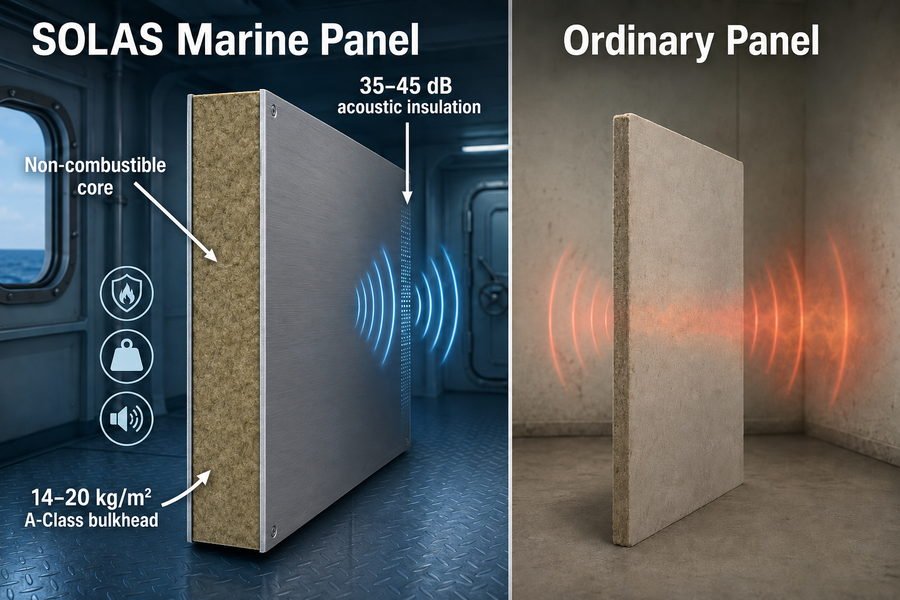
When buyers ask me why marine panels cost more, I tell them to look inside the panel. SOLAS marine panels are separated from ordinary panels by their core materials, strict weight limits, and acoustic features. You cannot find these three core attributes in a standard office wall.
Non-Combustible Cores and Strict Weight Requirements
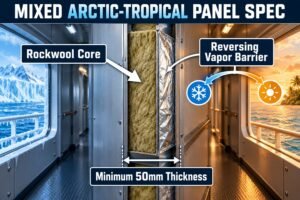
First, ordinary panels use wood, foam, or paper inside. SOLAS marine panels use a non-combustible rockwool or aluminum honeycomb core.13 Rockwool is the most common. It withstands temperatures over 1000°C.
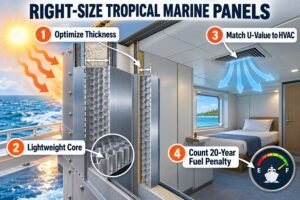
Second, the weight of a ship is very important. If the walls are too heavy, the ship uses too much fuel. A certified weight range of 14-20 kg/m² for A-Class bulkheads is standard in the industry. The factory must compress the rockwool to a specific density, usually 100 kg/m³ to 150 kg/m³, and bond it to thin steel sheets (0.6mm thick). This creates a strong, fireproof panel that stays within the weight limits. Ordinary panels do not control weight strictly.
Acoustic Insulation Properties in Marine Environments
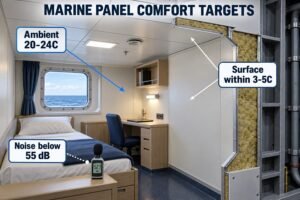
Third, ships are very loud environments. The engine, the generators, and the waves create constant noise. Ordinary building panels only stop about 20dB of sound. Marine panels must have specialized acoustic insulation properties ranging from 35dB to 45dB sound reduction.14 The rockwool core acts as a sound sponge. This keeps the passenger cabins quiet so people can sleep. To achieve a 45dB reduction, we sometimes use double-skin panels with an air gap. This level of engineering is why marine panels are superior and cost more than ordinary panels.
| Attribute | Ordinary Building Panel | SOLAS Marine Panel (A-Class) |
|---|---|---|
| Core Material | Gypsum, Wood, Foam | Rockwool, Aluminum Honeycomb |
| Weight Control | Variable / Heavy | Strict (14 - 20 kg/m²) |
| Acoustic Reduction | Low (~20dB) | High (35dB - 45dB) |
| Fire Rating | Varies by local code | A-0, A-15, A-30, A-60 |
Do Enclosed Technical Spaces On SOLAS Vessels Also Exclude Non-SOLAS Panels?
Do you think technical rooms are exempt from strict passenger cabin rules? Using cheap panels in technical spaces can cause disastrous engine room fires.
Yes, enclosed technical spaces on SOLAS vessels also entirely exclude non-SOLAS panels. These areas, categorized as high-fire-risk zones, require A-60 rated panels that withstand 945°C for 60 minutes, meaning standard panels are strictly forbidden and will fail mandatory classification society surveys.
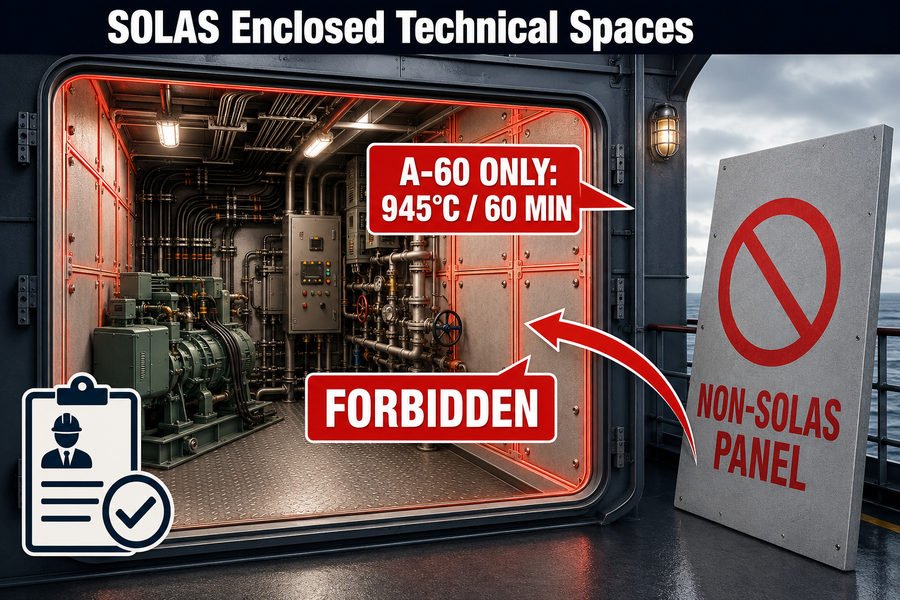
Some buyers think they can use cheap ordinary panels in the engine room because no passengers go there. This is a huge mistake. Yes, enclosed technical spaces on SOLAS vessels also entirely exclude non-SOLAS panels. In fact, the rules for technical spaces are much stricter than for cabins.
High-Fire-Risk Categorization of Enclosed Technical Spaces
Technical spaces include the engine room, the generator room, and fuel separator rooms. According to SOLAS regulations, these are categorized as high-fire-risk zones15. They contain hot exhaust pipes, spinning engines, and tons of diesel fuel. If a fire starts here, it will be incredibly hot and fast. You cannot use ordinary panels here because they will melt in seconds. These areas require the highest level of protection to stop the fire from reaching the crew cabins above.
The A-60 Rating Requirement and Classification Surveys
For these high-risk zones, you must use marine panels with an A-60 rating. An A-60 rating means the panel must withstand 945°C for 60 minutes.16 During this hour, the fire cannot pass through, and the temperature on the safe side of the wall cannot rise more than 180°C. Standard panels are strictly forbidden. They would burn to ash in five minutes.
When the ship is finished, surveyors from the classification society will perform mandatory classification society surveys. They will check the certificates for every panel in the engine room. If they find a non-SOLAS panel, they will fail the ship. You must buy properly certified A-60 rockwool panels, usually 50mm thick with a density of 150 kg/m³, to pass these surveys.
| Space Category | Fire Risk Level | Required Panel Rating | Furnace Temperature |
|---|---|---|---|
| Passenger Cabin Partition | Low to Medium | B-15 | 843°C for 30 mins |
| Corridor Bulkhead | Medium | B-15 or A-0 | 843°C / 945°C |
| Engine Room / Technical Space | High | A-60 | 945°C for 60 mins |
Conclusion
Using proper SOLAS-certified panels is not just a regulatory rule; it is a life-saving necessity. Never compromise on marine safety standards to save a few dollars on interior outfitting.
-
"What Is the Purpose and Scope of the IMO FTP Code? - Magellan ...", https://magellanmarinetech.com/what-purpose-scope-of-imo-ftp-code/. SOLAS fire-safety requirements and the IMO FTP Code require specified shipboard construction materials to meet non-combustibility and fire-test criteria for approved marine use; this supports the regulatory basis for excluding ordinary paper-faced gypsum boards where such approved non-combustible materials are required. Evidence role: expert_consensus; source type: institution. Supports: Standard gypsum panels are not acceptable for SOLAS-regulated marine bulkhead applications because required materials must meet IMO/SOLAS fire-performance approvals.. Scope note: The source may establish the approval/testing requirements rather than name every prohibited product; the article should avoid implying a universal explicit ban unless the regulation or flag/class guidance specifically identifies standard gypsum board. ↩
-
"noise and vibrations on board cruise ships: are new standards ...", https://www.academia.edu/7913564/NOISE_AND_VIBRATIONS_ON_BOARD_CRUISE_SHIPS_ARE_NEW_STANDARDS_EFFECTIVE. Measurements and vibration standards for ships report that machinery, propulsion, hull, and accommodation-area vibration commonly occurs in low-frequency bands that include the 5–30 Hz range, supporting the article’s description of continuous low-frequency marine vibration. Evidence role: statistic; source type: paper. Supports: A typical commercial ship can experience vibration in the 5 to 30 Hz range.. Scope note: Reported frequency ranges vary by vessel type, speed, machinery layout, and measurement location, so the cited range should be presented as typical or illustrative rather than universal. ↩
-
"47. Relative humidity over the oceans", https://www.gfdl.noaa.gov/blog_held/47-relative-humidity-over-the-oceans/. Marine meteorological references describe ocean and coastal air as generally humid, with relative humidity often high over open water; this provides contextual support for the article’s statement that shipboard environments can experience relative humidity near 80–90%. Evidence role: general_support; source type: government. Supports: At sea, relative humidity can commonly remain between 80% and 90%.. Scope note: Relative humidity at sea depends on region, season, ventilation, temperature, and onboard HVAC conditions; a general marine-climate source does not prove that all vessel interiors remain in this range. ↩
-
"What Is the Purpose and Scope of the IMO FTP Code? - Magellan ...", https://magellanmarinetech.com/what-purpose-scope-of-imo-ftp-code/. The IMO Fire Test Procedures Code Part 1 defines the non-combustibility test for ship materials using a furnace maintained at approximately 750°C, supporting the article’s description of the fire-certification test relevant to marine interior materials. Evidence role: definition; source type: institution. Supports: IMO FTP Code Part 1 uses a 750°C furnace test for determining non-combustibility of marine materials.. Scope note: This supports the test method and temperature; whether a specific gypsum board fails requires a separate product-specific test report or certification record. ↩
-
"Directive 96/98/EC - Wikipedia", https://en.wikipedia.org/wiki/Directive_96/98/EC. The EU Marine Equipment Directive establishes conformity-assessment procedures for marine equipment, including production-quality assurance and notified-body involvement, as a condition for placing wheel-marked equipment on EU ships. Evidence role: general_support; source type: government. Supports: The Marine Equipment Directive requires factory audits and quality-control procedures for marine equipment certification.. Scope note: This supports the MED/Wheelmark requirement in the EU context; it does not by itself establish the same requirement for US-flag ships. ↩
-
"[PDF] RESOLUTION MSC.307(88) (adopted on 3 December 2010 ...", https://wwwcdn.imo.org/localresources/en/KnowledgeCentre/IndexofIMOResolutions/MSCResolutions/MSC.307(88).pdf. The IMO Fire Test Procedures Code Part 2 specifies smoke and toxicity test methods and acceptance criteria for materials used on ships, providing the regulatory basis for limits on smoke production and toxic-gas emissions. Evidence role: definition; source type: institution. Supports: IMO FTP Code Part 2 covers smoke generation and toxic-gas emission limits for shipboard materials.. Scope note: The source defines the test framework and criteria; it does not prove that any specific land-based panel or adhesive fails those limits. ↩
-
"[PDF] PROCEDURES FOR PORT STATE CONTROL, 2023", https://wwwcdn.imo.org/localresources/en/OurWork/IIIS/Documents/A%2033-Res.1185%20-%20PROCEDURES%20FOR%20PORT%20STATE%20CONTROL,%202023%20(Secretariat)%20(1).pdf. Port State Control guidance from IMO and regional MoUs states that ships may be detained when deficiencies create an unreasonable risk to safety, health, or the marine environment, including serious SOLAS-related deficiencies. Evidence role: general_support; source type: institution. Supports: Port State Control inspectors can detain a vessel when non-compliant panels create a serious SOLAS-related deficiency.. Scope note: This supports detention as a regulatory risk; it does not prove that every non-SOLAS panel finding will automatically result in immediate detention. ↩
-
"[PDF] PROCEDURES FOR PORT STATE CONTROL, 2023", https://wwwcdn.imo.org/localresources/en/OurWork/IIIS/Documents/A%2033-Res.1185%20-%20PROCEDURES%20FOR%20PORT%20STATE%20CONTROL,%202023%20(Secretariat)%20(1).pdf. Studies and maritime guidance on vessel detention and off-hire costs describe detention as causing daily financial losses through lost earnings, port expenses, and delay-related charges. Evidence role: statistic; source type: paper. Supports: Vessel detention can cost shipowners thousands of dollars per day.. Scope note: The daily amount varies by vessel type, charter market, port costs, and contract terms, so the source would provide contextual support rather than verify the article’s exact dollar range. ↩
-
"Improved Management Practices Could Help Minimize Cost Growth ...", https://www.gao.gov/assets/a245498.html. Shipbuilding rework research identifies rework as a significant cost driver because it requires removal, replacement, additional labor hours, and schedule disruption after installation errors are discovered. Evidence role: general_support; source type: paper. Supports: Replacing non-compliant installed panels can create major rework costs, potentially exceeding material costs.. Scope note: Such sources can support the mechanism and scale of rework costs generally, but may not directly confirm the specific $100,000 figure for a medium vessel interior. ↩
-
"(PDF) SHIP'S CLASS AS A MARINE INSURANCE CONTRACT TERM", https://www.academia.edu/29746988/SHIPS_CLASS_AS_A_MARINE_INSURANCE_CONTRACT_TERM. Marine insurance and classification guidance commonly treats class status and statutory compliance as material to insurability, and loss of class or regulatory non-compliance may jeopardize coverage depending on policy wording. Evidence role: expert_consensus; source type: institution. Supports: Failure to obtain or maintain class/statutory compliance can create serious marine insurance coverage problems.. Scope note: This supports insurance risk, but not an automatic total voiding of all policies in every case; the legal effect depends on the policy terms and jurisdiction. ↩
-
"[PDF] RESOLUTION MSC.61(67) (adopted on 5 December 1996 ...", https://wwwcdn.imo.org/localresources/en/KnowledgeCentre/IndexofIMOResolutions/MSCResolutions/MSC.61(67).pdf. The IMO 2010 FTP Code, Annex 1, Part 5, sets out the surface-flammability test used to classify low flame-spread characteristics for shipboard surface materials, including measurements related to flame spread and heat release. Evidence role: definition; source type: institution. Supports: The IMO FTP Code Part 5 test is the relevant low flame-spread test for laminate surfaces used in SOLAS-regulated accommodation areas.. Scope note: This supports the purpose of the test, not the separate assertion that standard commercial laminates fail it. ↩
-
"[PDF] MSC.99(73) - International Maritime Organization", https://wwwcdn.imo.org/localresources/en/KnowledgeCentre/IndexofIMOResolutions/MSCResolutions/MSC.99(73).pdf. SOLAS Chapter II-2, Regulation 5 places a 45 MJ/m² gross calorific-value limit on certain combustible materials used on specified exposed interior surfaces and linings in accommodation and service spaces. Evidence role: general_support; source type: institution. Supports: SOLAS restricts the calorific value of relevant combustible surface materials in accommodation areas to no more than 45 MJ/m².. Scope note: The regulation applies to defined combustible surface materials and linings, so it should not be read as a blanket limit for every material in an accommodation space. ↩
-
"[PDF] RESOLUTION A.754(18) adopted on 4 November 1993 ...", https://wwwcdn.imo.org/localresources/en/KnowledgeCentre/IndexofIMOResolutions/AssemblyDocuments/A.754(18).pdf. The IMO/SOLAS framework for A-class divisions requires construction from steel or equivalent material and insulation with approved non-combustible materials, which supports the need for non-combustible cores in marine fire-rated panels. Evidence role: definition; source type: institution. Supports: SOLAS marine panels use non-combustible core materials rather than ordinary combustible panel cores.. Scope note: This supports the regulatory non-combustibility requirement for A-class marine divisions, but it does not by itself prove that rockwool or aluminum honeycomb are the only or universal core materials used. ↩
-
"How to choose the right marine wall panels for marine interior ...", https://magellanmarinetech.com/how-choose-right-marine-wall-panels-for-marine-interior-projects/. IMO guidance on shipboard noise establishes maximum noise levels for accommodation and working spaces, supporting the general need for acoustic control in marine interiors; published ship-acoustics studies can provide context for partition sound-reduction performance, though the cited range should be verified against a source that reports panel-level test values. Evidence role: general_support; source type: institution. Supports: Marine panels require acoustic insulation to reduce shipboard noise, with the article stating a typical 35–45 dB sound-reduction range.. Scope note: IMO noise rules support the need for acoustic insulation but may not directly specify a 35–45 dB sound-reduction range for marine panels; a laboratory test report or peer-reviewed acoustics source is needed for the exact range. ↩
-
"History of SOLAS fire protection requirements", https://www.imo.org/en/OurWork/Safety/Pages/History-of-fire-protection-requirements.aspx. SOLAS Chapter II-2 classifies ship spaces by fire risk and function, including machinery spaces of category A, and uses these categories to prescribe fire-integrity requirements for surrounding divisions. Evidence role: definition; source type: institution. Supports: Technical spaces such as engine rooms, generator rooms, and fuel separator rooms are treated under SOLAS as spaces with elevated fire-risk classifications.. Scope note: The article’s phrase “high-fire-risk zones” is a plain-language paraphrase; SOLAS uses formal space categories rather than that exact wording. ↩
-
"What Is the Purpose and Scope of the IMO FTP Code? - Magellan ...", https://magellanmarinetech.com/what-purpose-scope-of-imo-ftp-code/. The IMO Fire Test Procedures Code defines A-class divisions as divisions tested in a standard fire test and specifies that A-60 divisions must prevent smoke and flame passage for 60 minutes while limiting temperature rise on the unexposed face. Evidence role: definition; source type: institution. Supports: An A-60 marine panel rating denotes a 60-minute fire-resistance performance under the IMO standard fire-test regime, including limits on flame passage and unexposed-side temperature rise.. Scope note: The cited test standard supports the A-60 performance criteria; the exact furnace temperature is derived from the standard time–temperature curve rather than a single constant temperature for the entire test. ↩