Refitting a ship is a complex job. Getting SOLAS rules wrong causes delays and massive fines. Let us look at exactly when you must use SOLAS-compliant panels.
A ship refurbishment triggers SOLAS marine panel compliance during major conversions like passenger capacity changes, structural layout modifications, reflagging to international registries, and any direct replacement of existing SOLAS-certified materials. Cosmetic upgrades generally do not trigger new compliance unless they alter fire load or escape routes.
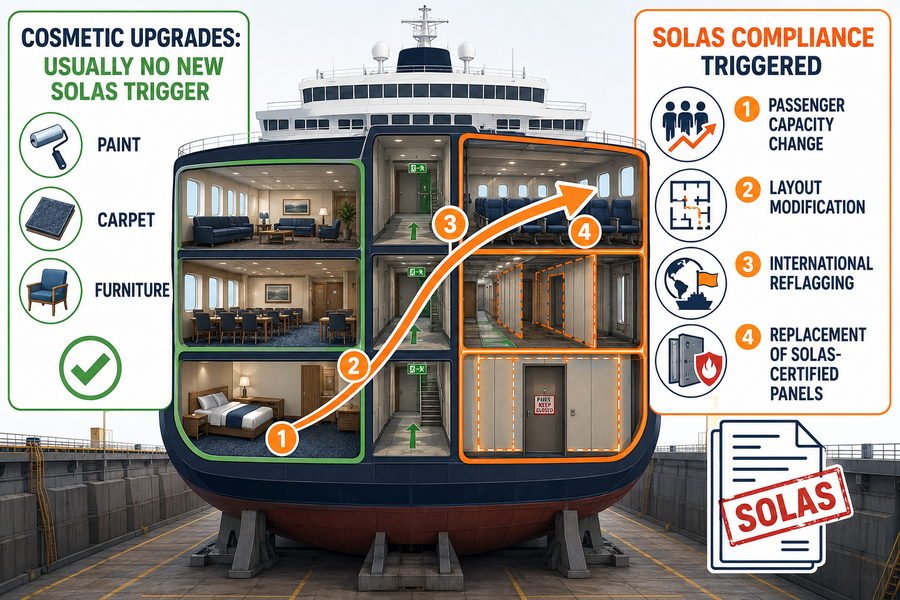
Knowing these rules saves you money and time. In my years working in marine outfitting, I have seen buyers purchase cheap panels, only to fail the final inspection. You must buy the right materials for the right project. Let us break down the specific situations you will face.
Does a partial interior refit require SOLAS-compliant marine wall and ceiling panels?
Replacing a few old cabins seems easy. But ignoring fire rules here can fail your entire deck inspection. You need to know the rules before you buy.
Yes, a partial interior refit requires SOLAS-compliant marine wall and ceiling panels if it alters fire boundaries, increases total combustible volume beyond 45kg/m2, or modifies escape routes. Simple cosmetic swaps on non-structural surfaces do not, but any new structural partition must meet current SOLAS Chapter II-2 standards.
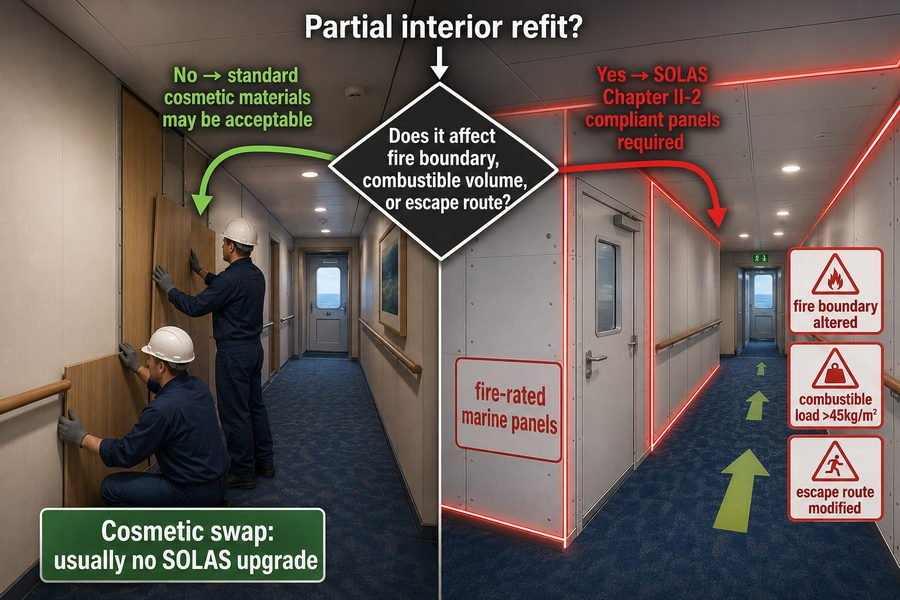
As a marine outfitting specialist at Magellan Marine, I often guide buyers through partial refits. You must look at every part of your project to see if SOLAS applies. I will explain the five critical triggers you must check.
Managing Fire Boundaries and Combustible Volume in Partial Refits
First, we must talk about fire boundaries. A fire boundary is an A-class or B-class division that stops fire from spreading1. If your partial refit alters a fire boundary, you must use SOLAS-approved panels. For example, if you remove an old A-60 wall to join two rooms, the new replacement wall must also be A-60 certified. You cannot use a lower grade.
Second, you must calculate your total combustible volume. SOLAS Chapter II-2 states you cannot exceed 45 kilograms of combustible material per square meter (45kg/m2)2 in accommodation spaces. If you add new wood furniture and non-certified ceiling panels, you might pass the 45kg limit. If this happens, inspectors will force you to rip out the new panels.
Third, pay close attention to escape routes. Escape routes are the hallways and stairs people use during a fire. If your partial refit touches an escape route, every panel you install there must meet strict SOLAS B-15 fire ratings. The IMO Fire Test Procedures (FTP) Code requires these panels to block flames for 30 minutes and limit temperature rise for 15 minutes3. A standard B-15 wall panel from a reliable Asian supplier usually costs between $45 and $65 USD per square meter.
Structural Partitions vs. Simple Cosmetic Swaps in Ship Interiors
Fourth, we have simple cosmetic swaps on non-structural surfaces. If you only change the surface finish on a wall that does not support weight or stop fire, you do not need new SOLAS-certified core panels. You can keep the old panels if they are in good condition.
Fifth, you must understand structural partitions. A structural partition is a new wall you build to create a new room. Even if it is just a small closet, it is a structural partition. Any new structural partition must meet current SOLAS Chapter II-2 standards4. You must use non-combustible materials like rockwool core panels.
| Refit Action | Does it trigger SOLAS panel compliance? | Reason based on SOLAS Chapter II-2 |
|---|---|---|
| Altering a fire boundary | Yes | Must maintain original A-class or B-class rating |
| Exceeding 45kg/m2 combustible limit | Yes | Breaches strict ship fire load limits |
| Modifying an escape route | Yes | Hallways require B-15 or higher fire protection |
| Simple cosmetic surface swap | No | Underlying certified panel remains intact |
| Building new structural partition | Yes | All new walls must use non-combustible materials |
Does converting a cargo ship to passenger service trigger SOLAS panel rules?
Changing ship types brings huge profit but strict rules. Passenger ships face the toughest fire safety codes in the world. Here is what you must do.
Yes, converting a cargo ship to passenger service completely triggers SOLAS panel rules. Under SOLAS Chapter II-2, passenger ships carrying over 36 passengers require strictly A, B, or C class non-combustible panels throughout all accommodation spaces, demanding a full replacement of standard cargo ship interior bulkheads.
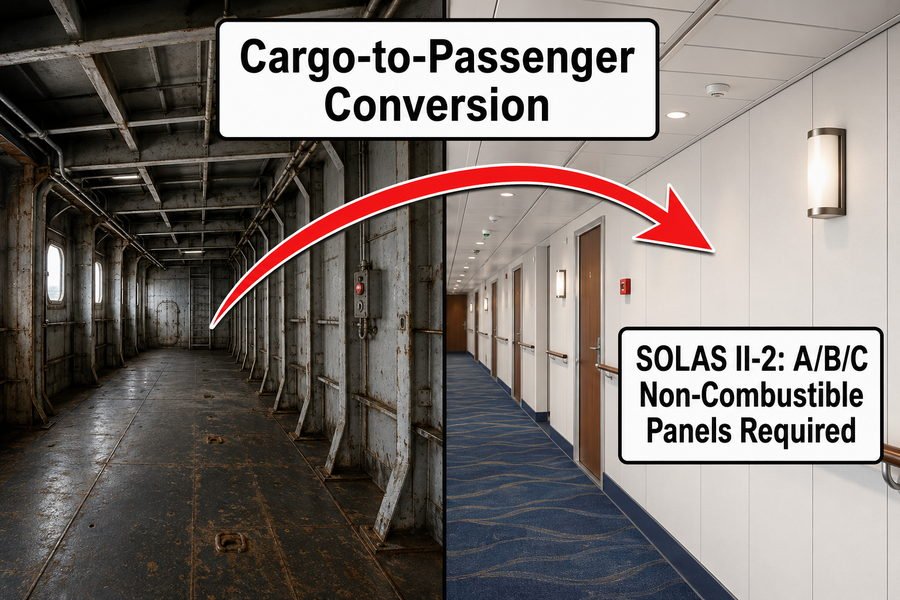
Converting a vessel is basically building a new interior. When I worked at the marine outfitting factory, we produced thousands of panels for these conversions. You cannot cut corners here. You must address the exact rules set by SOLAS.
SOLAS Chapter II-2 Rules for Passenger Ships Over 36 Passengers
First, we must look at the specific rules in SOLAS Chapter II-2. The rules change dramatically based on passenger count. If your converted ship carries over 36 passengers, the regulations become extremely strict. SOLAS requires a method of construction that relies entirely on non-combustible divisions.5 You cannot use any combustible materials for the main framework or bulkheads.
Second, you must understand the A, B, and C class non-combustible panels. A-class panels are steel or aluminum and heavily insulated.6 They protect high-risk areas like engine rooms. B-class panels (like B-15 or B-0) are used for cabin walls.7 They are made of non-combustible materials like rockwool or calcium silicate. C-class panels are non-combustible but have no specific smoke or fire requirements. You must use these specific classes for every single wall and ceiling in the accommodation area.
The Financial Impact of Full Cargo Ship Interior Bulkhead Replacement
Third, this conversion demands a full replacement of standard cargo ship interior bulkheads. Cargo ships often use simpler, less fire-resistant materials in their small crew spaces. You cannot keep these. You must tear them all out.
Fourth, you need to budget for this full replacement. The price difference is huge. A basic, non-certified wood-based panel for a local cargo boat might cost $15 USD per square meter. But a high-quality, MED-certified B-15 rockwool panel will cost around $50 to $70 USD per square meter.8 If you need A-60 panels for the galley or engine room boundaries, expect to pay $110 to $150 USD per square meter. For a standard 100-passenger conversion project, the total panel budget can easily exceed $150,000 USD just for the raw materials.
| Panel Class | Typical Location on Passenger Ship | Estimated Cost (USD per sqm) | SOLAS Requirement |
|---|---|---|---|
| A-60 Class | Engine room, Galley boundaries | $110 - $150 | Blocks fire for 60 mins |
| B-15 Class | Cabin walls, Escape corridors | $50 - $70 | Blocks fire for 15 mins |
| C Class | Bathrooms, Open spaces | $35 - $45 | Non-combustible only |
| Non-certified | NOT ALLOWED | $10 - $20 | Must be removed completely |
Must like-for-like replacement panels on a SOLAS vessel stay SOLAS-certified?
You only need to replace a broken door or panel. Can you buy a cheaper, uncertified one? Doing so will void your ship's certificate.
Yes, any like-for-like replacement panels on a SOLAS vessel must stay SOLAS-certified. Even replacing a single damaged B-15 wall panel requires a MED-approved equivalent with the exact same or better fire rating and acoustic properties to maintain the vessel's original fire safety plan and certification.
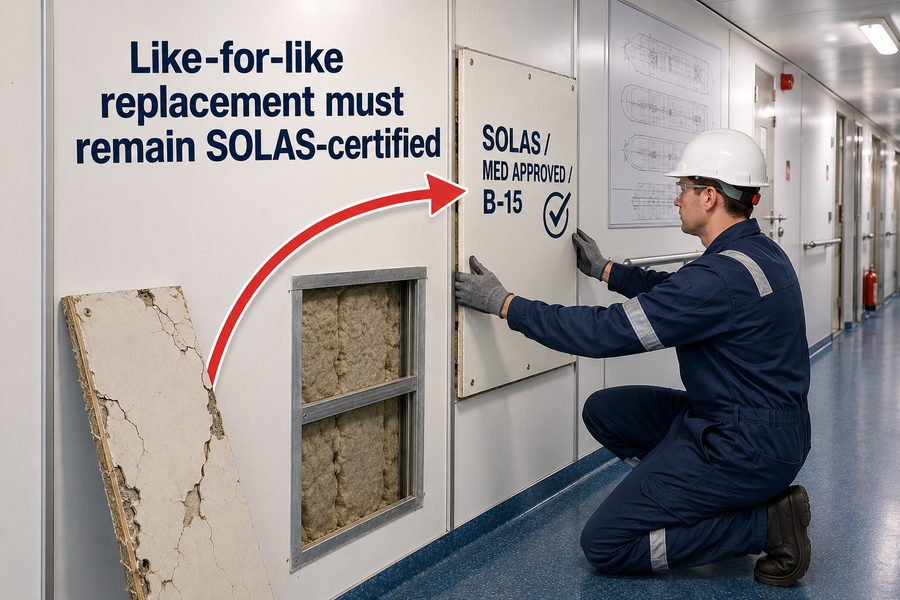
I often get calls from buyers who just want to buy one or two panels to fix a hole. They ask for the cheapest option. I always tell them no. You must match the original specs exactly. Let me explain the four specific things you must match.
Meeting MED Approval and Fire Rating Standards for Replacement Panels
First, your replacement panel must be MED-approved9. MED stands for Marine Equipment Directive. Products with this approval carry a "Wheelmark" logo. This logo proves the panel passed the IMO Fire Test Procedures. If an inspector boards your ship and sees a panel without a Wheelmark, they can detain the ship10. You cannot fake this certification.
Second, you must provide the exact same or better fire rating. If the damaged wall was a B-15 panel, the new one must be B-15 or B-30. You cannot use a B-0 panel, even if it looks identical. A B-15 panel stops heat transfer for 15 minutes, while a B-0 panel only stops flames, not heat.11 The safety of the ship relies on that specific 15-minute barrier.
Maintaining Acoustic Properties and the Ship's Fire Safety Plan
Third, you must consider the acoustic properties. Many buyers forget this. SOLAS and local maritime rules dictate noise levels in cabins. According to the IMO Code on Noise Levels on Board Ships, cabin-to-cabin walls must typically have a sound reduction index (Rw) of at least 35 dB12. If you replace a thick acoustic panel with a cheap, hollow panel, the room will fail the noise inspection. High-acoustic B-15 panels (around 45 dB) cost about $80 to $100 USD per square meter, but you must buy them if the original design required them.
Fourth, you must maintain the vessel's original fire safety plan and certification. Every SOLAS ship has a massive book of drawings called the fire control plan. This plan lists the exact materials used in every room. When a classification society like DNV or Lloyd's Register approves your ship, they approve that specific plan. If you use uncertified panels, your ship no longer matches the plan. Your safety certificate becomes invalid instantly.
| Replacement Requirement | Why It Is Mandatory | Consequence of Failing |
|---|---|---|
| MED-Approved (Wheelmark) | Proves compliance with IMO testing | Ship detention by Port State Control |
| Exact/Better Fire Rating | Maintains 15/60 minute fire barriers | Fire spreads faster than designed |
| Acoustic Properties (dB) | Meets IMO Code on Noise Levels | Fails crew health and safety checks |
| Matches Fire Safety Plan | Keeps Classification Society approval | Loss of vessel insurance and certification |
Does reflagging to an international registry force SOLAS-compliant interior panels?
Changing your ship's flag state? The new registry will check everything. Your old local panels might not pass the new international rules.
Yes, reflagging a domestic ship to an international registry forces compliance with SOLAS-compliant interior panels. International flag states require the vessel to meet full SOLAS Chapter II-2 fire safety standards, often necessitating the complete removal of domestic-grade wooden or low-fire-rating panels to achieve MED certification.
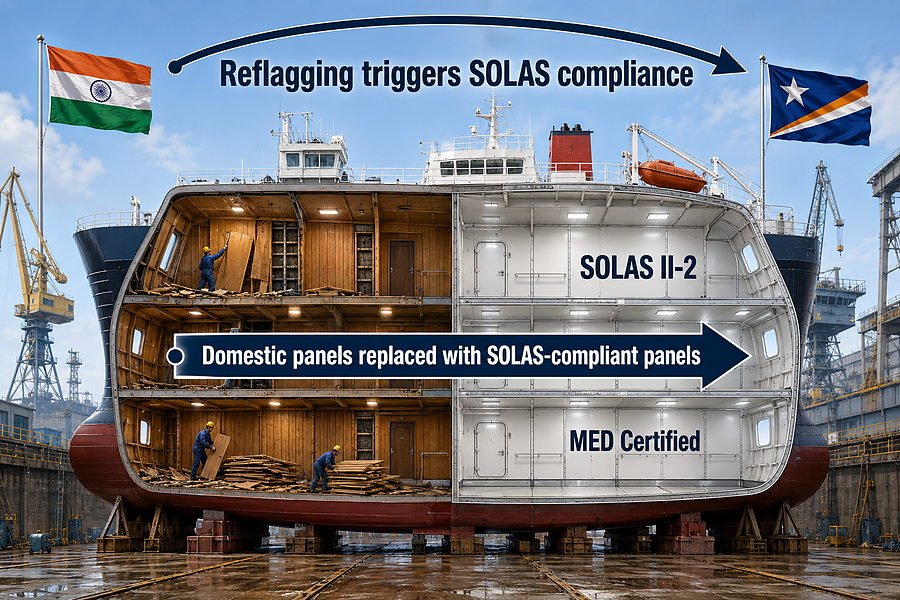
Reflagging is a major legal and physical change for a ship. I have helped clients upgrade ships bought from local Chinese rivers to sail internationally. The panel upgrade is always the biggest shock for them. We need to look at the four elements that make this happen.
Meeting Full SOLAS Chapter II-2 Standards During Flag Changes
First, international flag states require the vessel to meet full SOLAS Chapter II-2 fire safety standards. When a ship sails only in local waters, it follows local rules. These local rules are often much weaker than SOLAS. But the moment you register the ship in Panama, Liberia, or the Marshall Islands, you must follow global SOLAS rules13. There is no escape.
Second, this means achieving MED certification for the interior. The new flag state will send a surveyor from an IACS classification society14 (like ABS or Bureau Veritas) to inspect the ship. They will ask to see the MED certificates for your wall and ceiling panels. If your old panels only have a local certificate, the surveyor will reject them.
Removing Domestic-Grade Wooden and Low-Fire-Rating Panels
Third, this process often forces the complete removal of domestic-grade wooden panels. Many older local ferries use beautiful wood panels in their dining rooms. Under SOLAS rules, large amounts of exposed wood are a massive fire hazard15. You must tear out all this wood.
Fourth, you must also remove low-fire-rating panels. A local panel might resist fire for 5 minutes. SOLAS requires a minimum of 15 minutes (B-15) for most cabin corridors16. Removing and replacing these panels is a big investment. For a 50-meter offshore supply vessel, replacing 2000 square meters of local panels with MED-approved rockwool panels will cost roughly $100,000 to $130,000 USD in materials alone. Plus, you have the labor cost of removing the old panels.
| Ship Type Status | Fire Standard Used | Acceptable Panel Materials |
|---|---|---|
| Domestic/Local River | Local Maritime Authority Rules | Treated wood, low-grade PVC, C-class |
| International Registry | Full SOLAS Chapter II-2 | MED-certified Rockwool, Aluminum honeycomb |
| Transition/Reflagging | Must upgrade to SOLAS | Complete removal of non-MED materials |
Do dry-dock cosmetic upgrades require SOLAS marine panel replacement?
Upgrading wallpaper or carpet in dry-dock seems safe. But adding the wrong materials can create a fire hazard and fail your inspections.
No, simple dry-dock cosmetic upgrades do not require SOLAS marine panel replacement if the underlying certified panels remain intact. However, the surface materials used (like veneers, paints, or laminates) must have low flame-spread characteristics, generate low smoke, and not exceed a calorific value of 45 MJ/m2.
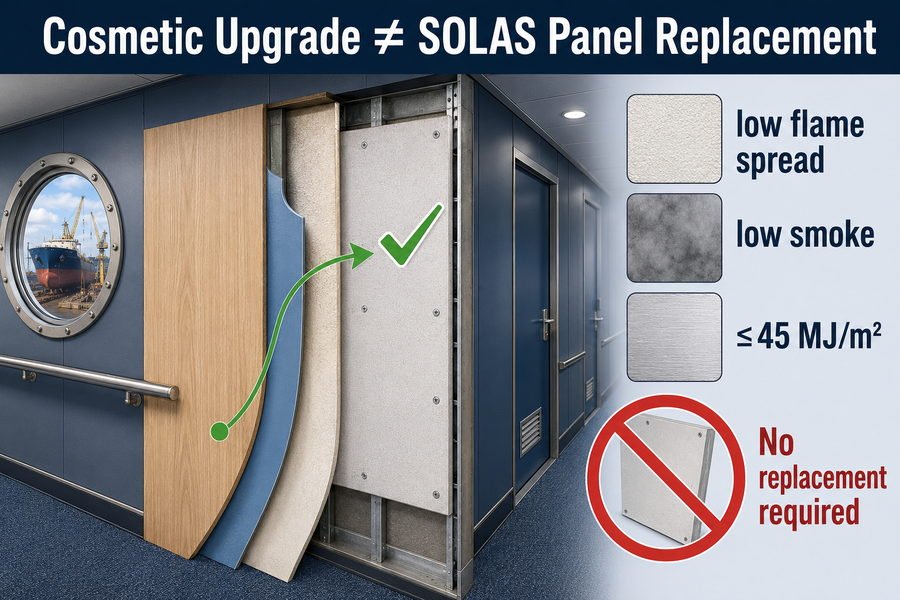
Dry-dock time is tight. Buyers always want to refresh the cabins quickly to impress the ship owners. As a marine outfitting specialist, I tell them they can save money by keeping the old core panels, but they must be very careful with the new surfaces. Here are the five rules you must follow.
Protecting Intact Certified Panels During Cosmetic Upgrades
First, the underlying certified panels must remain intact. If you have a B-15 rockwool panel17, it is the metal skin and rockwool core that stop the fire. As long as you do not cut large holes in it or break the joints, the panel is still legal. You do not need to replace it.
Second, you must look at the specific surface materials used. You cannot use normal house wallpaper or standard building paint. You must use marine-grade veneers, paints, or laminates. A standard PVC marine film usually costs about $3 to $5 USD per square meter. It is thin, usually between 0.15mm and 0.6mm thick.
Third, these materials must have low flame-spread characteristics. This is tested under the IMO FTP Code Part 518. When exposed to heat, the surface must not let flames run quickly across the wall. If a fire starts in a trash can, a low flame-spread laminate will stop the fire from climbing the wall easily.
Smoke Generation and Calorific Value Limits for Surface Materials
Fourth, the new surface must generate low smoke. IMO FTP Code Part 2 regulates smoke and toxicity. Most people in ship fires die from smoke, not heat.19 The laminate or paint you stick on the wall must not release deadly toxic gases like hydrogen cyanide when it burns.
Fifth, the material must not exceed a calorific value of 45 MJ/m2. Calorific value measures how much energy (heat) a material releases when it burns. SOLAS Chapter II-2 is very strict about this. The total thickness of combustible veneers cannot exceed 2mm in standard spaces, and only 1.5mm in corridors and stairways.20 This keeps the calorific value low. If you glue three layers of heavy wallpaper on top of each other over the years, you will break the 45 MJ/m2 limit and fail the safety inspection.
| Cosmetic Material Aspect | SOLAS / IMO Requirement | Practical Meaning for Procurement |
|---|---|---|
| Underlying Core Panel | Must remain intact | Do not break or drill big holes in old panels |
| Flame-Spread | Low flame-spread (FTP Part 5) | Fire cannot travel fast across the surface |
| Smoke & Toxicity | Low smoke (FTP Part 2) | Cannot release deadly gases when heated |
| Calorific Value | Max 45 MJ/m2 | Limits total energy released during a fire |
| Veneer Thickness | Max 1.5mm to 2mm | Cannot stack multiple layers of thick laminate |
Does a cabin layout redesign re-trigger SOLAS marine panel review?
Moving walls to make cabins bigger? This changes escape paths and fire zones. You cannot do this without a new safety review.
Yes, any cabin layout redesign re-triggers a SOLAS marine panel review. Moving bulkheads alters the established fire control plan, escape route widths, and ventilation airflow. The new layout must be re-evaluated by a classification society to ensure all newly placed B-15 or C class panels meet current safety codes.
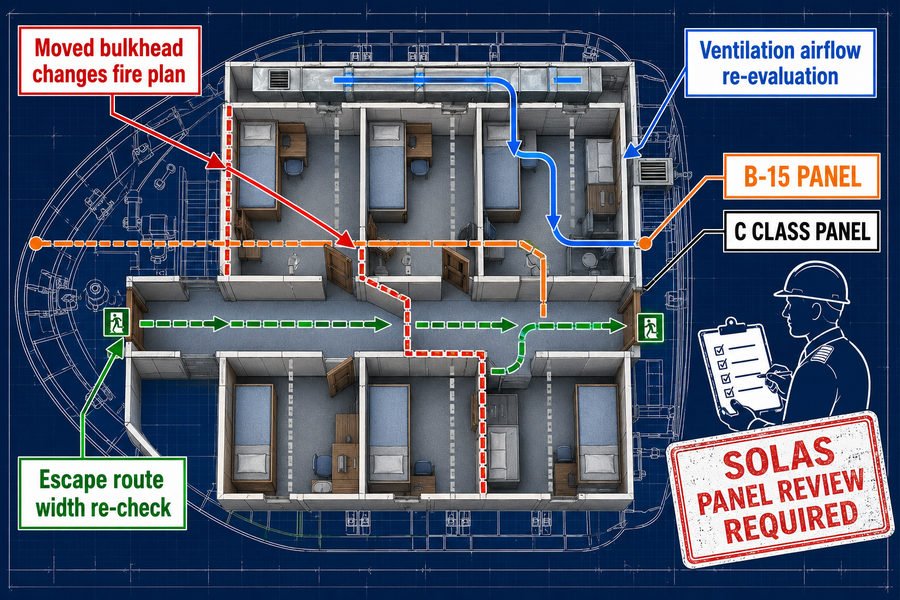
Ship owners love to redesign cabins. They want bigger suites or more beds. But moving a wall is not just a carpentry job. It is a major safety event. At Magellan Marine, we always remind buyers about the heavy paperwork involved. Let us review the five reasons a redesign triggers a new review.
How Moving Bulkheads Alters Escape Routes and Fire Control Plans
First, moving bulkheads alters the established fire control plan21. The fire control plan is the master map of the ship's safety. If you move a wall just one meter to the left, the map is wrong. The fire crew will not know the true layout. This is illegal.
Second, a redesign always affects escape route widths. SOLAS Chapter II-2 dictates exactly how wide a hallway must be based on passenger numbers22. Typically, a main corridor must be at least 900mm wide. If you make a cabin bigger and narrow the hallway to 800mm, you create a deadly bottleneck. The reviewer will check your new drawing to ensure the panels do not squeeze the escape route.
Third, moving walls changes the ventilation airflow. Marine panels often have specific gaps or louvers for air. The ship's HVAC system relies on this layout to manage smoke in a fire. Changing the room shape changes how smoke moves23. This requires a full engineering check.
Getting Classification Society Approval for Newly Placed Panels
Fourth, the new layout must be re-evaluated by a classification society24. You cannot just build the new rooms and sail away. You must submit the new CAD drawings to ABS, DNV, or your specific class society. They will charge engineering fees to review the new layout. This process can take several weeks.
Fifth, they must ensure all newly placed B-15 or C class panels meet current safety codes. Even if you use the exact same brand of panel, the new location might require a higher rating. A wall that used to be a C-class (no fire rating) divider between two beds might now become a B-15 wall if it borders a new hallway. You must buy the correct panels for the new specific locations.
| Redesign Factor | Why it Triggers a Review | Classification Society Action |
|---|---|---|
| Moving Bulkheads | Invalidates old fire plan | Requires submission of new CAD drawings |
| Escape Route Widths | Must meet SOLAS min widths (e.g. 900mm) | Rejects plans if corridors are too narrow |
| Ventilation Airflow | Smoke extraction paths change | Checks HVAC and panel louver placement |
| Panel Class Placement | New wall location may need higher rating | Verifies B-15 panels are used near hallways |
Conclusion
A ship refurbishment triggers SOLAS compliance whenever you alter fire boundaries, change passenger capacity, reflag the vessel, or modify the cabin layout. Always verify with your classification society before starting work.
-
"[PDF] RESOLUTION MSC.307(88) (adopted on 3 December 2010 ...", https://wwwcdn.imo.org/localresources/en/KnowledgeCentre/IndexofIMOResolutions/MSCResolutions/MSC.307(88).pdf. SOLAS Chapter II-2 and the IMO Fire Test Procedures Code define A-class and B-class divisions as rated bulkheads or decks tested for fire integrity and insulation performance, supporting the description of fire boundaries as divisions intended to limit fire spread. Evidence role: definition; source type: institution. Supports: A fire boundary is an A-class or B-class division intended to stop or limit the spread of fire.. ↩
-
"[PDF] MSC.99(73) - International Maritime Organization", https://wwwcdn.imo.org/localresources/en/KnowledgeCentre/IndexofIMOResolutions/MSCResolutions/MSC.99(73).pdf. A SOLAS or flag-state guidance source identifies limits or calculation methods for combustible materials/fire load in accommodation spaces and provides context for the cited 45 kg/m² threshold. Evidence role: statistic; source type: institution. Supports: SOLAS Chapter II-2 sets or is applied through a 45 kg/m² combustible-material limit in accommodation spaces.. Scope note: Applicability may depend on vessel type, flag administration, and whether the cited figure is a SOLAS requirement or an implementing guidance criterion. ↩
-
"What Is the Purpose and Scope of the IMO FTP Code? - Magellan ...", https://magellanmarinetech.com/what-purpose-scope-of-imo-ftp-code/. The IMO Fire Test Procedures Code describes B-class divisions as preventing flame passage for a specified fire-test period and distinguishes B-15 insulation by its temperature-rise criterion for the first 15 minutes, supporting the stated performance basis for B-15 panels. Evidence role: mechanism; source type: institution. Supports: B-15 rated panels are tested to resist flame passage and limit temperature rise for the relevant time periods.. Scope note: The source supports the test-performance definition of B-class/B-15 divisions; it does not by itself prove that every refit panel in every escape route must be B-15. ↩
-
"[PDF] MSC.99(73) - International Maritime Organization", https://wwwcdn.imo.org/localresources/en/KnowledgeCentre/IndexofIMOResolutions/MSCResolutions/MSC.99(73).pdf. SOLAS Chapter II-2 sets construction and fire-safety requirements for ship divisions, accommodation spaces, and materials, supporting the proposition that newly installed partitions in regulated areas must comply with applicable current fire-safety standards. Evidence role: general_support; source type: institution. Supports: New structural partitions installed during a refit must comply with applicable SOLAS Chapter II-2 fire-safety requirements.. Scope note: The exact rating and material requirement depends on the vessel type, space category, fire-control plan, and flag/class interpretation. ↩
-
"Summary of SOLAS chapter II-2 - International Maritime Organization", https://www.imo.org/en/ourwork/safety/pages/summaryofsolaschapterii-2-default.aspx. SOLAS Chapter II-2 sets fire-safety requirements for passenger ships, including structural fire protection provisions that require specified divisions and materials to meet non-combustibility and fire-resistance standards. Evidence role: expert_consensus; source type: institution. Supports: SOLAS requires passenger ships carrying more than 36 passengers to use non-combustible divisions in key structural fire protection arrangements.. Scope note: The source supports the regulatory framework and material requirements, but the exact applicability depends on the vessel type, size, date of construction, and flag-state interpretation. ↩
-
"Are Marine Fire Divisions the Same as Marine Panel Ratings?", https://magellanmarinetech.com/are-marine-fire-divisions-same-as-marine-panel-ratings/. SOLAS and IMO fire-test guidance define A-class divisions as divisions formed by steel or equivalent material, suitably stiffened and insulated so as to meet prescribed temperature-rise limits for a specified fire-exposure period. Evidence role: definition; source type: institution. Supports: A-class fire divisions are made from steel or equivalent material and are insulated to achieve defined fire-resistance performance.. Scope note: The source defines A-class divisions generally; it may not use the commercial term “panels” or describe every approved product construction. ↩
-
"Summary of SOLAS chapter II-2 - International Maritime Organization", https://www.imo.org/en/ourwork/safety/pages/summaryofsolaschapterii-2-default.aspx. SOLAS structural fire-protection rules distinguish B-class divisions from A-class divisions and prescribe their use in accommodation and service spaces according to fire integrity tables for passenger ships. Evidence role: general_support; source type: institution. Supports: B-class divisions such as B-15 or B-0 are commonly required for cabin walls and other accommodation-area boundaries under SOLAS fire-integrity arrangements.. Scope note: This supports the regulatory context for B-class divisions in accommodation layouts; the exact rating required for a particular cabin wall depends on the ship arrangement and the adjacent-space category. ↩
-
"How Do Overseas Buyers Verify a Marine Panel Supplier's SOLAS ...", https://magellanmarinetech.com/how-overseas-buyers-verify-marine-panel-suppliers-solas-chapter-ii-2-awareness/. Marine Equipment Directive documentation identifies certified marine fire-protection products and approval requirements for equipment placed on EU-flagged ships, providing context for why certified B-class panels command different pricing than uncertified interior panels. Evidence role: general_support; source type: government. Supports: MED-certified B-15 panels are a distinct certified product category whose cost differs substantially from non-certified panels.. Scope note: The source can support the certification context, but current per-square-meter pricing is market-specific and should be verified with dated supplier quotations or procurement data. ↩
-
"Directive 96/98/EC - Wikipedia", https://en.wikipedia.org/wiki/Directive_96/98/EC. European Marine Equipment Directive materials explain that equipment within the Directive’s scope must meet applicable international testing standards and bear the Wheelmark conformity mark before being placed on EU ships. Evidence role: definition; source type: government. Supports: Replacement panels subject to the Marine Equipment Directive should be MED-approved and identified by the Wheelmark.. Scope note: This supports the regulatory meaning of MED/Wheelmark approval in general; the exact test standard depends on the product category and certificate. ↩
-
"Port State Control - International Maritime Organization", https://www.imo.org/en/ourwork/iiis/pages/port%20state%20control.aspx. Port State Control guidance describes detention as an enforcement measure where deficiencies make a ship unsafe or non-compliant with applicable convention requirements. Evidence role: general_support; source type: institution. Supports: A ship may be detained by Port State Control when safety-related equipment or construction is found non-compliant.. Scope note: This supports the enforcement mechanism; it does not establish that every missing Wheelmark on a panel would automatically result in detention. ↩
-
"[PDF] recommendation for fire test procedures for “a” and “b” class ...", https://wwwcdn.imo.org/localresources/en/KnowledgeCentre/IndexofIMOResolutions/AssemblyDocuments/A.163(ES.IV).pdf. SOLAS fire-test definitions for B-class divisions specify prevention of flame passage for 30 minutes and insulation performance for the stated rating period, such as 15 minutes for B-15 and 0 minutes for B-0. Evidence role: definition; source type: institution. Supports: B-15 and B-0 ratings differ in required insulation time, even where both are B-class fire divisions.. Scope note: The source defines the rating categories; actual panel performance still depends on the certified assembly and installation conditions. ↩
-
"[PDF] MSC.337(91) (adopted on 30 November 2012) CODE ON NOISE ...", https://wwwcdn.imo.org/localresources/en/KnowledgeCentre/IndexofIMOResolutions/MSCResolutions/MSC.337(91).pdf. The IMO Code on Noise Levels on Board Ships includes airborne sound insulation criteria for accommodation boundaries, including Rw values for cabin partitions, as part of shipboard noise-control requirements. Evidence role: statistic; source type: institution. Supports: Cabin partitions on many ships are subject to IMO noise-code sound insulation requirements, commonly expressed as Rw ratings such as 35 dB.. Scope note: The applicable threshold can vary by ship type, construction date, and whether the Code is mandatory for the vessel in question. ↩
-
"[PDF] resolution msc.532(107) - International Maritime Organization", https://wwwcdn.imo.org/localresources/en/KnowledgeCentre/IndexofIMOResolutions/MSCResolutions/MSC.532%28107%29.pdf. The International Maritime Organization describes SOLAS as the principal international convention governing merchant-ship safety, with Chapter II-2 setting fire protection, detection, and extinction requirements for ships subject to the Convention. Evidence role: general_support; source type: institution. Supports: A vessel moved from purely domestic service to an international registry and international operation may need to comply with SOLAS Chapter II-2 fire-safety requirements.. Scope note: SOLAS applicability depends on vessel type, gross tonnage, construction date, and whether the vessel is engaged on international voyages; the source would not prove that every reflagged vessel is automatically covered. ↩
-
"[PDF] RESOLUTION MSC.349(92) (Adopted on 21 June 2013) CODE ...", https://wwwcdn.imo.org/localresources/en/KnowledgeCentre/IndexofIMOResolutions/MSCResolutions/MSC.349(92).pdf. IMO materials on recognized organizations and the RO Code explain that flag administrations may authorize classification societies or other recognized organizations to carry out statutory certification and survey functions on their behalf. Evidence role: mechanism; source type: institution. Supports: Flag states commonly use authorized classification societies or recognized organizations to inspect vessels and verify compliance during statutory certification processes.. Scope note: Authorization is flag-state specific; the evidence supports the regulatory mechanism but not that every Panama, Liberia, or Marshall Islands reflagging survey is performed by an IACS member. ↩
-
"What Is the Purpose and Scope of the IMO FTP Code? - Magellan ...", https://magellanmarinetech.com/what-purpose-scope-of-imo-ftp-code/. SOLAS Chapter II-2 and the IMO Fire Test Procedures framework restrict combustible materials and require specified surface flammability and non-combustibility standards in accommodation and service spaces, supporting the fire-safety rationale for limiting exposed wood interiors. Evidence role: mechanism; source type: institution. Supports: Extensive exposed combustible wood in ship interiors can conflict with SOLAS fire-safety requirements because combustible linings and finishes increase fire load and flame-spread risk.. Scope note: The source would support the general fire-safety basis for restricting combustible finishes, but the need to remove all wood depends on the vessel’s layout, material treatment, quantity, and applicable SOLAS tables. ↩
-
"[PDF] recommendation for fire test procedures for “a” and “b” class ...", https://wwwcdn.imo.org/localresources/en/KnowledgeCentre/IndexofIMOResolutions/AssemblyDocuments/A.163(ES.IV).pdf. SOLAS Chapter II-2 fire-integrity tables define B-class divisions by insulation performance, including B-15 divisions that prevent the average unexposed-side temperature rise beyond the prescribed limit for 15 minutes; accommodation corridor requirements are then assigned through vessel-specific SOLAS tables. Evidence role: definition; source type: institution. Supports: B-15 is a recognized SOLAS fire-integrity rating corresponding to a 15-minute insulation performance, and corridor bulkhead requirements may call for B-class divisions depending on the vessel category.. Scope note: The citation would directly support what B-15 means, but whether B-15 is required for “most cabin corridors” varies by ship type, size, construction date, and the applicable SOLAS accommodation-space table. ↩
-
"[PDF] RESOLUTION MSC.307(88) (adopted on 3 December 2010 ...", https://wwwcdn.imo.org/localresources/en/KnowledgeCentre/IndexofIMOResolutions/MSCResolutions/MSC.307(88).pdf. SOLAS and the IMO FTP Code define B-class divisions by their tested fire-resistance performance and construction requirements, supporting the need to preserve the certified panel assembly rather than treating the finish layer alone as the fire barrier. Evidence role: definition; source type: institution. Supports: A B-15 rockwool panel’s fire performance depends on the certified assembly, including its core, skins, and joints, remaining intact.. Scope note: The source supports the regulatory framework for B-class divisions; it does not certify any specific existing panel unless its approval documentation and condition are verified. ↩
-
"[PDF] RESOLUTION MSC.307(88) (adopted on 3 December 2010 ...", https://wwwcdn.imo.org/localresources/en/KnowledgeCentre/IndexofIMOResolutions/MSCResolutions/MSC.307(88).pdf. The IMO Fire Test Procedures Code, Part 5, specifies the test method and criteria for surface flammability of bulkhead, ceiling, and deck finish materials, providing the regulatory basis for low flame-spread requirements on marine interior surfaces. Evidence role: definition; source type: institution. Supports: Marine surface materials must demonstrate low flame-spread characteristics under IMO FTP Code Part 5.. ↩
-
"Smoke inhalation injury during enclosed-space fires: an update - PMC", https://pmc.ncbi.nlm.nih.gov/articles/PMC4075838/. Fire-safety literature and public fire statistics commonly identify smoke inhalation and toxic combustion products as leading causes of fire fatalities, supporting the emphasis on smoke generation and toxicity controls for interior materials. Evidence role: general_support; source type: government. Supports: Smoke and toxic gases are a major life-safety hazard in fires, often more lethal than direct heat exposure.. Scope note: Evidence may be strongest for fires in general or enclosed-space fires; it may not provide a ship-specific fatality percentage for all maritime incidents. ↩
-
"What does SOLAS Chapter II-2 require for marine wall and ...", https://magellanmarinetech.com/what-solas-chapter-ii-2-require-for-marine-wall-ceiling-panels/. SOLAS Chapter II-2 limits combustible veneers on bulkheads, linings, ceilings, and similar surfaces, including lower permitted thicknesses in escape routes such as corridors and stairways, which supports the stated procurement limit for layered decorative finishes. Evidence role: definition; source type: institution. Supports: SOLAS restricts the thickness of combustible veneers, with stricter limits in corridors and stairways.. Scope note: The exact applicability depends on vessel type, space category, flag-state interpretation, and the approved material system. ↩
-
"History of SOLAS fire protection requirements", https://www.imo.org/en/OurWork/Safety/Pages/History-of-fire-protection-requirements.aspx. IMO/SOLAS materials describe fire control plans as required shipboard documents showing fire-safety arrangements and equipment locations, so structural layout changes can require the plan to be updated to remain accurate. Evidence role: general_support; source type: institution. Supports: Moving bulkheads can make the existing fire control plan inaccurate and trigger an update or review.. Scope note: The source may establish the requirement and purpose of fire control plans generally, rather than address a one-meter bulkhead relocation as a specific scenario. ↩
-
"[PDF] resolution msc.27(61) - International Maritime Organization", https://wwwcdn.imo.org/localresources/en/KnowledgeCentre/IndexofIMOResolutions/MSCResolutions/MSC.27(61).pdf. SOLAS Chapter II-2 includes requirements for means of escape and evacuation arrangements on passenger ships, including escape-route dimensions and capacity considerations tied to the number of persons served. Evidence role: definition; source type: institution. Supports: SOLAS regulates escape-route arrangements and widths based on occupancy and ship-safety requirements.. Scope note: Specific minimum widths can vary by ship type, route category, and applicable flag-state or class interpretation; the source should be checked before supporting the exact 900 mm example. ↩
-
"Fire modeling programs | NIST", https://www.nist.gov/el/fire/fire-modeling-programs. Research on compartment fire dynamics shows that room geometry, openings, and ventilation conditions influence smoke movement and layer development, providing a technical basis for reassessing ventilation after layout changes. Evidence role: mechanism; source type: paper. Supports: Changing cabin geometry and ventilation paths can affect smoke movement during a fire.. Scope note: General fire-dynamics literature supports the mechanism but may not directly evaluate marine cabin-panel redesigns or a particular ship HVAC design. ↩
-
"Federal Register, Volume 61 Issue 250 (Friday, December 27, 1996)", https://www.govinfo.gov/content/pkg/FR-1996-12-27/html/96-32801.htm. Classification-society rules generally require drawings and technical documentation for structural and safety-related modifications to be submitted for review so that the vessel remains in class after alteration. Evidence role: expert_consensus; source type: institution. Supports: A ship layout redesign affecting bulkheads, escape routes, or fire boundaries may require class review and plan approval.. Scope note: Exact submission thresholds, review scope, and timing depend on the vessel, flag administration, class society, and whether the modification affects statutory or class items. ↩