Are you confused by marine panel classifications? Picking the wrong type wastes money and fails shipyard inspections. Let me clear up this common accommodation panel mix-up.
Marine accommodation panels fall into three complete categories: decorative panels (0mm fire rating, pure aesthetics), structural panels (load-bearing steel/aluminum forming the hull/deckhouse), and functional panels (B-0 to B-15 fire-rated partitions with acoustic and thermal insulation). You must use all three together to build safe ship interiors.
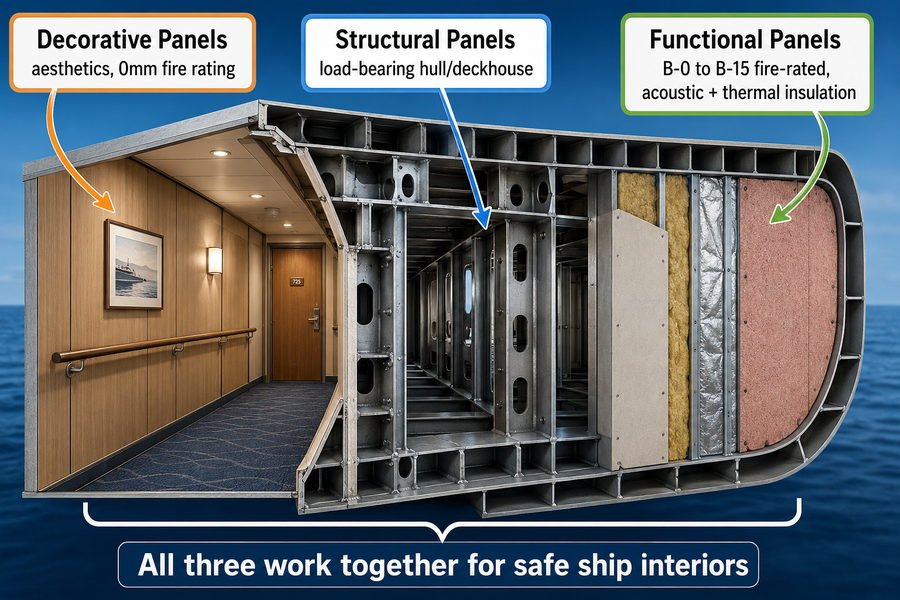
I see buyers struggle with this every day. Understanding these differences helps you buy the right products from Asia without overspending or risking safety. Let's look at the exact details of each type.
Which Marine Accommodation Panels Are Decorative-Only With No Fire Rating?
You need a nice finish, but safety rules are strict. Buying unrated panels for the wrong area will cause failed inspections and costly rework. Let's fix this.
Decorative-only marine panels include three specific types: PVC-faced aluminum sheets, melamine resin laminates (HPL), and lightweight aluminum honeycomb panels without ceramic cores. These panels have absolutely zero fire rating (C-Class) and are strictly used to cover existing fire-rated structural bulkheads for visual appeal.
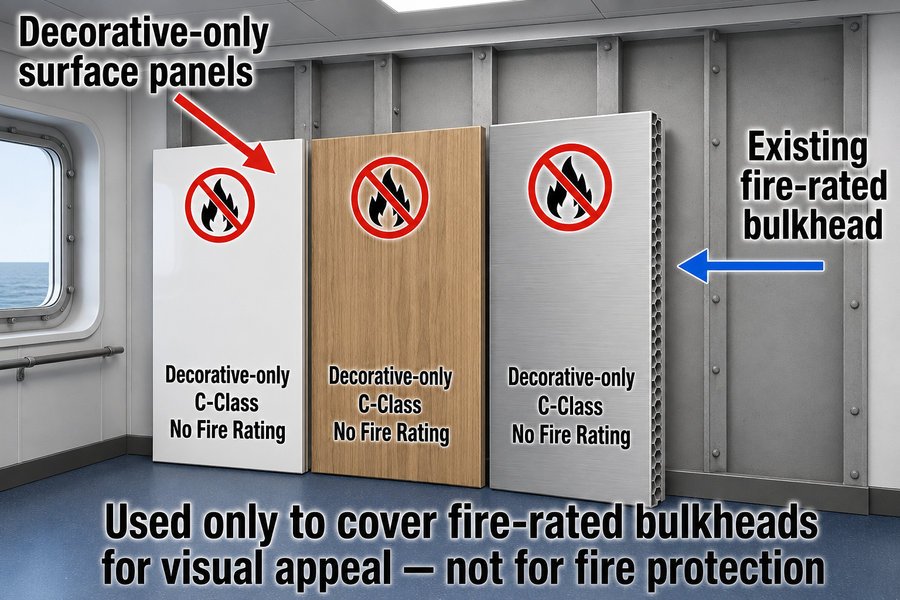
I work with marine outfitting materials every day. I often see procurement teams buy pure decorative panels and try to use them as functional walls. This is a big mistake. You must know the exact specifications of the three decorative types to use them correctly.
Characteristics of PVC-Faced and Melamine Resin Laminates
The first two types of decorative panels are PVC-faced aluminum sheets and melamine resin laminates. We also call melamine laminates HPL (High-Pressure Laminate)1. These materials are very thin. A standard PVC-faced aluminum sheet is usually 1.2mm to 2.0mm thick. An HPL sheet is even thinner, usually between 0.7mm and 1.2mm. They do not have any core material like rockwool. Because they lack a non-combustible core, they provide zero fire resistance.2 We classify them as C-Class materials under marine regulations. Their only job is to look good. You apply them directly over raw steel walls to hide the metal. In the Asian market, you can buy a good quality HPL sheet for about $8 to $15 per square meter. A PVC-faced aluminum sheet costs around $12 to $20 per square meter. I always tell buyers to check the IMO surface flammability certificate for these thin films, even though the panel itself has no fire rating.
Features of Lightweight Aluminum Honeycomb Panels
The third type is the lightweight aluminum honeycomb panel. This panel has two thin aluminum sheets on the outside and an aluminum honeycomb grid inside.3 The total thickness is usually 10mm, 15mm, or 25mm. The weight is very low. A 15mm thick panel weighs only about 5.5 kg per square meter. However, the aluminum honeycomb core melts very quickly in a fire. It does not stop heat or flames. Therefore, this panel also has zero fire rating. It is purely decorative. You use it for ceilings or lightweight decorative partitions in low-risk areas. The cost is higher than laminates. You will pay between $25 and $45 per square meter for a good aluminum honeycomb panel.
| Panel Type | Typical Thickness | Weight per m² | Estimated Cost (m²) | Fire Rating |
|---|---|---|---|---|
| PVC-Faced Aluminum | 1.2mm - 2.0mm | 3.5 kg - 5.5 kg | $12 - $20 | C-Class (Zero) |
| Melamine Laminate (HPL) | 0.7mm - 1.2mm | 1.0 kg - 1.7 kg | $8 - $15 | C-Class (Zero) |
| Aluminum Honeycomb | 10mm - 25mm | 4.5 kg - 7.0 kg | $25 - $45 | C-Class (Zero) |
Do Decorative Marine Accommodation Panels Add to A-60 Fire Integrity?
You might think adding thick decorative panels improves fire resistance. This mistake leads to dangerous false confidence and deadly safety hazards on board. Here is the truth.
No, decorative marine accommodation panels add exactly zero minutes to A-60 fire integrity. A-60 integrity requires a steel bulkhead insulated with at least 50mm of 110 kg/m³ rockwool. Adding decorative layers only adds combustible mass and smoke risk, without improving the official SOLAS A-60 certification.
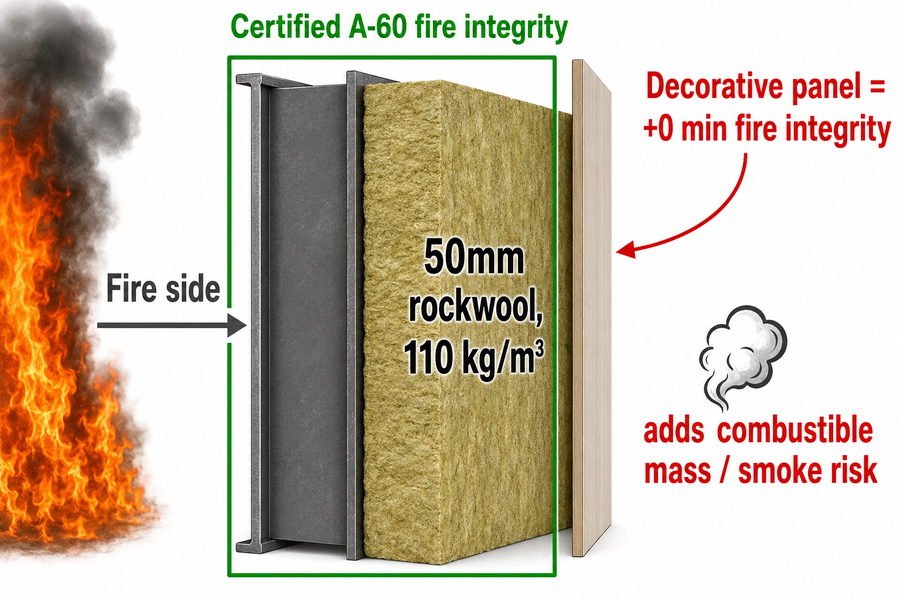
Many buyers ask me if a 25mm aluminum honeycomb decorative panel will help their steel wall pass an A-60 test. The answer is always no. Fire safety rules at sea are very strict. You cannot guess the safety limits. We must look at the exact rules for A-60 fire integrity and understand why decorative materials do not help.
Core Requirements for A-60 Fire Integrity Standards
The SOLAS (Safety of Life at Sea) regulations define A-60 class divisions very clearly. An A-60 wall must stop smoke and flames for 60 minutes.4 It must also stop heat. The unexposed side of the wall cannot get hotter than 140 degrees Celsius above the starting temperature5. To achieve this, you need a heavy structural steel core. The steel plate must be at least 4.5mm thick.6 Then, you must add certified marine rockwool. According to standard IMO test approvals, you need rockwool with a density of 110 kg/m³ to 120 kg/m³. The rockwool must be at least 50mm thick. The steel and the rockwool do all the work. A decorative HPL sheet or PVC film does absolutely nothing to stop the 945-degree Celsius test fire. It provides zero insulation value.
The Dangers of Combustible Mass in Decorative Panels
Adding decorative panels can actually make the fire situation worse. Decorative laminates and PVC films contain plastic and resins. These materials are combustible. When you add them to an A-60 wall, you increase the fire load. The IMO rules strictly limit this. The combustible decorative veneer on an A-60 or B-15 wall cannot be thicker than 1.5mm in corridors and stairway enclosures7. If you use a decorative layer thicker than 2.0mm, you create too much toxic smoke and flame spread risk. I always warn my clients to keep decorative layers as thin as possible over fire-rated walls.
| Material Layer | Thickness | Density/Weight | Fire Integrity Contribution | Risk Factor |
|---|---|---|---|---|
| Structural Steel Plate | 4.5mm (min) | 7850 kg/m³ | Base structure (Stops flames) | None |
| Marine Rockwool Insulation | 50mm | 110 - 120 kg/m³ | 60 minutes (Stops heat) | None |
| Decorative PVC Film | 0.15mm - 0.2mm | ~0.2 kg/m² | 0 minutes | Low (If IMO approved) |
| Decorative HPL Panel | 1.0mm | 1.4 kg/m² | 0 minutes | Medium (Adds fuel load) |
What Defines a Functional vs Decorative Marine Accommodation Panel?
Buyers often mix up functional and decorative panels. This confusion causes you to buy expensive functional panels when cheap decorative ones would work. Let me explain.
Functional panels differ from decorative panels in three complete ways: they provide certified fire ratings (B-0 to B-15), offer acoustic reduction (30dB to 45dB), and contain a non-combustible core (like rockwool). Decorative panels only provide surface aesthetics with no core insulation, fire rating, or sound reduction.
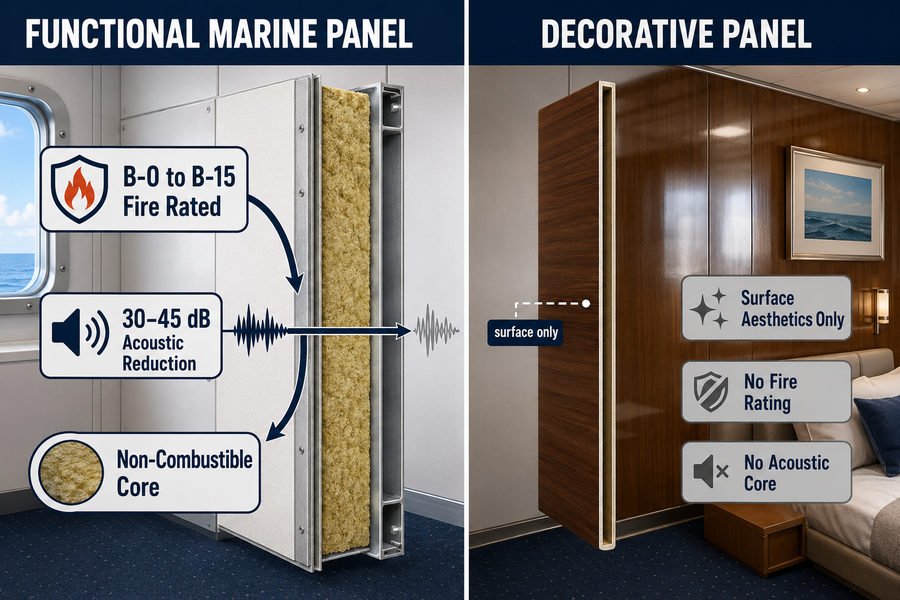
When you source interior materials for a shipyard project, you must separate your purchasing list into functional panels and decorative panels. If you do not separate them, you will waste your budget. I have helped shipyards cut costs by 15% just by applying this rule correctly. Let us look closely at the three main differences.
Fire Rating and Core Materials in Functional Panels
The biggest difference is the core material and the fire rating. A functional marine panel is built like a sandwich. It has a 0.6mm galvanized steel sheet on both sides. Inside, it has a thick, non-combustible core. Most manufacturers in China and Vietnam use high-density rockwool for this core. The standard density is 120 kg/m³. Because of this thick rockwool core, a 50mm functional panel achieves a B-15 fire rating. This means it can stop a fire for 30 minutes and stop heat transfer for 15 minutes8. A B-15 functional panel costs around $20 to $35 per square meter. A B-0 panel costs around $18 to $28 per square meter. Decorative panels do not have this rockwool core. They have no fire rating. They just look nice.
Acoustic Performance Differences Between Panel Types
The second major difference is sound reduction. Ships are very loud9. Functional panels solve this problem. A standard 50mm B-15 functional panel with a rockwool core provides a sound reduction of about 30dB to 32dB10. This blocks out normal engine hum and conversation. Decorative panels, like a 10mm aluminum honeycomb sheet or a 1mm HPL sheet, provide almost zero sound insulation. Sound goes right through them. If you build a cabin wall with only a decorative panel, the crew will hear everything. You must use the functional panel as the real wall, and only use the decorative panel as an extra surface layer if needed.
| Feature | Functional Marine Panel | Decorative Marine Panel |
|---|---|---|
| Fire Rating | B-0, B-15, or B-30 | C-Class (Zero fire rating)11 |
| Core Material | Non-combustible rockwool | None, or aluminum honeycomb |
| Sound Reduction | 30dB to 45dB | < 10dB (Negligible) |
| Standard Thickness | 25mm, 50mm, or 100mm | 0.7mm to 25mm |
| Main Purpose | Fire boundary and noise control | Visual appearance only |
Can Decorative Marine Accommodation Panels Replace Structural Bulkhead Panels in Crew Cabins?
Trying to save weight by swapping structural bulkheads with decorative panels is tempting. But doing this will compromise the ship's physical integrity and violate marine laws.
Absolutely not. Decorative panels cannot replace structural bulkheads in crew cabins for two critical reasons: they lack the load-bearing strength (minimum 4mm steel or 6mm aluminum) required by hull design, and they fail the mandatory SOLAS A-Class or B-Class fire boundary requirements for crew partitions.
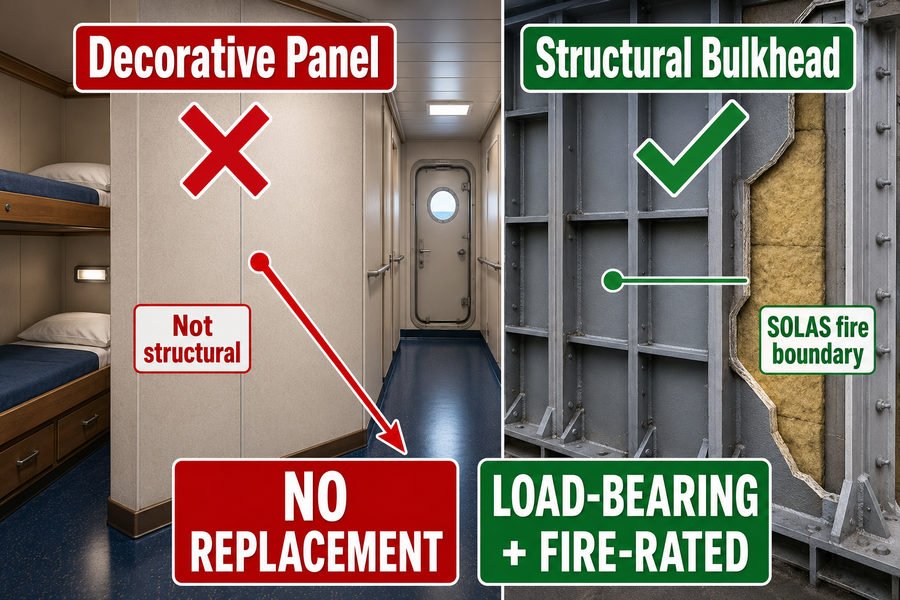
I once had a client who wanted to build entirely new crew cabins using only 25mm decorative aluminum honeycomb panels to save ship weight. I had to stop the order immediately. Structural bulkheads and decorative panels are completely different animals. You cannot swap them. Let me break down the exact mechanical and legal reasons why this is impossible.
Load-Bearing Strength Requirements for Structural Bulkheads
A structural bulkhead holds the ship together. It supports the deck above it. It resists the twisting forces of ocean waves.12 To do this job, structural panels must be incredibly strong. Most commercial ships use marine-grade mild steel plates (like Grade A steel). These steel plates must be at least 4.0mm to 5.0mm thick. The yield strength of this steel is 235 MPa. If the ship uses aluminum for weight savings, the aluminum plate must be at least 6.0mm to 8.0mm thick. A decorative panel has zero load-bearing strength. A thin HPL sheet will snap under any pressure. Even a thick 25mm aluminum honeycomb panel will crush if you put a heavy load on top of it. If you build a cabin with only decorative panels, the ceiling will collapse.
SOLAS Fire Boundary Regulations for Crew Cabins
The law also forbids this replacement. The IMO SOLAS Chapter II-2 regulations are very clear about crew cabins. The walls separating crew cabins from corridors must be constructed as B-0 or B-15 fire boundaries. The walls separating cabins from machinery spaces must be A-60 boundaries.13 Structural steel bulkheads covered with rockwool meet the A-60 standard. Functional sandwich panels meet the B-15 standard. Decorative panels fail all of these tests. They are C-Class materials. You cannot use a C-Class material as a primary cabin boundary.14 You must build the structural steel wall or the functional B-Class wall first. Then, you can attach the decorative panel to it.
| Requirement Area | Structural Bulkhead | Decorative Panel |
|---|---|---|
| Material Composition | Grade A Steel or Marine Aluminum | PVC, Melamine, or light Aluminum |
| Minimum Thickness | 4.0mm (Steel) / 6.0mm (Aluminum) | 0.7mm to 25mm |
| Yield Strength | Minimum 235 MPa | Very low (Not rated for load) |
| Fire Boundary Legal Status | Forms A-Class boundaries | Fails B-Class and A-Class |
| Shipyard Application | Welded directly to the ship hull | Glued or screwed to finished walls |
What Risks Come From Using Decorative Marine Accommodation Panels on Fire-Rated Bulkheads?
Gluing random decorative panels onto fire-rated walls seems harmless. However, this creates hidden hazards that can spread toxic gas and fail maritime safety audits.
Using unapproved decorative panels on fire-rated bulkheads introduces three major risks: high flame spread surface characteristics, excessive toxic smoke emission, and the generation of dangerous calorific values (exceeding 45 MJ/m²). These factors violate the IMO FTP Code and turn safe bulkheads into fire hazards.
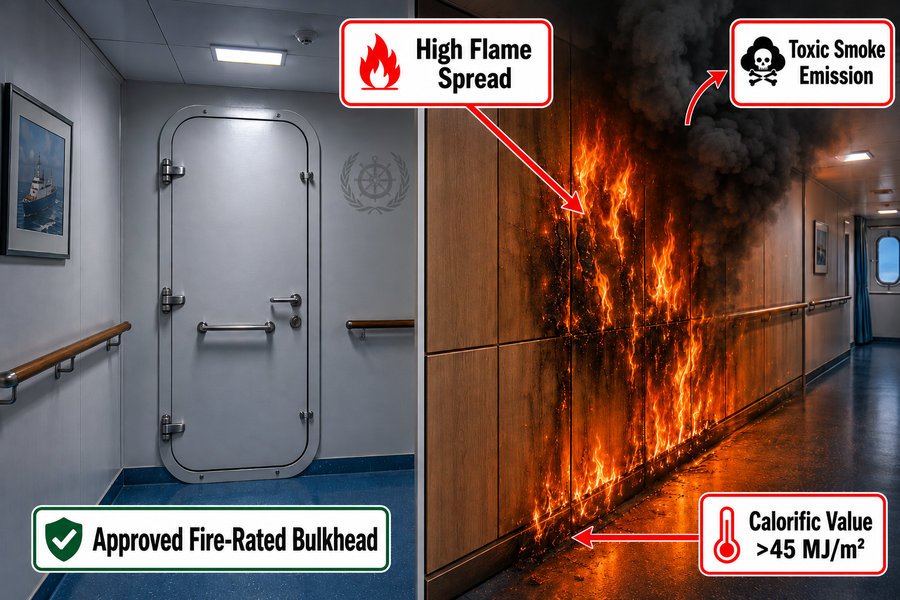
When you buy decorative materials from suppliers who do not understand the marine industry, you put the whole ship in danger. A beautiful wall is useless if it kills the crew during a fire. I always review the test certificates before I approve any decorative finish. You must understand these three specific risks to avoid buying dangerous products.
High Flame Spread and Toxic Smoke Emission Risks
The first two risks are flame spread and toxic smoke. When a fire starts, a bad decorative panel will act like a fuse. The flames will travel rapidly across the surface of the PVC or melamine, spreading the fire from one cabin to the next. The IMO FTP Code Part 5 tests materials for this low flame spread characteristic.15 Standard commercial plastics fail this test easily. The second risk is smoke. Burning plastics release deadly gases. The IMO FTP Code Part 2 measures smoke toxicity. It checks the levels of Carbon Monoxide (CO), Hydrogen Chloride (HCl), and Hydrogen Cyanide (HCN)16. Unapproved decorative panels emit huge amounts of thick, black, toxic smoke. In a real ship fire, this smoke kills people before the flames ever reach them.
Calorific Value Limits Under the IMO FTP Code
The third risk is the calorific value. The calorific value measures how much total heat energy a material releases when it burns. Even if a thin decorative film has low flame spread, it still contains fuel. The SOLAS regulations state that the maximum gross calorific value for combustible veneers on bulkheads cannot exceed 45 Mega Joules per square meter (MJ/m²)17. This is a strict limit. A standard 1.0mm unapproved plastic sheet can easily exceed 60 MJ/m². If you glue this to a certified B-15 functional panel, you ruin the B-15 rating. The wall now holds too much fuel. You must only buy decorative films and panels that come with official MED (Marine Equipment Directive) or USCG type approval certificates proving they stay under the 45 MJ/m² limit.
| Fire Safety Metric | IMO FTP Code Requirement | Risk of Unapproved Decorative Panel |
|---|---|---|
| Surface Flame Spread | Must be "Low Flame Spread" (Part 5) | Rapid flame travel across cabins |
| Smoke Toxicity | Strict limits on CO, HCl, HCN (Part 2) | Emits heavy, blinding, toxic black smoke |
| Gross Calorific Value | Maximum 45 MJ/m² | Exceeds 60 MJ/m², adding excessive heat |
| Combustible Thickness | Maximum 1.5mm in corridors18 | Thick plastics act as concentrated fuel |
Which Marine Accommodation Panel Type Handles Acoustic Insulation?
Engine noise ruins the comfort of a ship cabin. If you choose the wrong panel, crew members cannot sleep. Here is the exact panel you need.
Functional marine panels handle acoustic insulation, specifically using two main designs: standard composite rockwool panels (providing 30dB to 35dB reduction) and double-skin acoustic panels with a central air gap and damping sheets (providing 40dB to 48dB reduction). Decorative and structural panels do not provide adequate soundproofing.
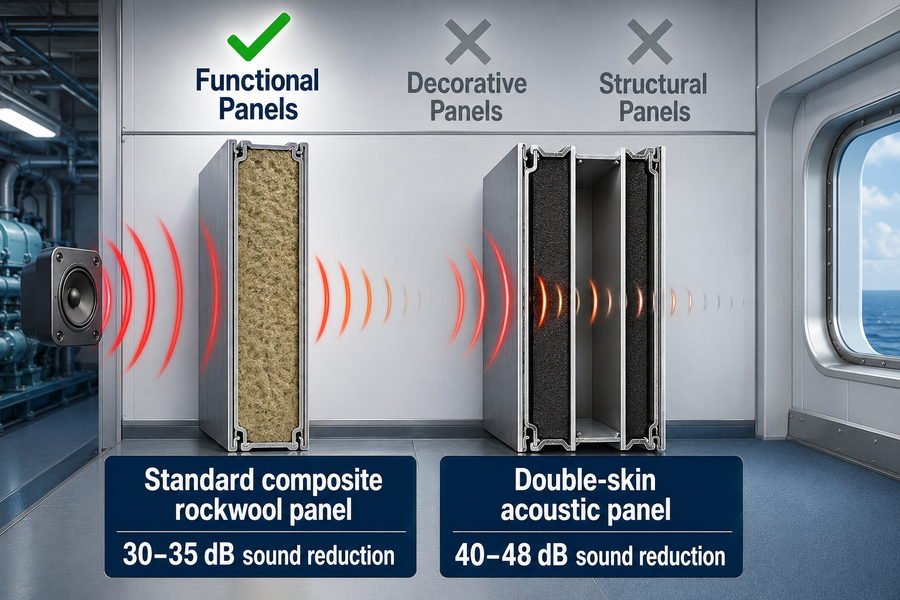
Sound travels through steel ship hulls very easily19. You cannot fix noise problems after the ship is built. You must buy the right acoustic panels from the start. I have seen shipowners spend thousands of dollars to rip out cheap walls because the cabins were too loud. You must choose between the two specific functional panel designs based on the noise level of the area.
Sound Reduction in Standard Composite Rockwool Panels
The first design is the standard composite rockwool panel. This is your everyday functional panel. It uses a heavy rockwool core pressed between two 0.6mm galvanized steel plates. The density of the rockwool is the key here. We use 120 kg/m³ rockwool. The mass of the steel and the density of the rockwool block the sound waves. A standard 50mm thick panel of this type will give you a sound reduction index (Rw) of 30dB to 35dB. This level is perfect for standard crew cabins located far away from the main engines. It stops people from hearing conversations in the next room. The cost is very reasonable, usually between $25 and $35 per square meter.
High-Performance Double-Skin Acoustic Panels for Extreme Noise
The second design is the double-skin acoustic panel. You need this panel for cabins located directly above the engine room or next to the bow thruster. A standard panel is not enough here. The double-skin panel uses a clever design. It usually consists of two 25mm rockwool panels separated by an internal air gap or a heavy damping sheet (like a 1.2mm steel sheet or a mass-loaded vinyl layer). This disconnected design stops the vibration from passing through20. These special acoustic panels are usually 50mm to 100mm thick. They can provide an amazing sound reduction of 40dB to 48dB. They are more expensive, costing between $50 and $80 per square meter, but they are the only way to meet the strict IMO noise code limits for high-noise areas21.
| Panel Design | Thickness | Core Construction | Sound Reduction (Rw) | Best Application Area |
|---|---|---|---|---|
| Standard Composite Panel | 50mm | 120 kg/m³ Rockwool | 30dB - 35dB | Standard cabins and corridors |
| Double-Skin Acoustic Panel | 50mm | Rockwool + 1.2mm Damping Steel | 40dB - 43dB | Cabins near machinery spaces |
| Heavy Acoustic System | 100mm | Rockwool + Air Gap + Damping | 44dB - 48dB | Engine control rooms |
| Pure Decorative Panel | 10mm | Aluminum Honeycomb | < 10dB | Visual ceiling covers only |
Conclusion
Marine accommodation panels serve specific roles. You must combine pure decorative panels, load-bearing structural bulkheads, and fire-rated functional panels correctly to build safe, quiet, and compliant ship interiors.
-
"Surface chemistry of gravure printed décor paper and adhesion of ...", https://bioresources.cnr.ncsu.edu/resources/surface-chemistry-of-gravure-printed-decor-paper-and-adhesion-of-melamine-formaldehyde-resin-coatings/. A technical or encyclopedic source defines HPL as high-pressure decorative laminate made by consolidating resin-impregnated layers under heat and pressure, supporting the terminology used for melamine/phenolic laminate sheets. Evidence role: definition; source type: encyclopedia. Supports: Melamine resin laminates are commonly referred to as HPL, meaning High-Pressure Laminate.. Scope note: The source may define general HPL construction rather than marine-grade laminate specifications. ↩
-
"[PDF] RESOLUTION MSC.307(88) (adopted on 3 December 2010 ...", https://wwwcdn.imo.org/localresources/en/KnowledgeCentre/IndexofIMOResolutions/MSCResolutions/MSC.307(88).pdf. IMO/SOLAS fire-safety definitions and FTP Code guidance distinguish approved fire divisions and surface flammability testing from decorative surface materials, supporting the point that decorative laminates without a certified non-combustible insulating core should not be treated as fire-resisting divisions. Evidence role: expert_consensus; source type: institution. Supports: Thin decorative panels without a non-combustible core should not be assumed to provide fire resistance under marine fire-safety requirements.. Scope note: This provides regulatory context rather than proving that every PVC-faced or HPL product has zero fire resistance; actual performance depends on the product’s approval certificate and test results. ↩
-
"[PDF] Performance Evaluation Of Composite Sandwich Structures With ...", https://scholarsmine.mst.edu/cgi/viewcontent.cgi?article=4255&context=matsci_eng_facwork. Engineering literature describes aluminum honeycomb sandwich panels as structures composed of thin face sheets bonded to a honeycomb core, supporting the stated construction and explaining their low weight-to-stiffness design rationale. Evidence role: definition; source type: paper. Supports: Aluminum honeycomb panels consist of two thin outer aluminum skins bonded to an internal aluminum honeycomb core.. Scope note: The source would support the general construction of aluminum honeycomb sandwich panels, not the exact thickness, weight, cost, or marine approval status of a specific product. ↩
-
"What Is the Purpose and Scope of the IMO FTP Code? - Magellan ...", https://magellanmarinetech.com/what-purpose-scope-of-imo-ftp-code/. The IMO FTP Code defines Class A divisions as steel or equivalent divisions that prevent the passage of smoke and flame for one hour under the standard fire test, with A-60 requiring the specified insulation performance for 60 minutes. Evidence role: definition; source type: institution. Supports: An A-60 wall must resist smoke and flame passage for 60 minutes.. ↩
-
"Are Marine Fire Divisions the Same as Marine Panel Ratings?", https://magellanmarinetech.com/are-marine-fire-divisions-same-as-marine-panel-ratings/. The IMO FTP Code temperature-rise criteria for A-class divisions state that the average temperature on the unexposed side must not rise more than 140°C above the initial temperature during the relevant rating period. Evidence role: definition; source type: institution. Supports: The unexposed side of an A-60 wall is limited to an average temperature rise of 140°C above the initial temperature.. ↩
-
"[PDF] RESOLUTION A.754(18) adopted on 4 November 1993 ...", https://wwwcdn.imo.org/localresources/en/KnowledgeCentre/IndexofIMOResolutions/AssemblyDocuments/A.754(18).pdf. Marine fire-test guidance and type-approval documentation for A-class steel bulkheads commonly use steel plating of about 4.5 mm or greater as the tested structural substrate for A-60 assemblies. Evidence role: general_support; source type: institution. Supports: A-60 wall assemblies typically require a substantial steel substrate, often specified as at least 4.5 mm in tested approvals.. Scope note: This supports the article’s statement as a common tested configuration; actual acceptance depends on the exact approved assembly and flag-state or classification-society approval, not plate thickness alone. ↩
-
"What does SOLAS Chapter II-2 require for marine wall and ceiling ...", https://magellanmarinetech.com/what-solas-chapter-ii-2-require-for-marine-wall-ceiling-panels/. SOLAS fire-safety provisions restrict combustible veneers on exposed surfaces in accommodation and service spaces, including corridors and stairway enclosures, with a 1.5 mm maximum veneer thickness commonly cited for such spaces. Evidence role: definition; source type: institution. Supports: Combustible decorative veneer thickness is limited to 1.5 mm in corridors and stairway enclosures.. Scope note: The rule concerns combustible veneers and exposed-surface fire risk; it does not by itself determine whether a complete decorative panel system is acceptable without separate IMO surface-flammability and smoke/toxicity approvals. ↩
-
"[PDF] RESOLUTION MSC.307(88) (adopted on 3 December 2010 ...", https://wwwcdn.imo.org/localresources/en/KnowledgeCentre/IndexofIMOResolutions/MSCResolutions/MSC.307(88).pdf. The IMO/SOLAS fire-test framework defines B-class divisions as preventing flame passage for 30 minutes, with B-15 indicating that prescribed temperature-rise limits are maintained for at least 15 minutes; this supports the meaning of the B-15 label rather than the performance of any specific product. Evidence role: definition; source type: institution. Supports: A B-15 marine panel is expected to prevent flame passage for 30 minutes and limit heat transfer for 15 minutes under the relevant marine fire-test standard.. Scope note: Supports the standard definition of B-15, not the tested rating of the particular panel described. ↩
-
"[PDF] MSC.337(91) - International Maritime Organization", https://wwwcdn.imo.org/localresources/en/KnowledgeCentre/IndexofIMOResolutions/Documents/MSC%20-%20Maritime%20Safety/337(91).pdf. The IMO Code on Noise Levels on Board Ships and related occupational-noise guidance document that shipboard accommodation and machinery spaces are subject to regulated noise limits, providing context for why acoustic control is a design concern on ships. Evidence role: general_support; source type: institution. Supports: Ship interiors require attention to noise control because shipboard environments can have significant noise exposure.. Scope note: This supports the general need for shipboard noise control, not the noise level of every vessel or space. ↩
-
"How to choose the right marine wall panels for marine interior ...", https://magellanmarinetech.com/how-choose-right-marine-wall-panels-for-marine-interior-projects/. Laboratory or classification-society acoustic test data for rockwool-filled marine wall panels can substantiate whether 50 mm B-class panels commonly achieve sound-reduction indices in the low-30 dB range; such evidence would support the performance range only for tested assemblies and installation conditions. Evidence role: statistic; source type: research. Supports: A 50 mm B-15 functional marine panel with a rockwool core can provide approximately 30–32 dB of sound reduction.. Scope note: Acoustic performance depends on panel construction, joints, penetrations, mounting, and test method, so one source may not prove all standard 50 mm B-15 panels perform identically. ↩
-
"What Do A-Class, B-Class, and C-Class Divisions Mean in Marine ...", https://magellanmarinetech.com/what-a-class-b-class-c-class-divisions-mean-in-marine-wall-ceiling-panels/. SOLAS/IMO definitions distinguish A-, B-, and C-class divisions and specify that C-class divisions are made of approved non-combustible materials but are not required to meet the A- or B-class insulation and integrity time criteria; this contextualizes the article’s characterization of C-class as lacking a timed fire-resistance rating. Evidence role: definition; source type: institution. Supports: C-class marine divisions do not carry the same timed fire-resistance criteria as B-0, B-15, or B-30 divisions.. Scope note: The phrase “zero fire rating” is an informal simplification; C-class still has material requirements and should not be equated with having no fire-safety properties at all. ↩
-
"classification notes strength analysis of hull structures in container ...", https://www.academia.edu/5429614/CLASSIFICATION_NOTES_STRENGTH_ANALYSIS_OF_HULL_STRUCTURES_IN_CONTAINER_SHIPS. A naval architecture or ship-structure reference explains that transverse and longitudinal bulkheads can function as primary structural members, contributing to hull girder strength, deck support, subdivision, and resistance to racking or torsional loads. Evidence role: mechanism; source type: education. Supports: Structural bulkheads can be load-bearing ship structures that support decks and help resist wave-induced hull loads.. Scope note: The exact load path depends on the vessel type, bulkhead location, and structural design, so the source would support the general structural role rather than every bulkhead on every ship. ↩
-
"[PDF] MSC.99(73) - International Maritime Organization", https://wwwcdn.imo.org/localresources/en/KnowledgeCentre/IndexofIMOResolutions/MSCResolutions/MSC.99(73).pdf. SOLAS Chapter II-2 and the IMO Fire Safety Systems/FTP framework define A- and B-class divisions and provide accommodation-area fire integrity requirements for boundaries such as corridors and machinery-space separations. Evidence role: expert_consensus; source type: institution. Supports: SOLAS fire-safety rules require rated A- or B-class fire divisions for certain accommodation boundaries, including cabin corridors and machinery-space separations.. Scope note: The exact required rating depends on ship type, tonnage, space category, flag administration, and the applicable SOLAS table; the source should be used to verify the specific B-0/B-15 and A-60 applications for the vessel in question. ↩
-
"[PDF] recommendation for fire test procedures for “a” and “b” class ...", https://wwwcdn.imo.org/localresources/en/KnowledgeCentre/IndexofIMOResolutions/AssemblyDocuments/A.163(ES.IV).pdf. IMO fire-test and SOLAS materials provisions distinguish non-combustible A- and B-class divisions from C-class divisions, which are not required to meet the same smoke- and flame-temperature rise criteria as A- or B-class fire boundaries. Evidence role: definition; source type: institution. Supports: C-class materials cannot substitute for required A- or B-class rated cabin fire boundaries unless separately approved for that required rating.. Scope note: This supports the regulatory distinction between C-class materials and rated fire divisions; final acceptability of a specific product depends on its certified test report and the vessel’s approved fire-control plan. ↩
-
"[PDF] RESOLUTION MSC.307(88) (adopted on 3 December 2010 ...", https://wwwcdn.imo.org/localresources/en/KnowledgeCentre/IndexofIMOResolutions/MSCResolutions/MSC.307(88).pdf. The IMO Fire Test Procedures Code identifies Part 5 as the surface flammability test used to assess whether exposed materials meet low flame-spread requirements for shipboard use. Evidence role: definition; source type: institution. Supports: IMO FTP Code Part 5 is the relevant test for low flame-spread characteristics of shipboard materials.. ↩
-
"[PDF] RESOLUTION MSC.61(67) (adopted on 5 December 1996 ...", https://wwwcdn.imo.org/localresources/en/KnowledgeCentre/IndexofIMOResolutions/MSCResolutions/MSC.61(67).pdf. The IMO Fire Test Procedures Code Part 2 covers smoke and toxicity testing and includes measurement criteria for toxic gases such as carbon monoxide, hydrogen chloride, and hydrogen cyanide produced during combustion. Evidence role: definition; source type: institution. Supports: IMO FTP Code Part 2 measures smoke toxicity and checks CO, HCl, and HCN levels.. ↩
-
"[PDF] MSC.99(73) - International Maritime Organization", https://wwwcdn.imo.org/localresources/en/KnowledgeCentre/IndexofIMOResolutions/MSCResolutions/MSC.99(73).pdf. SOLAS chapter II-2 limits the gross calorific value of combustible veneers used on regulated shipboard surfaces to 45 MJ per square metre for the thickness applied. Evidence role: general_support; source type: institution. Supports: SOLAS sets a maximum gross calorific value of 45 MJ/m² for combustible veneers on relevant shipboard surfaces.. Scope note: The citation supports the regulatory limit; it does not verify the calorific value of any particular decorative product. ↩
-
"What does SOLAS Chapter II-2 require for marine wall and ceiling ...", https://magellanmarinetech.com/what-solas-chapter-ii-2-require-for-marine-wall-ceiling-panels/. SOLAS chapter II-2 restricts the thickness of combustible veneers on surfaces subject to low flame-spread requirements, with a stricter 1.5 mm limit in corridors, stairway enclosures, and control stations. Evidence role: general_support; source type: institution. Supports: Combustible veneers in corridors are limited to a maximum thickness of 1.5 mm under SOLAS fire safety requirements.. Scope note: The citation supports the general SOLAS thickness restriction; applicability depends on the vessel type, space, and surface classification. ↩
-
"HULL VIBRATION ANALYSIS OF RIVER BOATS - Academia.edu", https://www.academia.edu/16149992/HULL_VIBRATION_ANALYSIS_OF_RIVER_BOATS. Research on shipboard noise identifies steel hull and structural members as efficient paths for structure-borne sound and vibration transmission in vessels. Evidence role: mechanism; source type: paper. Supports: Sound travels through steel ship hulls very easily.. Scope note: This supports the general mechanism of structure-borne transmission through steel ship structures, not a quantified transmission rate for every hull design. ↩
-
"Airborne sound insulation performance of lightweight double ...", https://pmc.ncbi.nlm.nih.gov/articles/PMC11666719/. Acoustics literature on double-leaf partitions explains that separating two panel skins with an air cavity or resilient/damping layer reduces mechanical coupling and can improve airborne and structure-borne sound insulation. Evidence role: mechanism; source type: education. Supports: A double-skin panel with separated layers reduces vibration transmission compared with a rigid single-skin construction.. Scope note: This supports the acoustic principle of decoupling, but the phrase “stops” is stronger than the evidence; such systems reduce rather than eliminate vibration transmission. ↩
-
"[PDF] MSC.337(91) (adopted on 30 November 2012) CODE ON NOISE ...", https://wwwcdn.imo.org/localresources/en/KnowledgeCentre/IndexofIMOResolutions/MSCResolutions/MSC.337(91).pdf. The IMO Code on Noise Levels on Board Ships sets maximum noise-level limits for ship spaces, including accommodation, machinery, control, and other operational areas. Evidence role: historical_context; source type: institution. Supports: There are IMO noise-code limits that apply to high-noise areas and adjacent ship spaces.. Scope note: The IMO code establishes regulatory limits; it does not by itself prove that a specific panel type is the only way to comply in all vessel designs. ↩