Worried about damage to your ship interior panels during heavy daily use? Replacing broken boards costs time and ruins your budget. Let us see how glass-reinforced plastics solve this problem.
GRP/FRP face sheets handle impacts on marine panels by absorbing energy through flexible resin matrices and distributing stress across strong fiberglass reinforcements. They prevent permanent dents seen in steel and resist cracking better than PVC, offering durable, low-maintenance surfaces for high-traffic ship areas according to ASTM D256 standards.
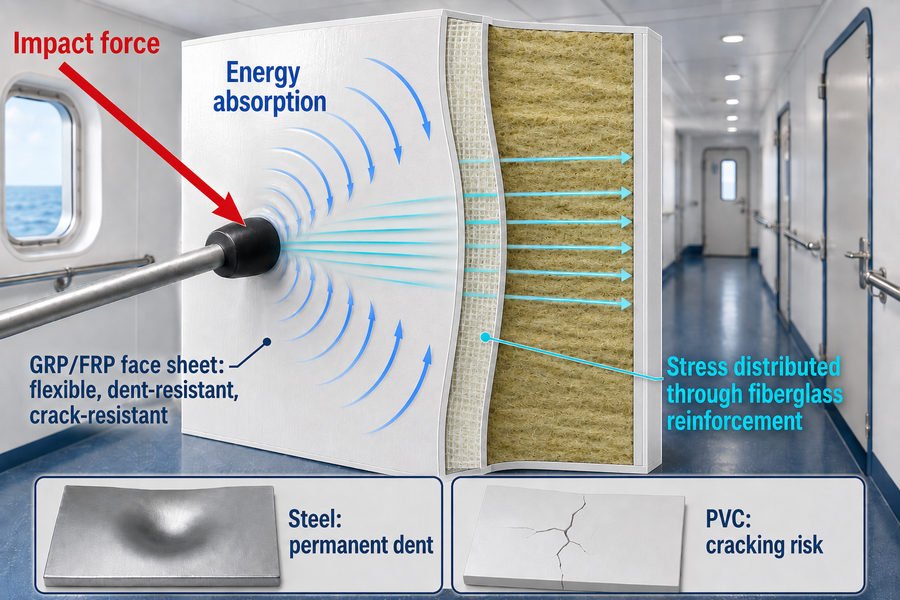
Understanding how these plastic composite panels take hits can save you from buying the wrong materials for your interior project. Let me break down exactly what happens when these boards get knocked around.
What Is the Impact Strength of a Standard GRP/FRP Marine Accommodation Panel Face Sheet?
Are you unsure if your panels can survive moving luggage or tools? Weak panels mean angry shipyard clients. You need clear numbers to prove the strength of your choice.
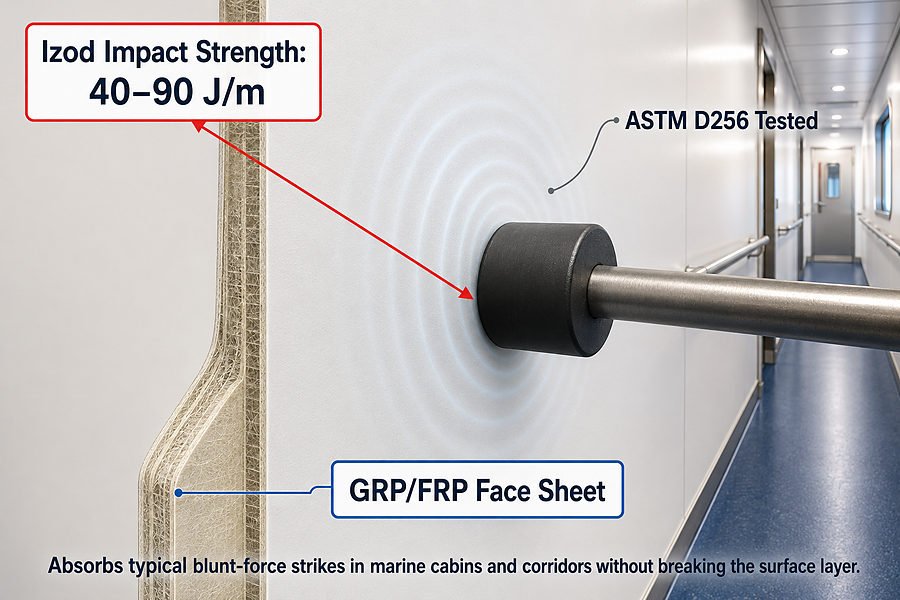
Standard GRP/FRP marine panel face sheets exhibit an Izod impact strength ranging from 40 to 90 Joules per meter (J/m) under ASTM D256 testing, depending on glass fiber content. This strength allows the sheet to absorb typical blunt-force strikes in cabins and corridors without breaking the surface layer.
Measuring Izod Impact Strength of GRP/FRP Face Sheets
When I first started checking panels at the marine outfitting factory, I saw many bad boards fail. Now, I always check the actual test data. We measure impact strength using the Izod impact test. This test follows the clear rules of the ASTM D256 standard. For standard marine GRP (Glass Reinforced Plastic) face sheets, the passing values sit between 40 J/m and 90 J/m. A testing lab swings a heavy metal hammer into a small cut piece of the plastic face sheet. The machine measures how much energy the plastic absorbs before it snaps. A higher number means the panel takes a harder hit before breaking. You must look for these specific numbers when buying panels from suppliers in Asia.
Fiber Content Effect on Impact Resistance
You cannot just ask for a basic GRP panel and hope it works for a tough shipyard project. The glass fiber content changes the impact strength completely. The plastic resin gives the sheet a flat shape, but the hidden glass fibers give it real power. If a factory makes a panel with only short, chopped glass fibers, it absorbs less energy. It stays at the lower 40 J/m to 50 J/m range. But if the factory uses continuous woven glass fibers1, everything changes. The impact stress spreads out much faster across a wider area of the wall. This pushes the strength up to the 80 J/m to 90 J/m range. This higher level handles heavy dropped tools or fast cart bumps without cracking.
| Fiber Reinforcement Type | Glass Fiber Content (%) | Estimated Izod Impact Strength (ASTM D256) | Best Marine Application Area |
|---|---|---|---|
| Chopped Strand Mat (Short) | 20% - 30% | 40 J/m - 50 J/m | Low-traffic private cabins |
| Mixed Mat (Short + Long) | 30% - 40% | 55 J/m - 70 J/m | General crew areas |
| Woven Roving (Continuous) | 45% - 55% | 80 J/m - 90 J/m | Public spaces, heavy corridors |
Does GRP/FRP Face Sheet Crack or Delaminate Under Hard Impact?
Have you ever seen a panel peel apart after a hard knock? Delamination ruins the fire rating and looks terrible. Knowing how GRP fails helps you avoid bad products.
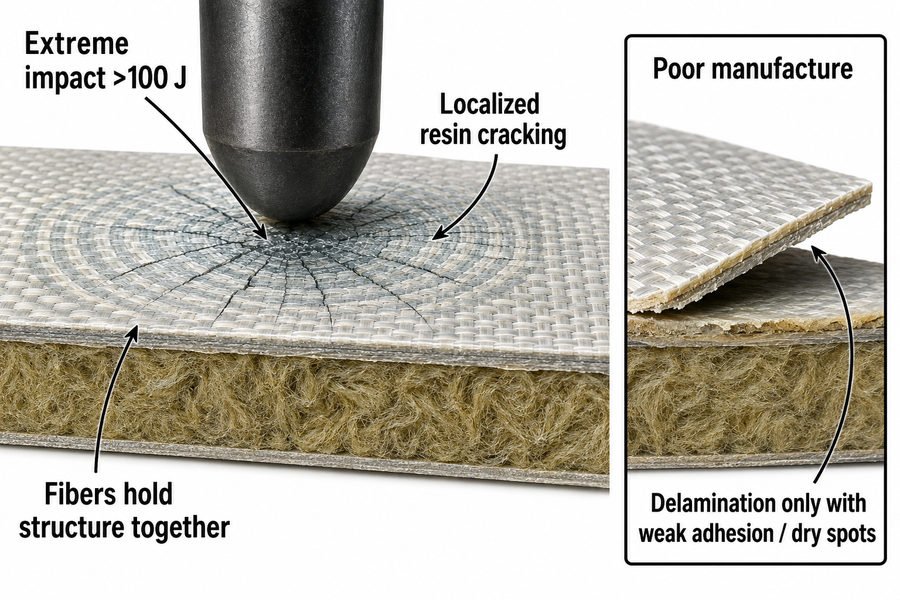
Under extreme impacts exceeding 100 J/m, GRP/FRP face sheets experience localized resin cracking but rarely undergo full delamination. The woven glass fibers hold the structure together. Poorly manufactured panels with dry spots or weak core adhesion are the only ones that completely delaminate under heavy blunt force.
How Resin Cracking Occurs Under Extreme Impacts
Clients often ask me what happens when a really hard hit happens on the ship. If a heavy metal pipe hits the wall panel with a force over 100 Joules per meter, the GRP/FRP face sheet will show visible damage. You will see localized resin cracking. This looks like a small white spider web mark on the surface of the plastic. The polyester or epoxy resin breaks because it is rigid. But this is the important part: the glass fibers inside the resin do not break easily2. They hold the broken resin pieces together tightly. This keeps the whole face sheet from falling apart. It keeps the core safe inside.
Why Poor Manufacturing Causes Delamination
Full delamination means the plastic face sheet peels completely away from the rockwool or aluminum honeycomb core. I rarely see good GRP sheets do this. Delamination only happens when the factory makes a bad mistake. If the factory leaves "dry spots" where the liquid resin does not wet the glass fibers fully, those dry spots form hidden weak points3. When a cart hits a dry spot, the layers split open. Also, if the glue amount between the GRP sheet and the core is too low, a hard hit will pop the sheet right off the wall. We follow ISO 14125 standards for flexural testing to make sure the bond is strong enough to stop this peeling problem.
| Damage Type | Cause of Damage | Visual Appearance | Structural Integrity Impact |
|---|---|---|---|
| Resin Cracking | Hit force exceeds 100 J/m | White starburst or web pattern | Face stays attached, core protected |
| Surface Dents | Sharp point impact | Small groove | No loss of fire rating |
| Full Delamination | Bad factory glue or dry spots | Skin peels away from core | Complete loss of fire containment |
What GRP/FRP Face Sheet Thickness Withstands Corridor and Cabin Knocks?
Choosing a thin sheet saves money but risks easy breakage. Picking a thick sheet wastes your budget. You need the exact thickness for different ship zones.
A 1.0mm to 1.2mm thick GRP/FRP face sheet withstands daily cabin knocks. For high-traffic corridors and public spaces, a 1.5mm to 2.0mm thickness is required to resist heavy carts and luggage impacts. Using these specific thicknesses ensures long life and meets standard marine classification society interior wear requirements.
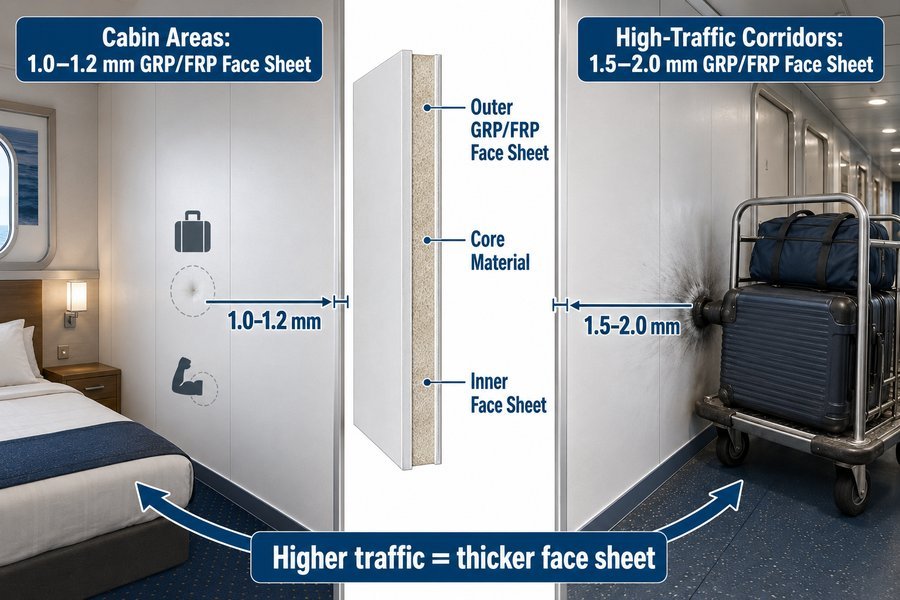
GRP/FRP Face Sheet Thickness for Standard Ship Cabins
Cost is a big issue when you buy materials from Asia for shipyards in Europe or the US. You want to save money. But the quality must pass inspection. Inside standard crew cabins and passenger rooms, the walls do not face heavy hits. People might bump the wall with a small chair or a light bag. For these quiet inside areas, a GRP/FRP face sheet with a thickness of 1.0mm to 1.2mm is completely fine. This specific thickness gives the wall enough flex to bounce back from very light hits. It keeps your material cost low. It also keeps the overall ship weight down, which is good for fuel saving4. A 1.0mm sheet typically costs around $5 to $7 per square meter. It is the smart, low-cost choice for private rooms.
Required GRP/FRP Thickness for High-Traffic Marine Corridors
Corridors are a completely different story. Hallways, crew mess rooms, and public spaces take a lot of daily abuse. Metal food carts, heavy toolboxes, and big luggage hit these walls every single day. A thin 1.0mm sheet will crack quickly in these areas. You must use a 1.5mm to 2.0mm thick GRP/FRP face sheet. I always tell my buyers to follow this rule. The extra 0.5mm to 1.0mm adds about 30% to 50% more impact resistance5. When a 50kg service cart hits a 2.0mm sheet at normal walking speed, the thick sheet spreads the energy out safely. This thicker sheet might cost $8 to $11 per square meter. But it saves huge money in the end. Shipyard guidelines usually state that public area panels need this extra thickness to stop costly repair work.
| Ship Area | Expected Impact Level | Recommended GRP Thickness | Approximate Cost Impact |
|---|---|---|---|
| Private Cabins | Light (bags, chairs) | 1.0mm - 1.2mm | Base cost |
| Wet Units / Bathrooms | Light to Medium | 1.2mm - 1.5mm | +15% cost |
| Corridors / Mess Rooms | Heavy (carts, tools) | 1.5mm - 2.0mm | +30% cost |
| Cargo Control Rooms | Very Heavy | 2.0mm - 2.5mm | +50% cost |
How Is GRP/FRP Marine Accommodation Panel Skin Impact Damage Repaired Onboard?
Does a cracked panel mean you must replace the whole wall? Panel replacement takes days and ruins schedules. Quick, onboard repair methods save massive amounts of time.
GRP/FRP marine panel skin impact damage is repaired onboard in three steps: sanding the cracked area to remove loose fibers, applying a two-part marine-grade epoxy filler to rebuild the surface, and painting over the cured filler to match the original color, restoring full fire and structural integrity.
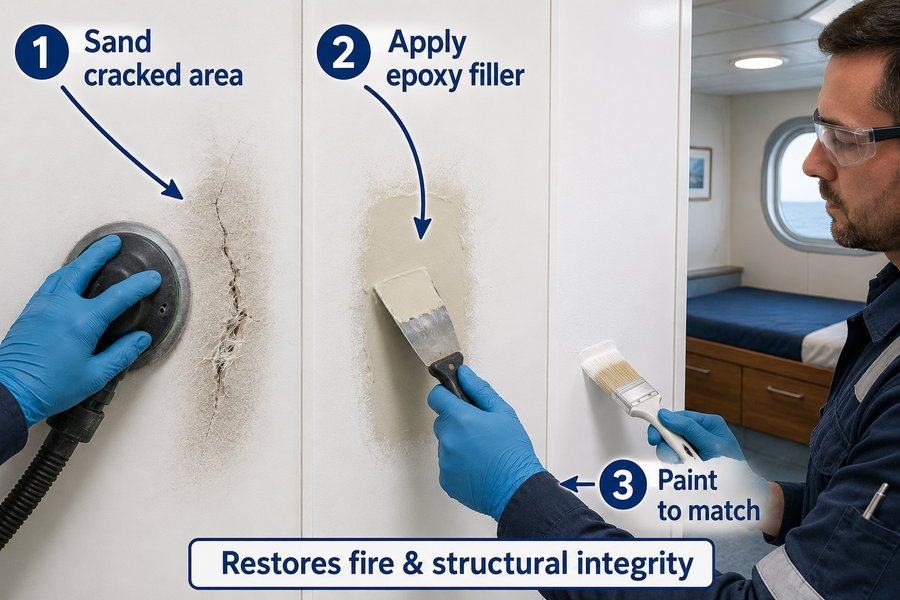
Step 1: Sanding and Preparing the Damaged GRP Surface
Even the best panels can break if someone drops heavy shipyard equipment on them. The good news is you do not have to buy a new panel every time a crack happens. GRP is very easy to fix right on the ship. The first repair step is to clean the wound. You must sand the cracked area. Use rough 80-grit sandpaper. You have to remove all the loose glass fibers and broken plastic resin. If you leave any cracked, loose pieces, the new patch will just fall off later. Sanding makes the surface rough and clean. This rough texture helps the repair glue hold tight to the old wall material.6
Step 2 and 3: Applying Epoxy Filler and Painting the Surface
After proper sanding, you start step two. You apply a two-part marine-grade epoxy filler. You mix the liquid resin and the hardener together. Then, use a flat metal knife to press the wet filler into the hole or crack. Make sure it is smooth and flat with the rest of the wall. The epoxy usually needs 4 to 6 hours to cure hard at a room temperature around 20 degrees Celsius. Once it is fully hard, you move to step three. You sand the hard filler again with 200-grit fine sandpaper to make it perfectly smooth. Finally, you paint over the cured filler to match the original wall color. The wall is strong again. It will still pass the SOLAS fire ratings7 because the inner core remains safe.
| Repair Step | Tools and Materials Needed | Estimated Time Required | Purpose of Step |
|---|---|---|---|
| 1. Sanding | 80-grit sandpaper, safety mask | 15 minutes | Remove weak, broken material |
| 2. Epoxy Filling | Marine epoxy filler, flat putty knife | 10 mins work + 4 hrs cure | Rebuild structural strength |
| 3. Painting | 200-grit sandpaper, color-matched paint | 20 minutes | Restore visual look and seal patch |
Why Do GRP/FRP Face Sheets Resist Dents Better Than Thin Steel Skins?
Steel panels get ugly dents from the smallest bumps, causing endless complaints. Why does plastic outperform metal here? The secret lies in material memory and flexibility.
GRP/FRP face sheets resist dents better than thin steel skins because they possess high elastic memory and a lower modulus of elasticity. While a 0.6mm steel sheet permanently deforms under 50 Joules of impact, a GRP sheet flexes inward and snaps back to its original flat shape.
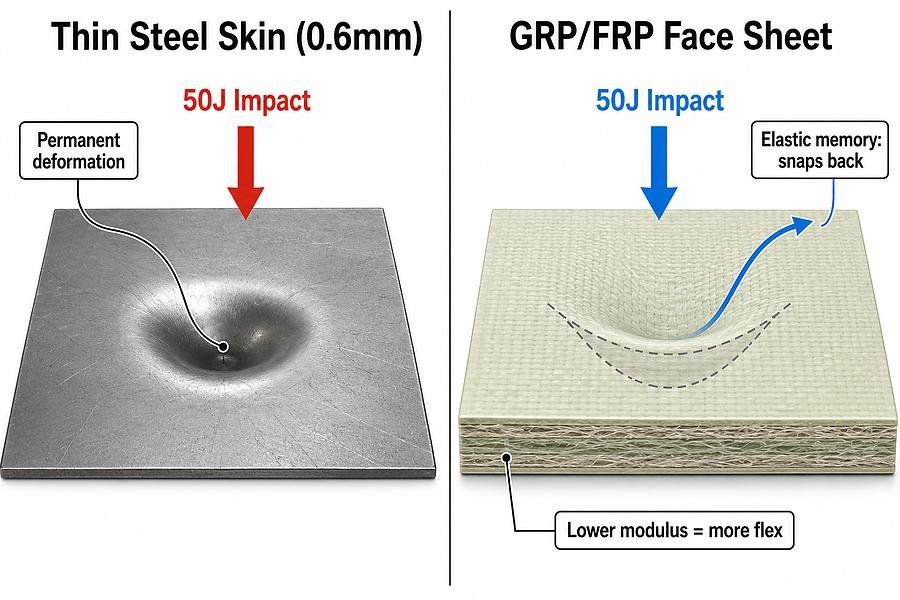
The Role of Elastic Memory in GRP/FRP Panels
Many buyers think steel is always the best choice for strength. But inside a ship cabin, thin steel can look terrible after just a few months of use. GRP/FRP face sheets resist dents much better because of elastic memory. Plastic composites have a natural physical ability to return to their original shape after bending.8 When a hard object hits the GRP panel, the plastic panel bends inward for a split second. Then, it snaps right back to flat. The woven glass fibers inside act like millions of tiny springs. They hold the tension and release it smoothly. Because of this fast bounce-back, you get no permanent marks from moderate hits like luggage bumps or shoulder knocks.
Permanent Deformation Limits in Thin Steel Skins
Now, look at a standard 0.6mm PVC-coated galvanized steel skin. Ships use these on many marine walls. Steel has a high modulus of elasticity, which means it is very stiff. But it has a very low yield limit for dents. If a service cart hits the thin steel skin with just 50 Joules of energy9, the steel stretches beyond its physical limit. It permanently deforms. It leaves an ugly, deep dent that you can see from across the room. You cannot pop that dent back out easily because the metal has stretched and grown longer in that spot. This stretching is why many high-end passenger ships prefer GRP/FRP today. It keeps the interior walls looking new for a much longer time.
| Material | Modulus of Elasticity | Impact Energy to Cause Permanent Dent | Recovery Ability After Impact |
|---|---|---|---|
| 1.2mm GRP/FRP | Lower (Flexible) | > 80 Joules | Excellent (Snaps back to flat) |
| 0.6mm Galvanized Steel | High (Stiff) | 30 - 50 Joules | Poor (Stretches, leaves permanent dent) |
Which Test Method Verifies GRP/FRP Marine Accommodation Panel Face Sheet Impact Resistance?
You cannot trust a sales brochure without proof. Fake test reports lead to major project failures. Knowing the exact testing standards protects you and your shipyard clients.
The primary test methods verifying GRP/FRP marine panel impact resistance are ASTM D256 (Izod pendulum test) for measuring energy absorption per meter, and ISO 6603 (puncture impact behavior) for testing hard object strikes. Marine class societies use these exact standards to approve interior outfitting materials for vessel use.
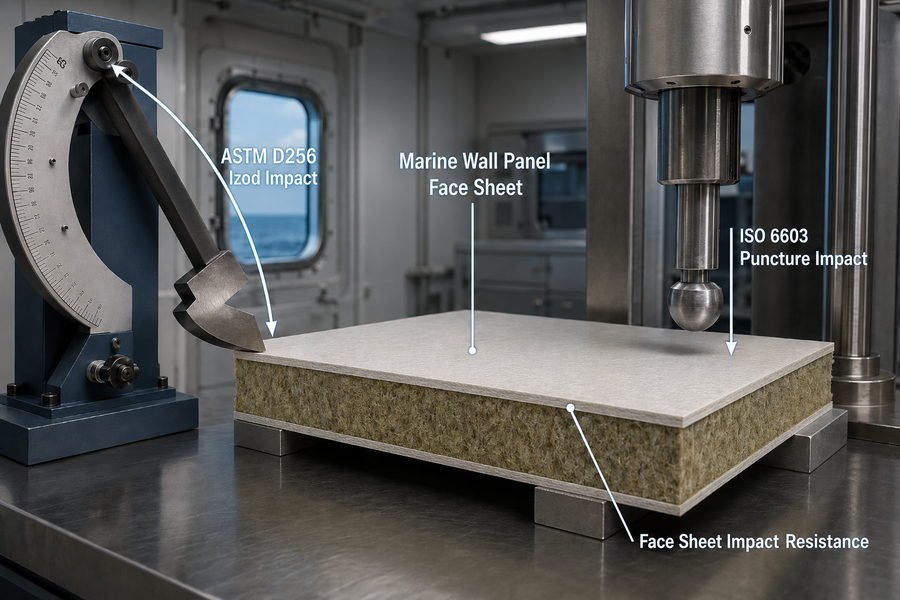
ASTM D25610 Izod Pendulum Test for Energy Absorption
When you buy panels from factories in Asia, you must ask for real lab test reports. Do not just take their word for it. The most common standard is ASTM D256. This is the Izod pendulum test. In an official lab, a heavy swinging hammer hits a small, cut piece of the GRP face sheet. The testing machine measures exactly how much energy is lost when breaking the sample. The result is given clearly in Joules per meter (J/m). If a supplier shows you a real ASTM D256 report with a value over 60 J/m, you know you are buying a strong face sheet. I always tell buyers to reject any batch that does not pass this specific test.
ISO 6603 Puncture Impact Behavior Testing
The other major testing standard you should look for is ISO 6603. This test is very realistic for rough ship environments. It measures puncture impact behavior. A machine drops a heavy metal dart directly onto the flat face sheet from a high point. This perfectly copies what happens when a sharp pipe or heavy tool hits the wall straight on. The test shows the exact force needed to break completely through the resin and glass layers. Marine classification societies like DNV or ABS look closely at these ISO 6603 and ASTM D256 results. They must see good numbers before they issue official type approval certificates for the panel structure.
| Test Standard | Testing Method | What It Measures | Minimum Recommended Value |
|---|---|---|---|
| ASTM D256 | Swinging Pendulum Hammer | Energy absorption before breaking (J/m) | > 50 J/m for general use |
| ISO 6603 | Dropped Weight Dart | Force required to puncture surface | Varies by panel thickness |
| ISO 14125 | 3-Point Flexural Bend | Panel bending strength and core glue bond | > 100 MPa |
Conclusion
GRP/FRP face sheets offer superior impact resistance for marine panels by utilizing flexible resin and strong glass fibers, providing easy-to-repair, dent-free, and certified solutions for modern ship interiors.
-
"Mechanical characterization of glass fiber (woven roving/chopped ...", https://ui.adsabs.harvard.edu/abs/2017AIPC.1859b0108B/abstract. Research on glass-fiber-reinforced polymer composites reports that fiber volume fraction and reinforcement architecture, including continuous or woven fabrics versus chopped fibers, affect impact energy absorption and damage propagation. Evidence role: mechanism; source type: paper. Supports: Continuous woven glass fiber reinforcement can improve impact resistance compared with short chopped glass fiber reinforcement.. Scope note: Published impact values vary with resin system, layup, fiber volume fraction, specimen geometry, notch condition, and test method, so this source would support the mechanism more directly than the exact 80–90 J/m range. ↩
-
"[PDF] Impact damage of carbon fiber polymer–matrix composites, studied ...", http://www.acsu.buffalo.edu/~ddlchung/Impact%20damage%20paper.pdf. Composite materials references describe glass-fiber-reinforced polymers as systems in which the brittle polymer matrix may crack under impact while the glass fibers provide much of the tensile load-bearing capacity, helping limit immediate separation of cracked matrix regions. Evidence role: mechanism; source type: education. Supports: In GRP/FRP panels, resin can crack visibly under impact while glass fibers often remain comparatively intact and continue to hold the face sheet together.. Scope note: This supports the general damage mechanism in glass-fiber composites, but it does not prove that fibers will remain intact under every shipboard impact condition or energy level. ↩
-
"Delamination and Manufacturing Defects in Natural Fiber ...", https://pmc.ncbi.nlm.nih.gov/articles/PMC8073675/. Composite manufacturing literature identifies incomplete fiber wet-out, voids, and resin-starved regions as defects that can reduce interlaminar strength and promote delamination or debonding under mechanical loading. Evidence role: mechanism; source type: paper. Supports: Dry spots caused by incomplete resin wetting can become weak points where composite layers split or delaminate after impact.. Scope note: The source would support dry spots as a recognized contributor to delamination risk, but not the stronger assertion that delamination occurs only because of manufacturing mistakes. ↩
-
"Improving the energy efficiency of ships", https://www.imo.org/en/ourwork/environment/pages/improving%20the%20energy%20efficiency%20of%20ships.aspx. Naval-architecture and maritime-efficiency literature links vessel fuel consumption to displacement, resistance, and required propulsion power; reducing outfit weight can therefore contribute to lower fuel use in context-dependent operating conditions. Evidence role: mechanism; source type: institution. Supports: Lower-weight GRP/FRP face sheets can help reduce overall ship weight, which can support fuel savings.. Scope note: The fuel-saving effect is indirect and depends on vessel type, speed, loading condition, and route profile rather than panel thickness alone. ↩
-
"[PDF] INTERIAMINAR SHEAR STRENGTH OF GLASS-FIBER ...", https://ir.library.oregonstate.edu/downloads/8w32r951s. Experimental studies on glass-fiber-reinforced polymer laminates under low-velocity impact generally report increased peak load, absorbed energy, or damage tolerance as laminate thickness increases; any 30–50% figure should be read as dependent on laminate layup, resin system, and impact-test method. Evidence role: statistic; source type: paper. Supports: Increasing GRP/FRP face sheet thickness by 0.5 mm to 1.0 mm can materially improve impact resistance.. Scope note: A general GFRP impact study may support the direction of the effect, but may not directly validate the exact percentage for marine wall face sheets unless the material construction and test conditions match. ↩
-
"Surface Treatments on Repair Bond Strength of Aged Resin ...", https://pmc.ncbi.nlm.nih.gov/articles/PMC9615938/. Composite-repair literature identifies abrasion/sanding and removal of damaged or contaminated surface material as standard surface-preparation steps that improve adhesive bonding by increasing surface roughness and contact area. Evidence role: mechanism; source type: paper. Supports: A rough, cleaned GRP surface improves adhesion of the repair filler or glue to the existing panel.. Scope note: The exact bond strength still depends on the GRP resin system, adhesive chemistry, sanding method, and environmental conditions. ↩
-
"How Does the IMO FTP Code Connect with Other Marine Fire Safety ...", https://magellanmarinetech.com/how-imo-ftp-code-connect-with-other-marine-fire-safety-frameworks/. SOLAS fire-safety compliance is tied to approved fire-test procedures and certified construction details for ship materials and divisions, so the source can support the regulatory context for fire ratings but not prove that any individual epoxy repair remains compliant without testing or approval. Evidence role: general_support; source type: institution. Supports: A repaired wall panel can only be said to retain SOLAS fire-rating performance if the repair remains consistent with the tested and approved fire-rated assembly.. Scope note: This is contextual support only; whether a repaired panel still passes depends on the certified assembly, repair material, extent of damage, and applicable approval process. ↩
-
"Interrelation between Fiber–Matrix Interphasial Phenomena and ...", https://pmc.ncbi.nlm.nih.gov/articles/PMC8004977/. Materials-science literature on glass-fiber-reinforced polymer composites describes elastic deformation and recovery after unloading when stresses remain below damage or failure thresholds, supporting the general mechanism of shape recovery in GRP/FRP panels. Evidence role: mechanism; source type: paper. Supports: Plastic composites, including GRP/FRP, can return toward their original shape after bending because of elastic behavior below damage thresholds.. Scope note: This support is contextual; elastic recovery depends on resin type, fiber architecture, panel thickness, support conditions, and impact severity. ↩
-
"[PDF] ANVIL EFFECT IN SPHERICAL INDENTATION TESTING ON ...", https://oaktrust.library.tamu.edu/bitstreams/0d723447-b782-4a6a-8e94-5fbc8d3b51e1/download. Low-velocity impact and denting studies of thin steel sheets can document that localized impact energy may produce plastic deformation once stresses exceed the sheet’s yield strength, supporting the mechanism behind permanent dent formation. Evidence role: statistic; source type: paper. Supports: A 0.6 mm galvanized steel skin can permanently dent under a localized impact around the stated energy range because the steel plastically deforms.. Scope note: The exact 50 J threshold is likely geometry- and material-specific; a source may support a comparable range or mechanism rather than prove this value for every 0.6 mm PVC-coated galvanized marine wall skin. ↩
-
"Izod impact strength test - Wikipedia", https://en.wikipedia.org/wiki/Izod_impact_strength_test. ASTM D256 specifies pendulum-impact methods for determining the Izod impact resistance of plastics, with absorbed breaking energy commonly normalized by specimen width and reported in units such as J/m; this supports the test-method description but not any universal GRP face-sheet pass/fail threshold. Evidence role: definition; source type: institution. Supports: ASTM D256 is the Izod pendulum impact test and reports energy absorption for breaking a specimen in units such as J/m.. Scope note: Supports the standard’s method and reporting context, but not the article’s specific strength threshold or rejection rule. ↩