Do your ship cabins feel cold or show strange wet spots on the walls? Unsealed holes for cables and pipes let heat escape fast, ruining your interior outfitting work.
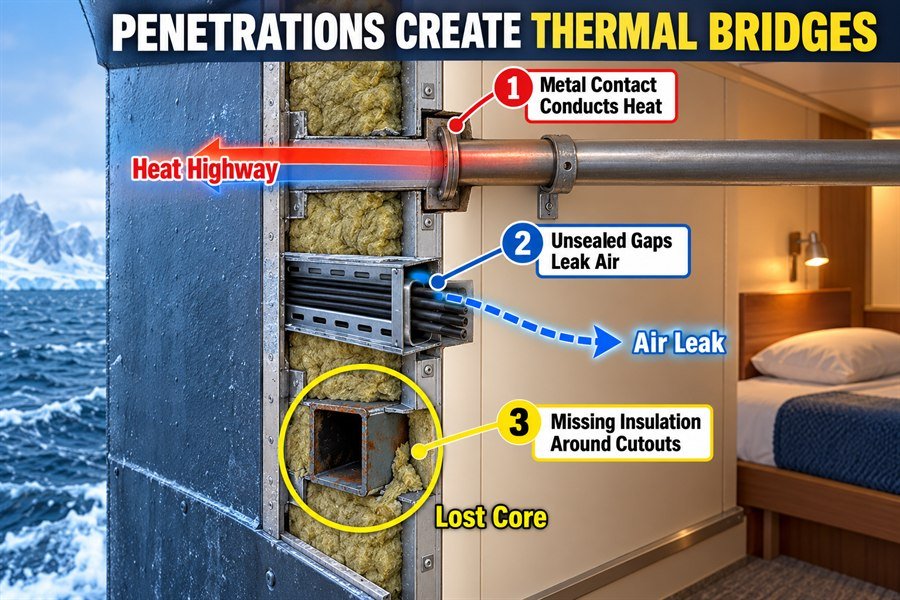
Penetrations create thermal bridges in marine interior panels through three main ways: direct metal-to-metal contact conducting heat, air leaks through unsealed gaps, and missing insulation material around cutouts. These three pathways bypass the panel's built-in thermal resistance, leading to energy loss and immediate condensation risks.
Let us look closer at why these heat leaks happen and how we can stop them to protect your project quality and save your money.
Why Do MCTs and Pipes Cause Thermal Bridges in Marine Bulkheads?
You install top-quality A-60 panels, but the bulkhead still fails heat tests. Metal cable transits (MCTs) and steel pipes slice right through your expensive insulation, causing massive heat leaks.
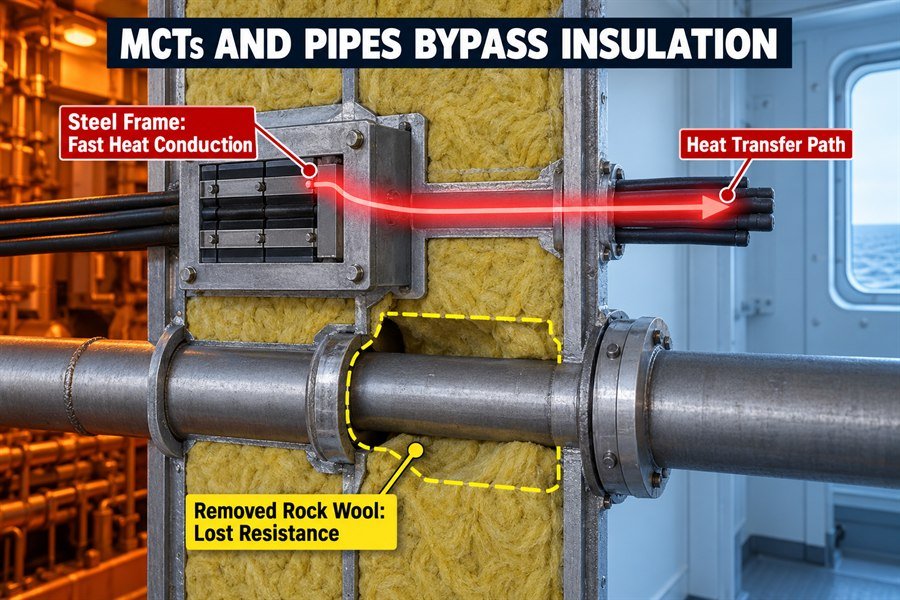
MCTs and pipes cause thermal bridges in marine bulkheads via two mechanisms: high thermal conductivity of the steel transit frames and the physical displacement of the panel's rockwool core. Both mechanisms transfer heat rapidly from the hot side to the cold side, dropping surface temperatures drastically.
I see this problem all the time. When we cut a hole in a marine wall panel for a pipe, we create a massive thermal bridge. You must understand both reasons why this happens so you can fix it.
Heat Transfer Through Steel MCT Frames and Pipes
The first mechanism is the high thermal conductivity of the steel transit frames. Steel conducts heat very fast. According to the ISO 10456 standard, carbon steel has a thermal conductivity value of about 45 W/m·K1. In contrast, the rockwool core inside our marine panels has a value of only 0.034 W/m·K2. This means steel moves heat over 1,300 times faster than the rockwool. When an MCT frame or a steel pipe goes through the panel, it acts like a fast highway for heat. The heat skips the insulation completely. During an A-60 fire test required by the IMO FTP Code Part 3, the unexposed side of the wall must stay below a 140 degrees Celsius temperature rise3. But a bare steel pipe can easily exceed 180 degrees Celsius on the cold side. This will fail your certification instantly. Failing a fire test can cost your company over $10,000 in re-testing fees.
Impact of Rockwool Displacement by Pipes
The second mechanism is the physical displacement of the panel's rockwool core. When we install pipes, we must remove the rockwool to make space. This creates an empty zone. If this empty zone is 150mm wide, you lose 150mm of thermal resistance. The cold air from the outside moves straight into the warm cabin. I remember a project last year where a shipyard forgot to pack the gaps around a 100mm pipe. The steel pipe pulled the cabin temperature down by 4 degrees Celsius near the wall. This made the room very uncomfortable. The shipyard had to tear down the wall and rebuild it, wasting days of labor.
| Material Type | Thermal Conductivity (W/m·K) | Insulation Quality | Risk Level for Thermal Bridging |
|---|---|---|---|
| Rockwool Core (120 kg/m3) | 0.034 | Excellent | Very Low |
| Air Gap (Unsealed) | ~0.025 (but allows convection) | Poor | High |
| Aluminum Pipe | 237 | None | Critical |
| Carbon Steel Pipe/MCT | 45 | None | Critical |
| Stainless Steel Pipe | 15 | None | High |
How Do HVAC Openings Reduce Marine Ceiling Insulation?
Does your ship ceiling let noise and cold air through despite good panels? Big HVAC vents cut away huge sections of ceiling insulation, destroying your carefully planned climate control.
HVAC openings reduce marine ceiling insulation by causing three major issues: removing large areas of the insulated core, creating unsealed air leak pathways around the duct edges, and introducing thin metal diffusers that conduct heat quickly. These three factors combined destroy the ceiling's overall thermal performance.
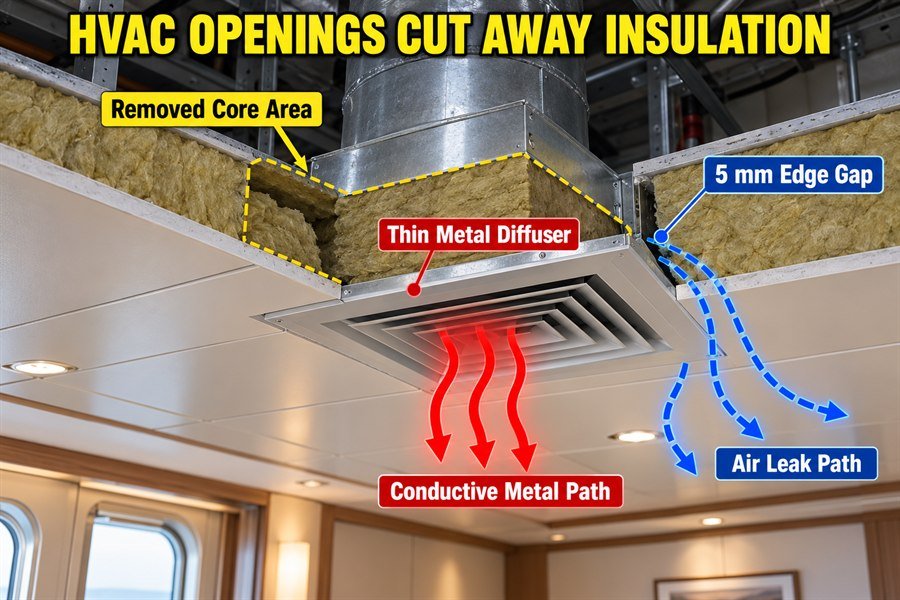
Every time we install an air conditioner vent on a ship, we must cut the ceiling. This causes major issues that will ruin your cabin comfort if you ignore them.
Loss of Insulated Core and Thin Metal Diffusers
The first issue is removing large areas of the insulated core. A standard marine ceiling panel has a 25mm or 50mm rockwool core.4 When we cut a 300mm by 300mm hole for an HVAC vent, we remove 0.09 square meters of insulation. If a cabin has four vents, you lose almost half a square meter of protection. You pay for good insulation, but you cut it away. The second issue is introducing thin metal diffusers that conduct heat quickly. The aluminum diffusers usually have a thickness of just 1.0mm to 1.5mm. Aluminum has a thermal conductivity of 237 W/m·K5, which is even worse than steel. It pulls the cold air from the space above the ceiling right into the room. If the space above the ceiling is 10 degrees Celsius, the aluminum vent will get very cold and chill the room.
Air Leak Pathways Around HVAC Duct Edges
The third major issue is creating unsealed air leak pathways around the duct edges. The cut hole is always slightly larger than the HVAC duct. If the workers leave a 5mm gap around a 300mm duct, it creates an open hole. Air moves freely through this gap. I have tested cabins where the air leaking through these unsealed gaps changed the room temperature by 3 degrees Celsius in just one hour. According to ASHRAE guidelines, air leaks can account for up to 30% of total heating and cooling energy loss in a room6. This forces the HVAC system to work much harder, burning more fuel. You must seal these gaps with fire-rated silicone7 to stop the air leaks completely.
| HVAC Cutout Size (mm) | Lost Insulation Area (m²) | Estimated Energy Loss Increase | Recommended Sealant Volume |
|---|---|---|---|
| 150 x 150 (Small Vent) | 0.022 | 2% - 4% | 1/4 Tube |
| 300 x 300 (Standard) | 0.090 | 5% - 8% | 1/2 Tube |
| 600 x 600 (Main Return) | 0.360 | 12% - 15% | 1 Full Tube |
| 1200 x 300 (Linear Slot) | 0.360 | 15% - 18% | 1.5 Tubes |
How to Insulate Around MCT Penetrations in Marine Bulkheads?
Failing a fire inspection because of poor MCT insulation costs you time and money. If you do not pack the transits correctly, fire and cold air will spread rapidly.
To insulate around MCT penetrations in marine bulkheads, you must execute three critical steps: pack the transit frame tightly with certified halogen-free insert blocks, apply intumescent fire sealant around the cables, and install a 600mm insulation sleeve extending from the bulkhead. These three steps guarantee thermal protection.
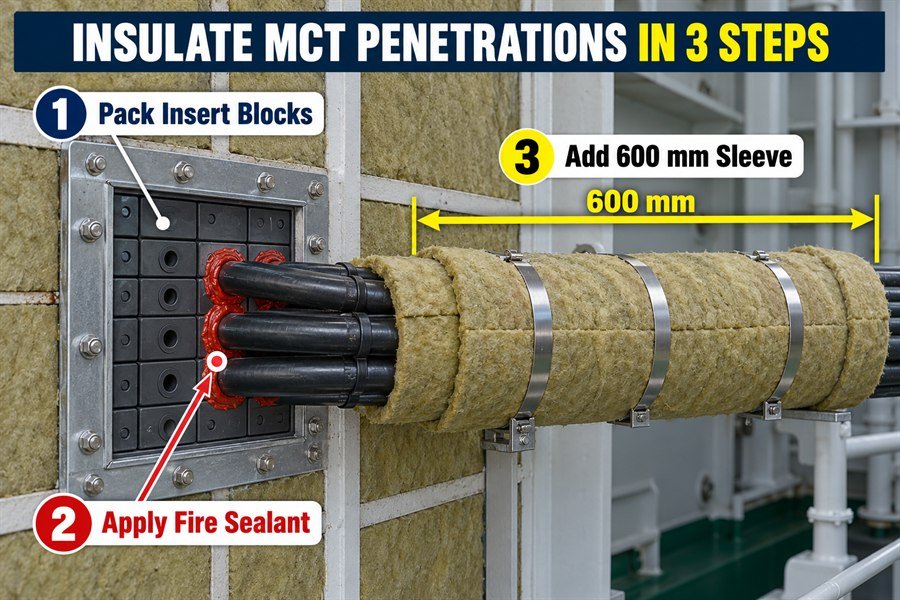
I always tell my clients that doing the MCT insulation right is the most important part of the wall installation. You cannot cut corners here. You must follow three clear steps to pass your inspections.
Packing Insert Blocks and Applying Fire Sealant in MCTs
First, pack the transit frame tightly with certified halogen-free insert blocks. These blocks are usually made of special EPDM rubber. You must fill every single gap between the cables. A standard 120mm by 60mm MCT frame might need 20 to 30 small blocks. If you leave even one block out, the thermal bridge remains open. Air and heat will rush through that tiny hole. Second, apply intumescent fire sealant around the cables. This sealant expands when it gets hot. According to the manufacturer data, a good marine sealant expands up to 3 times its original volume at 150 degrees Celsius. This stops heat and fire from passing through the tiny spaces between the rubber blocks and the copper cables. You should inject at least a 10mm depth of sealant on both sides of the transit.
Installing the 600mm Insulation Sleeve on Bulkheads
The third step is to install a 600mm insulation sleeve extending from the bulkhead. The MCT frame itself is metal, so it will conduct heat. To stop this, the IMO FTP Code requires us to insulate the cables or pipes extending away from the wall8. You must wrap the cables with marine-grade rockwool that has a density of at least 110 kg/m3. The wrap must extend for a minimum of 600mm from the bulkhead surface. Some A-60 rules require a 900mm sleeve, but 600mm is the minimum standard for most A-30 walls. You must tie this rockwool tightly with steel wire every 150mm. If you do not add this sleeve, the heat will travel down the copper cables and bypass the wall entirely, starting a fire in the next room.
| Insulation Step | Required Material | Key Measurement / Spec | Purpose |
|---|---|---|---|
| 1. Block Packing | Halogen-free EPDM blocks | Zero visible gaps | Block air and physical heat transfer |
| 2. Fire Sealant | Intumescent mastic | 10mm minimum depth | Seal micro-gaps and expand during fire |
| 3. Sleeve Wrap | Rockwool (110 kg/m3) | 600mm minimum length | Stop heat traveling down cables/pipes |
| 4. Securing | Galvanized steel wire | Tie every 150mm | Keep rockwool wrap tight against pipe |
Why Do Service Penetrations Cause "Sweating" on Marine Bulkheads?
Condensation ruins your expensive interior finishes and causes deadly mold. Water pools around cables and pipes because these service penetrations create cold spots where moisture turns into liquid water.
Service penetrations cause sweating on marine bulkheads due to two main reasons: localized temperature drops on the metal surface reaching the dew point, and high relative humidity inside the cabin. These two conditions turn the uninsulated pipe or cable tray into a magnet for liquid condensation.
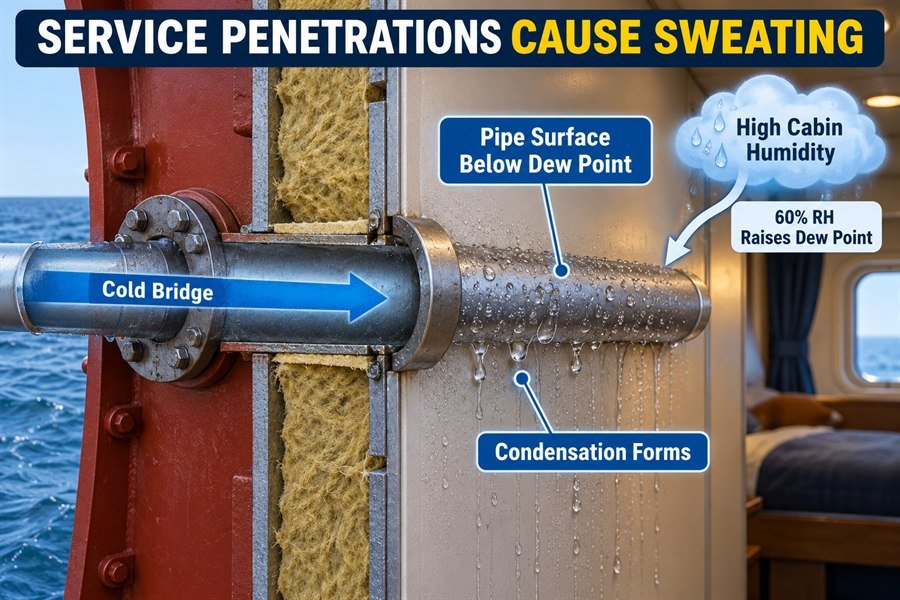
"Sweating" is just another word for condensation. I have seen brand new ceiling panels and beautiful PVC films destroyed by water dripping from uninsulated pipes. You must understand the two reasons why this happens.
How Localized Temperature Drops Reach the Dew Point
The first reason is localized temperature drops on the metal surface reaching the dew point. When a steel pipe goes through the bulkhead to the outside deck, the cold outside temperature travels inside through the solid metal9. If the outside air is 5 degrees Celsius, the pipe surface inside the cabin might drop down to 10 degrees Celsius. The dew point is the temperature where air can no longer hold water vapor. If the pipe is colder than the dew point, water drops form on the metal. It is exactly like a cold glass of beer on a hot day. The glass sweats because it is cold. The pipe sweats for the exact same reason.
The Effect of High Relative Humidity in Ship Cabins
The second reason is high relative humidity inside the cabin. Ships are surrounded by water, so the air is naturally wet. A typical ship cabin has a relative humidity of 50% to 60%. If the cabin temperature is 22 degrees Celsius and the humidity is 60%, the dew point is exactly 13.9 degrees Celsius. If that steel pipe we talked about is sitting at 10 degrees Celsius, it is fully below the dew point. It will start sweating immediately. The water will drip down the wall, rot the carpets, and ruin your interior outfitting work. Replacing a water-damaged PVC marine panel can cost $150 per square meter. To fix this, you must wrap the pipe with closed-cell elastomeric foam insulation. The foam needs to be at least 19mm thick to keep the surface temperature safely above the dew point.10
| Cabin Temp (°C) | Relative Humidity (%) | Dew Point Temp (°C) | Pipe Temp at 5°C Outside | Will the Pipe Sweat? |
|---|---|---|---|---|
| 20 | 40% | 6.0 | 10.0 | No |
| 22 | 50% | 11.1 | 10.0 | Yes |
| 22 | 60% | 13.9 | 10.0 | Yes (Heavy) |
| 24 | 70% | 18.2 | 10.0 | Yes (Severe) |
How to Detail HVAC and Lighting Cutouts in Marine Ceilings?
Messy cutouts for lights and vents look terrible and leak conditioned air. If your installation team does not detail these holes properly, your ceiling panels will lose their integrity.
To detail HVAC and lighting cutouts in marine ceilings, you must follow three methods: frame the cutout edges with U-shaped steel profiles, seal the gaps with high-temperature silicone, and reinstall a rockwool collar above the fixture. These three methods restore the structural and thermal strength.
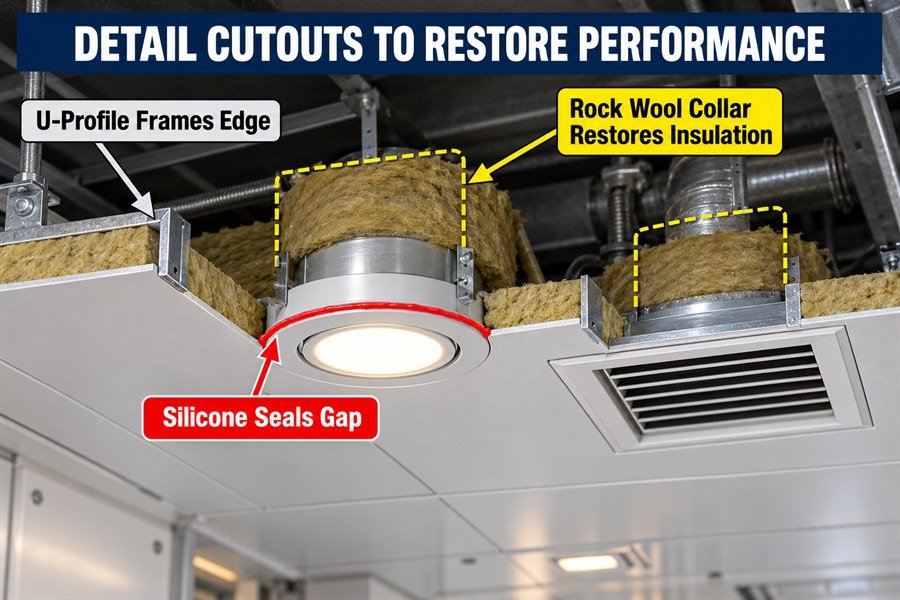
Cutting holes in marine ceiling panels is easy, but making them right is hard. I always train my buyers' installation teams to follow three specific methods to detail these cutouts properly.
Framing Cutout Edges with U-Shaped Steel Profiles
First, you must frame the cutout edges with U-shaped steel profiles. When you cut a sandwich panel, you expose the soft rockwool inside. You must cover this raw edge. We use galvanized steel U-profiles with a thickness of 0.6mm. You push this profile over the cut edge and secure it with a steel pop-rivet every 150mm. This gives the lighting fixture or the heavy HVAC vent a strong, solid metal base to sit on. It stops the ceiling skin from bending.11 It also stops the itchy rockwool dust from falling into the cabin and causing health problems for the crew.
Sealing Gaps and Reinstalling the Rockwool Collar
Second, seal the gaps with high-temperature silicone. Even with the steel profile, there will be tiny air gaps between the light fitting and the ceiling surface. You must run a continuous bead of marine-grade silicone sealant around the edge. This silicone should handle temperatures up to 200 degrees Celsius. This stops air and noise from passing through.12 Third, you must reinstall a rockwool collar above the fixture. When you cut the hole, you removed important insulation. You must put it back. Cut a piece of 50mm thick rockwool with a density of 100 kg/m3. Shape it into a box or collar and place it directly over the back of the light fixture in the ceiling void. This stops the heat from escaping into the space above.13
| Detailing Method | Material Specification | Primary Benefit | Secondary Benefit |
|---|---|---|---|
| U-Profile Framing | 0.6mm Galvanized Steel | Restores panel stiffness | Blocks rockwool dust |
| Gap Sealing | 200°C Marine Silicone | Stops air leaks | Reduces sound transmission |
| Rockwool Collar | 50mm thick, 100 kg/m3 | Restores thermal rating | Provides extra fire safety |
| Riveting | 4mm Steel Pop-Rivets | Locks profile in place | Prevents vibration noise |
How Do Metal Sleeves Affect A-60/B-15 Marine Interior Fire Integrity?
A bad pipe penetration can burn down a ship. When you weld metal sleeves into fire bulkheads without proper care, you destroy the A-60 or B-15 rating instantly.
Metal sleeves affect A-60 and B-15 marine interior fire integrity by acting as direct heat conductors and by creating structural weak points during thermal expansion. Both of these effects can cause premature panel failure and allow deadly fire to spread to the safe side.
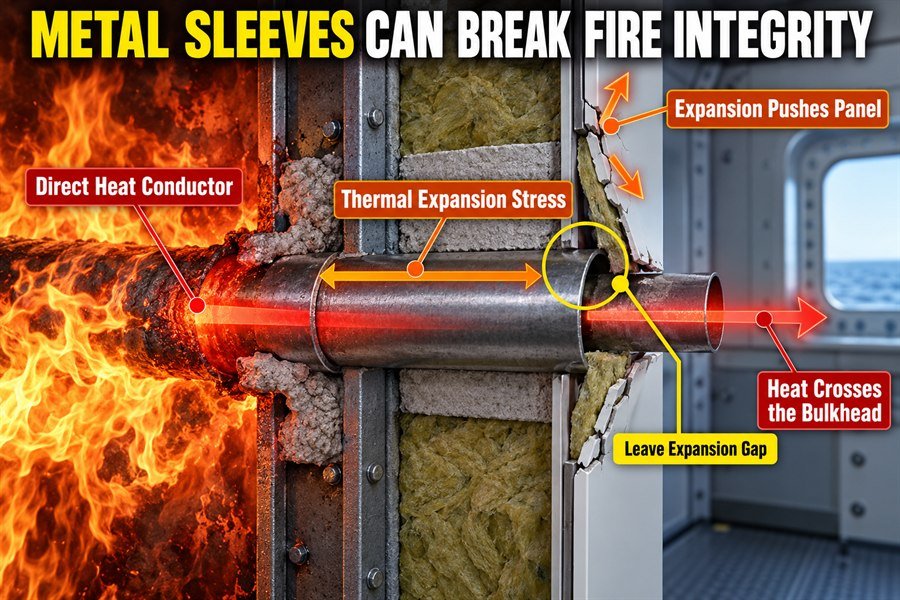
Metal sleeves are heavy steel pipes welded into the bulkhead to let cables pass through safely. They are absolutely necessary, but they affect A-60 and B-15 fire integrity in two very dangerous ways. You must manage them correctly.
Metal Sleeves Acting as Direct Heat Conductors
First, they act as direct heat conductors. As I mentioned earlier, steel moves heat incredibly fast14. In an A-60 fire test, the hot side reaches nearly 945 degrees Celsius in 60 minutes, following the standard ISO 834 fire curve15. The metal sleeve absorbs this massive heat and brings it straight through the panel to the unexposed side. If the sleeve is not properly insulated with a 600mm rockwool wrap, the cold side of the sleeve will reach 400 degrees Celsius in just 15 minutes. This temperature will instantly ignite any nearby plastics, papers, or clothing. The wall will stand, but the fire will cross over. This is a complete failure.
Structural Weak Points Caused by Thermal Expansion
Second, the sleeves create structural weak points during thermal expansion. When steel gets hot, it grows. A heavy steel sleeve can expand in length by 5mm or more during a severe fire. Because the sleeve passes through the thin 50mm marine panel, this movement pushes hard against the panel. This pushing force can crack the panel joints or rip the steel skins right off the rockwool core. Once the panel skin opens, the fire gets inside the wall and burns the core. To stop this, classification societies like DNV and ABS strictly require the sleeve to be welded only to the heavy main structural bulkhead, never just to the decorative B-15 panel. You must leave an expansion gap around the B-15 panel cut.
| Metal Sleeve Issue | Cause During Fire Test | Consequence on Panel | Required Fix |
|---|---|---|---|
| Heat Conduction | Steel moves heat fast | Cold side ignites over 400°C | Add 600mm rockwool wrap |
| Thermal Expansion | Metal grows when hot | Panel skin rips open | Weld to main structure only |
| Panel Cracking | Movement pushes panel | Joints break and let smoke in | Leave 5mm expansion gap |
| Heat Radiation | Bare metal emits heat | Warps adjacent PVC finishes | Paint with intumescent paint |
Conclusion
Thermal bridges from penetrations will ruin your ship interiors. By properly insulating MCTs, wrapping pipes, and detailing HVAC cutouts, you guarantee high quality, pass inspections, and keep your clients happy.
-
"List of thermal conductivities", https://en.wikipedia.org/wiki/List_of_thermal_conductivities. ISO 10456 tabulates design thermal values for building materials, including carbon steel at approximately 45 W/m·K, supporting the stated order of magnitude for steel conductivity. Evidence role: definition; source type: institution. Supports: Carbon steel has a thermal conductivity of about 45 W/m·K.. Scope note: The standard provides reference design values rather than measurements for a specific MCT frame or pipe alloy. ↩
-
"Determination of Thermal Properties of Mineral Wool ... - PMC", https://pmc.ncbi.nlm.nih.gov/articles/PMC10488771/. Published material data for mineral wool/rock wool insulation commonly report thermal conductivity in the low 0.03 W/m·K range, which supports the comparison with steel conductivity. Evidence role: definition; source type: paper. Supports: Rockwool insulation can have a thermal conductivity of about 0.034 W/m·K.. Scope note: The value may vary by density, temperature, moisture content, and product formulation, so a source may support the range rather than this exact panel value. ↩
-
"What Is the Purpose and Scope of the IMO FTP Code?", https://magellanmarinetech.com/what-purpose-scope-of-imo-ftp-code/. The IMO FTP Code fire-resistance criteria for A-class divisions specify limits on average temperature rise of the unexposed face, supporting the stated 140 °C criterion for A-60 performance. Evidence role: definition; source type: institution. Supports: An A-60 fire test under the IMO FTP Code includes a 140 °C unexposed-side average temperature-rise limit.. Scope note: The full criterion may also include maximum temperature-rise limits at individual points and integrity requirements, so the citation should not imply that the average-temperature limit is the only requirement. ↩
-
"What Thickness Factors Apply to Marine Accommodation ...", https://magellanmarinetech.com/what-thickness-factors-apply-marine-accommodation-ceiling-panels/. Marine accommodation ceiling-panel specifications commonly list mineral-wool or rockwool insulation cores in nominal thicknesses such as 25 mm and 50 mm, supporting the article’s description of typical insulated ceiling construction. Evidence role: general_support; source type: institution. Supports: Standard marine ceiling panels often use 25 mm or 50 mm rockwool/mineral-wool cores.. Scope note: Product and class-compliant panel specifications vary by manufacturer and vessel type, so this would support typical practice rather than a universal standard. ↩
-
"Aluminum 6061-T6 (UNS AA96061)", https://www.nist.gov/mml/acmd/aluminum-6061-t6-uns-aa96061. Reference tables for pure aluminum report thermal conductivity values near 237 W/m·K at room temperature, supporting the stated order of magnitude for heat conduction through aluminum diffusers. Evidence role: definition; source type: education. Supports: Aluminum has a thermal conductivity of about 237 W/m·K.. Scope note: The exact value depends on alloy composition and temperature, so the citation supports pure aluminum or typical reference values rather than every diffuser alloy. ↩
-
"Energy Impacts of Infiltration and Ventilation in US Office ...", https://tsapps.nist.gov/publication/get_pdf.cfm?pub_id=860765. Building-science and energy-efficiency sources report that uncontrolled air leakage or infiltration can represent a substantial share of heating and cooling load, with figures around 25–40% cited in some building contexts; this supports the plausibility of a 30% contribution. Evidence role: statistic; source type: government. Supports: Air leakage can account for a large share, up to around 30%, of heating and cooling energy loss.. Scope note: Most available data concern buildings rather than ship cabins, so the evidence would be contextual rather than direct marine-cabin proof. ↩
-
"Firestop Product Selection Guide", https://usmadesupply.com/resources/guides/firestop-product-selection-guide. Firestopping guidance for service penetrations describes fire-rated sealants, including silicone-based systems, as materials used to seal annular gaps around penetrations and help maintain fire-resistance and smoke-control performance. Evidence role: mechanism; source type: institution. Supports: Fire-rated silicone sealant is an appropriate material category for sealing gaps around HVAC penetrations where fire-resistance and air/smoke leakage control are required.. Scope note: Such sources support the function and code rationale of fire-rated sealing systems, but they do not prove that any installation will stop air leakage completely without correct detailing and inspection. ↩
-
"What Is the Purpose and Scope of the IMO FTP Code?", https://magellanmarinetech.com/what-purpose-scope-of-imo-ftp-code/. An IMO FTP Code or recognized marine fire-test source should establish that fire-rated divisions and their penetrations are tested as assemblies, including any insulation needed around pipes or cable transits to preserve the division rating. Evidence role: expert_consensus; source type: institution. Supports: Marine fire-rated bulkhead penetrations may require insulation of services extending from the division to preserve the tested fire rating.. Scope note: The FTP Code may specify test performance and assembly conditions rather than a universal field rule for every cable or pipe penetration length. ↩
-
"Thermal Conductivity and the Wiedemann-Franz Law", http://hyperphysics.phy-astr.gsu.edu/hbase/thermo/thercond.html. Heat-transfer references define conduction as heat transfer through solids caused by a temperature gradient, which explains why a metal pipe or penetration can carry exterior cold inward. Evidence role: mechanism; source type: education. Supports: A steel pipe passing from an outside deck into a cabin can conduct cold inward through the metal.. Scope note: This supports the mechanism, but the exact indoor pipe-surface temperature depends on pipe geometry, material, airflow, insulation, and boundary conditions. ↩
-
"What Is Dew Point Temperature? Condensation ...", https://www.cky.com.tw/en/insights/dew-point-condensation-prevention. Condensation-control guidance from building-services or insulation engineering sources supports selecting insulation thickness so the outer surface temperature remains above the ambient dew point; a 19 mm closed-cell elastomeric layer may be consistent with such calculations under the stated cabin and exterior conditions. Evidence role: expert_consensus; source type: institution. Supports: Closed-cell elastomeric insulation of about 19 mm can help keep a cold pipe surface above dew point under specified cabin conditions.. Scope note: This does not prove 19 mm is sufficient in every installation; required thickness depends on pipe size, insulation conductivity, ambient temperature, humidity, air movement, and surface emissivity. ↩
-
"Composite Sandwich Panels - Lehigh Preserve - Lehigh University", https://preserve.lehigh.edu/system/files/derivatives/coverpage/505079.pdf. A structural engineering source on sandwich panels or framed penetrations can support that cutouts reduce local stiffness and that edge reinforcement helps transfer loads around openings; this would substantiate the mechanical rationale rather than prove the specific 0.6 mm profile design. Evidence role: mechanism; source type: paper. Supports: Framing cutout edges with a U-shaped steel profile helps provide a stronger support base and reduces bending around the ceiling opening.. Scope note: Support is likely to be general to sandwich-panel behavior and edge reinforcement, not specific to this exact marine ceiling assembly or rivet spacing. ↩
-
"Air Sealing Colorado Homes | CSU Extension", https://extension.colostate.edu/resource/air-sealing-colorado-homes/. A building-acoustics or sealant reference can support that sealing gaps and penetrations reduces air leakage and can improve sound isolation by limiting flanking paths; this supports the principle, while actual acoustic performance depends on installation quality and assembly testing. Evidence role: mechanism; source type: research. Supports: Applying a continuous sealant bead around fixtures can reduce air leakage and sound transmission through gaps.. Scope note: The evidence would likely support the general sealing mechanism rather than certify the performance of a particular marine-grade silicone product or ceiling system. ↩
-
"International Journal of Heat and Mass Transfer", https://htp.engin.umich.edu/wp-content/uploads/sites/119/2024/05/Wet-insulation.pdf. A thermal-insulation source can support that mineral wool has low thermal conductivity and is used to reduce heat transfer in building and marine assemblies; this supports the rationale for replacing insulation around a cutout, although it does not verify the exact thermal rating of the specified collar geometry. Evidence role: mechanism; source type: institution. Supports: Reinstalling a rockwool collar above a cutout helps restore insulation and reduce heat transfer into the ceiling void.. Scope note: The source would support mineral wool’s insulating function generally, not the certified thermal performance of the described 50 mm, 100 kg/m³ collar around a fixture. ↩
-
"Thermal Conductivity", http://hyperphysics.phy-astr.gsu.edu/hbase/Tables/thrcn.html. Engineering references list carbon steel as having substantially higher thermal conductivity than mineral wool insulation and many building materials, supporting the mechanism by which a steel penetration can conduct heat through a fire-rated assembly. Evidence role: mechanism; source type: education. Supports: Steel sleeves can act as direct heat conductors through a fire-rated bulkhead or panel.. Scope note: Thermal conductivity values explain the mechanism but do not by themselves quantify temperatures in a specific sleeve design. ↩
-
"Charring properties and temperature profiles of laminated ...", https://bioresources.cnr.ncsu.edu/resources/charring-properties-and-temperature-profiles-of-laminated-bamboo-under-single-side-of-iso-834-fire-exposure/. ISO 834 and derivative standard time–temperature curves are commonly used in fire-resistance testing to define furnace temperature rise over time, with temperatures approaching about 945 °C at 60 minutes. Evidence role: definition; source type: institution. Supports: In an A-60 fire test, the hot side reaches nearly 945 degrees Celsius in 60 minutes, following the standard ISO 834 fire curve.. Scope note: The source supports the standardized fire exposure curve, not the performance of any particular sleeve or marine panel assembly. ↩