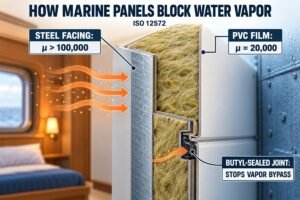
Tired of wiping water off your new ship interior? Wet panels ruin cabins and upset shipyard clients. Let me show you how to fix this annoying issue permanently.
Thermal bridging causes condensation on marine accommodation panels by creating highly conductive paths through insulation, which cools the interior surface below the dew point (typically 12°C at 22°C/50% RH, per ASHRAE). This leads to continuous sweating, requiring anti-condensation tape, PVC profiles, or thermal breaks to stop moisture.
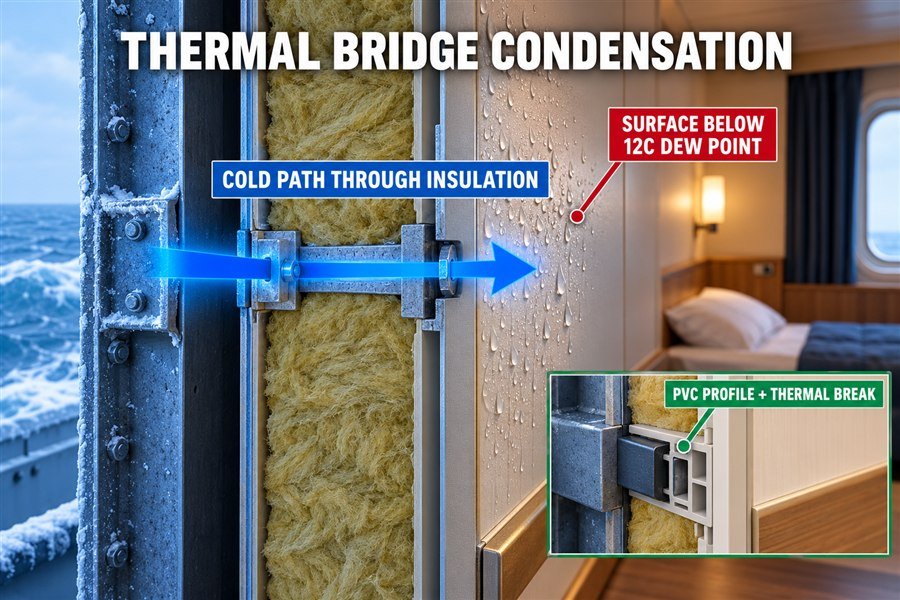
Let us look at exactly why this happens on board and how you can stop it from ruining your hard work and protect your profit margins.
How Do Thermal Bridges Trigger "Sweating" on Marine Interior Panels?
Waking up to wet cabin walls is terrible. The dampness causes mold and damages expensive finishes. You can stop this by understanding how heat moves through steel.
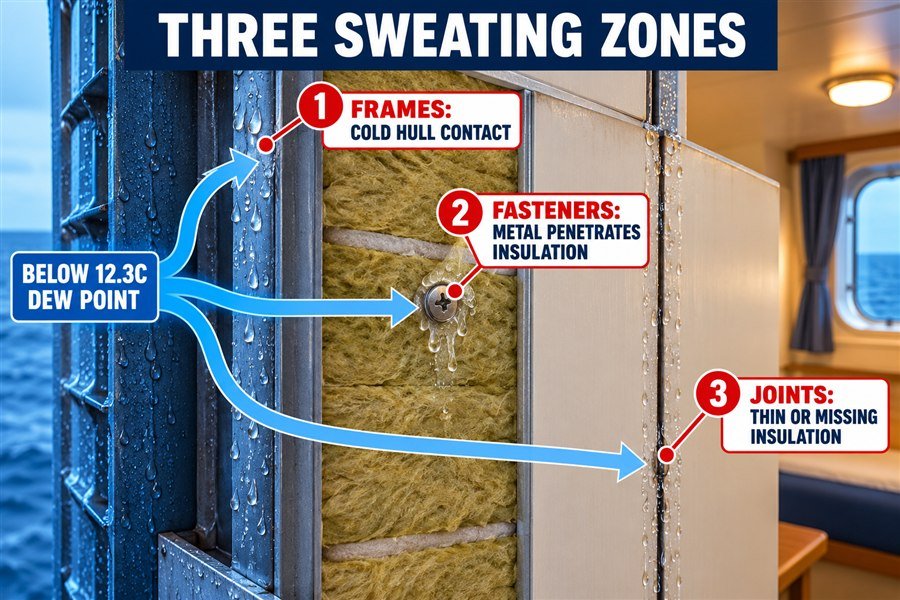
Thermal bridges trigger sweating on marine interior panels by transferring cold outside temperatures rapidly through steel components to the warm interior. When the steel surface temperature drops below the cabin's dew point (around 12.3°C), the air's moisture turns into liquid water (sweat) across three main areas: frames, fasteners, and joints.
The Physical Process of Sweating on Marine Panels
I often see contractors puzzled by water appearing inside a dry cabin. Sweating on marine panels is a simple physics problem. According to ASHRAE standards, a typical ship cabin sits at 22°C with 50% relative humidity. At these conditions, the dew point is exactly 12.3°C1. If any part of the wall panel drops below 12.3°C, the moisture in the air immediately turns into liquid water on that surface. Steel is an excellent conductor of heat. When the outside hull is freezing, the cold travels straight through the metal connections into the cabin. The insulation cannot do its job if a piece of metal cuts right through it. This creates a "thermal bridge2" that acts like a highway for the cold.
Identifying the Three Main Condensation Areas on Ships
In my years working at Magellan Marine, I learned that you must check three main areas to stop this problem. You cannot just look at the middle of the panel. First, you must check the frames. The structural steel frames connect directly to the cold hull. If your interior panel touches this frame without a thermal break, it will sweat. Second, look at the fasteners. Steel screws and bolts punch right through your expensive rockwool insulation. Each metal screw becomes a tiny ice-cold dot on your wall. Finally, you must inspect the joints. Where two panels meet, the insulation is often thin or missing. I always tell my clients to buy panels with good joint designs.
| Condensation Area | Primary Cause of Thermal Bridging | Typical Surface Temperature (at 0°C outside) | Risk Level |
|---|---|---|---|
| Structural Frames | Direct metal-to-metal contact with hull | 5°C to 8°C | Very High |
| Fasteners / Screws | Metal penetrating the rockwool insulation | 9°C to 11°C | Medium |
| Panel Joints | Missing insulation or metal connecting profiles | 8°C to 12°C | High |
Why Do Cold Spots Form at Marine Bulkhead H-Profiles and Tracks?
Finding water pooling near base tracks is a nightmare for installers. It delays the project handover. You need to know why these specific metal profiles fail.
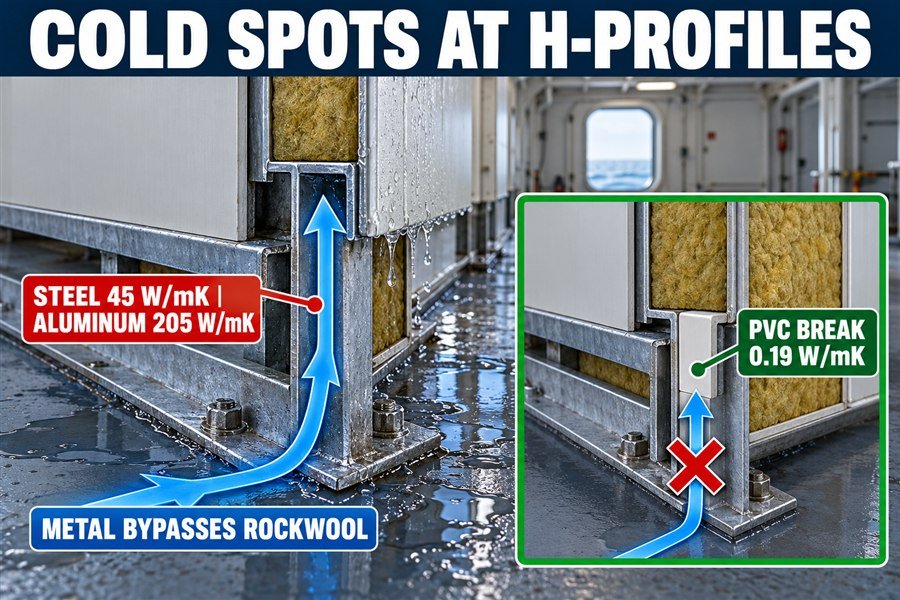
Cold spots form at marine bulkhead H-profiles and base tracks because they are typically made of highly conductive galvanized steel (45 W/m·K) or aluminum (205 W/m·K) directly touching the cold deck. Without PVC thermal breaks, these metal tracks bypass the rockwool insulation, instantly dropping below the dew point.
The High Thermal Conductivity of Metal Bulkhead Profiles
You buy high-quality 50mm marine wall panels to keep the cabin warm. But then you install them into bare metal tracks on the floor and ceiling. This is a big mistake I see often. Standard galvanized steel has a thermal conductivity of about 45 W/m·K. Aluminum is even worse at 205 W/m·K.3 When you screw an aluminum H-profile to a cold steel deck, the cold rushes up into the profile. The profile then touches the metal skin of your wall panel. You just bypassed all your nice rockwool insulation. The temperature of the track drops far below the 12.3°C dew point. This is why you see puddles of water on the floor right next to the wall tracks. The air hits the cold track, sweats, and the water runs down.4
Solving Track Cold Spots with PVC Thermal Breaks
You can fix this problem easily and cheaply during your purchasing phase. Do not buy bare metal tracks for exterior facing cabins. Instead, buy PVC profiles or steel tracks with a pre-installed PVC thermal break. PVC has a thermal conductivity of only 0.19 W/m·K. It blocks the cold completely. A bare galvanized steel base track costs about $0.80 per meter. A steel track with a good PVC thermal break costs about $1.50 per meter. Paying an extra $0.70 per meter is much cheaper than replacing a ruined cabin floor later. I always advise procurement officers to spend this small extra amount. It saves huge headaches during the shipyard inspection.
| Profile Material | Thermal Conductivity (W/m·K) | Average Cost per Meter | Condensation Risk |
|---|---|---|---|
| Aluminum | 205.0 | $1.20 | Extremely High |
| Galvanized Steel | 45.0 | $0.80 | High |
| Stainless Steel (304) | 15.0 | $2.50 | Medium |
| PVC / Plastic | 0.19 | $1.50 (with steel core) | Very Low |
How Do Thermal Bridges Drop Marine Ceilings Below the Dew Point?
Dripping ceilings can ruin expensive cabin furniture. This makes your client very angry. You can prevent this by fixing the ceiling suspension system.
Thermal bridges drop marine ceilings below the dew point when steel hanger pins (conductivity 45 W/m·K) connect the cold upper deck directly to the metal ceiling grid. This bypasses the 50mm ceiling insulation, pulling the ceiling panel temperature below the typical 12°C dew point, causing water to drip.
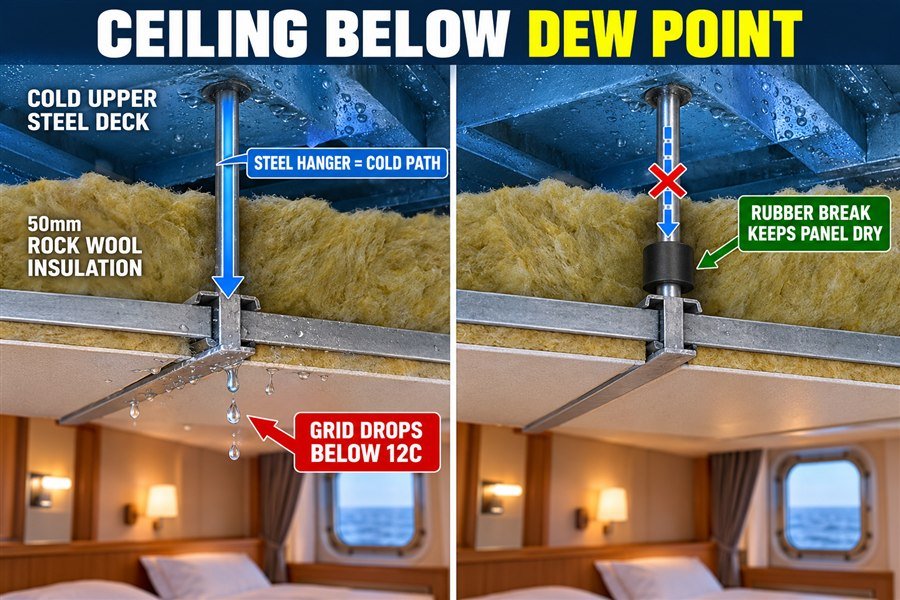
Heat Transfer Through Steel Ceiling Hanger Pins
A marine ceiling is usually hung from the steel deck above using metal hanger pins. I remember a project where the client bought the best B-15 rated ceiling panels. But they used cheap 4mm steel rods to hang them. The deck above was exposed to winter air at 2°C. Because steel is a great conductor, the cold traveled straight down the 4mm rods into the ceiling support grid. Even though the ceiling panels had 50mm of dense rockwool (100kg/m3), the metal grid was freezing cold. The grid touched the surface of the ceiling panels. This created lines of cold spots across the entire ceiling. The temperature on these spots dropped to 9°C. Since the cabin dew point was 12.3°C, the ceiling started dripping water onto the beds below.
Calculating Dew Point Drops in Marine Ceilings
To stop this, you must understand the numbers. If your cabin is 22°C and 50% humidity, your safe zone is above 12.3°C. When a steel hanger pin bypasses the insulation, it can easily drop the local surface temperature by 10 to 15 degrees.5 If you increase the cabin temperature to 24°C and the humidity rises to 60%, your new dew point becomes 15.8°C. This makes condensation even more likely. You must buy ceiling suspension systems that include rubber or plastic vibration isolators. These isolators act as a thermal break. They stop the cold from traveling down the pin. They cost about $0.30 each, which is a tiny price to pay for a dry ceiling.
| Cabin Temperature | Relative Humidity | Dew Point (Sweat Point) | Ceiling Hanger Temp (Steel) | Result |
|---|---|---|---|---|
| 20°C | 50% | 9.3°C | 7.0°C | Sweating |
| 22°C | 50% | 12.3°C | 8.0°C | Sweating |
| 24°C | 60% | 15.8°C | 9.0°C | Heavy Sweating |
| 22°C | 50% | 12.3°C | 18.0°C (with rubber break) | Dry |
Why Does Condensation Concentrate at Marine Bulkhead Joints?
Wet seams make the wall panels look cheap and poorly installed. This hurts your reputation. You must block the air from reaching the cold steel behind.
Condensation concentrates at marine bulkhead joints because the 1mm to 3mm gaps between panels allow warm, moist cabin air to leak into the cold void space behind. This air hits the uninsulated ship hull (often 5°C or lower), condenses, and the water runs down and out through the joints.
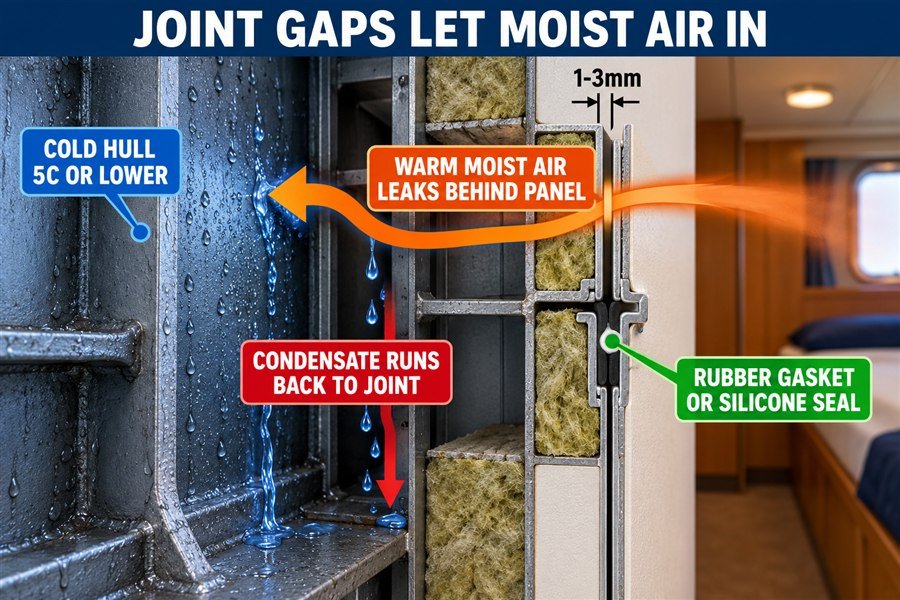
Air Leakage Through 1mm to 3mm Bulkhead Panel Gaps
Many people think wall panels must be perfectly tight. But in reality, standard marine wall panels always have a small gap. When you lock two 50mm panels together, there is usually a 1mm to 3mm gap at the joint. I have seen many installers ignore this gap. Inside the cabin, the air is warm and full of moisture. Behind the wall panel, there is a void space (usually 50mm to 100mm wide) before you hit the bare steel hull. The steel hull is very cold, often around 5°C. The warm cabin air pushes through the 1mm panel joint into this cold void space. When the warm air hits the cold hull, it immediately dumps its water.6 The water runs down the hull, hits the floor track, and leaks out into the cabin right through the same joint.
Managing Void Space Temperatures Behind Marine Bulkheads
You cannot just leave this void space empty if it is against the outer hull. According to SOLAS regulations and good engineering practices, you must insulate the outer hull with structural fire protection. But even with that, you must seal the panel joints. If you buy standard tongue-and-groove panels, ask your supplier for omega profiles with rubber gaskets. The rubber gasket seals the gap completely. Another cheap method is to use marine-grade silicone sealant inside the joint during installation. A tube of good silicone costs about $4.00 and can seal many meters of joints. If you stop the warm air from leaking into the cold void, you stop the condensation at the joint.
| Joint Gap Size | Air Leakage Rate | Moisture Penetration Risk | Recommended Solution |
|---|---|---|---|
| 0mm (Sealed) | None | Zero | None required |
| 1mm to 2mm | Low | Medium | Silicone Sealant |
| 3mm to 5mm | High | Very High | Omega Profile with Rubber Gasket |
| > 5mm | Extreme | Guaranteed Condensation | Cover profile with heavy sealant |
How Does Detailing Reduce Condensation at Marine Interior Thermal Bridges?
Poor installation details ruin good panels. You waste money replacing them. Good detailing stops the cold paths before they even form.
Detailing reduces condensation at marine interior thermal bridges through three specific methods: installing 3mm rubber isolation pads under floor tracks, wrapping steel pillars with 25mm ceramic fiber, and applying anti-sweat tape around window frames. These details break the metal-to-metal contact, keeping panel surface temperatures safely above the dew point.
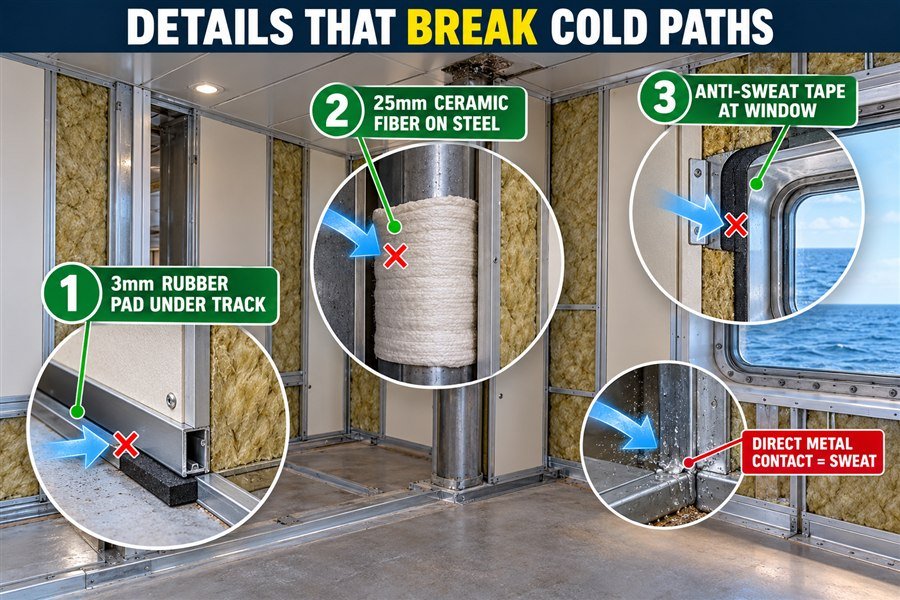
Implementing 3mm Rubber Isolation Pads at Base Tracks
The first method is the easiest and cheapest. When you buy your base tracks, you must also buy rubber isolation pads. I recommend a 3mm thick neoprene rubber pad. You place this pad on the bare steel deck before you screw down the metal base track. The rubber breaks the direct metal-to-metal contact.7 It stops the track from absorbing the cold from the deck. A roll of 3mm rubber pad costs only about $0.50 per meter. This small detail keeps the bottom of your wall panels warm and dry. I always force my installation teams to use these pads on every single exterior wall track.
Wrapping Structural Steel with 25mm Ceramic Fiber
The second method is for structural pillars. Sometimes a steel pillar must run right through your cabin space. You cannot just build your panels around it and leave it bare. The pillar will sweat heavily. You must wrap the pillar tightly before you close the wall. I suggest buying 25mm thick ceramic fiber blankets. Ceramic fiber is fireproof and has excellent thermal resistance. You cut the blanket, wrap it around the steel pillar, and secure it with steel wire. A square meter of 25mm ceramic fiber costs about $8.00. This wrap acts as a heavy sweater for the pillar, trapping the cold inside so it cannot reach your panels.
Applying Anti-Sweat Tape Around Marine Window Frames
The third method focuses on windows. Window frames are massive thermal bridges because they connect directly to the outside hull.8 When you order window boxes or linings, you must use anti-sweat tape. This is a special foam tape with a strong adhesive on one side. It is usually 3mm to 5mm thick. You apply this tape all around the edge of the metal window frame where the interior panel will touch it. A roll of good anti-sweat tape costs about $12.00 for 10 meters. The foam stops the cold from the window frame from transferring into your clean white panels. If you do these three detailing steps, your cabins will stay perfectly dry.
| Detailing Method | Material Used | Average Cost | Target Area |
|---|---|---|---|
| Floor Isolation | 3mm Neoprene Rubber Pad | $0.50 / meter | Base tracks and floor U-profiles |
| Pillar Insulation | 25mm Ceramic Fiber Blanket | $8.00 / sq. meter | Structural steel columns and beams |
| Frame Thermal Break | 3mm to 5mm Foam Anti-Sweat Tape | $1.20 / meter | Window frames and heavy door frames |
Why Do Metal Hangers Stay Colder Than the Surrounding Marine Ceiling?
You might wonder why only the hanger spots sweat while the rest of the ceiling is dry. It is highly frustrating. Here is the science behind it.
Metal hangers stay colder than the surrounding marine ceiling because their small cross-sectional area (typically 4mm diameter) acts as a highly efficient heat sink, continuously pulling cold from the bare deck (often 2°C) much faster than the surrounding 50mm rockwool insulated panels, creating localized cold spots of 10°C.
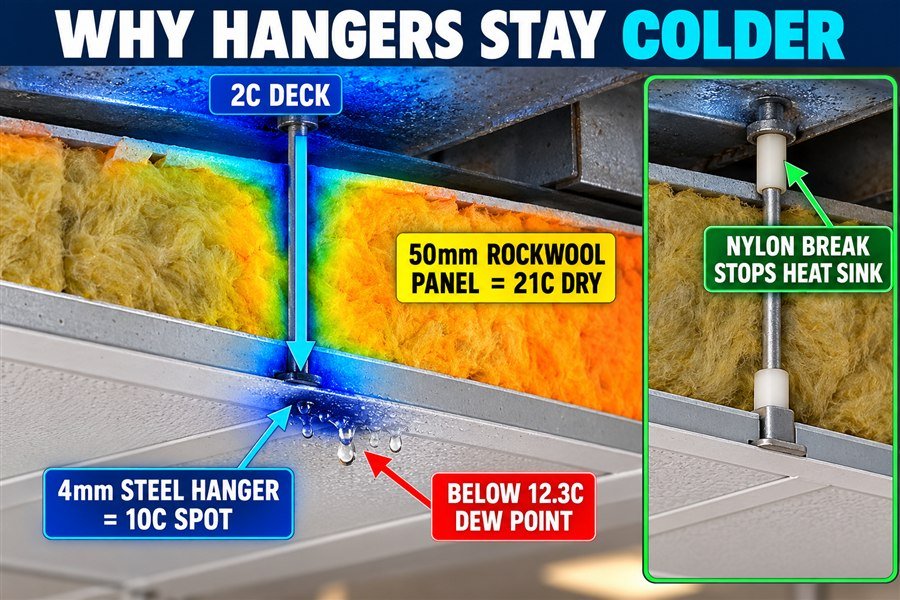
The Heat Sink Effect of 4mm Diameter Steel Hangers
It looks strange when you look up at a ceiling and see perfectly dry panels, but water dripping from just six specific spots. Those spots are where the metal hangers are located. Think of a 4mm diameter steel hanger as a fast-flowing river for cold temperatures. Steel pulls heat away very quickly.9 In engineering terms, we say it has a very low thermal resistance, or R-value. The deck above might be sitting at 2°C in the winter. The steel hanger pulls that 2°C temperature down into the cabin like a vacuum. Because the hanger is small, it focuses all that cold into one tiny point on the ceiling grid. This concentrated cold spot drops to 10°C, which is below the 12.3°C dew point, causing localized sweating.
Temperature Differentials Between Hangers and 50mm Rockwool
To understand the difference, look at the rest of the ceiling panel. A standard marine ceiling panel has 50mm of rockwool insulation inside it. Rockwool has a very high R-value. It is designed to stop heat transfer. While the 4mm steel hanger is pulling cold down quickly, the 50mm rockwool is blocking the cold completely. So, the surface of the panel stays at a nice, warm 21°C. The air hits the 21°C panel and does nothing. But when the air flows over to the 10°C metal hanger spot, it sweats. If you want to solve this, ask your supplier for composite hangers or stainless steel hangers with nylon inserts. Stainless steel has a lower conductivity than normal carbon steel, and the nylon stops the cold dead.10
| Material / Component | Thickness / Size | Thermal Resistance (R-value estimate) | Surface Temp (at 22°C room, 2°C deck) |
|---|---|---|---|
| 50mm Rockwool Panel | 50mm | High (Good insulator) | 21.0°C (Dry) |
| Carbon Steel Hanger | 4mm diameter | Very Low (Poor insulator) | 10.0°C (Sweating) |
| Stainless Steel Hanger | 4mm diameter | Low (Medium insulator) | 13.5°C (Dry, but close) |
| Hanger with Nylon Break | 4mm diameter | Medium (Breaks the cold) | 19.0°C (Dry) |
Conclusion
Thermal bridging causes expensive condensation problems that ruin panels. By using PVC profiles, rubber pads, and proper insulation details, you can stop sweating, save money, and deliver perfect ship interiors.
-
"Psychrometric Calculator", https://people.tamu.edu/~i-choudhury/psych.html. A psychrometric reference or dew-point calculation method supports that dew point is determined by air temperature and relative humidity and can be used to verify the stated cabin-condition value. Evidence role: statistic; source type: institution. Supports: At 22°C and 50% relative humidity, the cabin air has a dew point of 12.3°C.. Scope note: The source may support the calculation method rather than the article’s exact 12.3°C figure, which should be checked against the cited chart or formula. ↩
-
"The moisture distribution in wall-to-floor thermal bridges and ...", https://pmc.ncbi.nlm.nih.gov/articles/PMC10171419/. Building-physics references define a thermal bridge as a conductive path through or around insulation that increases heat transfer and can lower interior surface temperatures enough to promote condensation. Evidence role: mechanism; source type: education. Supports: Metal connections that penetrate or bypass insulation act as thermal bridges, transferring cold inward and increasing condensation risk.. Scope note: Most neutral sources discuss buildings rather than ship interiors, so the support is for the heat-transfer mechanism rather than marine-panel-specific measurements. ↩
-
"Aluminum 6061-T6 (UNS AA96061)", https://www.nist.gov/mml/acmd/aluminum-6061-t6-uns-aa96061. Reference tables for thermal conductivity report values in this range for common steels and aluminum, supporting the claim that metal profiles conduct heat far more readily than insulating materials. Evidence role: statistic; source type: encyclopedia. Supports: Galvanized steel and aluminum have high thermal conductivity, approximately 45 W/m·K and 205 W/m·K respectively.. Scope note: Exact conductivity varies by alloy, temper, coating, and temperature; galvanized steel is often represented by the underlying carbon-steel range rather than the zinc coating alone. ↩
-
"Moisture Durability with Vapor-Permeable Insulating ...", http://apps1.eere.energy.gov/buildings/publications/pdfs/building_america/moisture_durability_insulating_sheathing.pdf. Building-science guidance describes condensation forming when moist indoor air contacts a surface whose temperature is below the air’s dew point, providing the physical mechanism for water forming on cold metal tracks. Evidence role: mechanism; source type: government. Supports: Cold metal tracks can cause condensation when their surface temperature falls below the dew point of the surrounding air.. Scope note: This supports the condensation mechanism generally; it does not verify the article’s specific 12.3°C dew-point value or the exact temperature reached by a given marine wall track. ↩
-
"Thermal Bridges", https://web.ornl.gov/sci/buildings/2016/docs/presentations/workshops/workshop-3/Workshop3_Bossche.pdf. Research on thermal bridges shows that metal penetrations through insulation can create localized heat-flow paths and reduce adjacent interior surface temperatures, increasing condensation risk. Evidence role: mechanism; source type: paper. Supports: Steel hanger pins that bypass insulation can act as thermal bridges and significantly lower local ceiling surface temperatures.. Scope note: Such sources support the mechanism of surface-temperature reduction, but the stated 10–15°C drop would require assembly-specific calculation or measurement. ↩
-
"condensation: dew, fog and clouds", http://cimss.ssec.wisc.edu/wxwise/class/dewfog.html. Psychrometric guidance supports that moist air deposits liquid water on a surface when the surface temperature is below the air’s dew point, explaining why warm cabin air can condense on a cold steel hull. Evidence role: mechanism; source type: education. Supports: Warm, moisture-laden cabin air can condense on a cold steel hull surface in the void behind a bulkhead panel.. Scope note: This supports the condensation mechanism generally; it does not verify the specific cabin humidity, hull temperature, or leakage rate in this installation. ↩
-
"Methods for improving the thermal performance of ... - PMC - NIH", https://pmc.ncbi.nlm.nih.gov/articles/PMC11651610/. A heat-transfer or building-science source explains that placing a low-conductivity layer between metal components interrupts direct conductive heat flow and reduces the effect of a thermal bridge. Evidence role: mechanism; source type: education. Supports: A rubber pad between a steel deck and metal base track can reduce conductive thermal bridging by breaking direct metal-to-metal contact.. Scope note: This supports the thermal-break mechanism generally; it does not prove that a 3 mm neoprene pad is sufficient for every marine base-track condition. ↩
-
"Improving The Thermal Performance Of Vinyl-Framed ...", https://eta-publications.lbl.gov/sites/default/files/32782.pdf. Fenestration and building-envelope research documents that metal window frames can act as thermal bridges, increasing heat transfer and lowering interior surface temperatures near the frame. Evidence role: general_support; source type: paper. Supports: Metal window frames connected to an exterior structure can form significant thermal bridges into interior panels.. Scope note: Most available evidence is from buildings rather than marine cabins, so it supports the thermal-bridge principle rather than proving the magnitude in a specific hull design. ↩
-
"Thermal Conductivity Database of Various Structural ...", https://ntrs.nasa.gov/api/citations/19970041399/downloads/19970041399.pdf. Materials-property references report thermal conductivity values for steels that are far higher than those of common insulating materials, supporting the characterization of a small steel hanger as a potential thermal bridge. Evidence role: mechanism; source type: encyclopedia. Supports: Steel hangers can conduct heat rapidly and act as low-resistance thermal bridges.. Scope note: The source would support the material-property contrast, not the exact ceiling-surface temperature in this installation. ↩
-
"Thermophysical Properties of Stainless Steels", https://www.osti.gov/servlets/purl/4152287. Thermal-property tables list stainless steel with lower thermal conductivity than many carbon steels and nylon with much lower conductivity than metals, supporting the use of stainless components and polymer inserts as thermal-break strategies. Evidence role: mechanism; source type: research. Supports: Stainless steel and nylon inserts can reduce conductive thermal bridging compared with a carbon-steel hanger.. Scope note: The wording “stops the cold dead” is figurative; a polymer insert reduces conductive heat flow but does not eliminate all heat transfer. ↩