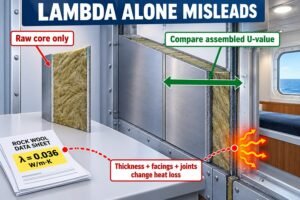
You need quiet cabins for a high-quality ship, but failing noise tests at sea ruins your project profits. Here is how you can verify sound ratings before you buy anything.
To verify an Rw target, shipyards must check three things: ISO 10140-2 certified lab test reports, exact panel build-up configurations matching the tested specimen, and third-party Type Approvals from societies like DNV. This ensures the actual panel performs exactly as promised during final sea trials.
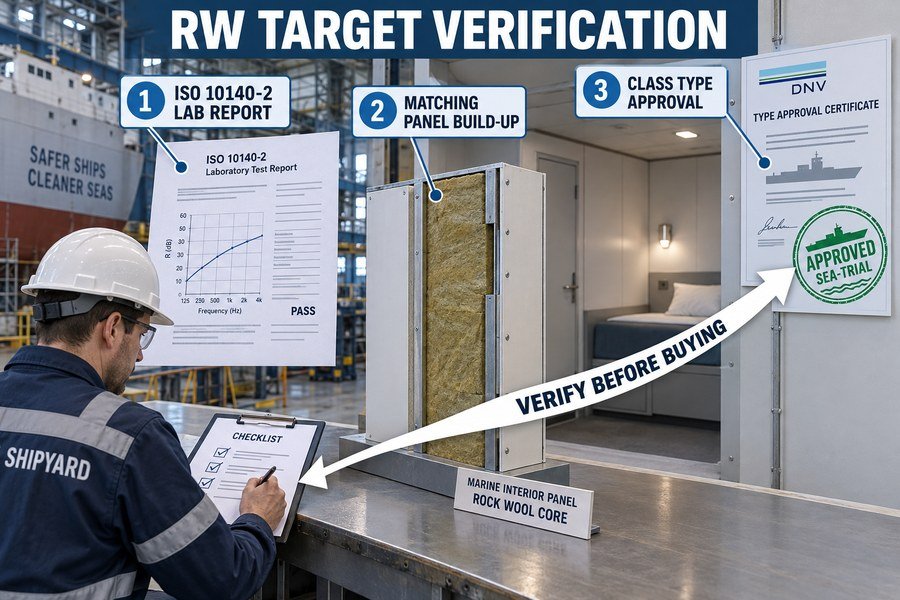
Getting the right marine panels from Asia to Europe is hard when the technical data is missing. I have helped many buyers avoid bad products over the years. Let me show you exactly what to look for when you check your supplier's documents.
What Lab Test Data Proves a Marine Bulkhead Construction's Acoustic Insulation?
Fake test reports are common, which puts your whole outfitting project at risk. You need the right lab data to prove your bulkhead really stops noise.
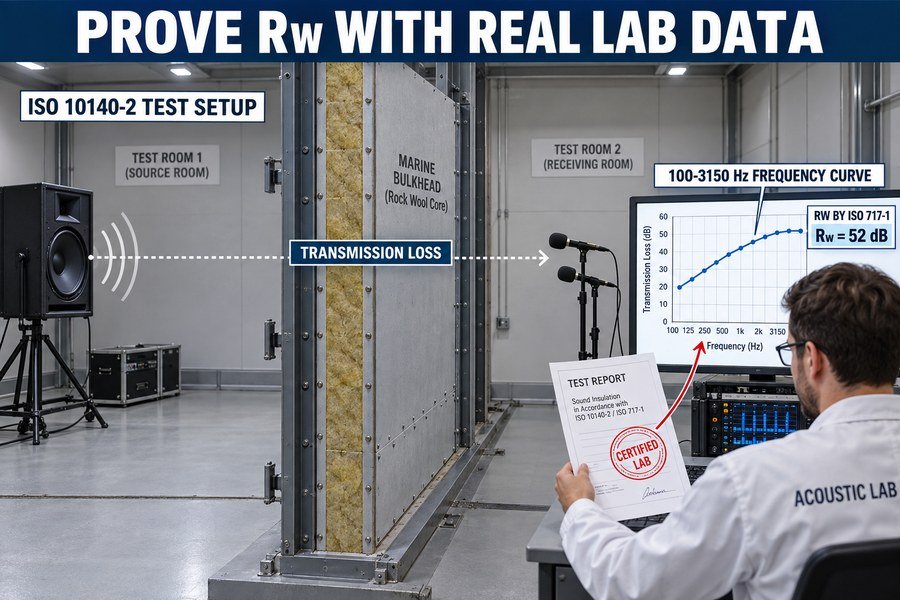
Reliable lab data must include a complete ISO 10140-2 acoustic test report, a clear Rw value calculated per ISO 717-1, and a detailed graph showing sound transmission loss across frequencies from 100 Hz to 3150 Hz, tested by an accredited independent laboratory.
Reviewing ISO 10140-2 Acoustic Test Reports from Accredited Labs
When I worked at a marine outfitting factory, I saw many buyers accept a simple one-page document as a sound test. You should never do this. A real test must follow the ISO 10140-2 standard. This standard tells the laboratory exactly how to measure sound passing through the marine bulkhead. You must also check if the laboratory is independent and accredited. A report from the supplier's own internal room is not enough. You need stamps from testing centers like SGS, Intertek, or national acoustic laboratories. The full report will show the test date, room temperature, and the exact size of the sample wall. A standard sample is usually around 10 square meters.1
Understanding ISO 717-1 Rw Calculations and the 100 Hz to 3150 Hz Frequency Graph
The test report must give you an Rw value. The laboratory calculates this single number using the ISO 717-1 standard. For example, a standard 50mm marine wall panel might have an Rw of 35 dB. However, you also need to look at the frequency graph. This graph shows the sound transmission loss at different pitches, from a low 100 Hz up to a high 3150 Hz. Engine noise is very low frequency, often around 125 Hz to 250 Hz.2 The Rw value might be good, but the panel might fail to block low engine noise. You must read the data points on the graph to see how the panel performs at every level.
| Required Lab Data Component | Related International Standard | Why Buyers Need This Data |
|---|---|---|
| Acoustic Testing Method | ISO 10140-2 | Ensures the physical test setup is fair and accurate. |
| Rating Calculation | ISO 717-1 | Provides a single Rw number to compare different suppliers. |
| Frequency Graph | None (Data output) | Shows sound loss from 100 Hz to 3150 Hz to catch low-frequency failures. |
| Independent Accreditation | ISO/IEC 17025 | Proves the laboratory results are not fake or altered. |
How Can Buyers Verify a Supplier's Rw Value Matches the Actual Marine Accommodation Panel Build-Up?
A supplier promises a 45 dB rating, but the delivered panels fail the sound test on the ship. This happens when the tested structure does not match your purchase.
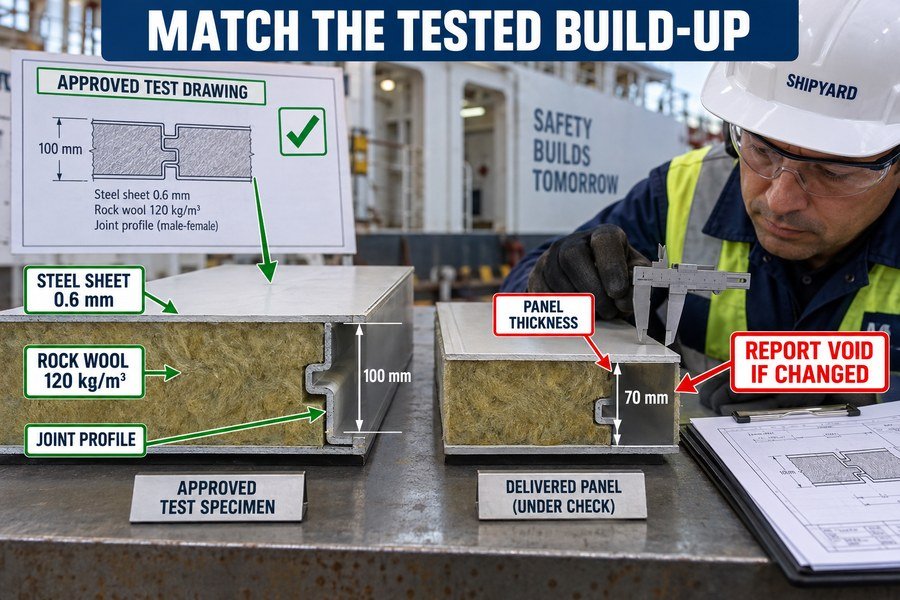
Buyers can verify this by checking four specific details on the drawing: the rockwool core density (like 120 kg/m³), total panel thickness, steel sheet thickness (like 0.6mm), and the joint profiles. If the factory changes any of these four elements, the test report is completely void.
Verifying Rockwool Core Density and Total Panel Thickness
I always tell buyers to read the first two pages of the sound test report carefully. The laboratory will describe the exact panel they tested. First, you must check the rockwool core density. High-quality marine panels use a density of 120 kg/m³ to 150 kg/m³. If the test used 150 kg/m³, but your quote says 100 kg/m³, the sound insulation will drop.3 Second, you must check the total panel thickness. A 50mm thick panel will stop less noise than a 100mm thick double-skin system. If you buy a 50mm panel, you cannot use a test report made for a 100mm system. You must force the supplier to give you the drawing that matches the test report perfectly.
Inspecting Steel Sheet Thickness and Joint Profiles
The metal outside the panel also changes the sound rating. You must verify the steel sheet thickness. Most marine bulkheads use 0.6mm galvanized steel. Sometimes, factories use 0.5mm steel to save money. This thinner steel vibrates more and lets more sound pass through.4 Finally, you must check the joint profiles. How the panels connect is very important. A simple C-profile joint leaks more noise than a tight Z-profile joint. If the tested panel used a special acoustic sealant in the joints, your shipyard workers must also use that same sealant. If the factory changes the joint design, the Rw value on the paper means nothing.
| Verification Detail | Standard Value Example | Impact on Sound Insulation if Changed |
|---|---|---|
| Rockwool Core Density | 120 kg/m³ | Lower density means less mass to absorb sound waves. |
| Total Panel Thickness | 50mm | Thinner panels reduce the overall sound barrier depth. |
| Steel Sheet Thickness | 0.6mm | Thinner steel increases vibration and sound transmission. |
| Joint Profiles | Z-profile connection | Poor joints create physical gaps for noise to travel through. |
What Acoustic Documentation Must Accompany a Reliable Marine Bulkhead Quote?
An empty quote with just a price and an "Rw=45" note is very dangerous. You will lose control of quality if you accept this simple paper.
A reliable quote must include three documents: the full acoustic laboratory test report, a detailed technical drawing of the panel cross-section, and a valid Type Approval certificate from a recognized marine classification society like DNV, ABS, or Lloyd's Register.
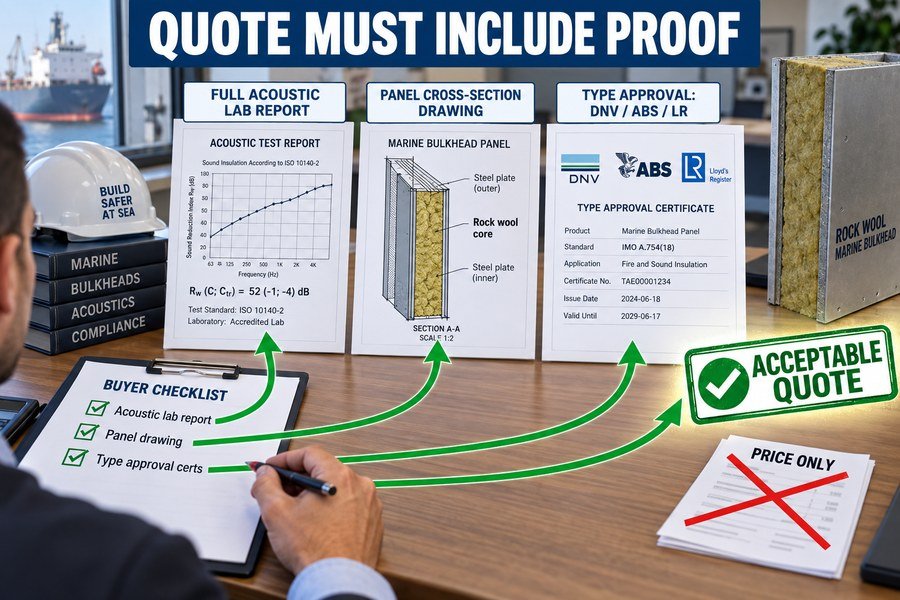
Requesting Full Acoustic Laboratory Test Reports and Panel Cross-Section Drawings
When I receive quotes for interior projects, I reject any supplier that only sends a price sheet. You must ask for the full acoustic laboratory test report5. This is usually a document of 10 to 15 pages. It shows the graphs, the testing room details, and the stamp of the laboratory. Next, you must demand a detailed technical drawing of the panel cross-section. This drawing shows the inside of the wall. It must clearly mark the rockwool, the steel, and the glue. The drawing is your proof of what the factory will actually build. You will use this drawing later to inspect the goods when they arrive at your warehouse.
The Importance of Valid Type Approvals from Marine Classification Societies
The third document you need is a valid Type Approval certificate. This is the most critical paper for the shipowner. Marine classification societies like DNV, American Bureau of Shipping (ABS), and Lloyd's Register (LR) issue these certificates. A Type Approval proves that the panel meets the safety rules of SOLAS (Safety of Life at Sea). While this certificate is mainly for fire safety, it locks in the design of the panel. The classification society audits the factory every year. This means the factory cannot secretly change the materials. If the panel has a Type Approval, you know the factory is making the exact same panel that they sent to the acoustic testing laboratory.
| Essential Document | What the Document Shows | Why the Buyer Needs It |
|---|---|---|
| Full Acoustic Lab Report | ISO test results, 10-15 pages | Proves the real Rw value and frequency graph. |
| Cross-Section Drawing | Internal materials and sizes | Gives a standard to check the final goods against. |
| Type Approval Certificate | DNV, ABS, or LR stamp | Proves SOLAS compliance and prevents material changes. |
How Can Engineers Spot Exaggerated Sound Insulation Claims for a Marine Ceiling?
Some sales teams promise a 55 dB rating for a thin, cheap ceiling panel. If you believe this, your shipyard client will be very angry when the ship fails inspection.
Engineers spot exaggerated claims by looking for three red flags: Rw values above 50 dB for standard 50mm single-skin ceilings, lack of a 100-3150 Hz frequency curve in the report, and testing methods that do not use realistic suspended ceiling cavities.
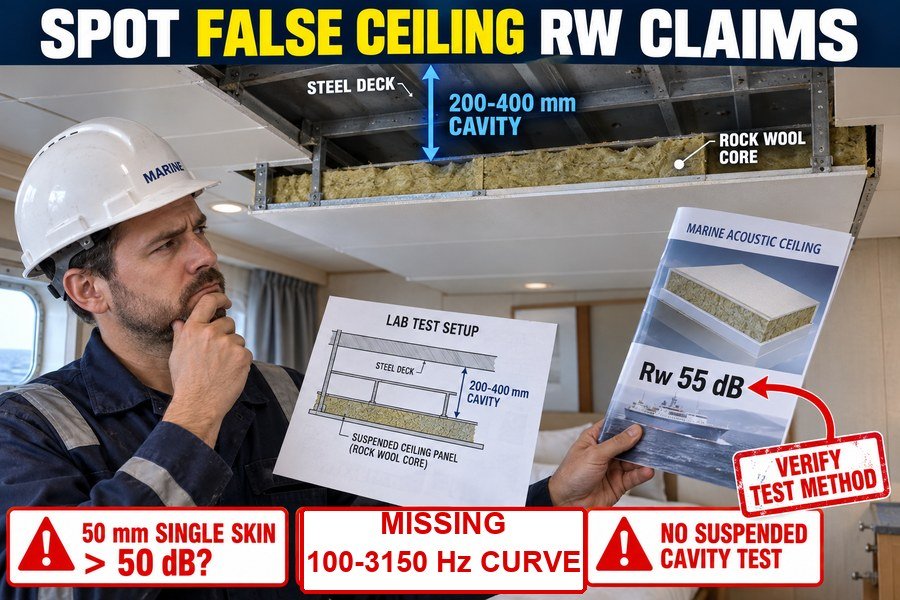
Spotting Unrealistic Rw Values for 50mm Marine Ceilings and Missing Frequency Curves
I have seen many fake brochures from small workshops in Asia. Engineers must know the physical limits of materials. A standard 50mm single-skin marine ceiling cannot reach 55 dB. Most good 50mm ceilings have an Rw of 45 dB to 47 dB. To reach 55 dB, you need a heavy double-skin ceiling with a large air gap. If you see a claim above 50 dB for a simple 50mm board, it is a red flag. The second red flag is a missing frequency curve. Fake reports often just type "Rw=50" on a piece of paper. Real reports always have a graph from 100 Hz to 3150 Hz. If the supplier refuses to send the curve, they are hiding a bad test or they stole the Rw number from another company.
Identifying Improper Test Methods and Missing Suspended Ceiling Cavities
The third way to spot a lie is by checking the test method on page two of the report. A marine ceiling is not a wall. On a ship, ceilings hang from the steel deck. There is empty space, called a cavity, between the ceiling panel and the steel deck above. This cavity is usually 200mm to 400mm deep. Good laboratories test the ceiling panels by hanging them with a real cavity. If the laboratory tested the ceiling panel by putting it flat against a wall with no cavity, the test is wrong. Sound behaves differently when there is an air space.6 You must read the test report to ensure they used a suspended ceiling setup.
| Red Flag in Supplier Claim | The Reality of Marine Physics | Engineer Action Required |
|---|---|---|
| Claiming Rw > 50 dB for 50mm board | Physical limit is roughly 47 dB for single skins. | Reject the claim and ask for double-skin options. |
| Missing 100-3150 Hz curve | Real tests always produce a graph. | Demand the full 15-page laboratory report. |
| Testing flat against a wall | Real ceilings hang with a 200-400mm air cavity. | Check the laboratory setup drawings in the report. |
Why Must Acoustic Tests Specify the Exact Marine Interior Panel Configuration?
A small change in the factory can change how sound travels through the wall. Relying on a general test for a specific shipyard project will cause failure at sea.
Tests must specify the exact configuration because changing two main things alters the Rw: the type of core material (like mineral wool versus aluminum honeycomb) and the installation accessories (like floating floor rubber mounts or ceiling suspension hangers). Every small change breaks the acoustic seal.
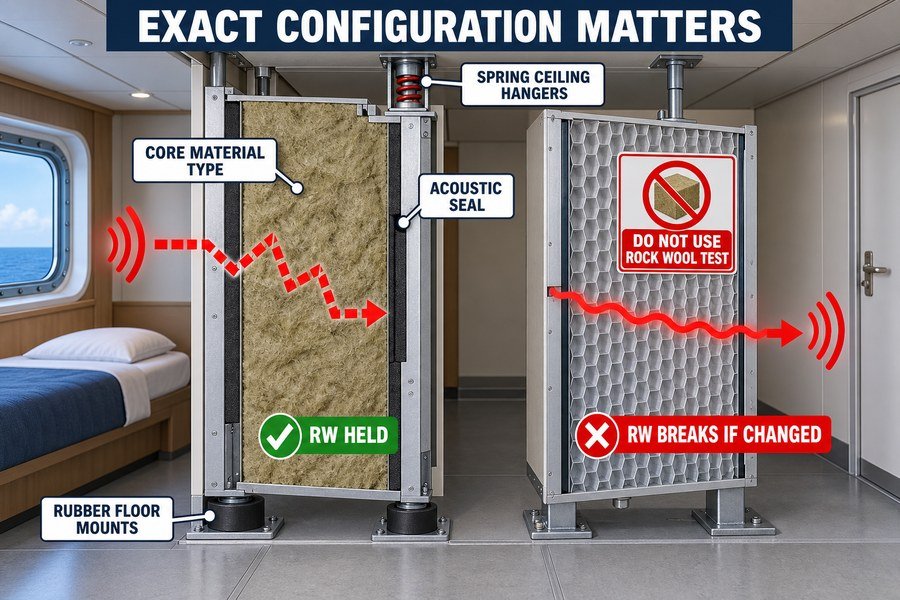
How the Type of Core Material Changes Acoustic Test Results
In my experience, buyers often try to change the core material to save weight. They see a good sound test for a rockwool panel and assume an aluminum honeycomb panel will have the same rating. This is a huge mistake. The core material is the most important part of stopping noise.7 Heavy mineral wool, like 120 kg/m³ rockwool, absorbs sound energy very well. Aluminum honeycomb is very light and stiff. It is great for saving fuel on fast ships, but it is terrible for sound. A 25mm honeycomb panel might only achieve an Rw of 30 dB. You cannot use a rockwool acoustic test to sell a honeycomb panel. The test must specify the exact core material inside the metal skins.
The Impact of Installation Accessories on Marine Sound Transmission
The panels are only one part of the system. The installation accessories carry sound vibrations from the steel ship to the cabin. The test must specify exactly what accessories were used. For example, if a floating floor was tested with special 50mm rubber mounts, you must buy those exact rubber mounts. The rubber stops the low engine vibrations8 from shaking the floor panels. If you buy cheap, hard plastic mounts instead, the sound will go straight into the room. The same rule applies to ceiling hangers. The test report will list the exact type of steel spring hanger or Z-profile bracket used. You must buy the exact configuration listed in the paper.
| Configuration Element | Examples of Materials | Impact on Overall Sound Rating |
|---|---|---|
| Core Material Type | Rockwool vs. Aluminum Honeycomb | Drastically changes sound absorption and final Rw value. |
| Floor Mounts | Rubber isolators vs. Hard plastic | Controls how much vibration enters from the steel deck. |
| Ceiling Hangers | Spring brackets vs. Rigid metal rods | Stops sound from traveling down from the deck above. |
How Should Buyers Compare Rw and STC Ratings for Marine Bulkhead Suppliers?
Asian suppliers usually use the Rw standard, while American shipyards ask for STC ratings. Mixing these two up can lead to buying the wrong panels and failing inspections.
Buyers should compare them by knowing three rules: Rw is an international standard (ISO 717-1), STC is an American standard (ASTM E413), and while they are often within 1 to 2 decibels of each other, Rw is slightly stricter at low frequencies. Always convert requirements properly.
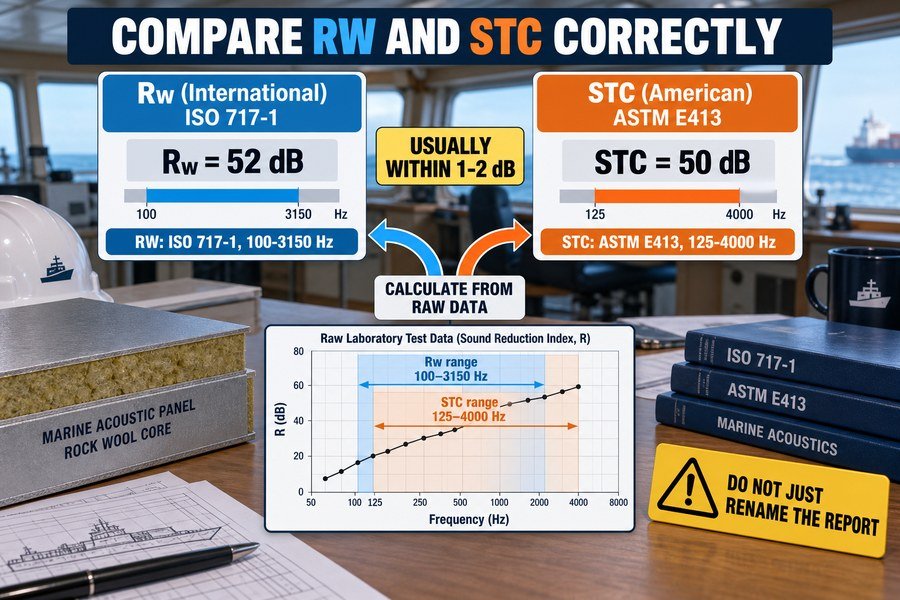
Understanding Rw (ISO 717-1) for International Marine Projects
Most of the world uses the Rw rating. It stands for Weighted Sound Reduction Index. European shipyards and Asian factories test their products according to ISO 717-1 to get this number. The Rw standard tests sound from 100 Hz to 3150 Hz. Because it starts at 100 Hz, it is very good at catching low-frequency noises. Ships have massive diesel engines and large propellers. These machines make very low, deep noises. Therefore, the International Maritime Organization (IMO) and European shipowners strongly prefer Rw. When you buy from China or Vietnam, the factory will almost always give you an Rw report. You must know how to read it.
Comparing STC (ASTM E413) to Rw and Handling the 1 to 2 Decibel Difference
If your client is a shipyard in the United States, they will probably ask for an STC rating. STC stands for Sound Transmission Class. It uses the American ASTM E413 standard. STC tests sound from 125 Hz to 4000 Hz. Because STC starts at 125 Hz, it ignores some of the deep, low-frequency noises that Rw catches. When I help buyers convert these numbers, I tell them the general rule: STC and Rw are usually within 1 to 2 decibels of each other for marine bulkheads. An Rw of 45 dB is often equal to an STC of 45 or 46. However, you cannot just cross out "Rw" and write "STC" on the paper. You must ask the laboratory to calculate the STC number using the raw test data.
| Acoustic Standard | Governing Body | Frequency Range Tested | Primary Geographic Use |
|---|---|---|---|
| Rw (Weighted Sound Reduction) | ISO 717-1 | 100 Hz to 3150 Hz | Europe, Asia, International Marine |
| STC (Sound Transmission Class) | ASTM E413 | 125 Hz to 4000 Hz | United States, North America |
Conclusion
Verifying your marine interior's Rw target protects your business and your profits. Always demand full lab reports, check the exact panel build-up, and compare acoustic standards carefully before you make a purchase.
-
"Sound insulation dataset of 30 wooden and 8 concrete floors ...", https://pmc.ncbi.nlm.nih.gov/articles/PMC10365936/. ISO 10140 guidance and summaries of laboratory sound-insulation testing describe specimen mounting in standardized test openings, with full-scale wall or partition specimens commonly tested at about 10 m² to approximate building-element performance under controlled conditions. Evidence role: general_support; source type: institution. Supports: A standard acoustic test sample for a marine wall or bulkhead panel is usually around 10 square meters.. Scope note: The exact required specimen size can depend on the element type, laboratory opening, and the relevant part of the ISO 10140 series, so the source should support this as a common practice rather than a universal requirement. ↩
-
"Relationship between container ship underwater noise levels ...", https://pmc.ncbi.nlm.nih.gov/articles/PMC3641522/. Studies of ship and diesel-engine noise spectra commonly report dominant low-frequency components in octave or one-third-octave bands around 125–250 Hz, supporting the need to inspect low-frequency transmission-loss data rather than relying only on a single-number rating. Evidence role: general_support; source type: paper. Supports: Marine engine noise is often concentrated in low-frequency bands around 125 Hz to 250 Hz.. Scope note: The dominant frequency range varies with engine type, speed, load, mounting, and vessel structure, so the evidence is contextual rather than proof for every marine engine installation. ↩
-
"Investigation of Sound Transmission Loss Through ...", https://www.academia.edu/58114441/Investigation_of_Sound_Transmission_Loss_Through_Sandwich_Panel_with_Foam_Core. Research on mineral-wool and other porous acoustic materials shows that bulk density influences flow resistivity and sound-absorption/transmission behavior, supporting the need to match the tested core density when relying on a laboratory rating. Evidence role: mechanism; source type: paper. Supports: A lower rockwool core density than the tested specimen can reduce the sound-insulation performance of a panel.. Scope note: The source would support the acoustic relevance of density, but the exact amount of insulation loss depends on the full panel construction, frequency range, and installation details. ↩
-
"[PDF] Sound Transmission Loss of Composite Sandwich Panels", https://etd.auburn.edu/bitstream/10415/1702/3/Ran%20Zhou_Dissertation.pdf. Acoustics references on the mass law for single-leaf panels state that sound transmission loss generally increases with surface mass, which supports the claim that reducing sheet thickness can increase vibration response and sound transmission. Evidence role: mechanism; source type: education. Supports: Using thinner steel sheets can reduce acoustic isolation because lower surface mass is associated with lower sound transmission loss.. Scope note: Mass-law evidence is a general principle and may not predict the precise Rw change for a specific marine sandwich panel with joints, cores, and mounting constraints. ↩
-
"Sound insulation dataset of 30 wooden and 8 concrete floors ...", https://pmc.ncbi.nlm.nih.gov/articles/PMC10365936/. ISO 10140 specifies laboratory methods for measuring sound insulation of building elements, while ISO 717-1 defines the Rw single-number rating derived from frequency-band results; these standards support the use of laboratory reports to substantiate acoustic performance claims. Evidence role: expert_consensus; source type: institution. Supports: A full acoustic laboratory test report is needed to verify the panel’s Rw value and frequency-performance data.. Scope note: The standards support the need for standardized acoustic test evidence but do not require a report to be exactly 10–15 pages. ↩
-
"[PDF] Lightweight ventilated façade: Acoustic performance in laboratory ...", https://upcommons.upc.edu/bitstreams/1461e2b6-4894-415d-8dce-164ba923d840/download. Building-acoustics literature describes the mass-air-mass effect in double-leaf constructions, where an air cavity changes transmission loss through cavity resonance and decoupling between layers, supporting the statement that a suspended ceiling with an air gap cannot be treated acoustically like a panel mounted directly against a rigid surface. Evidence role: mechanism; source type: paper. Supports: Sound behaves differently when there is an air space.. Scope note: This provides general acoustic mechanism support; the exact 200–400 mm cavity range and marine-ceiling test configuration would require a product standard or laboratory method specific to the ceiling system. ↩
-
"Providing an optimal porous absorbent pattern to reduce mid ...", https://pmc.ncbi.nlm.nih.gov/articles/PMC6277340/. Research on sandwich-panel acoustics shows that core density, stiffness, porosity, and damping can substantially affect sound absorption and transmission loss, supporting the claim that changing the core material can change acoustic test results; it does not directly verify the performance of any specific marine panel configuration. Evidence role: mechanism; source type: paper. Supports: Changing the core material inside metal-skinned panels can significantly change acoustic performance and test results.. Scope note: Contextual support for the acoustic mechanism, not direct proof of the article’s specific Rw example. ↩
-
"[PDF] Barry-isolators-selection-guide.pdf", https://wp.optics.arizona.edu/optomech/wp-content/uploads/sites/53/2016/08/Barry-isolators-selection-guide.pdf. Engineering literature on vibration isolation explains that resilient rubber mounts reduce transmitted vibration by adding compliance and damping between a vibrating structure and the supported floor, supporting the stated mechanism; the source would not necessarily confirm the effectiveness of the exact 50 mm mounts mentioned in the article. Evidence role: mechanism; source type: education. Supports: Rubber isolators can reduce low-frequency vibration transmission from a ship structure into floating floor panels.. Scope note: Supports the general vibration-isolation principle, not the performance of a specific mount product or installation. ↩