Are passenger complaints about noise keeping you awake? A high-quality marine bulkhead is useless if the joints let noise through. Let us fix these acoustic leaks right now.
Joints and interfaces degrade marine bulkhead acoustics by creating flanking paths and air leaks, reducing overall sound insulation by 3 dB to 15 dB. Proper sealing, precise edge profiles, and decoupled ceiling connections are critical to maintaining the panel's original acoustic rating in real-world shipboard installations.
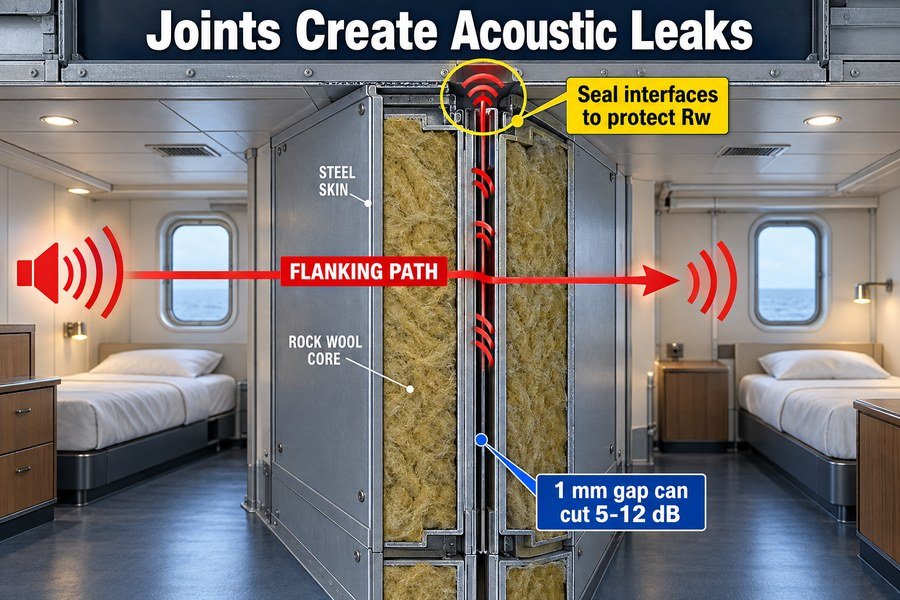
When I worked at a marine outfitting factory, I saw many high-end panels fail simply because of bad connections. You can buy the best panels in Asia, but bad joints will ruin your project. Let us look at the exact details of these joints.
How Much Does an Unsealed Joint Degrade a Marine Bulkhead's Sound Insulation?
You paid for a 45 dB panel, but the cabin feels noisy. Even a tiny gap ruins the soundproofing and causes failed shipyard inspections.
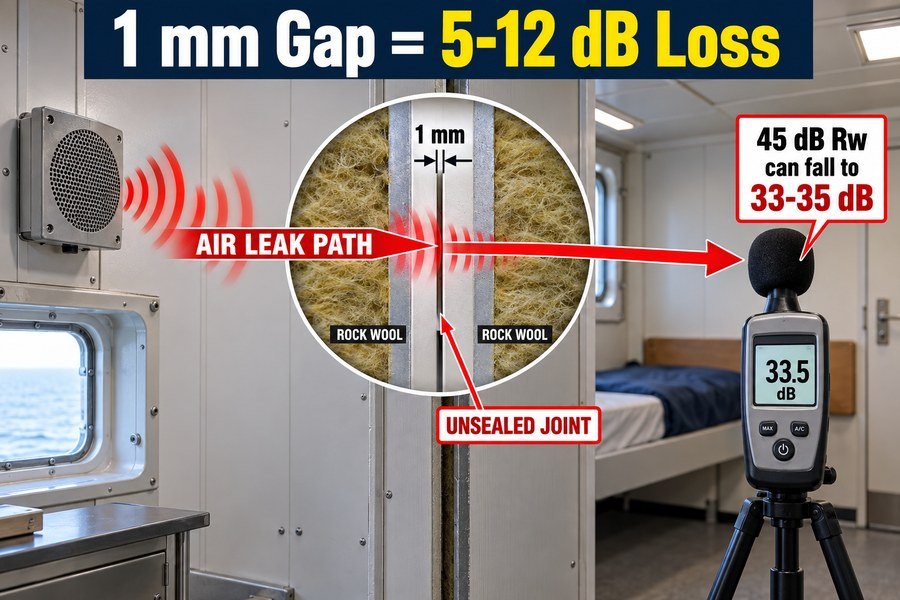
An unsealed joint of just 1 millimeter over a 2.4-meter panel height degrades a marine bulkhead's sound insulation by 5 dB to 12 dB, depending on the frequency. This turns a premium 45 dB Rw panel into an unacceptable 33 dB barrier.
I always tell my clients that sound acts exactly like water. If there is a hole, the sound will flow through it.1 The size of the gap directly determines how much noise enters the cabin.
The Exact Decibel Drop from Unsealed Marine Bulkhead Joints
Let us look at the math. A standard marine wall panel is usually 2400 mm high. If the installation leaves just a 1 mm gap between two panels, you create a 2400 square millimeter hole. According to acoustic testing standards from ISO 101402, this small gap allows mid-to-high frequency sound waves to pass right through the wall.
A panel rated at 45 dB in the factory will drop to around 33 dB to 35 dB on the ship because of this 1 mm gap. If the gap is 2 mm, the sound insulation can drop by up to 15 dB. This means you waste the money you spent on high-quality materials. Shipyards in Europe and the United States will test this with acoustic meters. If the cabin measures 35 dB instead of 45 dB, they will reject the work. You will have to tear down the wall and build it again. This destroys your profit margin.
Cost-Effective Sealing Methods for Marine Panel Joints
You must seal every joint to prevent this decibel drop. The best way to do this is by using acoustic caulk or intumescent fire sealants. These materials add mass and block the air path.
When you buy supplies, do not just buy the panels. You need to budget for the sealants. A standard tube of marine-grade acoustic silicone costs about $4 to $6. One tube can seal about 5 meters of a joint. For a standard cabin, you might need 10 tubes, which adds $40 to $60 to the material cost. This is a very small price to pay to save a $5,000 cabin installation. You should apply the sealant deep inside the joint before you push the panels together.
| Gap Size (over 2400mm height) | Estimated Decibel (dB) Drop | Resulting Rw of a 45 dB Panel | Recommended Fix |
|---|---|---|---|
| 0 mm (Perfect Seal) | 0 dB | 45 dB | None needed |
| 1 mm | 5 to 10 dB | 35 to 40 dB | Acoustic silicone sealant |
| 2 mm | 10 to 12 dB | 33 to 35 dB | Backer rod and acoustic sealant |
| 5 mm | 15+ dB | Under 30 dB | Panel realignment and heavy sealing |
Why Does the Gap Between Laboratory Rw and Installed R'w Matter for Marine Accommodation Joints?
You buy a panel based on its lab test, but the real ship test fails. This difference costs you time and money to fix.
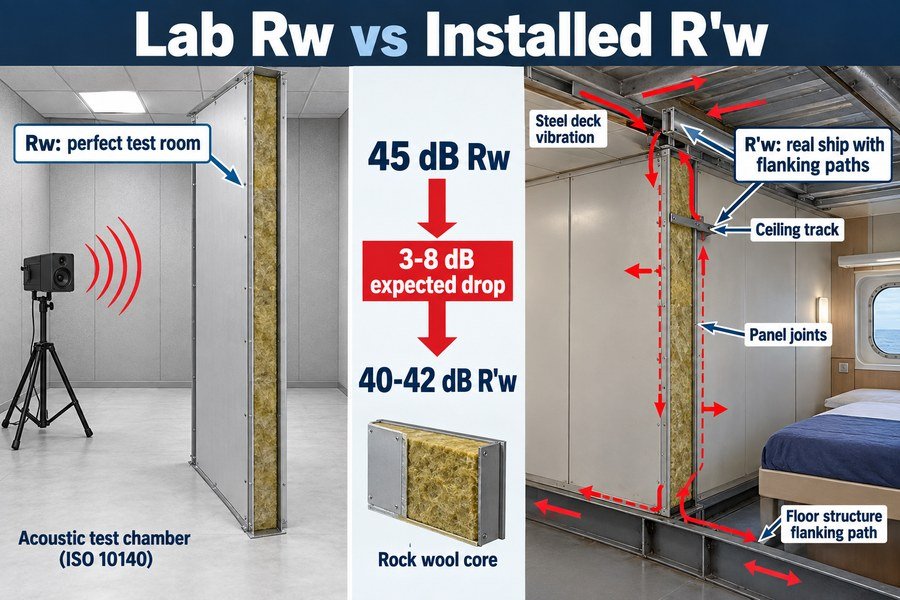
The gap between laboratory sound reduction (Rw) and installed sound reduction (R'w) exists because real ship environments introduce flanking transmission, structural vibrations, and imperfect joints. R'w is typically 3 dB to 8 dB lower than Rw, making this difference critical for meeting strict shipyard noise specifications.
Many procurement officers make a very common mistake. They read the test report from the factory and think that number will match the final ship test. This is never true.
Understanding the Difference Between Rw and R'w in Marine Outfitting
Rw stands for Weighted Sound Reduction Index. Factories test this in a perfect laboratory according to ISO 717-1. The room has no vibrations, no adjacent walls, and perfect joints. It is a controlled environment.
R'w is the Apparent Sound Reduction Index. This is the real number measured on the ship after installation. On a ship, sound travels through the steel deck. It travels through the ceiling track. It travels through the tiny gaps in your panel joints. This is called flanking transmission. Because of these flanking paths and structural vibrations, the R'w is always lower than the Rw. According to the IMO (International Maritime Organization) noise code regulations3, you must meet specific R'w targets inside the cabin. If you do not plan for the gap between these two numbers, your final project will fail the inspection.
How Procurement Officers Can Plan for the R'w Drop
You must plan for a 3 dB to 8 dB drop when you buy materials. If the shipyard requires an R'w of 40 dB between two passenger cabins, you cannot buy a panel rated at 40 dB Rw. It will fail.
You must buy a panel rated at 45 dB Rw or higher. This gives you a safe margin. High-quality marine interior outfitting suppliers in Asia can provide 45 dB to 47 dB panels at very competitive prices. A 45 dB panel might cost $45 to $55 per square meter, while a 40 dB panel might cost $35 to $40. It is always better to spend the extra $10 per square meter. It will save you from failing the shipyard acoustic test.
| Metric | Testing Environment | Flanking Transmission | Expected dB Value for a Standard Panel |
|---|---|---|---|
| Rw (Laboratory) | Perfect ISO test room | None | 45 dB |
| R'w (Good Installation) | Real ship cabin | Low (well-sealed joints) | 40 dB to 42 dB |
| R'w (Poor Installation) | Real ship cabin | High (unsealed gaps) | 33 dB to 37 dB |
How Do Edge Profiles Affect Flanking Sound Transmission on Marine Bulkheads?
Are you choosing standard flat edges to save money? This choice might cause flanking sound to travel straight through your expensive cabin walls.
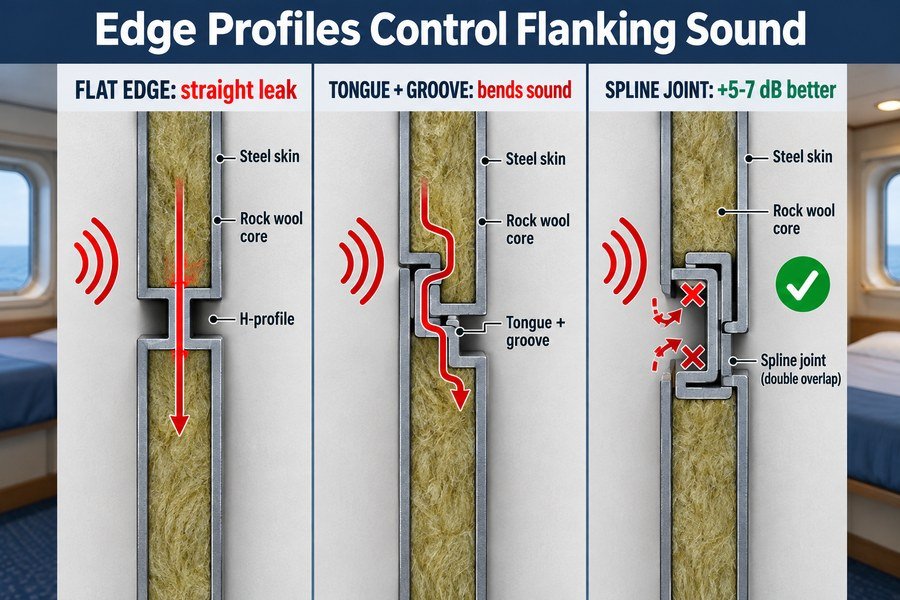
Edge profiles affect flanking transmission by determining the tightness of the interlock between panels. The three main types—flat edges, tongue-and-groove, and spline joints—block noise differently. Tongue-and-groove and spline joints reduce flanking transmission by 4 dB to 7 dB compared to simple flat edges.
The shape of the panel edge is a very big detail. Many buyers focus on the core material of the wall, but they ignore the edges. The edge profile decides how much sound leaks through the wall.4
Flanking Transmission Paths in Flat Edge Marine Panels
Flat edges are the cheapest type of panel joint. The two panels just push flat against each other. Usually, installers put a metal H-profile over the joint to hold them together.
This is very bad for acoustics. A flat edge creates a straight line from one cabin to the next. Sound waves love straight lines. The sound easily travels through the tiny air gaps in the H-profile.5 This straight path creates massive flanking transmission. Even if the rockwool inside the panel is very thick, the flat edge lets the sound bypass the insulation completely. You should avoid flat edges if the shipyard requires high acoustic ratings.
Sound Reduction Benefits of Tongue-and-Groove and Spline Joints
You should choose tongue-and-groove or spline joints for better soundproofing. These edges force the sound waves to bend and turn.
A tongue-and-groove edge has a protruding side that fits deeply into a slot on the next panel. A spline joint uses a separate metal or fireproof insert that slides into grooves on both panels. Because the joint overlaps, there is no straight line for the sound to travel through.6 This overlapping design blocks the flanking transmission. Based on factory test data, a tongue-and-groove or spline joint can improve the wall's sound reduction by 4 dB to 7 dB compared to a flat edge7. These panels cost a bit more, usually adding $2 to $5 per square meter, but they make installation faster and guarantee better noise control.
| Edge Profile Type | Acoustic Path | Typical Flanking Noise Reduction | Best Use Case |
|---|---|---|---|
| Flat Edge with H-Profile | Straight line (Poor) | 0 dB (Baseline) | Corridors with low noise requirements |
| Tongue-and-Groove | Overlapping zig-zag (Good) | +4 to +5 dB better | Passenger cabins, crew quarters |
| Spline Joint | Double overlapping (Excellent) | +5 to +7 dB better | High-noise engine room boundaries |
How Does a Marine Ceiling to Bulkhead Connection Create Acoustic Leaks?
You insulated the walls perfectly, but you hear voices from next door. The connection between the ceiling and bulkhead is often the culprit.
A marine ceiling to bulkhead connection creates acoustic leaks in two ways: through physical air gaps at the joint and through structural vibration transfer. Without an acoustic profile or floating track, noise travels over the bulkhead through the ceiling void, causing a 6 dB to 10 dB noise loss.
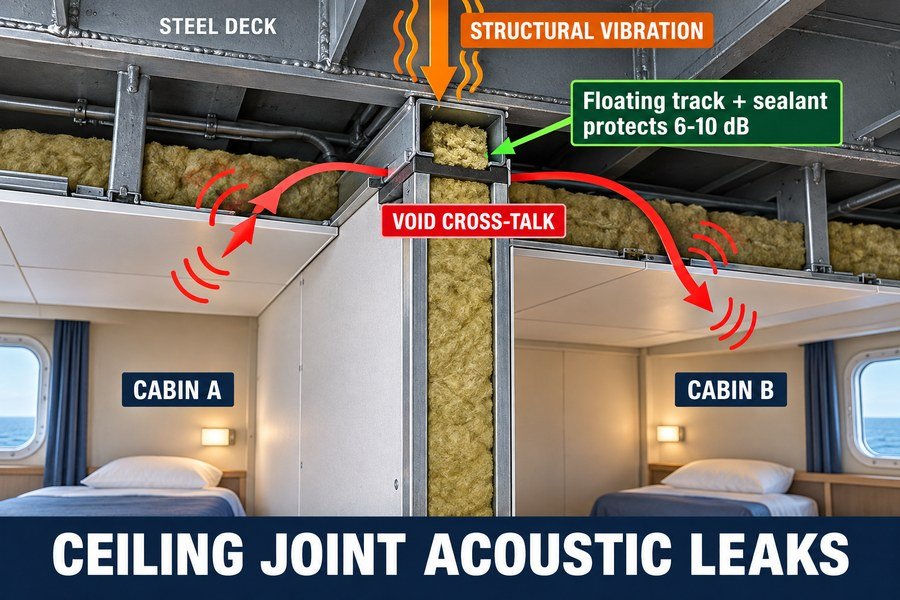
When I visit ships during the outfitting stage, I always climb up a ladder to look above the ceiling. This is where most acoustic failures happen. The gap between the top of the wall and the ceiling structure is the weakest point in the cabin.8
Air Gaps and Void Transmission at the Marine Ceiling Interface
The first way this connection leaks sound is through physical air gaps. The marine wall panel usually stops right below the ceiling deck. The void space above the ceiling can be anywhere from 200 mm to 500 mm high.
If you do not seal the physical gap where the bulkhead meets the ceiling panel, sound will travel up from Cabin A, enter the void space, and travel down into Cabin B. This is called a "cross-talk" path.9 Even a 5 mm physical air gap at the top track can ruin the cabin's privacy.10 To fix this, you must pack rockwool tightly into the top track and use fireproof acoustic caulk to seal the physical joints completely.
Preventing Structural Vibration Transfer at Marine Top Tracks
The second way this connection leaks sound is through structural vibration transfer. Most installers use a rigid metal top track to hold the wall panels. They bolt this track directly to the steel deck above.
When the ship engine runs, or when someone walks on the deck above, the vibration travels down the steel deck. It goes directly into the rigid metal track and shakes the wall panels. The wall panel turns into a giant speaker. This structural vibration transfer can reduce the cabin's acoustic performance by up to 10 dB. To stop this, you must use a floating track or an acoustic profile. You put a layer of dense rubber or ceramic fiber tape between the steel deck and the metal track. This soft layer absorbs the vibration. Acoustic tape costs about $1.50 per meter, but it is necessary for stopping vibration transfer.
| Leak Type | Cause of the Leak | Acoustic Impact | Solution to Fix the Leak |
|---|---|---|---|
| Physical Air Gap | Unsealed spaces at the top track | 5 to 8 dB loss (airborne noise) | Pack with rockwool and acoustic caulk |
| Void Transmission | Sound traveling over the wall | 6 to 10 dB loss (cross-talk) | Install a sound barrier in the ceiling void |
| Structural Vibration | Rigid metal track bolted to steel | 8 to 10 dB loss (structure-borne) | Use acoustic rubber tape under the track |
Why Do Highly-Rated Marine Interior Panels Underperform After Joints and Penetrations Are Added?
You spend big money on a 50 dB panel, but the cabin fails the noise test. Cables, pipes, and poor joints destroy your investment.
Highly-rated panels underperform because shipboard installations require joints for assembly and penetrations for cables, pipes, and HVAC. These three elements break the panel's continuous mass. A single unsealed 50mm cable penetration can reduce a 50 dB panel's performance to just 38 dB in real-world conditions.
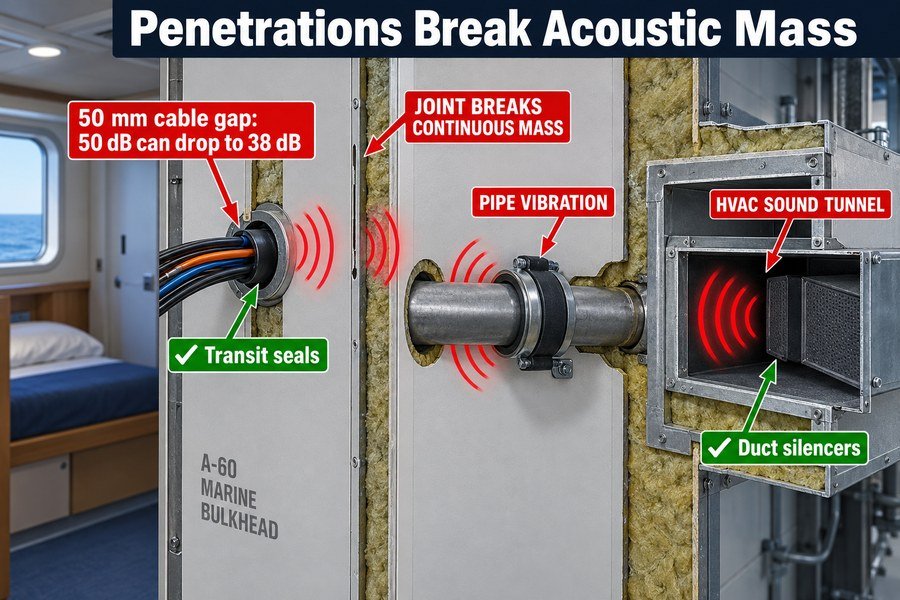
A panel only performs at its factory rating when it is whole and untouched. But on a ship, you can never leave a panel untouched. You must join them together, and you must cut holes in them. This completely changes how the panel stops noise.
The Impact of Panel Joints on Continuous Acoustic Mass
First, let us look at the joints for assembly. Sound insulation relies on continuous mass.11 The steel skins and the dense rockwool core block the sound.
When you put two panels together, you create a break in that continuous mass. The joint is a line of weakness. Even with a good tongue-and-groove edge, the density at the joint is lower than the density in the middle of the panel. If the installation crew does not push the panels tightly together, or if they forget to use acoustic sealant, the joint becomes a direct path for noise12. The continuous mass is broken, and the panel underperforms.
Dealing with Cable, Pipe, and HVAC Penetrations in Marine Bulkheads
Second, you must cut holes in the walls. Every modern ship needs cables for electricity, pipes for water, and HVAC ducts for air conditioning. These three penetrations are the biggest enemies of acoustic performance.
When you drill a 50 mm hole for a cable bundle, you remove the sound-blocking rockwool. The cables themselves do not block sound. Sound travels right through the gaps between the wires. A single unsealed 50 mm cable penetration can drop a 50 dB panel down to 38 dB.13
Water pipes cause similar problems. If a metal water pipe touches the metal skin of the wall panel, it transfers vibrations directly into the wall.
HVAC ducts are the worst. A large air duct is basically a hollow tunnel connecting two rooms. Sound travels freely through this tunnel.14
To fix these issues, you must use specialized marine transit systems for cables and pipes. These transit blocks cost about $20 to $50 each, but they seal the gap completely. For HVAC, you must install acoustic silencers or baffles inside the duct to absorb the noise before it crosses the wall.
| Penetration Type | Acoustic Problem | Impact on 50 dB Panel | Required Acoustic Solution |
|---|---|---|---|
| Panel Joints | Breaks continuous mass | Drops to 42-45 dB | Tight assembly and acoustic sealants |
| Cable Bundles | Air gaps between wires | Drops to 38-40 dB | Marine cable transit seal systems |
| Water Pipes | Vibration transfer to panel | Drops to 40-42 dB | Rubber isolation sleeves around pipe |
| HVAC Ducts | Hollow tunnel for sound | Drops to 35-38 dB | Internal acoustic silencers/baffles |
Conclusion
Joints, edges, and penetrations determine your true acoustic success. By using tight edge profiles, isolation tapes, and quality sealants, you can maintain your panel's sound rating and easily pass shipyard inspections.
-
"[PDF] MODELING THE TRANSMISSION LOSS OF TYPICAL HOME ...", https://repository.gatech.edu/server/api/core/bitstreams/124b4a58-8706-4fc8-9139-9b18ed96233e/content. Building-acoustics references describe air gaps, cracks, and other leaks as flanking or leakage paths that can substantially reduce the effective sound insulation of a partition by allowing airborne sound transmission around the main barrier. Evidence role: mechanism; source type: education. Supports: Openings or unsealed gaps in a partition allow airborne sound to bypass the wall assembly and reduce cabin sound insulation.. Scope note: This supports the acoustic-leakage mechanism, not the article’s literal analogy that sound behaves exactly like water. ↩
-
"Sound insulation dataset of 30 wooden and 8 concrete floors ...", https://pmc.ncbi.nlm.nih.gov/articles/PMC10365936/. ISO 10140 specifies laboratory methods for measuring the airborne sound insulation of building elements, including standardized test conditions for deriving sound reduction performance. Evidence role: definition; source type: institution. Supports: ISO 10140 is a recognized standard series for laboratory measurement of airborne sound insulation.. Scope note: ISO 10140 supports the measurement framework; it does not by itself prove the specific decibel losses attributed to 1 mm or 2 mm gaps in the article. ↩
-
"Which Regulations Set Cabin Noise Limits for Ships?", https://magellanmarinetech.com/which-regulations-set-cabin-noise-limits-for-ships/. The IMO Code on Noise Levels on Board Ships sets noise and acoustic criteria for ships, including requirements relevant to accommodation spaces and airborne sound insulation expressed using field performance indices such as R′w. Evidence role: expert_consensus; source type: institution. Supports: Marine projects may have to satisfy IMO noise-code requirements, including acoustic targets for shipboard accommodation spaces.. Scope note: The Code’s exact applicability depends on vessel type, tonnage, flag-state implementation, and the edition or amendments in force for the project. ↩
-
"[PDF] Review of Modelling and Prediction Methods for Flanking ...", https://upcommons.upc.edu/bitstreams/61ecb1e5-2d31-4e5a-9331-36438f565f22/download. Building-acoustics literature defines flanking transmission as sound transfer through paths other than the main separating element, including junctions and construction details, supporting the relevance of panel-edge geometry to total sound leakage. Evidence role: definition; source type: encyclopedia. Supports: Panel edge profile can materially affect sound leakage through a wall.. Scope note: This supports the general acoustic principle rather than quantifying leakage for a specific marine panel system. ↩
-
"[PDF] This is normal text - K-REx", https://krex.k-state.edu/bitstreams/62260782-9dea-4f95-8b14-8896b13cc012/download. Acoustics guidance and research on partitions report that small cracks, gaps, and unsealed penetrations can substantially reduce airborne sound insulation by creating leakage paths through otherwise massive or absorptive assemblies. Evidence role: mechanism; source type: education. Supports: Tiny air gaps at a panel joint can allow sound transmission and reduce acoustic isolation.. Scope note: The source may address building partitions generally and not H-profile marine-panel joints specifically. ↩
-
"Nonlinear Acoustics Used To Reduce Leakage Flow", https://ntrs.nasa.gov/api/citations/20050215279/downloads/20050215279.pdf. Studies and technical references on acoustic seals and labyrinth paths describe how overlapping or tortuous joint geometries reduce direct air-leakage paths and can improve attenuation compared with simple open gaps. Evidence role: mechanism; source type: paper. Supports: Overlapping tongue-and-groove or spline joints reduce direct acoustic leakage paths compared with flat butt joints.. Scope note: This is contextual support for the mechanism of overlapping joints; actual performance depends on dimensions, sealing, materials, and installation quality. ↩
-
"How to Match a Marine Accommodation Panel System to the ...", https://magellanmarinetech.com/how-match-marine-accommodation-panel-system-to-the-correct-noise-path/. A laboratory test report or peer-reviewed comparison of panel-joint configurations should document measured sound reduction indices for flat, tongue-and-groove, and spline joints and support the stated 4–7 dB difference under controlled conditions. Evidence role: statistic; source type: research. Supports: Tongue-and-groove or spline joints can improve wall sound reduction by 4–7 dB relative to flat-edge joints.. Scope note: A measured 4–7 dB improvement would apply only to the tested panel construction, frequency range, installation method, and rating standard, and should not be generalized to all marine panels without qualification. ↩
-
"How to Match a Marine Accommodation Panel System to the ...", https://magellanmarinetech.com/how-match-marine-accommodation-panel-system-to-the-correct-noise-path/. A source on building or ship-accommodation acoustics should support that junctions, penetrations, and ceiling voids often create flanking paths that weaken the apparent sound insulation of partitions. Evidence role: expert_consensus; source type: paper. Supports: The wall-to-ceiling gap is a particularly weak point for cabin acoustic isolation.. Scope note: This would support the general vulnerability of wall-ceiling interfaces, not prove that this is the weakest point in every cabin design. ↩
-
"(PDF) Effects of noise flanking paths on ceiling attenuation class ...", https://www.academia.edu/87622757/Effects_of_noise_flanking_paths_on_ceiling_attenuation_class_ratings_of_ceiling_systems_and_inter_room_speech_privacy. A technical acoustics reference should define cross-talk or flanking transmission as sound passing between rooms through indirect paths such as ceiling voids above partitions. Evidence role: definition; source type: education. Supports: Sound can bypass a partition through the ceiling void, creating a cross-talk or flanking path between adjacent cabins.. Scope note: The source may use the broader term “flanking transmission” rather than the article’s specific cabin example. ↩
-
"[PDF] OPEN-PLAN OFFICE SPACES AND THEIR ACOUSTIC ...", https://www.arc.miami.edu/_assets/pdf/acoustics_shannaroconnor_stantec.pdf. A building-acoustics or laboratory reference should show that small unsealed gaps or leaks can significantly reduce the sound insulation of an otherwise rated partition. Evidence role: mechanism; source type: research. Supports: Small air gaps in a partition can significantly degrade acoustic privacy.. Scope note: The cited evidence may quantify leakage for generic partitions rather than specifically for 5 mm gaps in marine top tracks. ↩
-
"[PDF] Ultrasonic, Normal-Incidence Insertion Loss through Common ...", https://physics.byu.edu/docs/thesis/269. A building-acoustics source on the mass law supports that heavier, continuous partitions generally provide greater airborne sound transmission loss, especially where leaks and flanking paths are controlled. Evidence role: mechanism; source type: education. Supports: Sound insulation relies on continuous mass.. Scope note: Mass is only one factor; stiffness, damping, coincidence effects, sealing, and installation quality also affect the final rating. ↩
-
"[PDF] MODELING THE TRANSMISSION LOSS OF TYPICAL HOME ...", https://repository.gatech.edu/server/api/core/bitstreams/124b4a58-8706-4fc8-9139-9b18ed96233e/content. Acoustics guidance on sound leaks supports that gaps, joints, and unsealed cracks in partitions can create airborne leakage paths that reduce the effective sound isolation of an otherwise high-rated assembly. Evidence role: mechanism; source type: institution. Supports: If panels are not tightly assembled or sealed, the joint becomes a direct path for noise and the panel underperforms.. Scope note: The source may address building partitions generally rather than marine sandwich panels specifically. ↩
-
"Comparison of sound transmission loss on difference types ...", https://www.academia.edu/92984449/Comparison_of_sound_transmission_loss_on_difference_types_wall_partition. Research on apertures and leakage in sound-rated partitions supports that even relatively small unsealed openings can substantially reduce the composite sound transmission loss of a high-performing wall. Evidence role: statistic; source type: paper. Supports: A single unsealed 50 mm cable penetration can significantly reduce the effective acoustic rating of a 50 dB panel, potentially to about 38 dB.. Scope note: The exact reduction from 50 dB to 38 dB depends on wall area, aperture geometry, frequency spectrum, and test method; a source may support the magnitude of the effect rather than this precise scenario. ↩
-
"[PDF] Upgrading UNLV's ASTM E477 Test Facility to Meet the Current ...", https://oasis.library.unlv.edu/cgi/viewcontent.cgi?article=2563&context=thesesdissertations. HVAC acoustics references support that ducts can transmit airborne noise between spaces and that duct silencers or lined/baffled sections are used to attenuate sound traveling through ventilation paths. Evidence role: mechanism; source type: institution. Supports: Large HVAC ducts can act as airborne sound transmission paths between rooms unless attenuated by silencers, lining, or baffles.. Scope note: The degree of transmission depends on duct dimensions, lining, bends, airflow conditions, and connected room absorption. ↩