Ship cabins are often too noisy, leading to crew fatigue and unhappy shipyard clients. Face-sheet configuration directly controls the sound transmission loss of your marine wall and ceiling panels.
Face-sheet configuration dictates a marine accommodation panel's sound transmission loss through three main factors: face-sheet thickness, skin stiffness-to-mass ratio, and asymmetric skin designs. Adjusting these three variables controls the coincidence frequency, reduces sound dips, and improves broadband acoustic insulation across the 100 Hz to 3150 Hz frequency range.
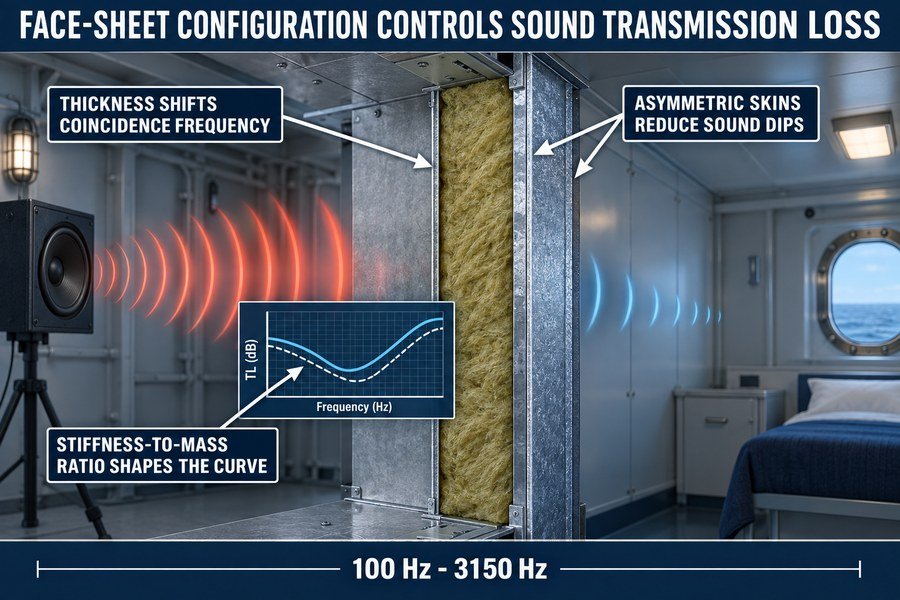
I have seen many procurement teams buy standard panels only to fail shipyard noise tests. Understanding how the metal skins on these panels block sound helps you buy the right product at the right price from Asian factories.
How Does Face-Sheet Thickness Shift a Marine Bulkhead's Coincidence Frequency?
A common problem is panels failing acoustic tests at specific frequencies. This causes expensive project delays. Changing the face-sheet thickness shifts the coincidence frequency, stopping sound waves from passing through the bulkhead.
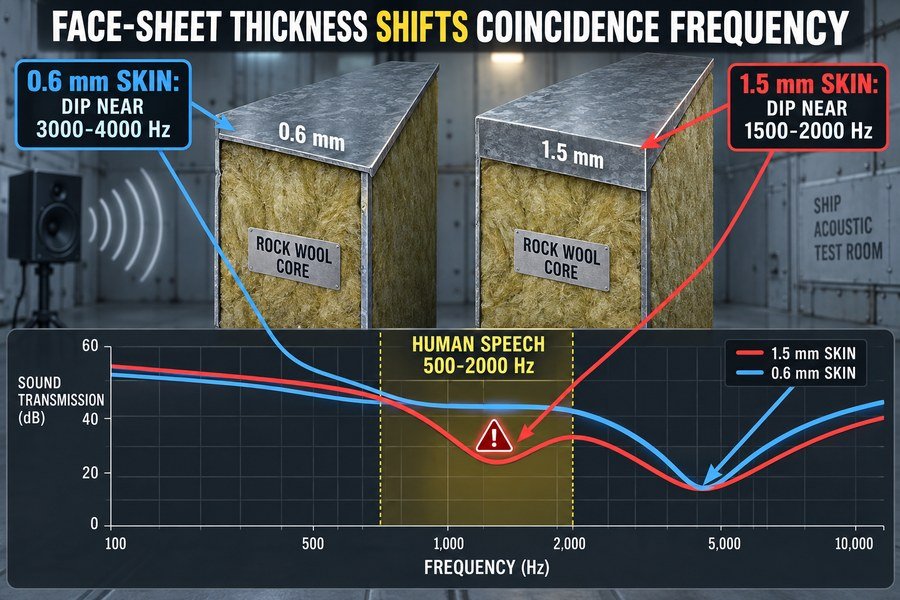
Increasing the face-sheet thickness from 0.6 mm to 1.5 mm shifts the coincidence frequency to a lower range, while decreasing thickness shifts it higher. This shift moves the acoustic weak point out of the critical human speech frequencies of 500 Hz to 2000 Hz, preventing noise complaints.
The Physics of Coincidence Frequency in Thin Face-Sheets
When I worked at the factory, we tested standard PVC-laminated galvanized steel skins every day. If you use a thin 0.6 mm steel skin, the coincidence frequency sits high, usually around 3000 Hz to 4000 Hz based on ISO 717-1 acoustic testing standards. At this exact point, the bending wave of the steel matches the sound wave in the air1. The panel loses its ability to block sound. Decreasing the thickness pushes this dip even higher on the spectrum2. But if you increase the thickness to a 1.2 mm or 1.5 mm steel plate, the mass increases and the stiffness changes. This physical change shifts the coincidence frequency down to around 1500 Hz to 2000 Hz. When we manufacture these panels, the rolling machines compress the 1.5 mm steel tightly. This physical mass addition is measurable. The 1.5 mm steel weighs about 11.77 kg/m², whereas the 0.6 mm steel weighs only 4.71 kg/m²3. This extra 7 kg/m² shifts the bending wave properties significantly. You need to know this because human hearing is very sensitive in these ranges.
Selecting the Right Steel Thickness to Avoid Human Speech Frequencies
If you buy a bulkhead with a 1.2 mm skin on both sides, the coincidence dip falls right in the middle of human speech frequencies (500 Hz to 2000 Hz). The shipyard will reject this because crew members can hear people talking in the next cabin. To fix this, you use a 0.6 mm face-sheet on one side to keep the dip near 4000 Hz, which is outside the main speech range. I always advise buyers to check the exact mm thickness of the steel on the specification sheet. According to IMO SOLAS standards for noise levels on board ships, cabins must stay below 60 dB(A)4. Changing the thickness from 0.6 mm to 1.5 mm changes the total Sound Reduction Index (Rw) by up to 4 dB.
| Face-Sheet Steel Thickness | Approximate Weight (kg/m²) | Typical Coincidence Frequency Dip | Impact on Human Speech Frequencies |
|---|---|---|---|
| 0.6 mm | 4.71 kg/m² | 3000 Hz - 4000 Hz | Low Impact (Outside main range) |
| 0.8 mm | 6.28 kg/m² | 2500 Hz - 3000 Hz | Moderate Impact |
| 1.2 mm | 9.42 kg/m² | 1800 Hz - 2200 Hz | High Impact (Inside main range) |
| 1.5 mm | 11.77 kg/m² | 1500 Hz - 1800 Hz | High Impact (Inside main range) |
Why Do Asymmetric Face-Sheets Improve a Marine Interior Sandwich Panel's Broadband Insulation?
Ship owners hate hearing engine noise in the living quarters. It ruins the comfort of the entire vessel. Using asymmetric face-sheets solves this by blocking a wider range of sound frequencies across the whole panel.
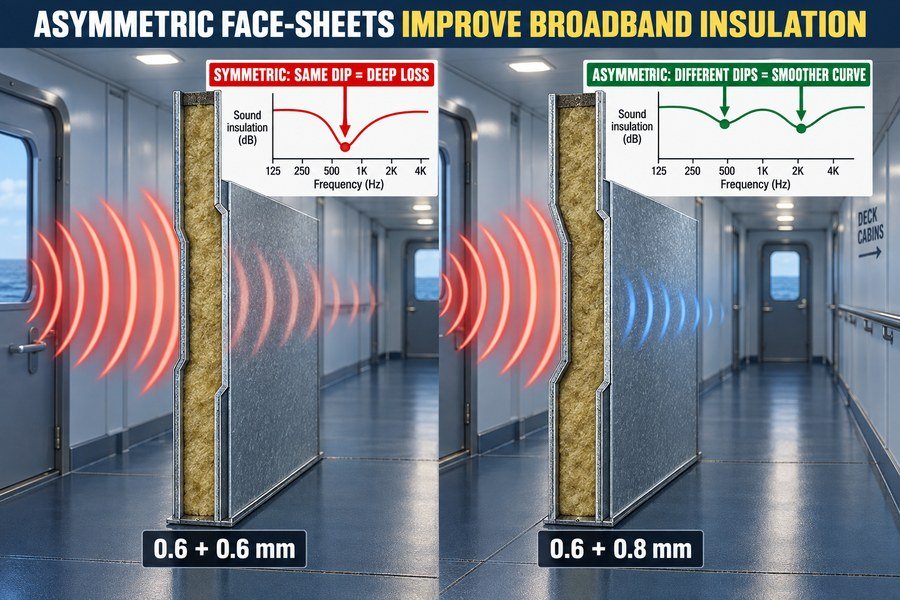
Asymmetric face-sheets improve broadband insulation by combining two different skin thicknesses on the same panel, such as a 0.6 mm front and a 0.8 mm back. This prevents both sides from vibrating at the same coincidence frequency, eliminating deep acoustic dips and increasing overall sound transmission loss.
The Problem with Symmetric Face-Sheets in Marine Panels
Many buyers ask for symmetric panels, like 0.6 mm steel on both sides, to save money. This is a mistake. When both face-sheets have the exact same thickness, they share the exact same coincidence frequency.5 If that frequency is 3150 Hz, both skins stop blocking sound at 3150 Hz at the exact same time. The sound wave passes straight through the rockwool core into the room. According to laboratory tests based on ASTM E90, a symmetric 50 mm rockwool panel with two 0.6 mm steel skins will show a massive 8 dB to 10 dB drop in sound insulation at its coincidence frequency6. The shipyard acoustic test will fail at this exact point, and you will have to explain the failure to your boss.
How Different Skin Thicknesses Create Broadband Insulation
The solution is simple and very effective. We use a 0.6 mm steel skin on the cabin side and a 0.8 mm steel skin on the corridor side. The 0.6 mm skin has a coincidence dip at 3150 Hz. The 0.8 mm skin has a coincidence dip near 2500 Hz. Because the dips do not match, the panel never loses its full ability to block sound. The 0.8 mm skin blocks the 3150 Hz noise, and the 0.6 mm skin blocks the 2500 Hz noise. This creates strong broadband insulation. Data from the Society of Naval Architects and Marine Engineers (SNAME) shows that this asymmetric design improves the overall Sound Reduction Index (Rw) by 3 dB to 5 dB7 without adding thick, heavy steel. Installing asymmetric panels is exactly the same as installing symmetric ones. The installation crew uses the same U-profiles and top angles. The cost difference is very small. A standard symmetric panel might cost $25 per square meter, while the asymmetric version costs $26.50 per square meter from a good Asian supplier. That small $1.50 difference prevents a $5000 penalty from the shipyard for failing the noise test.
| Panel Configuration | Face-Sheet A | Face-Sheet B | Max Insulation Dip Depth | Estimated Rw Rating | Cost per Square Meter |
|---|---|---|---|---|---|
| Symmetric Panel | 0.6 mm Steel | 0.6 mm Steel | 8 dB to 10 dB | 31 dB | ~$25.00 |
| Asymmetric Panel | 0.6 mm Steel | 0.8 mm Steel | 3 dB to 4 dB | 34 dB | ~$26.50 |
| Asymmetric Panel | 0.6 mm Steel | 1.0 mm Steel | 2 dB to 3 dB | 35 dB | ~$28.00 |
How Does Face-Sheet Stiffness Limit a Marine Ceiling's High-Frequency Insulation?
High-pitched whistling from air ducts ruins the cabin environment. Crew members cannot sleep with this constant noise. Avoiding high face-sheet stiffness preserves your marine ceiling's ability to block these high-frequency noises.
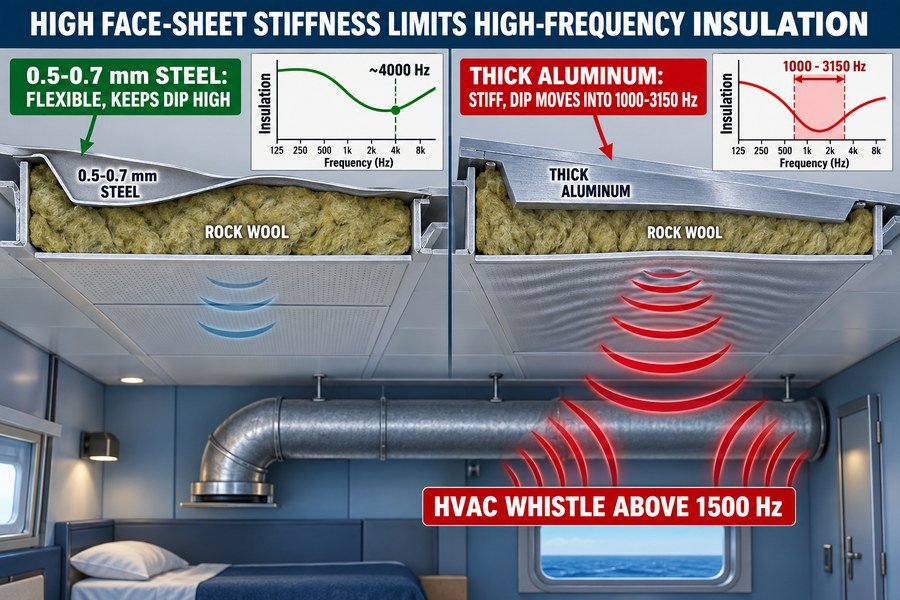
High face-sheet stiffness limits a marine ceiling's high-frequency insulation by moving the coincidence frequency lower into the audible range, typically between 1000 Hz and 3150 Hz. Rigid materials like thick aluminum transmit high-frequency bending waves easily, reducing the ceiling's ability to block HVAC and machinery noise.
The Negative Impact of Rigid Materials on High-Frequency Noise
People often think that a stiffer ceiling panel blocks more sound. This is not true for high frequencies. I have seen buyers order highly rigid 1.0 mm aluminum ceiling panels because they feel strong in the hand. However, high stiffness lowers the critical coincidence frequency8. When you use very stiff materials, the bending waves travel faster through the metal skin. According to the mass law of acoustics, sound transmission loss should increase by 6 dB for every doubling of frequency9. But when the panel is too stiff, the coincidence frequency drops directly into the 1000 Hz to 3150 Hz range. HVAC systems in large cruise ships or offshore platforms push massive amounts of air. This moving air creates a whistling sound that hits the ceiling panels at frequencies above 1500 Hz. If the ceiling face-sheet is too rigid, the metal simply vibrates and passes this whistle straight into the cabin.
Controlling Ceiling Panel Stiffness to Block HVAC Noise
To block high-frequency HVAC noise, you need a flexible face-sheet. Standard marine ceilings use 0.5 mm or 0.7 mm galvanized steel. Steel is heavy but less stiff per unit of mass compared to thick aluminum. A 0.5 mm steel ceiling skin keeps the coincidence frequency high, near 4000 Hz. This means the ceiling remains highly effective at blocking the 1000 Hz to 2000 Hz noise generated by ventilation fans. The American Society of Heating, Refrigerating and Air-Conditioning Engineers (ASHRAE) states that cabin noise from HVAC must stay below Noise Criteria (NC) 35. You cannot meet NC 35 with highly stiff face-sheets. Data from marine acoustic engineering firms indicates that reducing the face-sheet stiffness can improve high-frequency transmission loss by 4 dB to 7 dB in the 2000 Hz band10. You can buy low-stiffness steel ceilings from factories in China at very competitive prices, around $15 to $20 per square meter, while completely fixing the high-frequency noise issue.
| Ceiling Material | Thickness | Stiffness Level | Transmission Loss at 2000 Hz | Suitability for HVAC Noise |
|---|---|---|---|---|
| Galvanized Steel | 0.5 mm | Low | High (approx. 40 dB) | Excellent |
| Galvanized Steel | 0.7 mm | Medium | Good (approx. 37 dB) | Very Good |
| Aluminum Plate | 1.0 mm | High | Poor (approx. 30 dB) | Bad |
| Aluminum Honeycomb | 15.0 mm | Very High | Very Poor (approx. 25 dB) | Terrible |
How Do Differing Skin Thicknesses Reduce Coincidence Dips in Marine Accommodation Panels?
Deep coincidence dips cause panels to fail noise inspections. You lose money replacing failed materials. Using differing skin thicknesses flattens these dips, giving you a smooth and reliable sound transmission curve.
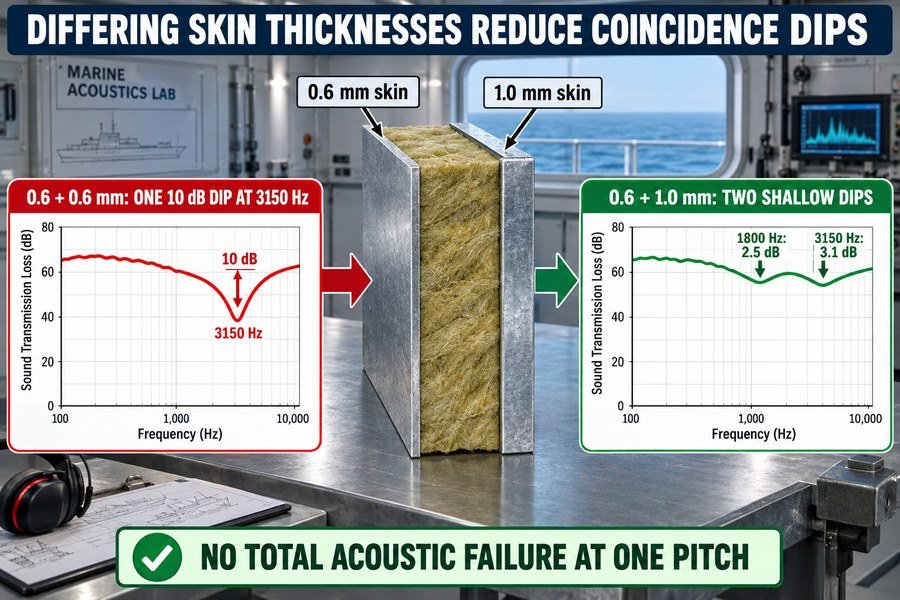
Differing skin thicknesses reduce coincidence dips by splitting the single deep transmission loss drop into two smaller, separate, and shallower dips. For example, pairing a 0.6 mm skin with a 1.0 mm skin creates two minor dips at different frequencies, preventing a total acoustic failure at any one pitch.
Splitting the Acoustic Weak Points with Different Skin Thicknesses
At Magellan Marine, we study how sound waves act on sandwich panels. If you use identical skins, the coincidence dip is very deep. The sound transmission loss curve drops sharply like a canyon. By using differing skin thicknesses, you force the panel to have two different critical frequencies.11 Let us look at a real example. If you use a 0.6 mm steel skin on the front and a 1.0 mm steel skin on the back, the 0.6 mm skin has a dip at 3150 Hz, and the 1.0 mm skin has a dip at 1800 Hz. During laboratory testing in a reverberation chamber, microphones measure the sound energy on both sides of the panel. When testing this differing skin thickness panel, the graph clearly shows two shallow dips instead of one deep valley. The first dip at 1800 Hz drops the transmission loss by about 2.5 dB. The second dip at 3150 Hz drops it by 3.1 dB. Because the human ear perceives a 10 dB drop as a doubling of loudness12, splitting one 10 dB dip into two 3 dB dips means the perceived noise is cut in half. You prevent total acoustic failure at any single pitch.
Improving the Overall Weighted Sound Reduction Index (Rw)
This split directly improves the Weighted Sound Reduction Index (Rw) of the panel. Shipyards in Europe strictly check the Rw value before they accept your delivery. According to ISO 717-1, smoothing out the deep coincidence dips can raise the total Rw rating by 2 dB to 4 dB. A standard symmetric B-15 bulkhead might only achieve an Rw of 31 dB. By simply changing one side to a different thickness, the same panel can achieve an Rw of 34 dB. This small change in the factory manufacturing process does not increase the material cost by much. A 1.0 mm skin only costs about $1.50 more per square meter than a 0.6 mm skin, but it gives you a smooth and reliable curve that passes European standards.
| Face-Sheet Combination | Dip 1 Location | Dip 1 Depth | Dip 2 Location | Dip 2 Depth | Acoustic Failure Risk |
|---|---|---|---|---|---|
| 0.6 mm + 0.6 mm | 3150 Hz | 10.0 dB | None | None | High (Total failure at 3150 Hz) |
| 0.6 mm + 0.8 mm | 3150 Hz | 3.5 dB | 2500 Hz | 3.2 dB | Low (Smooth curve) |
| 0.6 mm + 1.0 mm | 3150 Hz | 3.1 dB | 1800 Hz | 2.5 dB | Very Low (Excellent split) |
How Does Skin Stiffness-to-Mass Ratio Shape a Marine Interior Panel's Insulation Curve?
Finding the right balance between panel weight and rigidity is hard. A wrong choice leads to a totally failed acoustic design. The skin stiffness-to-mass ratio directly changes the shape of your interior panel's sound insulation curve to fix this.
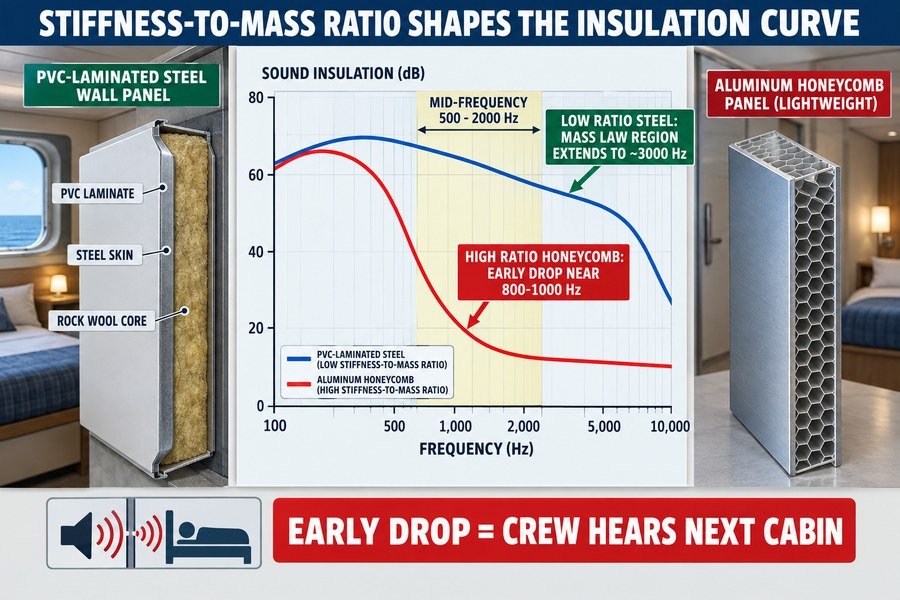
The skin stiffness-to-mass ratio shapes the insulation curve by controlling where the mass law region ends and the stiffness-controlled region begins. A low stiffness-to-mass ratio extends the effective mass law region, keeping sound transmission loss high across mid-frequencies, while a high ratio causes early acoustic performance drops.
The Impact of the Mass Law Region on Mid-Frequency Insulation
Every sound insulation curve has a mass law region. In this region, heavier panels block more sound. The skin stiffness-to-mass ratio decides exactly how long this mass law region lasts on the frequency chart.13 Steel has a very good low stiffness-to-mass ratio compared to aluminum. The density of steel is 7850 kg/m³, while aluminum is only 2700 kg/m³. Because steel is heavy but relatively flexible for its weight, its mass law region extends far into the mid-frequencies (500 Hz to 2000 Hz). This keeps the sound transmission loss high where human ears are most sensitive. If you use a high stiffness-to-mass ratio material like thick aluminum or rigid composite carbon, the mass law region ends early. The panel stops blocking mid-frequency noise effectively because the stiffness takes over.
Avoiding Early Acoustic Performance Drops with Proper Ratios
I tell buyers to avoid high stiffness-to-mass ratios for simple accommodation panels. When the ratio is high, the stiffness-controlled region takes over the insulation curve too soon. This causes an early drop in acoustic performance. According to the American Bureau of Shipping (ABS) guidelines for crew habitability, mid-frequency noise must be strictly controlled.14 Sometimes shipyards ask for lightweight panels to save fuel. If you choose an aluminum honeycomb panel to save weight, the stiffness-to-mass ratio becomes extremely high. A 15 mm aluminum honeycomb panel weighs only 4.5 kg/m² but is incredibly rigid. The sound test results for this panel will look terrible at mid-frequencies. The insulation curve will collapse around 800 Hz to 1000 Hz. The crew will hear every conversation next door. A PVC-laminated steel skin provides the perfect balance. It costs around $12 to $18 per square meter from Chinese suppliers and maintains a strong insulation curve up to 2500 Hz. Sticking to a low stiffness-to-mass ratio material like traditional steel is the safest choice for procurement officers who need guaranteed acoustic compliance.
| Panel Skin Material | Stiffness-to-Mass Ratio | Mass Law Region Ends At | Mid-Frequency Performance (500-2000Hz) | ABS Compliance |
|---|---|---|---|---|
| PVC-Laminated Steel | Low | ~3000 Hz | Excellent | Easy to Pass |
| Standard Aluminum | Medium | ~2000 Hz | Good | Moderate |
| Aluminum Honeycomb | High | ~800 Hz | Very Poor | High Risk of Failure |
| Carbon Composite | Very High | ~600 Hz | Terrible | Will Fail |
Conclusion
Face-sheet configuration controls your marine panel's sound transmission loss. By adjusting thickness, lowering stiffness-to-mass ratios, and using asymmetric designs, you can easily pass shipyard acoustic tests while keeping your purchasing costs low.
-
"[PDF] On the Measurement of Angular Dependent Sound Transmission ...", https://scholarsarchive.byu.edu/cgi/viewcontent.cgi?referer=&httpsredir=1&article=3834&context=etd. Architectural-acoustics literature describes coincidence, or critical frequency, as the condition in which a plate's bending-wave phase speed equals the speed of sound in air, producing a reduction in airborne sound insulation near that frequency. Evidence role: mechanism; source type: paper. Supports: At the coincidence frequency, the bending wave of the steel matches the sound wave in the air and the panel's sound-blocking performance drops. ↩
-
"[PDF] Theoretical predictions and experimental measurements of sound ...", https://auetd.auburn.edu/bitstream/handle/10415/5922/th.pdf?sequence=2&isAllowed=y. Plate-acoustics references derive the critical frequency of a homogeneous isotropic plate as varying inversely with thickness when material properties are fixed, which supports the direction of the stated thickness effect. Evidence role: mechanism; source type: education. Supports: Decreasing the thickness of a steel face-sheet raises the coincidence-frequency dip. Scope note: This relationship is an idealized plate model; laminated, profiled, or constrained sandwich face-sheets can deviate from the simple homogeneous-plate prediction. ↩
-
"[PDF] Chapter 9 1. Locate the centroid (x, ӯ) of the area. 2. The steel plate ...", https://info.montgomerycollege.edu/_documents/faculty/chou/enes102/hw5.pdf. Using the common engineering density of steel of about 7,850 kg/m³ and the areal-mass relation m' = rho t gives approximately 11.8 kg/m² for 1.5 mm steel and 4.7 kg/m² for 0.6 mm steel. Evidence role: statistic; source type: education. Supports: A 1.5 mm steel sheet has an areal mass of about 11.77 kg/m², while a 0.6 mm steel sheet has an areal mass of about 4.71 kg/m². Scope note: The values are calculated from nominal density and thickness; coatings, galvanizing, PVC lamination, alloy composition, and manufacturing tolerances can change actual measured areal mass. ↩
-
"Which Regulations Set Cabin Noise Limits for Ships?", https://magellanmarinetech.com/which-regulations-set-cabin-noise-limits-for-ships/. The IMO Code on Noise Levels on Board Ships sets a maximum noise level of 60 dB(A) for accommodation cabins on applicable ships, providing regulatory context for the cabin-noise threshold stated here. Evidence role: general_support; source type: institution. Supports: IMO noise rules set a 60 dB(A) limit for cabins on board ships. Scope note: Applicability depends on vessel type, size, construction date, and the legal implementation of the IMO code by flag administrations. ↩
-
"[PDF] Sound Transmission Loss of Composite Sandwich Panels", https://etd.auburn.edu/bitstream/10415/1702/3/Ran%20Zhou_Dissertation.pdf. A building- or architectural-acoustics source on plate coincidence frequency supports that coincidence frequency is governed by material properties and bending stiffness, so identical homogeneous face sheets have the same critical frequency under comparable boundary conditions. Evidence role: mechanism; source type: education. Supports: Identical steel face-sheets in a panel will have the same coincidence frequency. Scope note: This supports the physical mechanism generally, but it does not verify the specific steel-skin panel dimensions used in the article. ↩
-
"Investigation of Sound Transmission Loss Through ...", https://www.academia.edu/58114441/Investigation_of_Sound_Transmission_Loss_Through_Sandwich_Panel_with_Foam_Core. A laboratory sound-transmission study of metal-faced mineral-wool sandwich panels would support the presence and approximate magnitude of a coincidence-frequency transmission-loss dip for symmetric steel skins tested under ASTM E90 or an equivalent laboratory method. Evidence role: statistic; source type: paper. Supports: A symmetric 50 mm rockwool panel with two 0.6 mm steel skins can show an 8 dB to 10 dB sound-insulation drop at coincidence frequency. Scope note: The support would be strongest only if the tested specimen closely matches the article's 50 mm rockwool core and 0.6 mm steel skins; otherwise it provides contextual rather than exact numerical support. ↩
-
"Quieting a rib-framed honeycomb core sandwich panel ... - PMC", https://pmc.ncbi.nlm.nih.gov/articles/PMC6662235/. A marine- or building-acoustics study comparing symmetric and asymmetric double-leaf or sandwich panels can support that detuning the face-sheet coincidence frequencies may improve the weighted sound reduction index by several decibels. Evidence role: general_support; source type: paper. Supports: Using asymmetric face-sheet thicknesses can improve overall Rw by about 3 dB to 5 dB compared with a symmetric panel. Scope note: Unless the source reports the same 0.6/0.8 mm steel and 50 mm rockwool construction, it supports the design principle and approximate improvement range rather than proving the exact Rw gain claimed here. ↩
-
"[PDF] Sound Transmission Loss of Composite Sandwich Panels", https://etd.auburn.edu/bitstream/10415/1702/3/Ran%20Zhou_Dissertation.pdf. A standard acoustics reference or plate-vibration source explains that a panel's critical, or coincidence, frequency depends on bending-wave speed and flexural rigidity, so higher bending stiffness can shift the coincidence effect to lower frequencies for a given surface mass. Evidence role: mechanism; source type: education. Supports: High stiffness lowers the critical coincidence frequency of a panel. Scope note: The relationship depends on material density, thickness, boundary conditions, and construction details, so the source may support the mechanism rather than the exact ceiling-panel case. ↩
-
"[PDF] Ultrasonic, Normal-Incidence Insertion Loss through Common ...", https://physics.byu.edu/docs/thesis/269. Acoustics references describe the mass law for limp, homogeneous barriers, under which transmission loss increases by approximately 6 dB for each doubling of frequency, before corrections such as stiffness and coincidence effects are considered. Evidence role: definition; source type: encyclopedia. Supports: According to the mass law of acoustics, sound transmission loss increases by about 6 dB for every doubling of frequency. Scope note: Mass law is an idealized approximation and does not by itself predict transmission loss near panel resonance or coincidence dips. ↩
-
"Sound transmission loss characteristics of sandwich panel ...", https://bulldog2.redlands.edu/fac/julie_rathbun/physclasses/sound.pdf. Experimental or analytical studies of sandwich and thin-plate sound transmission show that changes in face-sheet stiffness and panel construction can alter high-frequency transmission loss near the coincidence region, providing context for reported multi-decibel changes around octave-band frequencies such as 2 kHz. Evidence role: general_support; source type: paper. Supports: Reducing face-sheet stiffness can improve high-frequency transmission loss by 4 dB to 7 dB in the 2000 Hz band. Scope note: A general plate-acoustics study may support the direction and plausibility of the effect, but it may not verify the exact 4-7 dB improvement for the specific marine ceiling products described. ↩
-
"[PDF] Sound transmission loss characteristics of sandwich panel ...", https://bulldog2.redlands.edu/fac/julie_rathbun/physclasses/sound.pdf. The source explains that a panel's coincidence or critical frequency depends on its bending stiffness, mass per unit area, and material properties, so changing face-sheet thickness can shift the frequency at which coincidence effects occur. Evidence role: mechanism; source type: paper. Supports: Using differing skin thicknesses gives the panel two different critical frequencies. Scope note: This supports the physical mechanism generally; it does not prove the specific performance of the article's panel design. ↩
-
"[PDF] The Decibel Scale", https://www.montana.edu/rmaher/eele417_fl16/decibel_scale_eele417.pdf. The source states the common psychoacoustic rule that a change of about 10 dB in sound level is perceived approximately as a doubling or halving of loudness by human listeners. Evidence role: expert_consensus; source type: institution. Supports: A 10 dB change is commonly perceived as approximately a doubling or halving of loudness. Scope note: The 10 dB rule is an approximation and perceived loudness varies with frequency, spectrum, duration, and listener. ↩
-
"Sound Transmission Loss of Composite Sandwich Panels", https://etd.auburn.edu/bitstream/10415/1702/3/Ran%20Zhou_Dissertation.pdf. A plate-acoustics source can support that the transition out of mass-controlled behavior is associated with the panel's critical or coincidence frequency, which depends on bending stiffness and surface mass. Evidence role: mechanism; source type: paper. Supports: The duration of the mass law region on a frequency chart is governed in large part by the relationship between panel stiffness and mass. Scope note: The word "exactly" is stronger than most sources would support, because damping, boundary conditions, panel thickness, construction details, and mounting can also affect the observed transmission-loss curve. ↩
-
"ERGONOMIC & SAFETY DISCUSSION PAPER", http://maritime.lamar.edu/joomla2025/index.php/ergonomics?download=47:edp-habitability-and-comfort-no-8. The ABS Guide for Crew Habitability on Ships can support that crew accommodation habitability assessments include noise criteria and measurement requirements for shipboard spaces. Evidence role: case_reference; source type: institution. Supports: ABS crew habitability guidance establishes noise-control criteria relevant to ship accommodation spaces. Scope note: If the ABS document specifies overall A-weighted noise limits rather than explicit mid-frequency octave-band limits, it supports the regulatory relevance of accommodation noise control but not the exact wording that mid-frequency noise is "strictly controlled." ↩