
Specifying coatings for steel-faced marine accommodation panels feels overwhelming. A bad choice means rust, failed inspections, and ruined budgets. Here is how you can choose the right coating system safely.
To specify coatings for steel-faced marine accommodation panels, you must select from three primary finishes: PVC laminated film (150-200 microns) for decorative cabins, baked enamel paint (20-30 microns) for utility areas, and stainless steel finishes for galleys. Each requires specific zinc-galvanized substrates (Z80-Z120) and compatible primers.
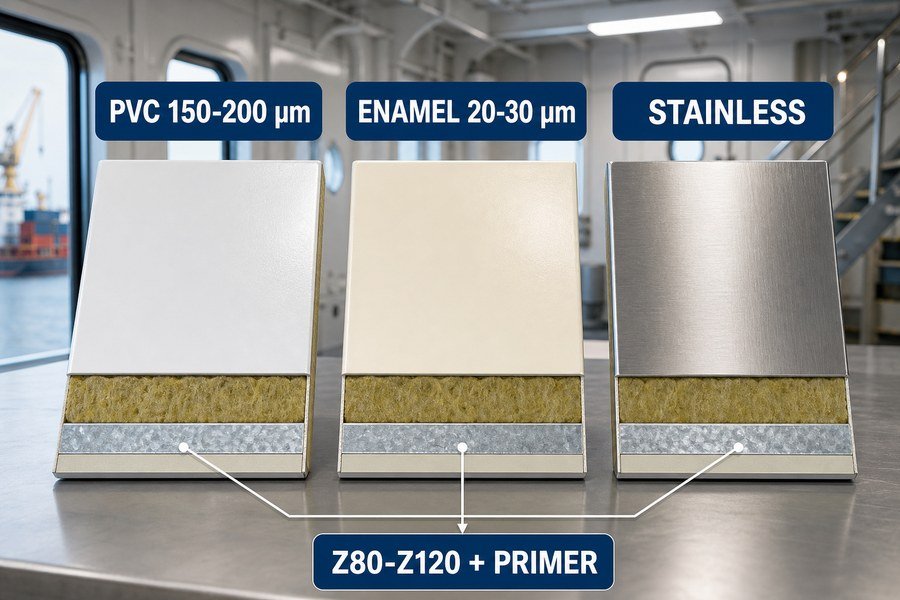
Getting the surface right is the first step in outfitting a vessel. Let us look closely at the specific paint systems and details you need to know.
Which Factory Paint Systems Coat Marine Accommodation Panel Steel Face Sheets?
Peeling paint on steel face sheets destroys the look of a cabin. If the factory uses the wrong paint system, you face costly replacements. Knowing the right paint prevents this.
Marine panel steel sheets use three main factory paint systems: polyester resin paint (20-25 microns) for standard dry cabins, epoxy resin paint (30-40 microns) for high-humidity areas, and polyurethane paint (25-35 microns) for high UV exposure. All require a hot-dip galvanized steel base.
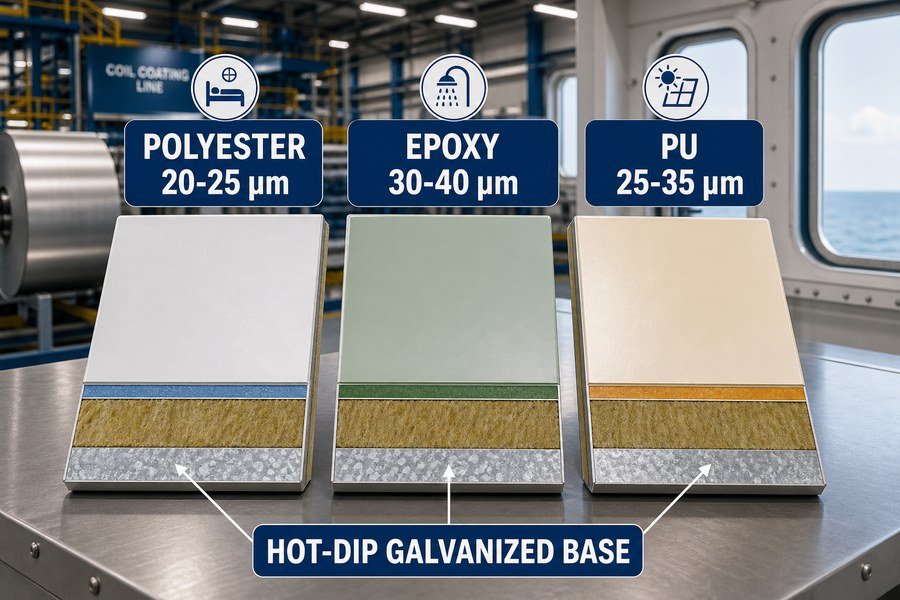
In my years working at the marine outfitting factory, I saw many buyers struggle with paint choices. They often chose the cheapest option, only to face massive problems later. To make the right choice, we need to look at the three main paint systems used for marine panels.
Polyester Resin Paint Systems for Standard Marine Cabins
The first and most common system is polyester resin paint. Factories apply this paint through a coil coating process. The standard thickness is 20 to 25 microns. According to the ISO 12944 standard, this thickness works perfectly for C2 environments. A C2 environment is a dry, indoor space with low pollution. Therefore, polyester paint is the best choice for standard crew cabins and interior corridors. It costs less than other paints. I always advise my clients to use polyester paint for dry areas because it saves money without losing quality. It gives a smooth, clean finish that shipyard owners like.
Epoxy Resin Paint and Polyurethane Paint Systems for Tough Marine Areas
Standard paint is not always enough. You need stronger paints for harsh areas. The second system is epoxy resin paint. Factories apply this at a thickness of 30 to 40 microns. Epoxy paint resists water and chemicals very well.1 This makes it perfect for high-humidity areas like marine sanitary units, wet rooms, and laundry rooms. However, epoxy paint can lose its color if sunlight hits it directly.
This is where the third system comes in: polyurethane (PU) paint. PU paint has a thickness of 25 to 35 microns. It fights ultraviolet (UV) light perfectly.2 If your panels are near large windows or exterior doors, you must use PU paint. It keeps the color bright and stops the steel from getting too hot. All three of these paint systems must go over a hot-dip galvanized steel base. We normally specify a zinc coating of Z80 to Z120 (80 to 120 grams of zinc per square meter)3 to stop rust before it starts.
| Factory Paint System | Standard Thickness | Best Marine Application Area | Key Advantage |
|---|---|---|---|
| Polyester Resin Paint | 20 - 25 microns | Standard dry cabins, corridors | Low cost, good indoor look |
| Epoxy Resin Paint | 30 - 40 microns | Sanitary units, laundry rooms | High moisture resistance |
| Polyurethane Paint | 25 - 35 microns | Areas near windows, exterior doors | High UV resistance, keeps color |
What PVC Film Thickness Is Standard on Decorative Steel-Faced Marine Accommodation Panels?
Thin PVC film tears easily during installation. If you accept sub-standard film, the cabin walls will look terrible before the ship even sails. Here are the exact numbers.
The standard PVC film thickness for decorative marine accommodation panels falls into three categories: 150 microns for standard flat walls, 200 microns for high-traffic corridors, and 250 microns for deep-textured woodgrain finishes. IMO FTP Code Part 5 mandates all thicknesses must have low flame spread characteristics.
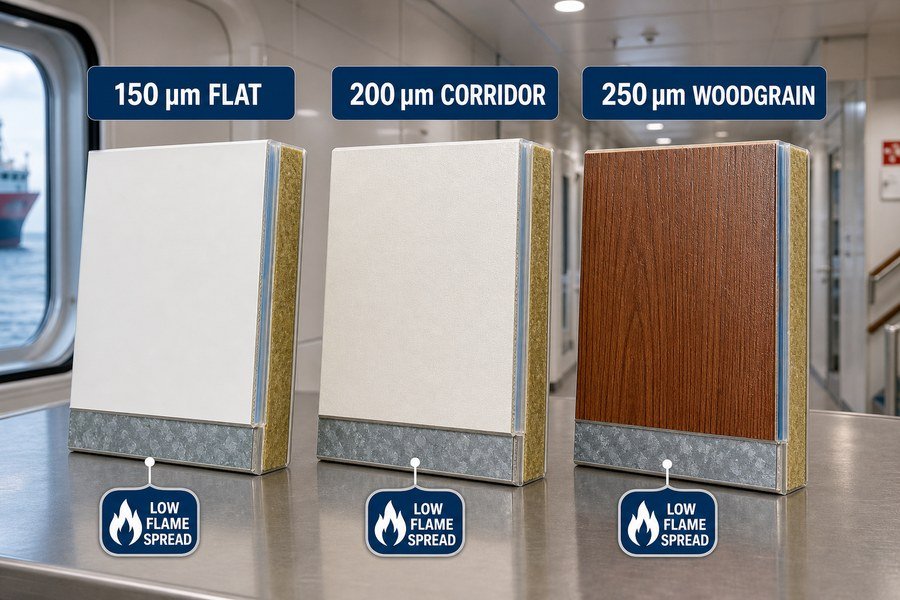
When you buy decorative marine panels, the PVC film is what everyone sees. If the film is too thin, workers will scratch it easily when they move furniture into the cabin.4 I have helped clients fix panels because they bought the wrong thickness to save a few dollars. Let us break down the three exact thickness categories you must know.
150-Micron PVC Film for Standard Flat Marine Walls
The first category is the 150-micron PVC film. This is the starting point for marine panels. It works very well for flat, solid colors like light grey or off-white. You should use the 150-micron film inside standard crew cabins where foot traffic is low. Even though it is the thinnest option, it must still pass strict safety tests. The International Maritime Organization (IMO) FTP Code Part 5 states that this film must not spread fire quickly. The 150-micron film keeps your costs low while meeting all basic shipyard demands.
200-Micron and 250-Micron PVC Film for High-Traffic and Textured Marine Panels
The second category is the 200-micron PVC film. This is thicker and stronger. You need this thickness for high-traffic areas like public corridors and dining rooms. In these areas, people bump into walls with heavy bags and cleaning carts. The 200-micron film stops these bumps from reaching the steel under it.5
The third category is the 250-micron PVC film. This is the thickest standard option. Factories use this for deep-textured finishes, like realistic woodgrain or stone patterns. The extra 50 microns give the factory room to stamp deep lines into the plastic.6 Without this thickness, the woodgrain would look flat and fake. When a client wants a luxury look for a passenger ship or a captain's room, I always tell them to specify the 250-micron film.
| PVC Film Thickness | Pattern Style | Best Marine Application Area | Primary Benefit |
|---|---|---|---|
| 150 Microns | Solid, flat colors | Standard crew cabins | Lowest cost, meets IMO fire codes |
| 200 Microns | Light textures, patterns | High-traffic corridors | Resists bumps and scratches |
| 250 Microns | Deep woodgrain, stone | Luxury rooms, captain cabins | Allows deep embossing, rich look |
How Are Steel Face Sheet Cut Edges Sealed Against Moisture on Marine Accommodation Panels?
Unsealed cut edges absorb moisture quickly. This leads to internal rust and panel delamination over time. Knowing the sealing methods saves your entire project.
Steel face sheet cut edges on marine panels are sealed against moisture using three methods: folded-edge construction wrapping the steel 180 degrees, application of two-component polyurethane marine sealants along raw edges, and U-shaped PVC or metal edge-banding profiles. These methods stop moisture ingress in wet areas.
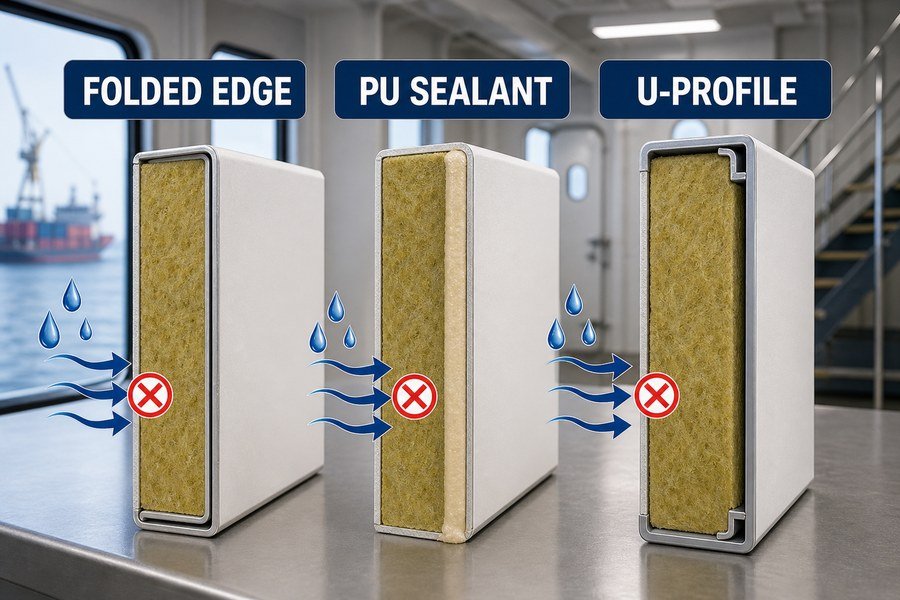
Water is the biggest enemy of a marine wall panel. The rockwool core inside the panel will soak up water like a sponge if the edges are open. When the steel face sheet is cut at the factory, the raw steel edge is exposed7. We must cover it. I always check edge sealing first when inspecting panels. Here are the three methods factories use to seal these edges.
Folded-Edge Construction for Marine Panel Sheets
The first and most reliable method is folded-edge construction. During production, the factory cuts the steel sheet slightly larger than the panel. Then, a machine bends the extra steel 180 degrees over the edge of the rockwool core. This usually creates a return lip of 10 to 15 millimeters. Because the steel wraps completely around the edge, no raw steel faces the outside air. I strongly suggest this method. It requires no extra chemicals and provides a very strong mechanical barrier against water.
Polyurethane Sealants and U-Shaped Profiles for Raw Marine Panel Edges
Sometimes, you have to cut panels on the ship during installation. You cannot fold the steel on-site. This brings us to the second method: using two-component polyurethane marine sealants. Workers apply a liquid sealant, like Sikaflex 291i, directly to the raw cut edge. This sealant cures in about 24 hours. It forms a hard, waterproof rubber barrier.
The third method uses U-shaped edge-banding profiles. Workers push a U-shaped track over the raw edge. These profiles are made of hard PVC or 0.5mm thick stainless steel. The shipyard will put a line of glue inside the U-profile before pushing it onto the panel edge. This method seals the edge and also makes the cut look neat and professional. You should always keep U-profiles ready when outfitting a ship.
| Edge Sealing Method | Application Location | Material Used | Waterproof Reliability |
|---|---|---|---|
| Folded-Edge Construction | Done at the factory | Base steel sheet (180-degree bend) | Very High |
| Two-Component PU Sealant | Done on the ship | Liquid marine sealant (e.g., Sikaflex) | High |
| U-Shaped Edge-Banding | Done on the ship | Hard PVC or 0.5mm stainless steel | High (if glued properly) |
Which Primer Is Required Under PVC Film on Marine Accommodation Panel Steel Face Sheets?
If the primer fails, the decorative PVC film peels off the steel. This ruins the cabin interior completely. Selecting the correct primer is your best defense.
Under PVC film on marine panel steel sheets, manufacturers require two main primers: solvent-based polyurethane primers (5-10 microns thick) for standard galvanized steel, and epoxy-based primers (10-15 microns thick) for areas demanding high corrosion resistance. Both ensure strong chemical bonding and prevent film delamination.
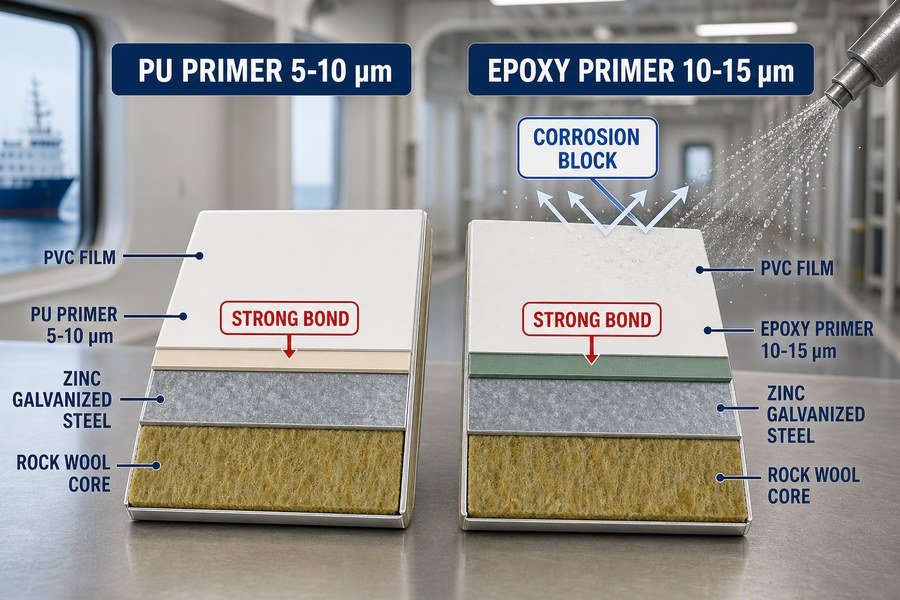
The bond between the steel face and the PVC film is very important. You cannot just glue plastic to raw metal.8 The film will fall off when the ship gets hot or cold. The secret to a good panel is the primer layer. As a specialist, I spend a lot of time checking primer specs. There are two main primers you must know about to avoid disaster.
Solvent-Based Polyurethane Primers for Standard Galvanized Steel Panels
The first type is the solvent-based polyurethane primer. This is the standard choice for most marine accommodation panels. The factory applies this primer over the Z80 galvanized steel layer. The primer thickness is very thin, usually just 5 to 10 microns. The coil coating machine heats the steel to about 200°C for a few seconds. This heat bakes the primer onto the metal. When the factory presses the PVC film onto this hot primer, the two materials melt together. This creates a very strong chemical bond. For normal ship cabins with controlled temperatures, the solvent-based polyurethane primer works perfectly and keeps costs low.
Epoxy-Based Primers for High-Corrosion Marine Panel Applications
The second type is the epoxy-based primer. You need this when the ship works in very harsh places. For example, if the ship sails in deep ocean environments (C4 corrosion class9), salt air will try to enter the panel. Epoxy primers are thicker, usually 10 to 15 microns. Epoxy sticks to steel better than any other chemical.10 It stops salt and water from moving under the PVC film. Epoxy primer costs more than polyurethane primer. However, if your shipyard client builds offshore oil platforms or heavy-duty workboats, you must specify the epoxy primer. It stops the PVC film from peeling off for many years.
| Primer Type | Application Thickness | Best Used For | Key Characteristic |
|---|---|---|---|
| Solvent-Based Polyurethane | 5 - 10 microns | Standard passenger and crew cabins | Fast curing, low cost, strong heat bond |
| Epoxy-Based Primer | 10 - 15 microns | Offshore platforms, harsh sea air | Maximum corrosion block, superior grip |
What Finish Options Exist for Visible Steel-Faced Marine Accommodation Wall Panels?
Choosing the wrong panel finish causes unhappy ship owners. You lose future contracts if the cabins look cheap. You need to know all the available options.
Visible steel-faced marine accommodation panels offer four finish options: PVC laminated film for decorative cabins, pre-painted polyester for economy crew areas, brushed stainless steel (Grade 304/316L) for galleys, and antimicrobial powder coating (60-80 microns) for medical rooms. Each matches specific zone requirements.
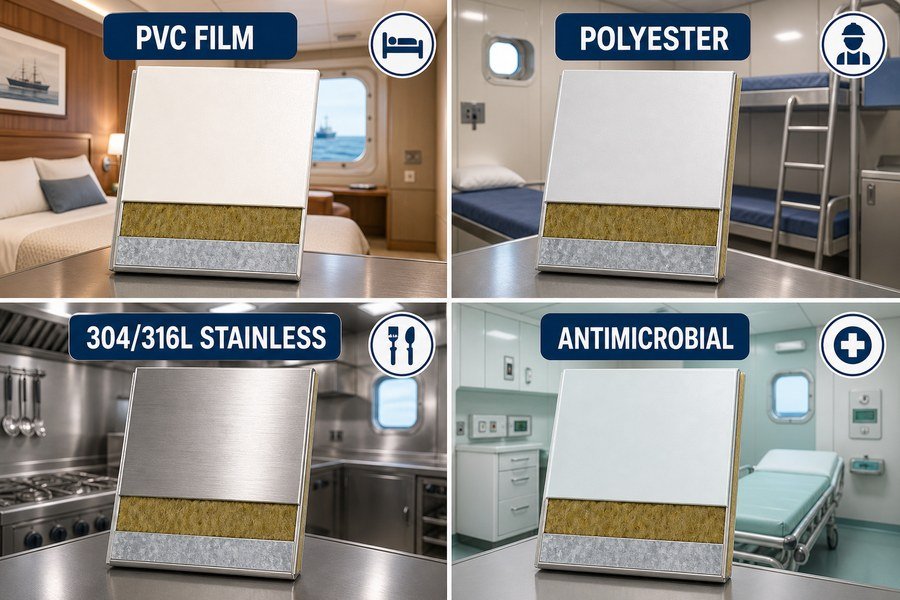
A ship has many different rooms. You cannot use the same wall panel finish everywhere. A bedroom needs a warm look, but a kitchen needs a tough, clean look. I always ask my clients to give me a map of the ship first. Then, we match the finish to the room. Here are the four finish options you can choose for visible steel panels.
PVC Laminated Film and Pre-Painted Polyester for Marine Cabins
The first finish is PVC laminated film. This is the most popular choice. As we discussed, the film is usually 150 to 250 microns thick. It allows you to make the steel look like real wood, fabric, or wallpaper. We use this finish for decorative cabins, dining rooms, and lounges.
The second finish is pre-painted polyester. This is just a smooth layer of paint, about 25 microns thick11. It does not have a pattern. It is usually plain white or light grey. We use this finish for economy crew areas, storage rooms, and hidden hallways. Pre-painted polyester is the cheapest option. It helps you save money on the project where nobody cares about fancy decorations.
Stainless Steel and Antimicrobial Coatings for Specialty Marine Rooms
The third finish is brushed stainless steel. We do not use paint or film here. We use a real sheet of stainless steel, usually Grade 304 or Grade 316L, with a thickness of 0.6mm. You must use this finish for galleys (ship kitchens) and food storage rooms.12 Stainless steel does not burn13, and it is very easy to wash hot oil off it.
The fourth finish is antimicrobial powder coating. The factory sprays a dry powder onto the steel and bakes it. The thickness is 60 to 80 microns. This special paint releases silver ions. These silver ions kill bacteria on the wall.14 You must specify this finish for the ship's hospital or medical rooms. It keeps the sick crew members safe from infections.
| Panel Finish Option | Material Details | Required Ship Zone | Main Reason for Use |
|---|---|---|---|
| PVC Laminated Film | 150-250 microns thick | Decorative cabins, lounges | High aesthetics, looks like wood/fabric |
| Pre-Painted Polyester | 25 microns thick | Economy crew areas, storage | Lowest cost, simple clean look |
| Brushed Stainless Steel | Grade 304 or 316L (0.6mm) | Galleys, kitchens | Fireproof, easy to clean grease |
| Antimicrobial Powder | 60-80 microns (silver ions) | Medical rooms, ship hospitals | Kills bacteria, high hygiene |
How Are Field Scratches on Steel-Faced Marine Accommodation Panels Repaired?
Scratches happen during ship construction. Tearing down a scratched panel costs too much time and money. Here are the exact ways to fix them on site.
Field scratches on marine panels are repaired using three methods: marine-grade touch-up paint pens for minor superficial clear-coat scratches, self-adhesive PVC repair patches for deep gouges in laminated panels, and two-part epoxy filler followed by color-matched spray paint for severe steel substrate damage.
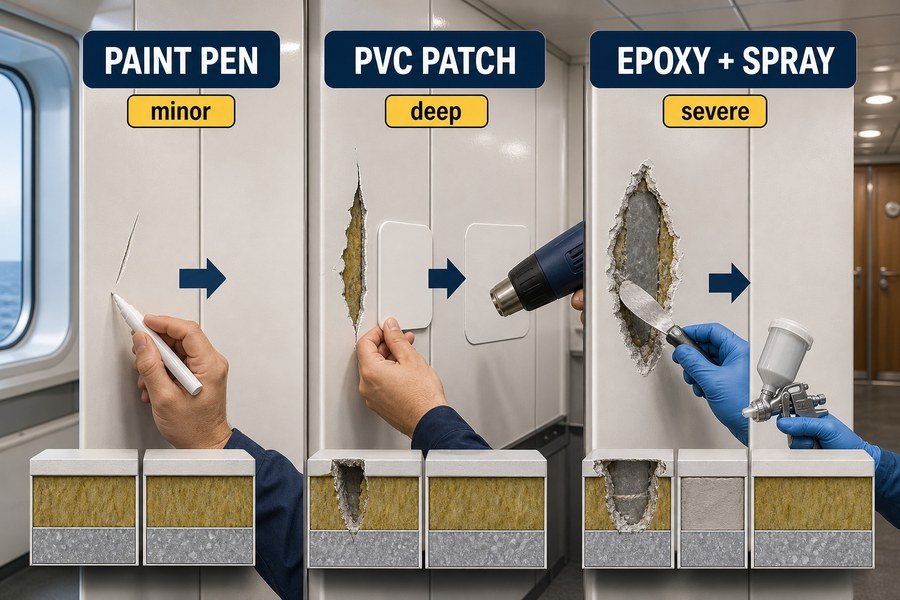
No matter how careful the workers are, someone will drop a tool and scratch the wall. Replacing an installed panel takes hours. It is better to fix the scratch. Over the years, I have taught many shipyard workers how to save damaged panels. You must carry the right repair tools. Let us look at the three methods used to fix field scratches.
Paint Pens and PVC Patches for Minor Marine Panel Damage
The first method uses marine-grade touch-up paint pens. You use this for minor scratches. A minor scratch is very thin, usually less than 0.1mm deep15. It only marks the clear coat on the surface. You shake the pen, press the tip into the scratch, and wipe away the extra fluid. The paint dries in 10 minutes.
The second method uses self-adhesive PVC repair patches. You use this when a worker tears a deep gouge into a PVC laminated panel. The manufacturer will supply small rolls of matching PVC film. You cut a patch slightly larger than the hole. You use a heat gun set to 60°C to warm the patch. Then, you press it firmly over the tear. The heat melts the glue16 and blends the patch into the wall. If you do this slowly, the repair is almost invisible.
Epoxy Fillers and Color-Matched Spray for Severe Marine Panel Damage
The third method is for severe damage. Sometimes, a heavy machine hits the wall and gouges all the way down to the raw zinc layer. You cannot just put a sticker over this. You must use a two-part epoxy filler17. You mix the two pastes and push the filler into the deep hole. Wait one hour for it to turn hard. Next, you must sand the area smooth with 400-grit sandpaper. Finally, you spray the area with color-matched polyurethane spray paint. This method takes time, but it saves the panel and stops the raw steel from rusting18.
| Damage Level | Repair Method | Tools Required | Drying / Curing Time |
|---|---|---|---|
| Minor (Surface only) | Touch-up paint pen | Paint pen, dry cloth | 10 minutes |
| Medium (Torn PVC) | PVC repair patch | Matching PVC patch, heat gun (60°C) | Instant (when cool) |
| Severe (Deep steel gouge) | Epoxy filler + Spray paint | 2-part epoxy, 400-grit paper, PU spray | 1 hour for filler |
Conclusion
Specifying the correct coatings, primers, edge sealing, and repair methods for marine panels ensures your outfitting project meets safety codes, stays within budget, and satisfies the shipyard perfectly.
-
"Overview of Recent Developments in Composite Epoxy Resin in ...", https://pmc.ncbi.nlm.nih.gov/articles/PMC11990607/. Coatings literature commonly describes epoxy coatings as having strong adhesion and resistance to water and many chemicals, supporting their selection for humid or chemically exposed service areas; actual resistance depends on resin chemistry, curing, film build, and the specific chemicals present. Evidence role: expert_consensus; source type: paper. Supports: Epoxy paint resists water and chemicals very well.. Scope note: The support is general to epoxy coatings and does not verify the exact factory formulation or 30–40 µm thickness stated in the article. ↩
-
"The Puncture and Water Resistance of Polyurethane - PMC - NIH", https://pmc.ncbi.nlm.nih.gov/articles/PMC7022708/. Technical coatings references describe polyurethane topcoats, especially aliphatic polyurethane systems, as having good weathering resistance and color or gloss retention under ultraviolet exposure; this supports the UV-resistance rationale but not an absolute claim that the coating resists UV “perfectly.” Evidence role: mechanism; source type: paper. Supports: Polyurethane paint has high UV resistance and helps retain color near sunlight-exposed areas.. Scope note: Evidence is likely to support relative UV durability, not perfect UV protection, and performance varies by polyurethane chemistry and pigment package. ↩
-
"[PDF] DoD 2013-3557", https://www.waru.edu/sites/default/files/Migrated/CopDocuments/Examination%20of%20Zinc%20Galvanized%20Steel%20Corrosion%20Rates%20in%20Various%20Atmospheric%20and%20Soil%20Exposure%20Conditions.pdf. Galvanizing standards and corrosion guidance explain that zinc coatings protect steel through barrier and sacrificial mechanisms, and that coating mass is a key variable in corrosion durability; this supports the rationale for specifying a zinc-coated steel base, but does not prove that Z80–Z120 is adequate for every marine-panel exposure condition. Evidence role: mechanism; source type: institution. Supports: A Z80 to Z120 zinc coating on hot-dip galvanized steel helps reduce corrosion risk before the paint system is applied.. Scope note: The evidence supports the protective role of zinc coating generally; adequacy of Z80–Z120 depends on environment, substrate standard, coating system, and service-life target. ↩
-
"Study on the Micro-Abrasion Wear Behavior of PVD Hard ...", https://pmc.ncbi.nlm.nih.gov/articles/PMC10142251/. Materials-science literature on polymer coatings reports that coating thickness influences abrasion wear-through and scratch protection, supporting the rationale that thinner decorative films provide less protective margin; this evidence is contextual and does not establish a universal scratch threshold for marine PVC panels. Evidence role: mechanism; source type: paper. Supports: Thin PVC decorative films are more likely to be scratched during cabin installation or furniture movement.. Scope note: Contextual support only; it does not directly test the article’s specific marine panel products or handling scenario. ↩
-
"[PDF] Onset of failure in corrosion protective barrier coatings", https://www.waru.edu/sites/default/files/Migrated/CopDocuments/Onset%20of%20failure%20in%20corrosion%20protective%20barrier%20coatings.pdf. Research on protective polymer films and coatings shows that thicker layers can improve resistance to impact, abrasion, and substrate exposure by providing more material to absorb or wear away; this supports the mechanism generally, but not the exact protective performance of a 200-micron marine PVC film. Evidence role: mechanism; source type: research. Supports: A thicker 200-micron PVC film can better protect the underlying steel panel from bumps and abrasion in high-traffic areas.. Scope note: General materials evidence; direct validation would require product-specific impact or abrasion testing on the panel assembly. ↩
-
"[PDF] Impact of polymer film thickness and cavity size on ... - OSTI.GOV", https://www.osti.gov/servlets/purl/893154. Technical literature on thermoplastic film embossing explains that embossing depth and pattern fidelity depend on film thickness, temperature, pressure, and material flow; this supports the claim that thicker PVC film can accommodate deeper textures, while not proving that exactly 250 microns is necessary for all woodgrain or stone finishes. Evidence role: mechanism; source type: paper. Supports: Additional PVC film thickness helps manufacturers create deeper embossed textures such as woodgrain or stone patterns.. Scope note: Contextual manufacturing support; embossing capability also depends on tooling, temperature, pressure, and PVC formulation. ↩
-
"[PDF] Coatings for corrosion protection - GovInfo", https://www.govinfo.gov/content/pkg/GOVPUB-C13-14327283e491f213d199e8c784e520bc/pdf/GOVPUB-C13-14327283e491f213d199e8c784e520bc.pdf. Corrosion references for steel in marine or chloride-containing environments describe exposed, unprotected steel surfaces and cut edges as susceptible to corrosion, supporting the need to cover or protect raw panel-sheet edges. Evidence role: mechanism; source type: government. Supports: Cut steel panel edges expose raw metal that should be protected from the marine environment.. Scope note: The evidence would support the general corrosion mechanism for exposed steel; it may not directly test the specific marine wall panel construction described in the article. ↩
-
"[PDF] Achieving Better Adhesion with Proper Surface Preparation", https://fpg.phys.virginia.edu/fpgweb/useful_info/Master_Bond-Proper_Surface_Preparation_Bonding.pdf. Technical literature on adhesive bonding of metals explains that surface preparation and primers are commonly used to improve adhesion durability and resistance to environmental degradation; this supports the general bonding principle rather than proving this specific PVC-film panel construction. Evidence role: mechanism; source type: education. Supports: Raw metal surfaces generally require surface preparation or primer systems for durable plastic-to-metal bonding.. Scope note: Contextual support; the source may address metal adhesive bonding generally, not PVC film laminated to galvanized marine panels specifically. ↩
-
"Evaluation of Protective Coatings for High-Corrosivity Category ...", https://pmc.ncbi.nlm.nih.gov/articles/PMC6515464/. ISO 12944-2 corrosion-environment guidance defines C4 as a high-corrosivity category associated with industrial or coastal atmospheres with moderate salinity; this contextualizes the marine exposure terminology, although offshore or open-sea exposures may require higher categories such as C5 or CX. Evidence role: definition; source type: institution. Supports: C4 is a recognized corrosion-class designation used for high-corrosivity coastal or industrial environments.. Scope note: This may qualify rather than fully support the article’s wording if “deep ocean environments” are more severe than the C4 category in the standard. ↩
-
"[PDF] ADHESION TESTING OF EPOXY COATING", https://fsel.engr.utexas.edu/pdfs/1265_6.pdf. Reviews of epoxy coatings report strong adhesion to steel substrates and widespread use as anticorrosive primers because of their barrier properties and interfacial bonding; such sources support high adhesion performance but do not establish that epoxy is superior to every other coating chemistry in all conditions. Evidence role: expert_consensus; source type: paper. Supports: Epoxy primers are widely recognized for strong adhesion to steel and corrosion-protective performance.. Scope note: Does not substantiate the absolute superlative “better than any other chemical”; performance varies with surface preparation, formulation, and exposure conditions. ↩
-
"Prepainted metal", https://en.wikipedia.org/wiki/Prepainted_metal. An industry or technical source on coil-coated/pre-painted metal can support that polyester topcoats on pre-painted steel are commonly specified in the approximate 20–25 μm range; this contextualizes the stated figure rather than proving it for every marine panel product. Evidence role: general_support; source type: institution. Supports: Pre-painted polyester on steel panels is commonly applied as a relatively thin smooth paint layer of about 25 microns.. Scope note: Coating thickness varies by manufacturer, substrate, primer system, and performance class. ↩
-
"[PDF] Vessel Sanitation Program Construction Guidelines - CDC Stacks", https://stacks.cdc.gov/view/cdc/7147/cdc_7147_DS1.pdf?. Ship sanitation or food-hygiene guidance can support that galley and food-storage surfaces should be durable, non-absorbent, corrosion-resistant, and easy to clean; this supports the rationale for stainless steel but does not establish that stainless steel is the only permissible finish. Evidence role: expert_consensus; source type: government. Supports: Galleys and food storage rooms require finishes that are hygienic, durable, corrosion-resistant, and easy to clean, making stainless steel an appropriate choice.. Scope note: Most public health guidance specifies performance characteristics for food-area surfaces, not a mandatory single material or finish. ↩
-
"[PDF] Best practice guidelines for structural fire resistance design of ...", https://nvlpubs.nist.gov/nistpubs/technicalnotes/nist.tn.1681.pdf. Fire-performance references for stainless steel can support that stainless steel is a non-combustible metallic material with high melting temperatures; this supports the material-level statement but not the fire rating of a complete wall-panel assembly. Evidence role: mechanism; source type: institution. Supports: Stainless steel itself is non-combustible and therefore suitable where fire resistance is important.. Scope note: A finished marine panel’s fire performance also depends on adhesives, insulation, backing materials, joints, and certification testing. ↩
-
"The Antibacterial Mechanism of Silver Nanoparticles and Its ... - PMC", https://pmc.ncbi.nlm.nih.gov/articles/PMC7174845/. Peer-reviewed reviews of silver-based antimicrobial materials can support that Ag+ ions can inhibit or kill bacteria through interactions with cell membranes, proteins, and DNA; this supports the antimicrobial mechanism but not the performance of every coated wall in service. Evidence role: mechanism; source type: paper. Supports: Silver ions released from antimicrobial coatings can kill or inhibit bacteria on coated surfaces.. Scope note: Antibacterial efficacy depends on coating formulation, silver-ion release rate, surface contamination, contact time, cleaning practices, and the tested organisms. ↩
-
"To Improve Auto Coatings, New Tests Do More Than Scratch the ...", https://www.nist.gov/news-events/news/2018/09/improve-auto-coatings-new-tests-do-more-scratch-surface. A coatings or materials-engineering source can support that superficial coating defects are commonly distinguished from deeper damage by whether they remain within the topcoat or clear-coat layer; the specific 0.1 mm threshold should be treated as a practical shop guideline rather than a universal standard. Evidence role: definition; source type: paper. Supports: A minor scratch is usually less than 0.1 mm deep and affects only the surface clear coat.. Scope note: The source may support the concept of superficial coating damage but not the exact numerical cutoff for every marine panel system. ↩
-
"[PDF] PRESSURE SENSITIVE ADHESIVE TAPES AND POLYMER ...", https://hammer.purdue.edu/articles/thesis/MECHANICS_OF_POLYMER_INTERFACES_PRESSURE_SENSITIVE_ADHESIVE_TAPES_AND_POLYMER_MATRIX_COMPOSITES/23734140/1/files/41691585.pdf. A polymer-adhesive or pressure-sensitive adhesive reference can support that heat increases adhesive flow and tack, helping self-adhesive polymer films conform to a substrate; support for an exact 60°C application temperature would usually be product-specific. Evidence role: mechanism; source type: paper. Supports: Heating a self-adhesive PVC patch helps activate or soften the adhesive so the patch bonds and conforms to the panel surface.. Scope note: This would support the general heat-assisted bonding mechanism, not necessarily the exact temperature or invisibility of a particular PVC patch repair. ↩
-
"[PDF] Evaluation of Different Paint Systems for Over-Coating Existing ...", https://rosap.ntl.bts.gov/view/dot/66177/dot_66177_DS1.pdf. Marine coatings literature commonly describes two-component epoxy materials as durable barrier layers used for filling, patching, or priming damaged steel surfaces before topcoating; this supports the material choice in principle, though curing time and surface-preparation details vary by formulation. Evidence role: expert_consensus; source type: institution. Supports: Severe gouges in coated metal panels can be repaired with a two-part epoxy filler before sanding and repainting.. Scope note: The source would support the general suitability of epoxy repair materials, not the exact one-hour cure time stated in the article. ↩
-
"[PDF] Coatings for corrosion protection - GovInfo", https://www.govinfo.gov/content/pkg/GOVPUB-C13-14327283e491f213d199e8c784e520bc/pdf/GOVPUB-C13-14327283e491f213d199e8c784e520bc.pdf. Corrosion-control references from government or standards bodies support that exposing carbon steel in marine environments accelerates corrosion and that restoring a protective coating barrier reduces oxygen, moisture, and salt access to the steel surface. Evidence role: mechanism; source type: government. Supports: Filling and repainting a deep gouge helps prevent exposed steel from rusting.. Scope note: This supports the corrosion-prevention rationale generally, not proof that the described repair will perform adequately in every shipboard environment. ↩