
Choosing between steel and aluminum face sheets is hard. Wrong choices lead to overweight ships and high fuel costs. Here is how to balance weight and cost for your projects.
Marine accommodation panels use either steel or aluminum face sheets, creating trade-offs in weight, cost, fire ratings, and rigidity. Steel offers high durability and fire resistance at a lower price, while aluminum provides critical weight savings for upper decks, reducing fuel consumption and improving vessel stability.
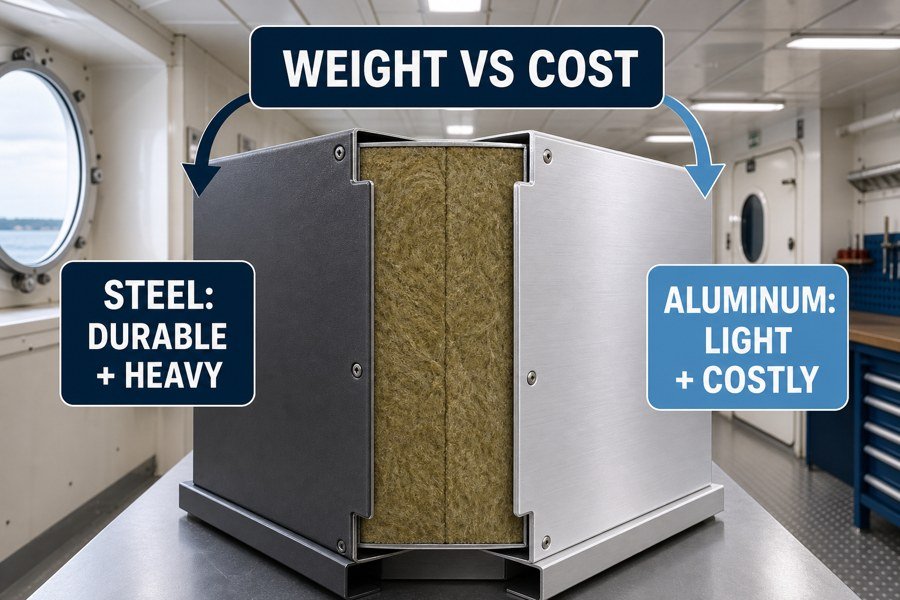
You might think picking a panel material is just about the unit price, but the hidden costs can ruin a project. Let me show you why weight is the real deal-breaker that you must not ignore to keep your project profitable.
What Is the kg/m² Gap Between Steel-Faced and Aluminum-Faced Marine Accommodation Panels?
Worried about panel weight estimates? Guessing the numbers can cause major project delays. Let us look at the exact weight differences you need to know.
The weight gap between standard 50mm steel-faced and aluminum-faced marine accommodation panels ranges from 6.0 to 7.5 kg/m². A standard 0.6mm steel-faced panel weighs approximately 16.5 to 18.0 kg/m², whereas a 0.6mm aluminum-faced panel weighs roughly 10.5 to 12.0 kg/m², assuming a 120 kg/m³ rockwool core.
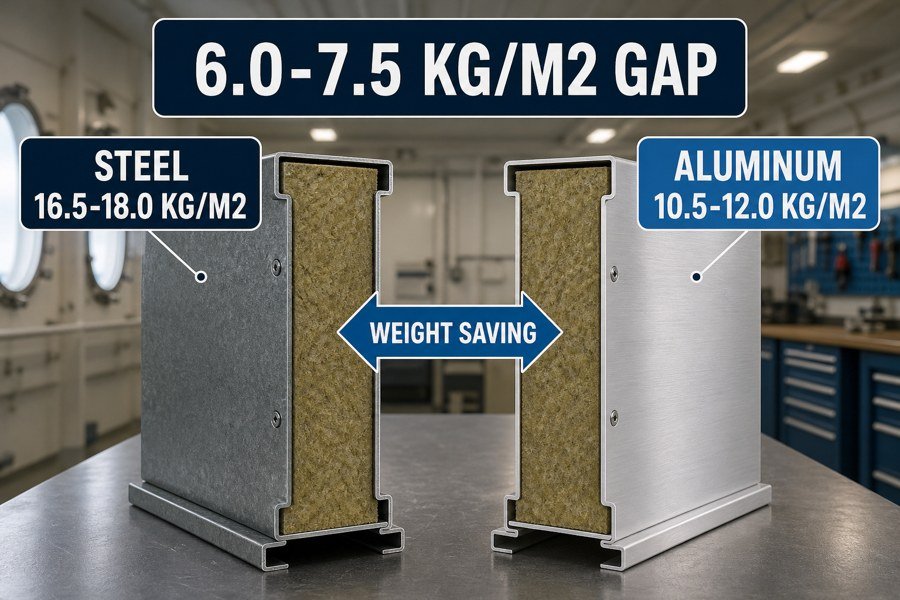
When I first started working at the marine outfitting factory, I used to lift these panels by hand all day. You can feel the weight difference immediately. But in procurement and engineering, you need exact numbers, not just feelings. Let us break down the exact math so you can calculate shipping and installation costs accurately.
Exact Weight Breakdown of 50mm Steel-Faced Marine Panels
To understand the total weight, we must look at the parts. A standard marine panel has two metal face sheets, a rockwool core, and adhesive glue. The density of standard galvanized steel is 7850 kg/m³.1 If you use a 0.6mm thick steel sheet, one square meter weighs about 4.71 kg. Because a panel has two sides, the steel alone weighs 9.42 kg/m². Next, we add the core. According to marine suppliers like Magellan Marine, a standard A-15 or B-15 fire-rated panel uses a 50mm thick rockwool core with a density of 120 kg/m³. This core adds 6.0 kg/m². Finally, the special marine adhesive adds about 1.0 to 1.2 kg/m². Adding this up, your steel panel will weigh around 16.5 to 17.0 kg/m² before you add PVC films or cable conduits.
Exact Weight Breakdown of 50mm Aluminum-Faced Marine Panels
Aluminum is much lighter. The density of marine-grade aluminum is only about 2700 kg/m³.2 If we use the exact same 0.6mm thickness, one square meter of aluminum weighs just 1.62 kg. For two sides, that is 3.24 kg/m². We still use the same 120 kg/m³ rockwool core (6.0 kg/m²) and the same glue (1.0 kg/m²). The total weight of the aluminum panel is about 10.24 to 11.0 kg/m². The gap between the two options is a solid 6.0 to 7.5 kg/m². When you are buying panels for a large shipyard project, this weight difference changes your shipping container limits. A 40-foot container has a strict weight limit.3 You can fit more square meters of aluminum panels into one container than steel panels before hitting the maximum weight.
Comparison Table of Marine Panel Weights
| Component (1 sq meter) | 0.6mm Steel Panel Weight | 0.6mm Aluminum Panel Weight | Weight Gap |
|---|---|---|---|
| Top Face Sheet | 4.71 kg | 1.62 kg | 3.09 kg |
| Bottom Face Sheet | 4.71 kg | 1.62 kg | 3.09 kg |
| 50mm Rockwool Core | 6.00 kg | 6.00 kg | 0.00 kg |
| Adhesive Glue | 1.00 kg | 1.00 kg | 0.00 kg |
| Total Estimated Weight | 16.42 kg/m² | 10.24 kg/m² | 6.18 kg/m² |
How Does Steel-Faced Marine Accommodation Panel Weight Affect Vessel Lightship Calculations?
Is your vessel failing its weight targets? Heavy panels add up fast across hundreds of cabins. See how this changes the ship design.
Steel-faced panel weight significantly impacts lightship calculations by increasing the total deadweight, reducing cargo or passenger payload capacity, and raising fuel consumption over the vessel's lifetime. A heavy lightship limits operational profitability and forces naval architects to redesign ballast or reduce other outfitting allowances to compensate.
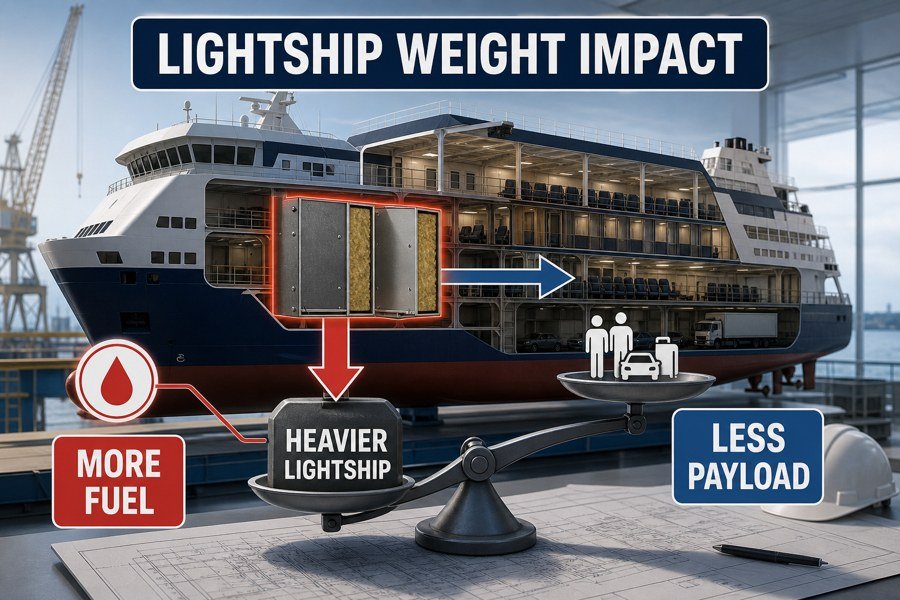
When shipyards build a new ship, they track every single kilogram. This total base weight is called the lightship weight4. I always remind my clients that the interior outfitting makes up a huge part of this weight. Let us look deeply into how panel choices change the whole ship's performance.
Impact of Panel Weight on Total Deadweight and Payload
A ship has a maximum weight it can safely displace in the water. If the ship itself (the lightship) is heavy, the owner can carry less cargo, fuel, or passengers. This usable weight is called deadweight5. Imagine an interior decoration project for a mid-sized cruise ship or ferry. You might need to buy and install 15,000 square meters of wall and ceiling panels. If you choose steel panels instead of aluminum, you add an extra 6.5 kg for every square meter. That equals 97,500 kg, or almost 100 metric tons of extra weight. That is 100 tons less paying cargo the ship owner can load. For a commercial shipyard, a heavy ship is a bad ship because it hurts the owner's profits.
Long-Term Fuel Consumption Effects from Heavy Marine Panels
Heavy ships sit deeper in the water. This increases water resistance6. To push a heavier ship through the sea, the engines must burn more fuel. Over a 20-year or 30-year lifespan of a vessel, that extra 100 tons from steel panels will cost the operator hundreds of thousands of dollars in extra marine diesel oil. This is why buyers in Europe and the United States push hard for lightweight aluminum options. Even though aluminum panels cost more to buy at first, the fuel savings over time make it a better choice for the ship owner.
If the shipyard uses steel panels and the lightship weight gets too high, naval architects must fix the problem. The Society of Naval Architects and Marine Engineers (SNAME) rules show that designers will have to reduce allowances elsewhere7. They might have to reduce the size of fresh water tanks, use lighter but much more expensive equipment, or add permanent ballast water to balance the ship. Redesigning ballast because of heavy panels wastes time and money. Buying the right panels early prevents this.
Weight Impact on Ship Payload Capacity
| Project Size (Panel Area) | Total Extra Weight if Using Steel vs Aluminum | Equivalent Payload Loss | Long-Term Fuel Impact |
|---|---|---|---|
| 1,000 m² (Small Workboat) | + 6.5 Metric Tons | Loss of ~65 adult passengers | Minor increase |
| 5,000 m² (Offshore Platform) | + 32.5 Metric Tons | Loss of heavy drilling tools | Moderate increase |
| 15,000 m² (Passenger Ferry) | + 97.5 Metric Tons | Loss of ~65 cars or 1000 people | Severe increase |
When Is Steel Face Sheet Weight Unacceptable for Upper-Deck Marine Accommodation Panels?
Placing heavy panels on top decks is risky. It can make the ship unstable and fail safety tests. Here is when you must avoid steel.
Steel face sheet weight is unacceptable for upper-deck marine panels when it raises the vessel's center of gravity (VCG) too high, negatively impacts the metacentric height (GM) causing instability, or violates strict SOLAS safety regulations for passenger ferries and offshore living quarters where weight limits are rigorously enforced.
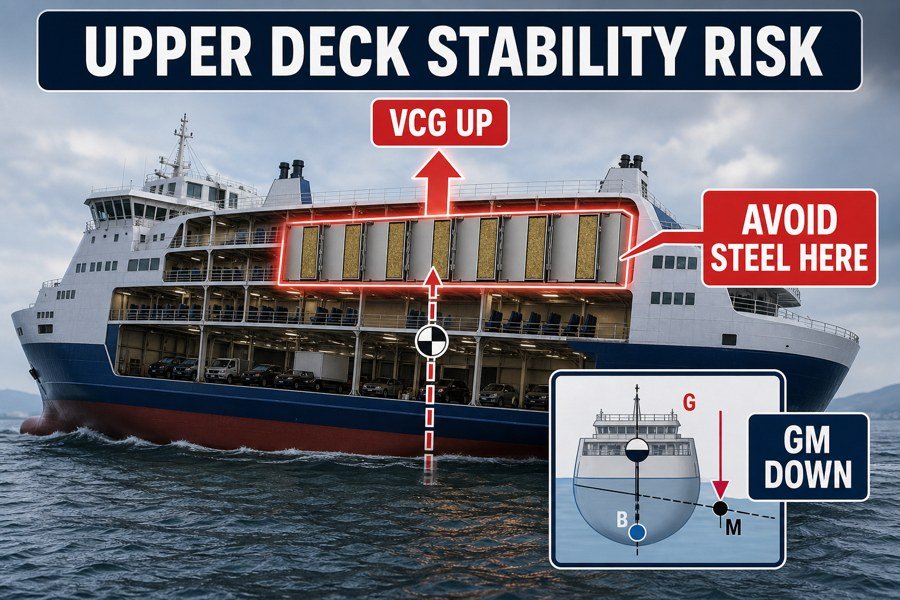
One of the biggest lessons I learned at Magellan Marine is that where you put the panel is just as important as what the panel is made of. The same steel panel that is perfect for the bottom deck can be dangerous on the top deck. Let us examine the technical reasons why top decks demand lighter materials8.
The Relationship Between Panel Weight and Center of Gravity (VCG)
Every ship has a Vertical Center of Gravity, or VCG. Think of holding a heavy box. If you hold it near your waist, you feel balanced. If you hold it over your head, you feel like you might fall over. Ships work the exact same way. Upper-deck accommodations, like the bridge deck or VIP cabins, are high above the water line. If you install thousands of kilograms of heavy steel panels on deck 8 or deck 9, you pull the VCG higher9. A high VCG makes the ship top-heavy. In the sea, a top-heavy ship rolls wildly side to side when hit by waves.
How High Metacentric Height (GM) Determines Ship Stability
Ship engineers use a value called Metacentric Height (GM) to measure stability. A good, safe ship has a positive GM. If the VCG goes too high because of heavy steel walls on the top floors, the GM value drops. If GM becomes zero or negative10, the ship will simply capsize and flip over in the water. For smaller vessels like fast crew boats or small ferries, the GM margins are very tight. On these ships, using steel panels on upper decks is strictly unacceptable. It creates a severe instability risk. This is a common pain point for shipyards, and it is why they specify aluminum to you.
SOLAS Regulations and Weight Enforcement for Passenger Ships
Safety of Life at Sea (SOLAS) regulations are strict laws for shipbuilding. Passenger ferries and offshore living quarters must pass severe tilt and roll tests11. Inspectors will look at the exact weight of your outfitting materials. If the upper decks are too heavy, the ship will fail its safety certification. When a ship fails SOLAS testing, the shipyard must tear out the steel panels and buy aluminum panels anyway. This destroys the project budget and the lead time. As a buyer, you must always check the deck level before ordering steel.
Upper Deck Stability Risk Matrix
| Deck Level | VCG Impact if Using Steel Panels | GM (Stability) Impact | Material Recommendation |
|---|---|---|---|
| Lower Decks (Deck 1-3) | Very Low | Minimal to None | 0.6mm Steel (Cost Effective) |
| Mid Decks (Deck 4-6) | Moderate | Manageable | Steel or Aluminum |
| Upper Decks (Deck 7+) | High | Dangerous Reduction | 0.8mm - 1.0mm Aluminum |
| Superstructure/Bridge | Extreme | Critical Instability | 1.0mm Aluminum Only |
Which Face Sheet Material Balances Rigidity and Weight for Marine Cabin Accommodation Walls?
You want a strong wall but cannot afford the heavy weight. Finding the sweet spot is key to a good cabin. Let us compare the options.
To balance rigidity and weight for marine cabin walls, builders use 0.6mm galvanized steel for high-traffic areas needing maximum impact resistance, and 0.8mm to 1.0mm aluminum for weight-critical zones. Increasing the aluminum thickness provides similar stiffness to thinner steel while still maintaining a lower overall panel weight.
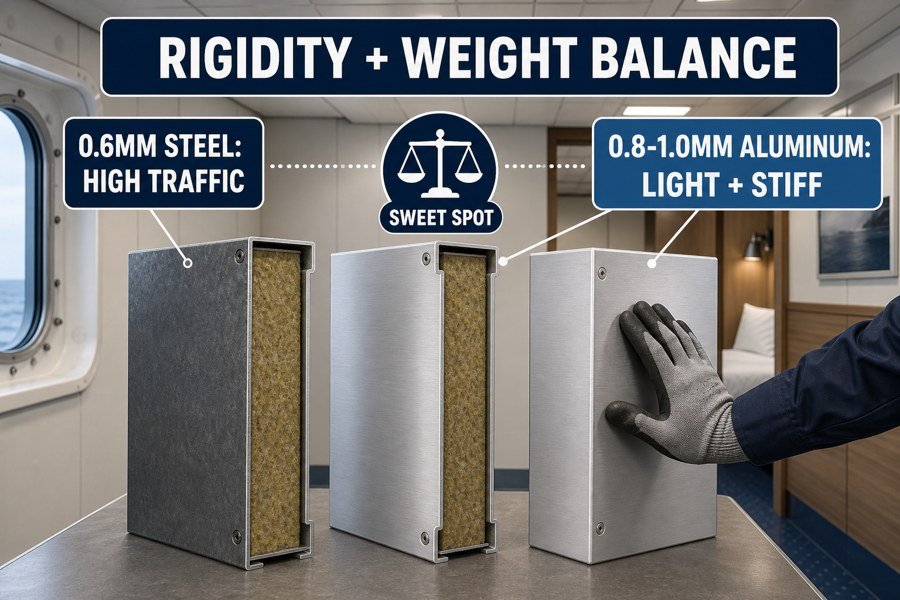
When communicating with shipyards in Europe, you will often hear complaints about aluminum panels denting too easily. Procurement officers want low weight, but the installation workers want strong panels that do not bend when a tool hits them. Here is how we balance the physical strength of these metals.
High-Traffic Durability Using 0.6mm Galvanized Steel Panels
Steel is naturally much stiffer than aluminum. In engineering terms, steel has a Young's modulus of about 200 GPa, while aluminum is only about 69 GPa12. This means a standard 0.6mm steel sheet is very hard to bend or dent. In a ship, public corridors, dining halls, and luggage areas see a lot of abuse. People bump into the walls with heavy bags, and food carts crash into corners. For these high-traffic areas, 0.6mm galvanized steel is the best material. It provides maximum impact resistance. Even though it is heavy, you must use it here because thin aluminum would get ruined in weeks, and the shipyard would complain about poor quality.
Achieving Required Stiffness with 0.8mm to 1.0mm Aluminum Panels
Inside the actual cabins where passengers sleep, the walls do not get hit as hard. This is the perfect weight-critical zone. However, if you use a 0.6mm aluminum sheet, the panel feels soft. If you press it with your hand, the wall might flex. To solve this and balance rigidity with weight, factories increase the thickness of the aluminum13. We use 0.8mm or 1.0mm aluminum sheets instead. A 1.0mm aluminum sheet provides stiffness that feels very similar to a 0.6mm steel sheet14 to the person leaning on it.
Even though we use thicker aluminum, it is still much lighter than steel. A 1.0mm aluminum sheet weighs 2.7 kg/m². That is still 2.0 kg lighter than the 4.71 kg/m² steel sheet.15 This is the exact secret to balancing the two needs. You get the strong, flat wall the shipyard wants, and you get the low weight the naval architect demands.
Face Sheet Material Balance Guide
| Material and Thickness | Relative Rigidity (Stiffness) | Weight (Single Sheet) | Best Application Area |
|---|---|---|---|
| 0.6mm Galvanized Steel | Excellent (Hard to dent) | 4.71 kg/m² | Corridors, Galleys, High-Traffic |
| 0.6mm Aluminum | Poor (Flexes easily) | 1.62 kg/m² | Rarely used, too soft |
| 0.8mm Aluminum | Good (Standard feel) | 2.16 kg/m² | Standard Cabins, Washrooms |
| 1.0mm Aluminum | Very Good (Feels like steel) | 2.70 kg/m² | Premium Cabins, Upper Lounges |
How Does Steel-Faced Marine Accommodation Panel Weight Affect Ceiling Suspension Grid Loading?
Ceilings falling down is a nightmare. Heavy steel ceilings put huge stress on the support grid. Learn how to design a safe ceiling.
Steel-faced panel weight drastically increases ceiling suspension grid loading, requiring a denser grid layout, thicker steel hanger profiles, stronger deck welding brackets, and more frequent support points. If not properly supported, the 14 to 16 kg/m² load can cause the ceiling grid to sag, fail, or rattle under vibration.
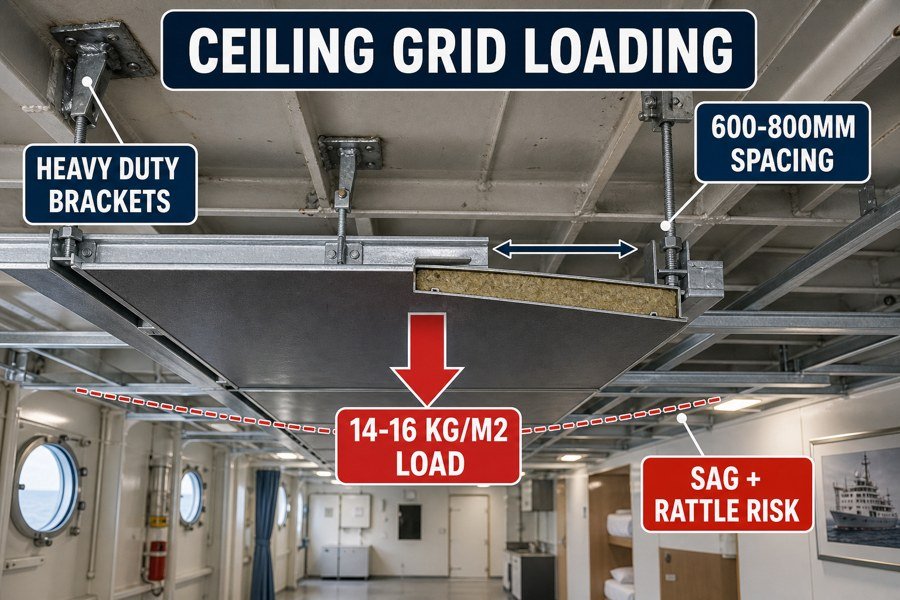
Many buyers focus entirely on the wall panels and forget about the ceiling. I have seen projects delayed because the installation team realized too late that the steel ceiling was too heavy for the standard support grid. The weight of the ceiling changes the whole support structure you need to buy.
Denser Grid Layouts and Thicker Hanger Profiles for Steel Ceilings
A marine ceiling does not touch the floor. It hangs in the air, attached to the steel ship deck above it. We use a suspension grid made of Z-profiles and C-profiles to hold the panels. A standard steel-faced ceiling panel weighs about 14.0 to 16.0 kg/m². This is a massive dead load pulling down on the metal profiles. To stop the grid from breaking, you must use a denser grid layout. For light aluminum ceilings (which weigh about 8.0 to 10.0 kg/m²), you can space the main support hangers 1200mm apart. But for heavy steel ceilings, the hangers must be spaced every 600mm or 800mm16. You also must buy thicker steel hanger profiles, which increases your material cost.
Welding Bracket Strength and Support Point Frequency Requirements
Every hanger must be welded to the ship's steel structure. Because heavy steel panels need more hangers, the shipyard workers must do twice as much welding. This hurts the lead time and increases labor costs. The welding brackets themselves must be rated for higher shear strength.17 If a shipyard uses small brackets designed for an aluminum ceiling to hold a steel ceiling, the brackets can snap. As a procurement officer, you need to buy the heavy-duty bracket kits if you buy steel ceiling panels.
Preventing Grid Sag and Vibration Under Heavy Panel Loads
Ships vibrate constantly from the main engines and propellers. If a heavy 16 kg/m² steel ceiling is not supported by frequent, tight points, the metal profiles will bend downward over time. This is called sagging. Once the grid sags, the panel joints open up. Worse, a heavy ceiling on a weak grid will rattle loudly when the ship moves, making the cabin noisy and uncomfortable. Using the correct, denser suspension grid prevents this failure and keeps the ceiling safe and quiet.
Ceiling Grid Support Requirements Based on Panel Weight
| Ceiling Panel Material | Average Panel Weight | Required Hanger Spacing | Bracket Strength Need | Vibration Risk if Unsupported |
|---|---|---|---|---|
| Aluminum Ceiling | 8.0 - 10.0 kg/m² | Every 1200mm | Standard Duty | Low |
| Steel Ceiling | 14.0 - 16.0 kg/m² | Every 600mm - 800mm | Heavy Duty | High (Sagging/Rattling) |
Conclusion
Choosing between steel and aluminum panels comes down to balancing weight, cost, and stability. Always calculate lightship limits and grid loading to ensure a safe, profitable marine outfitting project.
-
"[PDF] Chapter 9 1. Locate the centroid (x, ӯ) of the area. 2. The steel plate ...", https://info.montgomerycollege.edu/_documents/faculty/chou/enes102/hw5.pdf. A materials reference or engineering handbook gives the density of carbon/galvanized steel as approximately 7,850 kg/m³, supporting the mass-per-area calculation for 0.6 mm steel sheet. Evidence role: definition; source type: education. Supports: Standard galvanized steel has a density of about 7850 kg/m³. ↩
-
"[PDF] 6A × 40s = 1.2 × 10 So the number of electrons is", http://users.physics.ucsd.edu/2012/Spring/physics1b/Sol_Chap_21.pdf. Materials references list aluminum and common aluminum alloys at roughly 2,700 kg/m³, supporting the use of this density for estimating aluminum face-sheet mass. Evidence role: definition; source type: education. Supports: Marine-grade aluminum has an approximate density of 2700 kg/m³. Scope note: Exact density varies slightly by alloy and temper, so the value is appropriate for engineering estimation rather than alloy-specific certification. ↩
-
"Intermodal container - Wikipedia", https://en.wikipedia.org/wiki/Intermodal_container. International container specifications and carrier guidance define maximum gross mass and payload limits for 40-foot freight containers, supporting the statement that panel loading can be constrained by container weight rather than volume alone. Evidence role: general_support; source type: institution. Supports: A 40-foot shipping container is subject to maximum weight limits that can affect how many panels can be shipped. Scope note: Actual allowable payload depends on container rating, tare weight, route rules, and carrier limits, so the source supports the existence of strict limits rather than a single universal payload figure. ↩
-
"[PDF] COURSE OBJECTIVES CHAPTER 3 - USNA", https://www.usna.edu/NAOE/_files/documents/Courses/EN400/02.03%20Chapter%203.pdf. A naval-architecture reference defines lightweight or lightship displacement as the weight of the completed vessel excluding cargo, fuel, passengers, stores, and other variable loads. Evidence role: definition; source type: encyclopedia. Supports: The ship’s total base weight is called the lightship weight. ↩
-
"Deadweight tonnage - Wikipedia", https://en.wikipedia.org/wiki/Deadweight_tonnage. Standard naval-architecture definitions describe deadweight as the carrying capacity equal to the difference between a vessel’s loaded displacement and its lightweight displacement. Evidence role: definition; source type: institution. Supports: If lightship weight increases, the remaining usable carrying capacity, or deadweight, decreases. Scope note: This supports the general weight relationship; the exact payload impact depends on vessel class, loading condition, and regulatory limits. ↩
-
"[PDF] Chapter 7 Resistance and Powering of Ships - USNA", https://www.usna.edu/NAOE/_files/documents/Courses/EN400/02.07%20Chapter%207.pdf. Ship-resistance literature explains that greater displacement and draft generally increase wetted surface area and resistance, which can raise required propulsive power at a given speed. Evidence role: mechanism; source type: education. Supports: A heavier ship sitting deeper in the water can experience increased resistance and require more power. Scope note: The magnitude of the effect is hull-form and speed dependent; the source would support the mechanism rather than a fixed fuel penalty for every vessel. ↩
-
"Weight Design Margins in Naval Ship Design — A Rational Approach", https://www.academia.edu/26650567/Weight_Design_Margins_in_Naval_Ship_Design_A_Rational_Approach. Ship weight-control guidance describes the use of weight estimates, margins, and weight budgets during design, noting that increases in one system often require compensating reductions or design changes elsewhere to meet stability, draft, and capacity requirements. Evidence role: expert_consensus; source type: institution. Supports: When lightship weight exceeds targets, naval architects may need to adjust other allowances or redesign aspects of the vessel. Scope note: This supports the general design-control practice; it may not prove that SNAME has a binding rule requiring any specific compensation measure. ↩
-
"(PDF) Aluminum at Sea - Academia.edu", https://www.academia.edu/42717557/Aluminum_at_Sea. Materials and naval-architecture references document that aluminum alloys have substantially lower density than steel and are commonly used where reducing upper-structure weight is important, providing contextual support for the use of lighter materials on higher decks. Evidence role: general_support; source type: research. Supports: Top-deck structures often benefit from lighter materials because reducing weight high in the vessel helps control topweight and stability effects. Scope note: This supports the rationale for lightweight upper-deck construction generally, but it does not prove that aluminum is mandatory for every vessel or deck arrangement. ↩
-
"[PDF] COURSE OBJECTIVES CHAPTER 4 4. STABILITY - USNA", https://www.usna.edu/NAOE/_files/documents/Courses/EN400/02.04%20Chapter%204.pdf. A naval-architecture stability source explains that adding weight above a vessel’s existing vertical center of gravity raises KG/VCG, supporting the stated mechanism by which heavy upper-deck outfitting increases topweight. Evidence role: mechanism; source type: education. Supports: Installing heavy panels high in the vessel raises the ship’s vertical center of gravity. Scope note: This supports the stability principle generally, but not the specific deck numbers or panel masses used in the article. ↩
-
"[PDF] COURSE OBJECTIVES CHAPTER 4 4. STABILITY - USNA", https://www.usna.edu/NAOE/_files/documents/Courses/EN400/02.04%20Chapter%204.pdf. Standard ship-stability references define positive metacentric height as a condition of initial stability and describe zero or negative GM as indicating neutral or unstable equilibrium, supporting the claim that loss of GM can lead to capsizing risk. Evidence role: definition; source type: encyclopedia. Supports: A zero or negative metacentric height indicates loss of initial stability and potential capsize risk. Scope note: GM is an initial-stability measure; actual capsize depends on hull form, loading, free-surface effects, waves, and other dynamic conditions. ↩
-
"[PDF] Electronic Version for Distribution via the WWW. - ROSA P", https://rosap.ntl.bts.gov/view/dot/64012/dot_64012_DS1.pdf. IMO and flag-state stability rules require passenger ships to satisfy intact-stability criteria and generally undergo an inclining experiment or equivalent stability verification, supporting the article’s claim that passenger vessels are subject to formal stability testing before certification. Evidence role: expert_consensus; source type: institution. Supports: Passenger vessels must meet formal stability verification requirements as part of safety certification. Scope note: The source may refer specifically to inclining experiments and stability criteria rather than using the article’s informal phrase “severe tilt and roll tests.” ↩
-
"6061 aluminium alloy - Wikipedia", https://en.wikipedia.org/wiki/6061_aluminium_alloy. A materials-property reference lists typical Young’s modulus values for steels near 200 GPa and for aluminum alloys near 69–70 GPa, supporting the comparison of elastic stiffness between the two metals. Evidence role: definition; source type: encyclopedia. Supports: Steel has a Young’s modulus of about 200 GPa, while aluminum is about 69 GPa. Scope note: Exact values vary by alloy, temper, and test conditions, so the figures should be treated as typical engineering values rather than constants for every grade. ↩
-
"[PDF] A STUDY OF LARGE DEFLECTION OF BEAMS AND PLATES", https://rucore.libraries.rutgers.edu/rutgers-lib/31143/PDF/1/play/. A mechanics-of-materials source on plate or beam bending states that flexural rigidity increases with elastic modulus and the cube of thickness, providing the mechanical basis for using thicker aluminum sheets to compensate for aluminum’s lower modulus. Evidence role: mechanism; source type: education. Supports: Increasing aluminum sheet thickness can improve panel rigidity and offset some of aluminum’s lower stiffness compared with steel. Scope note: This supports the stiffness mechanism in simplified bending; actual wall-panel feel also depends on panel geometry, backing, adhesives, corrugation, and boundary conditions. ↩
-
"[PDF] Lehigh Preserve Institutional Repository", https://preserve.lehigh.edu/_flysystem/fedora/2024-01/320734.pdf. Using the standard flexural-rigidity relation for a flat plate, bending stiffness scales approximately with E·t³, which gives comparable order-of-magnitude stiffness for 0.6 mm steel and 0.8–1.0 mm aluminum sheets when typical moduli are used. Evidence role: mechanism; source type: education. Supports: A thicker aluminum sheet can have bending stiffness in the same range as a thinner steel sheet. Scope note: The source would support a simplified stiffness comparison, not the subjective statement that the panel 'feels' the same in a finished ship interior. ↩
-
"Aluminium - Wikipedia", https://en.wikipedia.org/wiki/Aluminium. Standard density values for aluminum of about 2,700 kg/m³ and steel of about 7,850 kg/m³ support the mass-per-area calculations of roughly 2.7 kg/m² for 1.0 mm aluminum and 4.71 kg/m² for 0.6 mm steel. Evidence role: statistic; source type: encyclopedia. Supports: A 1.0 mm aluminum sheet weighs about 2.7 kg/m², while a 0.6 mm steel sheet weighs about 4.71 kg/m². Scope note: Actual sheet weights vary with alloy composition, galvanizing thickness, coatings, and manufacturing tolerances. ↩
-
"[PDF] IR 25-2: Suspended Lay-In Panel Ceiling: 2019 CBC - DGS.ca.gov", https://www.dgs.ca.gov/-/media/Divisions/DSA/Publications/interpretations_of_regs/IR_25-2-19.pdf. An installation standard or technical manual should support that heavier suspended marine ceiling systems require closer hanger spacing, with 600–800 mm spacing documented for certain steel ceiling configurations. Evidence role: general_support; source type: institution. Supports: Heavy steel marine ceilings may require hanger spacing of 600 mm to 800 mm rather than wider spacing. Scope note: Hanger spacing is system-specific and depends on panel mass, profile dimensions, fire rating, vibration criteria, and class or yard requirements; a cited source may not make this spacing universally applicable. ↩
-
"[PDF] Construction Requirements for Suspended Ceiling Systems", https://www.grantspassoregon.gov/DocumentCenter/View/600. A structural engineering or classification-society source should establish that welded support brackets must be designed for the shear and dead-load forces imposed by suspended equipment or outfitting components. Evidence role: mechanism; source type: institution. Supports: Welded ceiling support brackets for heavier panels must be rated for higher shear loads. Scope note: Such evidence supports the engineering principle of load-rated welded brackets, but the exact bracket rating must be calculated for the specific ceiling system and vessel arrangement. ↩