
Wavy cabin walls make high-end marine interiors look cheap. If your current panels warp during installation, you risk project delays. Steel face sheets offer the ultimate structural fix.
Steel face sheets improve marine panel rigidity and flatness by providing high tensile strength, superior yield limits, and thermal stability. These factors prevent buckling during installation, resist impact damage in busy ship corridors, and maintain a perfectly smooth surface under changing maritime temperatures and structural ship flex.
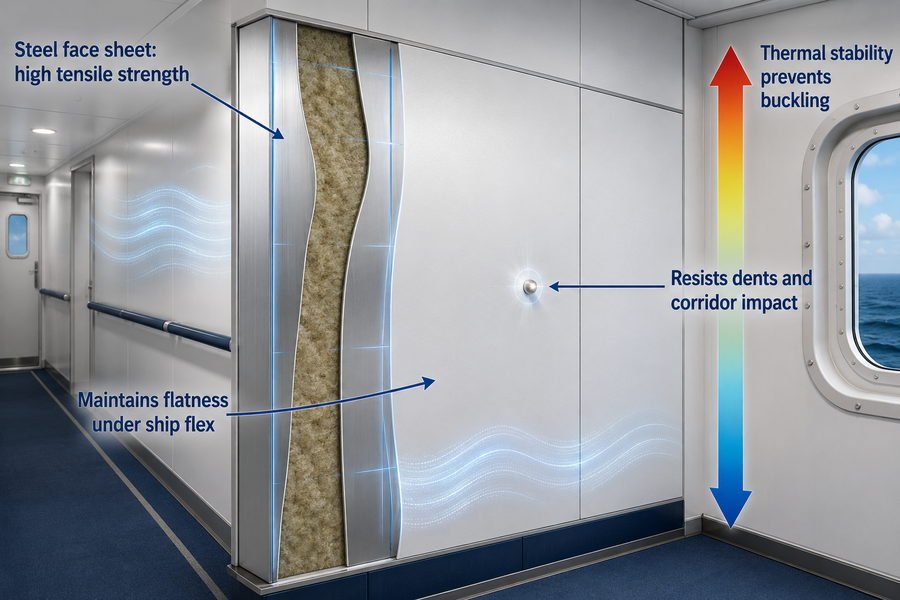
Let me show you how this material choice affects your daily outfitting projects, speeds up your installation time, and saves you from costly rework and shipyard rejections.
Why Are Steel-Faced Marine Accommodation Panels Flatter Than Aluminum-Faced Marine Accommodation Panels?
Do aluminum panels look bent after you mount them? This common problem causes shipyard inspectors to reject your work. Steel faces solve this through basic physics.
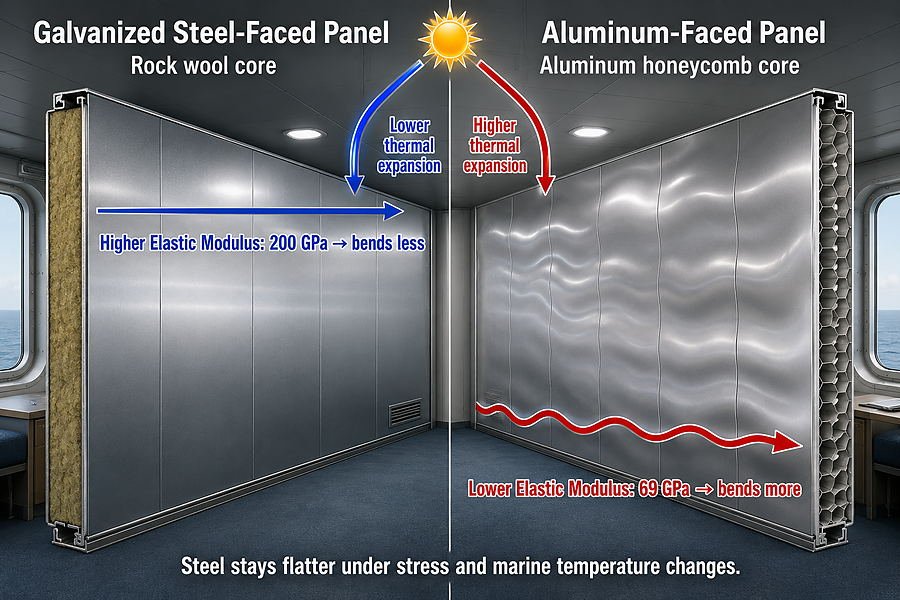
Steel-faced panels are flatter than aluminum because galvanized steel has a higher modulus of elasticity (200 GPa vs 69 GPa) and a lower coefficient of thermal expansion. This means steel bends less under mechanical stress and expands less when temperatures change in marine environments.
Elasticity Modulus Impact on Panel Bending
The biggest reason steel stays flatter is its high stiffness. In engineering terms, we look at the Young's Modulus. Galvanized steel has a modulus of roughly 200 GPa, while aluminum is only about 69 GPa1, according to ASM Material Data. This means steel is nearly three times stiffer. When installing bulkheads, workers push and force the panels into the floor tracks. Aluminum easily bows under this pressure, leaving a permanent wave. Steel stays rigid. I remember a project where we bought cheaper aluminum panels from a local factory to save money. The workers deformed 15% of them just by carrying and installing them. We had to order replacements, which ruined our lead time. Steel faces stop this handling damage completely.
Thermal Expansion Effects on Cabin Walls
Thermal expansion is the second reason steel is flatter. The linear thermal expansion coefficient of aluminum is roughly 23 µm/(m·K), while galvanized steel is about 12 µm/(m·K), according to the Engineering ToolBox. When a ship sails from a cold port to a hot climate, the steel panels expand half as much as aluminum. If a panel expands too much, it pushes against the metal frame and buckles outward.2 This causes a very obvious "wavy" look on the wall. Shipyards in Europe will not accept this finish. By using steel, you limit this expansion and keep the walls perfectly straight.
| Material Feature | Galvanized Steel Face | Aluminum Face | Impact on Flatness |
|---|---|---|---|
| Young's Modulus | ~200 GPa | ~69 GPa | Steel resists bending during installation better. |
| Thermal Expansion | ~12 µm/(m·K) | ~23 µm/(m·K) | Steel expands less in heat, preventing buckling. |
| Handling Damage | Low Risk | High Risk | Steel stays flat even with rough worker handling. |
What Span Limits Apply to Steel-Faced Marine Accommodation Ceiling Panels?
Sagging ceilings are a major safety hazard and look terrible. If you guess the span limits, the ceiling will eventually drop. Knowing the exact limits is vital.
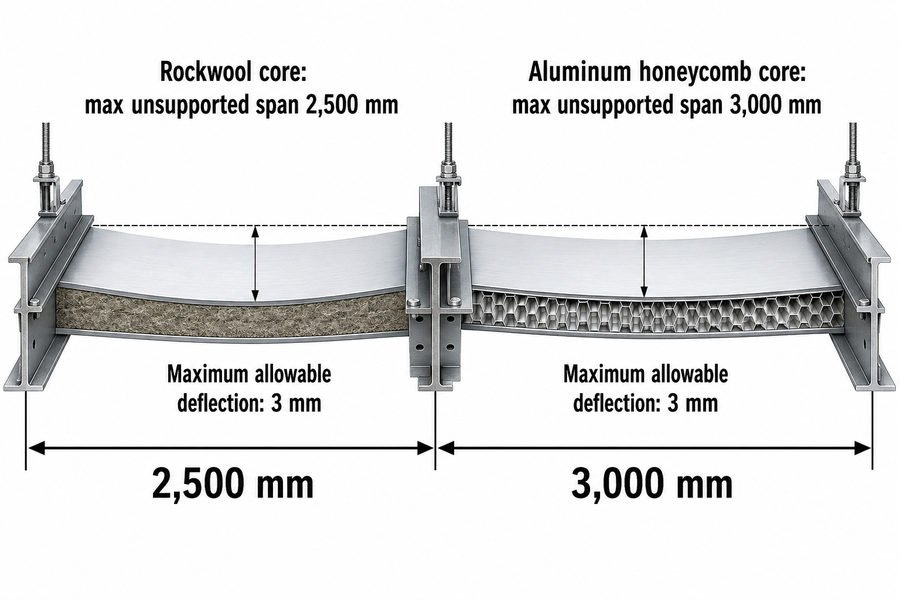
Steel-faced marine accommodation ceiling panels generally have a maximum unsupported span limit of 2,500 mm to 3,000 mm depending on the core material. Panels with rockwool cores support shorter spans, while aluminum honeycomb cores allow longer spans before sagging exceeds the maximum allowable deflection of 3 mm.
Span Limits for Rockwool Core Marine Ceilings
For standard 50 mm thick A-Class fire-rated ceiling panels with a rockwool core, the safe span limit is usually between 2,000 mm and 2,500 mm. The rockwool core is heavy, typically with a density of 120 to 150 kg/m³3. This heavy core pulls the panel down. If you span it over 2,500 mm without a support beam, the center will sag more than 3 mm. According to general marine outfitting standards like ISO 834, visual deflection should not be noticeable to the eye. I always tell my clients to use support hangers every 2,000 mm for heavy A-60 rockwool ceilings to be completely safe. This prevents any long-term dropping.
Span Limits for Honeycomb Core Marine Ceilings
When you use a lightweight aluminum honeycomb core with 0.6 mm galvanized steel face sheets, the span limit increases significantly. These panels can safely span up to 3,000 mm without sagging. The honeycomb structure gives high shear strength but weighs much less4 than rockwool. This is why we use them for large public spaces on ships. You save money on your installation because you need fewer ceiling hanger profiles and less labor. Even at 3,000 mm, the strong steel faces keep the whole panel straight and secure.
| Core Material | Density | Max Safe Span | Common Application Area |
|---|---|---|---|
| Rockwool (A-Class) | 120 - 150 kg/m³ | 2,000 - 2,500 mm | Cabins, Corridors, Galleys |
| Aluminum Honeycomb | 20 - 30 kg/m³ | 3,000 mm | Public Rooms, Large Lounges |
What Steel Sheet Rolling Tolerance Is Acceptable for Visible Marine Accommodation Panels?
Surface bumps ruin the finish of high-end ship interiors. If you buy panels with bad steel sheets, applying PVC film will only make the bumps worse.
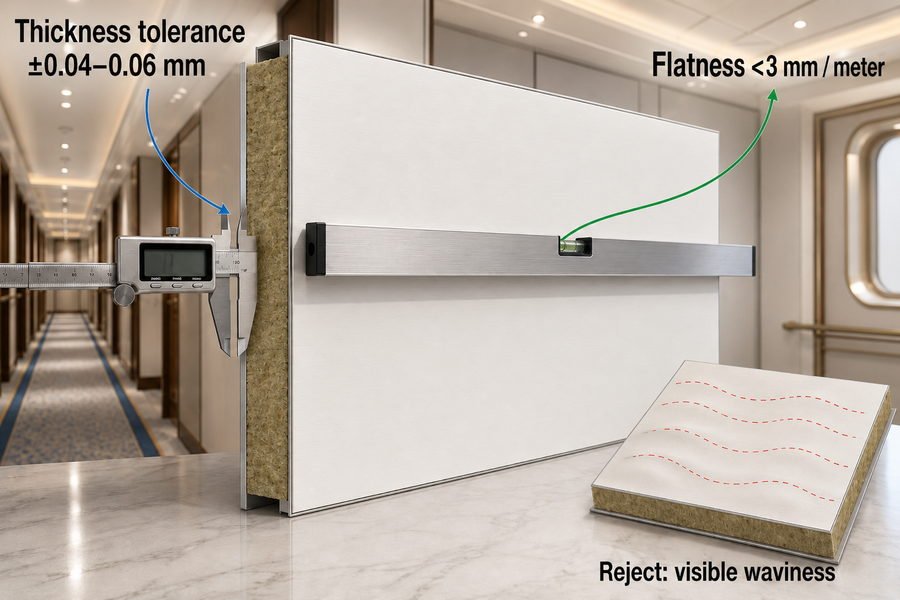
The acceptable steel sheet rolling tolerance for visible marine accommodation panels is typically ±0.04 mm to ±0.06 mm in thickness, and a flatness tolerance of less than 3 mm per meter. Strict tolerances ensure no visible waves or ripples appear under decorative PVC or PET finishes.
Thickness Tolerance for Marine Steel Sheets
For a standard 0.6 mm galvanized steel sheet used in marine bulkheads, the thickness tolerance must be tightly controlled. The industry standard, such as EN 10143 for galvanized steel, requires special or tight tolerances. This is usually ±0.04 mm to ±0.06 mm. If the thickness changes too much across the sheet, the pressure during the factory lamination process will be uneven. This causes weak spots in the glue. Later, the steel skin might peel off the rockwool core.5 To get high-quality panels at a good price, you must ensure the Asian supplier uses steel coils that meet these strict thickness rules.
Flatness Tolerance for Decorative Marine Panels
Flatness tolerance is even more critical for visible panels. It should be less than 3 mm of deviation per 1,000 mm length. When you apply a glossy or solid-color PVC film to the steel face, every tiny wave becomes easy to see under the bright cabin lights. Ship owners hate this because it looks cheap. I once visited a factory that used cheap steel coils with a 5 mm per meter flatness tolerance. The final panels looked terrible, and the buyer rejected the whole batch. You must ask your supplier for their steel coil inspection reports before you buy.
| Tolerance Type | Standard Acceptable Range | Result of Poor Tolerance |
|---|---|---|
| Thickness Tolerance | ±0.04 mm to ±0.06 mm | Uneven glue pressure, delamination risk. |
| Flatness Deviation | < 3 mm per 1,000 mm | Visible ripples under PVC films. |
How Does Core-to-Steel-Face Bonding Affect Marine Accommodation Panel Stiffness?
Even thick steel faces will fail if the glue fails. Panel delamination destroys your reputation with shipyards. You need perfect bonding to maintain true stiffness.
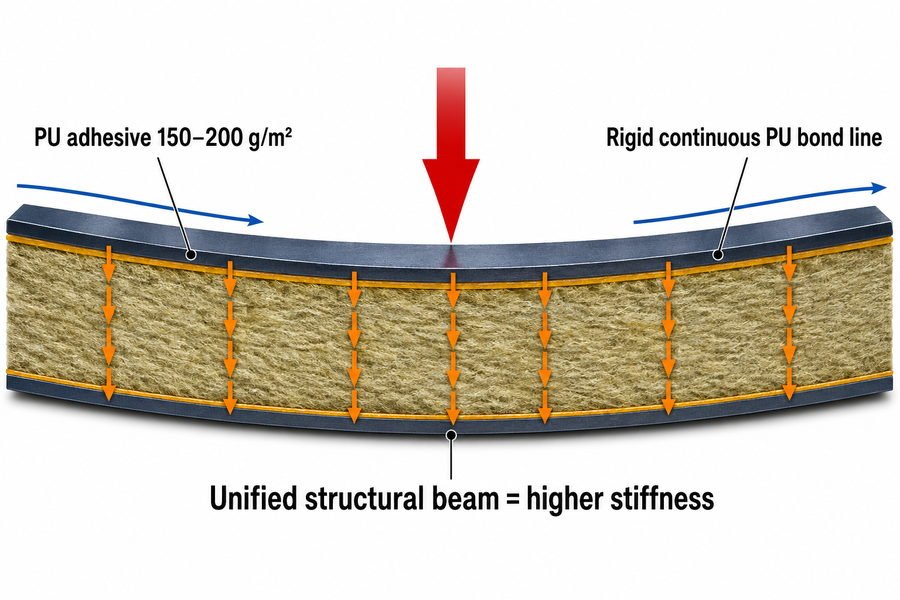
Core-to-steel-face bonding affects marine panel stiffness through two key factors: adhesive type and application weight. Two-part polyurethane (PU) adhesives applied at 150-200 g/m² create a rigid, continuous bond line that transfers stress between the steel skins, creating a unified structural beam that resists bending.
Polyurethane Adhesive Impact on Structural Integrity
A panel works exactly like a steel I-beam. The steel sheets act as the flanges, and the core acts as the web.6 If the bond between them is weak, the steel sheets will slide over the core when you bend the panel. This destroys the stiffness. We must use a two-part Polyurethane (PU) adhesive. According to marine testing laboratories, PU adhesive provides high shear strength and handles high temperatures without melting. If the factory uses cheap water-based glue or hot melt, the steel will eventually separate from the core, making the panel soft and weak.
Adhesive Application Weight and Bond Continuity
The amount of glue matters just as much as the type. The standard application rate for marine panels is 150 to 200 grams per square meter (g/m²).7 If the factory uses less than 150 g/m² to save money, there will be dry spots inside the panel. These dry spots have zero stiffness. During normal ship vibration, these spots will pop and bulge outward. I always check the glue spread rate machine when I audit factories. It is a hidden detail that makes a huge difference in overall panel rigidity and stops the panels from warping over time.
| Bonding Factor | Standard Requirement | Risk if Ignored |
|---|---|---|
| Adhesive Type | Two-part Polyurethane (PU) | Low heat resistance, steel separation. |
| Application Weight | 150 to 200 g/m² | Dry spots, panel bulging, loss of stiffness. |
| Application Method | Automated Even Spreading | Weak areas where glue is missing. |
Which Face Sheet Material Maintains Flatness in Long Marine Accommodation Corridors?
Long ship corridors easily show wavy walls. Using the wrong material here highlights every flaw to the passengers. You must choose the right metal skin.
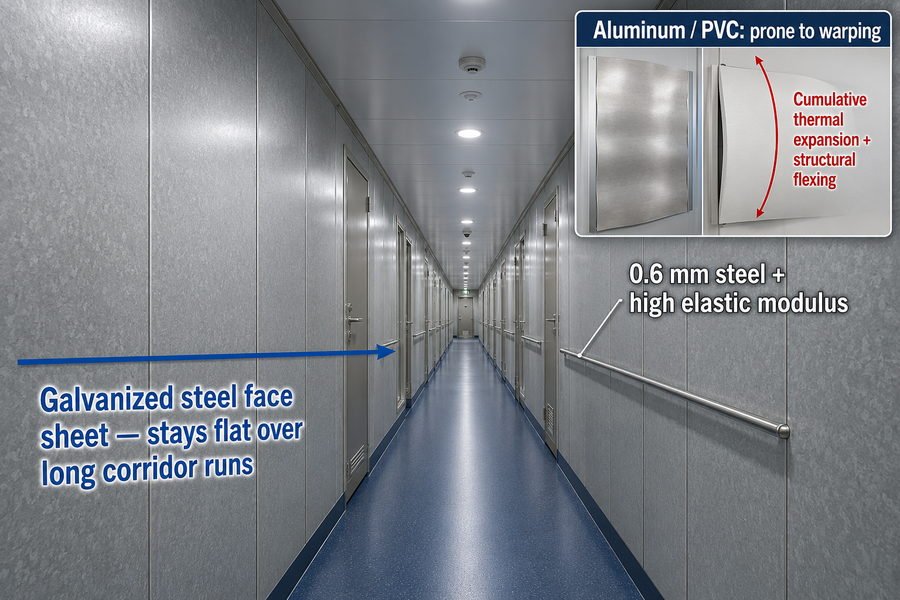
Galvanized steel is the best face sheet material to maintain flatness in long marine accommodation corridors. Its high elastic modulus, combined with a standard 0.6 mm thickness, resists the cumulative thermal expansion and structural flexing that cause aluminum or PVC composite panels to warp over long distances.
Overcoming Structural Flex in Long Corridors
A long ship corridor is the hardest place to keep panels flat. A corridor can easily be 50 meters long. As the ship moves on the sea, the heavy steel hull bends and twists. This flex transfers directly into the accommodation panels. If you use 0.6 mm aluminum or plastic face sheets, they will bend and warp under this stress. Galvanized steel, with its 200 GPa elastic modulus, absorbs this stress while staying flat. The large European shipyards I work with always specify steel for corridor bulkheads for this exact reason. It handles the movement of the ship better than anything else.
Managing Cumulative Thermal Expansion
Long corridors also face cumulative thermal expansion. Even small temperature changes add up over a 50-meter distance. Since aluminum expands twice as much as steel (23 µm/(m·K) vs 12 µm/(m·K))8, an aluminum wall system will push heavily against its expansion joints. If the joints max out, the panels have nowhere to go and buckle outward. PVC composite panels are even worse. Galvanized steel panels expand much less. This keeps the long corridor wall looking like one continuous, flat surface, no matter where the ship sails or how hot it gets.
| Face Sheet Material | Elastic Modulus | Thermal Expansion Risk | Suitability for Long Corridors |
|---|---|---|---|
| Galvanized Steel | High (200 GPa) | Low | Excellent - Stays flat over distance. |
| Aluminum | Low (69 GPa) | High | Poor - High risk of buckling. |
| PVC Composite | Very Low | Very High | Unacceptable - Warps easily. |
Why Do Large-Format Marine Accommodation Ceiling Panels Require Steel Face Sheets?
Oversized ceiling panels save installation time but often bow under their own weight. If they drop in the middle, the room looks unsafe. Steel faces fix this.
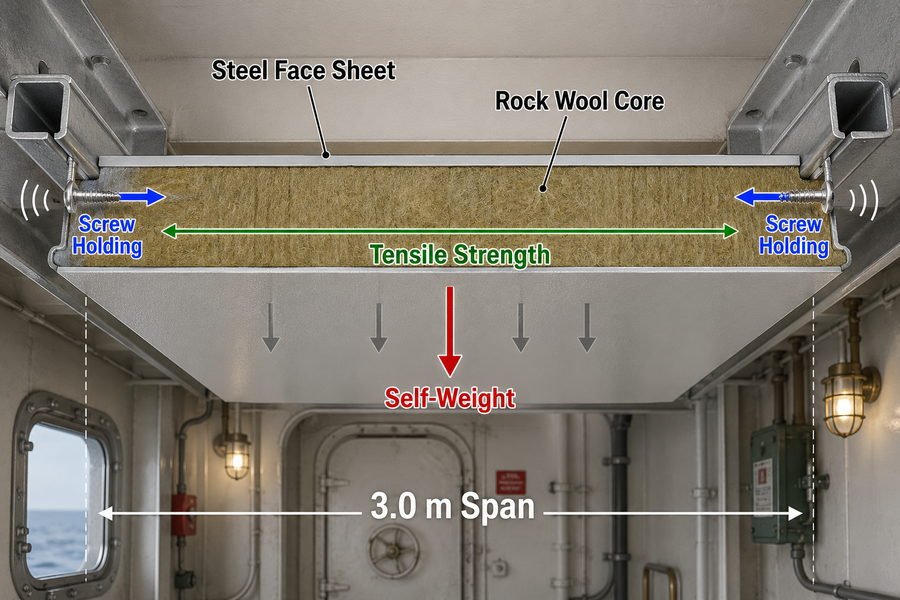
Large-format marine accommodation ceiling panels require steel face sheets because steel provides the necessary tensile strength to resist self-weight deflection across spans up to 3 meters. Additionally, steel firmly holds self-tapping screws and mounting profiles, which prevents heavy panels from tearing loose during intense ship vibrations.
Deflection Resistance in Oversized Panels
Large-format ceiling panels are usually longer than 2,400 mm, sometimes reaching up to 3,000 mm. When a panel is this big, its own weight becomes a big problem. A standard 50 mm rockwool panel weighs about 15 kg/m² to 18 kg/m². Without a very stiff face sheet, the center of this large panel will sag. The high tensile strength of steel, which has around a 250 MPa yield strength9, keeps the bottom skin tight. This tension stops the panel from bending downward. Aluminum simply does not have enough tensile strength to hold large, heavy panels flat over a long period.
Secure Fastening Under Vibration Stress
Large panels also need much stronger connections. When you mount these big panels, you use self-tapping screws to attach them to the metal ceiling grid. A ship engine creates constant, heavy vibrations. Steel face sheets grip screw threads very tightly. Aluminum is soft, and screws can pull out if the vibration is strong10. I have seen aluminum ceilings rattle loose after just one year at sea. Steel faces ensure your large-format panels stay safely locked in place, meeting the strict safety demands of international classification societies without failing.
| Material Characteristic | Galvanized Steel Face | Aluminum Face |
|---|---|---|
| Yield Strength | ~250 MPa | ~145 MPa (varies by alloy) |
| Screw Holding Power | Excellent (threads hold tight) | Poor (threads strip easily) |
| Deflection on 3m Span | Minimal (meets 3mm standard) | High (visibly sags) |
Conclusion
Steel face sheets are essential for marine panel rigidity. They prevent warping, handle wide spans safely, secure fasteners tightly, and deliver the premium flat finish that top European shipyards demand.
-
"Aluminium - Wikipedia", https://en.wikipedia.org/wiki/Aluminium. Materials-property references commonly list Young’s modulus for carbon or structural steels near 200 GPa and for aluminum alloys near 69–70 GPa, supporting the comparison that steel is about three times stiffer in elastic bending. Evidence role: general_support; source type: education. Supports: Galvanized steel has a modulus of roughly 200 GPa, while aluminum is only about 69 GPa.. Scope note: Exact modulus values vary by alloy, temper, and test method; galvanizing is a surface coating and does not by itself define the bulk modulus of the steel sheet. ↩
-
"[PDF] Thermal buckling and postbuckling of columns accounting for ...", https://web.mst.edu/vbirman/papers/ThermalBuckling_2022.pdf. Engineering treatments of thermal buckling explain that restrained thermal expansion can create compressive stresses in plates or panels; when those stresses exceed a critical level, the panel may buckle out of plane. Evidence role: mechanism; source type: education. Supports: A panel that expands against a constraining frame can develop compressive stress and buckle outward.. Scope note: This supports the general structural mechanism of restrained thermal expansion and plate buckling, not a direct measurement of buckling in the specific ship-cabin wall system described. ↩
-
"[PDF] Comparative Testing of Thermal Conductivity for Thermal Insulation ...", https://docs.lib.purdue.edu/cgi/viewcontent.cgi?article=1013&context=thermal. Mineral wool product data and technical references commonly report high-density rock/mineral wool boards in roughly the 100–160 kg/m³ range, supporting the stated order of magnitude for dense rockwool cores used in fire-rated panels. Evidence role: general_support; source type: institution. Supports: The rockwool core is heavy, typically with a density of 120 to 150 kg/m³.. Scope note: This supports the material-density range generally, not the specific density of every marine ceiling panel or supplier configuration. ↩
-
"[PDF] Sandwich Constructions - USNA", https://www.usna.edu/Users/mecheng/pjoyce/composites/Short_Course_2003/13_PAX_Short_Course_Sandwich-Constructions.pdf. Engineering literature on honeycomb sandwich panels describes honeycomb cores as providing high stiffness and shear performance at low mass because the core separates the face sheets while adding relatively little weight. Evidence role: mechanism; source type: paper. Supports: The honeycomb structure gives high shear strength but weighs much less than rockwool.. Scope note: This supports the mechanical rationale for lightweight honeycomb panels, but it does not directly prove the article’s specific 3,000 mm allowable marine-ceiling span. ↩
-
"Towards Reliable Adhesive Bonding: A Comprehensive Review of ...", https://pmc.ncbi.nlm.nih.gov/articles/PMC12195023/. Research on bonded sandwich panels reports that manufacturing defects such as nonuniform adhesive bondlines, inadequate contact pressure, voids, or weak skin-core adhesion can reduce bond strength and promote debonding or delamination under service loads. Evidence role: mechanism; source type: paper. Supports: Uneven lamination pressure from sheet-thickness variation can create weak adhesive areas that increase the risk of steel-skin peeling from the rockwool core.. Scope note: This evidence supports the general bonding mechanism; it may not directly test galvanized-steel/rockwool marine bulkhead panels made with the same adhesive system. ↩
-
"[PDF] Sandwich Constructions - USNA", https://www.usna.edu/Users/mecheng/pjoyce/composites/Short_Course_2003/13_PAX_Short_Course_Sandwich-Constructions.pdf. Structural descriptions of sandwich panels explain that the face sheets carry tensile and compressive bending stresses while the core carries shear and maintains separation between the faces, an arrangement commonly compared with an I-beam. Evidence role: mechanism; source type: education. Supports: The steel sheets function like I-beam flanges and the core functions like the web in resisting bending.. Scope note: The source may support the general sandwich-panel mechanics rather than the specific steel-and-core panel configuration discussed here. ↩
-
"[PDF] ssc-403 design guide for marine applications of composites - ROSA P", https://rosap.ntl.bts.gov/view/dot/40834/dot_40834_DS1.pdf. A marine-composite or adhesive-bonding standard, classification-society rule, or peer-reviewed manufacturing reference should document whether adhesive spread rates in the 150–200 g/m² range are specified or commonly used for bonded marine panels. Evidence role: statistic; source type: institution. Supports: Marine panels have a standard adhesive application rate of 150 to 200 g/m².. Scope note: If the source is a manufacturer data sheet rather than an independent standard, it would support only a product-specific application range, not an industry-wide marine standard. ↩
-
"Material Properties References", https://trc.nist.gov/cryogenics/materials/references.htm. A materials reference listing typical coefficients of linear thermal expansion for aluminum alloys and steels would support the comparison that aluminum expands at roughly twice the rate of steel under the same temperature change. Evidence role: definition; source type: research. Supports: Aluminum has a typical linear thermal expansion coefficient of about 23 µm/(m·K), while steel is about 12 µm/(m·K).. Scope note: Values vary by alloy, temperature range, and heat treatment, so the cited figures should be treated as representative rather than universal constants. ↩
-
"[PDF] Mechanical properties of structural steel - GovInfo", https://www.govinfo.gov/content/pkg/GOVPUB-C13-8620f9e60cbfd1c3ac9e0bf55ba3770c/pdf/GOVPUB-C13-8620f9e60cbfd1c3ac9e0bf55ba3770c.pdf. Reference data for common structural steels list nominal yield strengths near 250 MPa for grades such as S235/A36, supporting the stated order of magnitude; this is grade-dependent and does not establish the yield strength of every galvanized face sheet. Evidence role: general_support; source type: encyclopedia. Supports: Steel used in panel face sheets can have a yield strength of roughly 250 MPa.. Scope note: Yield strength varies by steel grade, temper, coating process, and panel-face thickness, so the source would support a typical value rather than the exact material used in the article. ↩
-
"[PDF] Fatigue Analysis of the Cast Aluminum Base", https://library.ctr.utexas.edu/hostedpdfs/tti/75-11.pdf. Experimental studies of self-tapping or self-drilling screws in thin metal sheets show that pull-out and strip-out capacity depend strongly on sheet material strength and thickness, providing contextual support for the risk of fastener loosening or pull-out in lower-strength aluminium under repeated loading; such studies may not directly test marine ceiling panels under ship-engine vibration. Evidence role: mechanism; source type: paper. Supports: Aluminium face sheets may have lower screw-holding resistance than steel face sheets, increasing the risk of screw pull-out under strong vibration.. Scope note: The evidence is likely to be contextual unless it specifically examines aluminium ceiling panels on ships under long-term vibration exposure. ↩