Moisture ruins ship interiors fast. Peeling PVC films and rusted panel joints cause expensive shipyard claims. Understanding shipboard humidity helps you buy durable marine panels every time.
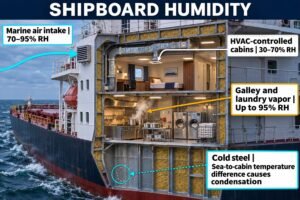
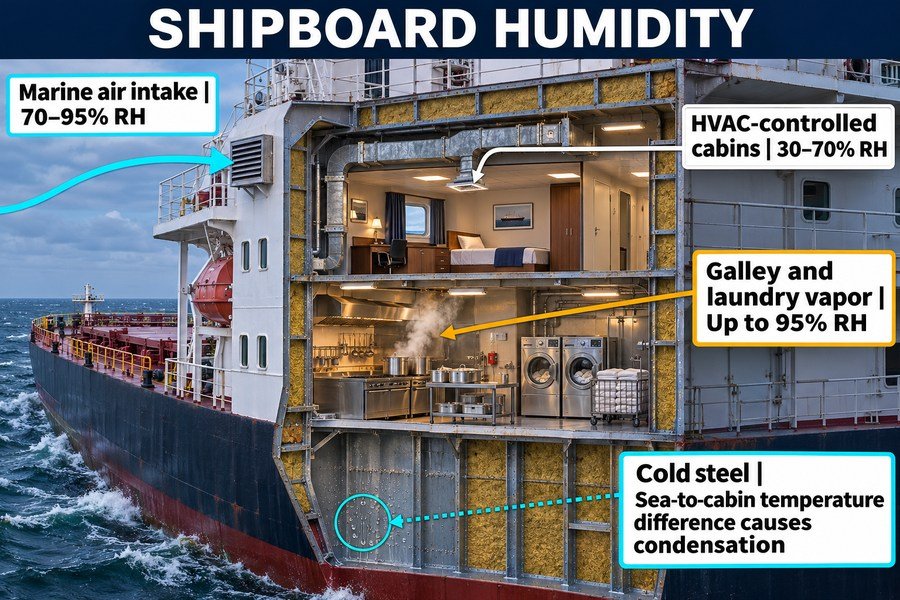
An operating vessel’s humidity environment is defined by four factors under ISO 7547: outdoor marine air intake (70%–95% RH), HVAC climate control (30%–70% RH in cabins), wet-space vapor loads (up to 95% RH in galleys and laundries), and steel bulkhead condensation driven by sea-to-cabin temperature differentials.
I started my career on the production floor of a marine outfitting factory before I joined Magellan Marine as a specialist. Over the years, I have helped many procurement managers fix expensive cabin refurbishment failures. Often, buyers order standard marine wall panels and ceiling panels from Asian factories at a very competitive price. The panels pass visual inspection in a dry warehouse. But six months after the vessel leaves the shipyard, the decorative PVC film starts bubbling and rust stains bleed through the bottom profiles. The shipyard blames the contractor, and the contractor blames the factory glue. In reality, the failure happens because nobody matched the panel specifications to the actual humidity environment inside an operating ship. Below, I will break down the exact moisture conditions on board so you can write tight purchase orders, verify factory quality, and protect your project margins.
What Relative Humidity Levels Do Ship Interiors Sustain During Operation?
Guessing shipboard humidity leads to wrong material choices. Excess moisture warps panels and corrodes steel within months. Knowing exact compartment humidity levels protects your outfitting budget.
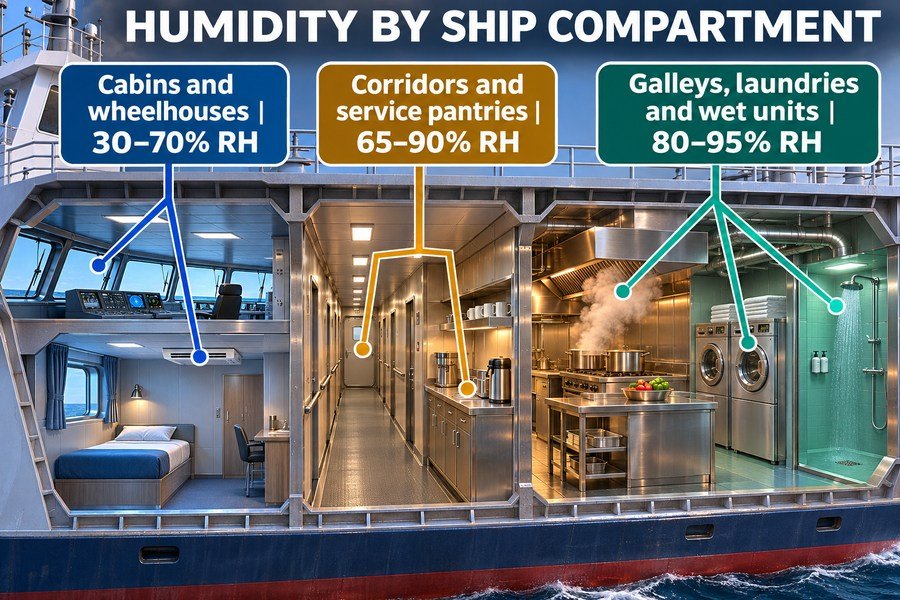
Operating ship interiors sustain three distinct relative humidity (RH) tiers under ISO 7547 and ABS Habitability guidelines: 30%–70% RH in air-conditioned cabins and wheelhouses, 65%–90% RH in semi-conditioned corridors and service pantries, and 80%–95% RH in high-moisture galleys, laundries, and sanitary wet units.
Relative Humidity Levels in Air-Conditioned Cabins, Offices, and Wheelhouses
When I review technical specifications for European and US shipyard projects, I always start with the first humidity tier: air-conditioned living and working spaces. This tier covers crew cabins, passenger staterooms, mess rooms, ship offices, and the wheelhouse. According to ISO 7547:2022 (Ships and marine technology — Air-conditioning and ventilation of accommodation spaces), marine HVAC systems are designed to hold cabin relative humidity around 50% RH during summer cooling at an indoor temperature of +27°C. During winter heating at +22°C, the indoor relative humidity drops to between 30% RH and 40% RH. Also, the ABS Guide for Crew Habitability on Ships sets the acceptable continuous operating range for these conditioned spaces at 30% RH to 70% RH1. In normal sailing conditions, standard B-15 and B-0 composite rockwool panels perform well in this 30%–70% RH window. However, when a ship sails through tropical monsoons in Southeast Asia, the HVAC dehumidification coils often struggle to keep up. I have measured cabin humidity on operating cargo vessels in Indonesia where the actual cabin reading stayed at 68% to 72% RH for weeks at a time.
Relative Humidity Levels in Semi-Conditioned Corridors and Wet Compartments
The second and third humidity tiers cause 90% of the panel warranty claims I handle at Magellan Marine. The second tier includes semi-conditioned spaces like stairwells, deck corridors, store rooms, and dry service pantries. Because crew members open exterior weathertight doors and move between decks, these zones sustain 65% RH to 90% RH under DNV Rules for Classification of Ships and ISO 7547 ventilation profiles. The third tier covers high-moisture wet compartments, specifically main galleys, dishwashing rooms, laundries, and modular sanitary wet units. Even with mechanical exhaust running at 15 to 40 air changes per hour per ISO 75472, steam from cooking kettles, industrial dryers, and hot showers pushes relative humidity in these rooms to 80%–95% RH continuously. During peak meal preparation or shower shifts, local humidity hits 100% RH with visible water condensation on the ceiling panels. If you install standard dry-cabin panels in a laundry or galley to save $4 per square meter, the panel edges will rust within one year3.
| Ship Compartment Tier | Typical Spaces Included | Normal Operating RH Range | Peak Operating RH | Governing Marine Standard |
|---|---|---|---|---|
| Tier 1: Conditioned Dry Spaces | Crew cabins, wheelhouse, offices, lounges | 30% – 70% RH (50% design target) | 75% RH | ISO 7547:2022 / ABS Habitability |
| Tier 2: Semi-Conditioned Zones | Corridors, stairwells, dry pantries, stores | 65% – 90% RH | 92% RH | ISO 7547:2022 / DNV Ship Rules |
| Tier 3: Wet & High-Vapor Spaces | Galleys, laundries, showers, sanitary units | 80% – 95% RH | 100% RH (Condensing) | ISO 7547:2022 / IMO SOLAS Ch. II-2 |
How Does Shipboard Humidity Exposure Differ From Land-Based Buildings?
Treating a ship like an office building is a mistake. Land-grade specs fail at sea and cause panel rust. Understanding shipboard humidity differences prevents procurement failures.
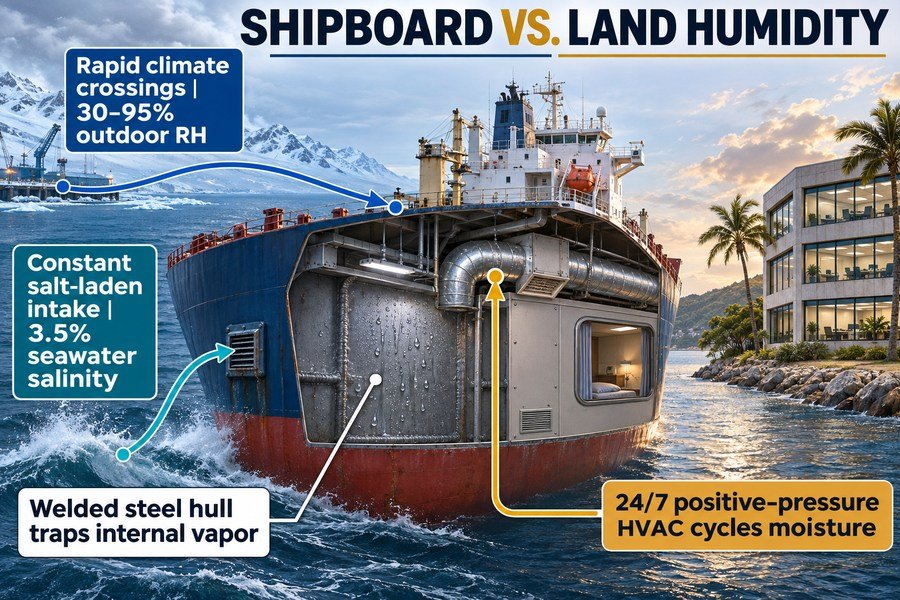
Shipboard humidity exposure differs from land-based buildings across four operational parameters: rapid climate zone crossings (shifting outdoor RH from 30% to 95% within days), continuous salt-laden air intake (3.5% salinity), airtight steel hulls that trap internal vapor, and 24/7 positive-pressure HVAC moisture cycling.
Rapid Climate Zone Crossings and Salt-Laden Marine Air Intake
Many interior contractors who move from hotel projects into shipyard outfitting assume that indoor humidity is the same everywhere. I learned early in my factory days that shipboard moisture acts nothing like land moisture. First, a land building stays in one climate zone forever. An operating container ship or offshore supply vessel moves across climate zones in a single voyage. A vessel can leave a northern winter port at -15°C and 30% RH and arrive in equatorial waters at +35°C and 90% RH just seven days later.4 This rapid swing creates massive thermal and moisture expansion stress on wall panels and fire doors. Second, all outdoor air entering a ship carries marine sea salt. Seawater has an average salinity of 3.5% (35,000 ppm)5, and ISO 9223 classifies the marine atmosphere as corrosivity category C5-M (very high marine). Airborne sodium chloride and magnesium chloride crystals settle on interior panel joints. Because sea salt is hygroscopic, it lowers the deliquescence point of moisture. On land, pure water condenses at 100% RH. On a ship, salt-coated steel panel edges start absorbing liquid water from the air at just 75% RH6.
Airtight Steel Hull Containment and 24/7 Positive-Pressure HVAC Cycling
The third major difference is hull containment. A commercial building on land is built with concrete, brick, and drywall. Under ASHRAE Standard 62.1, land walls have natural porosity and allow 0.5 to 1.5 air changes per hour of natural vapor diffusion to the outside. A ship is a welded steel box. Steel plates have a water vapor permeability of zero. Any moisture generated inside the hull stays locked inside the steel boundary unless the mechanical exhaust removes it. Fourth, shipboard HVAC systems operate 24 hours a day under positive pressure. Per ISO 7547, accommodation blocks maintain a positive overpressure of 15 Pa to 25 Pa to keep engine fumes and sea spray out, while cycling air at 8 to 12 air changes per hour. This constant positive pressure forces warm, humid indoor air through every tiny gap in your ceiling panels and wall profiles straight toward the cold outer steel hull.
| Humidity Exposure Parameter | Operating Marine Vessel | Land-Based Commercial Building | Impact on Marine Interior Outfitting |
|---|---|---|---|
| Climate Zone Stability | Shifts from -20°C/30% RH to +35°C/95% RH in 7 days | Fixed geographic climate year-round | Rapid expansion/contraction of panel joints |
| Airborne Salt Content | High chloride load (ISO 9223 C5-M, 3.5% sea salt) | Negligible salt (except coastal strip) | Salt triggers wet corrosion at 75% RH |
| Structural Envelope | Welded steel hull (0 g/m²·hr vapor permeability) | Porous masonry/curtain wall (natural breathing) | Zero natural drying through exterior walls |
| HVAC Pressure & Duty Cycle | 24/7 operation, 15–25 Pa positive pressure | 10–12 hr daily cycle, neutral pressure | Pushes warm cabin vapor behind cold bulkheads |
Why Do Marine Interior Panels Face Higher Moisture Loads Than Building Panels?
Standard building panels swell and rust inside ship cabins. Hidden moisture behind bulkheads ruins rockwool in months. Knowing why marine panels face higher moisture helps buyers.
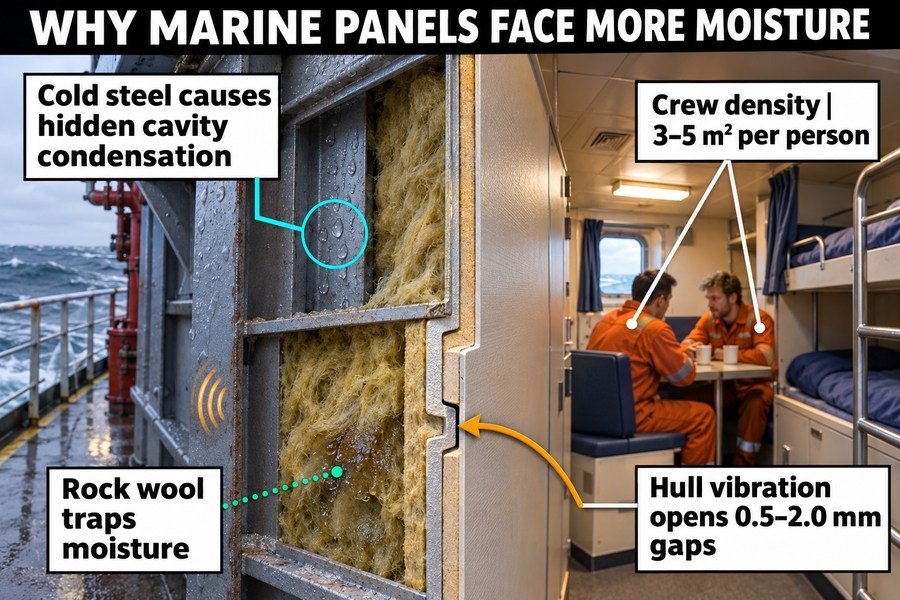
Marine interior panels face higher moisture loads than building panels due to four physical stressors: hidden cavity condensation against cold steel frames, higher occupant density (3–5 m² per crew member), hull vibration opening panel joints (0.5–2.0 mm gaps), and hygroscopic rockwool insulation trapping moisture.
Cavity Condensation on Cold Steel Bulkheads and High Crew Occupant Density
When a procurement officer asks me why a cheap panel failed, I tell them to look at the back of the panel, not the front. The first stressor is hidden cavity condensation against cold steel frames. On an operating ship, a 50 mm to 100 mm air cavity sits between the A-class steel hull bulkhead and your B-15 cabin lining panel. When the ship sails in cold seawater (+2°C to +10°C), the steel hull temperature drops well below the cabin dew point of +14°C (at +22°C and 60% RH)7. Even with hull pin-insulation, steel stiffeners act as thermal bridges. They generate 200 to 400 g/m² of liquid condensation every day8 right behind your wall panels. The second stressor is high occupant moisture density. Under the Maritime Labour Convention (MLC 2006) and ABS habitability rules, single crew cabins measure 4.5 m² to 7.5 m², while shared rooms offer 3.0 m² to 5.0 m² per person. By comparison, land offices allocate 15 m² to 25 m² per worker under ASHRAE standards. Each crew member releases 1.5 kg to 2.5 kg of water vapor per day through breathing and sweat into a very small cabin volume.
Hull Vibration Joint Micro-Gaps and Rockwool Core Moisture Retention
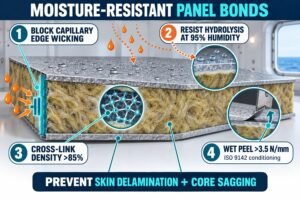
The third physical stressor is continuous ship vibration. Under ISO 20283-5, main engines and propellers create structural vibrations between 5 Hz and 80 Hz across the accommodation block. Over months at sea, this vibration flexes the tongue-and-groove joints or M-profile splines of marine wall panels, opening micro-gaps of 0.5 mm to 2.0 mm. Warm, moist cabin air leaks through these opened joints directly into the cold cavity behind the panel. That brings us to the fourth stressor: rockwool core moisture retention. To meet IMO SOLAS Chapter II-2 and FTP Code Part 3 fire ratings, marine B-0 and B-15 panels use mineral rockwool cores with densities of 60 kg/m³ to 150 kg/m³. If a supplier uses cheap rockwool with a hydrophobicity (water-repellent rate) below the 98% minimum required by GB/T 11835 or EN 1609, the rockwool acts like a sponge. Once wet, the core increases panel weight by 30% to 50%, rots the galvanized steel skin from the inside out, and causes the PVC film to peel off.
| Physical Moisture Stressor | Quantitative Marine Value | Authoritative Reference | Direct Failure Mode on Interior Panels |
|---|---|---|---|
| Cold Steel Cavity Condensation | 200 – 400 g/m²/day liquid condensate | ASHRAE Psychrometrics / ISO 7547 | Back-side rusting of galvanized steel skin |
| High Crew Occupant Density | 3.0 – 7.5 m²/person (1.5–2.5 kg vapor/day) | MLC 2006 / ABS Habitability Guide | Elevated cabin dew point (+14°C to +18°C) |
| Hull Vibration Joint Flexing | 5 – 80 Hz frequency; 0.5 – 2.0 mm gap | ISO 20283-5 | Vapor leakage through panel spline joints |
| Rockwool Core Absorption | <98% hydrophobicity in low-grade wool | IMO FTP Code / EN 1609 / GB/T 11835 | Core sagging, internal rust, PVC delamination |
What Ambient Humidity Range Should Be Specified for Marine Interior Panels?
Vague purchase orders let factories ship weak panels. Missing humidity specs cause peeling PVC and rusted steel sheets. Setting clear humidity ranges guarantees long panel life.
Procurement specifications for marine interior panels must define three ambient humidity ranges: 30%–75% continuous RH for standard B-15/B-0 dry-cabin panels, 85%–95% continuous RH (up to 100% intermittent) for wet-space and galley panels, and 40%–95% RH at +40°C for 240-hour factory damp-heat testing.
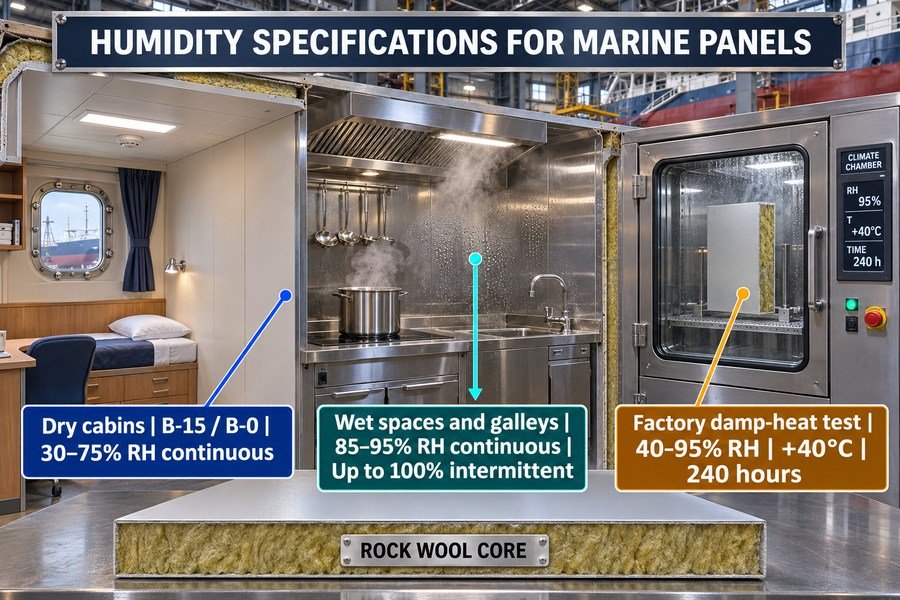
Continuous Operating Humidity Specs for Dry Cabins Versus Wet Spaces
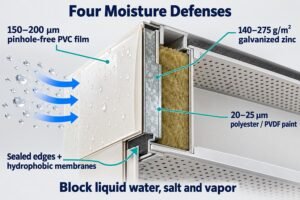
Many buyers send inquiries to Asian factories that only say "B-15 marine wall panel, 50 mm thick, MED certified." That gives the factory complete freedom to use the cheapest steel and glue available. To protect your project, you must write three specific humidity ranges into your technical purchase agreement. First, for standard dry cabins, corridors, and wheelhouses, specify a continuous ambient humidity resistance of 30%–75% RH at -10°C to +45°C. To survive this range, require 0.6 mm hot-dip galvanized steel sheets with a zinc coating mass of at least 120 g/m² to 140 g/m² (Z120 to Z140 under EN 10346), laminated with 0.15 mm flame-retardant marine PVC film certified to IMO FTP Code Part 5. Second, for galleys, laundries, and sanitary wet units, specify 85%–95% continuous RH and 100% intermittent condensing humidity. For these wet zones, standard Z120 galvanized steel will fail. You must specify either 0.6 mm SUS 304 / SUS 316L stainless steel skins (per ASTM A240) or heavy galvanized steel with 275 g/m² zinc coating (Z275) plus a 25-micron polyester backer coat. Also, require two-component polyurethane (PU) glue instead of cheap water-based white glue.
Pre-Shipment Damp-Heat Qualification Testing at 95% Relative Humidity
The third humidity range you must specify is the factory qualification test before shipment. Never trust a paper certificate alone when buying from a new factory in China or Vietnam. In my contracts at Magellan Marine, I require the supplier to run a cyclic damp-heat test at 40%–95% RH and +40°C for 240 hours (10 days) in accordance with IEC 60068-2-30 or ISO 6270-2 on production samples. After 240 hours inside the humidity chamber, the panel must show zero PVC film blistering, zero edge rust, and a film-to-steel 180-degree peel strength of at least 25 N/25mm under ASTM D903. Adding Z275 zinc coating and two-component PU adhesive only adds $1.50 to $2.50 per square meter to the factory FOB price. Specifically, a standard dry-cabin B-15 panel costs $18 to $24 per square meter FOB China, while a high-humidity Z275/PU panel costs $20 to $26 per square meter, and a SUS 304 stainless steel wet-space panel costs $32 to $45 per square meter. Spending $2 more per square meter upfront saves $150 per square meter in offshore replacement labor later.
| Specification Category | Target Ambient RH Range | Required Steel & Coating Spec | Required Adhesive & Core Spec | Typical FOB Price (USD/m²) |
|---|---|---|---|---|
| Dry Cabin & Corridor Panels | 30% – 75% RH continuous | 0.6 mm GI steel, Z120–Z140 (120–140 g/m² zinc, EN 10346) | Solvent/PU glue; ≥98% hydrophobic rockwool | $18.00 – $24.00 / m² |
| Galley, Laundry & Wet Units | 85% – 95% RH (100% peak) | 0.6 mm SUS 304/316L (ASTM A240) or Z275 GI + 25μm back coat | 2-component waterproof PU glue; sealed edges | $28.00 – $45.00 / m² |
| Pre-Shipment Lab Test Spec | 40% – 95% RH cyclic at +40°C | 240-hour chamber test per IEC 60068-2-30 / ISO 6270-2 | Peel strength ≥25 N/25mm (ASTM D903), 0 blisters | Included in QA lot testing |
How Does the Surrounding Sea Raise Baseline Humidity Across Ship Compartments?
Buyers often think air conditioning blocks all ocean moisture. Yet seawater pushes humidity into every deck. Knowing how the sea raises baseline humidity prevents mistakes.
The surrounding sea raises baseline shipboard humidity through four transmission pathways: saturated marine boundary-layer air intake (75%–90% RH within 30 meters of sea level), sub-waterline hull cooling that drops interior steel temperatures, bilge and ballast water evaporation, and seawater tracked indoors on crew gear.
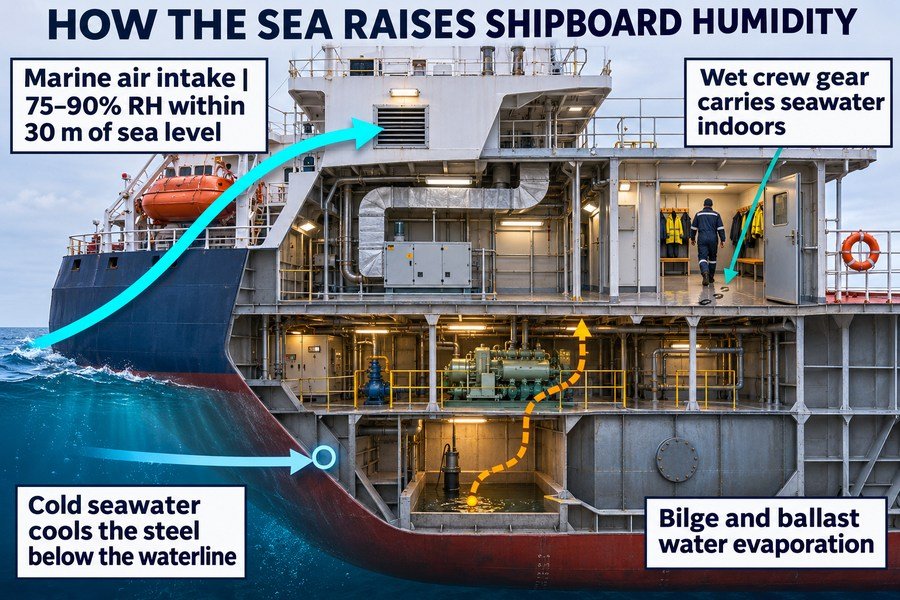
Marine Boundary-Layer Air Intake and Sub-Waterline Hull Thermal Cooling
Sometimes clients ask me why a vessel with a brand-new HVAC unit still suffers from damp lower-deck cabins. The answer lies in the four ways the ocean pushes moisture inside the hull. First, every ship draws its fresh makeup air from the marine atmospheric boundary layer. HVAC intake louvers sit between 5 meters and 25 meters above the sea surface. At this low altitude, ocean wave spray and surface evaporation keep the outdoor air at 75% RH to 90% RH year-round9. Under ISO 7547 summer design conditions (+35°C and 70% RH), every kilogram of dry outdoor air entering the ship carries 25 grams of water vapor. If the HVAC chilled-water temperature rises by just 3°C due to fouled seawater condensers, the supply air enters the cabins at 65%–75% RH instead of 50% RH.10 Second, the sea cools the lower hull plates below the waterline. Seawater acts as an infinite heat sink, cooling lower-deck steel bulkheads by 8°C to 15°C below the cabin air temperature. According to ASHRAE psychrometric charts, when +24°C cabin air at 50% RH touches a +14°C steel zone near the floor profile, the local relative humidity right at the panel base jumps to 92% RH11, even though the room thermostat reads 50% RH.
Bilge Water Vapor Migration and Weather-Deck Crew Moisture Ingress
The third pathway is internal evaporation from bilge wells, ballast tank boundaries, and machinery spaces. Under ISO 8861 (Engine room ventilation), machinery spaces operate at +35°C to +45°C and hold standing bilge water, steam drains, and washing water. Warm humid air in the engine casing and pipe trunks creates a vapor pressure differential of 3.0 kPa to 5.5 kPa compared to the cooler accommodation decks above.12 This vapor migrates upward through elevator shafts, dumbwaiters, cable transits, and A-60 fire door perimeters into the accommodation block. Fourth, working crew members bring seawater directly indoors. On offshore support vessels, tugboats, and bulk carriers, deck crews open weather-deck doors 40 to 100 times per day. They walk into changing rooms and passageways wearing wet oilskins, immersion suits, and sea-soaked boots. A single crew shift brings 5 kg to 12 kg of liquid seawater into the changing room, which then evaporates into the corridor air stream and attacks nearby wall panels and fire door frames.
| Sea-to-Ship Moisture Pathway | Quantitative Moisture Metric | Primary Ship Zones Affected | Outfitting Countermeasure Required |
|---|---|---|---|
| Boundary-Layer Air Intake | 75% – 90% ambient RH (18–28 g H₂O/kg air) | All HVAC-served cabins and public rooms | Specify panels rated to 75% continuous RH minimum |
| Sub-Waterline Hull Cooling | 8°C – 15°C steel temperature drop; >85% local RH | Lower accommodation decks, bottom U-profiles | Use 1.2 mm SUS 304 bottom U-channels with sealant |
| Bilge & Engine Vapor Migration | 3.0 – 5.5 kPa upward vapor pressure differential | Casing bulkheads, stair towers, lower corridors | Seal A-60/B-15 penetrations; use Z275 coated panels |
| Weather-Deck Crew Ingress | 40 – 100 door openings/day; 5–12 kg seawater/shift | Mudrooms, changing rooms, main deck foyers | Specify PVC-free painted GI or stainless panels |
What Makes Ship Interior Humidity Persistent Rather Than Occasional?
Short moisture tests miss long-term marine panel failures. Ship interiors never get a dry season to recover. Understanding why shipboard humidity stays persistent improves material selection.
Ship interior humidity remains persistent rather than occasional due to four non-stop operational drivers: 24/7 round-the-clock crew occupancy across three watch shifts, unvented behind-panel steel cavities that prevent drying, continuous wet-service operations (galleys, showers, and laundries), and uninterrupted marine air makeup.
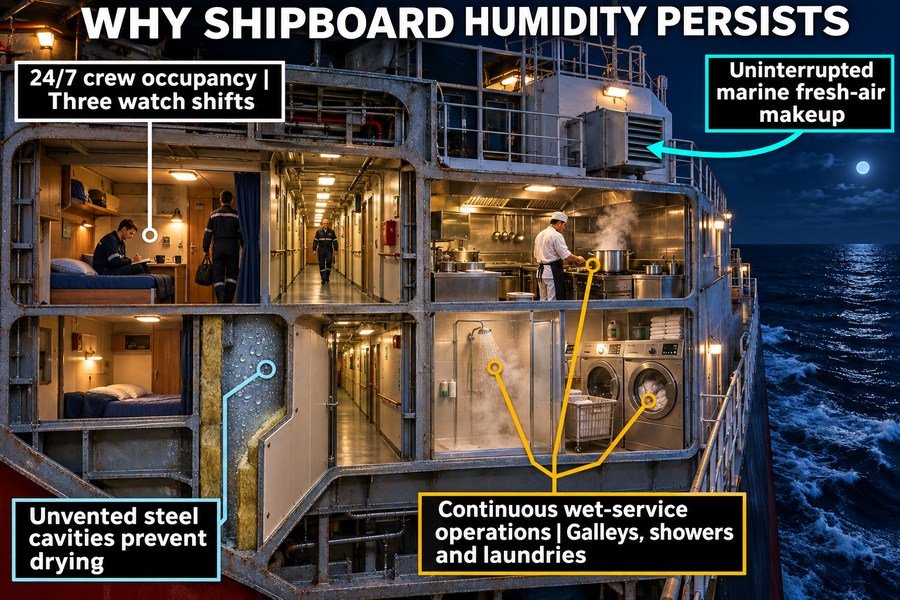
Round-the-Clock Three-Watch Crew Schedules and Continuous Wet-Service Operations
In a land office building, the humidity load drops to zero at 6:00 PM when employees go home, giving walls and ceilings 12 to 14 hours every night to dry out. On an operating ship, that drying window never happens. The first driver of persistent humidity is 24/7 crew occupancy. Under STCW watchkeeping regulations, commercial ships run on three 4-on/8-off watches or two 6-on/6-off shifts. At any hour of the day or night, one-third to one-half of the crew is sleeping in their cabins while another shift is eating or working. Respiration and body moisture loads run 24 hours a day, 365 days a year.13 This directly drives the third factor: continuous wet-service operations. Because crew shifts rotate every 4 to 6 hours, cabin showers, communal laundries, and galley steam ovens run at midnight, 4:00 AM, noon, and 8:00 PM. Instead of one brief humidity spike per day, wet units and adjacent corridors experience continuous vapor generation of 15 kg to 40 kg per hour with less than 2 hours of downtime between shift changes.
Unvented B-Class Panel Cavities and Non-Stop Marine Fresh-Air Makeup
The second driver—and the most dangerous one for marine wall and ceiling panels—is the unvented cavity behind B-class panels. Under IMO SOLAS Chapter II-2 Regulation 5.3 and Regulation 9, B-0 and B-15 cabin linings and ceilings must act as fire and smoke barriers, with draft stops installed at least every 14 meters in concealed spaces14. Because these cavities are sealed to stop fire spread, air velocity behind the wall panels is essentially 0 m/s. Once moisture condenses inside that cavity during a humid voyage, it cannot evaporate.15 The rockwool and back steel sheet stay wet for months on end, turning a one-time condensation event into permanent 95%–100% RH exposure behind the panel. Finally, the fourth driver is uninterrupted marine fresh-air makeup. Under ISO 7547, the HVAC system must supply at least 0.008 m³/s (28.8 m³/h) of fresh outdoor air per person continuously to dilute carbon dioxide and odors, plus makeup air for galley and sanitary exhausts. Operating 8,760 hours per year, this constant outdoor air intake guarantees that ocean moisture enters the interior compartments every single minute the vessel is in service.
| Persistent Humidity Driver | Shipboard Duty Cycle | Land Building Comparison | Long-Term Impact on Marine Panel Service Life |
|---|---|---|---|
| 3-Watch Crew Occupancy | 24 hours/day, 365 days/year (STCW shifts) | 8 – 10 hours/day, 5 days/week | Zero overnight drop in cabin vapor generation |
| Unvented B-Class Cavities | 0 m/s cavity airflow (SOLAS Ch. II-2 draft stops) | Vented wall studs / breathable drywall | Condensed moisture stays trapped for months |
| Multi-Shift Wet Operations | Showers/galleys active every 4–6 hours | Single daily peak (1–2 hours) | Wet-unit panels never reach dry equilibrium |
| Continuous Fresh-Air Makeup | 8,760 hours/year at ≥0.008 m³/s per person (ISO 7547) | Economizer shutdown during off-hours | Non-stop baseline moisture feed from ocean air |
Conclusion
Shipboard humidity is constant, salty, and unforgiving. Specify marine panels using ISO 7547 humidity limits, heavy galvanized steel, and polyurethane glue to prevent moisture failures on board.
-
"ERGONOMIC & SAFETY DISCUSSION PAPER", http://maritime.lamar.edu/joomla2025/index.php/ergonomics?download=47:edp-habitability-and-comfort-no-8. The ABS Guide for Crew Habitability on Ships provides environmental comfort criteria for crew spaces, including an acceptable relative-humidity range for continuously occupied accommodation areas. Evidence role: expert_consensus; source type: institution. Supports: ABS habitability guidance identifies 30% to 70% relative humidity as an acceptable operating range for conditioned crew accommodation spaces.. Scope note: The guide is a classification-society habitability criterion and may apply only when the relevant ABS habitability notation or guide is contractually adopted. ↩
-
"Appendix B. Air | Infection Control", https://www.cdc.gov/infection-control/hcp/environmental-control/appendix-b-air.html. ISO 7547 gives ventilation and exhaust design rates for ship accommodation service spaces, including higher exhaust rates for moisture-producing rooms such as galleys, laundries, and sanitary spaces. Evidence role: definition; source type: institution. Supports: ISO 7547 specifies mechanical exhaust or ventilation rates in the range of 15 to 40 air changes per hour for high-moisture shipboard service compartments.. Scope note: The standard supports the ventilation-rate basis; it does not by itself prove that these spaces will remain at 80%–95% RH in all operating conditions. ↩
-
"Marine Atmospheric Corrosion of Carbon Steel: A Review - PMC", https://pmc.ncbi.nlm.nih.gov/articles/PMC5506973/. Corrosion-engineering literature shows that sustained high relative humidity and surface condensation accelerate atmospheric corrosion of carbon steel and coated steel, especially at exposed edges where coatings are discontinuous. Evidence role: mechanism; source type: paper. Supports: Installing dry-cabin panels in high-humidity galley or laundry spaces can lead to rapid rusting at panel edges.. Scope note: Such sources support the corrosion mechanism and elevated risk under wet service conditions, but they may not verify the exact one-year failure timeline without vessel-specific exposure and coating data. ↩
-
"U.S. Climate Normals - National Centers for Environmental Information", https://www.ncei.noaa.gov/products/land-based-station/us-climate-normals. Meteorological climate-normal data for high-latitude winter ports and equatorial marine regions can substantiate that ship routes may span subfreezing, low-humidity conditions and hot, humid tropical conditions within a short voyage interval. Evidence role: general_support; source type: government. Supports: An operating vessel can experience a rapid transition from cold, dry port conditions to hot, humid equatorial marine conditions within a single voyage.. Scope note: This would support the plausibility of the stated exposure swing, but not prove that every vessel or route experiences the exact temperatures, humidity values, or seven-day timing. ↩
-
"Sea Water | National Oceanic and Atmospheric ...", https://www.noaa.gov/jetstream/ocean/sea-water. Oceanographic references such as NOAA or university materials commonly describe average seawater salinity as about 35 parts per thousand, equivalent to approximately 3.5%, supporting the salinity figure used here. Evidence role: statistic; source type: institution. Supports: Average seawater salinity is approximately 3.5%, or 35,000 ppm.. ↩
-
"Effect of relative humidity on corrosion of steel under sea salt ...", https://experts.umn.edu/en/publications/effect-of-relative-humidity-on-corrosion-of-steel-under-sea-salt-/. Peer-reviewed studies and corrosion references report that sodium chloride deliquesces at roughly 75% relative humidity at room temperature, explaining why salt-contaminated metal surfaces can form an electrolyte film below 100% RH. Evidence role: mechanism; source type: paper. Supports: Salt deposits on steel can absorb atmospheric moisture and form liquid films at around 75% RH rather than only at 100% RH.. Scope note: The 75% threshold applies most directly to sodium chloride under typical room-temperature conditions; mixed sea salts containing magnesium chloride can deliquesce at different, often lower, relative humidities. ↩
-
"Psychrometric Calculator", https://people.tamu.edu/~i-choudhury/psych.html. A psychrometric chart or dew-point calculator supports that indoor air at about 22°C and 60% relative humidity has a dew point near 14°C, establishing the condensation threshold for colder surfaces. Evidence role: mechanism; source type: education. Supports: At +22°C and 60% relative humidity, cabin air has a dew point of approximately +14°C.. Scope note: This supports the dew-point calculation, not the article’s broader claim about actual hull-surface temperatures in service. ↩
-
"Why Does Thermal Bridging Cause Condensation on Marine ...", https://magellanmarinetech.com/why-thermal-bridging-cause-condensation-on-marine-accommodation-panels/. Condensation-risk standards and hygrothermal calculation methods describe how interstitial condensation rates are estimated from indoor humidity, surface temperature, vapor pressure, and thermal bridging conditions. Evidence role: mechanism; source type: institution. Supports: Cold steel surfaces and thermal bridges can generate measurable interstitial condensation behind interior linings under suitable humidity and temperature conditions.. Scope note: Such sources usually provide calculation methods rather than direct proof of the specific 200–400 g/m²/day value for the described ship cavity. ↩
-
"47. Relative humidity over the oceans", https://www.gfdl.noaa.gov/blog_held/47-relative-humidity-over-the-oceans/. Marine boundary-layer climatology or ocean meteorological data showing high near-surface relative humidity over open water would support the stated humidity range as plausible, although regional and seasonal variability may prevent it from proving a universal year-round value. Evidence role: statistic; source type: paper. Supports: Near-surface marine air commonly has relative humidity in the 75% to 90% range.. Scope note: The claim is broad; most neutral sources will support typical high marine humidity, not a constant global year-round 75%–90% range. ↩
-
"A Literature Review On Heat Exchanger Air Side Fouling In ...", https://docs.lib.purdue.edu/cgi/viewcontent.cgi?article=2662&context=iracc. Heat-exchanger fouling literature and HVAC dehumidification references support the mechanism that reduced condenser or chilled-water performance raises cooling-coil apparatus dew point and leaving-air humidity, although they may not directly verify the exact 3°C and 65%–75% cabin-RH figures for every ship. Evidence role: mechanism; source type: paper. Supports: Fouled seawater condensers can raise chilled-water temperature and reduce HVAC dehumidification, increasing supply-air or cabin relative humidity.. Scope note: Likely sources will support the causal mechanism; the exact humidity outcome is system-specific and would require a modeled or measured case. ↩
-
"Psychrometric Calculator", https://people.tamu.edu/~i-choudhury/psych.html. Psychrometric equations or an ASHRAE psychrometric chart support that air initially at 24°C and 50% RH will approach saturation when cooled to about 14°C at constant moisture content, giving a local RH near the stated value. Evidence role: mechanism; source type: education. Supports: Cooling 24°C, 50% RH air to approximately 14°C at constant humidity ratio raises local relative humidity to roughly the low-90% range.. Scope note: The calculation assumes no moisture removal or mixing at the cooled surface and standard atmospheric pressure. ↩
-
"(PDF) Ventilation of engine rooms in diesel engines ships", https://www.academia.edu/83972749/Ventilation_of_engine_rooms_in_diesel_engines_ships. Psychrometric vapor-pressure formulas and marine ventilation references support that warm, moist machinery-space air can have substantially higher water-vapor pressure than cooler accommodation air, although the exact 3.0–5.5 kPa differential depends on assumed temperature and relative humidity. Evidence role: mechanism; source type: research. Supports: Warm humid engine-space air can generate a water-vapor pressure differential of several kilopascals relative to cooler accommodation spaces.. Scope note: The numerical range is condition-dependent and should be tied to stated temperature/RH assumptions or measured shipboard data. ↩
-
"Interior Moisture Design Loads for Residences", https://research.fs.usda.gov/download/treesearch/25691.pdf. Building-science and HVAC references quantify latent moisture released by occupants through respiration and perspiration, supporting the mechanism by which continuous occupancy adds water vapor to indoor air; this does not independently verify the vessel’s exact crewing level or annual occupancy pattern. Evidence role: mechanism; source type: research. Supports: Human occupants continuously generate indoor moisture through respiration and body moisture release.. Scope note: Supports the moisture-generation mechanism, not the specific claim that every vessel has the same 24/7/365 occupancy profile. ↩
-
"STOPS – FTA's Simplified Trips-on-Project Software", https://www.transit.dot.gov/funding/grant-programs/capital-investments/stops. SOLAS Chapter II-2 provisions on accommodation and service-space divisions require draught stops in specified concealed air spaces at intervals not exceeding 14 m, supporting the cited fire-containment requirement; applicability depends on the vessel category and the precise space classification. Evidence role: definition; source type: institution. Supports: SOLAS requires draught stops in relevant concealed spaces at intervals of no more than 14 m.. Scope note: The rule applies within the scope and definitions of SOLAS Chapter II-2 and may have exceptions or equivalent arrangements approved by the administration. ↩
-
"Condensation Potential in High Thermal Performance Walls", https://www.govinfo.gov/content/pkg/GOVPUB-A13-PURL-gpo123994/pdf/GOVPUB-A13-PURL-gpo123994.pdf. Hygrothermal research on enclosed or poorly ventilated cavities shows that limited air exchange strongly reduces drying potential after condensation, supporting the mechanism of prolonged moisture retention; the source would not directly prove that every B-class marine panel cavity remains wet for months. Evidence role: mechanism; source type: research. Supports: Condensation in sealed or poorly ventilated wall cavities can persist because restricted air exchange limits evaporation and drying.. Scope note: Contextual support: drying behavior depends on temperature gradients, material permeability, leakage paths, insulation properties, and vessel operating conditions. ↩