Are you worried about failing SOLAS fire safety inspections? Weak interior panels risk lives and heavy project delays. Let me show you exactly what happens inside during prolonged fires.
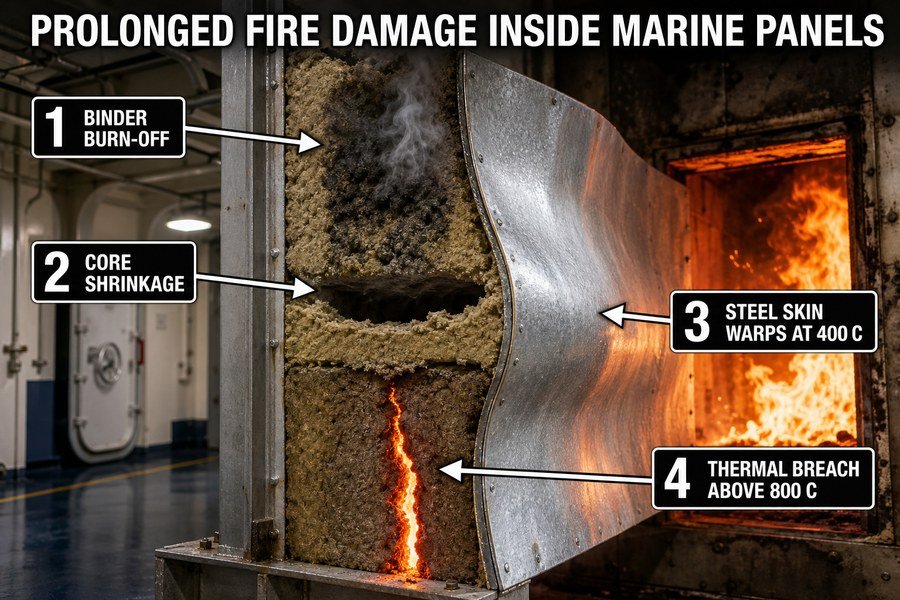
During a prolonged fire, marine interior panels undergo binder burn-off, core shrinkage, structural distortion, and eventual thermal breach. The galvanized steel skin warps at 400°C, while the rock wool core loses integrity past 800°C. Understanding these four stages helps you select truly compliant A-Class and B-Class bulkheads.
When you buy panels for European and US shipyards, quality is your bottom line. I have seen cheap panels fail in testing. These failures cost contractors millions of dollars. Let us look at the real engineering details.
How Does the Mineral Wool Binder in a Marine Interior Panel React to Prolonged Fire?
Do your panels smoke heavily during fire tests? Cheap binders break down fast. They release toxic gas and fail the test. Here is how panel binders actually react to heat.
The phenolic resin binder in mineral wool reacts to fire in three stages: initial off-gassing at 200°C, rapid oxidation and smoke release between 300°C and 400°C, and complete vaporization above 450°C. This three-stage breakdown destroys the panel's internal cohesion, turning the rigid rock wool block into loose fibers.
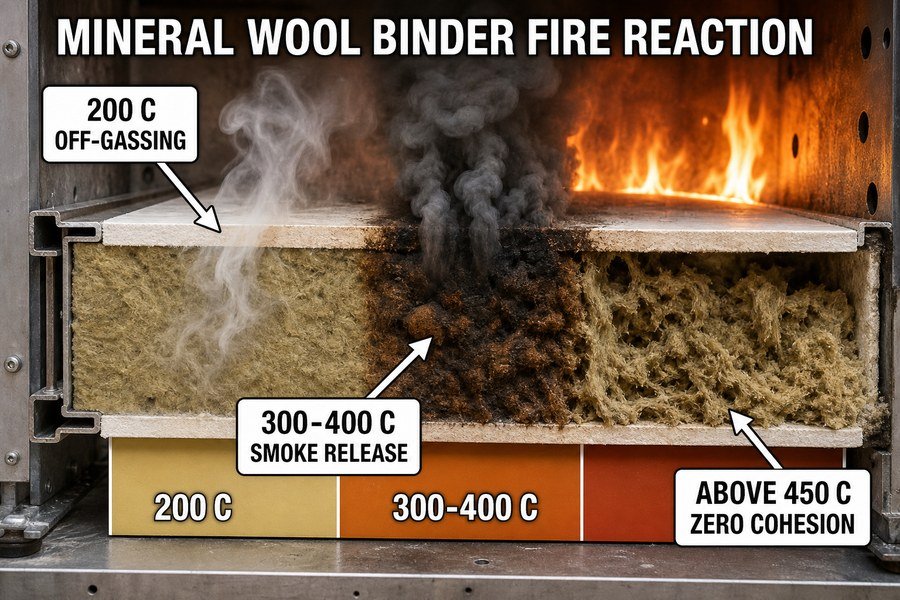
I started my career in a marine outfitting factory. I watched many fire tests. I learned exactly how the binder inside the rock wool reacts to heat. The binder is usually phenolic resin. It makes up 3% to 5% of the total mass of the mineral wool.1 This resin glues the rock wool fibers together. Without it, the panel loses all its mechanical strength. The reaction happens in three clear stages.
Initial Off-Gassing of Phenolic Resin Binder at 200°C
The first stage is initial off-gassing. This happens when the temperature reaches 200°C.2 The phenolic resin binder starts to break down. It releases small amounts of gas. You will see light smoke during a test. The rock wool still holds its shape at this point. The structural strength is mostly normal. But this is the start of the failure process. The IMO FTP Code Part 1 tests for non-combustibility. A good panel must limit this early off-gassing.
Rapid Oxidation and Complete Vaporization of Binder Above 300°C
The second stage is rapid oxidation and smoke release. This occurs between 300°C and 400°C. The binder burns aggressively. It creates heavy, dark smoke.3 This smoke can block escape routes on a ship. The internal structure gets weak. The third stage is complete vaporization. This happens above 450°C. The resin disappears completely. The rigid rock wool block turns into loose, soft fibers. The panel has no internal cohesion left. It cannot hold up its own weight.
| Temperature Range | Binder Reaction Stage | Impact on Panel Structure |
|---|---|---|
| 200°C to 250°C | Initial off-gassing | Very minor loss of strength. |
| 300°C to 400°C | Rapid oxidation | High smoke release, major strength drop. |
| Above 450°C | Complete vaporization | Zero cohesion, wool turns to loose fibers. |
Shipyards in Europe and the United States demand strict certification. They check the smoke generation limits.4 You must buy panels with high-quality, low-emission binders. Cheap binders save money but cause massive problems later.
What Internal Structural Shifts Occur in a Marine Ceiling Panel During a 60-Minute Fire?
Does your ceiling panel sag during a one-hour fire test? A collapsing ceiling puts the whole deck at risk. Let me explain the internal structural changes that cause this.
A marine ceiling panel experiences four internal structural shifts during a 60-minute fire: surface metal expansion in the first 10 minutes, core delamination at 20 minutes, rock wool fiber settlement by 40 minutes, and complete structural sagging of the steel support profiles by 60 minutes.
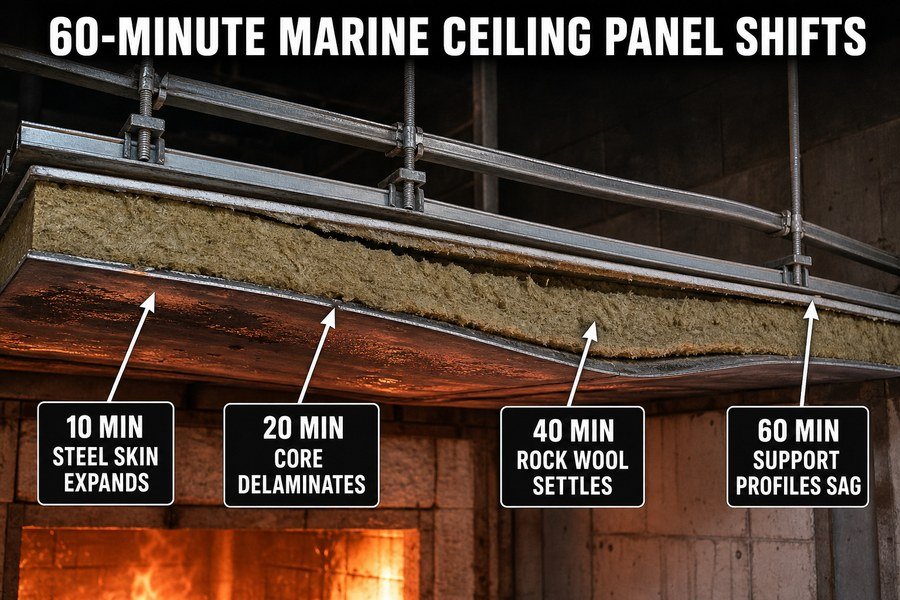
A standard A-30 or A-60 marine ceiling panel faces extreme stress during a fire. I help many clients at Magellan Marine fix ceiling failure issues. We use the ISO 834 standard fire test curve. The temperature reaches about 945°C after 60 minutes5. The panel undergoes four major structural shifts during this hour. These shifts destroy the integrity of the ceiling over time.
Surface Metal Expansion and Core Delamination in the First 20 Minutes
The first shift is surface metal expansion. This happens in the first 10 minutes. The exposed steel skin gets very hot. The steel is usually 0.6mm thick. It expands quickly. The unexposed side stays cool. This difference causes the panel to bow downward. The second shift is core delamination. This occurs at 20 minutes. The polyurethane glue melts at 150°C6. The steel skin separates from the rock wool core. The panel loses its composite strength. The skin just hangs there.
Rock Wool Settlement and Steel Profile Sagging Up to 60 Minutes
The third shift is rock wool fiber settlement. This happens by 40 minutes. The binder has burned away7. The bare rock wool fibers sink due to gravity. The insulation layer gets thinner in some spots. Heat moves through these thin spots quickly. The fourth and final shift is complete structural sagging. This happens at 60 minutes. The steel support profiles lose their yield strength. Steel loses 50% of its strength at 600°C8. The entire ceiling structure bends downward.
| Time in Fire Test | Internal Structural Shift | Cause of the Shift |
|---|---|---|
| 10 Minutes | Surface metal expansion | 0.6mm steel skin heats up and expands. |
| 20 Minutes | Core delamination | Internal PU glue melts at 150°C. |
| 40 Minutes | Rock wool fiber settlement | Binder burns off, gravity pulls fibers. |
| 60 Minutes | Complete structural sagging | Steel supports lose 50% strength at 600°C. |
You need to know these four shifts. They explain why cheap ceilings fail standard IMO tests. High-quality panels use better glue and stronger profiles. This slows down the shifts.
Why Does a Marine Interior Panel's Fire Resistance Degrade Non-Linearly Over Time?
Are you surprised when a panel holds up for 40 minutes but fails suddenly at minute 45? Unpredictable failure curves ruin certifications. Here is why the resistance drops non-linearly.
Marine interior panel fire resistance degrades non-linearly due to three factors: the sudden vaporization of internal moisture at 100°C, the rapid flash-off of chemical binders at 400°C, and the exponential increase in radiant heat transfer through the core as air pockets collapse above 700°C.
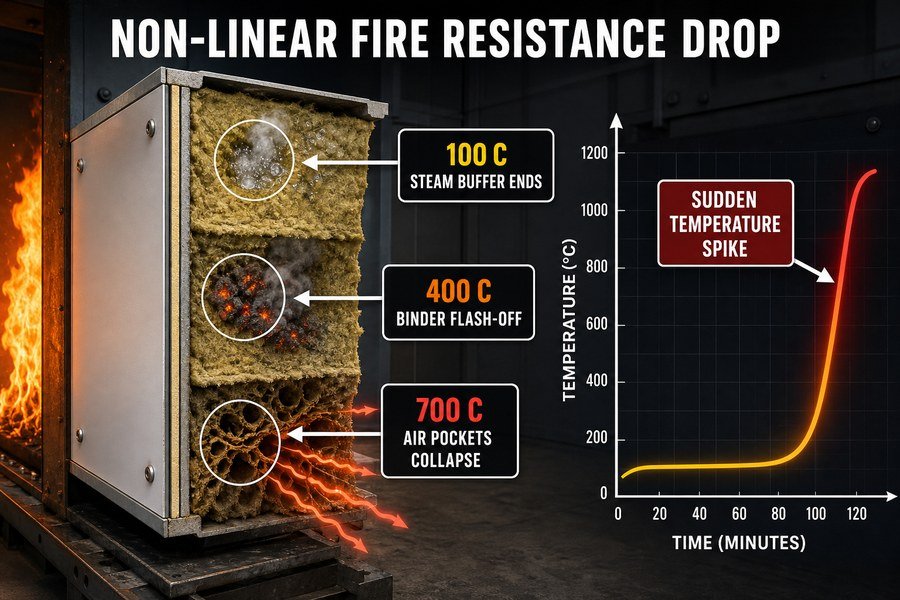
Many buyers think fire resistance drops in a straight line. They think a panel loses a little bit of strength every minute. This is not true. I see the test graphs all the time. The temperature on the unexposed side stays flat for a long time. Then it shoots up suddenly.9 This non-linear degradation comes from three specific internal factors. You must understand these three factors to buy safe panels.
Sudden Vaporization of Moisture and Chemical Binder Flash-Off
The first factor is the sudden vaporization of internal moisture. Rock wool absorbs a small amount of moisture from the air. When the internal temperature hits 100°C, this water turns into steam. This steam absorbs a lot of heat energy.10 It keeps the panel cool for a while. Once all the water boils away, the temperature spikes fast. The second factor is the rapid flash-off of chemical binders. At 400°C, the phenolic resin binder ignites.11 It creates its own internal heat. This extra heat pushes the temperature up even faster.
Exponential Radiant Heat Transfer from Collapsed Air Pockets
The third factor is the exponential increase in radiant heat transfer. Rock wool works because it traps tiny pockets of air. Air is a bad conductor of heat. But above 700°C, the rock wool fibers start to melt and shrink. The tiny air pockets collapse. Heat stops moving by simple conduction. It starts moving by thermal radiation. Radiant heat transfer grows exponentially with temperature. This means the heat blasts through the panel suddenly.
| Internal Factor | Critical Temperature | Effect on Heat Transfer |
|---|---|---|
| Vaporization of internal moisture | 100°C | Slows heat transfer down temporarily. |
| Rapid flash-off of chemical binders | 400°C | Adds sudden internal heat. |
| Collapse of air pockets | 700°C | Causes exponential radiant heat transfer. |
This non-linear process explains why a panel looks fine at 40 minutes and fails at 45 minutes. You need a core density of at least 120 kg/m³ to resist this radiant heat transfer for a full hour.12
How Does Core Shrinkage Threaten a Marine Wall Panel's Integrity?
Do you see gaps forming between panel joints during high heat? Shrinkage creates deadly pathways for flames. You must understand how core shrinkage destroys wall panel integrity.
Core shrinkage threatens a marine wall panel's integrity by creating three major failures: the opening of vertical installation joints, the creation of internal air voids that accelerate heat transfer, and the loss of compression friction against the metal skins. This allows fire to bypass the A-Class insulation entirely.
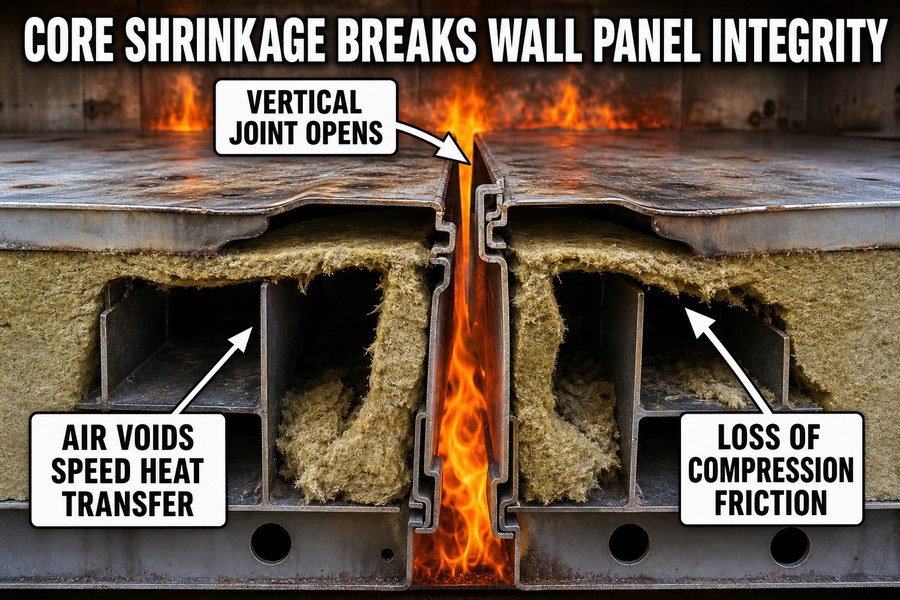
Core shrinkage is a massive problem in marine wall panels. I worked on a big cruise ship project last year. The shipyard rejected a batch of panels because the core shrank too much during testing. Standard mineral wool has a melting point above 1000°C. But it begins to shrink much earlier. It starts shrinking at about 700°C. It can lose up to 4% of its volume. This small shrinkage creates three major failures.
The Opening of Vertical Installation Joints Due to Shrinkage
The first major failure is the opening of vertical installation joints. Marine panels connect using a male and female joint system. When the core shrinks, the edges pull away from each other. The joint opens up. Flames and hot gas shoot right through the gap.13 The fire bypasses the insulation completely. The second failure is the creation of internal air voids. As the core shrinks, it leaves empty spaces inside the steel box. Heat moves very quickly across empty air voids.
Internal Air Voids and the Loss of Compression Friction
The third failure is the loss of compression friction. A good marine panel uses compression to hold the core tightly against the metal skins. When the wool shrinks, it becomes loose. It loses its grip on the steel. The wool sags down to the bottom of the panel. This leaves the top of the wall completely unprotected. The bare steel at the top melts fast.
| Core Shrinkage Failure | Physical Consequence | Impact on Fire Test |
|---|---|---|
| Opening of vertical joints | Creates gaps between panels. | Flames pass through the wall instantly. |
| Creation of internal air voids | Forms empty spaces inside. | Speeds up internal heat transfer. |
| Loss of compression friction | Core sags to the bottom. | Leaves top of the wall unprotected. |
To stop these three failures, you must check the factory's technical data. Ask for rock wool with a low shrinkage rate. High-quality suppliers add special ceramic fibers to stop the shrinkage.
What Ultimate Failure Causes a Breach in a Prolonged Marine Ceiling Panel Fire?
What is the final breaking point of a ceiling panel? If you buy cheap panels, this failure happens way too soon. I will break down the final breach event.
The ultimate breach in a prolonged marine ceiling panel fire is caused by three sequential failures: the complete melting of the mechanical suspension pins, the separation of the joint splines, and the final tearing of the unexposed steel skin due to massive thermal deflection.
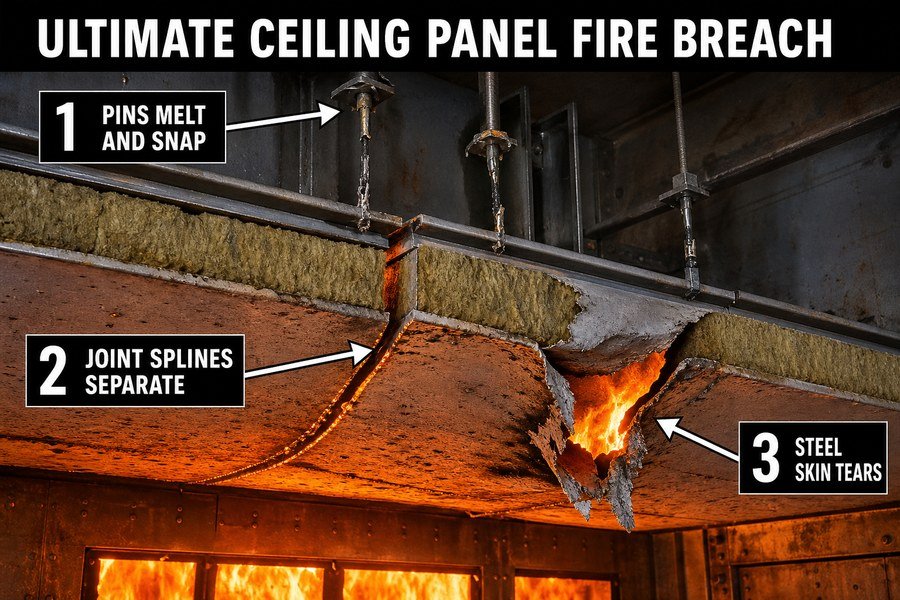
When a marine ceiling panel finally breaches, it is violent. I have reviewed high-speed cameras from standard fire tests. A breach means flames actually break through the unexposed side of the ceiling. This is an immediate test failure. It ruins the A-Class rating. This ultimate breach does not happen all at once. It is caused by three sequential failures. The parts break one by one.
Melting Suspension Pins and Separation of Joint Splines
The first failure is the complete melting of the mechanical suspension pins. These metal pins hold the ceiling to the deck above. They take a lot of heat. At around 800°C, basic steel pins lose all load-bearing capacity.14 They stretch and snap. The ceiling drops down a few inches. The second failure is the separation of the joint splines. The splines connect two ceiling panels together. When the panels drop and bend, the splines pull out of their grooves. A gap opens up between the panels.
Final Tearing of the Unexposed Steel Skin Due to Thermal Deflection
The third failure is the final tearing of the unexposed steel skin. This is caused by massive thermal deflection. The bottom skin expands greatly. The top skin tries to stay rigid. This forces the whole panel to bend like a banana. Eventually, the stress is too much. The steel skin rips open at the seams. Fire comes straight through the hole.
| Sequential Failure Step | Component Involved | Cause of Failure |
|---|---|---|
| Step 1 | Mechanical suspension pins | Pins melt and snap at 800°C. |
| Step 2 | Joint splines | Panels bend and pull splines out. |
| Step 3 | Unexposed steel skin | Massive thermal deflection rips steel. |
You must buy ceilings with heavy-duty suspension systems. Ask your supplier about the yield strength of their pins at high temperatures. Good pins prevent the first failure and stop the whole chain reaction.
Do Decades of Vessel Vibration Weaken a Marine Accommodation Panel's Fire Defenses?
Do older ships fail fire safety checks faster? Constant engine shaking destroys panels over time. Let me show you how vibration secretly kills your panel's fire resistance.
Decades of vessel vibration weaken a marine accommodation panel's fire defenses through three hidden damages: the micro-fracturing of the internal mineral wool fibers, the gradual settling of the core material leaving uninsulated gaps at the top, and the loosening of internal structural glue lines.
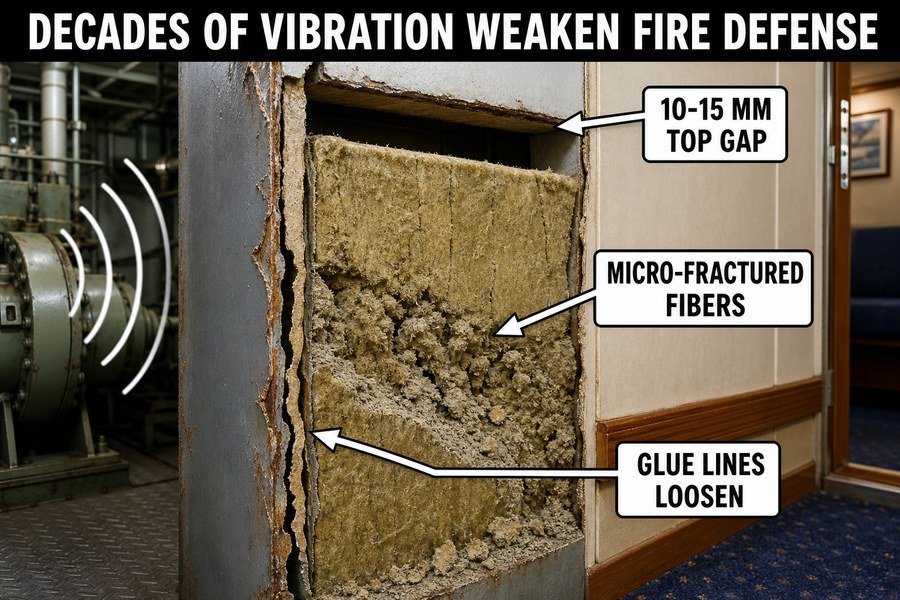
Ship vibration is a silent killer of marine panels. I deal with ship refit projects often. A ship engine creates constant low-frequency vibrations. These vibrations are usually between 5 Hz and 50 Hz15. They shake the walls 24 hours a day. After 15 or 20 years, an A-Class panel is not A-Class anymore. The fire resistance is gone. The vibration causes three hidden damages inside the panel.
Micro-Fracturing of Fibers and Gradual Settling of the Panel Core
The first hidden damage is the micro-fracturing of the internal mineral wool fibers. The constant shaking acts like a saw. The brittle rock wool fibers rub against each other and break. They turn into dust. The second damage is the gradual settling of the core material. As the fibers break into dust, gravity pulls the dust down. The core material sinks. I have seen old panels with a 10mm or 15mm empty gap at the top. There is no insulation left there at all.
Loosening of Internal Structural Glue Lines from Constant Shaking
The third damage is the loosening of internal structural glue lines. The panel uses polyurethane glue to bind the steel skin to the rock wool. Decades of shaking cause glue fatigue.16 The bond cracks and peels away. In a fire, the steel skin will fall off immediately because the glue is already broken.
| Hidden Vibration Damage | Resulting Physical Flaw | Impact on Fire Defense |
|---|---|---|
| Micro-fracturing of fibers | Fibers break into fine dust. | Lowers overall insulation value. |
| Gradual settling of core | 10mm to 15mm gap at the top. | Fire burns through the top instantly. |
| Loosening of glue lines | Steel separates from core. | Skin falls off quickly in a fire. |
You need to select panels designed for high vibration environments. The core density must be very uniform. High-quality marine interior outfitting suppliers use special elastic glues that absorb the engine shaking without cracking.
Conclusion
Understanding internal panel breakdown, binder loss, shrinkage, and vibration damage helps you choose the right suppliers. High-quality marine interior panels save lives and protect your hard-earned reputation.
-
"[PDF] EPA'S NOTICE: FORMALDEHYDE; DRAFT RISK E - Regulations.gov", https://downloads.regulations.gov/EPA-HQ-OPPT-2023-0613-0230/attachment_1.pdf. Technical literature on mineral-wool manufacture describes phenol-formaldehyde resin as a common binder and reports organic binder contents in the low single-digit weight-percent range, supporting the stated binder type and approximate mass fraction. Evidence role: general_support; source type: paper. Supports: Mineral wool commonly uses phenolic resin binder at about 3% to 5% of total mass.. Scope note: The exact binder percentage varies by product density, application, and manufacturer formulation. ↩
-
"Thermal degradation and stability of accelerated-curing phenol ...", https://bioresources.cnr.ncsu.edu/resources/thermal-degradation-and-stability-of-accelerated-curing-phenol-formaldehyde-resin/. Thermal-analysis studies of phenol-formaldehyde resins report the onset of volatile release and early degradation around or above 200°C, providing contextual support for the article’s 200°C off-gassing threshold. Evidence role: mechanism; source type: paper. Supports: Phenolic resin binder can begin off-gassing or thermally degrading around 200°C.. Scope note: The onset temperature depends on resin formulation, curing state, heating rate, and whether the test is conducted in air or inert gas. ↩
-
"Synthesis and Characterization of Bio-Oil Phenol Formaldehyde ...", https://pmc.ncbi.nlm.nih.gov/articles/PMC5554049/. Studies of phenolic-resin thermal oxidation and pyrolysis identify major decomposition, mass loss, and volatile or smoke-producing reactions in the several-hundred-degree Celsius range, supporting the claim that binder degradation becomes severe near 300–400°C. Evidence role: mechanism; source type: paper. Supports: Phenolic resin binder undergoes rapid degradation or oxidation with smoke-producing volatile release between about 300°C and 400°C.. Scope note: The source may support severe degradation in this temperature range but may not directly verify the article’s qualitative phrase “heavy, dark smoke” for every mineral-wool panel. ↩
-
"How Does the IMO FTP Code Govern Fire Testing Procedures for ...", https://magellanmarinetech.com/how-does-imo-ftp-code-govern-fire-testing-procedures-for-marine-panels/. The IMO Fire Test Procedures Code includes a smoke and toxicity test for surface materials, documenting that marine fire-testing regimes assess smoke production limits as part of material approval. Evidence role: historical_context; source type: institution. Supports: Marine material certification includes checks on smoke generation limits.. Scope note: This supports the existence of regulatory smoke-generation testing; it does not prove that every shipyard in Europe or the United States applies the requirement in the same procurement process. ↩
-
"Temperature in Steel Sections - Academia.edu", https://www.academia.edu/72932186/Temperature_in_Steel_Sections. The ISO 834 standard time-temperature relationship is commonly given as T = 20 + 345 log10(8t + 1), which yields approximately 945 °C at 60 minutes. Evidence role: definition; source type: institution. Supports: Under the ISO 834 standard fire test curve, the furnace temperature reaches about 945°C after 60 minutes.. ↩
-
"Thermal Stability and Heat Transfer of Polyurethanes for Joints ...", https://pmc.ncbi.nlm.nih.gov/articles/PMC11279557/. Polymer and adhesive studies report that polyurethane-based adhesives can soften, lose bond strength, or begin thermal degradation in elevated-temperature ranges around 100–200 °C, supporting the mechanism of heat-induced bond failure. Evidence role: mechanism; source type: paper. Supports: Polyurethane glue used in a composite ceiling panel can lose integrity around 150°C, contributing to delamination.. Scope note: The exact failure temperature depends on the polyurethane formulation, additives, cure chemistry, and loading conditions, so the source would contextualize rather than prove a universal 150 °C melting point. ↩
-
"Investigation of the occurrence of binder material on airborne ...", https://pubmed.ncbi.nlm.nih.gov/37104114/. Mineral wool products commonly use organic binders, and fire-exposure studies describe decomposition or burnout of organic binder at elevated temperatures, which can reduce cohesion within the insulation layer. Evidence role: mechanism; source type: paper. Supports: Rock wool binder can burn away during fire exposure, contributing to fiber settlement and thinning of the insulation layer.. Scope note: This supports binder loss as a plausible mechanism but may not establish that complete burnout occurs specifically by 40 minutes in every A-30 or A-60 ceiling assembly. ↩
-
"[PDF] A Overview of Fire Protection in Buildings - FEMA", https://www.fema.gov/pdf/library/fema403_apa.pdf. Structural fire-engineering references and Eurocode-based reduction factors show that carbon steel retains only about half, or less, of its room-temperature yield strength near 600 °C, explaining why steel members sag under sustained fire exposure. Evidence role: expert_consensus; source type: government. Supports: Steel support profiles lose a large share of their yield strength around 600°C, making structural sagging more likely.. Scope note: The exact reduction depends on steel grade, load ratio, heating rate, and whether yield strength or elastic modulus is being referenced. ↩
-
"[PDF] Evaluation of the fire performance of sandwich panel used in the ...", https://nvlpubs.nist.gov/nistpubs/Legacy/RPT/nbsreport10469.pdf. Fire-resistance test standards and furnace-test studies commonly evaluate failure by the temperature rise on the unexposed face, and temperature-time data can show delayed heating followed by rapid increases as insulation performance changes during exposure. Evidence role: general_support; source type: paper. Supports: In fire tests, the unexposed face of insulated panels can remain relatively cool for a period and then rise rapidly rather than degrading linearly.. Scope note: This would support the general non-linear behavior observed in tests, not prove that every rock-wool panel follows the same curve. ↩
-
"Water - the NIST WebBook", https://webbook.nist.gov/cgi/cbook.cgi?ID=C7732185&Mask=2. Thermodynamic references describe water vaporization near 100°C at atmospheric pressure and its large latent heat of vaporization, supporting the mechanism by which moisture can temporarily absorb heat during heating. Evidence role: mechanism; source type: education. Supports: Moisture in rock wool can vaporize near 100°C and absorb substantial heat energy, temporarily slowing temperature rise.. Scope note: The boiling point and heat absorption depend on pressure, pore structure, and actual moisture content inside the panel. ↩
-
"Exploring the Thermal Degradation of Bakelite - PMC - NIH", https://pmc.ncbi.nlm.nih.gov/articles/PMC12390329/. Materials studies of phenolic resins report thermal decomposition and oxidative degradation at elevated temperatures, providing context for binder breakdown during fire exposure. Evidence role: mechanism; source type: paper. Supports: Phenolic resin binders can degrade or ignite at elevated temperatures around the range discussed, contributing heat and changing insulation behavior.. Scope note: A source may support decomposition or oxidation over a temperature range rather than a single universal ignition point of exactly 400°C, which can vary with formulation and oxygen availability. ↩
-
"Determination of Thermal Properties of Mineral Wool Required for ...", https://pmc.ncbi.nlm.nih.gov/articles/PMC10488771/. Fire-performance studies and classification reports for mineral-wool sandwich panels relate core density, thickness, and construction details to fire-resistance ratings, offering contextual support for density as one determinant of one-hour performance. Evidence role: general_support; source type: paper. Supports: A minimum mineral-wool core density may be required for a panel assembly to achieve one-hour fire resistance, but the threshold depends on the full tested system.. Scope note: The exact threshold of 120 kg/m³ is assembly-specific and cannot be treated as a universal requirement without a tested panel configuration and standard fire-resistance rating. ↩
-
"What Is the Purpose and Scope of the IMO FTP Code?", https://magellanmarinetech.com/what-purpose-scope-of-imo-ftp-code/. Fire-resistance guidance for ship divisions treats the passage of flames or hot gases through cracks, joints, or openings as an integrity failure, supporting the claim that opened panel joints can defeat the insulating function of a fire-rated wall assembly. Evidence role: mechanism; source type: institution. Supports: Opened vertical installation joints in marine wall panels can allow flames and hot gases to pass through, bypassing insulation and compromising fire-test performance.. Scope note: Such sources support the general fire-integrity mechanism; they do not by themselves verify that a particular panel design or rejected batch failed in this way. ↩
-
"High Temperature Mechanical Properties of High Strength ...", https://pmc.ncbi.nlm.nih.gov/articles/PMC7890573/. Eurocode-based fire design data and steel-temperature strength-reduction tables show that structural steel retains only a small fraction of its room-temperature yield strength near 800°C, which explains why lightly sized steel suspension pins may no longer sustain design loads in a fire. Evidence role: mechanism; source type: government. Supports: Basic steel suspension pins can lose effective load-bearing capacity at approximately 800°C due to high-temperature strength degradation.. Scope note: This supports severe strength loss at about 800°C, not literal zero capacity for every steel grade, pin geometry, or loading condition. ↩
-
"[PDF] large gearbox vibration monitoring techniques", https://turbolab.tamu.edu/wp-content/uploads/2018/08/Tutorial_8.pdf. Ship-vibration literature describes propulsion and machinery-induced hull vibrations as predominantly low-frequency phenomena, with many operational excitation components falling in the single-digit to tens-of-hertz range. Evidence role: statistic; source type: paper. Supports: Ship engines commonly create low-frequency vibration, often in the approximate 5 Hz to 50 Hz range.. Scope note: The exact frequency band varies by vessel type, engine speed, shafting arrangement, and operating condition, so this would support the range as typical rather than universal. ↩
-
"Enhancing Fatigue Life and Strength of Adhesively Bonded ... - PMC", https://pmc.ncbi.nlm.nih.gov/articles/PMC10573937/. Research on adhesively bonded joints under cyclic loading shows that repeated vibration or fatigue loading can initiate cracks in the adhesive layer and promote progressive debonding at the adherend interface. Evidence role: mechanism; source type: paper. Supports: Long-term vibration can fatigue adhesive glue lines, causing cracking and loss of bond.. Scope note: This evidence supports the general fatigue mechanism in adhesive bonds, not necessarily the exact service life or failure behavior of a specific marine A-Class panel construction. ↩