Worried your ship interior might fail a strict fire inspection? Combustible panels risk lives and delay your entire project. Let us fix this by understanding true non-combustible marine materials.
Non-combustible materials ensure marine panel fire safety through four mechanisms: resisting temperatures above 750°C without burning, stopping flame spread via inorganic cores, producing zero toxic smoke, and limiting total heat release to strictly regulated SOLAS FTP Code thresholds, keeping passenger cabins totally safe.
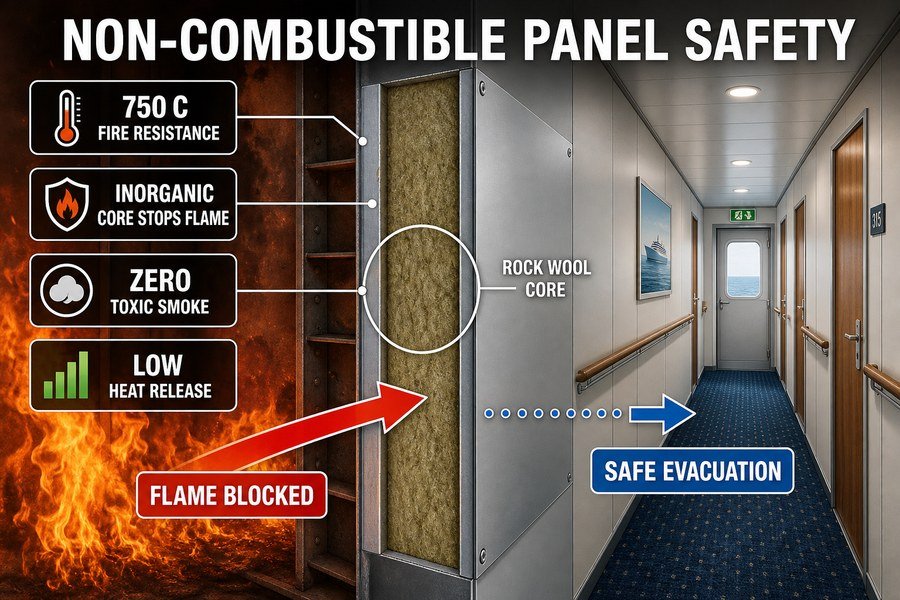
I remember a project where a single wrong panel choice caused a huge delay at the shipyard. Getting the right marine wall panels from Asia saves money, but you must know the technical details first. Let us look closely at how these materials actually work.
What Makes a Marine Interior Panel Material Strictly Non-Combustible Under SOLAS?
Confused about what SOLAS actually accepts for your ships? Buying fake non-combustible panels will ruin your shipyard project. Here is the exact standard you must meet.
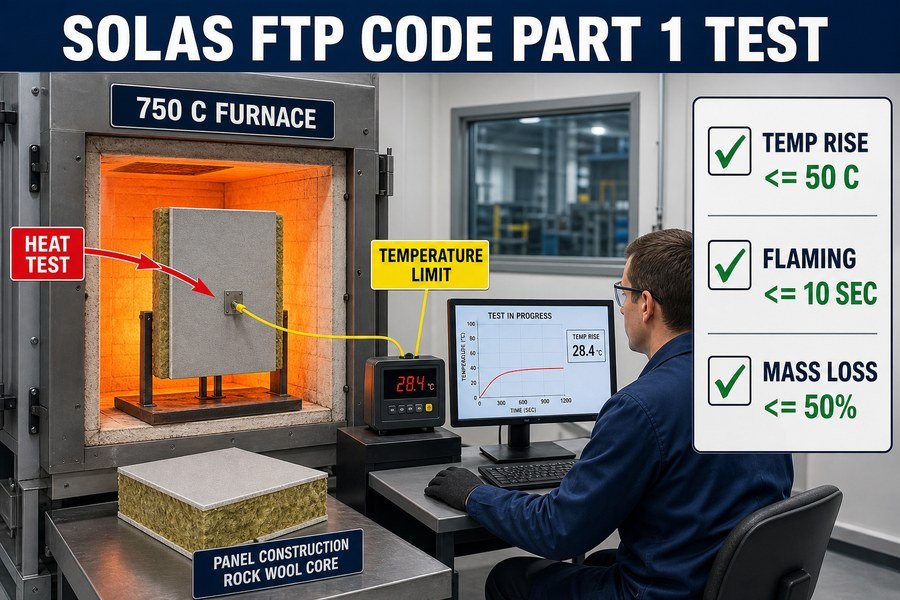
A marine interior panel material is strictly non-combustible under SOLAS if it passes FTP Code Part 1. It must not burn, emit flammable gases in quantities sufficient to ignite, or exceed a temperature rise of 50°C when placed in a 750°C test furnace.
Understanding Temperature Limits for SOLAS Non-Combustible Materials
When you buy marine wall panels, the core material must pass very strict rules. According to the International Maritime Organization (IMO) 2010 FTP Code Part 1, a material is only non-combustible if it survives a harsh test. The laboratory puts a sample of the material into a special furnace. The starting temperature inside this furnace is exactly 750°C. This is very hot. For a material to pass, it must not burn. More importantly, its internal temperature must not go up by more than 50°C above the furnace temperature. This means the material cannot create its own heat. I often see buyers purchase cheap panels that fail this rule. The core gets too hot, feeds the fire, and fails the inspection. You must ask your suppliers in China or Vietnam for the official lab report showing this exact temperature limit.
Tracking Flammable Gases and Material Weight Loss
The snippet also mentions two other vital rules: emitting flammable gases and losing weight. In the same 750°C furnace test, the lab watches for flames. If the material releases flammable gases, those gases will catch fire. The FTP Code states that any sustained flaming cannot last longer than 10 seconds1. If it flames for 11 seconds, the material is combustible. It fails. Also, the lab weighs the material before and after the test. The material must not lose more than 50% of its original weight. If a material burns away, it loses weight and fails the test. True non-combustible materials, like pure rockwool, lose almost zero weight. They do not emit gas. They do not burn. When you check panel quality, always look for these three specific test results. They prove the panel is safe.
| Test Parameter under FTP Code Part 1 | Maximum Allowed Limit | Purpose of the Limit |
|---|---|---|
| Furnace Temperature Rise | 50°C maximum increase | Prevents the material from generating its own heat. |
| Flaming Duration | 10 seconds maximum | Proves the material does not release flammable gases. |
| Material Weight Loss | 50% maximum mass loss | Ensures the material does not burn away completely. |
How Do Inorganic Cores Stop Fire Propagation Within Marine Wall Panels?
Afraid a small cabin fire will spread across the whole deck? Standard cores burn quickly. You need solid inorganic cores to block the flames completely.
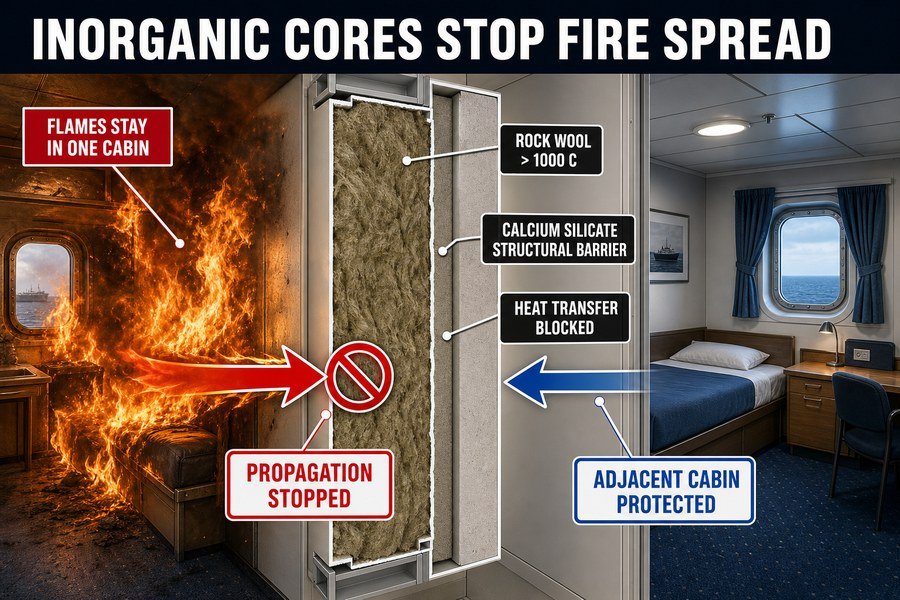
Inorganic cores, such as rockwool and calcium silicate, stop fire propagation in marine wall panels by acting as thermal insulators, refusing to melt below 1000°C, absorbing heat energy without combusting, and maintaining structural integrity to keep flames locked inside a single cabin.
The Role of Rockwool in Blocking Marine Fires
Inorganic cores are made from minerals, not plants or plastics. Let us discuss the four key actions from the snippet. First, they act as powerful thermal insulators. When a fire hits one side of a marine wall panel, the rockwool core stops the heat from reaching the other side. This protects the next room. Second, these materials refuse to melt at normal fire temperatures. According to basic material science, high-quality marine rockwool (made from basalt stone) only melts at temperatures above 1000°C2. Most cabin fires stay around 800°C to 900°C. Because the rockwool does not melt, it forms a solid wall against the fire. When I visit marine panel factories, I always check the density of the rockwool. For a good A-Class fire rating, the rockwool density should be between 120 kg/m³ and 150 kg/m³3. If a supplier offers a very low price, they might use low-density rockwool. This is dangerous and will not stop the fire.
Calcium Silicate Cores as Structural Fire Barriers
Third, inorganic materials absorb heat energy without combusting. Because they have no carbon-based fuel inside them, they simply soak up the heat. They do not add fuel to the fire. Finally, they maintain their structural integrity. This is very important for calcium silicate boards. Shipyards often use calcium silicate for heavy-duty bulkheads. During a real fire, a steel wall might bend or warp. But the strong calcium silicate core stays flat and strong. This keeps the flames locked inside the room where the fire started. It stops the fire propagation completely. If the core breaks, the fire escapes. So, buying panels with certified structural integrity is a very smart move for your interior decoration projects.
| Core Material Type | Melting Point | Typical Density Range | Key Fire Stopping Benefit |
|---|---|---|---|
| Marine Rockwool Core | > 1000°C | 120 - 150 kg/m³ | Excellent thermal insulation; blocks heat transfer. |
| Calcium Silicate Core | > 1200°C | 800 - 1000 kg/m³ | High structural integrity; prevents wall collapse. |
| Aluminum Honeycomb | ~ 660°C (Melts) | 20 - 50 kg/m³ | Poor fire resistance without special treatments. |
Why Do Combustible Adhesives Threaten Otherwise Safe Marine Ceiling Panels?
Think a non-combustible core is enough to keep your ship safe? Hidden glues can start a massive fire. Protect your panel investment by checking the adhesives.
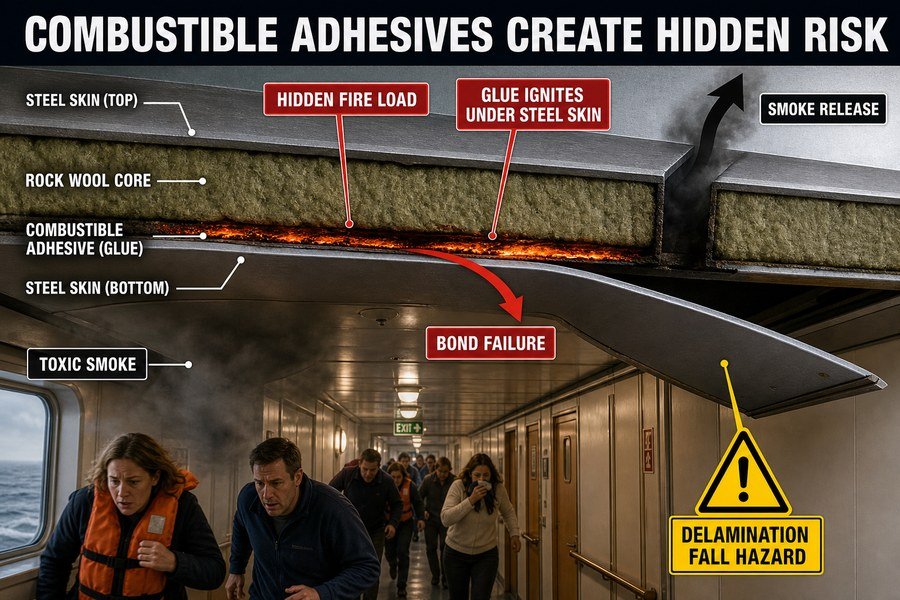
Combustible adhesives threaten marine ceiling panels because they add hidden fire load, can ignite beneath non-combustible steel skins, release toxic smoke when heated, and cause panel delamination during a fire, turning heavy steel sheets into dangerous falling hazards for escaping passengers.
Hidden Fire Loads from Standard Industrial Glues
Even if you buy a marine ceiling panel with good rockwool and steel plates, the glue between them can be dangerous. Let us look at the four threats mentioned in the snippet. First, bad adhesives add a hidden fire load. The "fire load" is the total amount of fuel available to burn. Cheap polyurethane (PU) glues contain a lot of carbon. They are basically liquid plastic. According to the FTP Code Part 5, the total heat value (calorific value) of combustible materials in a panel must be strictly limited.4 Second, these glues can ignite right beneath the non-combustible steel skins. When a fire makes the steel hot, the heat travels to the glue. The glue gets hot, turns into gas, and catches fire inside the panel.5 The fire spreads invisibly inside the ceiling. I have seen panels look fine on the outside, while the glue burned completely on the inside.
Delamination Risks and Passenger Escape Hazards
Third, burning glues release toxic smoke. We will talk more about smoke later, but chemical glues produce very dark, poisonous smoke when they burn.6 Fourth, and most importantly, bad glue causes panel delamination. Delamination means the steel skin separates from the rockwool core. The glue melts and loses its grip. When this happens during a fire, the heavy steel ceiling plates fall down. A falling steel plate will trap or hurt escaping passengers. It is a huge hazard. To fix this, you must buy panels made with special "low flame spread" adhesives. These approved glues hold strong even when hot. They do not add fuel. Always verify that your Asian suppliers use glues that pass IMO FTP Code Part 5.
| Adhesive Type in Marine Panels | Fire Load Risk | Delamination Risk in Fire | Regulatory Status |
|---|---|---|---|
| Standard Commercial PU Glue | High (Burns easily) | High (Melts quickly, plates fall) | Not allowed under SOLAS.7 |
| Marine Approved Epoxy Glue | Low (Hard to ignite) | Low (Maintains strong grip) | Approved if passes FTP Code Part 5. |
| Inorganic Silicate Adhesives | Zero (Does not burn) | Very Low (High heat resistance) | Fully compliant and safe. |
How Does Non-Combustibility Eliminate Smoke Output in Marine Accommodation Panels?
Did you know smoke kills more people on ships than actual flames? Cheap interior panels create deadly black clouds. True non-combustible materials stop this hazard.
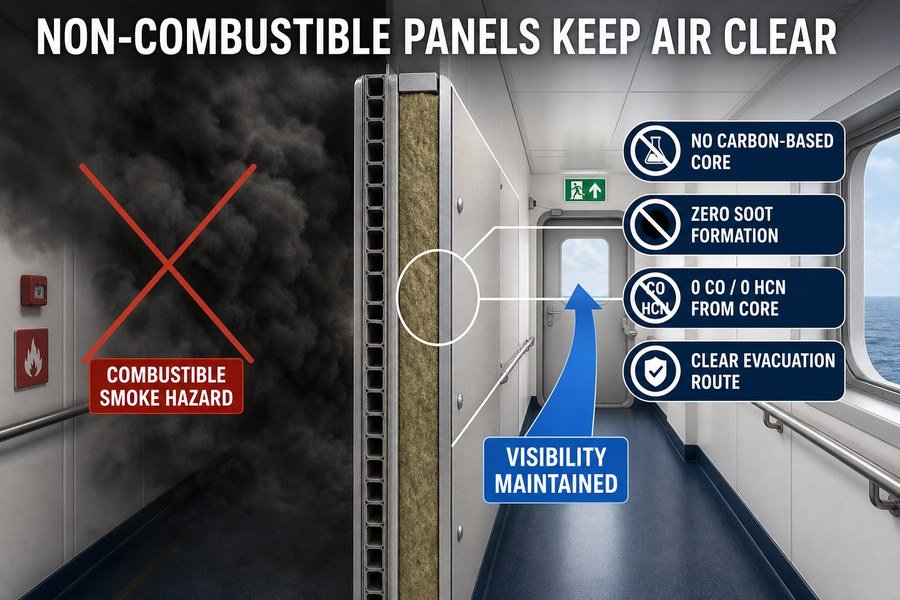
Non-combustible materials eliminate smoke output in marine accommodation panels because they lack carbon-based organic compounds, preventing the chemical breakdown that forms soot, and they produce zero toxic gases like carbon monoxide or hydrogen cyanide, ensuring clear visibility for passenger evacuation routes.
Lack of Organic Compounds in Marine Panel Cores
When a fire happens, smoke is the biggest enemy. Let us break down the three points from our snippet. First, non-combustible materials lack carbon-based organic compounds. Smoke is simply unburned carbon flying in the air. Materials like wood, plastic, or cheap PVC films are full of carbon. When they get hot, they break down. But materials like rockwool or steel are inorganic. They have no carbon. Second, because they have no carbon, they prevent the chemical breakdown that forms soot. Soot is the black dust that makes smoke dark. If you put a pure piece of rockwool in a fire, no black soot comes out. The air stays clear. This is why SOLAS is so strict about using non-combustible base materials. As a procurement officer, you must ensure the core of your panels is 100% inorganic.
Preventing Toxic Gas Emissions During Evacuation
Third, non-combustible materials produce zero toxic gases. When plastics burn, they release poisons. According to the IMO FTP Code Part 2 (Smoke and Toxicity Test), marine materials must not release high levels of deadly gases. For example, carbon monoxide (CO) must be below 1450 ppm, and hydrogen chloride (HCl) must be below 600 ppm8. True non-combustible materials do not release any CO or hydrogen cyanide. They produce zero toxic gas. This keeps the air clean. Clear air ensures clear visibility for passenger evacuation routes. If people can see the doors, and they can breathe easily, they can escape the ship safely. This is the main goal of marine fire safety.
| Toxic Gas Parameter (FTP Code Part 2) | Maximum Limit Allowed | Emission from Pure Non-Combustible Core |
|---|---|---|
| Carbon Monoxide (CO) | < 1450 ppm | 0 ppm |
| Hydrogen Chloride (HCl) | < 600 ppm | 0 ppm |
| Hydrogen Cyanide (HCN) | < 140 ppm | 0 ppm |
| Sulfur Dioxide (SO2) | < 120 ppm | 0 ppm |
How Is the FTP Code Compliance of a Marine Ceiling Panel Core Verified?
Frustrated with fake certificates from bad suppliers? Missing real proof will stop your project at the shipyard. Here is exactly how to verify panel safety.
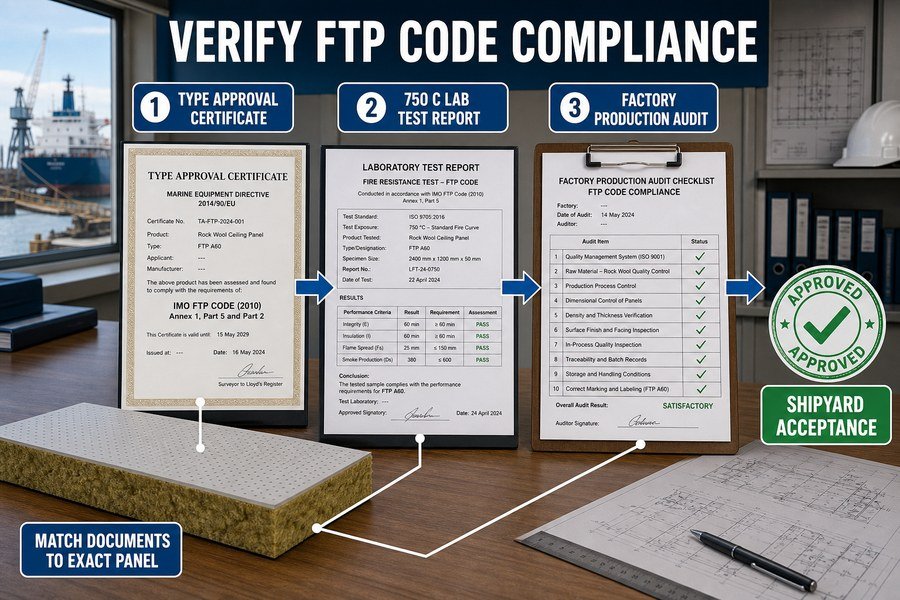
FTP Code compliance of a marine ceiling panel core is verified through three official documents: a valid Type Approval Certificate from a recognized classification society, a detailed laboratory test report passing the 750°C furnace test, and ongoing factory production control audits.
Checking the Type Approval Certificate for Marine Panels
You cannot just trust a supplier when they say a panel is safe. You must check the paper trail. The snippet lists three official documents you need. First, you need a valid Type Approval Certificate. This document is issued by a recognized classification society. Examples include DNV, ABS, Lloyd's Register (LR), or Bureau Veritas (BV). This certificate proves that the design of the marine ceiling panel meets the SOLAS rules9. When you check this paper, look at the expiry date. Many cheap suppliers try to use expired certificates. Also, check the product description. The certificate must clearly say the panel has a "non-combustible core". It is your job as a buyer to match the certificate to the exact product you are buying.
Reviewing Laboratory Test Reports and Factory Audits
Second, you need the detailed laboratory test report. The Type Approval is just a summary. The lab report shows the actual numbers from the 750°C furnace test10 we talked about earlier. It shows the real temperature rise and weight loss data. Ask your supplier for the full 20-page test report, not just the front page. Third, you must ask for proof of ongoing factory production control audits. In Europe, this is often called Module D certification. It means an inspector visits the Chinese or Vietnamese factory every year. The inspector checks if the factory still makes the panels exactly like the one that passed the lab test. If a factory does not have this audit paper, their quality will drop over time. Collecting all three documents ensures your shipyard clients will accept your materials without any arguments.
| Required Verification Document | Issued By | What You Must Check As a Buyer |
|---|---|---|
| Type Approval Certificate | Classification Society (e.g., DNV, ABS) | Valid dates, exact product name, non-combustible rating. |
| Laboratory Test Report | Independent Testing Lab | Furnace temperature rise (< 50°C), mass loss data. |
| Factory Audit Report (Module D) | Classification Society / Notified Body | Annual renewal stamp, quality control system checks. |
How Does Eliminating Combustible Mass Limit Heat Release in a Marine Wall Panel System?
Unsure how a small fire grows into a massive disaster in a room? Too much combustible mass feeds the fire. Stopping this makes your cabins completely safe.
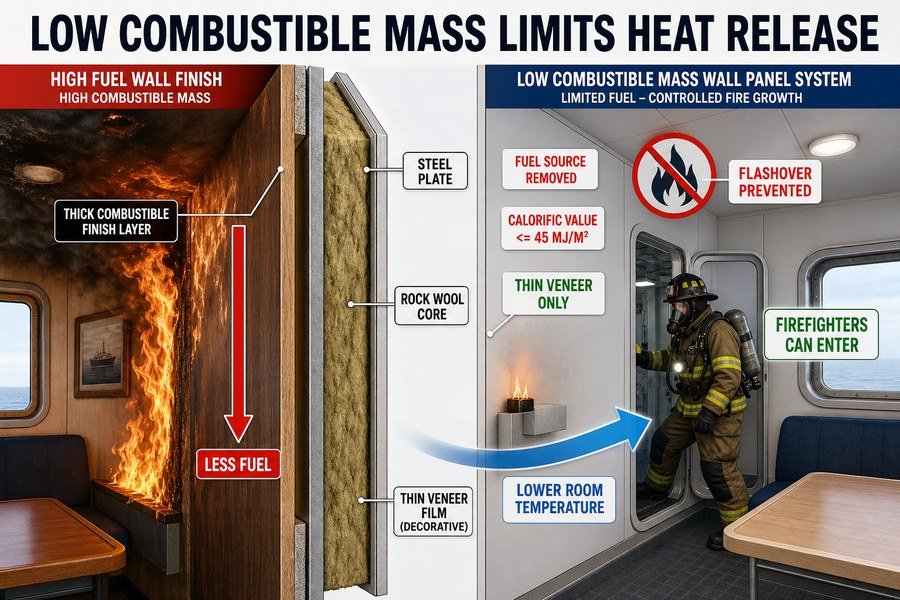
Eliminating combustible mass limits heat release in a marine wall panel system by removing the fuel source, restricting the total calorific value below 45 MJ/m2, preventing flashover events in enclosed cabins, and keeping ambient temperatures low enough for firefighters to enter.
Restricting Total Calorific Value in Marine Wall Panels
A fire needs fuel to grow strong. Let us discuss the four points from the snippet. First, eliminating combustible mass removes the fuel source. A marine wall panel has a non-combustible core, but it often has a decorative PVC film on the outside. This film is combustible mass. If you use too much PVC or thick paint, you add too much fuel. Second, SOLAS rules restrict the total calorific value. According to the FTP Code, the total heat energy (calorific value) of the combustible veneers must not go above 45 MJ/m²11. This is a strict limit. Also, the volume of combustible material cannot be thicker than a 2.5 mm veneer12. When you buy panels, you must ensure the decorative finishes are very thin and have a low heat release value. This keeps the total heat release of the panel very small.
Preventing Flashover Events in Ship Cabins
Third, keeping the heat release small prevents flashover events13. What is a flashover? In an enclosed ship cabin, if a small fire starts, smoke and heat rise to the ceiling. If the wall panels contain too much combustible mass, they catch fire and release more heat. When the room temperature reaches about 500°C to 600°C, every item in the room ignites all at once. That is a flashover. It destroys the room instantly. By using non-combustible panels with low calorific values, the room never gets hot enough to trigger a flashover. Fourth, this keeps the ambient temperatures low enough for firefighters to enter. If the walls do not burn, the fire stays small. The crew can open the door and use a hose to kill the fire. This is how smart material choices save ships.
| Panel Component | Combustibility Status | Calorific Value Limit (SOLAS) | Impact on Room Fire |
|---|---|---|---|
| Rockwool Core | Non-Combustible | 0 MJ/m² | Absorbs heat, stops fire growth. |
| Steel Surface Plate | Non-Combustible | 0 MJ/m² | Blocks flames, adds no fuel. |
| Decorative PVC Film | Combustible | Maximum 45 MJ/m² | Adds minor heat; must be kept very thin. |
Conclusion
Choosing true non-combustible marine panels ensures zero toxic smoke, stops fire spread, and strictly meets SOLAS rules. Always verify certificates and core materials to keep your shipyard projects safe and profitable.
-
"How Does the IMO FTP Code Govern Fire Testing Procedures ...", https://magellanmarinetech.com/how-does-imo-ftp-code-govern-fire-testing-procedures-for-marine-panels/. The FTP Code non-combustibility test criteria limit sustained flaming to no more than 10 seconds during the furnace exposure. Evidence role: definition; source type: institution. Supports: Sustained flaming for longer than 10 seconds is outside the permitted criterion for a non-combustible material in this test.. Scope note: The criterion documents one element of the non-combustibility test and should not be read as a comprehensive assessment of smoke, toxicity, or spread-of-flame behavior. ↩
-
"The Influences of Moisture on the Mechanical, Morphological ...", https://pmc.ncbi.nlm.nih.gov/articles/PMC7288152/. A materials reference on mineral wool or basalt-based fibers can support that these inorganic fibers have melting or softening temperatures around or above 1000°C, explaining why they remain solid under many fire-test conditions. Evidence role: definition; source type: research. Supports: High-quality marine rockwool made from basalt stone only melts at temperatures above 1000°C.. Scope note: The exact melting point varies by formulation and manufacturing process, so the source would support a typical range rather than every marine rockwool product. ↩
-
"What Is the Purpose and Scope of the IMO FTP Code?", https://magellanmarinetech.com/what-purpose-scope-of-imo-ftp-code/. Marine fire-test rules and type-approval documentation for A-class divisions can show how mineral-wool density is specified within tested panel systems, giving context for commonly used 120–150 kg/m³ insulation densities. Evidence role: expert_consensus; source type: institution. Supports: For a good A-Class fire rating, the rockwool density should be between 120 kg/m³ and 150 kg/m³.. Scope note: A-class approval is based on tested assemblies rather than a universal density requirement, so density alone does not prove compliance. ↩
-
"What Is the Purpose and Scope of the IMO FTP Code?", https://magellanmarinetech.com/what-purpose-scope-of-imo-ftp-code/. The IMO FTP Code Part 5 sets test criteria for surface flammability of bulkhead, ceiling, and deck finish materials, including limits related to heat release and combustion behavior for materials used in regulated ship spaces. Evidence role: general_support; source type: institution. Supports: FTP Code Part 5 restricts the combustible contribution of materials used in marine panels.. Scope note: The Code should be cited for the precise test criteria; it may not phrase the requirement exactly as a simple limit on total calorific value for every panel component. ↩
-
"(PDF) Insulated Sandwich Panels and Fire Risk", https://www.academia.edu/57257978/Insulated_Sandwich_Panels_and_Fire_Risk. Fire-safety literature on polymeric adhesives and sandwich panels describes heating-induced decomposition, volatile fuel generation, and concealed flame spread within panel assemblies when combustible core or bonding layers are exposed to sufficient heat. Evidence role: mechanism; source type: paper. Supports: Combustible adhesives can thermally decompose and generate flammable gases inside a heated panel.. Scope note: Such sources support the physical mechanism generally; whether it occurs in a specific ceiling panel depends on adhesive chemistry, panel construction, ventilation, and fire exposure. ↩
-
"Toxicity of combustion products from burning polymers", https://pubmed.ncbi.nlm.nih.gov/1026420/. Studies of polyurethane and other organic polymer combustion report production of smoke and toxic gases, including carbon monoxide and, depending on formulation and burning conditions, nitrogen-containing toxicants such as hydrogen cyanide. Evidence role: mechanism; source type: paper. Supports: Burning organic adhesives, including polyurethane-based glues, can emit dense smoke and toxic combustion products.. Scope note: The exact smoke density and toxicant profile vary by adhesive formulation, additives, oxygen availability, and fire temperature, so the source supports the general hazard rather than every glue product. ↩
-
"What Is the Purpose and Scope of the IMO FTP Code?", https://magellanmarinetech.com/what-purpose-scope-of-imo-ftp-code/. SOLAS and the IMO Fire Test Procedures Code require certain ship interior surface materials and finishes to meet prescribed fire-test performance criteria, so an untested or non-compliant commercial adhesive system would not be acceptable for regulated use. Evidence role: general_support; source type: institution. Supports: A standard commercial PU glue that does not pass the relevant IMO/SOLAS fire-test requirements is not acceptable for regulated marine panel use.. Scope note: This supports the regulatory logic but not a blanket ban on all standard commercial PU glues; compliance depends on the tested panel system and the vessel application. ↩
-
"Toxicity Test Requirements and Performance Criteria for ...", https://railroads.dot.gov/sites/fra.dot.gov/files/2021-02/Toxicity%20Test%20and%20Performance%20Criteria.pdf. The IMO Fire Test Procedures Code, Part 2, specifies smoke and toxicity test criteria for marine materials, including maximum average gas concentrations for carbon monoxide and hydrogen chloride under defined test conditions. Evidence role: case_reference; source type: institution. Supports: IMO FTP Code Part 2 sets maximum allowed concentrations for gases such as carbon monoxide and hydrogen chloride in smoke and toxicity testing.. Scope note: The limits apply within the FTP Code’s prescribed test method and should not be read as universal exposure limits for all fire scenarios. ↩
-
"What Is the Purpose and Scope of the IMO FTP Code?", https://magellanmarinetech.com/what-purpose-scope-of-imo-ftp-code/. SOLAS Chapter II-2 and the IMO Fire Test Procedures Code establish fire-safety requirements and test methods for ship materials, providing regulatory context for why marine ceiling panels require documented fire-performance approval. Evidence role: definition; source type: institution. Supports: The design of a marine ceiling panel must be documented as compliant with SOLAS fire-safety requirements.. Scope note: The source would establish the regulatory framework; whether a particular panel meets SOLAS depends on the exact certificate and test report. ↩
-
"What Is the Purpose and Scope of the IMO FTP Code?", https://magellanmarinetech.com/what-purpose-scope-of-imo-ftp-code/. The IMO Fire Test Procedures Code and related non-combustibility test standards describe a furnace test conducted at approximately 750°C, with results assessed using measurements such as temperature rise, mass loss, and flaming behavior. Evidence role: mechanism; source type: institution. Supports: The laboratory test report for a non-combustible marine panel records results from a 750°C furnace test, including temperature-rise and mass-loss data.. Scope note: Exact acceptance criteria may vary by the applicable edition of the FTP Code, referenced standard, and product application. ↩
-
"What Is the Purpose and Scope of the IMO FTP Code?", https://magellanmarinetech.com/what-purpose-scope-of-imo-ftp-code/. The cited maritime fire-safety rule should support that SOLAS/FTP Code provisions limit the gross calorific value of combustible veneers on bulkheads, linings, and ceilings to 45 MJ/m² in relevant shipboard applications. Evidence role: definition; source type: institution. Supports: The total heat energy, or calorific value, of combustible veneers under SOLAS/FTP Code requirements must not exceed 45 MJ/m².. Scope note: The rule may apply only to specified spaces, materials, and vessel categories under SOLAS, rather than to every marine wall panel universally. ↩
-
"What Is the Purpose and Scope of the IMO FTP Code?", https://magellanmarinetech.com/what-purpose-scope-of-imo-ftp-code/. The source should document the SOLAS/FTP Code restriction that combustible veneers or facings are limited by an equivalent veneer thickness, commonly stated as not exceeding 2.5 mm, for relevant interior surfaces. Evidence role: definition; source type: institution. Supports: Combustible material on relevant marine interior surfaces is limited to an amount equivalent to a 2.5 mm veneer.. Scope note: This supports the regulatory thickness concept only where the cited regulation applies; it may not cover all decorative coatings or all ship types. ↩
-
"Estimating Temperatures in Compartment Fires", https://tsapps.nist.gov/publication/get_pdf.cfm?pub_id=907752. A fire-dynamics source should support that lower fuel load and lower heat-release rate reduce the likelihood or delay the onset of compartment flashover, because flashover depends on heat feedback and fire growth within the enclosure. Evidence role: mechanism; source type: paper. Supports: Reducing heat release from wall-panel materials can reduce or delay the risk of flashover in a ship cabin or similar compartment.. Scope note: Such evidence supports risk reduction or delay, not an absolute guarantee that flashover cannot occur under all ventilation and fuel-load conditions. ↩