Panel face sheets often fail early when you use the wrong metal. Rust and peeling cost you money and ruin your reputation. Here is the right aluminum to choose.
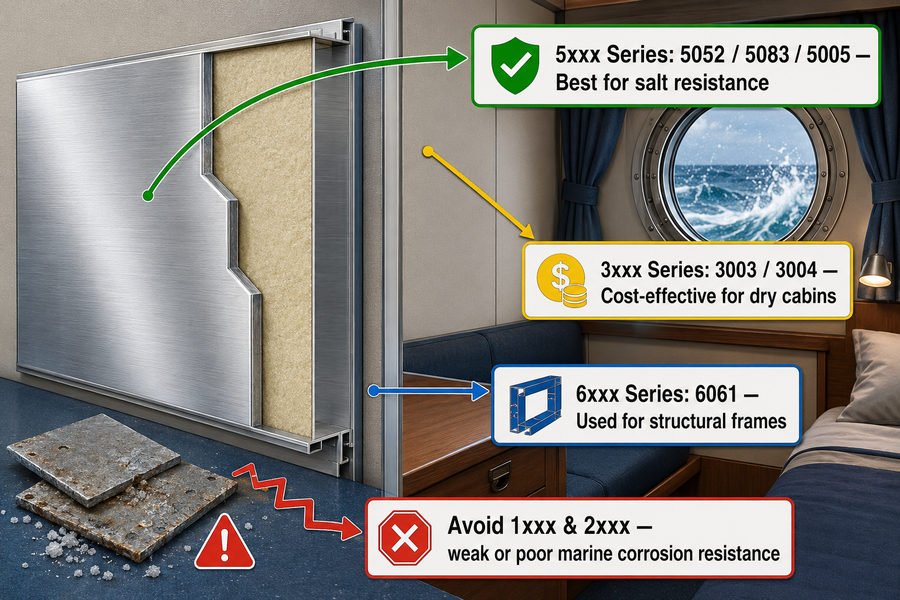
Marine accommodation panel face sheets use 5xxx series (5052, 5083, 5005) for high salt resistance, 3xxx series (3003, 3004) for cost-effective dry cabins, and sometimes 6xxx (6061) for structural frames. You must avoid 1xxx and 2xxx series due to poor strength and rapid marine corrosion.
Let us look closely at these options. Choosing the right metal saves your budget, speeds up your project, and keeps the shipyard happy.
What Is The Difference Between 3003 And 5052 Aluminum Face Sheets For Marine Accommodation Panels?
Many buyers confuse 3003 and 5052 aluminum. Buying 3003 for wet areas ruins panels fast. Let us compare them so you make the right choice.
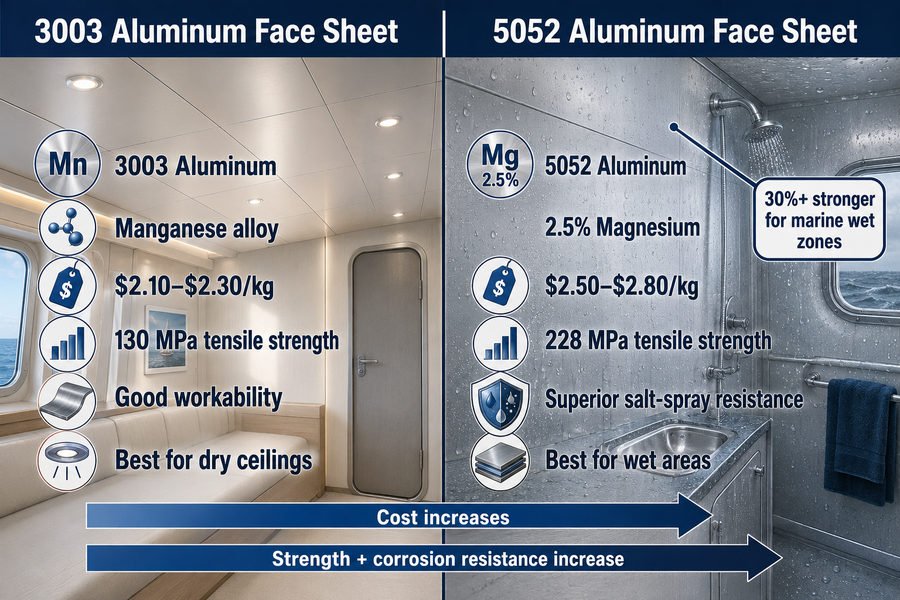
The difference is that 3003 aluminum uses manganese, costing $2.10-$2.30/kg, offering good workability for dry ceilings. 5052 uses 2.5% magnesium, costing $2.50-$2.80/kg, providing 30% higher tensile strength (228 MPa vs 130 MPa) and superior salt-spray resistance for wet areas like ship bathrooms.
I often see buyers try to save money on metal. When I worked at the factory, a client bought 3003 aluminum panels for a wet unit in a ship. Six months later, the panels showed white rust. They had to replace everything. This cost them three times the original price. You need to know the exact differences. The main difference is the chemical makeup. 3003 aluminum uses manganese. 5052 aluminum uses magnesium. This small change makes a big difference in how the metal acts on a ship.
Chemical Composition Of 3003 And 5052 Aluminum
The 3003 alloy contains about 1.2% manganese.1 This makes it about 20% stronger than pure 1100 aluminum. It is easy to bend and cut. But it does not fight salt very well. According to ASTM B209 standards, 5052 alloy contains 2.5% magnesium and 0.25% chromium.2 The magnesium makes it very strong and stops salt air from eating the metal.3
Tensile Strength Comparison For 3003 And 5052
Strength is very important for marine panels. Ship vibrations can crack weak panels. 3003 aluminum in the H14 temper has a tensile strength of about 130 MPa. 5052 aluminum in the H32 temper has a tensile strength of 228 MPa.4 This means 5052 can take much more force before it breaks. It holds screws better and keeps the panel flat.
Cost Differences Between 3003 And 5052 Panels
Price is always a big focus for procurement officers. Based on recent LME (London Metal Exchange) base prices plus processing fees, 3003 aluminum costs around $2.10 to $2.30 per kilogram. The 5052 aluminum costs more. It ranges from $2.50 to $2.80 per kilogram. You pay more for 5052, but you get a product that lasts years longer in a salty environment.
| Feature | 3003 Aluminum | 5052 Aluminum |
|---|---|---|
| Main Alloy Element | Manganese (1.2%) | Magnesium (2.5%) |
| Tensile Strength | ~130 MPa | ~228 MPa |
| Salt Water Resistance | Fair | Excellent |
| Best Application | Dry cabins, inland ceilings | Wet areas, ocean ship walls |
| Average Price per kg | $2.10 - $2.30 | $2.50 - $2.80 |
Why Is 5005 Aluminum Preferred For Marine Accommodation Panel Face Sheets?
You want high quality but also need to control costs. 5052 is great, but 5005 is often the secret choice for smart buyers.
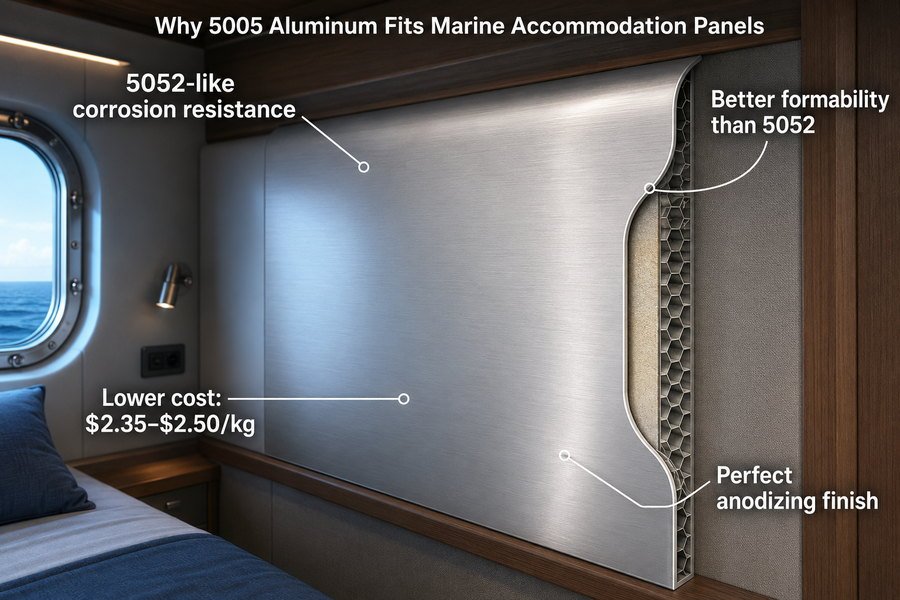
5005 aluminum is preferred because it blends the corrosion resistance of 5052 with the lower cost and better formability of 3003. It contains 0.8% magnesium, costs $2.35-$2.50/kg, and takes anodizing perfectly, making it the ideal middle-ground material for decorative marine wall panels.
In my work at Magellan Marine, I meet many buyers who feel stuck. They cannot afford 5052 for the whole ship. But European shipyards will reject 3003 because of quality rules. I always tell them to look at 5005 aluminum. It solves the problem. 5005 aluminum is the perfect middle choice. It has enough magnesium to stop rust, but it is soft enough to bend easily without cracking.
Balancing Cost And Performance With 5005, 5052, And 3003
We must look at the three main options. We know 3003 is cheap ($2.10-$2.30/kg) but lacks marine strength. We know 5052 is strong and resists salt, but it is expensive ($2.50-$2.80/kg). 5005 aluminum sits right in the middle. It costs about $2.35 to $2.50 per kilogram. It has 0.8% magnesium. This gives it much better salt resistance than 30035. But it is cheaper than 5052. For standard cabin walls, 5005 gives you the best value. Shipyards accept it, and you keep your profit high.
Anodizing Quality Of 5005 Aluminum
Many ship interior panels need a beautiful surface. Shipyards in Europe want perfect colors. 5005 aluminum is famous for how well it takes anodizing6. When you anodize 3003, it can look cloudy because of the manganese. When you anodize 5005, it looks clear and bright. The surface finish is very uniform. This makes 5005 the best choice for decorative panels where looks matter as much as safety.
Formability Of 5005 Aluminum For Panel Edges
Panel factories must fold the edges of the aluminum sheets to make the panels. 5052 can be hard to fold tight without cracking. 3003 folds easily. 5005 also folds very easily. It bends well around tight corners. This means the factory works faster and ruins fewer sheets.
| Aluminum Grade | Magnesium Content | Cost per kg | Anodizing Quality | Bending Ability |
|---|---|---|---|---|
| 3003 | 0% | $2.10 - $2.30 | Poor (cloudy) | Excellent |
| 5005 | 0.8% | $2.35 - $2.50 | Excellent (clear) | Excellent |
| 5052 | 2.5% | $2.50 - $2.80 | Good | Good |
Which Aluminum Grades Resist Corrosion In Marine Accommodation Panels?
Salt air eats normal metals fast. Panel failure delays projects and causes payment issues. Which grades actually survive the ocean air?
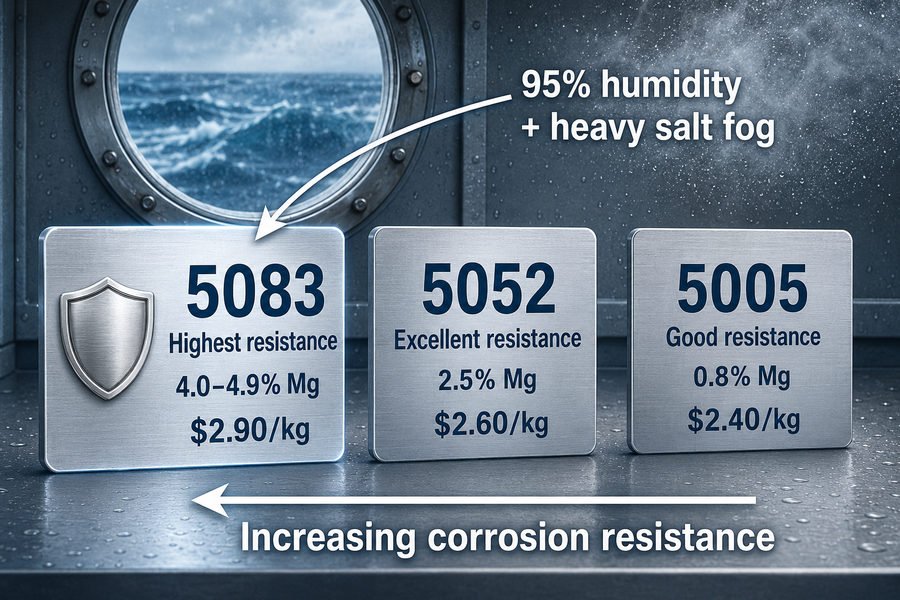
The most corrosion-resistant aluminum grades for marine panels are 5083 (highest resistance, 4.0-4.9% magnesium, $2.90/kg), 5052 (excellent resistance, 2.5% magnesium, $2.60/kg), and 5005 (good resistance, 0.8% magnesium, $2.40/kg). These 5xxx alloys prevent pitting in 95% humidity and heavy salt-fog environments.
I remember a project in Southeast Asia. The local humidity was 95% every day. The salt in the air was very thick. The interior panels sat outside the shipyard for a month before installation. The cheap panels rusted before they even got on the ship. The high-quality panels stayed perfect. If you sell to top shipyards, you must use grades that fight salt. The 5xxx series is the only real choice for true marine environments.7
The Superior Corrosion Resistance Of 5083 Aluminum
If you want the absolute best, 5083 is the king of marine aluminum. It has 4.0% to 4.9% magnesium.8 According to DNV rules for ship materials, 5083 can touch seawater directly and not rust. It costs the most, usually around $2.90 to $3.10 per kilogram. We do not often use it for normal cabin walls because it is too expensive and very hard to bend. But for panels near outside doors or in very wet areas, 5083 will never fail you.
The Excellent Corrosion Resistance Of 5052 Aluminum
As I mentioned before, 5052 is the standard for high-quality marine panels. With 2.5% magnesium, it forms a strong oxide layer on its surface. When salt hits this layer, the metal does not pit. In ASTM B117 salt spray tests, 5052 can last over 1000 hours without serious damage.9 At $2.60 per kilogram, it gives you the best safety for wet rooms and standard walls.
The Good Corrosion Resistance Of 5005 Aluminum
5005 has 0.8% magnesium. It is not as strong against salt as 5083 or 5052. But it is still a marine-grade metal. It resists general air moisture and light salt fog very well. For dry cabins inside the ship, 5005 ($2.40/kg) stops rust completely. You must use 5005, 5052, and 5083 correctly to balance your project costs.
| Aluminum Grade | Magnesium % | Salt Spray Test (ASTM B117) | Best Marine Location |
|---|---|---|---|
| 5083 | 4.0% - 4.9% | > 2000 hours (No pitting) | Exterior doors, heavy wet areas |
| 5052 | 2.5% | > 1000 hours (Minor surface marks) | Ship bathrooms, standard walls |
| 5005 | 0.8% | > 500 hours (Light surface marks) | Dry cabins, interior ceilings |
Is 1100 Aluminum Suitable For Marine Accommodation Panel Face Sheets?
Some suppliers offer very cheap panels. They might secretly use 1100 aluminum to cut costs. Will this pass marine inspection?
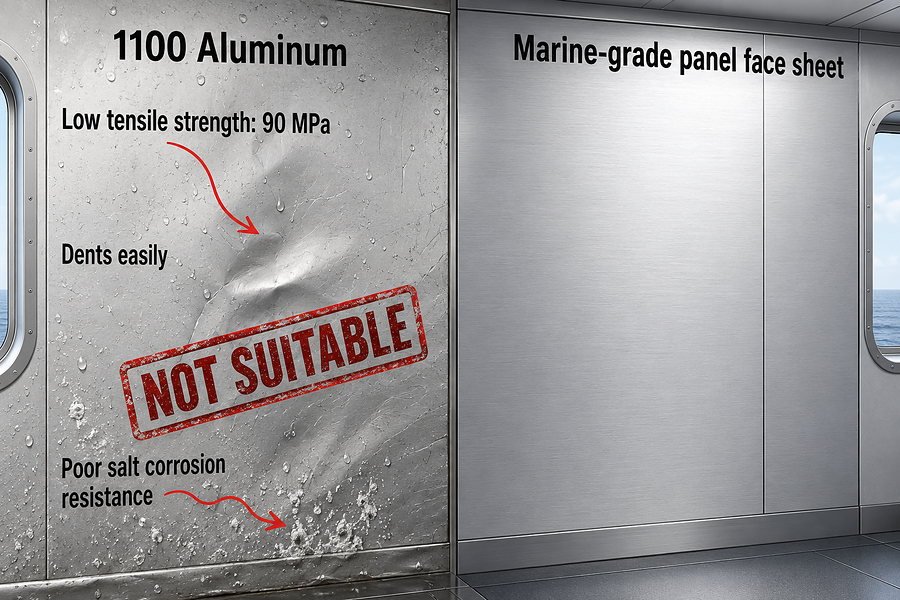
No, 1100 aluminum is not suitable for marine accommodation panel face sheets. Although it is 99.0% pure and cheap ($1.90-$2.10/kg), its tensile strength is too low (90 MPa) and it dents easily. It also lacks the alloying elements needed to stop aggressive salt corrosion.
A client once came to me with a very cheap quote from an unknown factory. The price was 20% lower than my cost. I told him to check the raw material. The factory was using 1100 aluminum. He almost bought it. If he did, the European shipyard would have rejected the whole order. You cannot use 1100 aluminum for ship panels. It is a big mistake.
The High Purity And Low Cost Of 1100 Aluminum
1100 aluminum is commercially pure. It is 99.0% pure aluminum. Because it has no special elements like magnesium or manganese, it is very cheap. The price is usually $1.90 to $2.10 per kilogram. It is very soft and easy to shape. People use it to make food containers and chemical tanks. It does not rust in normal indoor air.
The Low Tensile Strength Of 1100 Aluminum
The biggest problem with 1100 aluminum is its strength. Its tensile strength is only about 90 MPa. Compare this to 5052 aluminum, which is 228 MPa.10 Marine panels must pass heavy impact tests. Sailors drop heavy things on the deck. Doors slam shut. The ship shakes in big waves. If you use 1100 aluminum, the panel face will dent immediately. It will warp. SOLAS rules require materials to hold their shape during a fire and daily use. 1100 aluminum fails these mechanical tests.
Lack Of Alloying Elements To Stop Salt Corrosion
Pure aluminum forms a natural oxide layer. But without magnesium, this layer is weak against strong salt. In a real marine test, salt water breaks the thin oxide layer of 1100 aluminum11. Then, pitting starts very fast. Once pitting starts, the panel gets ugly black and white spots. Paint will peel off. You must avoid 1100 aluminum completely for ship panels.
| Feature | 1100 Aluminum | 5052 Aluminum (For Comparison) |
|---|---|---|
| Purity | 99.0% Pure | Alloyed (Mg, Cr) |
| Tensile Strength | ~90 MPa | ~228 MPa |
| Dent Resistance | Very Poor | High |
| Price per kg | $1.90 - $2.10 | $2.50 - $2.80 |
| Shipyard Approval | Rejected | Approved |
Which Aluminum Temper Suits Formed Marine Accommodation Panel Face Sheets?
Bending panels causes cracks if the metal is too hard. Wasted panels hurt your profit margin and slow down delivery. Which temper works best?
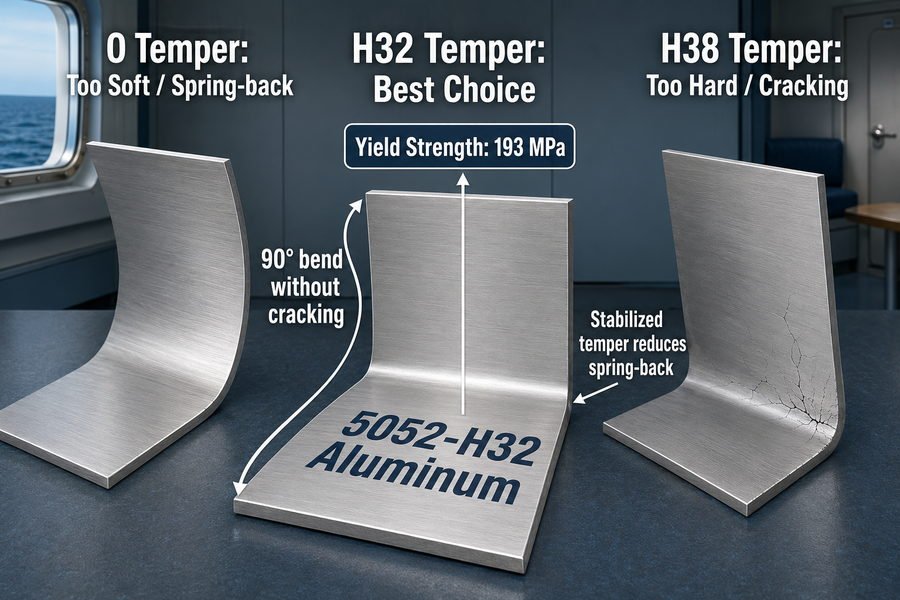
For formed marine accommodation panel face sheets, the H32 temper (strain-hardened and stabilized) is the best choice. It offers a 90-degree bend without cracking, a yield strength of 193 MPa for 5052-H32, and prevents spring-back, outperforming softer O-temper and brittle H38-temper.
When I was an employee at the marine outfitting factory, I saw machines break many aluminum sheets. The sheets cracked right at the fold line. The factory manager yelled at the purchasing team. They bought the right alloy (5052), but the wrong temper. Temper is just as important as the alloy. Temper tells you how hard or soft the metal is.
The Problems With O-Temper Aluminum
The letter "O" means annealed. O-temper aluminum is the softest form. It is fully heated to remove all hardness. It bends very easily. You might think this is good for forming panels. But it is a trap. O-temper 5052 has a yield strength of only 65 MPa.12 It is too soft. When you make a flat panel face sheet out of O-temper, it looks wavy. It does not stay flat. Shipyards hate wavy panels. It looks cheap.
The Problems With H38-Temper Aluminum
The number "8" means full hard. H38 temper is strain-hardened to the maximum safe level. It is very strong. But it has almost no flexibility. If you try to bend a 0.6mm sheet of 5052-H38 to a 90-degree angle for a panel edge, it will snap. The metal cracks completely open. You cannot use full hard temper for parts that need folding.
The Perfect Balance Of H32-Temper Aluminum
The number "2" means quarter hard. H32 means it is strain-hardened and then stabilized with low heat. This is the magic temper for marine panels. 5052-H32 has a yield strength of 193 MPa. This keeps the large flat areas perfectly straight and rigid. But it still allows tight bends. You can fold a 0.6mm sheet of H32 to a sharp 90-degree corner without any cracks. It also limits "spring-back", so the fold stays at exactly 90 degrees.
| Temper Code | Hardness Level | Yield Strength (5052) | Bending Performance | Panel Flatness |
|---|---|---|---|---|
| O | Annealed (Softest) | ~65 MPa | Excellent | Poor (Wavy) |
| H32 | Quarter Hard | ~193 MPa | Excellent | Excellent (Flat) |
| H38 | Full Hard | ~255 MPa | Very Poor (Cracks) | Excellent |
How Does Magnesium Content Affect Marine Accommodation Panel Durability?
Metal chemistry sounds hard. But magnesium is the magic ingredient for marine life. How does it work to protect your investment?
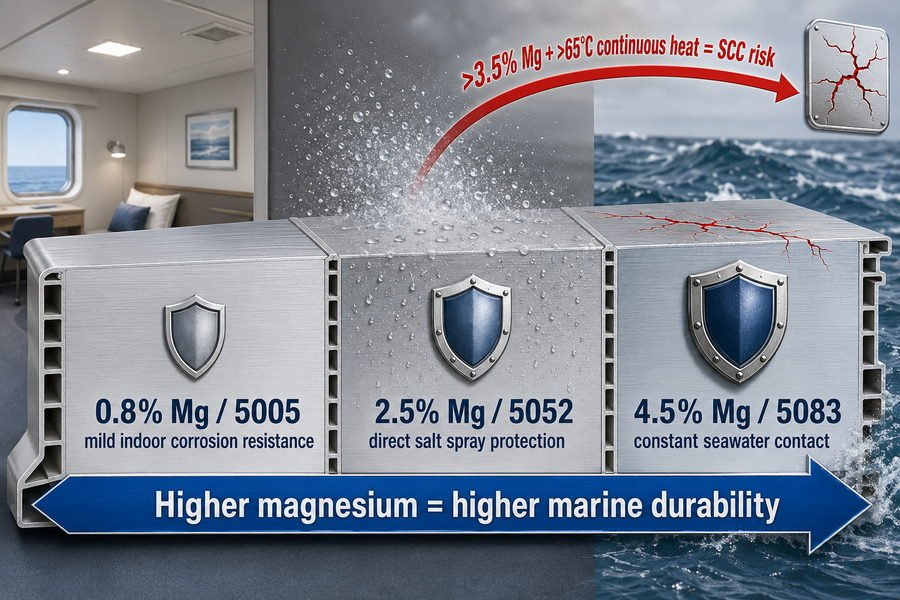
Magnesium content directly dictates durability. At 0.8% (5005), it stops mild indoor corrosion. At 2.5% (5052), it blocks direct salt spray. At 4.5% (5083), it survives constant seawater contact. However, above 3.5%, continuous temperatures over 65°C can cause stress corrosion cracking.
I once helped a client who wanted to use 5083 aluminum everywhere to get the best quality. I stopped him. I explained the science of magnesium. More is not always better. You must match the magnesium level to the exact environment on the ship. Magnesium changes the metal structure. It makes it strong and blocks salt. But you must understand the rules.
Low Magnesium Content (0.8%) For Mild Protection
In 5005 aluminum, the magnesium level is 0.8%.13 This is a low amount. But it is enough to make a solid oxide film14. This film stops moisture in the air from causing white rust. For inside cabin walls, this level of durability is perfect. The metal stays cheap, looks good, and lasts the whole life of the ship in a dry or slightly humid room.
Medium Magnesium Content (2.5%) For Salt Spray Protection
In 5052 aluminum, the magnesium level is 2.5%. This is the sweet spot for marine panels. At 2.5%, the oxide layer becomes very thick and tough. It can handle direct salt spray.15 If a wet bathroom is cleaned with harsh chemicals, the 2.5% magnesium protects the metal. It gives high durability without making the metal too hard to work with.
High Magnesium Content (4.5%) And The 65°C Limit
In 5083 aluminum, the magnesium level goes up to 4.5%. This provides incredible durability against direct, constant seawater. But there is a hidden danger. When aluminum has more than 3.5% magnesium, it changes how it reacts to heat.16 If the panel is placed near an engine room where the temperature stays above 65°C (150°F) for long periods, the magnesium atoms move. This causes Stress Corrosion Cracking (SCC). The metal becomes brittle and cracks suddenly. This is why you must pick the right magnesium level for the right room.
| Aluminum Alloy | Magnesium % | Salt Protection Level | Heat Danger (>65°C) | Best Use |
|---|---|---|---|---|
| 5005 | 0.8% | Mild (Humidity) | Safe | Dry indoor cabins |
| 5052 | 2.5% | High (Salt Spray) | Safe | Wet units, bathrooms |
| 5083 | 4.5% | Extreme (Seawater) | Risk of Cracking (SCC) | Cool, wet exterior areas |
Conclusion
Choosing the correct aluminum alloy, like 5052 or 5005 in H32 temper, ensures your marine panels pass shipyard inspections, resist harsh salt corrosion, and keep your total project costs low.
-
"3003 aluminium alloy - Wikipedia", https://en.wikipedia.org/wiki/3003_aluminium_alloy. A standardized alloy-composition reference lists 3003 aluminum as an Al–Mn alloy with manganese typically around 1.0–1.5%, supporting the stated nominal manganese content. Evidence role: definition; source type: institution. Supports: 3003 aluminum contains about 1.2% manganese.. Scope note: Composition ranges vary slightly by standard and product form, so the source supports an approximate value rather than a single universal percentage. ↩
-
"5052 aluminium alloy - Wikipedia", https://en.wikipedia.org/wiki/5052_aluminium_alloy. A recognized aluminum-alloy composition table identifies 5052 as an Al–Mg alloy containing roughly 2.2–2.8% magnesium and chromium in the approximate 0.15–0.35% range, supporting the stated nominal composition. Evidence role: definition; source type: institution. Supports: 5052 aluminum contains about 2.5% magnesium and 0.25% chromium.. Scope note: The cited ranges should be treated as nominal specification limits; actual mill certificates may report values within, not exactly equal to, those figures. ↩
-
"[PDF] CORROSION OF ALUMINUM ALLOY 2024 BELONGING TO THE ...", https://oaktrust.library.tamu.edu/bitstream/handle/1969.1/ETD-TAMU-3002/GUJARATHI-THESIS.pdf. Research and corrosion handbooks describe 5xxx-series Al–Mg alloys, including 5052, as having comparatively good resistance to marine atmospheric and seawater corrosion because of their stable passive oxide behavior and alloy chemistry. Evidence role: mechanism; source type: paper. Supports: Magnesium-containing 5052 aluminum is stronger and more resistant to salt-air corrosion than 3003 in marine environments.. Scope note: This supports improved corrosion resistance in marine exposure, but it does not prove immunity to corrosion or performance under all shipboard conditions. ↩
-
"[PDF] Understanding the Aluminum Temper Designation System", https://materialsdata.nist.gov/bitstream/handle/11115/186/Understanding%20Temper%20Designation.pdf?sequence=3&isAllowed=y. Published mechanical-property data for wrought aluminum tempers report tensile-strength values in the approximate range of 130 MPa for 3003-H14 and about 220–230 MPa for 5052-H32, supporting the comparison in strength between the two tempers. Evidence role: statistic; source type: research. Supports: 3003-H14 has a tensile strength around 130 MPa, while 5052-H32 is around 228 MPa.. Scope note: Mechanical-property values can vary with sheet thickness, test method, and specification minimums versus typical values. ↩
-
"[PDF] Aluminum Metallurgy - Mechanical & Aerospace Engineering", https://web.mae.ufl.edu/designlab/Online%20Resources_files/Omega%20Research%20Aluminum%20Metallurgy%20Info.pdf. Aluminum alloy references identify 5005 as an Al-Mg alloy and 3003 as an Al-Mn alloy, and corrosion literature generally associates 5xxx Al-Mg alloys with good marine-atmosphere corrosion resistance; this supports the basis for expecting 5005 to outperform 3003 in salt-exposed service. Evidence role: general_support; source type: institution. Supports: 5005 aluminum offers better salt resistance than 3003 because of its magnesium-containing composition.. Scope note: The source may support alloy-family corrosion behavior rather than provide a direct 5005-versus-3003 salt-spray comparison. ↩
-
"Process Specification for the Anodizing of Aluminum Alloys", https://www.nasa.gov/wp-content/uploads/2023/03/prc-5006-current.pdf. Technical references on anodizing and aluminum alloy selection describe AA 5005 as commonly used where a high-quality decorative anodized finish is required, supporting the statement that 5005 is well suited to anodized visible panels. Evidence role: expert_consensus; source type: institution. Supports: 5005 aluminum is particularly suitable for high-quality decorative anodizing.. Scope note: This supports 5005’s suitability for anodizing in general, but does not by itself prove superiority for every ship-interior panel specification. ↩
-
"[PDF] Corrosion and Protection of Aluminum Alloys in Seawater - OSTI.GOV", https://www.osti.gov/etdeweb/servlets/purl/20671863. Authoritative materials references describe 5xxx-series aluminum-magnesium alloys as widely used in marine applications because magnesium improves corrosion resistance in chloride-containing environments. Evidence role: expert_consensus; source type: institution. Supports: 5xxx-series aluminum alloys are especially suitable for marine environments because of their corrosion resistance.. Scope note: This supports the general suitability of 5xxx alloys for marine service, but not the absolute claim that they are the only viable choice in all marine environments. ↩
-
"5083 aluminium alloy - Wikipedia", https://en.wikipedia.org/wiki/5083_aluminium_alloy. Standard alloy composition tables list aluminum alloy 5083 as containing approximately 4.0–4.9% magnesium by weight. Evidence role: definition; source type: institution. Supports: 5083 aluminum contains about 4.0% to 4.9% magnesium.. ↩
-
"[PDF] Corrosion of Bare and Coated Al 5052-H3 and Al 6061-T6 in Seawater", https://www.hnei.hawaii.edu/wp-content/uploads/Corrosion-of-Aluminum-Alloys-in-Seawater.pdf. Published salt-spray or corrosion-testing data for 5052 aluminum can document reported exposure durations and observed surface degradation under ASTM B117 conditions. Evidence role: statistic; source type: paper. Supports: 5052 aluminum can withstand more than 1000 hours in ASTM B117 salt-spray testing without serious damage.. Scope note: ASTM B117 results are accelerated laboratory-test outcomes and do not directly predict service life in all real marine environments. ↩
-
"[PDF] Aluminum and Aluminum Alloys - NIST Materials Data Repository", https://materialsdata.nist.gov/bitstream/handle/11115/173/Aluminum%20and%20Aluminum%20Alloys%20Davis.pdf. Authoritative aluminum-alloy property tables report substantially lower tensile-strength ranges for AA 1100 than for AA 5052, supporting the comparison that 1100 is mechanically weaker for structural or impact-prone panel applications. Evidence role: statistic; source type: institution. Supports: 1100 aluminum has much lower tensile strength than 5052 aluminum, making it less suitable for dent- or impact-prone marine panels.. Scope note: Exact tensile-strength values depend on temper, product form, and test standard, so a source should support the stated values or clarify the applicable temper. ↩
-
"[PDF] CORROSION OF ALUMINUM ALLOY 2024 BELONGING TO THE ...", https://oaktrust.library.tamu.edu/bitstream/handle/1969.1/ETD-TAMU-3002/GUJARATHI-THESIS.pdf. Corrosion studies on aluminum in chloride-containing environments describe how chloride ions can locally disrupt the passive aluminum oxide film and initiate pitting, providing mechanistic support for concern about 1100 aluminum in seawater exposure. Evidence role: mechanism; source type: paper. Supports: Saltwater chloride can damage the passive oxide layer on 1100 aluminum and initiate pitting corrosion.. Scope note: This supports the corrosion mechanism in chloride environments, but it does not by itself prove that every 1100 aluminum ship panel will fail rapidly under all coatings, tempers, and service conditions. ↩
-
"[PDF] Aluminum and Aluminum Alloys - NIST Materials Data Repository", https://materialsdata.nist.gov/bitstream/handle/11115/173/Aluminum%20and%20Aluminum%20Alloys%20Davis.pdf. A materials-property handbook or university materials database reporting tensile properties for AA 5052 in the O temper supports the stated low yield-strength range relative to strain-hardened tempers; it does not by itself prove that finished panels will appear wavy in every fabrication setting. Evidence role: statistic; source type: education. Supports: O-temper 5052 has a yield strength of about 65 MPa.. Scope note: The source would support the material property value, while the visual flatness outcome also depends on sheet thickness, panel geometry, forming process, and installation conditions. ↩
-
"5005 aluminium alloy - Wikipedia", https://en.wikipedia.org/wiki/5005_aluminium_alloy. A recognized alloy-composition reference gives the nominal magnesium range for AA 5005 aluminum, supporting the statement that 5005 is a low-magnesium 5xxx-series alloy. Evidence role: definition; source type: institution. Supports: 5005 aluminum has a low magnesium content of about 0.8%.. Scope note: Composition standards usually provide allowable ranges rather than a single exact percentage, so the source may support 0.8% as nominal or approximate rather than universal. ↩
-
"In Situ Synthesis of Oxide Film on Aluminum Alloy for Enhanced ...", https://ui.adsabs.harvard.edu/abs/2026JMEP..tmp..113L/abstract. Materials-science references describe aluminum’s spontaneous formation of a protective oxide film and the role of alloy chemistry in corrosion behavior, supporting the mechanism by which aluminum alloys resist atmospheric moisture. Evidence role: mechanism; source type: education. Supports: A low-magnesium aluminum alloy can form a protective oxide film that helps resist moisture-related corrosion.. Scope note: This supports the general passivation mechanism; it does not directly prove that 5005 panels will last for the whole life of a ship in every cabin environment. ↩
-
"Insight of Salt Spray Corrosion on Mechanical Properties of TA1 ...", https://pmc.ncbi.nlm.nih.gov/articles/PMC9736290/. Corrosion studies and alloy references commonly classify AA 5052 as a marine-service aluminum alloy with good resistance to chloride-containing atmospheres, providing support for its use under salt-spray exposure. Evidence role: general_support; source type: paper. Supports: 5052 aluminum, with medium magnesium content, has good corrosion resistance under marine or salt-spray exposure.. Scope note: Salt-spray performance depends on coating, surface finish, exposure duration, cleaning chemicals, and design details; the source may support suitability in principle rather than guarantee performance in all bathrooms or marine panels. ↩
-
"Stress Corrosion Cracking (SCC) Resistance of the AW-5083 Alloy ...", https://pmc.ncbi.nlm.nih.gov/articles/PMC12786703/. Research on 5xxx-series aluminum alloys reports that alloys with more than about 3 wt.% magnesium can become sensitized during prolonged exposure to moderately elevated temperatures, forming magnesium-rich grain-boundary phases associated with intergranular corrosion and stress-corrosion cracking. Evidence role: mechanism; source type: paper. Supports: High-magnesium 5xxx aluminum alloys such as 5083 can become susceptible to stress-corrosion cracking after prolonged elevated-temperature exposure.. Scope note: The precise temperature-time threshold varies by alloy temper, prior processing, and exposure duration; the evidence supports the risk mechanism rather than proving every panel above 65°C will crack. ↩