Are heavy interior panels slowing down your shipbuilding projects? High fuel costs and strict fire codes demand better materials. Aluminum honeycomb cores offer the perfect solution.
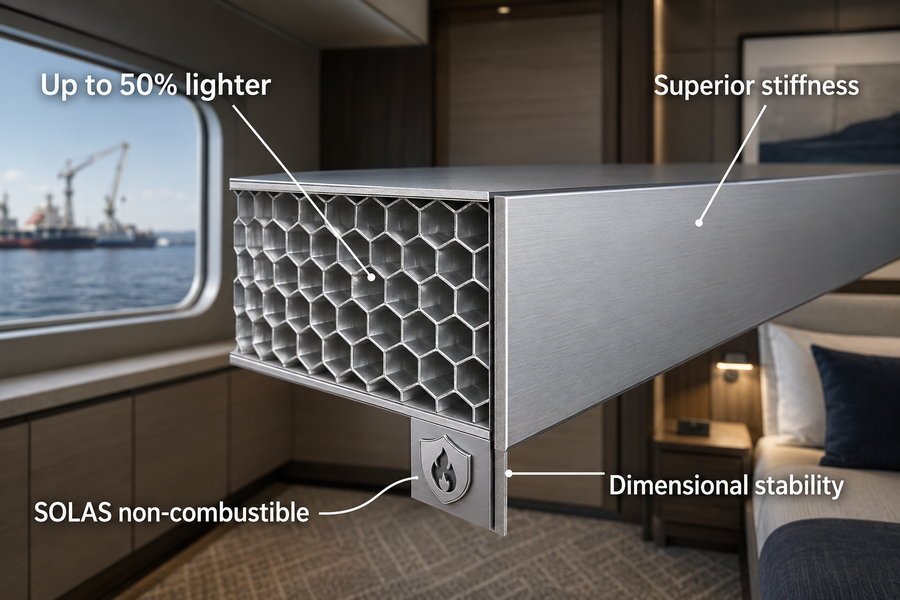
Aluminum honeycomb core is chosen for marine accommodation panels because it provides an unmatched combination of extreme weight reduction (up to 50% lighter than mineral wool), superior stiffness, true non-combustibility meeting SOLAS standards, and exceptional dimensional stability, making it ideal for high-end shipyard projects and rigorous topside stability requirements.
When you buy outfitting products from developing countries, balancing quality and price is tough. Let me break down exactly why this core material solves these shipyard demands and how it impacts your projects.
How Much Weight Does Aluminum Honeycomb Core Save in Marine Accommodation Panels?
Heavy interior bulkheads kill vessel speed and burn too much fuel. If your client complains about weight limits, you need a drastic change. Here is the real weight difference.
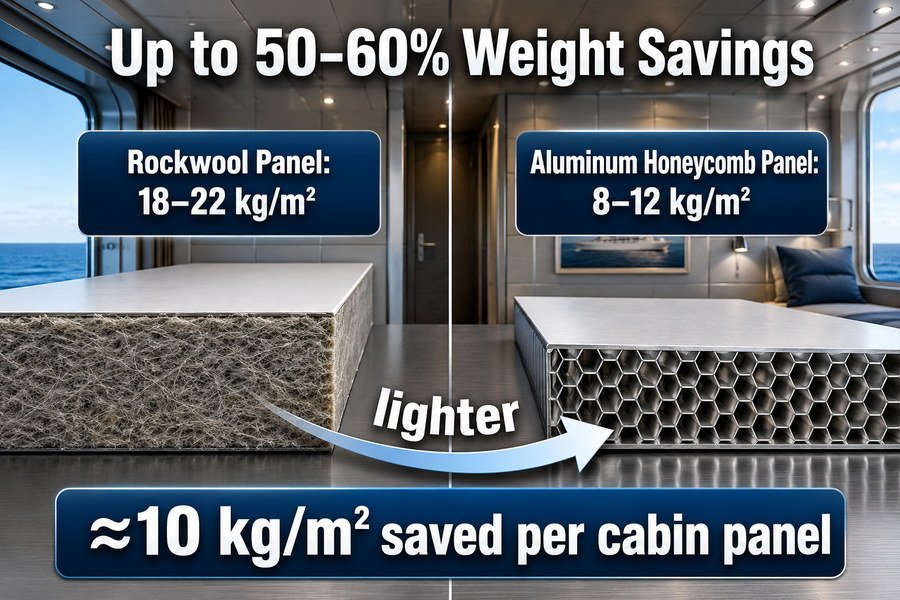
Aluminum honeycomb cores save up to 50-60% of weight compared to traditional A-Class rockwool panels. A standard 50mm honeycomb panel weighs roughly 8 to 12 kg/m², whereas a 50mm high-density mineral wool panel weighs between 18 and 22 kg/m², yielding savings of about 10 kg/m² per cabin.
In my experience at Magellan Marine, weight is the first thing European and American shipyards check. Every extra kilogram costs money over the lifespan of a ship.1 By choosing an aluminum honeycomb core, you directly fix this problem. We must look at the exact numbers to understand the impact of this choice on an entire project. The difference between 50-60% weight reduction is huge when you multiply it across hundreds of cabins.
Weight Comparison Between Honeycomb and Mineral Wool Panels
To see the real value, you must compare a standard 50mm honeycomb panel against a 50mm high-density mineral wool panel. Ship interior design manuals and major manufacturer catalogs show that a 50mm mineral wool panel weighs about 18 to 22 kg/m²2. This is because rockwool is a dense stone fiber. A 50mm aluminum honeycomb panel weighs only 8 to 12 kg/m².3 You save an average of 10 kg/m². If a standard cruise ship cabin uses 40 square meters of wall panels, you save 400 kg per cabin. For a ship with 1,000 cabins, that equals 400 tons of dead weight removed from the interior alone. This massive weight drop means the shipyard can add more passenger amenities like pools or larger dining areas.
Impact of Panel Weight on Marine Fuel Consumption and Logistics
The lower weight of the 50-60% lighter panels changes your entire logistics plan. When you order materials from China or Vietnam, shipping heavy rockwool panels fills up shipping container weight limits fast. You end up paying to ship heavy air. Because honeycomb panels are lighter, you can load more panels into a single container without hitting the road weight limits at the port. This drops your total shipping cost. For the shipyard, less weight means the ship burns less fuel. According to standard marine engineering formulas, reducing a ship's weight by just 1% can cut fuel consumption by about 0.5% to 1%.4
| Feature (50mm Panel Thickness) | Aluminum Honeycomb Panel | High-Density Mineral Wool Panel |
|---|---|---|
| Average Core Density | 30 - 80 kg/m³ | 120 - 150 kg/m³ |
| Total Panel Weight | 8 - 12 kg/m² | 18 - 22 kg/m² |
| Weight Saved Per m² | Base Value | Adds ~10 kg/m² |
| Freight Efficiency | High (Volume limited) | Low (Weight limited first) |
What Stiffness-to-Weight Ratio Does Aluminum Honeycomb Core Deliver in Marine Accommodation Panels?
Flimsy panels cause warping under sea conditions. You lose money replacing bent walls. How do you ensure high strength without adding massive weight? The answer is the honeycomb structure.
Aluminum honeycomb cores deliver an exceptionally high stiffness-to-weight ratio, typically offering a shear strength of 1.0 to 2.5 MPa and compressive strength of 1.5 to 3.0 MPa at a density of just 30 to 80 kg/m³, easily outperforming both solid aluminum and composite foams in structural rigidity.
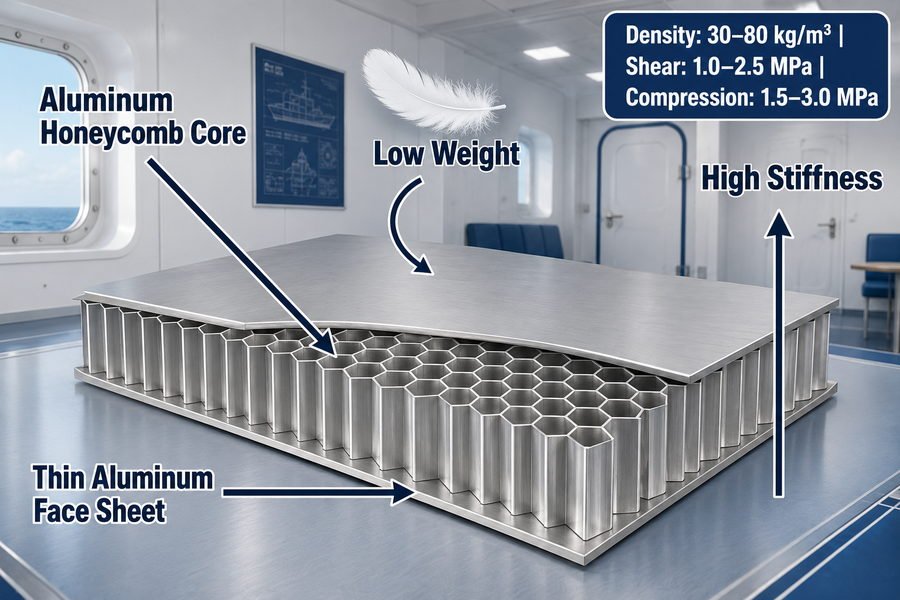
Ship vibrations tear weak panels apart over time. The shipyard relies on your panels to stand straight and look perfect for years. I always tell my clients that looking at density alone is a mistake. You must look at how the shape of the core handles pressure. The hexagonal shape acts like thousands of tiny pillars supporting the metal skins.5 This design gives the exact strength you need without the heavy mass of solid materials.
Compressive and Shear Strength of Honeycomb Structures
The numbers prove the strength. Standard testing data for marine-grade aluminum honeycomb cores shows a shear strength between 1.0 and 2.5 MPa. The compressive strength ranges from 1.5 to 3.0 MPa. The density stays very low, at just 30 to 80 kg/m³.6 When passengers lean on the walls or when heavy doors slam shut, the panel takes a sudden impact. The 1.5 to 3.0 MPa compressive strength means the core will not crush inward. The 1.0 to 2.5 MPa shear strength means the panel will not slide or twist under side-to-side ship movements. These exact ratings ensure the walls remain perfectly flat. If you buy cheap panels with poor core strength, the metal skins will pop off the core after a few months at sea.
Comparing Honeycomb Rigidity Against Solid Metal and Composite Foams
When we look at other options, honeycomb wins every time. Solid aluminum provides great strength, but it is much too heavy. Solid aluminum has a density of about 2,700 kg/m³.7 You cannot build cabin walls out of solid thick metal. Composite foams, like PVC or PU foam, are light. They have densities of 40 to 100 kg/m³. But they fail in strength. Foams bend easily and have much lower shear strength compared to the aluminum honeycomb.8 The hexagonal geometry uses the least amount of material to reach the highest possible stiffness. It gives the shipyard the rigidity of thick metal at a fraction of the weight of composite foams.
| Material Type | Density Range (kg/m³) | Compressive Strength | Shear Strength | Rigidity Profile |
|---|---|---|---|---|
| Aluminum Honeycomb Core | 30 - 80 | 1.5 - 3.0 MPa | 1.0 - 2.5 MPa | Extreme stiffness, very light |
| Composite PVC Foam Core | 60 - 100 | 0.9 - 1.5 MPa | 0.5 - 1.2 MPa | Low stiffness, bends easily |
| Solid Aluminum Sheet | ~2,700 | Very High | Very High | Far too heavy for bulkheads |
Which Aluminum Honeycomb Cell Size Suits Marine Accommodation Panels?
Picking the wrong cell size ruins the panel. If the cells are too big, the surface dents easily. If too small, costs skyrocket. You need the right specifications.
The ideal aluminum honeycomb cell sizes for marine accommodation panels are 6.4mm (1/4 inch), 9.5mm (3/8 inch), and 12.7mm (1/2 inch). A 6.4mm cell provides maximum surface smoothness for thin skins, while 9.5mm and 12.7mm cells offer the best cost-to-strength balance for standard bulkhead partitions.
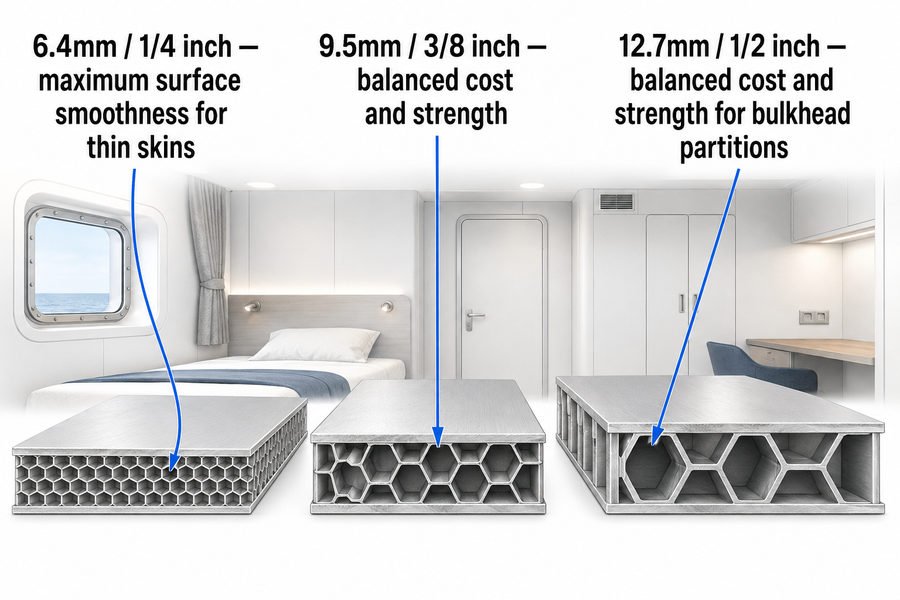
Cell size dictates both your final price and your product quality. When I visit factories in China and Vietnam, the first thing I measure is the honeycomb cell size. A smaller cell size uses more aluminum foil9, which drives up your purchase price. But a larger cell size leaves wide gaps under the surface skin. If you do not match the cell size to the shipyard's wall requirements, you will either lose money or get a rejected product. We have three main sizes to consider.
High-Strength Applications Using 6.4mm Honeycomb Cells
The 6.4mm (1/4 inch) cell size is the premium choice. Because the cells are very small, there are many more cell walls supporting the outer metal skins10. This size is strictly used when you need maximum surface smoothness. Sometimes, high-end cruise ships use very thin decorative surface skins, around 0.5mm to 0.7mm thick. If you put a thin skin over a large cell core, the surface will look dimpled11. This is called the "telegraphing" effect. The 6.4mm cell stops this completely. It provides a flawless, glass-like flat surface. I recommend this size for VIP cabins, luxury public areas, and any place where the visual finish must be perfect under bright lights.
Cost-Effective Bulkhead Partitioning with 9.5mm and 12.7mm Cells
For the majority of the ship, you do not need 6.4mm cells. Standard crew cabins, hallways, and working areas use standard bulkhead partitions. Here, you should buy panels with 9.5mm (3/8 inch) or 12.7mm (1/2 inch) cells. These sizes offer the best cost-to-strength balance12. The 9.5mm cell is very common for standard 50mm thick wall panels. It holds up well to normal wear and tear. The 12.7mm cell uses the least amount of foil among the three. This makes it the cheapest option. If your surface skin is thick enough, like 1.0mm steel or thicker aluminum, the 12.7mm cell works perfectly fine without showing dimples. Choosing the 9.5mm or 12.7mm sizes keeps your budget low while passing all basic strength tests.
| Cell Size (mm / inch) | Primary Advantage | Best Marine Application | Relative Cost |
|---|---|---|---|
| 6.4mm (1/4") | Maximum surface smoothness, high strength | VIP cabins, thin decorative skins | High |
| 9.5mm (3/8") | Great cost-to-strength balance | Standard cabin walls, regular skins | Medium |
| 12.7mm (1/2") | Lowest material cost, good basic strength | Thick skin bulkheads, large partitions | Low |
Is Aluminum Honeycomb Core Non-Combustible Per Marine Accommodation Panel Standards?
Fire safety is the biggest hurdle for ship interiors. One failed inspection means the shipyard rejects your panels. You must know how honeycomb cores hold up against strict fire rules.
Yes, bare aluminum honeycomb core is strictly non-combustible and fully complies with IMO FTP Code Part 1 and SOLAS regulations. It has a melting point of approximately 660°C. When combined with proper face sheets, it successfully forms C-Class partitions and contributes to B-Class and A-Class fire-rated bulkhead assemblies.
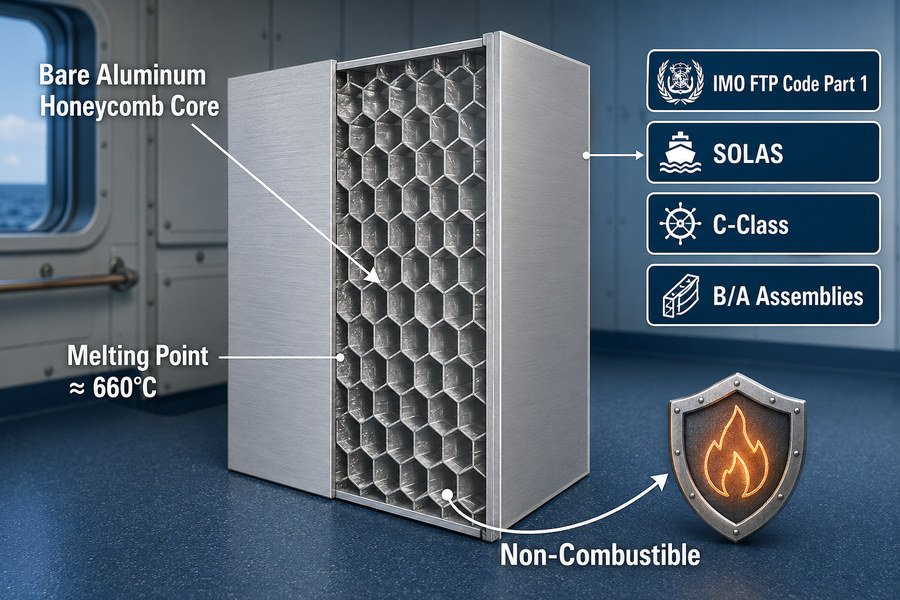
When selling to shipyards in Europe or America, the fire certificate is your ticket to entry. If you cannot prove your material is safe, nobody will buy from you. I have helped many buyers navigate these fire rules. Aluminum honeycomb is brilliant because it is just metal. But we must understand how it fits into the International Maritime Organization (IMO) rules and the different fire classes. You need to know how it acts alone and how it acts as part of a whole wall system.
Compliance with IMO FTP Code Part 1 for Non-Combustibility
The IMO Fire Test Procedures (FTP) Code Part 113 is the absolute law for marine materials. This test proves if a material burns and creates smoke. Bare aluminum honeycomb core passes this test perfectly.14 It is 100% metal. It does not ignite, it does not create toxic smoke, and it does not spread flames. The melting point of the aluminum alloy used in these cores is approximately 660°C.15 During a severe ship fire, temperatures can reach over 900°C. The aluminum core will melt at 660°C, but it will never catch fire or add fuel to the flames. Because it is non-combustible, you can safely use it as the base material for all types of marine interiors.
Integrating Honeycomb Cores into C-Class, B-Class, and A-Class Assemblies
A bare core is not a finished wall. The shipyard needs C-Class, B-Class, and A-Class partitions. The aluminum core easily forms a C-Class partition. C-Class walls just need to be non-combustible and do not need to stop heat transfer. When you need B-Class or A-Class ratings, things change. A-Class and B-Class walls must stop fire and stop heat from passing through.16 Because aluminum transfers heat quickly, the honeycomb core alone cannot pass the A-Class heat test. To fix this, factories add a thin layer of ceramic paper or special fire-resistant boards inside the panel. The honeycomb core provides the lightweight structure, and the extra layers provide the heat block. This combination creates fully certified B-Class and A-Class panels.
| Fire Class Rating | Requirement | How Honeycomb Core Fits In |
|---|---|---|
| C-Class | Non-combustible only | Forms the entire panel easily with standard skins. |
| B-Class (e.g., B-15) | Stops fire, limits heat for 15 mins | Used as structural core, paired with light fire insulation. |
| A-Class (e.g., A-60) | Stops fire, limits heat for 60 mins | Used in complex assemblies with heavy thermal breaks. |
Which Topside Stability Limits Drive Aluminum Honeycomb Core Selection?
Passenger ships add heavy features to the top decks. This creates a dangerous high center of gravity. You need light materials to keep the ship stable and safe.
Aluminum honeycomb core selection is driven by critical topside stability limits, specifically the ship's center of gravity (KG) and metacentric height (GM). By saving up to 50% weight on decks 5 and above, it lowers the KG, increases the GM, and meets the strict IMO intact stability criteria.
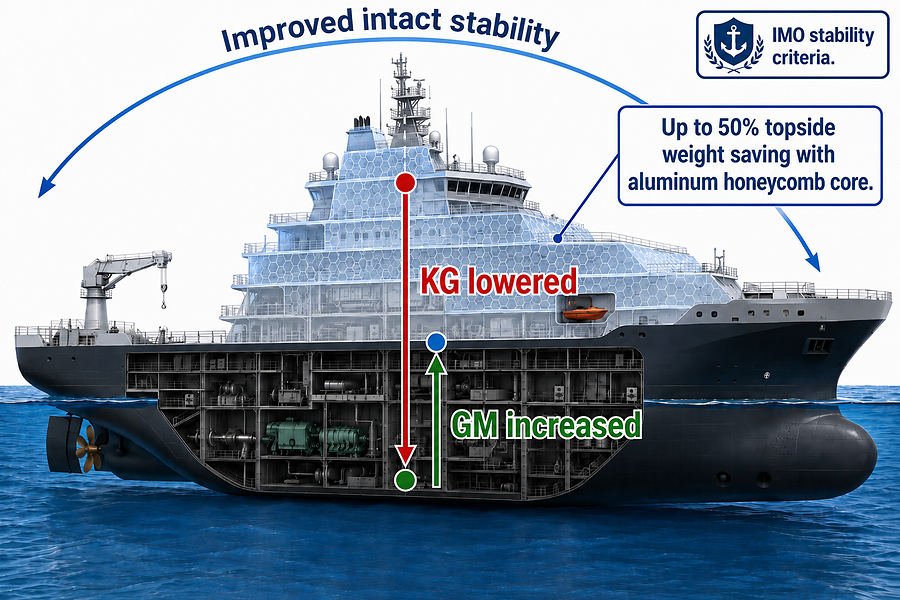
Naval architects obsess over the top of the ship. If the top is too heavy, the ship rolls too far in the waves. It might even flip over.17 I see interior outfitting companies win major contracts simply because they offer lighter topside materials. You are not just selling a wall; you are selling a solution to a severe engineering limit. The two big numbers the shipyard cares about are the KG and the GM. Let us see how your honeycomb panels control these numbers.
Impact of Honeycomb Cores on the Ship's Center of Gravity (KG)
The letter K stands for the keel (bottom of the ship). The letter G stands for the center of gravity. The KG is the distance from the bottom to the center of gravity.18 You always want a low KG. Modern cruise ships have 15 to 20 decks. Decks 5 and above are called topside decks. If you put heavy 20 kg/m² rockwool panels on deck 15, the KG goes up. A high KG makes the ship top-heavy. By using 10 kg/m² aluminum honeycomb panels on the upper decks, you cut the topside panel weight by 50%. This pulls the overall center of gravity downward. A lower KG makes the naval architect very happy because it makes the ship fundamentally safer in rough oceans.
Improving Metacentric Height (GM) to Meet IMO Intact Stability Criteria
The GM is the metacentric height. It measures how fast the ship pushes back when a wave tilts it. You want a positive and large GM. If the GM is too small, the ship is unstable. The IMO sets strict intact stability criteria that every ship must pass before it can sail.19 Lowering the KG directly increases the GM.20 When you supply aluminum honeycomb panels for the upper decks, you increase the GM. This allows the shipyard to pass the IMO intact stability tests easily. It also means the ship will rock gently and slowly, which stops passengers from getting seasick. This is a massive selling point when you talk to European shipyard engineers.
| Stability Metric | Definition | Effect of Heavy Rockwool | Effect of Light Honeycomb Core |
|---|---|---|---|
| KG (Center of Gravity) | Distance from keel to gravity center | Raises KG (Bad) | Lowers KG (Good) |
| GM (Metacentric Height) | Measure of ship's righting energy | Decreases GM (Bad) | Increases GM (Good) |
| IMO Intact Stability | Global safety standard for rolling | Harder to pass | Easier to pass |
How Does Aluminum Honeycomb Core Affect Marine Accommodation Panel Dimensional Stability?
Ships vibrate and bend in rough seas. Cheap panels warp, leaving ugly gaps. Your clients will demand a fix. You need materials that keep their shape perfectly.
Aluminum honeycomb core ensures exceptional dimensional stability by completely eliminating moisture absorption, resisting thermal expansion, and preventing mechanical sagging. Unlike wood or mineral wool, the rigid hexagonal aluminum cells maintain a fixed volume under severe ship vibrations and temperature shifts from -40°C to +80°C.
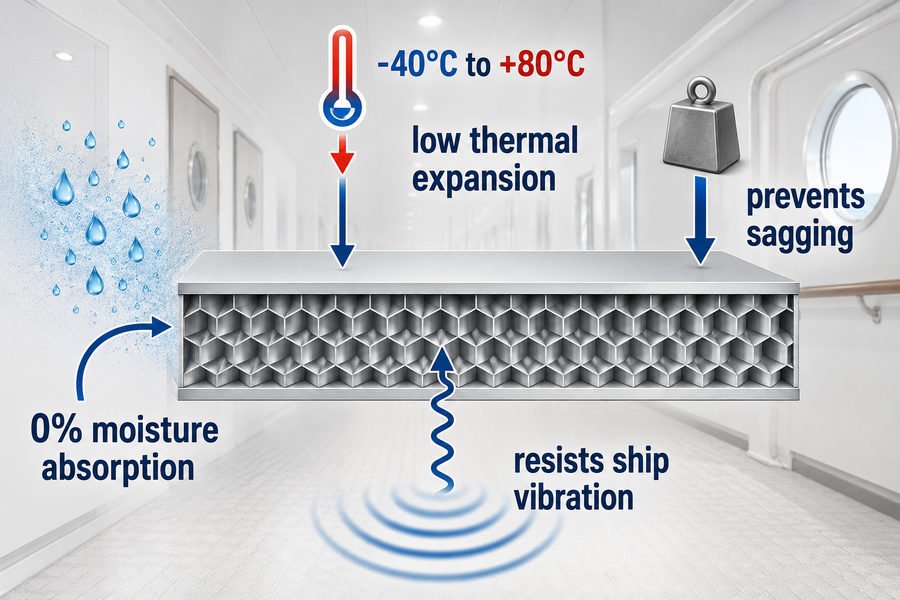
Dimensional stability simply means the panel stays the exact same size and shape over its whole life. A panel that is 2 meters tall today must be exactly 2 meters tall five years from now. I have seen cheap panels absorb water from the ocean air, swell up, and pop out of their frames. When you buy interior materials, you must guarantee they will survive harsh sea conditions. The aluminum honeycomb core tackles three main problems: moisture, heat, and gravity. Let us break down how it fights each one.
Preventing Panel Deformation from Moisture Absorption and Mechanical Sagging
The ocean is full of moisture. Mineral wool acts like a sponge if it gets exposed to wet air. Wood cores warp and rot when wet.21 Aluminum honeycomb has zero moisture absorption.22 Water cannot enter the solid metal foil. This means the panel will never swell or change thickness in humid tropical climates. Also, ships vibrate 24 hours a day. This vibration causes heavy materials like mineral wool to break down inside the panel and sink to the bottom.23 This is called mechanical sagging. The rigid hexagonal aluminum cells do not break down or sink. They hold the metal skins perfectly parallel, meaning the panel will not sag, warp, or form hollow spots at the top.
Managing Thermal Expansion Across Extreme Temperature Shifts
A ship might sail from freezing Alaska to the hot Caribbean in one month. The exterior steel hull heats up and cools down. The interior panels must handle these temperature shifts from -40°C to +80°C. Aluminum expands when it gets hot. But, because the honeycomb core is made of very thin corrugated foil, it handles thermal stress differently than a solid block of metal. The empty space inside the cells allows the panel to absorb minor thermal shifts without warping the entire wall.24 The strong glue lines hold the faces completely flat. This stops the walls from bending outward or inward when the ship's air conditioning changes the room temperature.
| Stress Factor | Reaction of Mineral Wool Core | Reaction of Aluminum Honeycomb Core | Result |
|---|---|---|---|
| High Humidity / Water | Absorbs water, swells, gains weight | Zero moisture absorption, no swelling | Honeycomb keeps exact dimensions |
| Constant Vibration | Fibers break, core sags down | Cells remain rigid, no sagging | Honeycomb stays flat and strong |
| Extreme Heat/Cold | Little thermal expansion | Handles stress via flexible thin walls | Both remain stable, but metal holds shape better |
Conclusion
Aluminum honeycomb core provides incredible weight reduction, high stiffness, full fire safety compliance, and stability. Choosing the right cell sizes ensures you meet strict shipyard demands efficiently and profitably.
-
"Improving the energy efficiency of ships", https://www.imo.org/en/ourwork/environment/pages/improving%20the%20energy%20efficiency%20of%20ships.aspx. Naval-architecture literature on ship resistance and propulsion explains that vessel displacement affects required propulsive power and fuel use, which links onboard weight to operating cost over a ship’s service life. Evidence role: mechanism; source type: paper. Supports: Additional ship weight can increase lifetime operating costs, especially through fuel consumption.. Scope note: The source would support the general weight–fuel–cost mechanism, not the exact cost per kilogram for a specific vessel. ↩
-
"[PDF] PRODUCT SELECTION GUIDE - Industrial Insulation", https://www.nrc.gov/docs/ML1923/ML19235A078.pdf. Technical references for mineral wool boards report density ranges for high-density rock/mineral wool products; when combined with a 50 mm thickness and typical panel facings, these data provide contextual support for the stated areal mass range. Evidence role: statistic; source type: institution. Supports: A 50 mm high-density mineral wool marine interior panel can be in the approximate range of 18–22 kg/m².. Scope note: Neutral sources may document core density rather than the finished marine panel weight, so the final kg/m² figure can vary with facings, adhesives, and fire-rating construction. ↩
-
"[PDF] Performance Evaluation Of Composite Sandwich Structures With ...", https://scholarsmine.mst.edu/cgi/viewcontent.cgi?article=4255&context=matsci_eng_facwork. Engineering references on aluminum honeycomb sandwich panels describe their low areal density relative to solid or mineral-fiber-core panels; panel datasheets or test reports can substantiate the approximate 8–12 kg/m² range for 50 mm constructions. Evidence role: statistic; source type: research. Supports: A 50 mm aluminum honeycomb panel can weigh approximately 8–12 kg/m².. Scope note: The stated range is construction-dependent, especially on aluminum skin thickness, cell size, foil gauge, and edge framing, so a source may support representative examples rather than all 50 mm honeycomb panels. ↩
-
"Speed management - GreenVoyage2050", https://greenvoyage2050.imo.org/technology/speed-management/. Studies of ship energy efficiency and resistance show that reduced displacement can lower required propulsion power and fuel consumption; some lightweighting analyses report fuel-saving ratios in the approximate range cited for comparable operating conditions. Evidence role: statistic; source type: paper. Supports: A 1% reduction in ship weight may reduce fuel consumption by roughly 0.5%–1% under certain operating assumptions.. Scope note: The percentage saving is not universal; it depends on hull form, speed profile, loading condition, propulsion system, and whether the vessel is displacement- or volume-limited. ↩
-
"[PDF] Mechanical Properties Characterization of Composite Sandwich ...", https://ntrs.nasa.gov/api/citations/19880000739/downloads/19880000739.pdf. Sandwich-structure mechanics literature explains that honeycomb cores separate and stabilize the face sheets while carrying transverse compression and shear loads; the pillar analogy is a simplified description of this load-transfer mechanism. Evidence role: mechanism; source type: education. Supports: A honeycomb core supports metal skins by stabilizing the face sheets and transmitting compressive and shear loads through its cellular geometry.. Scope note: The source would support the structural mechanism in general, not the exact visual analogy or performance of a specific panel product. ↩
-
"[PDF] Performance Evaluation Of Composite Sandwich Structures With ...", https://scholarsmine.mst.edu/cgi/viewcontent.cgi?article=4255&context=matsci_eng_facwork. Published test data for aluminum honeycomb sandwich cores report density, compressive strength, and shear strength values in ranges comparable to those stated, with results governed by cell size, foil thickness, alloy, and test direction. Evidence role: statistic; source type: paper. Supports: Marine-grade aluminum honeycomb cores can have shear strength around 1.0–2.5 MPa, compressive strength around 1.5–3.0 MPa, and density around 30–80 kg/m³.. Scope note: The cited ranges are not universal specifications for all marine-grade cores; they vary by core geometry, alloy, bonding system, and test standard. ↩
-
"Composition of ALUMINUM", https://physics.nist.gov/cgi-bin/Star/compos.pl?matno=013. Reference data for aluminum list its density at approximately 2.70 g/cm³, equivalent to about 2,700 kg/m³, supporting the stated comparison with low-density core materials. Evidence role: statistic; source type: government. Supports: Solid aluminum has a density of about 2,700 kg/m³.. Scope note: The value is an approximate density for pure aluminum; aluminum alloys and temperature conditions may differ slightly. ↩
-
"Comparative Analysis of Sandwich Composites with Balsa, Rohacell ...", https://pmc.ncbi.nlm.nih.gov/articles/PMC11901560/. Comparative studies of sandwich-core materials commonly report that aluminum honeycomb cores achieve higher shear stiffness or shear strength than many low-density polymer foam cores, although the relationship depends on foam grade, density, and loading direction. Evidence role: general_support; source type: paper. Supports: Low-density PVC or PU foam cores generally have lower shear strength or stiffness than comparable aluminum honeycomb cores.. Scope note: This evidence would support the comparison as a general trend, not as proof that every PVC or PU foam has lower shear strength than every aluminum honeycomb core. ↩
-
"[PDF] Performance Evaluation Of Composite Sandwich Structures With ...", https://scholarsmine.mst.edu/context/matsci_eng_facwork/article/4255/viewcontent/Performance_evaluation_of_composite_sandwich_structures_with_additively_manufactured_aluminum_honeycomb_____.pdf. Materials-science treatments of hexagonal honeycomb cores show that, for a fixed foil thickness and panel area, smaller cells increase cell-wall length per unit area and therefore core relative density, supporting the claim that more foil is consumed. Evidence role: mechanism; source type: paper. Supports: A smaller cell size uses more aluminum foil, which drives up your purchase price.. Scope note: This supports material usage directly; it does not by itself prove the final purchase-price increase, which also depends on alloy, labor, order volume, and supplier pricing. ↩
-
"Sandwich-structured composite - Wikipedia", https://en.wikipedia.org/wiki/Sandwich-structured_composite. Standard references on honeycomb sandwich construction describe the core as a stabilizing support for the face sheets and show that cell geometry controls the spacing and density of support points under the skins. Evidence role: mechanism; source type: encyclopedia. Supports: Because the cells are very small, there are many more cell walls supporting the outer metal skins.. Scope note: This establishes the structural mechanism generally, not that a particular 6.4 mm marine panel will meet a specified shipyard requirement. ↩
-
"High Temperature Mechanical Properties of a Vented Ti-6Al-4V ...", https://pmc.ncbi.nlm.nih.gov/articles/PMC7372331/. Engineering literature on sandwich panels and composite laminates discusses print-through or telegraphing as surface waviness caused by underlying core or reinforcement geometry, supporting the mechanism by which larger cells and thin skins can produce visible dimpling. Evidence role: mechanism; source type: paper. Supports: If you put a thin skin over a large cell core, the surface will look dimpled. This is called the 'telegraphing' effect.. Scope note: The source would support the general phenomenon; the visibility threshold depends on skin material, thickness, adhesive, lighting, finish, and manufacturing quality. ↩
-
"What Are Aluminum Honeycomb Panels?", https://magellanmarinetech.com/what-are-aluminum-honeycomb-panels/. Studies of honeycomb sandwich panels report that core cell size, foil thickness, and core density affect stiffness, shear strength, weight, and material consumption, providing context for the cost–strength trade-off described here. Evidence role: general_support; source type: research. Supports: The 9.5mm and 12.7mm cell sizes offer the best cost-to-strength balance for standard ship bulkhead partitions.. Scope note: This would support the existence of a cost–strength trade-off, but not prove that 9.5 mm and 12.7 mm are universally the optimal sizes for all marine bulkhead specifications. ↩
-
"[PDF] RESOLUTION MSC.307(88) (adopted on 3 December 2010 ...", https://wwwcdn.imo.org/localresources/en/KnowledgeCentre/IndexofIMOResolutions/MSCResolutions/MSC.307(88).pdf. The IMO FTP Code includes Part 1 as the prescribed non-combustibility test procedure for materials used under SOLAS fire-safety requirements. Evidence role: definition; source type: institution. Supports: IMO FTP Code Part 1 is the relevant non-combustibility fire-test standard for marine materials.. Scope note: This supports the regulatory role and scope of the test, but not whether any specific aluminum honeycomb product has passed it. ↩
-
"[PDF] RESOLUTION MSC.307(88) (adopted on 3 December 2010 ...", https://wwwcdn.imo.org/localresources/en/KnowledgeCentre/IndexofIMOResolutions/MSCResolutions/MSC.307(88).pdf. Aluminum is classified as a non-combustible metal in general materials references, and IMO FTP Code Part 1 evaluates non-combustibility by measured temperature rise, flaming, and mass loss under specified conditions. Evidence role: general_support; source type: institution. Supports: Bare aluminum honeycomb core is expected to meet non-combustibility requirements because aluminum metal does not burn under the test conditions.. Scope note: General aluminum properties do not certify a particular honeycomb core; certification depends on the tested alloy, coatings, adhesives, contaminants, and product construction. ↩
-
"Aluminum - the NIST WebBook", https://webbook.nist.gov/cgi/cbook.cgi?ID=C7429905&Mask=1F. Standard materials references report pure aluminum melting at about 660°C, with aluminum alloys melting over ranges near this value depending on composition. Evidence role: statistic; source type: encyclopedia. Supports: Aluminum used in honeycomb cores has a melting point approximately around 660°C.. Scope note: The exact melting range varies by alloy series and temper, so the figure is approximate unless the specific honeycomb alloy is identified. ↩
-
"Are Marine Fire Divisions the Same as Marine Panel Ratings?", https://magellanmarinetech.com/are-marine-fire-divisions-same-as-marine-panel-ratings/. SOLAS fire-division definitions distinguish A-class and B-class divisions by their ability to prevent passage of smoke and flame for specified periods and to limit average and maximum temperature rise on the unexposed side. Evidence role: definition; source type: institution. Supports: A-Class and B-Class marine partitions must resist flame passage and meet insulation-temperature limits for specified durations.. Scope note: This supports the regulatory meaning of A-class and B-class divisions, but does not show that a particular honeycomb panel assembly achieves any rating. ↩
-
"[PDF] COURSE OBJECTIVES CHAPTER 4 4. STABILITY - USNA", https://www.usna.edu/NAOE/_files/documents/Courses/EN400/02.04%20Chapter%204.pdf. Naval stability references describe how raising a vessel’s vertical center of gravity reduces transverse stability and can contribute to excessive heel or capsize when righting moments become insufficient. Evidence role: mechanism; source type: education. Supports: Excessive weight high in the ship can worsen rolling stability and, in extreme cases, contribute to capsize risk.. Scope note: This supports the general stability mechanism, not a prediction that any specific outfitting choice will cause capsize. ↩
-
"Metacentric height - Wikipedia", https://en.wikipedia.org/wiki/Metacentric_height. Standard ship-stability terminology defines KG as the vertical distance from the keel baseline to the vessel’s center of gravity. Evidence role: definition; source type: education. Supports: KG means the vertical distance from the keel to the ship’s center of gravity.. ↩
-
"[PDF] RESOLUTION MSC.267(85) (adopted on 4 December 2008 ...", https://wwwcdn.imo.org/localresources/en/KnowledgeCentre/IndexofIMOResolutions/MSCResolutions/MSC.267(85).pdf. The International Maritime Organization’s Intact Stability Code sets internationally recognized stability criteria for ship design and operation, including minimum standards used by flag administrations and classification processes. Evidence role: historical_context; source type: institution. Supports: IMO rules establish intact stability criteria that ships must satisfy through the applicable regulatory approval process.. Scope note: The IMO framework is implemented through flag-state and class approval systems, so the source may not describe approval as a single direct IMO test for every individual vessel. ↩
-
"[PDF] Chapter 2 - Review of Intact Statical Stability - USNA", https://www.usna.edu/NAOE/_files/documents/Courses/EN455/EN455_Chapter2.pdf. Ship-stability texts express metacentric height as GM = KM − KG, showing that, for a fixed metacentric height above the keel, reducing KG increases GM by the same amount. Evidence role: mechanism; source type: education. Supports: Reducing KG increases GM when the vessel’s KM is otherwise unchanged.. Scope note: The relationship is direct only when KM is treated as unchanged; in real designs, hull form, loading condition, and displacement can also affect KM. ↩
-
"Drying and control of moisture content and dimensional changes", https://research.fs.usda.gov/treesearch/7143. A wood-science or government forestry source can document that wood changes dimensions with moisture content and is susceptible to fungal decay when moisture conditions permit. Evidence role: mechanism; source type: government. Supports: Wood cores can warp and rot when exposed to wet conditions.. Scope note: This supports the general moisture sensitivity of wood, but it does not by itself compare all engineered marine wood-core panels or protected laminates. ↩
-
"[PDF] Aluminum and Aluminum Alloys - NIST Materials Data Repository", https://materialsdata.nist.gov/bitstream/handle/11115/173/Aluminum%20and%20Aluminum%20Alloys%20Davis.pdf. A materials reference or handbook can support that aluminum is non-hygroscopic and does not absorb water into its bulk, which explains why an aluminum honeycomb core is not expected to swell from moisture uptake. Evidence role: mechanism; source type: encyclopedia. Supports: Aluminum honeycomb cores do not absorb moisture in the way porous or hygroscopic core materials can.. Scope note: The source would support the behavior of aluminum as a material, not necessarily the long-term performance of a bonded panel, whose joints, adhesives, or corrosion protection may affect moisture durability. ↩
-
"[PDF] Settling of Loose-Fill Thermal Insulation ...... Development of a ...", https://web.ornl.gov/sci/buildings/conf-archive/1992%20B5%20papers/053.pdf. A technical paper or building-science source on fibrous insulation settlement can support that loose or insufficiently restrained fibrous insulation may settle under gravity and mechanical disturbance, reducing uniformity within a cavity. Evidence role: mechanism; source type: paper. Supports: Fibrous insulation materials can settle or sag under mechanical disturbance, gravity, or vibration when not adequately restrained.. Scope note: Evidence may be based on building or insulation tests rather than ship-interior panels specifically, so it would provide contextual support rather than direct proof for every marine panel design. ↩
-
"[PDF] Sandwich Constructions - USNA", https://www.usna.edu/Users/mecheng/pjoyce/composites/Short_Course_2003/13_PAX_Short_Course_Sandwich-Constructions.pdf. A sandwich-structure or honeycomb-core mechanics source can explain that honeycomb cores combine high out-of-plane stiffness with low density and cellular geometry, which can influence deformation and stress distribution under thermal loading. Evidence role: mechanism; source type: paper. Supports: Honeycomb cellular geometry can help a sandwich panel manage deformation and stress under thermal changes.. Scope note: Such a source would describe the structural mechanism in general; actual resistance to warping depends on face sheets, adhesive, cell geometry, panel size, and temperature gradients. ↩