Are you struggling to choose between aluminum honeycomb and rock wool for ship interiors? Picking the wrong core wastes budget and risks safety compliance. Let us fix that today.
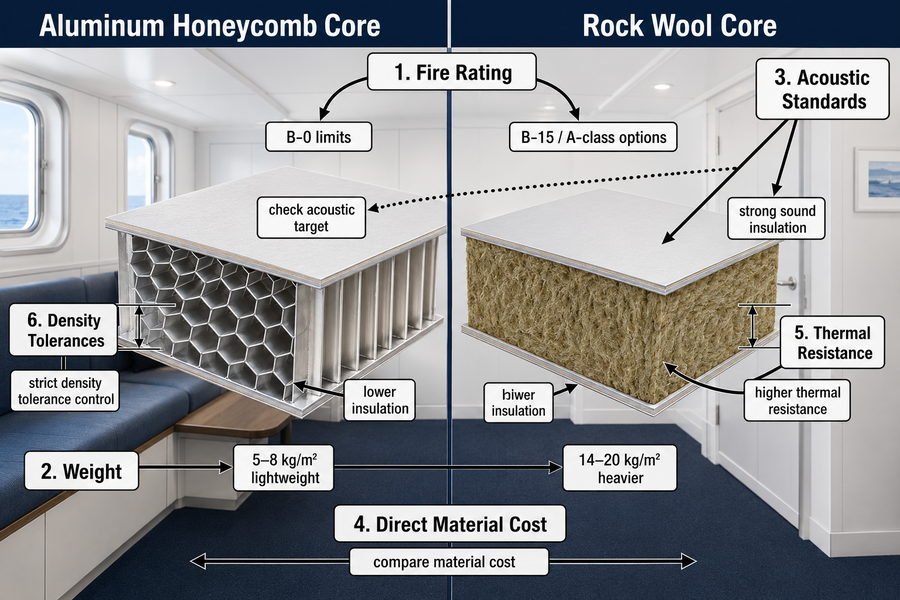
To compare aluminum honeycomb and rock wool cores, you must evaluate six specific metrics: fire rating limits (B-0 vs B-15/A-class), weight differences (5-8 kg/m² vs 14-20 kg/m²), acoustic standards, direct material costs, thermal resistance values, and strict density tolerances. Both serve distinct interior outfitting needs.
Let me walk you through my factory floor experience. I have seen procurement teams lose thousands of dollars on heavy panels when a lighter core would have worked. Or worse, fail an inspection because they used aluminum honeycomb where rock wool was mandatory. Read on so you do not repeat these costly errors.
Aluminum Honeycomb or Rock Wool: Which Achieves Higher Fire Rating in Marine Accommodation Panels?
Failing a fire inspection delays your entire shipbuilding project. Do you know which core material guarantees SOLAS compliance for critical bulkheads? The wrong choice is dangerous.
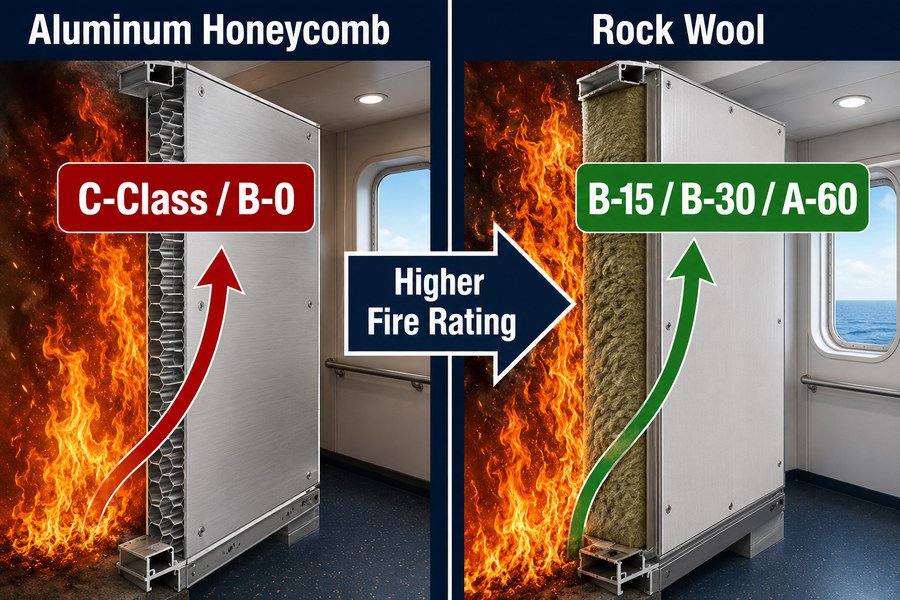
Rock wool achieves significantly higher fire ratings than aluminum honeycomb. Under IMO FTP Code Part 3, rock wool panels easily pass B-15, B-30, and A-60 tests. Aluminum honeycomb panels are limited to C-Class or B-0 ratings, making them unsuitable for areas requiring prolonged fire containment.
Fire Containment Capabilities of Rock Wool Cores (B-15, B-30, A-60)
When we talk about marine safety, the International Maritime Organization (IMO) sets the rules. Under the IMO Fire Test Procedures (FTP) Code Part 31, rock wool is the undisputed winner. It easily passes the strict requirements for B-15, B-30, and A-60 fire ratings. I always tell my clients to use rock wool for high-risk zones like engine room boundaries or main passenger corridors. The secret lies in the raw material. Rock wool is spun from melted basalt rock. It can withstand temperatures up to 1000°C before melting2. If a fire breaks out, a B-15 rock wool panel will stop flames and block smoke for a full 15 minutes. It will also keep the temperature on the unexposed side from rising more than 140°C on average3. An A-60 panel extends this protection to 60 minutes. This gives the crew enough time to evacuate.
Thermal Limitations of Aluminum Honeycomb Cores (C-Class, B-0)
Aluminum honeycomb tells a very different story. You can only use it for C-Class or B-0 applications. C-Class panels have no specific requirements for stopping smoke or resisting high temperatures. B-0 panels will stop flames for 15 minutes, but they will not stop the heat from passing through. The reason is simple physics. Aluminum melts at around 660°C. In a standard marine fire test, the furnace reaches 800°C within the first 30 minutes. The aluminum core simply melts away.4 Additionally, the thin glue used to bind the honeycomb structure fails at even lower temperatures. Therefore, you should only buy aluminum honeycomb panels for areas with low fire risks, such as wet units, internal partition walls within a single cabin, or fast ferry interiors where weight rules over fire class.
| Fire Core Material | Solas Fire Rating Limit | Melting Point | Best Marine Application Area |
|---|---|---|---|
| Rock Wool Core | B-15, B-30, A-60 | ~1000°C | Escape routes, stairwells, galleys, engine bulkheads |
| Aluminum Honeycomb | C-Class, B-0 | ~660°C | Fast ferries, private cabin partitions, washrooms |
How Do Aluminum Honeycomb and Rock Wool Cores Compare on kg/m² in Marine Accommodation Panels?
Heavy interiors eat up fuel and limit vessel capacity. Are your wall panels too heavy? Let us look at the exact weight difference between these two cores.
Aluminum honeycomb is drastically lighter, weighing between 5 to 8 kg/m² for a standard 25mm panel. In contrast, a 25mm rock wool panel weighs between 14 to 20 kg/m², depending on core density. Aluminum honeycomb saves up to 12 kg per square meter of bulkhead.
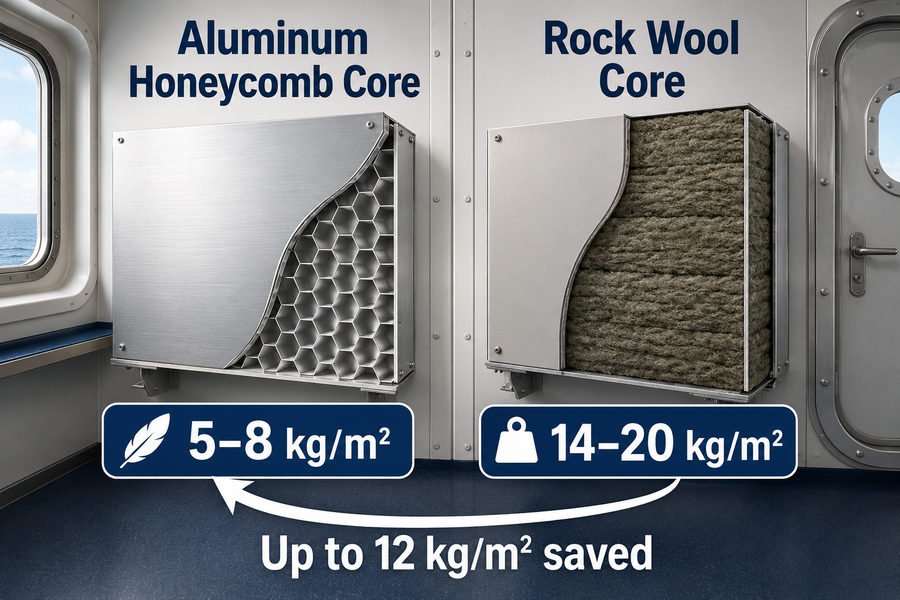
Weight Profile of Aluminum Honeycomb Panels (5 to 8 kg/m²)
If you are outfitting a fast patrol boat or a luxury yacht, weight is your biggest enemy. Every extra kilogram reduces the top speed of the ship.5 This is where aluminum honeycomb panels shine. A standard 25mm thick panel with a 0.7mm galvanized steel skin and an aluminum honeycomb core weighs only 5 to 8 kg/m²6. The core itself is mostly empty air. The aluminum foil used to make the hexagonal cells is incredibly thin, usually between 0.04mm and 0.06mm. I have seen shipyards cut the total interior weight of a vessel by 40% just by switching to aluminum honeycomb for non-load-bearing walls. It is very easy for a single worker to pick up and install these panels on the ship.
Weight Profile of Rock Wool Panels (14 to 20 kg/m²)
Rock wool panels are heavy. There is no way around this fact. A standard 25mm thick rock wool panel weighs between 14 and 20 kg/m²7. The exact weight depends on the density of the rock wool core inside. For marine applications, factories usually use rock wool with a density of 100 kg/m³, 120 kg/m³, or 150 kg/m³. To achieve a B-15 fire rating, you need a higher density, which pushes the total panel weight closer to 18 or 20 kg/m². I often warn procurement teams about this. If you buy 1,000 square meters of rock wool panels, you are adding about 18 tons to the ship. You must make sure the shipyard engineers have calculated this weight into the stability book of the vessel8. Installation is also harder. You usually need two workers to lift and position a full-sized rock wool panel.
| Panel Core Type (25mm Thickness) | Typical Weight Range (kg/m²) | Core Density / Foil Thickness | Handling Impact on Shipyard |
|---|---|---|---|
| Aluminum Honeycomb | 5 to 8 kg/m² | 0.04mm - 0.06mm foil | Easy 1-person installation |
| Rock Wool (Low Density) | 14 to 16 kg/m² | 100 kg/m³ to 120 kg/m³ | Requires 2 workers to lift |
| Rock Wool (High Density) | 17 to 20 kg/m² | 130 kg/m³ to 150 kg/m³ | Requires 2 workers to lift |
Which Standard Governs Acoustic Test Comparison Between Aluminum Honeycomb and Rock Wool Cores?
A noisy cabin ruins the passenger experience. Do you know how to prove your panels block sound? You need the right testing standard to avoid disputes.
The primary standard governing acoustic tests for both cores is ISO 10140 (formerly ISO 140) for sound reduction index (Rw), paired with ISO 717-1 for rating. Rock wool panels typically achieve 30 to 35 dB Rw, while standard aluminum honeycomb panels only manage 20 to 25 dB Rw.
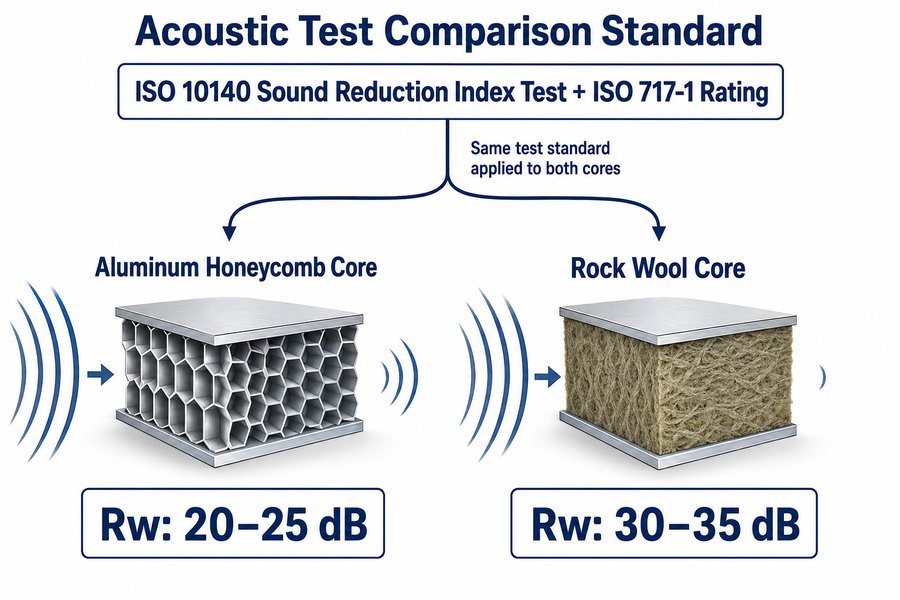
Applying ISO 101409 and ISO 717-1 to Marine Panels
When a shipyard asks you for the acoustic data of your panels, you cannot just give them a random number. You must provide a test report based on strict international standards. The laboratory will use ISO 10140. This standard details how to measure sound insulation in building elements. They place the panel between two sealed rooms. One room plays loud noise, and the other room measures how much noise comes through. Then, they use the ISO 717-1 standard to convert this raw data into a single number called the Weighted Sound Reduction Index, or Rw. This is the dB number you see on the catalog. I always check the test report to make sure it mentions ISO 10140 and ISO 717-1. If a supplier gives you a report with a different standard, the shipyard might reject the panels.
Acoustic Performance Comparison: 30-35 dB vs 20-25 dB
Now let us look at the actual performance. Rock wool panels are excellent at blocking sound. A standard 50mm thick rock wool panel usually scores between 30 dB and 35 dB Rw10. The dense, random fibers of the rock wool trap the sound waves and turn the acoustic energy into tiny amounts of heat. This makes rock wool perfect for passenger cabins next to noisy areas. On the other hand, aluminum honeycomb performs poorly in sound tests. A 50mm honeycomb panel usually only gets 20 dB to 25 dB Rw. The rigid aluminum cells and empty air spaces act like a drum. Sound vibrates straight from the front steel skin, through the aluminum web, and out the back skin. If you use honeycomb panels in a sleeping cabin, the passenger will hear people talking in the next room.
| Core Material | Testing Standard | Typical Acoustic Rating (Rw) | Sound Blocking Mechanism |
|---|---|---|---|
| Rock Wool | ISO 10140 / ISO 717-1 | 30 to 35 dB | High mass and random fibers trap sound waves |
| Aluminum Honeycomb | ISO 10140 / ISO 717-1 | 20 to 25 dB | Rigid structure transmits sound directly across panel |
What Is the Cost Gap Between Aluminum Honeycomb and Rock Wool Cores in Marine Accommodation Panels?
Profit margins in outfitting are tight. Paying too much for panels ruins your bottom line. Let us break down the exact dollar differences between these cores.
Standard rock wool marine panels cost between $15 to $22 per square meter in Asia. Aluminum honeycomb panels cost more, ranging from $25 to $38 per square meter. Upgrading to aluminum honeycomb increases your material costs by $10 to $16 per square meter for the project.
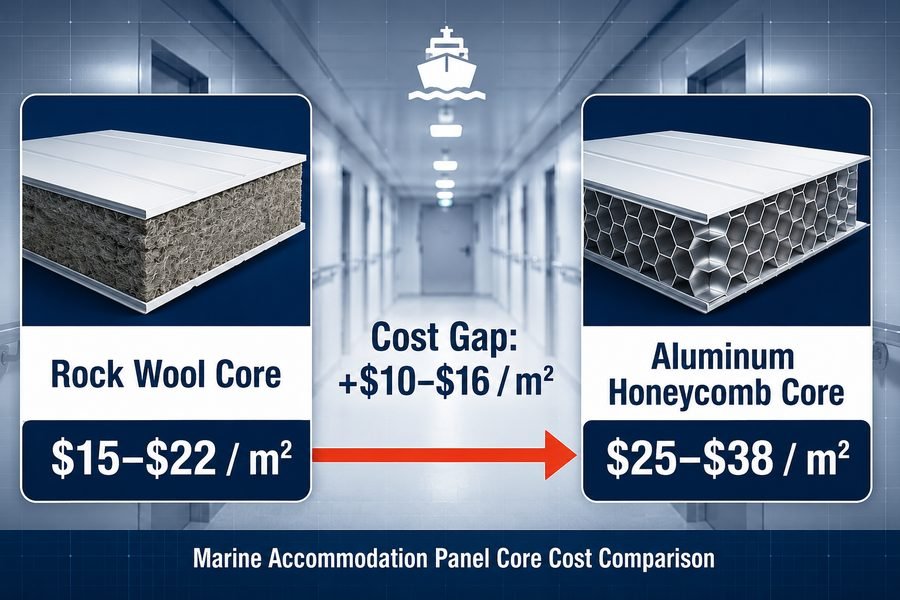
Cost Breakdown for Rock Wool Marine Panels ($15 to $22/m²)
If your main goal is to control the budget, rock wool is your best option. In my years of sourcing from Asian factories, mostly in China and Vietnam, standard rock wool marine panels consistently sit in the $15 to $22 per square meter price range. The price depends on the thickness of the steel skin and the density of the rock wool. The reason rock wool is cheap is the supply chain. Basalt rock is a very common raw material.11 The production lines for cutting rock wool blocks and gluing them to steel sheets are mature and highly automated. A factory can produce thousands of square meters in a single day. This mass production keeps the labor costs low and the final price very competitive for big shipyard projects.
Cost Breakdown for Aluminum Honeycomb Marine Panels ($25 to $38/m²)
Aluminum honeycomb panels require a bigger budget. The current market price ranges from $25 to $38 per square meter. Why is it more expensive? First, raw aluminum costs much more than basalt rock. The price fluctuates daily based on global metal markets.12 Second, the manufacturing process is much more complicated. The factory must stretch the aluminum foil to form perfect hexagons.13 Then, they use expensive, high-strength aviation glues to bond the honeycomb core to the steel skins. The pressing process takes longer and requires extreme precision. A small mistake ruins the panel. If you are buying 10,000 square meters of panels for a mid-sized passenger ship, choosing aluminum honeycomb will cost you an extra $100,000 to $160,000. You must ensure the weight savings are worth this huge cost gap.
| Marine Panel Core Type | Typical Price in Asia (per m²) | Main Cost Drivers | Best For |
|---|---|---|---|
| Rock Wool | $15 to $22 | Cheap basalt material, fast automated production | Budget-sensitive commercial ships |
| Aluminum Honeycomb | $25 to $38 | Raw aluminum prices, expensive adhesives, slow pressing | High-end projects, weight-sensitive vessels |
Which Core Insulates Better Thermally in Marine Accommodation Panels?
Bad insulation forces the ship's HVAC system to run non-stop. Are you ignoring the thermal resistance of your panels? This choice affects daily operational costs.
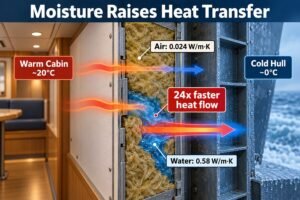
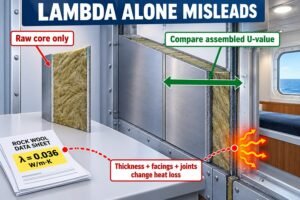
Rock wool insulates significantly better thermally than aluminum honeycomb. Rock wool has a low thermal conductivity (K-value) of roughly 0.035 to 0.045 W/mK. Aluminum honeycomb has a much higher thermal conductivity of 1.5 to 2.5 W/mK, as aluminum metal easily transfers heat across the panel structure.
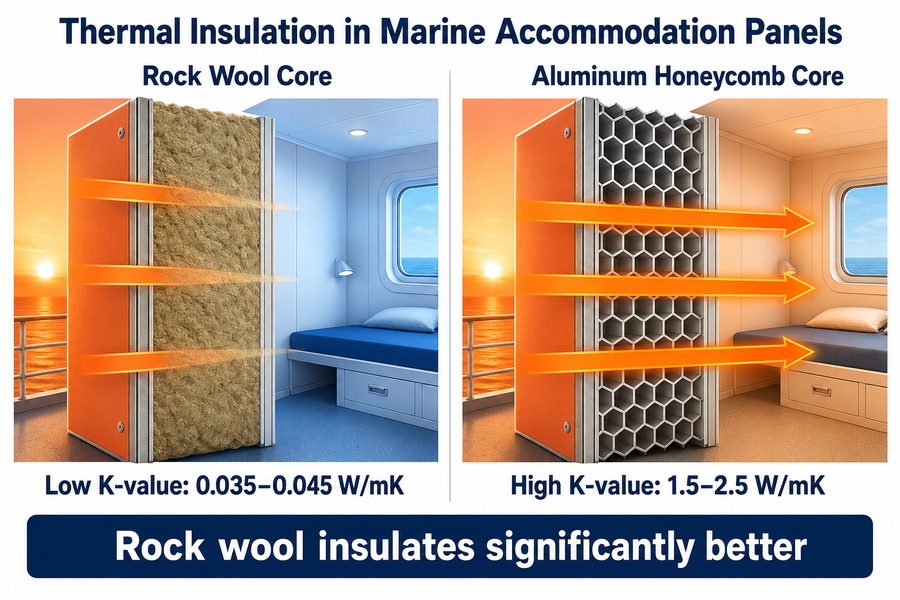
Thermal Conductivity of Rock Wool Cores (0.035 to 0.045 W/mK)
When a ship travels through cold northern waters or hot tropical seas, the air conditioning system works hard to keep the cabins comfortable. The walls play a huge role in this. We measure insulation using thermal conductivity, known as the K-value. A lower number means better insulation. Rock wool is a fantastic insulator. Its K-value sits between 0.035 and 0.045 W/(m·K).14 The magic is in the trapped air. The dense web of mineral fibers holds millions of tiny pockets of air. Air is a very poor conductor of heat. So, when the hot sun beats down on the outside of the ship, the rock wool core blocks that heat from reaching the passenger cabin inside. This saves the ship owner a massive amount of money on fuel used to run the cooling compressors.
Thermal Conductivity of Aluminum Honeycomb Cores (1.5 to 2.5 W/mK)
Aluminum honeycomb is terrible at insulating against heat. Its K-value is much higher, typically ranging from 1.5 to 2.5 W/(m·K)15. This happens because of a problem called thermal bridging. Aluminum is a metal, and metals love to transfer heat. The hexagonal walls of the honeycomb touch both the front steel skin and the back steel skin of the panel. If the air in the corridor is hot, the heat travels straight through the metal honeycomb web into the colder cabin. The empty air inside the cells does not help much because the metal path is unbroken. If you use aluminum honeycomb panels for a ship operating in extreme weather, you must add extra layers of separate insulation behind the panels. This adds labor time and hidden costs to your shipyard.
| Core Material | Thermal Conductivity (K-value) | Insulation Quality | Impact on Ship HVAC System |
|---|---|---|---|
| Rock Wool | 0.035 to 0.045 W/(m·K) | Excellent | Reduces AC power load, saves fuel |
| Aluminum Honeycomb | 1.5 to 2.5 W/(m·K) | Poor (Thermal Bridging) | Increases AC power load significantly |
What Core Density Tolerance Prevents Acoustic Drift in Marine Accommodation Panels?
Your sample panel passed the sound test, but bulk deliveries fail. Why does this happen? Density drift is the silent killer of acoustic compliance.
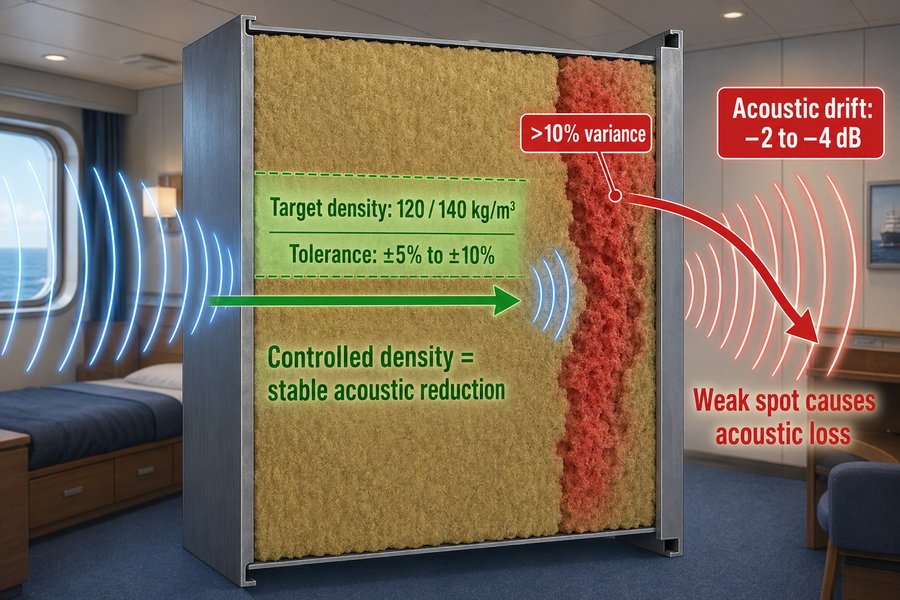
To prevent acoustic drift, rock wool core density must maintain a strict tolerance of ±5% to ±10% around the target density (typically 120 kg/m³ or 140 kg/m³). A variance larger than 10% creates weak spots in the panel, causing the final acoustic reduction to drop by 2 to 4 dB.
The Importance of the ±5% to ±10% Density Tolerance Range
When you order rock wool panels with a density of 120 kg/m³, you expect every single square meter to be exactly 120 kg/m³. In reality, factory production is never perfect. However, you must insist on a strict density tolerance of ±5% to ±10%. This means the rock wool must not drop below 108 kg/m³ or go above 132 kg/m³. I always write this specific percentage into the purchase contract. Why is this so critical? Because sound is like water; it finds the weakest path. If the factory uses cheap, uneven rock wool, some parts of the panel might drop to a density of 90 kg/m³. These low-density patches become acoustic holes. Sound waves easily pass through these weak spots, ruining the acoustic performance of the entire wall.
Consequences of Acoustic Drift (2 to 4 dB Drop)
When the density fluctuates by more than 10%, you experience acoustic drift. This means the mass-produced panels perform worse than the golden sample tested in the laboratory. A bad batch of uneven rock wool can cause the sound reduction index to drop by 2 to 4 dB16. In the world of acoustics, a 3 dB drop is huge. It means the sound energy passing through the wall has doubled17. If your contract with the ship owner guarantees a 32 dB noise reduction, and your panels only deliver 29 dB because of bad density tolerance, the owner will reject the cabins. You will have to tear down the walls and buy new panels. Always ask the Asian factory for their raw material quality control logs to prove they check the rock wool density before gluing.
| Target Core Density | Allowed Tolerance | Acceptable Density Range | Acoustic Impact if Tolerance Fails |
|---|---|---|---|
| 120 kg/m³ | ±10% | 108 to 132 kg/m³ | 2 to 4 dB drop in sound reduction |
| 140 kg/m³ | ±10% | 126 to 154 kg/m³ | 2 to 4 dB drop in sound reduction |
| 150 kg/m³ | ±5% (Strict) | 142.5 to 157.5 kg/m³ | Fails high-end passenger vessel acoustic specs |
Conclusion
Choosing between rock wool and aluminum honeycomb depends entirely on your project's fire rating needs, weight limits, and budget. Always check SOLAS regulations and match the core to the cabin class.
-
"How Is the IMO FTP Code Structured into Annexes and Parts?", https://magellanmarinetech.com/how-is-imo-ftp-code-structured-into-annexes-parts/. The IMO FTP Code, Annex 1, Part 3, specifies the test procedures for A-, B-, and F-class divisions used in shipboard fire-resistance classification. Evidence role: definition; source type: institution. Supports: IMO FTP Code Part 3 is the relevant standard for marine A-, B-, and related fire-division ratings.. Scope note: This supports the regulatory basis for the ratings, but it does not verify that any particular rock wool panel has passed those tests. ↩
-
"Mineral wool - Wikipedia", https://en.wikipedia.org/wiki/Mineral_wool. Technical literature on mineral wool describes rock wool as a basalt-derived fibrous insulation with high-temperature stability, commonly reported near 1000°C depending on composition and test method. Evidence role: general_support; source type: paper. Supports: Rock wool is made from basaltic or mineral raw materials and has high-temperature resistance around the 1000°C range.. Scope note: The exact softening or melting temperature varies with mineral composition, binder content, and whether the figure refers to fiber, binder, or finished panel behavior. ↩
-
"What Do A-Class, B-Class, and C-Class Divisions Mean in Marine ...", https://magellanmarinetech.com/what-a-class-b-class-c-class-divisions-mean-in-marine-wall-ceiling-panels/. IMO fire-division criteria use insulation limits based on the temperature rise of the unexposed face, including an average rise limit of 140°C for specified A- and B-class rating periods. Evidence role: definition; source type: institution. Supports: B- and A-class marine fire divisions use an average unexposed-side temperature-rise limit of 140°C during the relevant rating period.. Scope note: This supports the classification criterion; compliance still depends on a tested and certified panel assembly, not on the core material alone. ↩
-
"[PDF] RESOLUTION MSC.307(88) (adopted on 3 December 2010 ...", https://wwwcdn.imo.org/localresources/en/KnowledgeCentre/IndexofIMOResolutions/MSCResolutions/MSC.307(88).pdf. The ISO/IMO standard fire exposure follows a time-temperature curve that exceeds 800°C by about 30 minutes, while pure aluminum melts at about 660°C, providing a physical basis for aluminum-core vulnerability under severe fire-test conditions. Evidence role: mechanism; source type: paper. Supports: Standard fire-test temperatures can exceed aluminum’s melting point, making melting or structural loss of aluminum honeycomb plausible in such tests.. Scope note: Actual panel failure depends on alloy, foil thickness, adhesives, facings, heat transfer, and certified assembly design; melting-point comparison alone is not a complete fire-rating assessment. ↩
-
"[PDF] Chapter 7 Resistance and Powering of Ships - USNA", https://www.usna.edu/NAOE/_files/documents/Courses/EN400/02.07%20Chapter%207.pdf. Naval-architecture references explain that added displacement generally increases hull resistance and required propulsive power for a given speed, supporting the statement that weight can reduce attainable speed when installed power is fixed. Evidence role: mechanism; source type: education. Supports: Additional vessel weight can reduce a boat’s top speed.. Scope note: The magnitude of the speed loss depends on hull form, loading condition, propulsion system, and operating sea state. ↩
-
"[PDF] durability of low-density core materials and sandwich panels of the ...", https://www.fpl.fs.usda.gov/documnts/fplr/fplr1573_B.pdf. Published material-density data and honeycomb-panel specifications can be used to contextualize whether a 25 mm aluminum-honeycomb panel with thin metallic skins plausibly falls in the stated areal-weight range. Evidence role: general_support; source type: paper. Supports: A standard 25 mm aluminum honeycomb panel with thin metallic skin can weigh about 5 to 8 kg/m².. Scope note: This would contextualize plausibility rather than prove the exact weight of every panel; actual mass varies with skin material, number of skins, adhesive, foil gauge, and core density. ↩
-
"What Is The Typical Range Of Weight Per Square Meter For Marine ...", https://magellanmarinetech.com/what-is-typical-range-of-weight-per-square-meter-for-marine-wall-panels/. Technical literature on mineral-wool sandwich panels reports mineral-wool core densities and panel areal masses, which can support the stated 14–20 kg/m² range for 25 mm panels when combined with metallic facings. Evidence role: statistic; source type: paper. Supports: A standard 25 mm rock wool panel can weigh between 14 and 20 kg/m².. Scope note: The range is product-configuration dependent; facings, adhesives, core density, and fire-rating construction can change the final areal weight. ↩
-
"[PDF] RESOLUTION MSC.267(85) (adopted on 4 December 2008 ...", https://wwwcdn.imo.org/localresources/en/KnowledgeCentre/IndexofIMOResolutions/MSCResolutions/MSC.267(85).pdf. International and flag-state stability guidance requires vessel loading conditions, weights, and centers of gravity to be documented for stability assessment, supporting the need to account for substantial interior-panel weight additions in the vessel’s stability documentation. Evidence role: expert_consensus; source type: government. Supports: Adding large quantities of heavy panels should be included in the vessel’s stability calculations and stability documentation.. Scope note: Such guidance is general to vessel stability and does not specifically address rock wool panels or interior partitions. ↩
-
"Sound insulation dataset of 30 wooden and 8 concrete floors tested ...", https://pmc.ncbi.nlm.nih.gov/articles/PMC10365936/. ISO 10140 specifies laboratory methods for measuring airborne sound insulation of building elements, providing the test basis for reporting panel sound-reduction performance. Evidence role: definition; source type: institution. Supports: The laboratory will use ISO 10140 to measure sound insulation in building elements.. Scope note: The standard is written for building elements; its use for marine panels is contextual unless the shipyard or classification documentation explicitly requires it. ↩
-
"(PDF) A Novel Acoustic Sandwich Panel Based on Sheep Wool", https://www.academia.edu/94861062/A_Novel_Acoustic_Sandwich_Panel_Based_on_Sheep_Wool. Published laboratory data for mineral-wool or rock-wool sandwich panels can be used to show that 50 mm constructions often report weighted sound reduction indices in the low-to-mid 30 dB range. Evidence role: statistic; source type: paper. Supports: A standard 50 mm thick rock wool panel usually scores between 30 dB and 35 dB Rw.. Scope note: Rw depends on skins, density, mounting, joints, and test setup, so the cited source would support this as a typical range rather than a universal value. ↩
-
"Volcanic rocks of the eastern and northern parts of the San ...", https://pubs.usgs.gov/publication/70156633. A geological reference such as the USGS or Encyclopedia Britannica can support that basalt is among the most widespread volcanic rock types, providing context for its availability as a mineral-wool feedstock. Evidence role: general_support; source type: government. Supports: Basalt is a common raw material, helping explain why rock wool can be cost-competitive.. Scope note: This supports raw-material abundance generally, not the delivered cost of basalt for marine-panel factories in Asia. ↩
-
"Aluminum Statistics and Information | U.S. Geological Survey", https://www.usgs.gov/centers/national-minerals-information-center/aluminum-statistics-and-information. A commodity-market or government minerals source can show that aluminum is traded internationally with frequently updated benchmark prices, supporting the claim that aluminum input costs are exposed to global price volatility. Evidence role: statistic; source type: government. Supports: Aluminum prices fluctuate in response to global metal markets.. Scope note: This supports volatility in aluminum markets generally, not the exact purchase price paid by a specific marine-panel manufacturer. ↩
-
"[PDF] 19690022245.pdf - NASA Technical Reports Server (NTRS)", https://ntrs.nasa.gov/api/citations/19690022245/downloads/19690022245.pdf. Engineering references on honeycomb-core manufacture describe expansion of bonded aluminum foil sheets into hexagonal cells, supporting the stated mechanism for forming aluminum honeycomb cores. Evidence role: mechanism; source type: paper. Supports: Aluminum honeycomb cores are commonly made by expanding aluminum foil into hexagonal cells.. Scope note: This supports the general honeycomb-core manufacturing method; it does not prove that every supplier uses the same process or quality tolerance. ↩
-
"Determination of Thermal Properties of Mineral Wool Required for ...", https://pmc.ncbi.nlm.nih.gov/articles/PMC10488771/. Independent building-material references report mineral wool insulation thermal conductivity values in the approximate range of 0.035–0.045 W m−1 K−1, supporting the stated order of magnitude for rock wool cores. Evidence role: statistic; source type: institution. Supports: Rock wool has a thermal conductivity of about 0.035 to 0.045 W/(m·K).. Scope note: Most published values are for building-grade mineral wool insulation; marine panel performance can vary with density, moisture, facings, compression, and installation details. ↩
-
"[PDF] Analysis and Testing of Heat Transfer through Honeycomb Panels", https://digitalcommons.calpoly.edu/context/aerosp/article/1077/viewcontent/Analysis_and_Testing_of_Heat_Transfer_through_Honeycomb_Panels.pdf. Experimental and numerical studies of aluminum honeycomb sandwich structures report effective through-thickness thermal conductivity values on the order of 1–3 W m−1 K−1, consistent with the stated 1.5–2.5 W m−1 K−1 range. Evidence role: statistic; source type: paper. Supports: Aluminum honeycomb cores commonly have an effective thermal conductivity around 1.5 to 2.5 W/(m·K).. Scope note: Effective conductivity depends strongly on honeycomb alloy, foil thickness, cell size, core density, bonding layers, and measurement direction, so a single range is only representative. ↩
-
"Airborne sound insulation performance of lightweight double leaf ...", https://pmc.ncbi.nlm.nih.gov/articles/PMC11666719/. Studies of mineral-wool-filled building elements report that insulation density, airflow resistivity, and cavity filling conditions can affect measured sound transmission loss or sound reduction index by several decibels, providing contextual support for the claim that uneven rock wool may reduce acoustic performance. Evidence role: general_support; source type: paper. Supports: Uneven rock wool density can reduce the sound reduction index by about 2 to 4 dB.. Scope note: The source may support the magnitude only contextually unless it tests the same panel construction, density range, and manufacturing defect pattern described in the article. ↩
-
"Physics 4060, Acoustics Laboratory - HyperPhysics", http://hyperphysics.phy-astr.gsu.edu/hbase/Ph4060/p406i.html. The decibel scale is logarithmic: a 3 dB change corresponds approximately to a factor-of-two change in acoustic intensity or power, so a 3 dB reduction in sound insulation implies roughly doubled transmitted sound energy under comparable conditions. Evidence role: mechanism; source type: education. Supports: A 3 dB drop in sound reduction means the sound energy passing through the wall has doubled.. Scope note: This supports the decibel relationship mathematically; it does not independently verify the article’s specific panel performance scenario. ↩