Confusion between individual panel ratings and total division compliance causes costly rework in shipyards daily. Are you risking project approval by treating them as identical?
No, they are not the same. A marine fire division refers to the certified containment capability of the entire assembly (A, B, or C Class) acting as a barrier, whereas a marine panel rating refers only to the fire integrity and insulation performance of that specific component. You cannot assume a rated panel automatically results in a compliant division without a certified assembly installation.
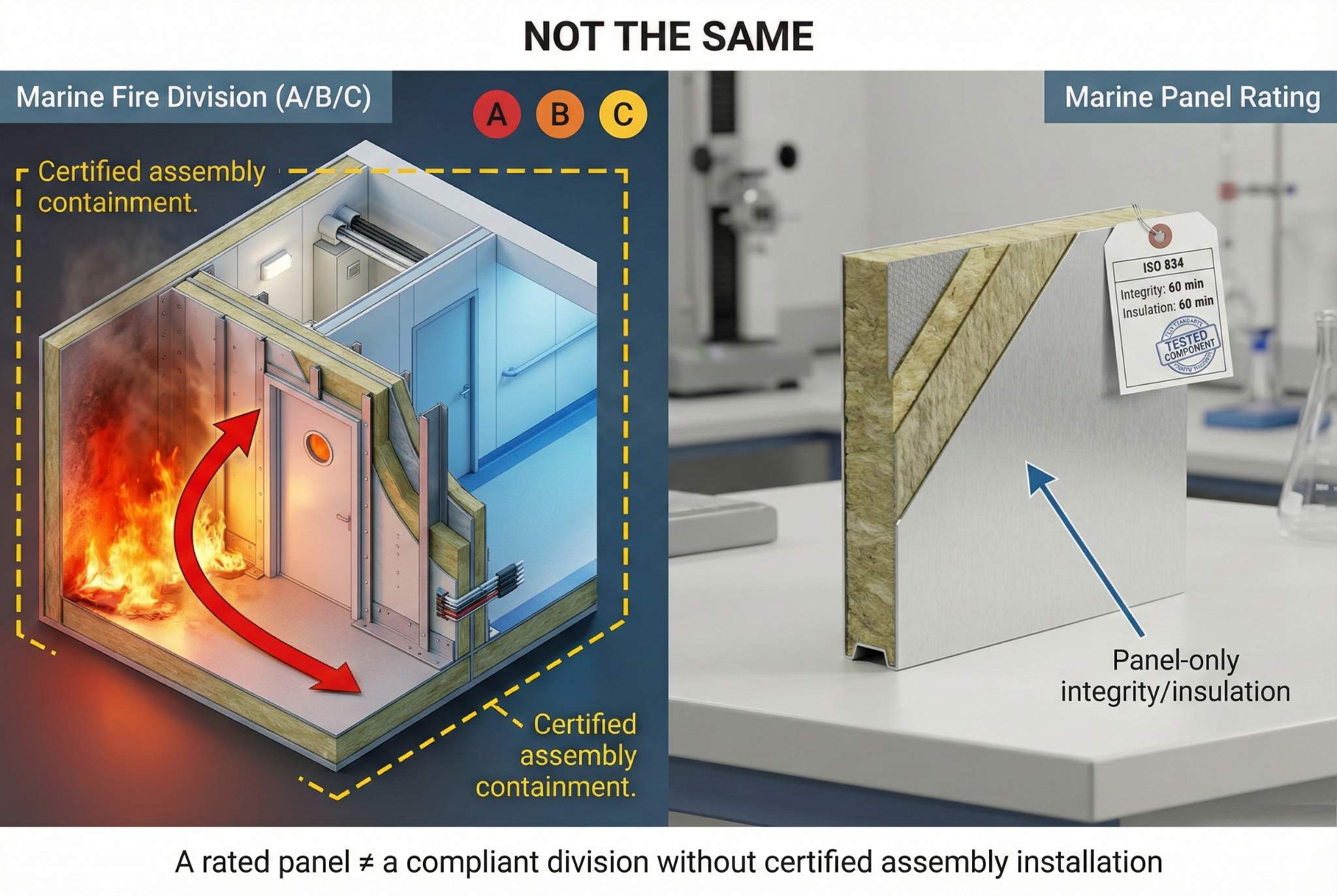
It is a common scenario I faced at Magellan Marine: a procurement officer buys "A-60 panels" and assumes the job is done. But when the inspector arrives, the bulkhead fails because the profiles or installation methods didn't match the division certificate. Understanding this distinction is vital for your budget and schedule.
How Are Marine Fire Divisions Defined by SOLAS Regulations?
Safety regulations are dense, but missing the definition of a fire division can lead to immediate inspection failure. What exactly does SOLAS require for these barriers?
SOLAS Chapter II-2 Regulation 3 defines marine fire divisions by their ability to prevent the passage of smoke and flame (integrity) and limit temperature rise (insulation) on the unexposed side for specific durations: 60, 30, 15, or 0 minutes. They are legally categorized into A-Class (steel or equivalent), B-Class (non-combustible materials), and C-Class (non-combustible only).
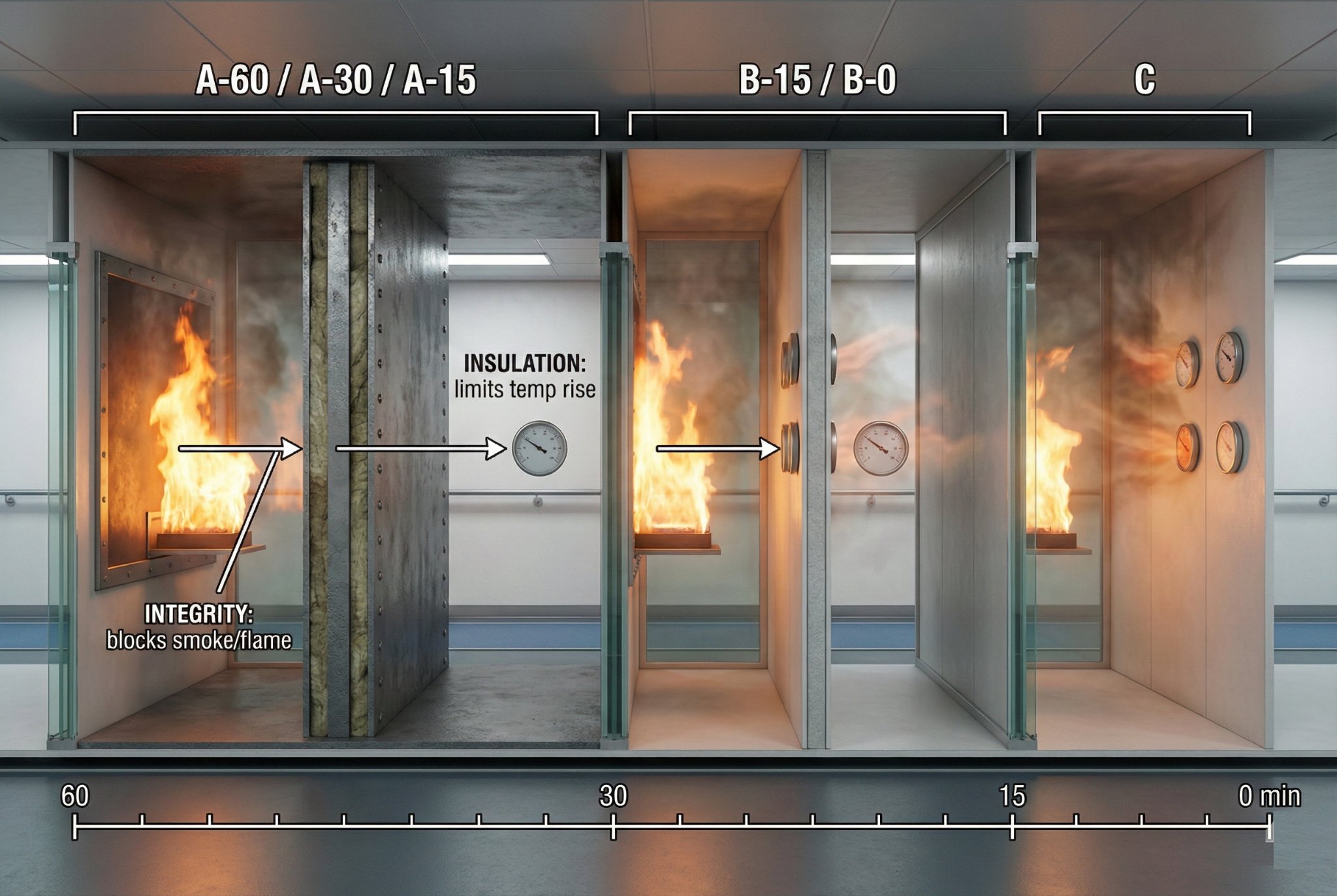
The Three Pillars of SOLAS Fire Division Standards
To understand fire divisions, I always tell my clients to look at the "Three Pillars" defined by the International Maritime Organization (IMO). It is not just about burning; it is about time and temperature.
- Material Composition: The division must be constructed of specific materials. For A-Class, this means steel or an equivalent material. For B-Class and C-Class, the materials must be approved non-combustible materials.
- Integrity (Flame & Smoke Prevention): This is the ability of the bulkhead or deck to stop flames and smoke from passing through to the other side.
- A-Class: Must maintain integrity for 60 minutes in a standard fire test.
- B-Class: Must maintain integrity for 30 minutes.
- Insulation (Temperature Limitation)1: This is often the hardest part to pass. The unexposed side (the side away from the fire) must not get too hot.
- Average Temperature Rise: Cannot exceed 140°C above the initial ambient temperature.
- Maximum Temperature Rise: At any single point (like a joint or screw head), it cannot exceed 180°C above ambient (or 225°C for B-Class).
Comparison of SOLAS Division Requirements
When you are buying materials, you need to match the product to the specific class required by the ship's fire control plan. Here is the breakdown I use when consulting on interior specs:
| Feature | A-Class Division | B-Class Division | C-Class Division |
|---|---|---|---|
| Primary Material2 | Steel or equivalent | Non-combustible materials | Non-combustible materials |
| Standard Fire Test Duration | 60 minutes | 30 minutes | None |
| Prevents Smoke/Flame? | Yes (60 mins) | Yes (30 mins) | No requirement |
| Insulation Requirements | A-60 (60 min), A-30 (30 min), A-15 (15 min), A-0 (0 min) | B-15 (15 min), B-0 (0 min) | None |
| Typical Application3 | Main vertical zones, engine rooms | Cabin partitions, corridor walls | Toilets, washrooms (where fire risk is low) |
Is Non-Combustibility a Mandatory Requirement for Marine Fire Divisions?
Many buyers assume "fire-resistant" means non-combustible, but buying the wrong core material creates a massive fire hazard. Is strict non-combustibility always required?
Yes, for A-Class and B-Class divisions, using non-combustible materials is mandatory under the IMO FTP Code. While the insulation and core must be strictly non-combustible, limited combustible veneers (maximum 1.5mm thickness for bulkheads) are permitted on the surface if they meet low flame-spread characteristics and calorific value limits.
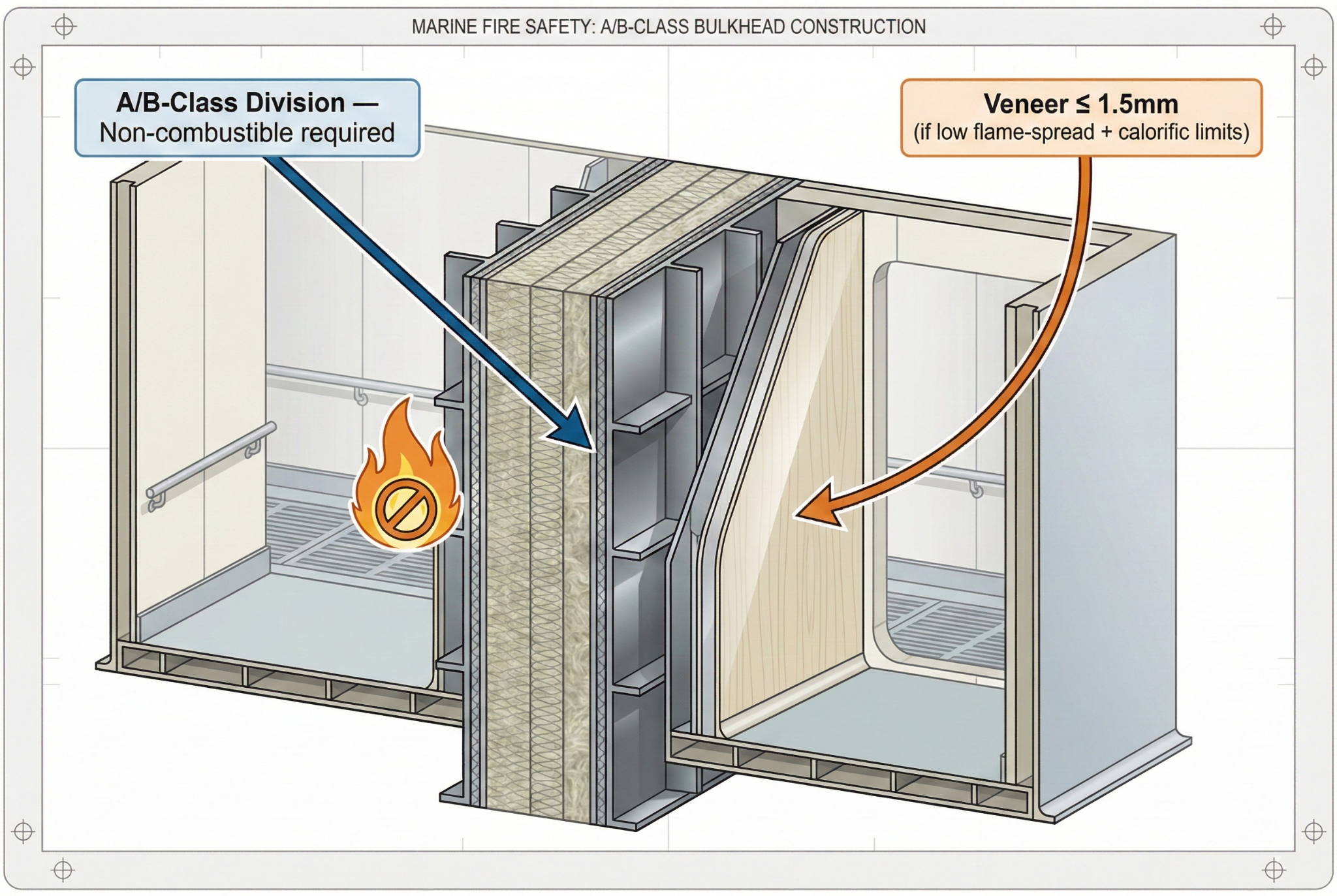
Defining Non-Combustible Materials per ISO 1182
In my years at the factory, I saw many "fire-retardant" materials fail because they were not truly "non-combustible." There is a big difference. "Non-combustible" is a specific technical designation determined by the ISO 11824 test. During this test, a sample is placed in a furnace at 750°C.
To pass, the material must meet three strict criteria:
- Temperature Rise: The furnace temperature cannot rise more than 30°C.
- Flame Duration: Any sustained flaming must not last longer than 10 seconds.
- Mass Loss: The sample cannot lose more than 50% of its mass.
If your core material (like rock wool or ceramic fiber) meets this, it is non-combustible. If you buy a cheap composite that burns for 15 seconds, it is rejected.
Allowances for Combustible Veneers in Marine Interiors
You want the ship to look good, so you cannot just have bare steel or rock wool. SOLAS allows us to use combustible veneers5 (like PVC or HPL) on top of the non-combustible division, but the rules are very strict to prevent flashover.
- Thickness Limit: For bulkheads and ceilings, the combustible veneer cannot exceed 1.5 mm in thickness.
- Calorific Value: The total volume of combustible material determines the fire load. The calorific value generally must not exceed 45 MJ/m² of surface area for the thickness used.
- Low Flame Spread: Even if it is thin, the surface must pass the surface flammability test (IMO FTP Code Part 5) to ensure fire does not race across the wall.
| Material Layer | Requirement | Standard Reference |
|---|---|---|
| Core Insulation (Rockwool) | Non-combustible | ISO 1182 |
| Steel Sheet (Face) | Non-combustible | ISO 1182 |
| Surface Veneer (PVC/HPL) | Low Flame Spread | IMO FTP Code Part 5 |
| Adhesive | Low Flame Spread | IMO FTP Code Part 5 |
How Are Fire Ratings Determined for Marine Wall and Ceiling Panels?
A certificate usually says "B-15," but do you know how that number is actually achieved in the lab? Understanding the test prevents you from buying panels that won't perform.
Ratings are determined through standard fire tests (IMO FTP Code Part 3) measuring integrity and insulation performance. A panel achieves a rating like B-15 only if it physically stops flames preventing passage and keeps the unexposed side cool (maintaining an average temperature rise below 140°C) for the full 15 minutes during a furnace test.
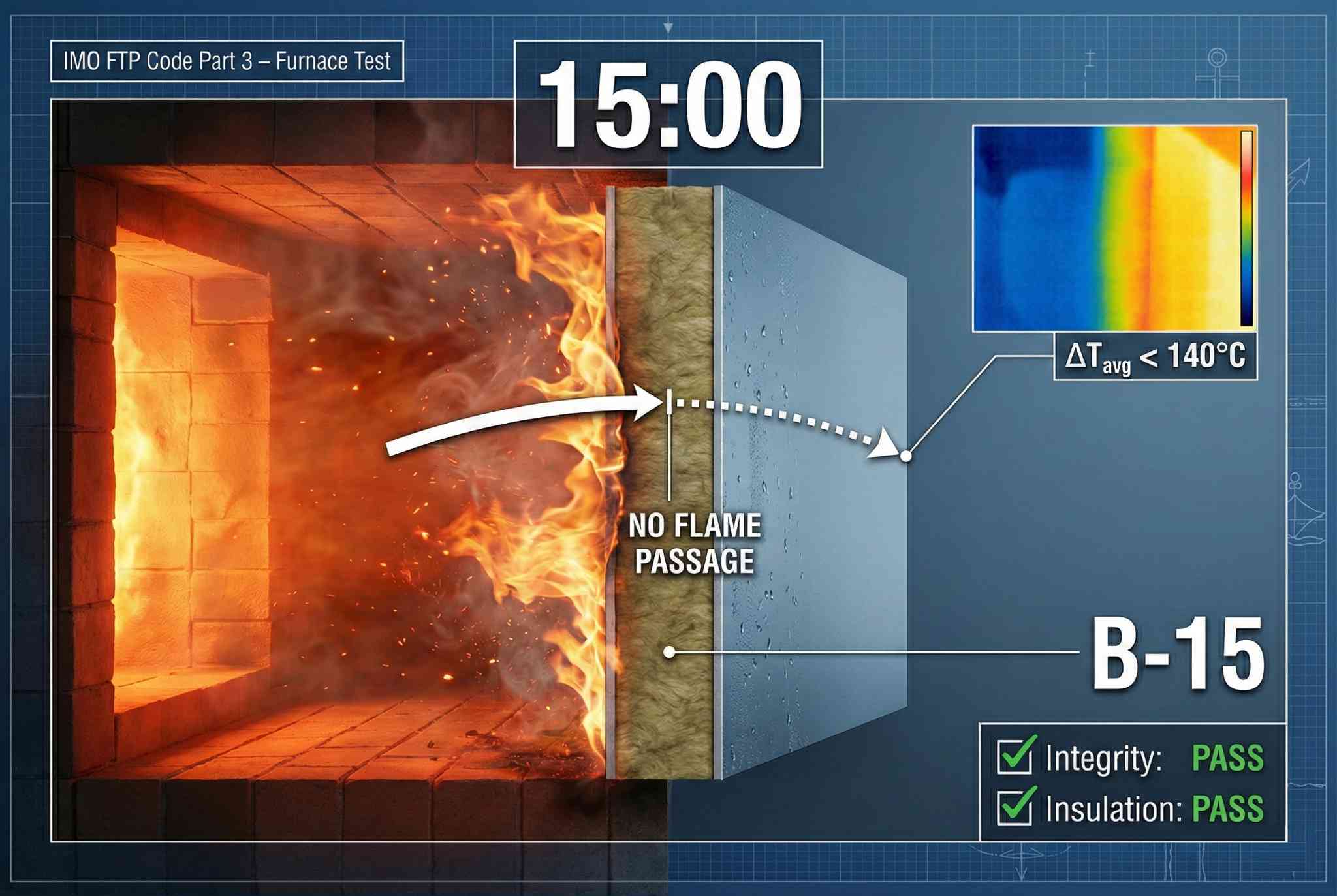
The Standard Fire Test Procedure (IMO FTP Code Part 3)
When I worked with testing labs, the procedure was intense. We would mount a sample bulkhead—usually 2.44 meters wide by 2.5 meters high—into a test frame. This frame is clamped to a giant furnace.
Once the test starts, the furnace follows a standard time-temperature curve6.
- At 5 minutes, the furnace is roughly 576°C.
- At 15 minutes, it reaches 738°C.
- At 30 minutes, it hits 842°C.
- At 60 minutes, it is up to 945°C.
If you are buying a B-15 panel, that panel has to sit in that 738°C heat. The rock wool core must stop that heat from transferring to the back. If the back of the panel gets hot enough to boil water (above 100°C rise), you fail.
Integrity vs. Insulation Failure Points
It is important to know why panels fail tests so you can inspect them properly on arrival.
- Integrity Failure: This happens if the panel cracks, collapses, or if flames flicker through a joint for more than 10 seconds. I have seen cheap glue fail, causing the steel skin to delaminate and the core to fall out. That is an instant failure.
- Insulation Failure: This is more subtle. The panel looks fine, but the thermocouples on the back read 181°C (above ambient). This usually happens at the joints (splines) where there is a thermal bridge. This is why the design of the joint profile is just as important as the panel itself.
| Test Criteria | Limit Value | Consequence of Exceeding |
|---|---|---|
| Cotton Wool Pad Test | Must not ignite | Integrity Failure (Gap exists) |
| Gap Gauge (6mm) | Cannot pass through gap into furnace | Integrity Failure |
| Gap Gauge (25mm) | Cannot pass through gap | Integrity Failure |
| Sustained Flaming | > 10 seconds on unexposed side | Integrity Failure |
| Max Temp Rise | > 180°C above ambient | Insulation Failure |
What Distinguishes a Complete Fire Division from Individual Marine Panels?
This is the most critical distinction for a procurement officer: buying a "product" versus buying a "system." Why is the single panel not enough?
A fire division is the total certified system, including panels, joint profiles, ceiling supports, doors, and internal insulation, tested together as a unit. A marine panel is just one component. A division requires the precise interaction of all parts to pass thermal criteria and structural stability, which a single panel cannot guarantee on its own.
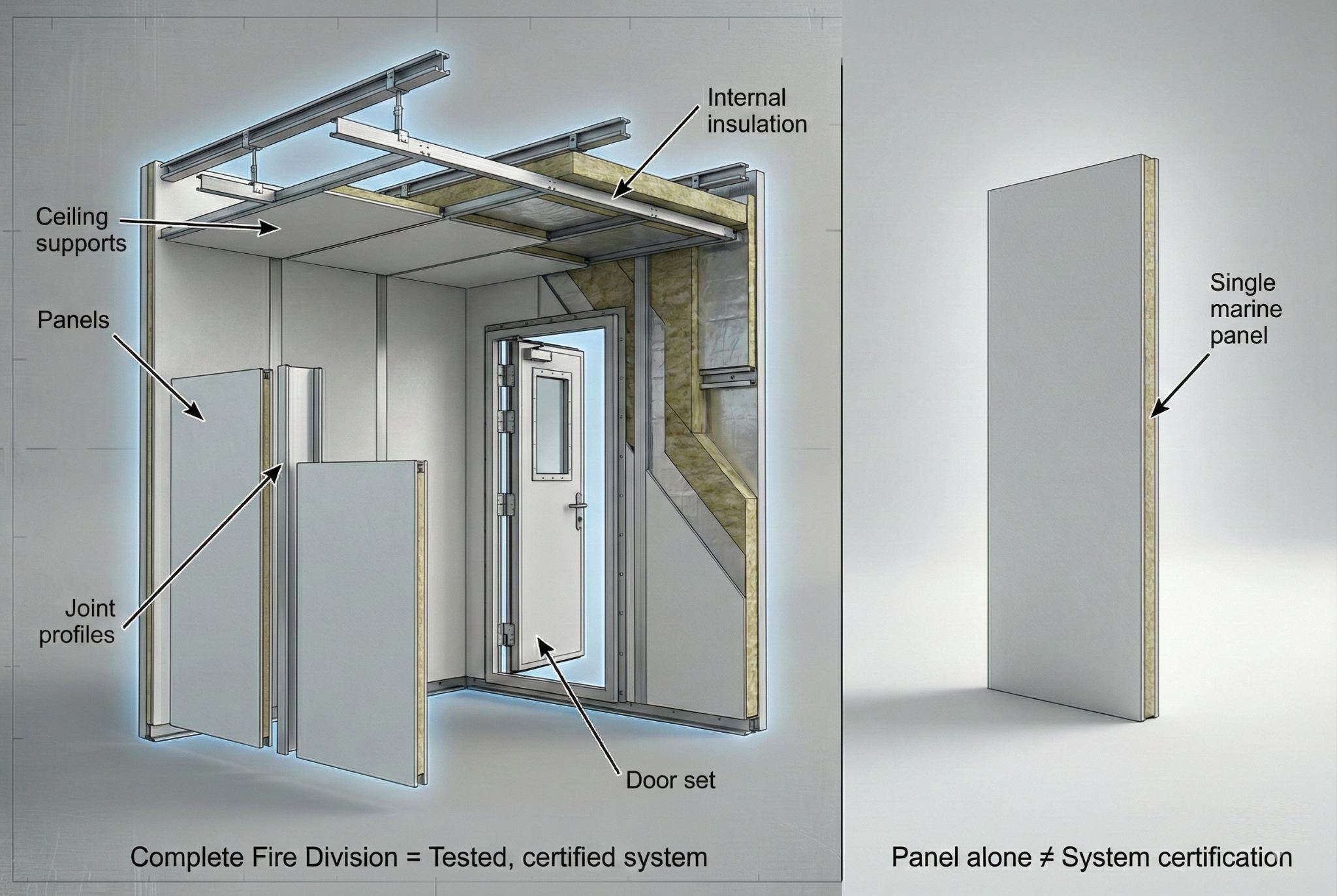
The "System" Concept in Marine Outfitting
When I supply a "B-15 Bulkhead," I am not just sending a pallet of sandwich panels. I am providing a system. This distinction is crucial because the Type Approval Certificate covers the assembly.
A complete division includes:
- The Panel: The main barrier (steel + rock wool).
- The Joint Profile: The specific spline or tongue-and-groove connection that holds panels together.
- The Top and Bottom Profiles: The U-channels that secure the panel to the deck and deckhead.
- Fixing Accessories: The specific rivets or self-tapping screws used.
If you buy a panel from Supplier A and a U-profile from Supplier B, you have broken the "system." You no longer have a certified fire division because that specific combination was never tested in the furnace.
Why Individual Components Fail Alone
Think about a chain. The panel is a strong link. But the division is the whole chain.
- Thermal Expansion: In a fire, steel expands. A 2.4-meter panel might grow by 10mm to 15mm7 in height during a fire. A certified division has an expansion gap designed into the top profile to accommodate this.
- Gas Tightness: An individual panel is gas-tight. But if you place two panels next to each other without the certified spline and ceramic wool insulation in the joint, smoke will pour through the gap in seconds. The panel is fine; the division has failed.
| Component | Function in Division | Risk if Incompatible |
|---|---|---|
| Wall Panel | Main fire barrier | Insulation failure if density is too low |
| Spline/Joint | Connects panels, blocks smoke | Integrity failure (flames pass through) |
| Top Profile | Holds panel, allows expansion | Structural collapse if no expansion gap |
| Kick-out Panel | Emergency exit (if applicable) | May jam or fall out prematurely |
Does the Installation Method Impact the Final Marine Fire Rating?
You can buy the most expensive A-60 panels in the world, but can a careless contractor ruin the rating during installation?
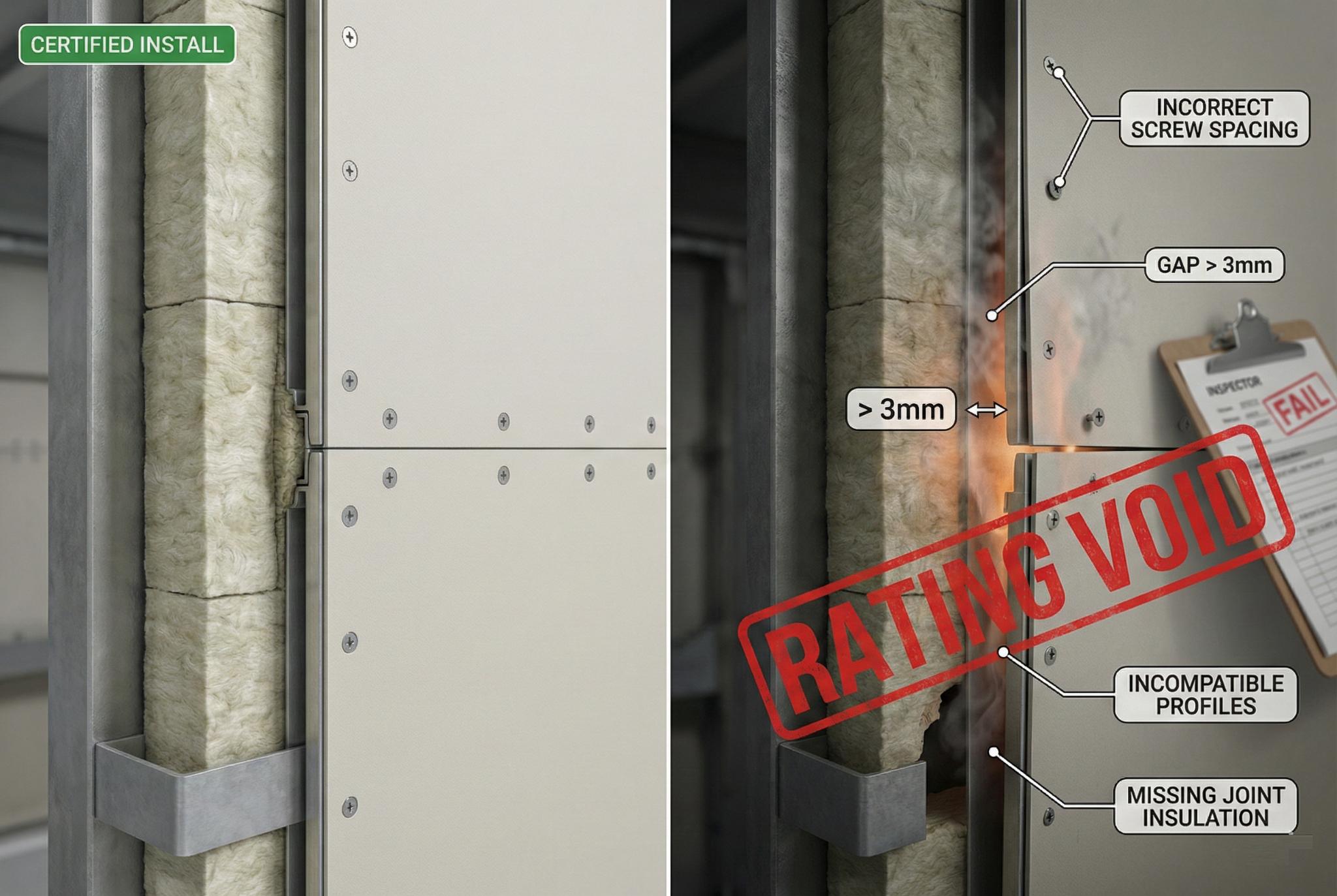
Yes, installation is critical and can easily void the rating. Using incorrect screw spacing, leaving gaps exceeding 3mm, mixing incompatible profiles, or missing insulation in the joints will cause the division to fail. A B-15 panel installed with non-certified methods will not perform as a B-15 division during a fire or inspection.
Critical Installation Tolerances
In my experience inspecting Asian shipyards, 80% of fire integrity issues are workmanship, not material. The Type Approval certificate usually comes with an "Appendix" or "Installation Manual." This is not a suggestion; it is the law8.
- Screw Spacing: If the manual says screws every 300mm, and the worker installs them every 500mm to save time, the panel may warp and detach during the intense heat of a fire.
- Expansion Gaps: As mentioned, panels expand. If the installer forces the panel tight against the steel deckhead without the required 20-30mm gap inside the U-channel, the panel will buckle and bow outward, breaking the seal.
- Joint Insulation: Many B-15 profiles require a strip of ceramic fiber paper or loose wool inside the joint profile. It is invisible once installed. If the worker forgets it, heat will transfer through the steel profile, exceeding the 180°C9 limit on the back side.
The Hidden Danger of Field Modifications
Often, installers cut holes for cables or pipes on site.
- Allowable Gaps: Generally, gaps between panels must be 0mm (tight fit). Gaps between the panel and the profile usually have a tolerance of 1-3mm depending on the design.
- Penetrations: You cannot just drill a hole and leave it. Every cable transit must be sealed with a certified marine fire stop compound10. I have seen clear B-15 bulkheads fail inspection because a worker drilled a 10mm hole for a LAN cable and didn't seal it. That tiny hole destroys the "Integrity" of the division.
| Installation Step | Common Mistake | Consequence |
|---|---|---|
| Top Profile Fixing | Screwing through the expansion slot rigidly | Panel buckles, integrity loss |
| Joint Assembly | Omitting internal joint insulation | Temperature rise failure (Insulation) |
| Bottom Track | Using aluminum rivets instead of steel | Rivets melt, wall collapses |
| Panel Cutting | Cutting too short (< 20mm overlap) | Panel falls out of track in fire |
Can High-Rated Marine Panels Guarantee a Compliant Fire Division?
If I buy A-60 panels for a B-15 requirement, surely I am safe? Or does over-specifying components still leave room for failure?
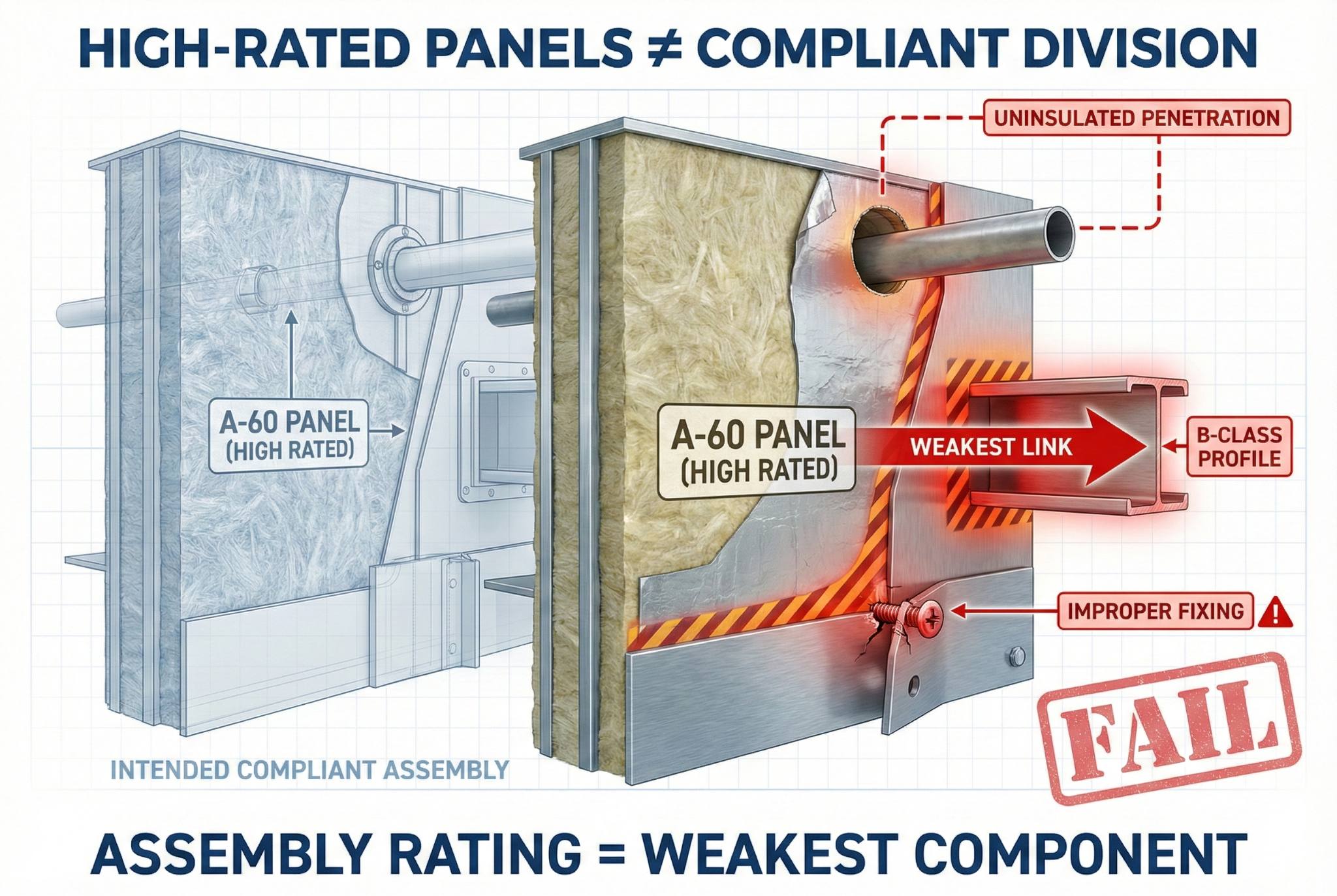
No, high-rated panels do not guarantee compliance. If you use A-60 panels but install them with B-class profiles, leave uninsulated penetrations, or use improper fixing methods, the division fails. The weakest link determines the division's rating, not the highest-rated component in the assembly.
The "Weakest Link" Principle
In engineering, we have a rule: The rating of the assembly is equal to the rating of its lowest-performing component.
- Scenario: You buy expensive A-60 panels (high density, steel core).
- Mistake: You install them using B-15 aluminum profiles to save weight or cost.
- Result: In a fire, aluminum melts at roughly 660°C. The fire test reaches that temperature in under 10 minutes. Your heavy-duty A-60 panels will fall over in 10 minutes because the frame melted. The entire division is now rated A-0 or worse, regardless of how good the panels are.
Mismatched Component Scenarios
I often help clients troubleshoot why their designs were rejected by Class Societies (like DNV, BV, or ABS). It is usually a mismatch.
- Door vs. Wall: If you put a B-0 door in a B-15 bulkhead, the entire bulkhead is downgraded to B-0. The fire will burn through the door in 5 minutes, rendering the 15-minute protection of the wall useless.
- Windows: Installing a standard non-fire-rated window11 in an A-60 bulkhead voids the A-60 rating. You must use an A-60 rated window box and glass.
- Cable Transits: As discussed, a single unsealed cable transit makes an A-60 wall an A-0 wall.
| Component A | Component B | Resulting System Rating | Reason |
|---|---|---|---|
| A-60 Panel | A-60 Door | A-60 | Matched system |
| A-60 Panel | B-15 Door | B-15 | Door is the weak link |
| A-60 Panel | Aluminum Profile | Fail / A-0 | Aluminum melts < 10 mins |
| B-15 Panel | A-60 Door | B-15 | Panel is the weak link |
What Are the Specific Differences Between A-Class, B-Class, and C-Class Marine Divisions?
Knowing the letters is one thing, but knowing where to put them saves money. Why pay for A-Class when C-Class is legally allowed?
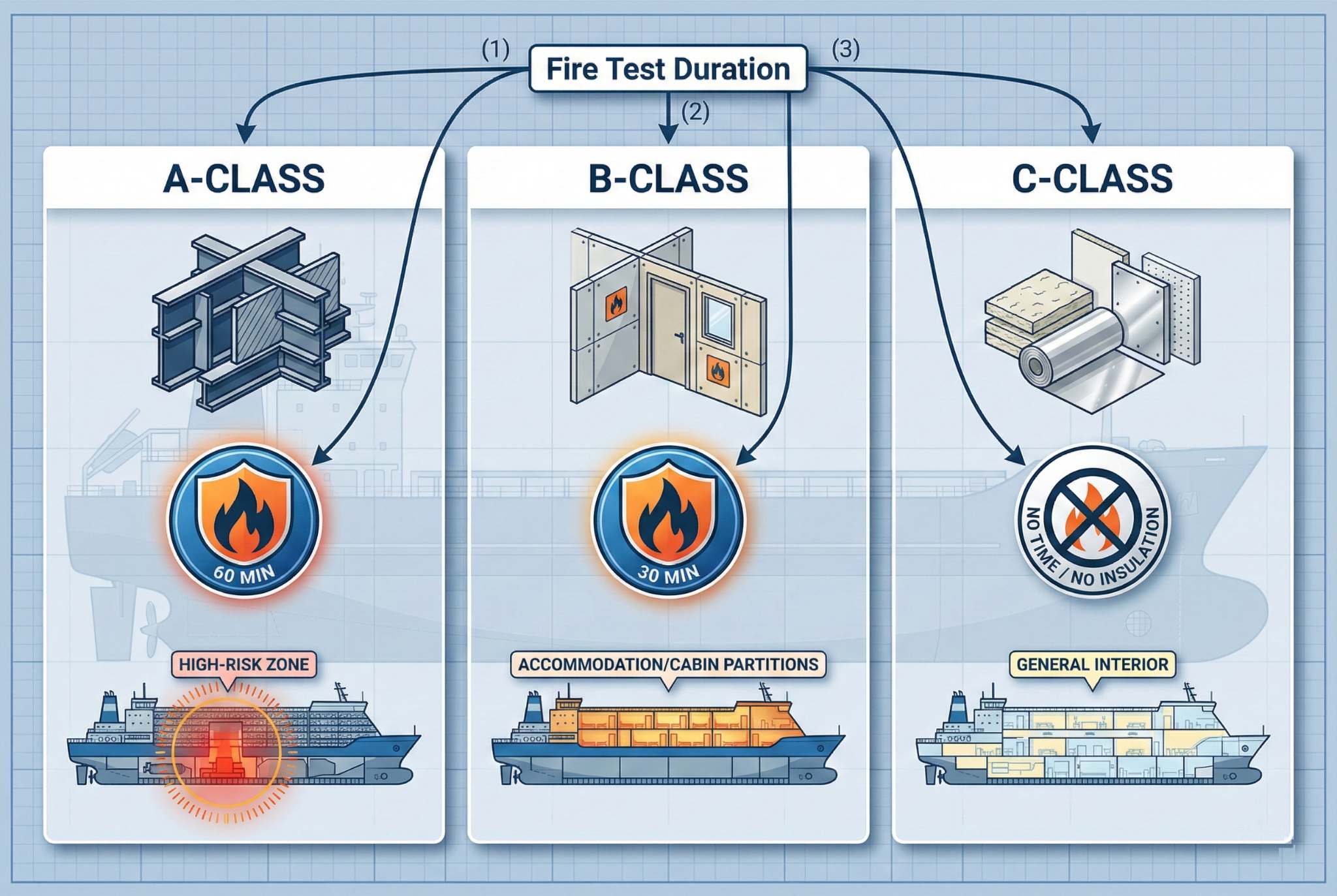
A-Class withstands fire for 60 minutes and is typically steel-structured for high-risk zones. B-Class withstands fire for 30 minutes, using non-combustible materials for cabin partitions. C-Class requires non-combustible materials but has no time integrity or insulation requirement. They differ in material composition, testing duration, and permitted locations on the ship.
Application of A-Class Divisions
A-Class is the "heavy armor" of marine fire protection.
- Location: You will find these separating high-risk areas. For example, the bulkhead between the Engine Room and the Accommodation Area must be A-60.
- Structure: They are almost always stiffened steel bulkheads insulated with rock wool.
- Cost: Highest. The material is heavy, and the insulation is thick (often 40-70mm depending on the manufacturer).
Application of B-Class Divisions
B-Class is the standard for "living areas."
- Location: These form the walls of your cabins, corridors, and messes. They protect passengers and crew in their sleeping quarters.
- Structure: Usually sandwich panels (steel sheets with mineral wool core). They are lighter and more aesthetic than A-Class.
- Cost: Moderate. This is the bulk of your interior budget.
Application of C-Class Divisions
C-Class is the "minimum standard."
- Location: Used where fire risk is negligible. For example, partitions inside a sanitary unit (toilet) or a wet room. Note: The wall separating the cabin from the corridor must be B-Class, but the wall separating the shower from the toilet inside the cabin can be C-Class.
- Structure: Still non-combustible (you cannot use wood), but it doesn't need to pass the 30-minute burn test12.
- Cost: Lowest.
| Feature | A-Class | B-Class | C-Class |
|---|---|---|---|
| Fire Integrity Time | 60 Minutes | 30 Minutes | 0 Minutes |
| Smoke/Flame Seal | Required | Required | Not Required |
| Material | Steel / Equivalent | Non-Combustible | Non-Combustible |
| Typical Use | Hull, Machinery Spaces | Cabins, Offices | Toilets, Void Spaces |
| Approx Cost Index | High ($$$) | Medium ($$) | Low ($) |
Conclusion
Marine fire divisions are certified systems, not just panels. While panels provide the rating potential, the division requires correct profiles, accessories, and installation to meet SOLAS A, B, or C-Class standards.
-
"What Do A-Class, B-Class, and C-Class Divisions Mean in ...", https://magellanmarinetech.com/what-a-class-b-class-c-class-divisions-mean-in-marine-wall-ceiling-panels/. The IMO FTP Code and SOLAS fire-division definitions use temperature-rise criteria on the unexposed face, including a 140°C average limit and point-temperature limits of 180°C for A-class divisions and 225°C for B-class divisions. Evidence role: definition; source type: institution. Supports: The unexposed side of SOLAS fire divisions must stay within specified temperature-rise limits, including 140°C average rise and maximum point-rise limits of 180°C or 225°C depending on class.. ↩
-
"What Do A-Class, B-Class, and C-Class Divisions Mean in ...", https://magellanmarinetech.com/what-a-class-b-class-c-class-divisions-mean-in-marine-wall-ceiling-panels/. SOLAS chapter II-2, regulation 3 defines A-class divisions as divisions formed by steel or equivalent material and B- and C-class divisions as divisions formed by approved non-combustible materials. Evidence role: definition; source type: institution. Supports: A-Class divisions use steel or equivalent material, while B-Class and C-Class divisions use approved non-combustible materials.. ↩
-
"Which vessel areas under SOLAS Chapter II-2 demand the ...", https://magellanmarinetech.com/which-vessel-areas-under-solas-chapter-ii-2-demand-strictest-marine-panel-requirements/. SOLAS chapter II-2 structural fire-protection tables assign higher-rated divisions to boundaries such as main vertical zones and machinery spaces and lower or limited requirements to some accommodation and sanitary spaces; this supports the table as a contextual summary rather than a universal prescription for every vessel arrangement. Evidence role: general_support; source type: institution. Supports: A-Class divisions are typically used for main vertical zones and engine rooms, B-Class divisions for cabin partitions and corridor walls, and C-Class divisions for toilets or washrooms where fire risk is low.. Scope note: Specific required divisions vary by ship type, space category, tonnage, and the approved fire control plan. ↩
-
"What Is the Purpose and Scope of the IMO FTP Code?", https://magellanmarinetech.com/what-purpose-scope-of-imo-ftp-code/. ISO 1182 and the IMO FTP Code Part 1 describe the non-combustibility furnace test, including exposure of specimens in a furnace at approximately 750°C and assessment using temperature rise, sustained flaming, and mass-loss criteria. Evidence role: definition; source type: institution. Supports: “Non-combustible” is a specific technical designation determined by the ISO 1182 test, in which a sample is placed in a 750°C furnace and evaluated against temperature-rise, flaming-duration, and mass-loss criteria.. Scope note: The exact acceptance thresholds may depend on the regulatory scheme applying ISO 1182, such as the IMO FTP Code, rather than ISO 1182 alone. ↩
-
"What does SOLAS Chapter II-2 require for marine wall and ...", https://magellanmarinetech.com/what-solas-chapter-ii-2-require-for-marine-wall-ceiling-panels/. SOLAS Chapter II-2 permits limited use of combustible veneers on non-combustible divisions subject to restrictions on thickness, calorific value per unit area, and low flame-spread performance under the FTP Code. Evidence role: general_support; source type: institution. Supports: SOLAS permits combustible veneers such as PVC or HPL over non-combustible marine interior divisions, but only within strict limits on thickness, calorific value, and flame-spread performance.. Scope note: The applicable limits can vary by ship type, space category, and SOLAS edition or amendment, so the source supports the regulatory framework rather than every installation condition. ↩
-
"What Is the Purpose and Scope of the IMO FTP Code?", https://magellanmarinetech.com/what-purpose-scope-of-imo-ftp-code/. The IMO FTP Code fire-resistance test procedure specifies a standard furnace time–temperature curve for class divisions, with temperatures of about 576 °C at 5 minutes, 738 °C at 15 minutes, 841–842 °C at 30 minutes, and 945 °C at 60 minutes. Evidence role: definition; source type: institution. Supports: The furnace follows a standard time-temperature curve with approximate temperatures of 576°C at 5 minutes, 738°C at 15 minutes, 842°C at 30 minutes, and 945°C at 60 minutes.. Scope note: This supports the prescribed laboratory exposure conditions, not the fire performance of any specific B-15 panel. ↩
-
"Thermal expansion of a few steels", https://nvlpubs.nist.gov/nistpubs/ScientificPapers/nbsscientificpaper433vol17p611_A2b.pdf. Engineering references on thermal expansion of steel can support the mechanism that steel members lengthen substantially when heated; applying the coefficient of thermal expansion to a 2.4 m member over fire-range temperature increases gives an order-of-magnitude expansion consistent with millimetre-scale growth. Evidence role: mechanism; source type: education. Supports: A steel-faced 2.4-meter bulkhead panel can expand by roughly 10–15 mm in height during a fire, requiring allowance in the top profile.. Scope note: The calculated expansion depends on assumed steel temperature, restraint, and panel construction, so it contextualizes rather than directly verifies the stated 10–15 mm range for every certified panel. ↩
-
"What Does Class Society Type Approval Mean for Marine Wall and ...", https://magellanmarinetech.com/what-class-society-type-approval-mean-for-marine-wall-ceiling-panels/. SOLAS Chapter II-2 and the IMO FTP Code require fire-resisting divisions and associated materials to be approved and installed consistently with the tested and approved arrangement; this supports the legal force of approved installation details, although the exact certificate appendix requirements may vary by flag administration and classification society. Evidence role: general_support; source type: institution. Supports: The installation manual or appendix attached to a marine fire-division approval is not optional but part of the regulated approved arrangement.. Scope note: Contextual support; the source establishes regulatory approval and testing obligations but may not use the article’s exact wording about an “Appendix” or “Installation Manual.” ↩
-
"How Does Temperature Rise on a Marine Interior Panel's ...", https://magellanmarinetech.com/how-temperature-rise-on-marine-interior-panels-unexposed-face/. The IMO FTP Code fire-resistance test criteria for insulated divisions limit the average temperature rise on the unexposed face to 140°C and the maximum temperature rise at any point to 180°C, supporting the stated back-side temperature criterion for insulation performance. Evidence role: definition; source type: institution. Supports: B-class fire-division insulation performance includes a 180°C maximum temperature-rise limit on the unexposed side.. ↩
-
"Are Marine Fire Divisions the Same as Marine Panel Ratings?", https://magellanmarinetech.com/are-marine-fire-divisions-same-as-marine-panel-ratings/. IMO and class guidance on fire divisions and penetrations requires cable and pipe penetrations through fire-rated divisions to maintain the division’s fire integrity using approved fire-stopping or penetration systems, supporting the need for certified sealing of cable transits. Evidence role: expert_consensus; source type: institution. Supports: Cable penetrations through marine fire-rated divisions must be sealed with an approved or certified fire-stopping system.. Scope note: The source may describe approved penetration systems generally rather than specifying a particular compound type for every installation. ↩
-
"What Is the Purpose and Scope of the IMO FTP Code?", https://magellanmarinetech.com/what-purpose-scope-of-imo-ftp-code/. SOLAS/IMO fire-safety rules and the FTP Code treat openings and closures in fire-resisting divisions as part of the tested division system, requiring them to maintain the division’s specified fire integrity; this supports the principle that an unrated window cannot preserve an A-60 bulkhead rating. Evidence role: expert_consensus; source type: institution. Supports: A non-fire-rated window installed in an A-60 bulkhead prevents the bulkhead assembly from retaining its A-60 fire rating.. Scope note: The source would establish the regulatory principle for openings in rated divisions, while the exact administrative consequence of being “voided” may depend on the approving authority and installation details. ↩
-
"What Is the Purpose and Scope of the IMO FTP Code?", https://magellanmarinetech.com/what-purpose-scope-of-imo-ftp-code/. SOLAS definitions distinguish B-class divisions, which must prevent flame passage for the first half hour of the standard fire test, from C-class divisions, which are non-combustible but have no smoke, flame, or temperature-rise performance requirement; this supports the article’s contrast while using more formal regulatory terminology than “burn test.” Evidence role: definition; source type: institution. Supports: C-Class divisions are non-combustible but do not need to pass the 30-minute fire-resistance test required for B-Class divisions.. Scope note: The source defines class requirements generally and may not address every approved product or installation detail. ↩